
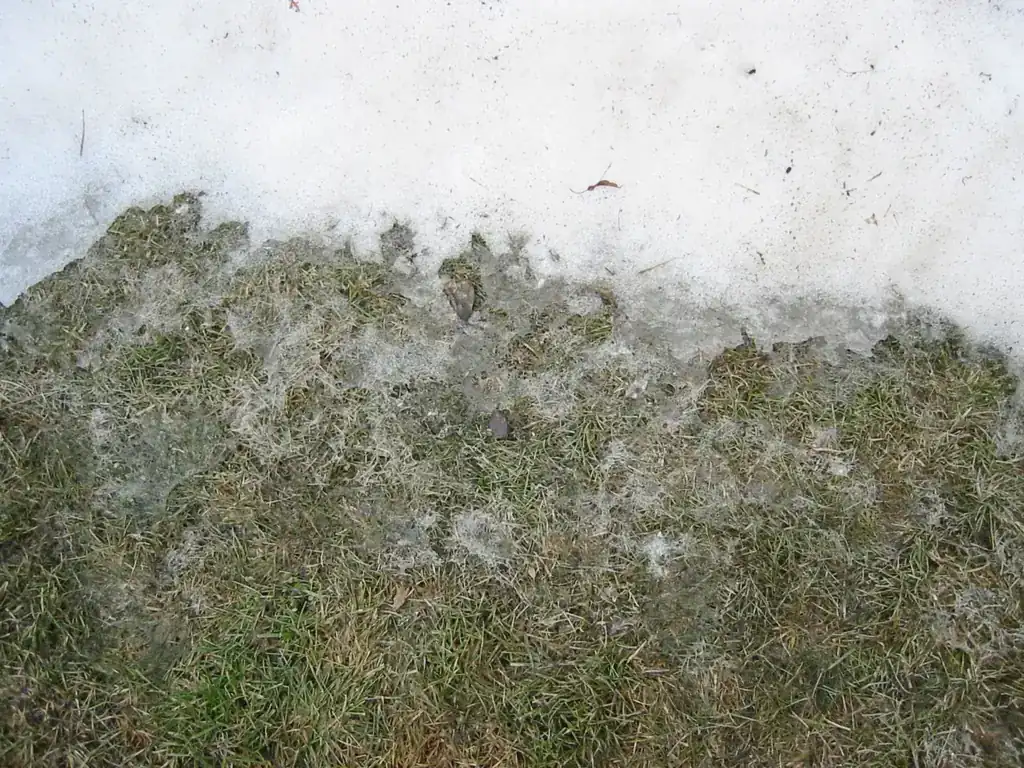
The last of the snowbank finally slumps off the lawn in March, and underneath it isn’t the green carpet you were hoping for. Instead there are round, straw-colored patches, the grass flattened and stuck together, and here and there a gray, cobweb-like fuzz that looks like something out of a basement. It’s unsettling the first time you see it.
Short answer: That fuzz is almost certainly snow mold, a cold-weather fungal disease of cool-season grass that grows under snow lying on unfrozen ground. Gray snow mold (Typhula blight) usually kills only leaf blades, so the lawn recovers after you rake the matted patches dry, while pink snow mold (Microdochium patch) can kill crowns and may need reseeding. Prevention happens in fall: stop nitrogen by early September, keep mowing until the grass stops growing, clear leaves, and don’t pile snow on the lawn.
The good news is that snow mold looks far worse than it usually is. By the end of this guide you’ll be able to tell gray from pink snow mold in a few seconds, know whether your patches will heal on their own, and have a simple fall-to-spring plan that keeps the problem small next year, mostly without spending a cent on fungicide.
Table of Contents
- What Is Snow Mold? Two Diseases Hiding Under One Name
- How to Identify Snow Mold on Grass: Gray vs Pink
- Why Snow Mold Shows Up: Long Snow, Soft Ground and Lush Fall Growth
- How to Prevent Snow Mold This Fall: A 6-Step Plan
- Snow Mold Lawn Treatment in Spring: How to Repair the Damage
- Do You Need a Fungicide for Snow Mold?
- A Note From the Agronomist’s Side
- FAQ
- Sources
What Is Snow Mold? Two Diseases Hiding Under One Name
“Snow mold” isn’t one fungus. It’s a nickname for two unrelated lawn diseases that both show up as the snow melts. Knowing which one you have matters, because one is mostly cosmetic and the other can actually kill grass.
- Gray snow mold (Typhula blight) is caused by Typhula incarnata and Typhula ishikariensis. Some turf scientists call the second one “speckled snow mold” because of the tiny black specks it leaves behind (Penn State Turfgrass Diagnostic Lab).
- Pink snow mold (Microdochium patch) is caused by Microdochium nivale, an older name for which is Fusarium patch (Montana State University Extension).
Both are cold-lovers. Cornell Cooperative Extension notes that both diseases thrive just above freezing, at roughly 32–45°F (Cornell). That’s exactly the temperature of soil insulated by a blanket of snow. The fungi survive summer as resting structures or in plant debris, then wake up in the cool, wet weather of late fall (Hsiang et al., 1999).
Every cool-season lawn grass is a potential host: Kentucky bluegrass, perennial ryegrass, tall fescue and fine fescue. Bentgrass is the most susceptible (Cornell). Warm-season southern lawns rarely see it, simply because they rarely sit under long-lasting snow.
How to Identify Snow Mold on Grass: Gray vs Pink
Look closely in the first few days after snowmelt. The fungal growth (mycelium) is easiest to see while the grass is still wet, and it fades fast once the patches dry. North Dakota State University describes it as a white, cottony, spiderweb-like growth that “disappears quickly” (NDSU Extension).
Key ID features of gray snow mold
- Roughly circular, bleached, straw-colored or silvery patches. On home lawns they range from a few inches to a few feet across; UW–Madison reports patches up to 2–3 feet (UW–Madison).
- A white-to-gray fluffy halo at the edge of the patch as the snow recedes (Cornell).
- Matted, crusty leaves that feel brittle once dry.
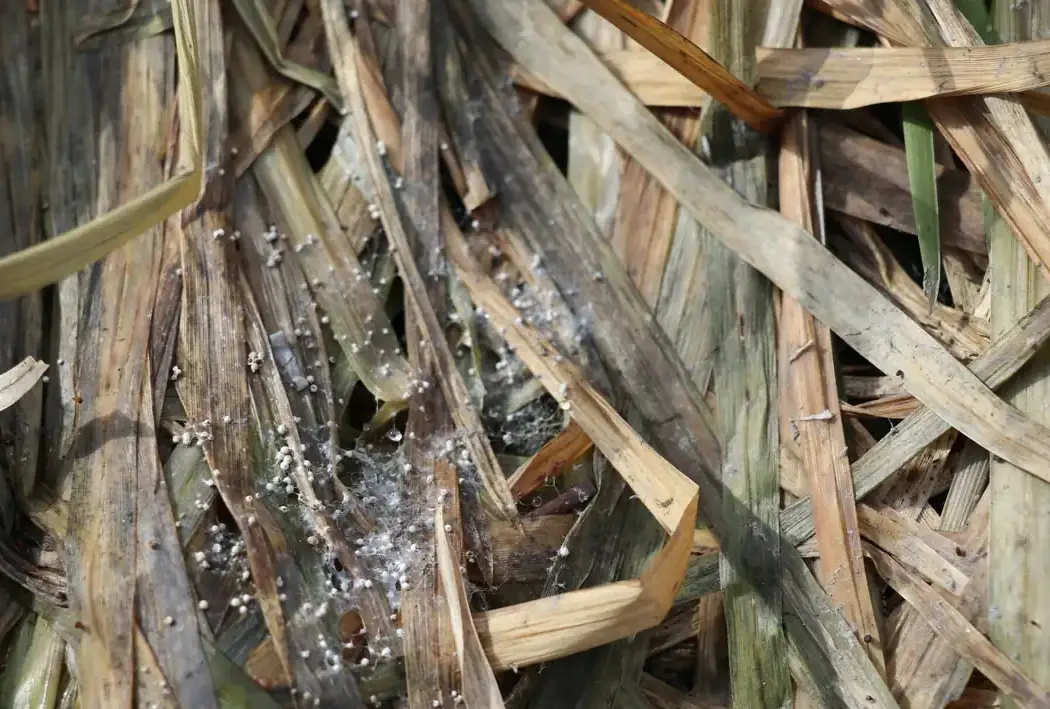
- Sclerotia: the giveaway. These are tiny round bodies stuck to dead leaves. T. incarnata makes reddish-brown ones about 1/16–3/16 inch across; T. ishikariensis makes black ones only 1/64–1/16 inch, like flakes of ground pepper (UW–Madison).
Key ID features of pink snow mold
- Smaller patches: under about 6 inches according to Iowa State (Iowa State), and usually under a foot according to Cornell.
- Bleached, matted grass with a pinkish or salmon edge, especially when the turf is wet or after a few hours of sun.
- No sclerotia. If you search a patch with a magnifier and find no specks, think pink.
- It doesn’t need snow. Pink snow mold can flare during long, cool, wet spells anywhere from early autumn to late spring (Cornell), and Montana State gives its active range as about 32–60°F.
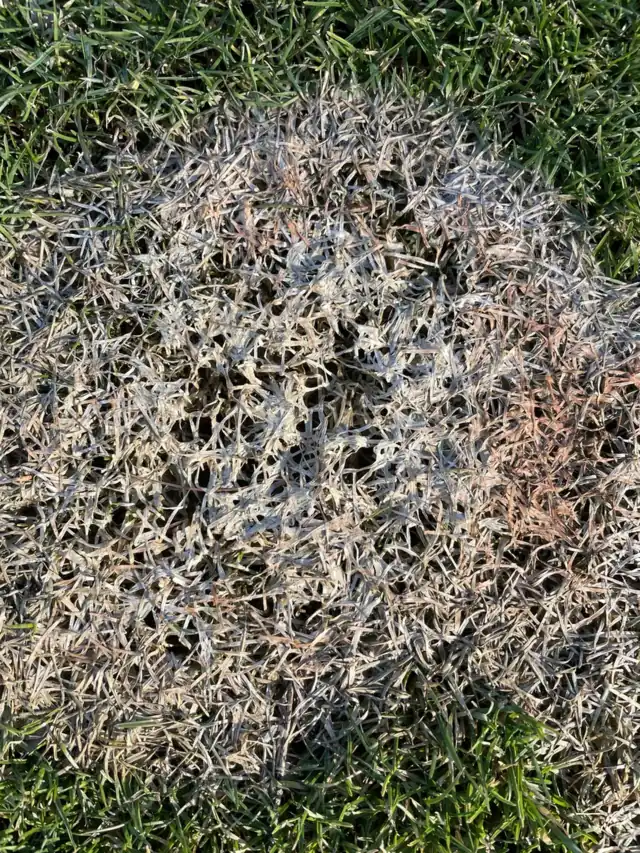
Here’s the side-by-side version you can check on your phone while standing on the lawn.
| Feature | Gray snow mold (Typhula blight) | Pink snow mold (Microdochium patch) |
|---|---|---|
| Cause | Typhula incarnata, T. ishikariensis | Microdochium nivale |
| Needs snow cover? | Yes, usually long cover on unfrozen ground | No; also hits in cool, wet weather without snow |
| Typical patch size | Inches to 2–3 ft | Under 6 in to about 1 ft |
| Color at the margin | White to gray fuzz | Pinkish to salmon |
| Sclerotia (specks) | Yes: reddish-brown or black | None |
| Active temperatures | About 32–45°F | About 32–60°F |
| Kills grass crowns? | Rarely (T. ishikariensis can) | Yes, in severe cases |
| Usual outcome | Rake, and it greens up | Rake; reseed dead spots |
Table sources: Cornell Cooperative Extension, UW–Madison Extension, Iowa State Extension, Montana State Extension.
Things that look like snow mold (but aren’t)
Not every dead patch in March is a fungus. Spots along the driveway where plows threw salty slush, urine spots from the dog, and areas where voles tunneled under the snow can all look straw-colored in spring. Vole damage shows as winding runways of clipped grass rather than circles. If there’s no mycelium, no sclerotia and no circular shape, look for another cause before you blame the fungus, and see our guide to why grass turns yellow for other culprits.
Why Snow Mold Shows Up: Long Snow, Soft Ground and Lush Fall Growth
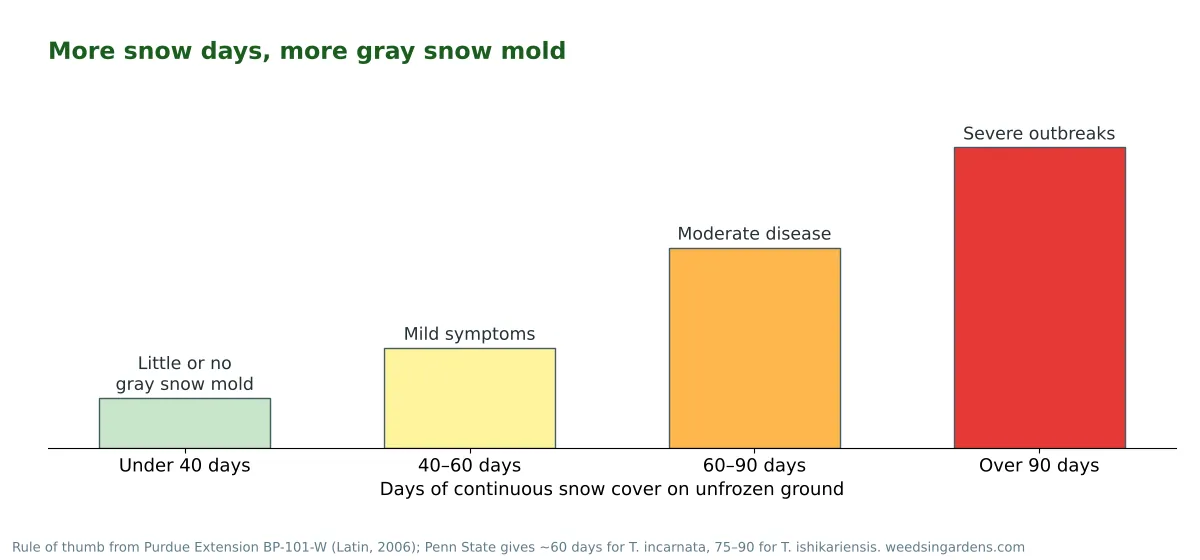
Gray snow mold is basically a timing disease. It grows when snow settles on ground that hasn’t frozen yet, and then stays there. UW–Madison puts the threshold at more than 60 days of snow on unfrozen ground, with soil just above freezing. The same source makes a point worth remembering: the disease typically does not develop if the ground freezes before the first snowfall, or if a mid-winter thaw exposes the soil to colder air.
Purdue’s long-standing rule of thumb ties severity directly to the length of snow cover. Penn State’s diagnostic lab gives similar numbers: about 60 days for T. incarnata and 75–90 days for T. ishikariensis.
| Days of continuous snow cover | What to expect (gray snow mold) |
|---|---|
| 40–60 days | Mild symptoms |
| 60–90 days | Moderate disease |
| More than 90 days | Severe outbreaks |
Source: Purdue Extension BP-101-W, a rule of thumb developed on golf turf.
Snow is only half the story. The other half is what you did to the lawn in September and October. These things tilt the odds toward infection:
- Late, heavy nitrogen. Soft, leafy growth going into winter is easy for the fungus to colonize. UW–Madison specifically flags fast-release fertilizer in late fall.
- Tall grass at freeze-up. Long blades flop over and mat under snow. NDSU notes that tall grass is more likely to mat down and become infected.
- Leaves and debris. A layer of wet leaves under snow is a perfect incubator. Iowa State and Montana State both advise raking them up in fall.
- Thick thatch. Iowa State recommends keeping thatch at 1/2 inch or less.
- Snow piles. Shoveled and plowed snow lasts weeks longer than the snow around it. That’s why the damage so often lines the driveway and sidewalk.
How to Prevent Snow Mold This Fall: A 6-Step Plan
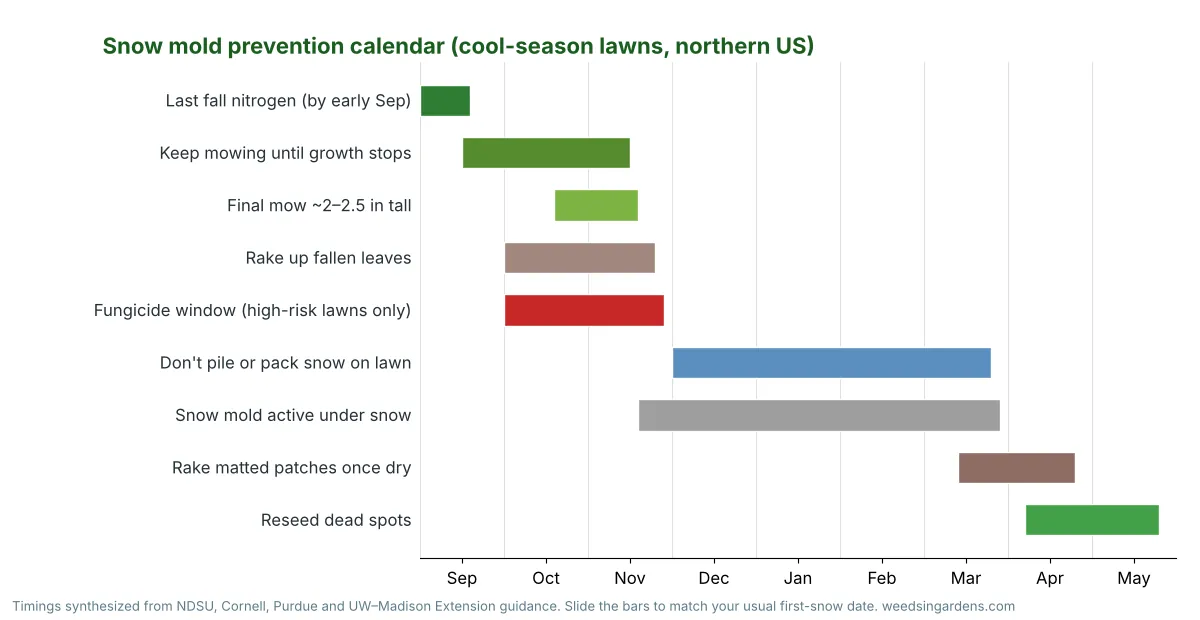
You can’t control the weather, but you can control almost everything else on that list. If you’re reading this in October or November, you’re right on time. These steps come from the overlap between several extension services, so they’ll work across most of the snow belt.
1. Finish nitrogen by early fall
NDSU suggests making the final fertilizer application around Labor Day, and Cornell advises applying fall fertilizer before October 1. If you like a late “winterizer”, keep it light: the Pacific Northwest Plant Disease Handbook recommends no more than 0.5 lb of nitrogen per 1,000 sq ft per application in late fall (PNW Handbook). Our article on when to apply winterizer explains how to time it without feeding the fungus.
2. Keep mowing until the grass stops growing
Every source agrees on this one. Keep cutting on your normal schedule until top growth stops. For the final cut, NDSU recommends about 2 inches, and Purdue suggests keeping lawns at about 2.5 inches into dormancy. Either way, you want grass short enough not to flop and mat under snow, but not scalped. Our guide to the last mow of the season covers height and timing in more detail.
3. Clear leaves before the first lasting snow
Rake, blow or mulch-mow leaves so the turf isn’t buried under a soggy layer. A thin layer of finely chopped leaves is fine; whole leaves lying flat are not. See leaves on lawn over winter for when mulching works and when it backfires.
4. Keep thatch in check
If you can push a finger into a spongy layer more than about 1/2 inch thick, plan to dethatch or core-aerate. Do it while the grass is still growing strongly, not right before snow. Our dethatching pros and cons guide helps you decide which method fits.
5. Manage where the snow goes
Purdue advises against piling snow along driveways and sidewalks on top of turf, and Cornell warns against compacting snow on the lawn. Spread big piles out so they melt faster (Iowa State). In windy spots where drifts always form, a snow fence placed to catch drifts elsewhere can help.
6. Choose tougher grass when you reseed
If the same lawn gets hit year after year, change the grass. NDSU notes that fine fescue blends containing hard fescue are more resistant, while Kentucky bluegrass, perennial ryegrass and tall fescue are quite susceptible. UW–Madison also lists fine fescues as less susceptible. Purdue cautions that no cool-season variety is truly resistant to gray snow mold, so think “less damage”, not “immune”.
Snow Mold Lawn Treatment in Spring: How to Repair the Damage
Here’s the honest truth from NDSU: no cure exists once the lawn has been affected. But you rarely need one. With gray snow mold, the leaves die but the crowns usually survive, and the grass greens up as the soil warms (Cornell, Iowa State). Your job is to help the patches dry out and get air.
- Wait until the lawn isn’t muddy. NDSU advises delaying raking if the soil is still soft. Walking on soggy turf compacts it.
- Rake lightly. Use a leaf rake (not a stiff dethatching rake) to fluff up matted patches. This lets sun and air dry them, which stops further fungal growth (Iowa State).
- Spread out lingering snow piles so the last patches can dry.
- Give it two to three weeks. Healthy crowns push new green leaves from the center of the patch once growth resumes.
- Reseed what stays brown. Tug on a few plants. If they pull out without resistance and the crowns are mushy, they’re dead. Rough up the soil and overseed; UW–Madison notes that turf hit by T. ishikariensis often needs replanting. Our guide on preparing soil for grass seed walks through it.
- Hold off on heavy spring fertilizer until the grass is actively growing. A modest feeding then helps recovery.
Quick decision table: what you see and what to do
| What you see in spring | Likely cause | What to do |
|---|---|---|
| Gray fuzz, reddish or black specks, big circles | Gray snow mold | Rake lightly once dry; wait 2–3 weeks |
| Small circles with pink edges, no specks | Pink snow mold | Rake; reseed any patches still dead by late spring |
| Patches along driveway or road edge only | Snow piles, maybe salt | Rake; flush with water; reseed if dead |
| Winding trails of chewed grass | Voles | Rake, then overseed; no fungicide needed |
| Same circles return every spring | Repeated disease pressure | Fix fall routine; consider fine fescue; fungicide only if needed |
Common mistakes to avoid
- Spraying fungicide in spring. The damage happened under the snow. Spring sprays on home lawns rarely change the outcome.
- Raking hard while the ground is soft. You’ll tear out living crowns and compact the soil.
- Throwing nitrogen at the patches in March. The grass can’t use it yet, and lush growth during a cool, wet spring can feed pink snow mold.
- Blaming the lawn mower or the dog without looking for sclerotia first. A minute with a magnifying glass settles it.
Do You Need a Fungicide for Snow Mold?
For most home lawns, no. Purdue, NDSU and Montana State all say fungicides are not recommended or usually not needed for home lawns, because the turf normally recovers with good care. NDSU adds that the most effective turf fungicides used on golf courses aren’t legal for residential use.
There are exceptions. Cornell and UW–Madison say a preventive fungicide can make sense when a lawn has a history of severe, repeated snow mold, or when snow is expected to sit on unfrozen ground for a long time. If that’s you, timing is everything:
- Apply in late fall, before the first lasting snow. UW–Madison suggests October or November, and Purdue says before the first snowfall.
- Don’t spray too early. The PNW Handbook warns that continued growth, rain and snowmelt dilute fungicides applied too soon.
- Spring sprays don’t fix winter damage. These are preventive products only.
| Active ingredient | Type | Listed against | Notes |
|---|---|---|---|
| Propiconazole | DMI (FRAC 3) | Gray and pink snow mold | Found in some homeowner lawn fungicides; UW–Madison, Cornell |
| Tebuconazole | DMI (FRAC 3) | Gray snow mold | UW–Madison; mostly professional products |
| Azoxystrobin | QoI (FRAC 11) | Gray and pink snow mold | UW–Madison, Cornell |
| Pyraclostrobin | QoI (FRAC 11) | Gray snow mold | UW–Madison; professional products |
| Thiophanate-methyl | Benzimidazole (FRAC 1) | Pink snow mold | Cornell |
Always read and follow the product label. The label is the law: it sets the rate, the grass types it’s registered for, and whether it’s allowed on residential lawns in your state. Registrations change, so Cornell recommends checking current registration before you buy. Don’t spray onto frozen or snow-covered turf, and keep products out of storm drains and away from pets until the spray has dried, as the label directs. For high-value lawns with a serious history, a licensed lawn-care professional can access the multi-ingredient programs that golf courses use.
A Note From the Agronomist’s Side
If you take one idea away from this article, make it this: this is a disease of conditions, not of bad luck. The fungi are already in nearly every northern lawn, sitting in thatch and old leaves. Whether they cause trouble depends on three things lining up: snow arriving before the soil freezes, that snow staying put for two months or more, and soft, leafy grass underneath. You can’t control the first two. You fully control the third.
That’s why the fall routine matters more than any product. Late nitrogen produces exactly the kind of tissue these fungi colonize best: high in water, low in stored carbohydrate. A lawn that goes into winter lean, short and clean of debris gives the fungus very little to feed on. From a cost point of view, it’s an easy call too. Raking and correct fertilizer timing cost you nothing, whereas a preventive fungicide on a typical lawn is a yearly expense for a disease that usually heals itself.
The second idea is to read the specks. Sclerotia tell you which Typhula species you have, and that changes your expectations. Reddish-brown sclerotia (T. incarnata) mean leaf damage and fast recovery. Tiny black ones (T. ishikariensis) mean a higher chance of crown death, so plan seed for those spots. No sclerotia plus pink margins points to Microdochium, which is the one to watch in mild, wet springs and even in cool, rainy autumns without any snow.
Finally, think about pattern. If the patches always appear in the same places, such as the north side of the house, along the driveway, or where drifts build, it’s a snow-management problem more than a lawn problem. Redirecting the snow blower or moving the plow pile can do more than anything you put in a spreader. And if the whole lawn suffers year after year, switching to a hard-fescue blend in the problem areas is a long-term fix the research supports. For other cold-season issues, our guide to mushrooms in lawn covers another fungus that shows up with fall rain, and dormant seeding explains how to get seed down in late fall for spring repairs.
FAQ
Is snow mold harmful to humans or pets?
It’s a plant disease and isn’t known to infect people or pets. NDSU Extension notes, however, that it can trigger allergies in some people. If you’re sensitive to mold, wear a dust mask and gloves when raking affected patches.
Will snow mold go away on its own?
Usually, yes. Gray snow mold normally kills only leaf blades, and lawns green up as the soil warms and the patches dry. Light raking speeds recovery. Pink snow mold and T. ishikariensis can kill crowns, so reseed any spots still brown by late spring.
What is the best treatment for snow mold on grass?
In spring, gently rake matted patches once the lawn is no longer muddy, spread out snow piles and reseed dead spots. There’s no curative spray for winter damage. Prevention in fall, with early-September nitrogen, mowing until growth stops and leaf removal, is the real treatment.
How do I tell gray snow mold from pink snow mold?
Gray snow mold forms larger patches with a white-gray fuzz and tiny reddish-brown or black specks called sclerotia on dead leaves. Pink snow mold forms smaller patches, often under 6 inches, with a pinkish edge and no sclerotia, and it can appear without snow.
Can you get snow mold without snow?
Pink snow mold, yes. Cornell notes Microdochium patch becomes severe during prolonged cool, wet weather from early autumn to late spring, even without snow cover. Gray snow mold needs long snow cover on unfrozen ground.
When should I apply snow mold fungicide?
Only on lawns with a history of serious damage. Apply preventively in late fall, in October or November according to UW–Madison, before the first lasting snow. Applying too early lets rain and growth dilute it. Follow the product label for rate and residential use.
Should I cut my grass short to prevent snow mold?
Cut it moderately short, not scalped. NDSU recommends a final mowing height of about 2 inches, and Purdue suggests keeping lawns near 2.5 inches into dormancy. Tall grass mats under snow and is more likely to be infected.
Sources
- Cornell Cooperative Extension (Monroe County). Snow Molds of Turfgrass.
- Iowa State University Extension and Outreach, Yard and Garden. Snow Mold.
- Latin, R. (2006). Gray Snow Mold. Purdue Extension publication BP-101-W.
- University of Wisconsin–Madison Extension, Wisconsin Horticulture. Typhula Blight.
- Penn State Turfgrass Diagnostic Lab. Gray and Speckled Snow Mold.
- McGinnis, E. (2022). Dakota Gardener: Snow Mold Is Affecting Lawns This Spring. NDSU Extension.
- Montana State University Extension. Snow Molds (2020).
- Pacific Northwest Plant Disease Management Handbook. Lawn and Turf: Typhula Blight (Gray Snow Mold).
- Hsiang, T., Matsumoto, N., and Millett, S. M. (1999). Biology and management of Typhula snow molds of turfgrass. Plant Disease 83(9): 788–798.