
The snow finally pulls back in March, and the lawn underneath looks like someone drew on it with a stick. Winding, shallow trails of dead grass snake across the yard, branch, cross each other and disappear under the shrubs. There are no mounds of soil and nothing looks dug up. The grass is simply gone in narrow strips.
Short answer: that pattern is classic vole damage in lawn turf. Voles are small, mouse-like rodents that spend the winter under the snow, clipping grass down to the crown along runways about 1 to 2 inches wide. The good news is that they usually leave the crowns and roots alone, so most lawns grow back within a few weeks. Rake out the dead grass, feed lightly, reseed only the strips that stay bare, and then use the fall to make your yard a worse place for voles to spend next winter.
By the end of this guide you’ll be able to tell vole trails from mole tunnels, gopher mounds and snow mold, repair the lawn in the right order, and decide honestly whether traps, repellents or baits are worth your time.
What vole damage in lawn turf looks like
Most people never see the animal. You identify voles by what they leave behind, and three signs do nearly all the work.
Surface runways
The runway is the giveaway. Voles clip the grass close to the ground and wear a path through it, leaving an open-topped trench rather than a buried tunnel. Iowa State University Extension describes these runways as 1 to 2 inches across, often closely clipped or dead, and Purdue Turfgrass Science puts meadow vole runways at about 1.5 to 2 inches wide.
They rarely run straight. Expect a branching network that criss-crosses the lawn and usually leads toward cover: a hedge, a mulched bed, a wood pile or tall grass along a fence. You’ll often find small pieces of clipped grass and droppings lying in the trails.
Small, clean holes
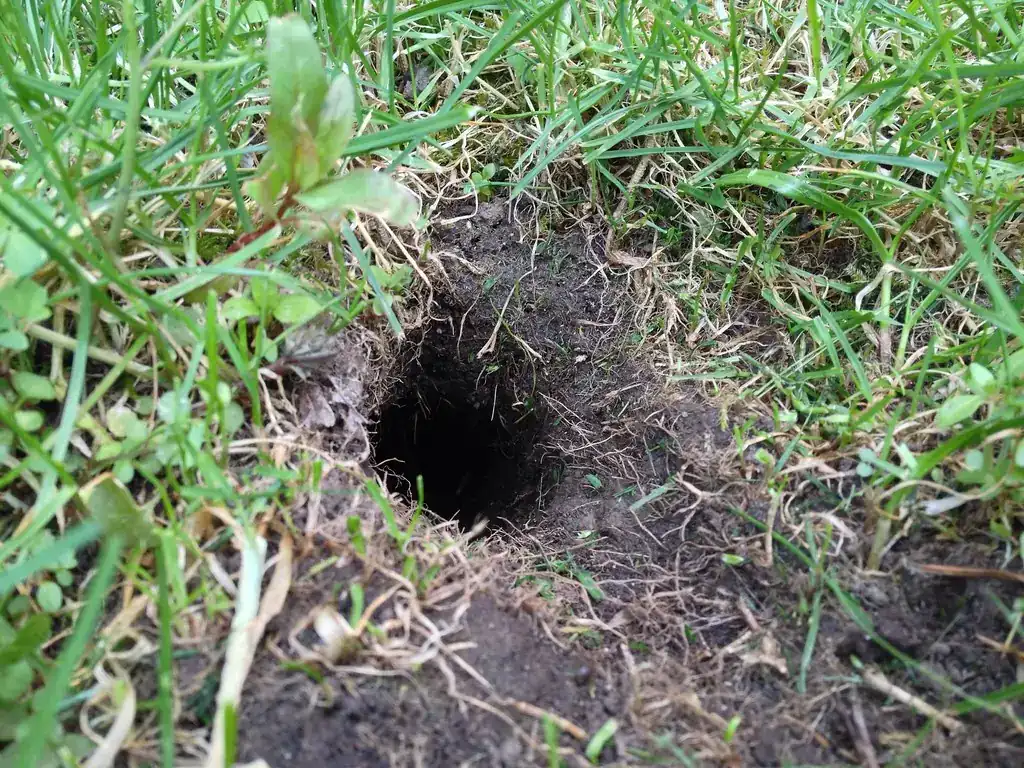
Runways connect burrow openings. The holes are small and neatly cut, with no pile of soil beside them. Sources give slightly different sizes because several vole species are involved: about 1 inch across according to University of Minnesota Extension, 1 to 1.5 inches according to Purdue, and 1.5 to 2 inches for California species according to UC IPM. A Montana State University Extension article sums it up neatly as dime- to quarter-sized.
Droppings and clipped grass
Fresh vole droppings are green, about 3/16 inch long, and turn brown or gray as they age, according to UC IPM. Ohio State describes them as shaped like grains of rice. Finding them in a trail tells you the runway is in use. If new grass is growing up through a trail, the voles have probably stopped using it.
The animal itself
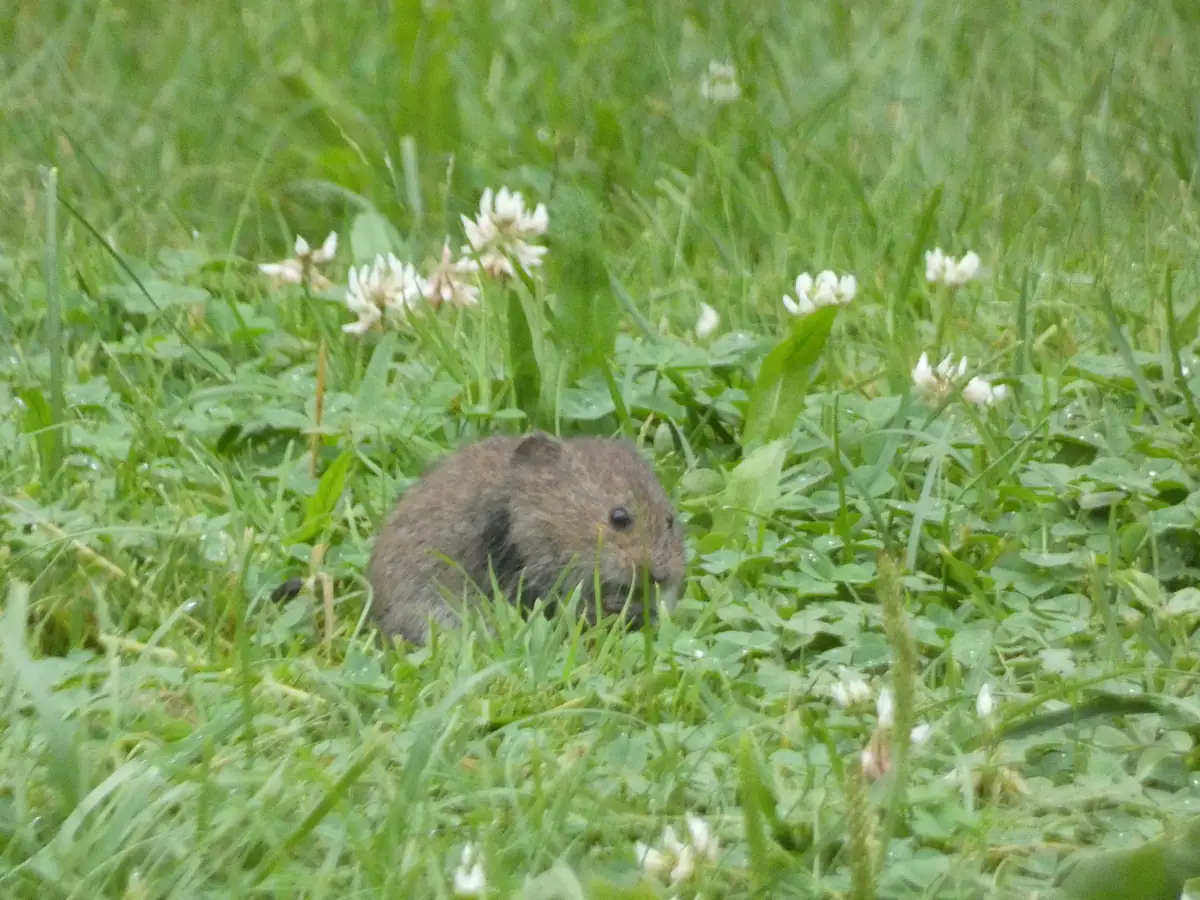
If you do catch a glimpse, a vole looks like a stocky mouse with a blunt nose, small eyes, ears partly hidden in the fur, and a short tail. UC IPM gives adults as 5 to 8 inches long including the tail. The tail is the easy tell: Iowa State notes it’s usually no more than an inch, about a third of the body length, while a house mouse’s tail is long and obvious.
One more clue helps. Iowa State points out that voles almost never come indoors. If a small gray animal with a pointed snout turns up in the basement, it’s far more likely a shrew or a mouse.
Voles vs moles, gophers and snow mold: who really did it?
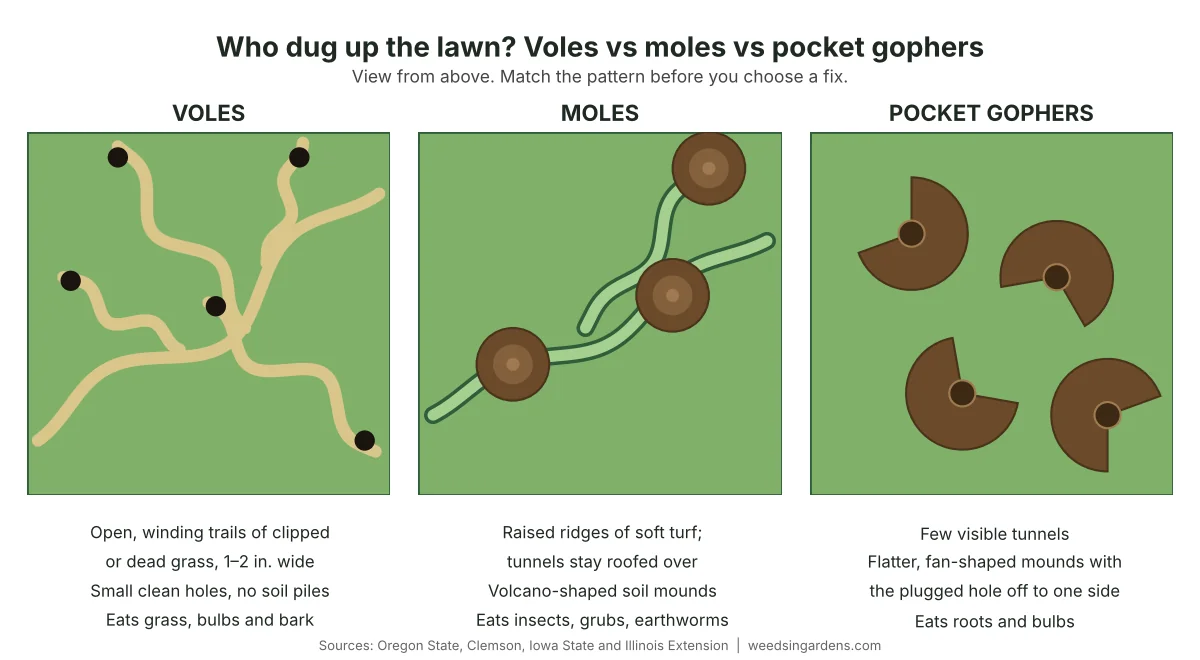
Here’s why this step matters: the fix for each culprit is completely different. Voles eat plants. Moles eat insects, grubs and earthworms, so mole control aimed at voles (or the reverse) is wasted effort.
| Sign in the lawn | Voles | Moles | Pocket gophers | Snow mold |
|---|---|---|---|---|
| Main pattern | Open, winding surface trails 1–2 in. wide | Raised ridges of soft turf; tunnels stay roofed over | Scattered soil mounds, few visible tunnels | Roughly circular matted patches, no trails |
| Soil mounds | None | Volcano-shaped hills | Flatter, fan-shaped, hole off to one side | None |
| Holes | Small, clean, open holes | Mostly closed | Plugged with soil | None |
| What it’s after | Grass blades, stems, bulbs, bark | Insects, grubs, earthworms | Roots and bulbs | A fungus, not an animal |
| When you notice it | Right after snowmelt | Spring and fall | Whenever mounds appear | Right after snowmelt |
The mound shapes come from Oregon State University Extension and Clemson HGIC. To complicate things, voles happily reuse old mole tunnels, so both animals can be present in the same yard. University of Minnesota Extension notes that moles often get blamed for root and bulb damage that voles actually caused.
Snow mold deserves a second look because it appears on the same morning as vole trails. UMass Extension notes that winter vole damage often shows up alongside snow mold or cold injury. The shapes are different, though. Voles leave lines; fungus leaves blotches. If you have blotches, our guide to gray and pink snow mold covers that repair.
And if the turf lifts up like a loose rug with no trails at all, think root feeders instead and check for grubs in the lawn.
Why voles chose your lawn (and why some winters are worse)
Vole damage in lawn grass feels random. It isn’t. Three things decide how bad a winter will be: how fast voles breed, where the population is in its cycle, and how much cover your yard offers.
They breed fast
University of Minnesota Extension says a single female can have 5 to 10 litters a year, averaging 3 to 5 young. UC IPM adds that females mature in just 35 to 40 days. Other sources give lower figures (University of Idaho lists one to five litters), but the point stands: a handful of voles in September can be a crowd by February.
Populations boom and crash
Vole numbers run in cycles. Minnesota describes a population boom every 3 to 5 years, and UC IPM gives peaks every 3 to 6 years. Density swings are huge. Ohio State cites 10 to 100 voles per acre, while UMass Extension relays a Massachusetts Audubon figure of 300 or more per acre in prime habitat. So one terrible spring doesn’t mean every spring will look like that.
Snow is their roof
Voles don’t hibernate. They stay active all winter, and a lasting snowpack hides them from hawks, owls, foxes and cats while they graze. That’s why Minnesota links mild winters with good snowfall to bigger populations, and why UMass calls an open winter without lasting snow “an excellent avenue of free vole control.”
Cover invites them in
Voles hate crossing open ground. Tall grass, thick ground cover, deep mulch, brush piles, wood piles and spilled birdseed all give them food or shelter right next to your turf. A lawn that goes into winter long and matted, or still buried in leaves, is ideal habitat. That’s one more reason to deal with leaves on the lawn before winter.
How to repair vole damage in your lawn, step by step
Start with the encouraging part. Voles chew grass down to the crown, the growing point at soil level, but UMass Extension notes that crowns and roots are typically not disturbed. Minnesota calls the damage “rarely permanent,” and Iowa State says damaged areas usually recover on their own within a few weeks. So the repair is mostly about helping the grass do what it already wants to do.
- Wait until the lawn is firm. Working soggy soil in early spring causes ruts and compaction, which create a different problem.
- Rake the runways thoroughly. Pull out the dead grass, clippings and droppings. Utah State University Extension recommends doing this as soon as possible so the crowns get light and air and regrow sooner.
- Feed lightly. UMass suggests a light application of fertilizer, and Colorado State University Extension gives the sequence as rake, fertilize and water. Follow the bag rate for a spring feeding. More is not better.
- Give it a few weeks of growing weather. In most lawns the surrounding grass fills the trails as it grows.
- Overseed only what stays bare. Where strips don’t green up, loosen the surface, sow a seed mix that matches your lawn and keep it moist. Extensive areas may need reseeding, Colorado State notes. If compaction is part of the picture, read our guide to seeding into compacted soil first.
- Fill any sunken spots. Collapsed burrow entrances can be topped up with soil and seeded with the rest.
One timing catch: if you plan to overseed, hold off on spring crabgrass preventer in those spots, because most pre-emergents also stop grass seed. Our pre-emergent timing guide explains how to work around that.
Honestly, for a few trails, a leaf rake and patience is the whole job.
How to stop vole damage in lawn areas next winter
This is where you actually win. Clemson calls habitat control the most effective approach for voles, and every extension source agrees on the logic: take away cover and food in fall, and voles either move on or get eaten.
Keep mowing until the grass stops growing
UMass recommends mowing until growth ceases in fall and going slightly lower on the final cut. Iowa State suggests keeping Kentucky bluegrass at 2.5 to 3.5 inches and mowing until growth stops, and Montana State advises turf at four inches or less. Slightly lower is the goal. Scalping isn’t. Our last mow of the season guide covers the right height for your grass type.
Remove the cover around the lawn
- Cut down tall weeds and grass along fences, sheds and bed edges.
- Move wood piles, brush piles and compost heaps well away from the lawn.
- Trim low shrubs up off the ground and thin dense ground covers.
- Clean up spilled birdseed, or take feeders down for the winter. Voles gather fallen seed under the snow.
- If your yard backs onto a field, a weed-free strip slows migration. Montana State suggests 5 to 15 feet wide, and Utah State suggests a 6-to-8-foot bare strip where that’s practical.
Rethink the mulch
Thick, fluffy mulch is a vole blanket. Illinois Extension recommends keeping mulch only 2 to 3 inches deep, and Iowa State says to keep wood mulch at least 6 inches away from the trunks of small trees. Pull it back in fall, and don’t pile it against shrubs.
Guard young trees and shrubs
Lawn damage heals. Bark damage often doesn’t. Under snow, voles gnaw the bark of young trees and shrubs, leaving irregular marks about 1/8 inch wide and 3/8 inch long. Utah State notes that trunks girdled more than 50 percent have a low survival rate, so this is the damage worth preventing.
Wrap trunks with a cylinder of 1/4-inch hardware cloth. Bury the bottom edge: sources range from 2 to 3 inches (Iowa State) to 4 to 6 inches (UC IPM, Ohio State). Make it taller than your usual snow line, since Montana State recommends 12 inches above expected snow, and leave room for the trunk to grow.
A season-by-season vole plan
| When | What to do | Why it works |
|---|---|---|
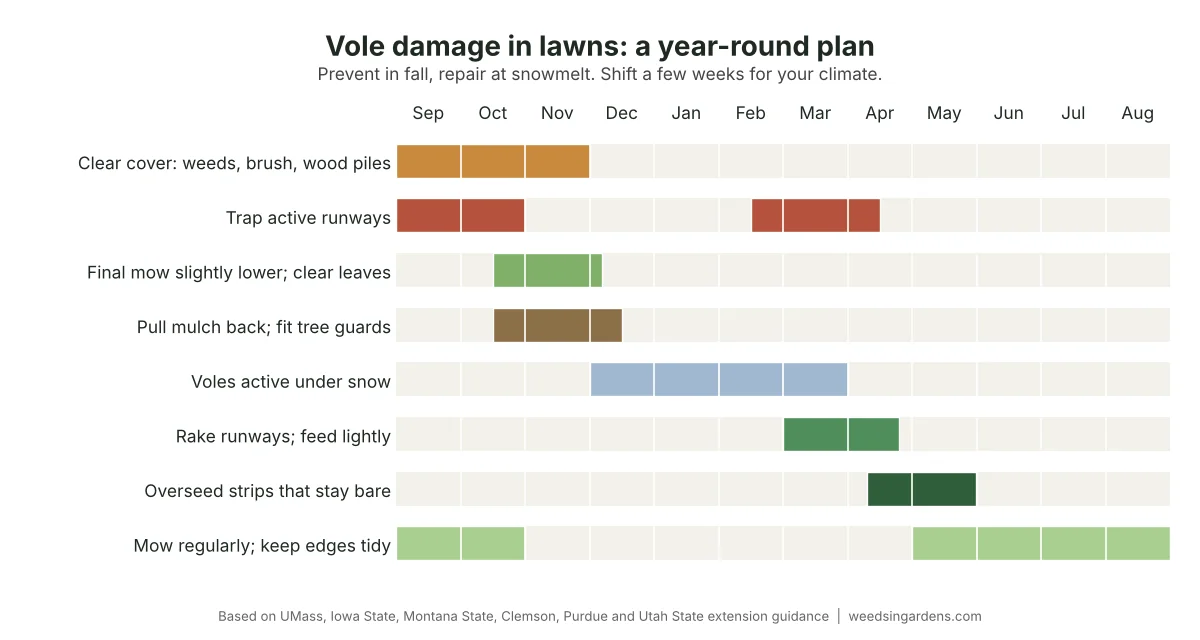
| September–October | Clear cover, cut back weeds, start trapping if you see active runways | Montana State recommends control in these months to prevent winter damage |
| Late fall | Final mow slightly lower, clear leaves, pull mulch back, install tree guards | Less cover under the coming snow |
| Winter | Keep birdseed off the ground; check guards after heavy snow | Deep snow lets voles reach higher on trunks |
| Snowmelt (March–April) | Identify the damage, rake runways, feed lightly | Crowns regrow faster with light and air |
| Mid to late spring | Overseed strips that stayed bare; trap again if runways are still active | Fall and late winter are the best trapping windows |
| Summer | Mow regularly and keep edges tidy | Mowing exposes voles to predators |
Trapping, repellents and baits: what’s worth doing
Most cases of vole damage in lawn turf don’t need any of this. UMass says outright that trapping or chemical control is rarely indicated for residential lawns. But if voles are also girdling shrubs or eating bulbs, here’s an honest comparison.
| Method | Does it work? | Cost and effort | Watch out for |
|---|---|---|---|
| Habitat cleanup | Yes; the most reliable long-term fix | Free; a weekend in fall | Needs repeating every fall |
| Snap traps | Yes, for small areas and small populations | Cheap, but daily checking | Cover traps to protect birds, pets and children |
| Hardware-cloth guards | Yes, for individual trees and shrubs | Low cost, one-time install | Must be buried and taller than the snow |
| Repellents (capsaicin, castor oil) | Questionable to mixed | Repeated purchases and re-application | Must go on before damage starts |
| Toxic baits | Can work on large populations | Often needs a licensed applicator | Poisoning risk to pets, birds and wildlife |
| Ultrasonic devices, gas cartridges | No | Wasted money | UC IPM lists these as ineffective |
How to trap voles properly
Use ordinary wooden mouse snap traps. Set each one at a right angle to a runway with the trigger end sitting in the trail. Bait with a peanut butter and oat mixture or a slice of apple, although UC IPM and Montana State both note that traps in a runway work unbaited too.
Numbers matter more than bait. UC IPM recommends at least a dozen traps for a small garden. Check them daily, keep trapping in one spot until you stop catching anything, then move the traps 15 to 20 feet. Cover each trap with a box, a board propped on bricks or a piece of gutter so birds and pets can’t reach it.
Wear gloves when you handle traps or dead voles. UC IPM warns that voles can carry infectious pathogens or parasites. And check your state’s rules first, since trapping and relocation regulations vary.
Repellents: don’t expect much
UC IPM calls the efficacy of capsaicin and castor-oil repellents “questionable,” Ohio State describes results as mixed, and the Montana State Extension article says bluntly that repellents and frightening devices aren’t worth the money. Mothballs don’t work either, and Clemson points out that using them this way is illegal pesticide misuse.
Baits: read the label before you buy
This is the part to slow down on. Zinc phosphide, the most common vole toxicant, is a restricted-use material according to UC IPM, and it has no antidote. University of Minnesota Extension notes that most pesticides recommended for voles can only be used by certified applicators. Anticoagulant baits are registered for voles in some states but not others, Purdue notes, so the product on the shelf may not be legal for voles in your yard.
Any bait also carries a risk to non-target animals. Colorado State specifically warns about secondary poisoning of dogs and cats. If a large population truly calls for bait, follow the label exactly, use tamper-resistant bait stations, or hire a licensed professional. The label is the law.
A note from the agronomist’s side
The most useful thing to understand about vole damage in lawn turf is where the grass plant keeps its growing point. In turfgrass it sits in the crown, right at the soil surface, below where a vole feeds. A vole grazing a runway is doing roughly what a mower set far too low would do: removing leaves, not killing plants. That’s why extension sources from Minnesota to Massachusetts are so relaxed about the lawn itself, and why raking and a light feeding outperform anything more dramatic.
It also explains the order of the repair. Seeding first is the common mistake. Seed scattered on a thatch of dead clippings and droppings doesn’t touch soil, and half of those strips would have regrown anyway. Rake, feed, wait, and only then seed what’s still bare. You’ll use a fraction of the seed.
On control, think like a prey animal. A vole’s whole strategy is to never be seen from above. Every source in this guide points at the same lever: short turf, open edges, thin mulch. Traps remove individuals, but with females maturing in about five weeks, removal alone is a treadmill unless the habitat changes too. And because populations crash on their own after a peak, be skeptical of any product that seems to have “worked” the year after a bad winter. The cycle may deserve the credit.
Finally, spend your effort where damage is permanent. A lawn recovers in weeks. A girdled young maple doesn’t. If you only do one thing this fall, put hardware cloth around your young trees.
FAQ
Will grass grow back after vole damage?
Usually, yes. Voles clip grass down to the crown but typically leave crowns and roots intact, so most runways fill in within a few weeks of spring growth. Rake out the dead grass, feed lightly, and overseed only the strips that stay bare.
What does vole damage in lawn grass look like?
Look for winding, open-topped trails of dead or closely clipped grass about 1 to 2 inches wide, usually seen right after snowmelt. The trails branch and connect small, clean holes with no soil mounds, and often contain rice-shaped droppings.
How do I tell vole damage from mole damage?
Voles leave open surface trails and no soil piles. Moles leave raised ridges of soft turf and volcano-shaped mounds of soil. Voles eat plants, while moles eat insects, grubs and earthworms, so the two need different control methods.
How do I repair vole damage in my lawn?
Once the soil is firm, rake the runways to remove dead grass and droppings, apply a light spring fertilizer and water if it’s dry. Give the lawn a few weeks to regrow, then overseed any strips that are still bare.
When is the best time to trap voles?
Fall and late winter are the best times, according to Clemson and Purdue. Montana State recommends September and October so numbers are lower before snow arrives. Set mouse snap traps at right angles to active runways.
Do vole repellents work?
Not reliably. UC IPM calls capsaicin and castor-oil repellents questionable, and Ohio State describes results as mixed. Removing cover, mowing through fall and protecting trees with hardware cloth are far more dependable.
Will voles come into my house?
Almost never. Iowa State University Extension notes that voles rarely enter houses. A small mouse-like animal indoors is much more likely to be a house mouse or a shrew.
Voles are one of several animals that trouble turf. For more, browse our lawn pests guides.
Sources
- Menken, J. University of Minnesota Extension. How to manage vole damage on lawns, trees and shrubs (reviewed 2024).
- Lanier, J.D. UMass Extension. Mole and Vole Damage to Lawns (revised 2011).
- Iowa State University Extension, Yard and Garden. What produces narrow snow pathways in my lawn? (updated 2024).
- Iowa State University Extension, Natural Resource Stewardship. Voles: Damage management (reviewed 2020).
- Baldwin, R.A. UC Statewide IPM Program. Voles (Meadow Mice), Pest Notes Publication 7439 (updated 2023).
- Gibb, T. Purdue University Turfgrass Science. Voles (remember the V).
- Davidson, D. & Shonle, I. Colorado State University Extension, PlantTalk 2311. Vole Damage in Your Yard.
- Ohio State University Extension, Buckeye Yard and Garden onLine. Surprise Under the Snow: VOLES.
- Smith, B.H. Clemson Cooperative Extension HGIC. How to Tell the Difference Between Moles and Voles (updated 2025).
- Pokorny, K. Oregon State University Extension. How to identify and manage moles, voles and gophers in Oregon gardens (2025).
- Vantassel, S.M. Montana State University Extension. Voles: The Bane of Landscape Plantings and Turf (2021).
- Banks, S. Utah State University Extension. Ask an Expert: Five Tips to Prevent Vole Damage (2016).
- Gunn, D. & Hirnyck, R. University of Idaho Extension. Meadow voles (2023).
- University of Illinois Extension. Plant Problems: Vole.