
It’s the first icy morning of the season. You’re standing on the front step with a bag of ice melt in one hand and a scoop in the other, looking at the strip of lawn that runs along the walk. Last April that strip came up brown and patchy, and you’re fairly sure the salt did it. So which bag is actually kind to grass?
Short answer: if you want an ice melt safe for grass, choose calcium magnesium acetate (CMA) first, then magnesium chloride or calcium chloride used sparingly. No deicer is completely harmless, though: every one is a salt, and too much of any of them will burn turf. Rock salt (sodium chloride) and potassium chloride do the most harm to lawns. How much you use, and where the slush ends up, matters as much as which product you buy.
This guide compares every common ice melt ingredient side by side: how cold each one works, how hard it is on grass, and what “pet safe” really means. It also gives you a simple storm-day routine and a spring repair plan. By the end you’ll know which bag to buy, how much to spread, and how to bring back a salt-burned lawn edge if it’s already too late.
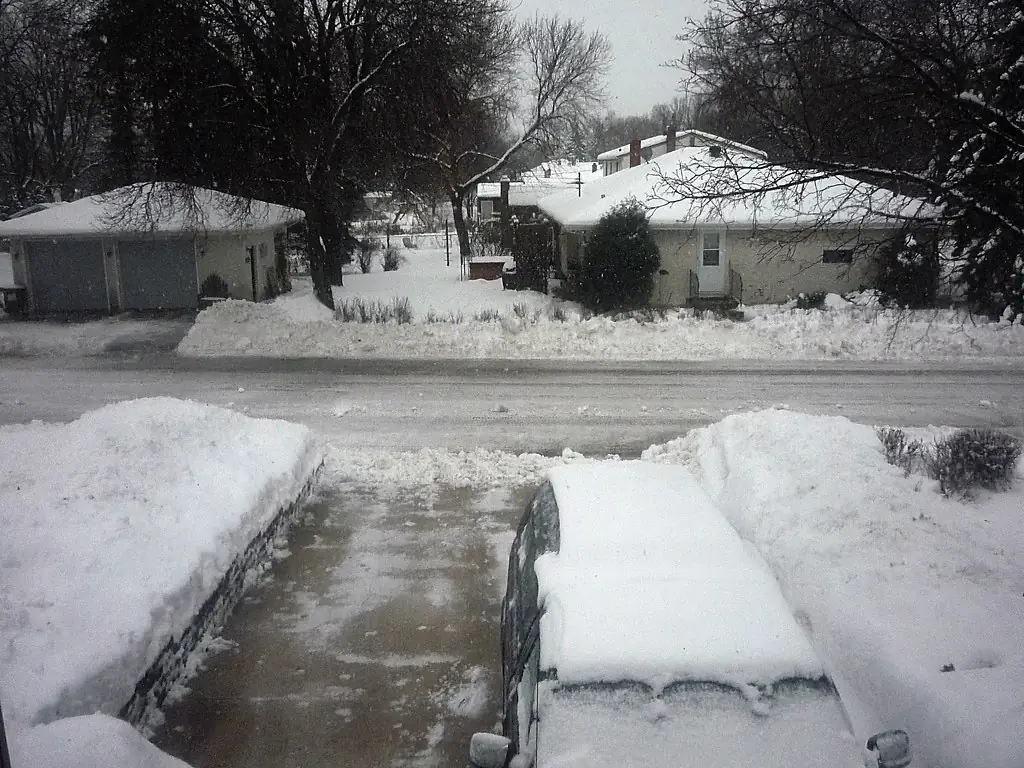
How ice melt damages grass (and why you only see it in spring)
Here’s the frustrating part: salt injury is mostly invisible in winter. The grass is dormant, so nothing looks wrong until it fails to green up in April. By then the cause is months old, and many people blame snow mold or the dog instead.
Ice melt hurts grass in three ways:
- It pulls water out of roots. Salt in the soil makes it harder for roots to take up water, so grass acts as if it’s in drought even when the ground is wet. Colorado State University notes that salt-stressed Kentucky bluegrass can turn a blue-gray color, the same sign it shows in a dry spell (CSU Extension).
- Chloride builds up and burns. Roots absorb chloride, and it accumulates in leaf tips until they die back. Symptoms include leaf tips and margins that look burned, stunting and root injury (Nebraska Extension G1121).
- Sodium wrecks soil structure. Sodium makes clay particles swell. The soil gets more compacted, water soaks in more slowly, and roots struggle to grow (University of Minnesota Extension). That’s why salt-damaged edges often stay thin for years.
Distance matters too. UW–Madison Extension says most deicing-salt damage to plants happens within about 30 feet of roads, driveways and parking areas, and in home landscapes it comes mainly from salt building up in the soil rather than from spray (UW–Madison Extension). In plain terms: the first foot or two of lawn beside your walk takes the worst of it, because that’s where you throw the slush.
Timing matters as well. Salt sitting on frozen ground has nowhere to go, but salt spread in late winter, when the soil has thawed, washes straight into the root zone. The Missouri Department of Conservation specifically warns homeowners to be careful with ice melters in late winter and early spring, when the ground is not frozen (MDC).
If you’ve read our guide on whether salt kills weeds, the mechanism will sound familiar: it’s the same chemistry, just applied by accident.
Ice melt safe for grass? Every ingredient compared
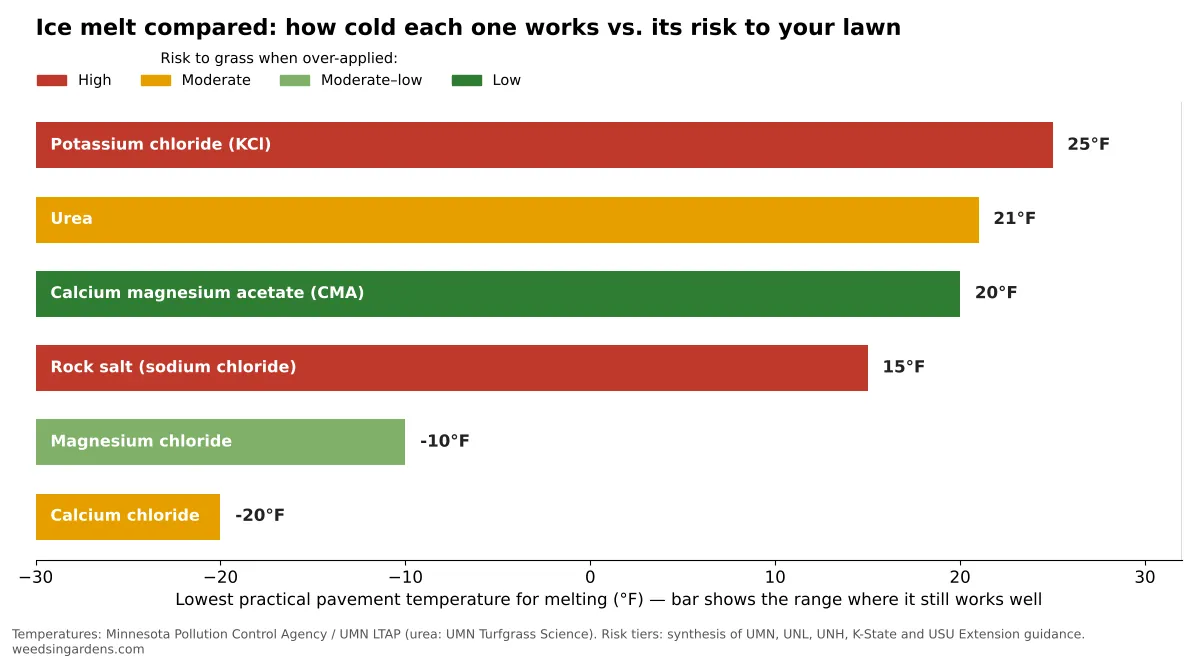
Most bags list one or more of six ingredients. Each has a different cold limit and a different level of risk to turf. The table pulls together the practical melting temperatures from the Minnesota Pollution Control Agency and University of Minnesota, plus plant-safety guidance from several extension services.
| Ingredient | Works well down to (pavement temp) | Risk to grass | What extension sources say | Cost |
|---|---|---|---|---|
| Calcium magnesium acetate (CMA) | 20°F | Lowest | Salt-free; studies show little impact on plants and animals (UNL). Probably the least toxic option for plants (UNH). Needs more product for the same melting (UMN Turf). | Very high: up to 40× rock salt (USU) |
| Magnesium chloride | −10°F | Moderate to low | UNH suggests it if you’re deicing mainly near turf. Less harmful to turf than rock salt, but can still cause problems (UMN Turf). | Higher |
| Calcium chloride | −20°F | Moderate | Works at the lowest temperatures. K-State’s first pick for gentleness on plants when used as directed; UNH notes it can still damage roots. | Higher |
| Urea (fertilizer) | about 21°F | Moderate | Lower burn potential than potassium chloride, but over-application burns turf, and nearby grass may grow excessively in spring (UNL, K-State). | Moderate |
| Rock salt (sodium chloride) | 15°F | High | Causes the most plant damage of common deicers and damages soil structure (UMN Extension). | Lowest |
| Potassium chloride | 25°F | High | High salt index; can burn foliage and inhibit rooting (UNL). Plant injury if over-applied (K-State). | Moderate |
Temperatures: MPCA and UMN LTAP; urea from UMN Turfgrass Science. Sources give slightly different numbers (K-State, for example, lists calcium chloride to −25°F and magnesium chloride to 5°F), so treat them as rough guides.
Calcium magnesium acetate: the most lawn-friendly ice melt
CMA is made from dolomitic limestone and acetic acid, the main compound in vinegar. It contains no chloride, which is the part of most deicers that builds up in soil and burns grass (UNL). If you want an ice melt safe for grass along a long, lawn-lined walk, CMA is the one to look for.
The catch is price and performance. Utah State University Extension puts CMA at up to 40 times the cost of rock salt (USU Extension), and it stops working well below about 20°F. University of Minnesota turf researchers also note that you need larger amounts to get the same melting (UMN Turfgrass Science). Many “CMA” products are blends, so check how much is really in the bag.
Magnesium and calcium chloride: the practical middle ground
For most homeowners, these two are the realistic choice. They melt ice at far lower temperatures than rock salt, they work fast because they draw moisture from the air, and they’re gentler on turf than sodium chloride. University of New Hampshire Extension suggests magnesium chloride if you’re deicing mainly near turf (UNH Extension). K-State’s horticulture department picks calcium chloride first, for its low-temperature performance and its gentleness on plants when used as directed (K-State).
The honest caveat: both are still chloride salts. University of Minnesota turf scientists put it plainly: they are less harmful than rock salt “but still may cause problems” for turf and soil (UMN Turfgrass Science). Less damaging isn’t the same as harmless.
Rock salt and potassium chloride: the two to keep off the lawn edge
Rock salt is cheap and everywhere, which is exactly why it causes so much lawn damage. University of Minnesota Extension names sodium chloride as the deicer that does the most plant damage (UMN Extension). It also stops working well below about 15°F, so people tend to pile on more during cold snaps, which is the worst-case scenario for the grass.
Potassium chloride surprises people because it’s sold as fertilizer (potash). Nebraska Extension warns its high salt index can burn foliage and inhibit rooting (UNL). Sources don’t fully agree here: Utah State lists it as less harmful to plants (USU). Either way, it only works down to about 25°F, so you’ll use a lot of it.
Urea: “fertilizer” doesn’t mean lawn-safe
A common belief is that fertilizer-based ice melts feed the lawn. A turf facility manager writing in a 2006 trade article (archived by Michigan State’s Turfgrass Information Center) pointed out the flaw: a normal ice-melt application of urea or potassium chloride is much higher than a fertilizer rate, and repeated doses on frozen turf can’t leach away (Brower 2006). Urea also loses nitrogen to the air if it sits on the soil surface, and nitrogen runoff is a water-quality problem (UNL, USU).
Read the bag: most blends are mostly rock salt
Bags labeled “plant safe” or “eco-friendly” are often blends. The University of Minnesota’s Smart Salting guide says most blends are mostly rock salt because it’s the cheapest ingredient, and manufacturers don’t have to list percentages (UMN LTAP). If sodium chloride is the first ingredient, assume the product behaves like rock salt around your lawn.
Pet-safe ice melt vs grass-safe ice melt: not the same thing
Lots of people search for an ice melt safe for pets and grass at the same time, and the labels encourage that. But the two claims are about different things.
“Pet safe” usually means the product is less likely to make an animal sick if it licks its paws. The ASPCA says pet-friendly ice melts typically contain urea or magnesium chloride. Even these can cause stomach upset, so it’s best to be careful with them as well (ASPCA). Urea is not especially kind to turf at high rates, so a pet-friendly urea product can still burn your lawn edge.
| Ingredient | Pets (ASPCA / Poison Control) | Grass |
|---|---|---|
| Rock salt (sodium chloride) | Eating too much can raise sodium levels and cause tremors and seizures | High risk |
| Calcium chloride | Can cause mouth ulceration if swallowed | Moderate risk |
| Magnesium chloride | Common in pet-friendly products; may still upset the stomach | Moderate to low risk |
| Urea | Common in pet-friendly products; may still upset the stomach | Moderate risk; burns if over-applied |
| Any ice melt on paws | Dryness and irritation; wipe or wash paws after walks | n/a |
What to do for your dog: wipe paws with a damp cloth when they come inside, don’t let them eat treated snow or slush, and consider booties or paw wax if pads crack (ASPCA, Poison Control). If your pet eats ice melt or shows symptoms, call your veterinarian or the ASPCA Animal Poison Control Center at (888) 426-4435.
If you need an ice melt safe for grass and paws alike, magnesium chloride is the most common compromise. The best product for both pets and grass is still the one you use the least of. That brings us to technique.
How to use any ice melt without killing your lawn
Most salt-burned lawns aren’t caused by the wrong product. They’re caused by too much of it. University of Minnesota turf researchers note that there’s a point where more salt no longer means more melting, and it’s lower than most people think (UMN Turfgrass Science). Follow these steps and even rock salt does far less harm.
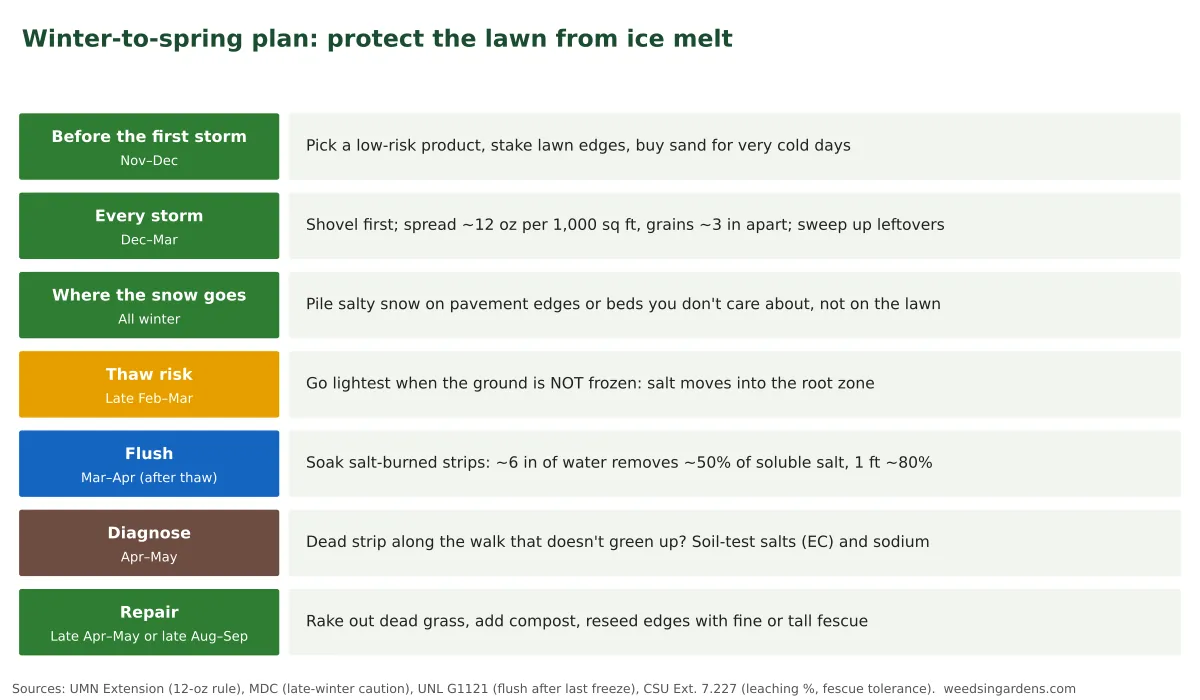
- Shovel first, every time. Ice melt isn’t meant to melt a whole snowfall. It works by boring through ice and loosening its bond with the pavement so you can scrape it off (UNL). Never spread it on top of unshoveled snow (UMN Extension).
- Measure with a coffee mug. About 12 ounces of salt, one heaping coffee mug, is enough for roughly 1,000 square feet: a 20-foot driveway or about 10 sidewalk squares. Spread it so grains sit about 3 inches apart (UMN Extension).
- Match the product to the pavement temperature. Rock salt slows dramatically in the cold. At a 30°F pavement temperature, 1 lb of salt melts about 46 lb of ice in 5 minutes; at 15°F it melts about 6 lb in an hour, and below about 10°F dry salt is basically ineffective (UMN LTAP / MPCA). On very cold days, switch to calcium or magnesium chloride, or use sand for traction.
- Use sand or grit for traction on bitter days. Sand doesn’t melt anything, but it stops slips, and it won’t salt your soil. UW–Madison suggests mixing salt with sand to cut the amount of salt used (UW–Madison Extension).
- Sweep up leftovers. Grains left on dry pavement end up on the lawn when it rains or thaws. Sweep them up and reuse them (UMN Extension).
- Throw slush away from the grass. Pile salty snow where the meltwater drains to the street or onto a gravel area, not onto the lawn or into beds (UW–Madison Extension).
- Go lightest in late winter. When the soil thaws, salt moves into the root zone instead of sitting on frozen ground (MDC).
- Keep soils draining well. Salts can only leach away in spring if the water can soak through. Well-drained, non-compacted soil helps flush salt out as it thaws (UMN Turfgrass Science). Our guide to fixing compacted soil explains how to loosen it.
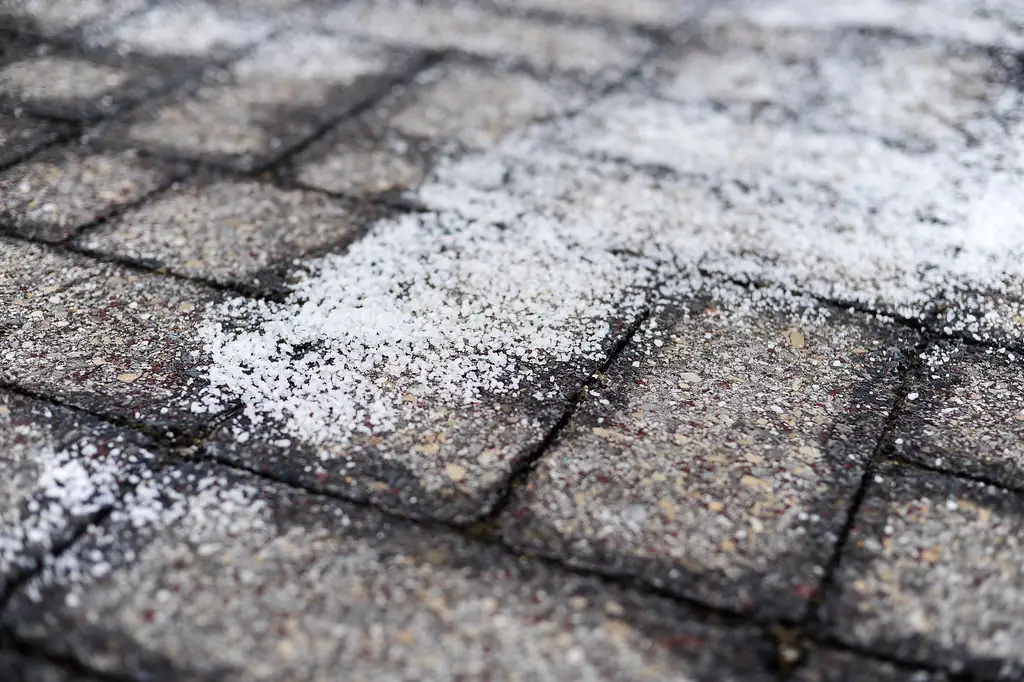
Pellets beat flakes, too. Nebraska Extension notes that round pellets about 1/16 to 3/16 inch across bore through ice faster and more efficiently than other shapes. Flakes melt as much sideways as down (UNL). Faster penetration means less product overall.
Ice melt is also hard on hardscapes. Rock salt and the chloride deicers can damage concrete and stone. If you’re dealing with green growth on your walk, see our guide to moss on pavers for methods that won’t make the salt problem worse.
Signs of salt damage in your lawn
Even an ice melt safe for grass can leave marks if the slush piles up in one spot. Salt damage has a clear pattern once you know to look for it. Check for these clues in early spring, before you assume a disease or pest:
| What you see | Likely salt damage if… | Could also be… |
|---|---|---|
| Brown or dead strip right along a walk, driveway or curb | The strip is narrow, follows the pavement edge, and is worst where you throw slush or the plow leaves snow | Snow mold (circular patches with gray or pink fuzz after snowmelt) |
| Grass that stays blue-gray and wilted even though the soil is moist | It sits in a low spot where meltwater collects | Drought or root damage |
| Seed or sod that fails along the edge year after year | Kentucky bluegrass keeps dying back while the rest of the lawn is fine | Compaction or heat from pavement |
| White or yellow-brown crust on the soil surface | It appears in a dry spell near salted areas | Naturally salty or sodic soil |
The blue-gray color and the surface crust come from Colorado State’s turf guidance (CSU Extension). If you see round patches with gray or pink fungal growth instead, read our guide to snow mold, which needs a very different response.
When you can’t tell, a soil test settles it. A lab can measure soluble salts (reported as electrical conductivity, or EC) and sodium. That tells you whether you have a saline problem, which water alone can flush, or a sodic one, which may need gypsum first (CSU Extension).
How to repair a salt-damaged lawn in spring
The good news: soluble salts move with water, so most edge damage can be fixed. The key is getting the salt out before you reseed. In a laboratory study, Kentucky bluegrass seed did not germinate at all under sodium chloride salinity, and salt stress cut root length, root mass and leaf water content in young plants (Mastalerczuk et al. 2019). Seed sown into salty soil is mostly wasted.
Step 1: Flush the salt out
Once the ground thaws, soak the damaged strip deeply with clean water. Nebraska Extension recommends flushing with large amounts of water after the last freeze (UNL). Colorado State’s figures show how much it takes:
| Clean water applied | Soluble salt removed |
|---|---|
| 6 inches | about 50% |
| 1 foot | about 80% |
| 2 feet | about 90% |
Source: CSU Extension Fact Sheet 7.227. This only works if water drains through the soil. Spread the soaking over several sessions so it soaks in rather than running off, and keep the runoff away from other plantings. Spring rain does part of the job for you.
Step 2: Use gypsum only where it can help
Gypsum (calcium sulfate) is often sold as a salt fix. It helps in one situation: when sodium has damaged soil structure. The calcium displaces sodium so it can be washed out. The Missouri Department of Conservation suggests 100 to 200 lb of gypsum per 1,000 square feet for moderately contaminated soil, repeated every three years (MDC).
But gypsum isn’t magic. UW–Madison points out that it needs good drainage to work, and the soil along walks and drives often drains poorly (UW–Madison Extension). Colorado State adds that gypsum is itself a salt and can make a saline (non-sodic) soil worse, so test before you apply it (CSU Extension).
Step 3: Reseed with a salt-tolerant grass
If the edge dies back every spring, change the grass rather than fighting the same battle. Colorado State lists approximate soil salt levels at which each species starts to struggle:
| Grass | Salt tolerance (EC, mmhos/cm) | Notes |
|---|---|---|
| Kentucky bluegrass | 3–6 | Performs poorly on salty roadsides (UMN) |
| Perennial ryegrass | 8–10 | Quick to establish |
| Turf-type tall fescue | 8–10 | Intermediate salt tolerance (UMN) |
| Fine fescues (creeping red, Chewings, sheep) | 8–12 | Best overall performers in UMN roadside trials |
| Bermudagrass | 16–18 | Warm-season; for southern lawns |
| Alkaligrass (‘Fults’, ‘Seasalt’) | 20–30 | Very tolerant but did not persist in low-input UMN trials |
Sources: CSU Extension; UMN Turfgrass Science. University of Minnesota researchers tested 75 cultivars of 9 species on Minnesota roadsides. Slender and strong creeping red fescue came out on top, which led to a salt-tolerant sod mix built mainly on fine fescues (UMN). For a home lawn edge, a seed mix with plenty of fine fescue or tall fescue is the practical choice (UMN Extension).
Rake out the dead grass, loosen the top inch or two, mix in some compost, then seed. Late summer is the classic window for cool-season seed, but small edge repairs can go in during spring once the salt is flushed. If you want to get ahead, dormant seeding lets you sow in late fall or winter so the seed sprouts as soon as the soil warms. That only works on edges that won’t be salted again before spring.
A note from the agronomist’s side
When people ask for an ice melt safe for grass, they’re really asking a dose question disguised as a product question. Every deicer works by putting dissolved salt into water; that’s the whole mechanism. Grass roots dislike high salt for the same reason. So the label on the bag shifts the risk, but the scoop in your hand decides it.
Here’s how I’d weigh the evidence. The ingredient ranking is consistent across extension services: CMA is gentlest, magnesium and calcium chloride sit in the middle, and sodium and potassium chloride are the ones to avoid near turf. Where sources disagree, as they do on potassium chloride and on exact melting temperatures, the disagreement is small compared with the effect of application rate. One heaping mug per 1,000 square feet is a tiny amount. Most homeowners use several times that, and that over-application is what shows up as a dead strip in April.
I’d also put more weight on soil than most guides do. Sodium damage is partly a structure problem. Compacted, poorly drained edge soil holds salt and prevents spring flushing, which is why the same strip fails every year. Fix drainage and grass choice together, and the lawn edge stops being a recurring cost.
My practical rule of thumb: buy a calcium or magnesium chloride product for the walks that border lawn, keep a pail of sand for sub-zero days, and save the cheap rock salt, if you use it at all, for spots that drain to the street. If you also water dormant grass during dry winter spells, you’ll go into spring with less salt in the root zone and a healthier lawn edge.
FAQ
Is there an ice melt that is completely safe for grass?
No. Even the gentlest product is a salt. All ice melts are salts and can burn grass if overused. Calcium magnesium acetate (CMA) is the least harmful to plants, followed by magnesium chloride and calcium chloride. Using a small amount, about 12 ounces per 1,000 square feet, matters as much as the product.
Does ice melt kill grass?
It can. Too much ice melt, especially rock salt, dries out roots, burns leaf tips with chloride and damages soil structure. The damage usually shows up in spring as a brown strip along walks and driveways that doesn’t green up.
Is calcium chloride ice melt safe for grass?
It is gentler than rock salt when used as directed, and K-State Extension lists it as a first choice. It is still a chloride salt, though, and can damage roots if overused. Spread it thinly and keep slush off the lawn.
Is pet-safe ice melt safe for grass?
Not necessarily. Pet-friendly ice melts usually contain urea or magnesium chloride. Magnesium chloride is fairly easy on turf, but urea can burn grass when over-applied. Check the ingredients and use as little as possible.
Will grass grow back after salt damage?
Often, yes, if the crown and roots survived. Flush the soil with plenty of water once it thaws, about 6 inches of water removes roughly half the salt, then reseed thin areas with a salt-tolerant grass such as fine or tall fescue.
Can I use ice melt to kill weeds?
It isn’t recommended. Salt doesn’t target weeds, it damages soil structure, and it moves into nearby lawns and beds with rain. Use a labeled weed control method instead.
What can I use instead of ice melt near my lawn?
Shovel early and often, then use sand, grit or another abrasive for traction. These don’t melt ice, but they add no salt to the soil. Sweep them up after the thaw.
Sources
- University of Minnesota Extension. The effects of deicing salts on landscapes.
- Friell, J. (2013). Minimize turf damage from salt this winter. University of Minnesota Turfgrass Science.
- Minnesota LTAP, University of Minnesota. Winter Salt Guide for Homeowners: Pavement temperature and deicer use.
- Minnesota Pollution Control Agency. Lowest practical melting temperature. Minnesota Stormwater Manual.
- Cavanaugh, M. Salt-tolerant roadside grasses: does anything actually survive? University of Minnesota Turfgrass Science (citing Friell, Watkins & Horgan 2012, Acta Agric. Scand. B 62:44–52).
- Fitzgerald, J.B. & Janssen, D.E. (rev. 2007). Winter Deicing Agents for the Homeowner (G1121). University of Nebraska–Lincoln Extension.
- UNH Cooperative Extension. Deicers: What is the best deicer to use near my plants?
- Honig, R. (2025). Choosing the best ice melt product. Kansas State University, Wild West District.
- Hadfield, J. (2024). De-icing compounds. Utah State University Extension.
- Spangenberg, B. (2025). Reducing deicing salt damage this winter. UW–Madison Division of Extension.
- Colorado State University Extension. Growing turfgrass on salt-affected sites (Fact Sheet 7.227).
- Missouri Department of Conservation. Ice melter damage.
- Mastalerczuk, G., Borawska-Jarmułowicz, B. & Kalaji, H.M. (2019). How Kentucky bluegrass tolerate stress caused by sodium chloride used for road de-icing? Environmental Science and Pollution Research. doi:10.1007/s11356-018-3640-4
- Brower, J. (2006). Breaking the ice: what facility managers need to know about ice melters. Archived by the Michigan State University Turfgrass Information Center.
- ASPCA Animal Poison Control Center (2018). Keeping pets safe during winter: the dangers of ice melts.
- National Capital Poison Center (Poison Control). Pets, kids, and ice melt products.