
The weekend is finally here, the dandelions and clover are back, and you’ve got the sprayer filled. Then you check your phone: 60% chance of showers by mid-afternoon. Do you spray now and hope, or pour the mix back and lose another week?
Short answer: Yes, you can spray weed killer before rain, as long as the product has had time to dry and soak into the leaves first. That “rain-free period” is printed on the label and ranges from about 10–30 minutes for some glyphosate concentrates to 4 hours for many lawn broadleaf sprays, and 24 hours for granular weed and feed. Pre-emergents are the exception: they actually need about half an inch of rain or irrigation to work.
This guide gives you the rain-free time for each common type of weed killer, a simple forecast decision chart, the special rules for granules and pre-emergents, and exactly what to do if a storm arrives sooner than expected. By the end, you’ll know in about ten seconds whether to spray weed killer before rain or hold off until the weekend clears.
Why Rain Matters: How Weed Killer Gets Into a Weed
A post-emergent weed killer only works once it’s inside the plant. Spray droplets land on the leaf, dry down, and the active ingredient then crosses the waxy cuticle. Systemic products such as glyphosate, 2,4-D and dicamba still have to travel from there to the roots and growing points. Until that first step is done, the chemical is just sitting on the surface, and water can rinse it off.
University of Missouri IPM puts it simply: rain or irrigation soon after application can dilute or remove the pesticide from the leaf, and the label usually lists the time needed before rainfall. Once the product has dried on the leaf or been absorbed, it performs as expected even if it rains afterwards (Warmund, University of Missouri).
Three things decide how much damage a shower does:
- Time since spraying. The longer the gap, the more product is already inside the leaf.
- How hard it rains. Missouri’s IPM team notes that 1 inch of rain in an hour strips more pesticide than a slow drizzle spread over several hours.
- Formulation. Built-in adjuvants (surfactants) and ester formulations generally soak in faster than older or salt formulations, which is why two products with the same active ingredient can have very different rain-free times.
The research backs this up. In a classic study, rain falling less than 1 minute after spraying cut the activity of an amine-salt form of 2,4-D far more than an ester form. The time needed to reach 80% of full effect ranged from under a minute (ester on lambsquarters) to more than 24 hours (salt on velvetleaf) (Behrens & Elakkad, 1981). In other words, the weed species and the formulation both matter, not just the active ingredient.
How Long Weed Killer Needs Before Rain, by Product
Labels call this the rainfast period: the minimum dry time after spraying before rain or sprinklers. South Dakota State University Extension points out that these periods assume good weather, so they stretch when conditions are poor (SDSU Extension). Here’s what the labels and extension tables actually say.
| Weed killer (active ingredient) | Typical use | Rain-free time needed | Where the number comes from |
|---|---|---|---|
| Roundup Weed & Grass Killer Concentrate Plus (glyphosate + diquat) | Kill-everything spot spray | 10–30 minutes (“rainproof”) | EPA label 71995-29 |
| Roundup PowerMax / WeatherMax (glyphosate) | Farm and professional | 30 minutes | UNL CropWatch table |
| Older glyphosate formulations without built-in adjuvant | Generic concentrates | 6–12 hours | Univ. of Missouri IPM |
| 2,4-D (generic burndown) | Broadleaf weeds | 1 hour | UNL CropWatch table |
| 2,4-D amine and ester brands | Pasture and turf broadleaf | 1 to 48 hours, depending on brand | Texas A&M AgriLife |
| Dicamba (Banvel) | Broadleaf weeds | 4 hours | UNL CropWatch table |
| Triclopyr (Remedy Ultra, Crossbow) | Woody weeds, brush, vines | 6 hours | Texas A&M AgriLife |
| Fertilome Weed Free Zone (2,4-D + MCPP + dicamba + carfentrazone) | Lawn broadleaf weeds | 4 hours (rain or watering may reduce effectiveness) | Product label 2217-855-7401 |
| Scotts Turf Builder Weed & Feed (granular) | Lawn weeds + fertilizer | 24 hours: no rain expected, no watering | EPA label 538-333 |
| Pre-emergents (prodiamine, dithiopyr, etc.) | Crabgrass and annual weed prevention | Needs about 0.5 in of rain or irrigation, ideally within 24 hours | Univ. of Arkansas Extension |
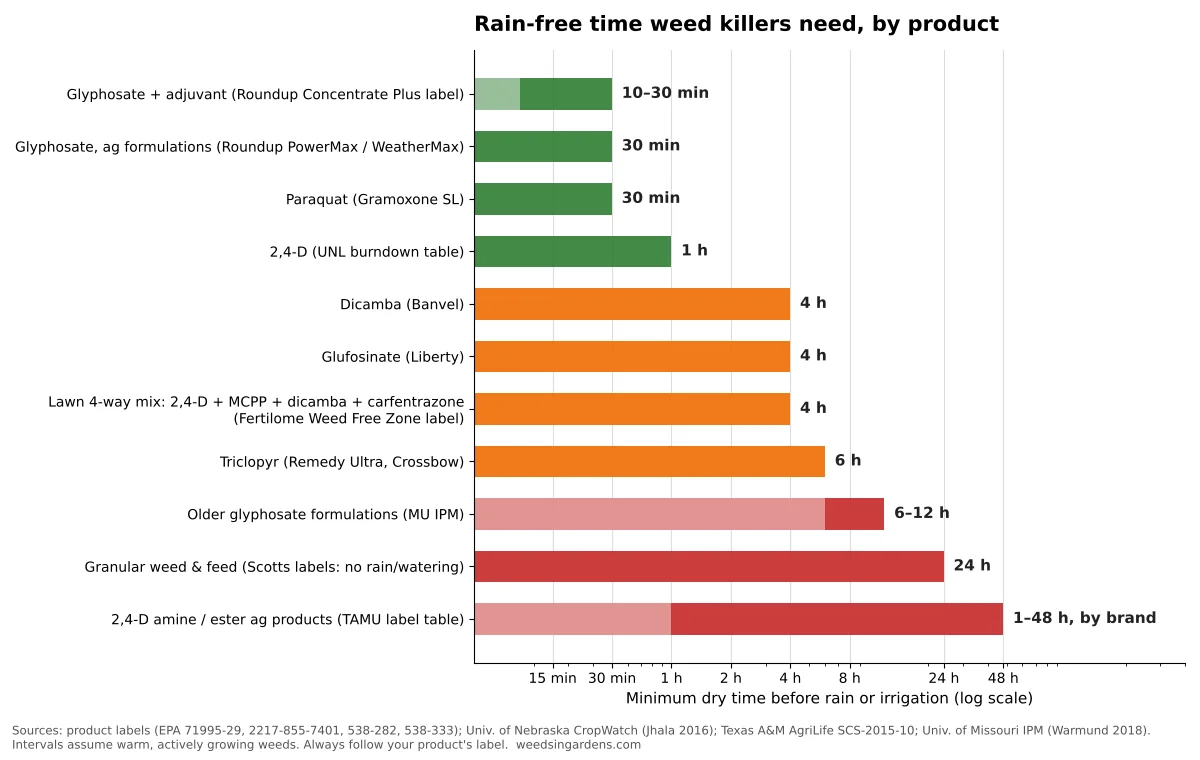
Two patterns jump out. First, modern glyphosate products with built-in adjuvants are fast: Missouri IPM notes newer formulations need only 30–60 minutes before rain, versus 6–12 hours for older ones. Second, brand matters more than you’d think. The Texas A&M table lists one 2,4-D amine product at 6 hours and another at 48 hours (Corriher-Olson et al., Texas A&M). That’s why “2,4-D needs X hours” is never a safe rule. Read the label on the bottle in your hand.
If you want to know what happens after the product is rainfast, our guide on how long weed killer takes to work walks through the symptoms day by day.
When to Spray Weed Killer Before Rain (and When to Wait)
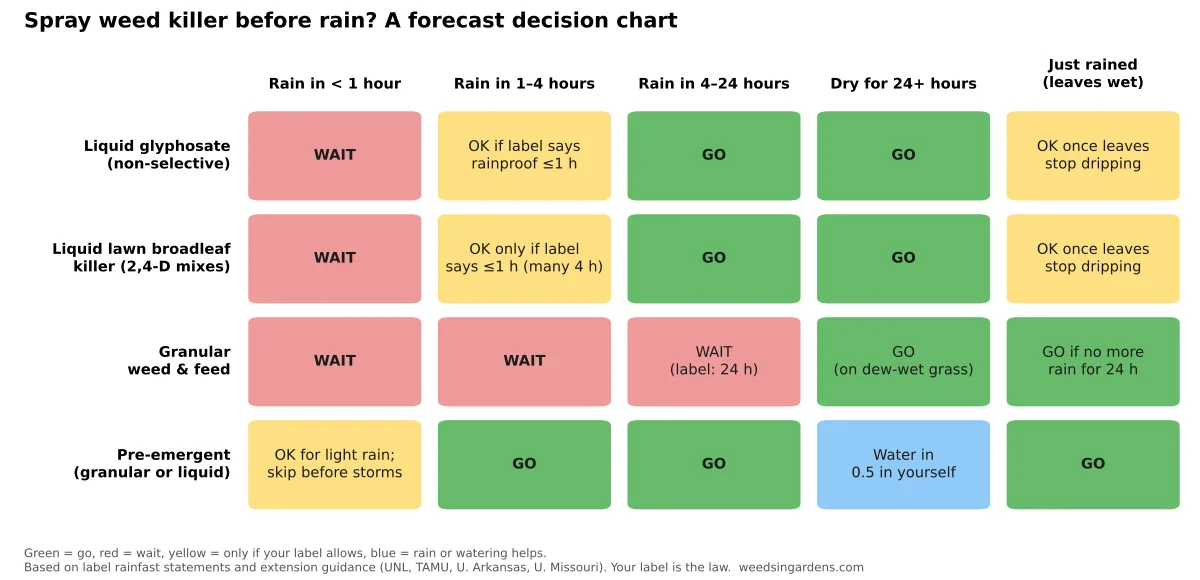
Most of the time the decision comes down to two things: what’s in your sprayer or spreader, and how many dry hours the forecast gives you. This chart sums it up.
Spray now if…
- The forecast gives you at least the label’s rain-free time plus a buffer. For a 4-hour product, look for 6 dry hours or more. Forecast timing is rarely exact.
- Weeds are actively growing and dry, and temperatures sit inside the label range (for example 45–90°F on Spectracide Weed Stop For Lawns, per its label).
- The rain coming is a light, steady shower later in the day rather than a downpour.
Wait if…
- Rain is due within the rain-free window. Several lawn labels go further. Spectracide Weed Stop For Lawns and Scotts Weed & Feed both say not to apply when it’s raining or when rain is expected that day, to keep product out of storm drains.
- A thunderstorm or heavy rain is forecast. Besides washing product off, a downpour can carry it onto paving and into gutters.
- It’s a cold, gray fall day (more on that below). The label’s rain-free time may not be enough.
- The leaves are dripping wet. Let them stop dripping first so your spray isn’t diluted or running straight off.
There’s also a runoff rule that many homeowners never notice. Lawn weed killer labels, including Scotts, Spectracide and Fertilome, carry a line saying that applying in calm weather when rain is not predicted for the next 24 hours helps keep wind or rain from moving the pesticide off the treated area. Even when your weeds would be fine, a big storm right after spraying is bad news for nearby streams (EPA label 538-282).
Cold, wet weather stretches the rain-free time
This is the part most product labels don’t spell out, and it matters right now in late fall. The University of Nebraska notes that rainfast ratings assume good growing conditions, and poor conditions may require a longer interval before rain. Glyphosate works best at 60–75°F. Below 60°F, weed growth slows, uptake and translocation slow down, and the rain-free period gets longer. Below 40°F, they advise not applying glyphosate at all (Jhala, UNL CropWatch).
So a “30-minute rainproof” label on a 48°F November afternoon is not a promise. Give it several extra hours, or pick a warmer, drier day. Our best temperature to spray weeds chart shows the safe zones month by month.
| Condition at spraying | Effect on uptake | What to do with the label’s rain-free time |
|---|---|---|
| 60–75°F, weeds actively growing, dry leaves | Fastest absorption | Label time is usually enough |
| Below 60°F or weeds drought-stressed | Slower uptake and movement | Add hours; aim for a fully dry day |
| Below 40°F (glyphosate) | Very poor | Don’t spray; wait for a warm spell |
| Above about 90°F | Grass injury risk on many lawn labels | Spray in the cool of the morning instead |
Granular Weed and Feed: The 24-Hour Rule
Granular weed and feed works in a completely different way from a spray, and it’s the product most often ruined by rain. The weed killer is coated on fertilizer granules. It only works if the granules stick to wet weed leaves and stay there long enough to be absorbed.
That’s why the Scotts Turf Builder Weed & Feed label asks for two things that sound contradictory. First, apply to grass that is wet from dew or sprinkling so the particles cling to the leaves. Second, apply only when rain is not expected for 24 hours, and don’t water or mow for at least 24 hours afterwards, because watering sooner “will wash the product off the weed’s leaves and reduce the effectiveness” (EPA label 538-333). The same label limits use to days that are regularly between 60°F and 90°F.
| Step | What to do | Why |
|---|---|---|
| Day before | Mow tall grass a day or two ahead; check a 24-hour dry forecast | Weeds need leaf surface exposed; rain would wash granules off |
| Morning of | Spread on dew-wet grass, or sprinkle lightly first | Moisture makes granules stick to weed leaves |
| Next 24 hours | No watering, no mowing, no rain | Granules must stay on the leaves to be absorbed |
| After 24 hours | Resume normal watering | Fertilizer can now move into the soil |
So the sweet spot for weed and feed is a dewy morning followed by a dry day. Unlike a fast-absorbing liquid, it’s a poor choice if you want to spray weed killer before rain on the same afternoon. For fall-specific timing, see our guide to fall weed and feed.
Pre-Emergents: The One Weed Killer That Wants Rain
Pre-emergent herbicides flip the whole question on its head. They don’t touch existing weeds. Instead, they form a chemical barrier in the top layer of soil that stops seeds from establishing as they germinate. University of Arkansas Extension explains that this barrier only forms after rainfall or irrigation activates it: about 0.5 inch of water, ideally within 24 hours of application (UACES, Preemergence Herbicides in the Home Lawn).
Clemson’s crop extension blog adds that roughly 0.25–0.5 inch is enough to activate most pre-emergence herbicides (Marshall, Clemson University). Missouri IPM puts the window at “within a few days.” That makes a gentle rain forecast tomorrow good news if you’re putting down crabgrass preventer this spring.
- Light to moderate rain due within a day: ideal. Apply now.
- Dry week ahead: water in about half an inch yourself. A tuna can on the lawn makes an easy rain gauge.
- Heavy storm imminent: wait. Too much water at once moves granules off slopes and hard surfaces.
Timing the season matters even more than timing the rain. Our guide on when to apply pre-emergent covers the soil-temperature triggers.
It Rained Right After Spraying: What Now?
It happens to everyone. The forecast said 4 p.m. and the shower rolled in at 1. When you spray weed killer before rain and the timing goes wrong, work through these steps before you reach for the sprayer again.
- Check how long it was dry. If the label’s rain-free time had passed, do nothing. The product is already inside the weed.
- Check how hard it rained. A light sprinkle shortly after spraying is less damaging than a downpour, but you can’t count on much control either way.
- Wait for symptoms. Systemic products are slow, so give them a week or two before you judge the result. Twisting, curling or yellowing means at least some product got in.
- Re-treat only survivors, by the label. Spectracide Weed Stop For Lawns, for example, says to repeat a spot treatment if tough weeds aren’t dead within three weeks. Never double the rate to “make up” for rain.
- Respect the yearly limits. Some products cap total applications, such as two broadcast applications a year for Scotts Weed & Feed. A rain-washed spray still counts.
Research suggests partial loss is more common than total failure. In a North Carolina State turf study, glyphosate gave at least 90% tall fescue control when no rain fell within 60 minutes, and still about 80% when only 30 rain-free minutes were provided (Gannon & Yelverton, 2008). Tough perennials are a different story. On purple nutsedge, a 1-inch simulated rain 1 hour after glyphosate cut its effectiveness in half, and rain at 24 hours cut it by a third. Only a 72-hour rain-free period prevented any loss (Bariuan et al., 1999).
For stubborn perennials like nutsedge, bindweed or creeping charlie, it pays to wait for a longer dry spell. Our post-emergent herbicide guide helps you match the product to the weed.
A Note from the Agronomist’s Side
Here’s a more useful way to think about rainfastness: it isn’t a switch that flips from “washed off” to “safe” at the label time. It’s a curve. Absorption climbs steeply in the first minutes to hours and then levels off. In the nutsedge study above, the amount of glyphosate absorbed rose from 2.8% at 1 hour to 21.4% after a week. The label number marks the point where enough is inside for the product to do its job under good conditions. That’s why every factor that slows uptake, such as cold, drought stress, dusty leaves or a thick waxy weed, pushes the safe point further out.
Three rules of thumb follow from that:
- Buffer the label. Treat the rain-free time as a minimum and add 50–100%, especially in spring and fall.
- Match the product to the forecast, not the other way round. In a showery week, a fast-absorbing formulation is the smarter choice. In a dry week, almost anything works.
- Hard-to-kill perennials deserve dry days. They need the most product inside to reach the roots, so give them the longest dry window you can.
Honestly, the costlier mistake usually isn’t the decision to spray weed killer before rain. It’s re-spraying too soon because nothing seems to happen for three days. Patience, and the label, will save you money and protect your lawn. This is especially true in autumn, the most effective window for perennial broadleaf weeds, as our fall weed control guide explains. You’ll find more label-by-label guides in our herbicides and pre-emergents section.
FAQ
How long does weed killer need before rain?
It depends on the product. Some glyphosate concentrates are rainproof in 10–30 minutes, many lawn broadleaf sprays need about 4 hours, triclopyr products about 6 hours, and granular weed and feed needs 24 hours with no rain or watering. Always check the label on your product.
Should I spray weed killer before or after rain?
For sprays, it’s usually better to spray after rain, once the leaves have stopped dripping and weeds are actively growing, with a dry forecast for at least the label’s rain-free time. Granular weed and feed goes on dew-wet grass with 24 dry hours ahead. Pre-emergents are best applied just before a light rain.
Is it OK to spray weed killer the day before rain?
Usually yes. If the rain is more than a day away, nearly every liquid weed killer has had time to absorb. Even granular weed and feed only needs 24 hours. Avoid spraying right before heavy storms, which can move product off the lawn.
Will rain wash away Roundup?
Not if it has had time to dry. The Roundup Weed & Grass Killer Concentrate Plus label says rain 10–30 minutes after application will not wash away effectiveness. Older glyphosate products without built-in adjuvants may need 6–12 hours.
Can you put down pre-emergent before rain?
Yes, and that’s ideal. Pre-emergents need about 0.5 inch of rain or irrigation, ideally within 24 hours, to form their barrier in the soil. Avoid applying right before a heavy downpour, which can wash granules off slopes and hard surfaces.
What happens if it rains after spraying weed killer?
If rain falls before the rain-free time, some product washes off and control is reduced, sometimes by half or more on tough perennials. Wait 1–3 weeks for symptoms, then re-treat only survivors, following the label’s rate and repeat-application limits.
Can I spray weed killer on wet grass?
Light dew is fine for most sprays and is actually recommended for granular weed and feed. Spraying liquid on dripping-wet leaves isn’t ideal, because the spray gets diluted and runs off. Wait until leaves stop dripping.
Sources
- Warmund, M. (2018). Rainfastness of Pesticides. Missouri Environment & Garden, University of Missouri IPM.
- Jhala, A. (2016). How Cool, Rainy Weather Affects Burndown Herbicide Efficacy. CropWatch, University of Nebraska–Lincoln.
- SDSU Extension. Temperature and Herbicide Performance. South Dakota State University.
- Corriher-Olson, V., Baumann, P. A., & Redmon, L. A. (2015). Rainfastness of Select Pasture and Hay Meadow Herbicides (SCS-2015-10). Texas A&M AgriLife Extension.
- University of Arkansas Cooperative Extension. Preemergence Herbicides in the Home Lawn.
- Marshall, M. (2021). Water Requirements for Activating Preemergence Herbicides. Clemson University.
- Gannon, T. W., & Yelverton, F. H. (2008). Effect of simulated rainfall on tall fescue (Lolium arundinaceum) control with glyphosate. Weed Technology, 22(3), 553–557. doi:10.1614/WT-07-158.1
- Behrens, R., & Elakkad, M. (1981). Influence of rainfall on the phytotoxicity of foliarly applied 2,4-D. Weed Science, 29(3), 349–355. doi:10.1017/S0043174500062111
- Bariuan, J. V., Reddy, K. N., & Wills, G. D. (1999). Glyphosate injury, rainfastness, absorption, and translocation in purple nutsedge (Cyperus rotundus). Weed Technology, 13(1), 112–119. doi:10.1017/S0890037X00045000
- US EPA. Roundup Weed & Grass Killer Concentrate Plus label, EPA Reg. No. 71995-29.
- US EPA. Scotts Turf Builder Weed & Feed label, EPA Reg. No. 538-333 and Turf Builder Plus 2 label, EPA Reg. No. 538-282.
- Voluntary Purchasing Groups. Fertilome Weed Free Zone label, EPA Reg. No. 2217-855-7401.
- Spectrum Brands. Spectracide Weed Stop For Lawns label, EPA Reg. No. 9688-341-8845 (via WSU PICOL).