
The dandelion in your October lawn looks harmless: flowers gone, leaves lying flat against the cooling grass. Underground it is anything but idle, pumping food down into its root to survive winter. So why is fall, of all seasons, the moment to fight them? That one habit is exactly what makes the next few weeks the best weed-killing window of the year.
Short answer: fall weed control is the most effective weed control of the year for perennial broadleaf weeds like dandelion, plantain, clover and ground ivy. Spray a three-way broadleaf herbicide between mid-September and early November, on a calm day with temperatures between 50 and 85°F and no rain expected for 24 hours (Purdue Extension, AY-9-W). It works because in fall these weeds pump food reserves down into their roots, and the herbicide rides the same flow. Do not mow for 3 days before or after spraying, and expect the results to show as a clean lawn next spring.
If your lawn grows the same dandelions and clover patches every year, fall weed control is how you break that cycle. Below: the science of why fall beats spring, exactly when and how to spray, which product ingredients match which weeds, and the mistakes that waste the whole effort.
Table of Contents
Why fall weed control works so well
Perennial broadleaf weeds survive winter as roots: taproots for dandelions, stolons and creeping stems for clover and ground ivy. In spring and summer, the plant moves carbohydrates upward, from the roots into new leaves and flowers. In fall the flow reverses: the plant sends food reserves downward to stock the roots for winter. Ohio State University Turfgrass Science describes exactly this seasonal shift, and it is the reason fall weed control outperforms every other season (Ohio State University, Turfgrass Weed Control).
A systemic broadleaf herbicide (2,4-D, MCPP, dicamba) enters through the leaf and travels with that carbohydrate stream. Spray in spring and the chemical fights the current, staying mostly in the top of the plant; the top dies, the root survives, and the weed returns. Spray in fall and the current carries the herbicide down into the taproot and creeping stems, killing the whole plant. Purdue Turf Science explains that this downward translocation is why broadleaf herbicides are more effective in fall than spring (Purdue Turf Science).
Two smaller bonuses. First, weeds are still actively growing in the mild days of fall, which systemic herbicides need. Second, most garden plants have been harvested or are shutting down, so accidental drift does less damage than it would in June (Ohio State). That combination is why Michigan State University Extension calls October the best month for controlling broadleaf weeds in the lawn (MSU Extension).
Which weeds fall weed control hits hardest
Fall weed control targets perennial broadleaf weeds: the plants that live for years and regrow from roots. Kansas State University’s home lawn guide rates how the three common herbicide ingredients perform on each one, and the differences matter when you pick a product (K-State MF2385):
| Weed | 2,4-D | MCPP (mecoprop) | Dicamba |
|---|---|---|---|
| Dandelion | Good | Fair | Good |
| White clover | Poor | Good | Fair |
| Ground ivy (creeping Charlie) | Poor | Fair | Best of the three |
| Plantain (broadleaf and buckhorn) | Good | Fair | Fair |
| Wild violet | Poor | Fair | Fair; repeat needed |
Dandelions are the classic fall target: every fall-sprayed taproot is one that cannot push up a rosette in April (more in our guide to why dandelions keep coming back). White clover answers better to MCPP than 2,4-D, which is worth knowing before you buy (see clover in lawn: keep it or kill it). Ground ivy is the toughest common one and wants dicamba in the mix; our creeping Charlie guide goes deeper. For wild violets, fall is still the best window, but plan on more than one treatment (wild violets in lawn).
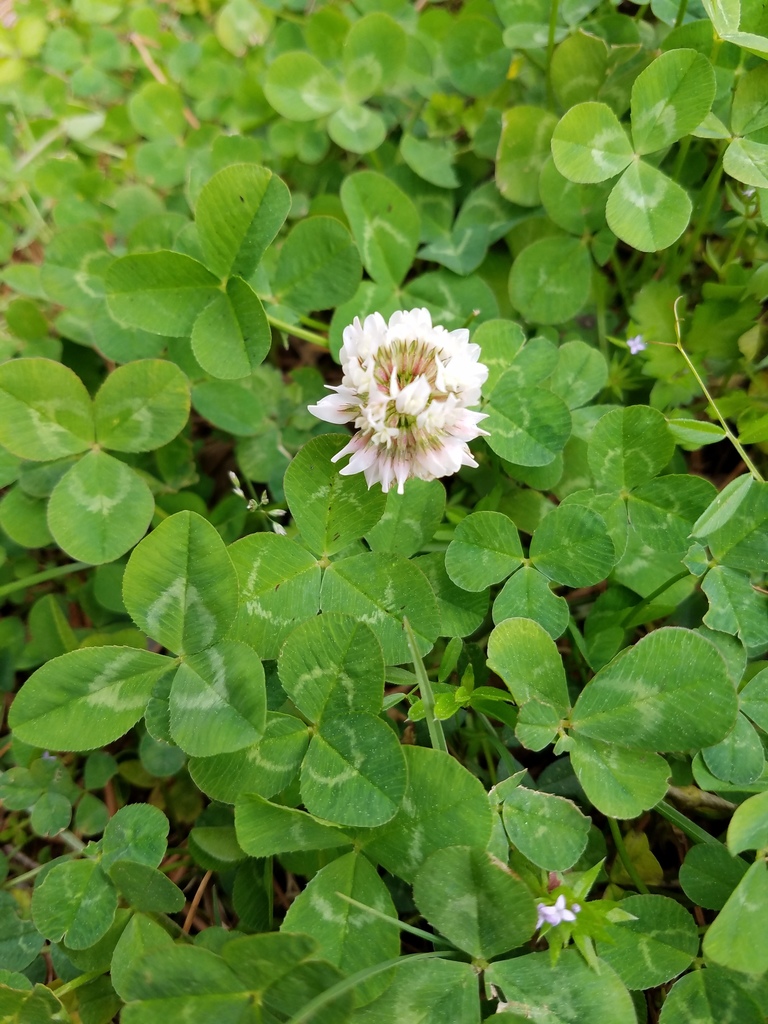
Photo: “White clover (Trifolium repens)” by Leila Dasher via iNaturalist, CC BY 4.0.
Fall weed control has one bonus target group: winter annual weeds such as henbit, chickweed and shepherd’s purse germinate in these same fall weeks (K-State MF2385). A fall pre-emergent or a late-fall spray stops them before they flower in spring; our companion guide to winter annual weeds covers that second job in detail.
Fall weed control timing: how late is too late
Purdue Extension puts the prime window at mid-September through early November for cool-season lawns (Purdue AY-9-W). Inside that window, the weed’s condition matters more than the date: spray while leaves are green and the plant is still actively growing. A hard freeze that browns the foliage ends the season, because dormant leaves no longer move herbicide to the roots.
Later than you think usually still works. In a Michigan State trial, herbicide applications made in October outperformed September ones, and treatments as late as mid-November still gave excellent dandelion control the following spring (Michigan State University trial report). Purdue’s own answer to “how late is too late” is the same: as long as the weeds are green and growing, fall weed control is still worth doing (Purdue Turf Science).
Region shifts the calendar, not the rule. Northern lawns hit the sweet spot from early September to mid-October; transition-zone lawns run from late September into November; southern lawns with warm-season grasses should follow product labels for their turf species, since some grasses are sensitive late in the season. Wherever you are, the usable signal is the same: green, growing weeds and daytime highs in the 50 to 85°F band.
Watch the 10-day forecast rather than the calendar. You want a stretch where nights stay above freezing, days sit in the 60s and 70s, and no storm is due within 24 hours of spraying. In most regions that stretch arrives two or three times each fall, so if the first window rained out, another usually follows. Fall weed control rewards patience inside the season far more than it rewards spraying on the first cool day.
How to do fall weed control, step by step
One afternoon of methodical work beats a season of resentful spot spraying. This sequence follows Purdue AY-9-W, Iowa State Extension and K-State guidance:
- Mow 3 days before spraying. You want maximum leaf area to catch the spray, then a few days of regrowth so leaves are actively moving sap. Purdue advises no mowing for 3 days before or after treatment.
- Pick the day. Temperatures 50 to 85°F, wind under 5 mph, no rain for 24 hours after application, and no temperatures above 85°F forecast for the next day (Iowa State; Purdue). Wind above 5 mph drifts spray onto garden plants.
- Check the weeds are healthy. Herbicides work on actively growing plants. If drought has stalled growth, water the lawn a few days first; K-State notes moist soil and 65 to 80°F weather give the best results.
- Match the product to the weed list. For mixed lawns, a three-way product containing 2,4-D, MCPP and dicamba covers dandelion, clover and ground ivy together. If clover dominates, confirm MCPP is in the mix; if ground ivy dominates, confirm dicamba (see the table above and our post-emergent herbicide guide).
- Spot spray, do not blanket. Iowa State recommends spot treating weedy patches rather than spraying the whole lawn. Use coarse droplets, and wet the leaves without letting spray drip off them.
- Keep off, and keep the mower off. Stay off treated areas until the spray dries per the label, then do not mow for 3 days: the plant needs intact leaves to finish moving the herbicide into the roots.
- Wait, then judge in spring. Treated perennials often yellow slowly over 2 to 4 weeks, and the full payoff is the missing weeds next spring. Tough survivors (ground ivy, violets) may need a second pass next fall.
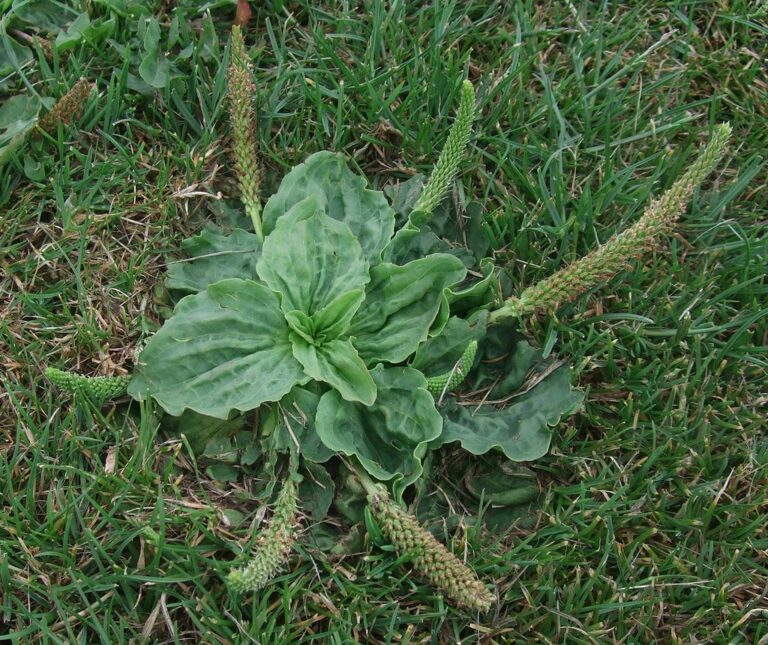
Broadleaf plantain: one rosette sprayed this fall is one less taproot next spring. Photo: “Greater Plantain” by SimonLH64, CC BY 2.0, via Flickr.
Respect the new-grass rules. Purdue AY-9-W advises waiting until a newly seeded lawn has been mowed 3 times before applying broadleaf herbicide, and giving new sod 4 to 6 weeks to establish. If you seeded this fall, mark the weed control for next fall instead.
Fall vs spring vs summer weed control
| Fall (mid-Sep to early Nov) | Spring (Apr to May) | Summer (Jun to Aug) | |
|---|---|---|---|
| Root kill on perennials | Best: herbicide rides the downward food flow to the roots | Weak: upward flow keeps herbicide in the top | Variable: drought-stressed weeds absorb poorly |
| Weed condition | Actively growing, storing reserves | Actively growing but pushing reserves up | Often heat-stalled |
| Drift damage risk | Lower: gardens winding down | Higher: everything tender and emerging | Highest: heat volatilizes some products |
| Visible results | Slow top dieback; clean lawn next spring | Faster cosmetic top kill, regrowth common | Slow, unreliable |
| Best use | Killing perennial broadleaf weeds for good | Emergencies and pre-emergent timing | Spot treatment only |
None of this forbids spring spraying; it just resets expectations. Spring treatment is cosmetic on established dandelions, while fall weed control is structural. If you only spray once a year, spray in fall.
Back up fall weed control with dense turf
Herbicide clears the weeds; turf density decides whether they return. The same Purdue publication that sets the spray window recommends mowing cool-season lawns at 3 to 3.5 inches and supplying 2 to 4 pounds of nitrogen per 1,000 square feet per year, with 60 to 100 percent of it applied in fall. Fall feeding thickens the lawn exactly when weeds vacate space, so grass, not a new weed, fills the gaps.
Clover is the tell-tale. It thrives where nitrogen is scarce, because it makes its own. A lawn dotted with clover is usually an under-fed lawn: after fall weed control removes it, raise mowing height and keep the fall fertilizer appointment, or clover simply reclaims the patch. Our clover guide weighs the option of keeping it as a bee-friendly filler instead.
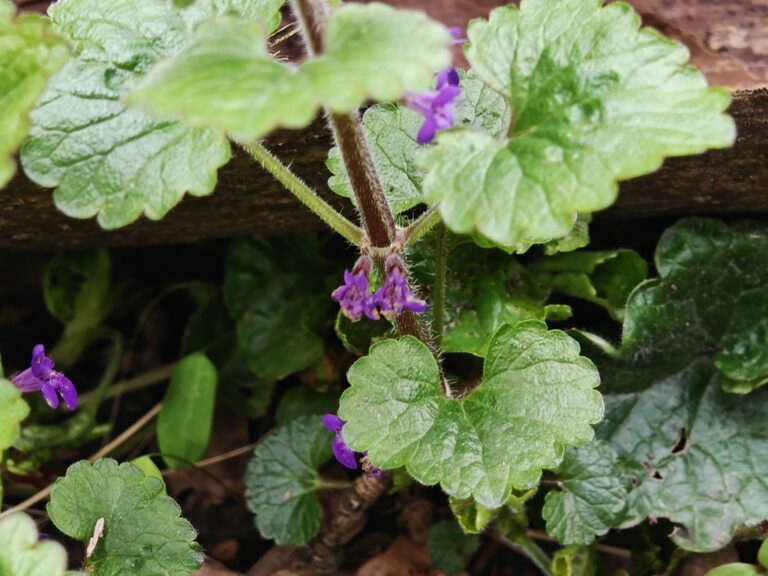
Photo: “Ground ivy (Glechoma hybrid)” by Andrey Polstianoi via iNaturalist, CC BY 4.0.
What not to do
- Do not spray in wind above 5 mph or when temperatures will top 85°F within 24 hours; drift and volatilization damage gardens and waste product (Iowa State).
- Do not mow right before or after spraying. The 3-day rule on both sides is what moves the chemical into the roots (Purdue).
- Do not spray drought-stressed, brown or frozen weeds. No active sap flow means no transport to the root.
- Do not blanket-spray a lawn with a dozen weeds. Spot treat; save blanket treatment for genuinely weedy lawns (Iowa State).
- Do not expect a pre-emergent to fix existing perennials. Pre-emergents stop seeds from sprouting; they do nothing to an established dandelion taproot.
- Do not treat brand-new grass. Wait for 3 mows on new seedlings and 4 to 6 weeks on new sod (Purdue AY-9-W).
- Do not judge the job in 2 weeks. Slow yellowing is normal; the real scorecard is next spring.
Where this applies
The translocation science applies to perennial broadleaf weeds anywhere. The calendar assumes cool-season turf (fescue, bluegrass, ryegrass) in northern and transition-zone climates, where fall is the strong growing season. Warm-season lawns (Bermuda, zoysia, St. Augustine, centipede) are winding down in fall and some are sensitive to herbicides near dormancy; check the product label for your turf species and follow your state extension timing. In mild-winter regions where broadleaf weeds grow all winter, the fall window simply runs longer.
FAQ
How late is too late for fall weed control?
Later than most people think. As long as weeds are green and actively growing, treatment is worthwhile: MSU found mid-November applications still gave excellent control the next spring, and Purdue gives the same answer. A hard freeze that kills the foliage is the real cutoff.
Is fall or spring better for broadleaf weed control?
Fall, for perennial weeds. In fall the weed moves food, and your herbicide, down to the roots; in spring the flow runs upward, so sprays burn the top while the root survives (Ohio State). Spring is for pre-emergents and emergencies; fall weed control is for killing the plant.
Can I overseed and spray in the same fall?
Not in the same weeks. Broadleaf herbicide can injure grass seedlings, so Purdue advises waiting until new grass has been mowed 3 times. Overseed this fall and spot spray next fall, or spray first and seed the following season per label intervals.
Will one fall treatment kill dandelions permanently?
Often, yes for the plants you hit: when the herbicide reaches the taproot, the whole plant dies. What returns is new seed from elsewhere and any roots that were dormant or missed. Two consecutive falls of fall weed control, plus dense turf, is what ends the cycle.
Is fall weed control safe near vegetable gardens and flower beds?
Safer than in spring, because most garden plants are harvested or shutting down (Ohio State), but drift still injures anything green. Spray on calm days with coarse droplets, keep a buffer from beds, and never use the same sprayer later for garden insecticides without a thorough cleanout.
Does fall weed control also stop henbit and chickweed?
Partly: a fall post-emergent spray kills winter annual seedlings that have already germinated, but they keep sprouting for weeks, so a fall pre-emergent in early to mid-September is the cleaner tool (Purdue Extension). Our guide to winter annual weeds walks through both windows.
What is the best herbicide for fall weed control?
For a mixed lawn, a three-way product combining 2,4-D, MCPP and dicamba. K-State’s ratings show why the blend matters: 2,4-D handles dandelion but is poor on clover, MCPP is the opposite, and dicamba is the strongest of the three on ground ivy. Check the label’s turf species list before buying, and match the mix to your worst weed using the table above.
Should I water the lawn after fall weed control spraying?
Not for the first 24 hours: the leaves need time to absorb the herbicide, and Purdue’s no-rain-for-24-hours rule applies to irrigation too. Before spraying is the opposite story; if the lawn is dry and the weeds are stalled, water a few days ahead so they are actively growing when you treat (K-State).
More seasonal lawn weed help: getting rid of creeping Charlie, wild violets in the lawn, and the full weed prevention section.
Sources
- Purdue Extension. Control of Broadleaf Weeds in Home Lawns (AY-9-W).
- Purdue Turf Science. Turf 101: Why Are Broadleaf Herbicides More Effective in the Fall Than Spring?
- Purdue Turf Science. How Late Is Too Late to Control Broadleaf Weeds?
- Ohio State University Turfgrass Science. Turfgrass Weed Control for Professionals.
- Michigan State University Extension. Controlling Broadleaf Weeds in the Lawn Is Best Done in October.
- Michigan State University. Fall Broadleaf Weed Control Timing Trial.
- Iowa State University Extension, Yard and Garden. Controlling Weeds in Home Lawns.
- K-State Research and Extension. Weed Control in Home Lawns (MF2385).
- Purdue Extension, DeKalb County. Henbit and Chickweed in Lawns.
Featured image: dandelion flowers and clock seed heads in turf, photo by Syd Cannings via iNaturalist, CC BY 4.0.