
It’s a crisp Saturday in November. The dandelions in your lawn are greener than the grass, the sprayer is mixed, and your phone says 48°F. Or it’s mid-July, 91°F by noon, and the spurge along the driveway is mocking you. Either way, the same question comes up: is it even worth spraying today?
Short answer: The best temperature to spray weeds with most post-emergent herbicides is a daytime high between 65°F and 85°F, with weeds actively growing and no hard freeze in the next few days. Lawn broadleaf sprays still work in fall when the high stays above about 55°F for several days. Below 40°F at night, results drop sharply. Above 90°F, most lawn weed killer labels tell you not to spray at all.
That’s the rule of thumb. The rest of this guide explains why it works, where the limits sit for each type of product, how frost changes the picture, and how to plan a whole year of spraying around the thermometer. By the end you’ll know exactly which days to spray, which to skip, and what to do instead when the weather won’t cooperate.
Best Temperature to Spray Weeds: The Quick Answer
Extension weed scientists in three different states land on the same range. South Dakota State, North Dakota State and Rutgers all say the ideal air temperature for most post-emergent herbicides is 65°F to 85°F (SDSU Extension; NDSU; Rutgers NJAES). Outside that window, weed killers don’t stop working. They just work more slowly, less completely, or with more risk to your lawn and garden.
Here’s how the thermometer translates into a spray-or-skip decision:
| Daytime high | What happens | What to do |
|---|---|---|
| Below 40°F | Weeds are barely growing; systemic products stall | Skip it and wait for a warm spell |
| 40–55°F | Slow uptake; weak, patchy kill | Avoid if nights are below 40°F; wait if you can |
| 55–65°F | Workable for lawn broadleaf sprays on sunny fall days | Spray if the high stays above 55°F for a few days |
| 65–85°F | Ideal: fast uptake and translocation | Best days to spray |
| 85–90°F | Ester and dicamba products volatilize; turf stress rises | Spot-treat early in the day, or wait |
| Above 90°F | Turf injury risk; most lawn labels prohibit use | Don’t spray lawns |
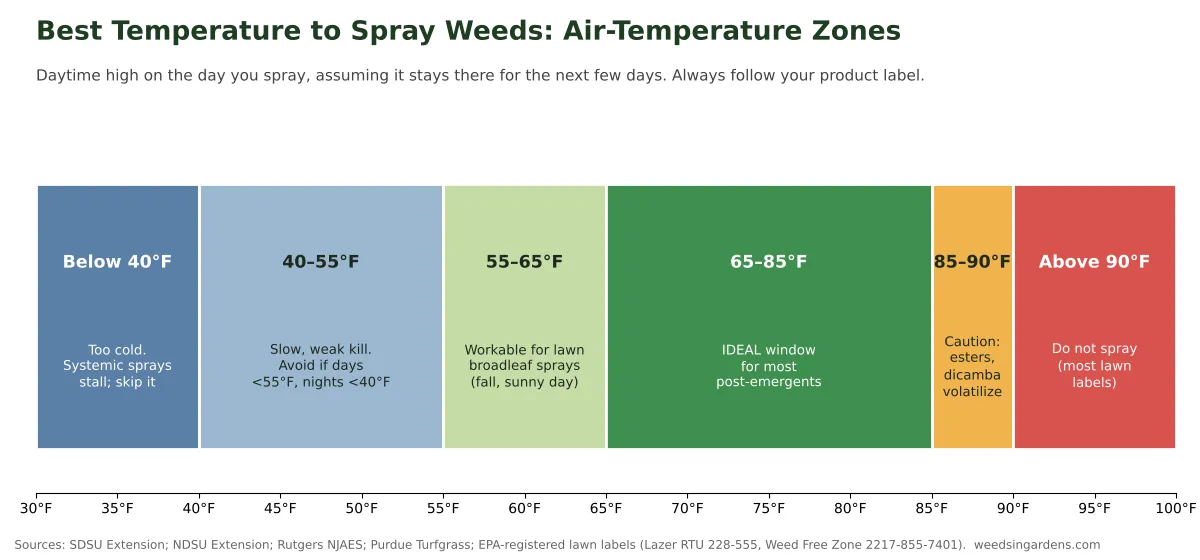
One detail matters more than people expect: it’s not just the temperature at the moment you spray. It’s the next few days. SDSU’s fall lawn guidance is to spray when the daily high will stay above 55°F for a few days (SDSU Extension, Fall Weed Control in Lawns). A warm Tuesday followed by a hard freeze on Wednesday is a poor spray day.
Why Temperature Changes How Well Weed Killer Works
Knowing the best temperature to spray weeds makes more sense once you see what the herbicide has to do inside the plant. Most lawn and garden weed killers are systemic. Glyphosate, 2,4-D, dicamba, MCPP and triclopyr all have to enter the leaf and then travel with the plant’s sugars down to the roots and growing points. That journey is powered by the weed’s own metabolism, so anything that slows the plant down slows the herbicide down too.
When the air drops below about 60°F, most plant growth slows, and so do herbicide uptake and translocation (SDSU Extension). The weed isn’t immune. It’s just in slow motion. Symptoms take longer to show, and if cold weather lingers, the dose may never reach the roots in a lethal amount.
Heat causes a different problem. In hot, dry weather, weeds close down to save water and build thicker leaf surfaces, and less herbicide gets in. A Kansas State study on kochia showed this clearly. Plants grown at 90.5/72.5°F day/night needed roughly four to five times more glyphosate to reach the same level of control as plants grown at 63.5/45.5°F, and dicamba lost effectiveness too, because less of it moved toward the growing points (Ou et al. 2018, Pest Management Science). In that study, the cool and moderate regimes (63.5/45.5°F and 77/59°F) gave the best control.
So there are two failure modes. Too cold, and the herbicide gets in but crawls. Too hot, and less gets in at all, while what’s on the leaf may evaporate and drift.
Actively growing beats any single number
Every extension source above says the same thing in different words: weeds are controlled best when they’re actively growing. Rutgers adds that weeds stressed by drought, flooding or mowing damage before the herbicide has moved through them won’t be controlled properly (Rutgers NJAES). A 75°F day during a drought can be a worse spray day than a 60°F day after a soaking rain.
Too Cold or Too Hot: Where Weed Killers Fail
The ideal band is easy. The hard calls happen at the edges, and that’s where most wasted product and damaged lawns come from.
How cold is too cold to spray weeds?
Rutgers recommends avoiding post-emergent applications during cool spells, defined as nights below 40°F and days below 55°F (Rutgers NJAES). SDSU goes further: if temperatures fall to 40°F for an extended time after spraying, control will likely be severely reduced, especially for systemic products like glyphosate and 2,4-D (SDSU Extension).
Cold nights alone aren’t a deal-breaker. NDSU notes that herbicides may be sprayed after cold nights as long as daytime temperatures warm to at least 60°F (NDSU). For lawn broadleaf sprays in fall, Purdue’s turf team sets the bar a little lower: apply on a dry, sunny day above 55°F (Purdue Botany & Plant Pathology).
Glyphosate products give their own hint. The label for Roundup Weed & Grass Killer Concentrate Plus says best results come from warm, sunny weather above 60°F, which speeds the herbicide’s movement through the plant (EPA label 71995-29).
What about frost?
Here’s the surprise: a light frost can actually help. Research in Nebraska found that 2,4-D and dicamba controlled dandelions and Canada thistle far better when applied 1 to 10 days after the first fall frost than 5 to 11 days before it (Wilson & Michiels 2003, Weed Science, as summarized by Purdue Turfgrass Science). After frost, perennial weeds push sugars down to their roots for winter, and the herbicide rides along.
The difference is between a light frost and a hard freeze. SDSU advises against spraying if a severe frost is forecast, because weeds damaged before the herbicide has moved through them won’t die properly (SDSU Extension). In practice: after a light frost, wait for the frost to melt and the leaves to dry, then spray on a sunny day that warms past 55°F. If a hard freeze is forecast in the next day or two, wait.
How hot is too hot?
Two things go wrong in the heat: drift and lawn injury.
Drift by vapor. Ester formulations of 2,4-D and dicamba evaporate rapidly above about 80°F, according to Rutgers, which recommends restricting ester products to fall, winter and early spring (Rutgers NJAES). NDSU likewise warns against applying 2,4-D ester, MCPA ester and dicamba in hot weather near sensitive plants (NDSU). Nebraska Extension uses the same 80°F line when explaining why fall spraying is safer for nearby ornamentals (Nebraska Extension). Vapor drift can carry far beyond the spray zone, onto tomatoes, roses and shrubs.
Lawn injury. Lawn weed killer labels set a hard ceiling. The label for Lazer RTU Lawn Weed Killer says not to treat when air temperatures exceed 90°F or damage to grass may occur (EPA label 228-555). Fertilome Weed Free Zone (2,4-D ester, MCPP-p, dicamba and carfentrazone) says to avoid spraying drought-stressed lawns or when temperatures are above 90°F, and notes that temporary yellowing may occur on St. Augustinegrass and some hybrid bermudagrass (Weed Free Zone label). Some products set a lower limit, so always read yours.
Honestly, in a heat wave the best weed killer is patience. Spot-treat only the worst weeds early in the day, or wait for a cooler week.
Temperature Limits by Herbicide Type
Not every product reacts to temperature the same way. Here’s how the main lawn and garden active ingredients compare, based on the sources above. Your product’s label always overrides this table.
| Active ingredient (examples) | Cool-weather behavior | Hot-weather risk | Practical window |
|---|---|---|---|
| 2,4-D, MCPP, dicamba (amine/salt) — most lawn weed killers | Slow but effective when highs stay above ~55°F | Lawn injury above 90°F; dicamba volatility in heat | Fall and spring, 55–85°F |
| 2,4-D or MCPA ester formulations | Works well in cool weather | Evaporates rapidly above ~80°F | Fall, winter and early spring only |
| Triclopyr (often in “tough weed” lawn mixes) | Like other systemics, slower in cold | Ester forms share vapor-drift risk; check label limits | Fall is ideal for perennials |
| Carfentrazone, sulfentrazone (fast-acting contact partners) | Contact partners; still need active growth | Follow label temperature limits | Spring and fall |
| Glyphosate (non-selective, e.g. Roundup) | Best above 60°F per label; slow below | Less absorbed in heat (kochia study) | Warm, sunny days, weeds actively growing |
| Pre-emergents (prodiamine, dithiopyr, etc.) | Timed by soil temperature, not air | Not applicable | Before soil reaches weed germination temps |
SDSU lists 2,4-D, dicamba, triclopyr, carfentrazone, sulfentrazone and mesotrione as active ingredients to look for when treating perennial lawn weeds in fall (SDSU Extension). If you want a deeper comparison of these products, see our guide to post-emergent herbicides.
Pre-emergents follow the soil, not the air
Pre-emergent weed killers only work if they’re in place before seeds sprout, so the thermometer that matters is in the ground. Rutgers notes that summer annuals such as crabgrass and lambsquarters need soil temperatures of 60–70°F to start germinating, and that pre-emergents should be down before soil reaches that range. Herbicides should never be applied on frozen ground (Rutgers NJAES). Our pre-emergent timing guide covers soil thermometers and regional dates in detail.
Season-by-Season Spraying Plan
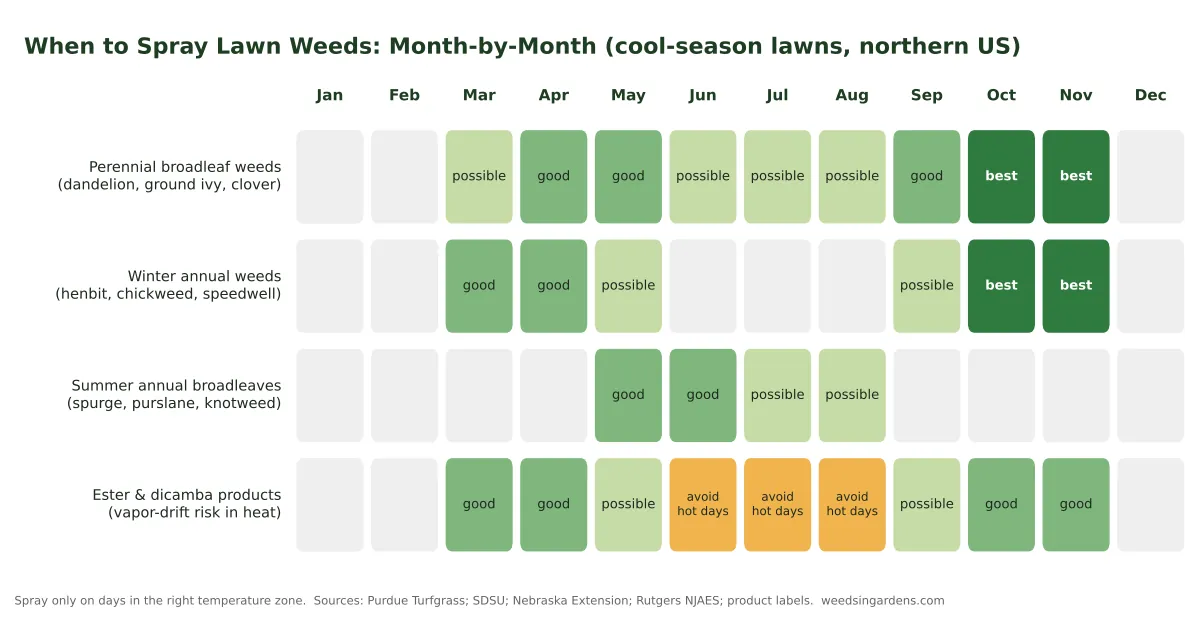
The best temperature to spray weeds tells you which day to spray. The season tells you which weeds are worth spraying at all. Put the two together and your weed control gets far more effective for the same amount of product.
| Season | Typical temps | Target weeds | Plan |
|---|---|---|---|
| Early spring (Mar–Apr) | Highs climbing into the 50s–60s°F | Winter annuals (henbit, chickweed), young perennials | Spray on warm sunny days; pre-emergents go down before soil warms |
| Late spring (May) | Often ideal 65–85°F | Perennials, young summer annuals | Good window; target small weeds |
| Summer (Jun–Aug) | Often above 85°F | Spurge, purslane, knotweed, clover | Spot-treat in the morning; skip days above 90°F; avoid esters |
| Early fall (Sep) | Mild; weeds recovering from summer | Perennials begin storing sugars | Good, but later-germinating winter annuals may be missed |
| Mid–late fall (Oct–Nov) | 50s–60s°F, light frosts | Dandelion, ground ivy, clover, winter annuals | The best window of the year for broadleaf weeds |
| Winter (Dec–Feb) | Mostly below 40°F | Little active growth | Pause; plan and sharpen tools |
Why is fall so good? Purdue’s turf research found that herbicides applied from October 1 through November 1 improved long-term ground ivy control, and that September applications can miss winter annuals that germinate later (Purdue Turfgrass Science). SDSU adds that perennials can take two to three times more product to control in spring or summer than in fall, because they’re bigger and their roots are more developed (SDSU Extension). If November is your spraying month, our fall weed control guide walks through the targets, including winter annuals like henbit and chickweed.
The product label agrees. Weed Free Zone states that spring and fall treatments under adequate soil moisture are preferred to summer treatments, and that summer applications to older, drought-stressed weeds are less effective (Weed Free Zone label).
How to Pick the Right Spray Day
The best temperature to spray weeds is the headline, but it shares the stage with rain, wind and moisture. Run through this checklist before you mix anything.
- Check the 3-day forecast. Highs should stay in the right zone, with no hard freeze and no heat spike right after you spray.
- Look for rain-free hours. Lazer RTU says not to apply if rain is expected within 24 hours (EPA label 228-555); Weed Free Zone says rain or watering within 4 hours may reduce effectiveness. Cold weather stretches these times because uptake is slower (Rutgers NJAES).
- Pick a calm day. Labels warn against fine mists and spraying in wind, which carries droplets onto plants you want to keep.
- Make sure the weeds aren’t stressed. If the soil is dry, water a day or two before. Don’t spray drought-stressed lawns.
- Skip the mower. Both lawn labels above say to delay mowing 1–2 days before and after application, so weeds have enough leaf to absorb the product.
- Liquid or granular? SDSU found liquids usually give better coverage and control. If you use a granular weed-and-feed, apply it to damp grass, such as after a heavy morning dew, so the granules stick to weed leaves (SDSU Extension). Our fall weed and feed article explains when the combo products are worth it.
Common mistakes to avoid
- Spraying on the first warm day in a cold week. The herbicide needs several warm days to move, not one.
- Spraying frosted leaves. Wait until the frost melts and the leaves dry.
- Using ester products in summer. Save them for cool seasons.
- Spraying again too soon. In cool weather, symptoms can take longer to appear. Re-spraying before the first dose has had time to act wastes product.
- Mixing stronger to “make up for” cold weather. Never exceed the label rate. SDSU’s advice for unavoidable cool-weather spraying is to choose a product with excellent activity on the target weed and use the highest labeled rate (SDSU Extension).
Non-chemical options when the weather won’t cooperate
Some weeks the thermometer just won’t play along. That’s a good time to remember that the hoe, the hand weeder and the mower don’t care what the temperature is.
- Hand-pulling and digging. Moist soil after rain makes it far easier to get whole taproots. This is the right move for a few dandelions or plantains, and a long, narrow weeding tool helps you get the whole root out.
- Hoeing annual weeds. Young annuals die quickly when cut below the growing point on a dry, sunny day.
- Boiling water for hard surfaces. It works the same at any air temperature on cracks and patios, though it kills only what it touches. See boiling water for weeds.
- Vinegar and other contact sprays. These burn leaves rather than travel to roots, so perennials often regrow. Our vinegar weed killer test explains the limits.
- Thicker turf. A dense lawn shades out weed seedlings. Fall is also the best season to fix thin spots, so pair your fall spray plan with overseeding, keeping the reseeding gap on your herbicide label in mind (2 weeks for Weed Free Zone; 3–4 weeks for Lazer RTU).
A Note From the Agronomist’s Side
If you remember one idea from this article, make it this: a herbicide is a passenger, and the weed is the vehicle. The chemical can only go where the plant’s own sap carries it. Temperature, moisture and the plant’s seasonal behavior decide how fast and how far that vehicle travels.
That’s why the “ideal” 65–85°F band, often quoted as the best temperature to spray weeds, is really a proxy for a weed that is photosynthesizing hard and moving sugars around. It’s also why fall beats spring for perennials even at cooler temperatures. In October and November, a dandelion or ground ivy plant is busy sending sugars down to its roots for winter. Spray it then, and you’re shipping the herbicide straight to the part that would otherwise regrow next April. The frost study from Nebraska makes the same point: the weeds weren’t more fragile after frost; they were sending more traffic to their roots.
The heat side is the mirror image. A 92°F afternoon looks like a great day for a fast burn, but the weed is in water-saving mode, the leaf surface is tougher, and the product on it is evaporating toward your neighbor’s tomatoes. The kochia data, where the dose needed rose roughly fourfold at high temperature, is a good reminder that “hotter” doesn’t mean “stronger.”
A handy rule of thumb for homeowners: if you would enjoy working outside in a light jacket or T-shirt, and it’s been that way for a few days and will be for a few more, it’s probably a good spray day. If you’d be shivering in a coat or hiding from the heat, the weeds are too. Wait, and you’ll use less product for a better result. And whatever the season, the label is the legal and practical last word.
FAQ
What is the best temperature to spray weeds?
For most post-emergent herbicides, the best temperature is a daytime high between 65°F and 85°F, with weeds actively growing. Lawn broadleaf sprays also work in fall when highs stay above about 55°F for several days. Avoid spraying when nights drop below 40°F or when it is above 90°F.
Can I spray weed killer at 50 degrees?
You can, but expect slow, weaker results. At 50°F weeds absorb and move herbicide slowly. Rutgers advises avoiding post-emergent sprays when days are below 55°F and nights below 40°F. If you must spray, choose a sunny day in a warm spell and use a product labeled for your target weed.
Is it too cold to spray Roundup in winter?
Usually, yes. The Roundup Weed & Grass Killer Concentrate Plus label says best results come in warm, sunny weather above 60°F with weeds actively growing. Dormant or frost-damaged winter weeds absorb little glyphosate, so wait for a warm spell or for spring growth.
Should I spray weeds before or after a frost?
A light frost can improve fall control of perennials: Nebraska research found 2,4-D and dicamba worked better 1 to 10 days after the first frost than before it. Wait for frost to melt and leaves to dry, and don’t spray if a hard freeze is forecast in the next few days.
Is it too hot to spray weeds at 90 degrees?
Yes, for lawns. Many lawn weed killer labels, including Lazer RTU and Weed Free Zone, say not to apply when temperatures are above 90°F because grass can be injured. Ester and dicamba products also evaporate and drift more in heat. Spot-treat in the cool morning or wait for a cooler week.
What time of day is best to spray weeds?
On hot days, spray in the cooler morning once dew has dried, so temperatures stay below label limits. In fall, spray around midday on a sunny day so weeds are warm and actively growing. Always choose a calm day with no rain in the forecast for the time your label requires.
How long after spraying weeds can it rain?
It depends on the product. Some glyphosate products are rainproof in 10 to 30 minutes, while lawn weed killers often need several hours or more; Weed Free Zone says rain within 4 hours may reduce control and Lazer RTU says not to apply if rain is expected within 24 hours. Cold weather lengthens the time needed.
Sources
- Shaffer, G. Temperature and Herbicide Performance. SDSU Extension. extension.sdstate.edu
- Shaffer, G. Fall Weed Control in Lawns. SDSU Extension. extension.sdstate.edu
- Temperature and Herbicide Application Questions. North Dakota State University Extension. ndsu.edu
- Besançon, T. (2020). Weather Conditions and Herbicide Performances. Rutgers NJAES Plant & Pest Advisory. plant-pest-advisory.rutgers.edu
- Reicher, Z. Broadleaf Control Improves Later in Fall. Purdue University Turfgrass Science. turf.purdue.edu
- Hardebeck, G. (2020). Fall broadleaf weed control applications. Purdue Botany & Plant Pathology, Picture of the Week. ag.purdue.edu
- Stoner, N. (2017). Control Broadleaf Weeds in the Fall. Nebraska Extension. water.unl.edu
- Wilson, R.G. & Michiels, A. (2003). Fall herbicide treatments affect carbohydrate content in roots of Canada thistle (Cirsium arvense) and dandelion (Taraxacum officinale). Weed Science 51:299–304. doi.org/10.1614/0043-1745(2003)051…
- Ou, J., Stahlman, P.W. & Jugulam, M. (2018). Reduced absorption of glyphosate and decreased translocation of dicamba contribute to poor control of kochia (Kochia scoparia) at high temperature. Pest Management Science 74(5):1134–1142 (via PubMed). doi.org/10.1002/ps.4463
- US EPA. Lazer RTU Lawn Weed Killer, EPA Reg. No. 228-555, accepted label (2016). epa.gov
- Fertilome Weed Free Zone, EPA Reg. No. 2217-855-7401, product label (2025). domyown.com
- US EPA. Roundup Weed & Grass Killer Concentrate Plus, EPA Reg. No. 71995-29, accepted label (2014). epa.gov