
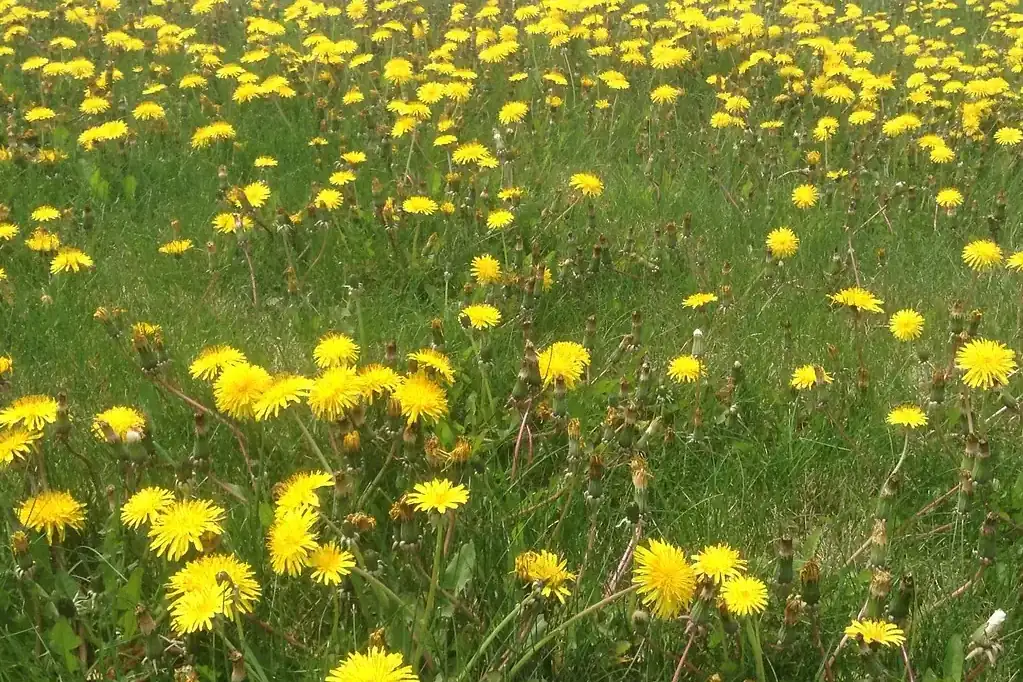
You sprayed the dandelions on Saturday. It’s Tuesday, and they’re still standing there, yellow heads up, looking a little twisted but very much alive. So you start wondering whether the product was a dud, whether the rain washed it off, or whether you should just spray again.
Short answer: How long does weed killer take to work? It depends on the type. Contact killers such as diquat burn weeds within hours and finish them in 1–2 days. Systemic glyphosate shows symptoms in 3–7 days and kills most annual weeds in 1–3 weeks, while established perennials can take 4 weeks or more. Selective lawn weed killers (2,4-D, dicamba, MCPP) start twisting weeds within 48 hours, but weeds usually take 2–4 weeks to die completely.
That slow death is usually a good sign, not a failure. In this guide you’ll see what each type of weed killer looks like day by day, why cold and drought slow it down, what to avoid while you wait, and exactly when it’s fair to spray again or reseed.
How Long Does Weed Killer Take to Work? The Quick Answer by Type
Every weed killer on the shelf falls into one of two camps. Contact herbicides damage only the tissue they touch, so they work fast but often leave roots alive. Systemic herbicides are absorbed and moved through the plant to the roots and growing points, so they work slowly but kill more of the plant. A third group, pre-emergents, never shows anything on existing weeds at all, because it only stops seeds from establishing.
The table below pulls together timelines from extension herbicide-symptom guides and EPA-accepted product labels. Treat the ranges as typical for warm, sunny weather with actively growing weeds.
| Weed killer type (examples) | How it works | First visible signs | Weed fully dead | Source |
|---|---|---|---|---|
| Contact: diquat, pelargonic acid, many “fast” RTU sprays | Burns the leaves it touches | Within hours (water-soaked, then brown) | 1–2 days for top growth; roots of perennials may survive | NC State Extension |
| Glyphosate alone (non-selective) | Systemic; moves to roots | 3–7 days (yellowing new growth) | Most annuals within about 3 weeks | UC IPM; NC State |
| Glyphosate + diquat combos | Fast contact burn plus systemic kill | As fast as 9–12 hours | Annuals 1–2 weeks; established perennials 4+ weeks | EPA label 71995-29 |
| Lawn broadleaf mixes: 2,4-D, dicamba, MCPP, quinclorac | Synthetic auxins; disrupt growth | Twisting, curling within 48 hours | 14–28 days | NC State; product label |
| Mesotrione (Tenacity) | Blocks pigment production | White, bleached leaves in about 5–7 days | Up to 3 weeks; repeat after 2–3 weeks | PNW Weed Handbook |
| Pre-emergents (prodiamine, dithiopyr, trifluralin) | Stops germinating seeds | None on existing weeds | Not applicable: prevents new weeds | Product labels |
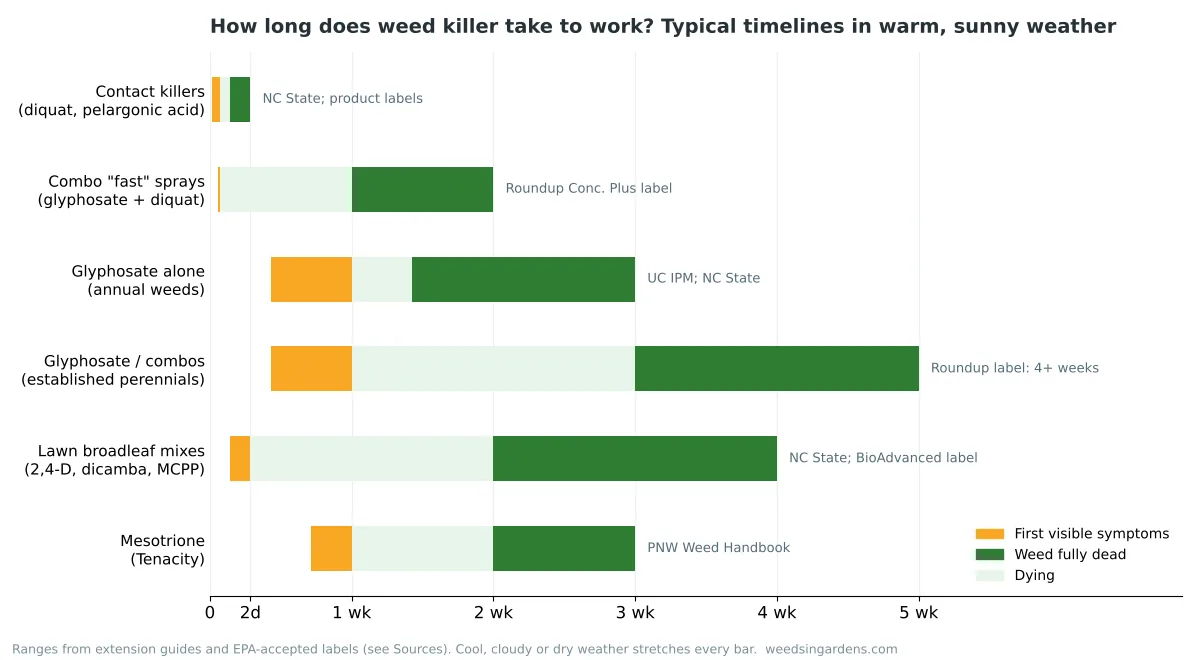
Notice the pattern: the faster a product looks like it’s working, the more likely it is to be a contact killer that may leave roots behind. A dandelion that turns brown overnight from a contact spray can push new leaves from its taproot two weeks later. A dandelion hit with a lawn broadleaf mix looks slow and ugly for a fortnight, but the herbicide has been moving into the root the whole time.
Why Some Weed Killers Work in Hours and Others Take Weeks
Speed comes down to where the herbicide acts and how far it has to travel to get there.
Contact killers: fast but shallow
Diquat and its relatives (the photosystem I inhibitors) hijack the plant’s own light reactions and produce compounds that rupture cell membranes. NC State Extension describes water-soaked leaves within hours and death of contacted foliage within one to two days (NC State, Photosystem I inhibitors). That speed is exactly why these products don’t travel far: they destroy the leaf tissue that would have carried them down to the roots.
Glyphosate: slow and thorough
Glyphosate blocks an enzyme plants need to build certain amino acids. The plant doesn’t collapse right away; it slowly runs out of building blocks, starting with the youngest, fastest-growing tissue. UC IPM notes that symptoms usually don’t appear until 3–7 days after treatment and develop more slowly in woody plants (UC IPM). NC State adds that the yellowing progresses to tip death in 5–10 days and to death of the whole plant within about 3 weeks (NC State, glyphosate).
Lawn broadleaf weed killers: visible early, dead late
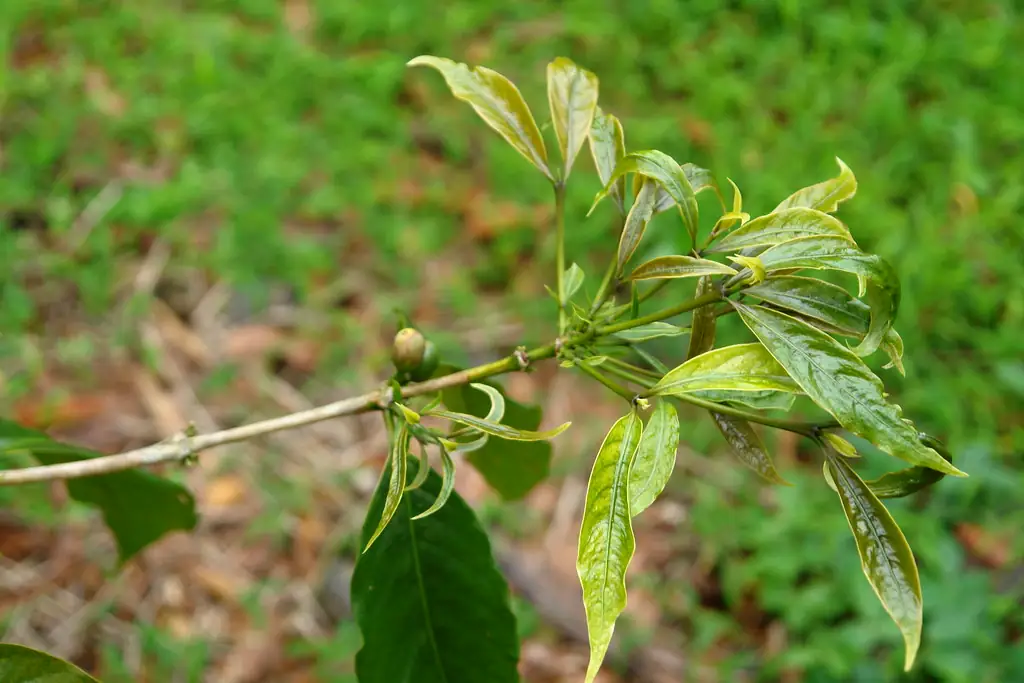
Products built on 2,4-D, dicamba, MCPP and triclopyr are synthetic auxins: they mimic a plant growth hormone and send growth out of control. NC State describes symptoms on new stems and leaf stalks within 48 hours, yellowing in about 7–10 days, and growth stopping in about four weeks (NC State, synthetic auxins). That’s why a treated dandelion curls and twists in the first two days but can stay green for another two weeks. One ready-to-use lawn product combining 2,4-D, quinclorac and dicamba states that weeds “are completely dead in 14–28 days” (BioAdvanced label, EPA Reg. No. 92564-41).
Mesotrione: the white-out
Mesotrione (sold as Tenacity) blocks pigment production, so treated weeds turn white or bleached. The PNW Weed Management Handbook says treated weeds stop growing, then turn white, and death can take up to 3 weeks, with a repeat application needed after 2–3 weeks for better control (PNW Weed Handbook). Don’t panic if your lawn grass whitens a little too: the same source notes temporary turf whitening that appears 5–7 days after application.
How Long Does Roundup Take to Work?
This is the most searched version of the question, and the honest answer is “it depends which Roundup.” The brand name covers several formulas. The classic concentrate contains glyphosate alone, while many current home versions pair glyphosate with a fast contact partner like diquat.
Take Roundup Weed & Grass Killer Concentrate Plus (EPA Reg. No. 71995-29), which contains 18% glyphosate plus 0.73% diquat. Its EPA-accepted label claims visible results in as fast as 9–12 hours and complete kill of most annual weeds in 1–2 weeks, but adds that “some established/hard-to-kill/perennial weeds may take 4 or more weeks for complete kill” (EPA label 71995-29). The same label recommends warm, sunny weather above 60°F and warns that visible results can be delayed in cool or cloudy conditions.
A different product shows how much the formula matters. Ortho GroundClear Super Weed & Grass Killer combines diquat, fluazifop and dicamba. Its label says sprayed weeds begin to wilt within hours, with complete kill within days to 1–2 weeks, and asks you to wait 28 days before making a second application (Ortho GroundClear Super label).
Bottom line: read the front panel. If the active ingredient list includes diquat or pelargonic acid, expect fast browning. If it’s glyphosate alone, expect a week of very little happening, followed by steady yellowing.
What Slows Weed Killer Down (and What Speeds It Up)
Still asking “how long does weed killer take to work?” because your weeds look untouched after the window in the table? Then the herbicide probably isn’t faulty. One of these factors is usually to blame.
| Factor | Effect on speed | What to do |
|---|---|---|
| Cool weather | Slows absorption and movement to the roots; symptoms can take noticeably longer | Spray when days are mild; Colorado State suggests 50–85°F for lawn broadleaf herbicides (CSU) |
| Very hot weather (above 85–90°F) | Weeds shut down; some products volatilize and drift | Avoid spraying above 90°F; one lawn label sets 85°F for bermudagrass (label) |
| Drought-stressed weeds | Thick, closed-down leaves absorb less | Water 1–2 days before treatment if the lawn is dry, as labels advise |
| Rain or irrigation too soon | Washes product off before it’s absorbed | Check the label’s rainfast time; Nebraska Extension advises no rain or irrigation for 24 hours (UNL) |
| Mowing right before or after | Removes leaf area that takes up the spray, or cuts off tissue before it can move | Don’t mow for 2–3 days before and after (UNL; CSU) |
| Large, mature or perennial weeds | More root mass to kill; more energy reserves to regrow | Treat young weeds, or plan a follow-up spray |
The temperature effect isn’t just folklore. In a peer-reviewed study on kochia, glyphosate and dicamba were both more effective under cooler day/night temperatures (17.5/7.5°C and 25/15°C) than under hot ones (32.5/22.5°C), because heat reduced glyphosate absorption and dicamba movement to the growing points (Ou et al., 2018, Pest Management Science). At the other end of the scale, a 2025 Nordic study found that barnyardgrass showed visible stress two days after glyphosate only under the warmer of two test climates (Bitarafan et al., 2025, Science of the Total Environment). In plain terms: mild, sunny, growing weather gives you the fastest result.
For a deeper look at the temperature side, see our guide to the best temperature to spray weeds.
Day-by-Day: What to Expect After You Spray Your Lawn
Most readers asking this question have just sprayed a selective lawn product on dandelions, clover or plantain. So how long does weed killer take to work on a lawn? Here’s a realistic timeline for those 2,4-D and dicamba mixes, plus what you should and shouldn’t do at each stage.
| When | What you’ll see | What to do |
|---|---|---|
| First hour | Nothing yet | Keep people and pets off the area as the label directs; check the label’s rainfast time (one lawn RTU lists 1 hour) |
| Day 1–2 | Leaves and stems start twisting, curling or cupping | Don’t mow, water or re-spray; let the plant keep moving the herbicide |
| Day 3–7 | Distortion gets worse; leaves start to yellow | Resume normal mowing after 2–3 days; keep the lawn watered if it’s dry |
| Day 7–14 | Yellowing and browning; flower stalks collapse | Note any weeds that look completely untouched |
| Day 14–28 | Most weeds dead and brown; tough perennials may still show green crowns | Spot-treat survivors if the label allows; rake out dead material |
| Day 30+ | Bare patches where the weeds were | Reseed after the label’s waiting period (K-State: at least 30 days after broadleaf herbicides) |
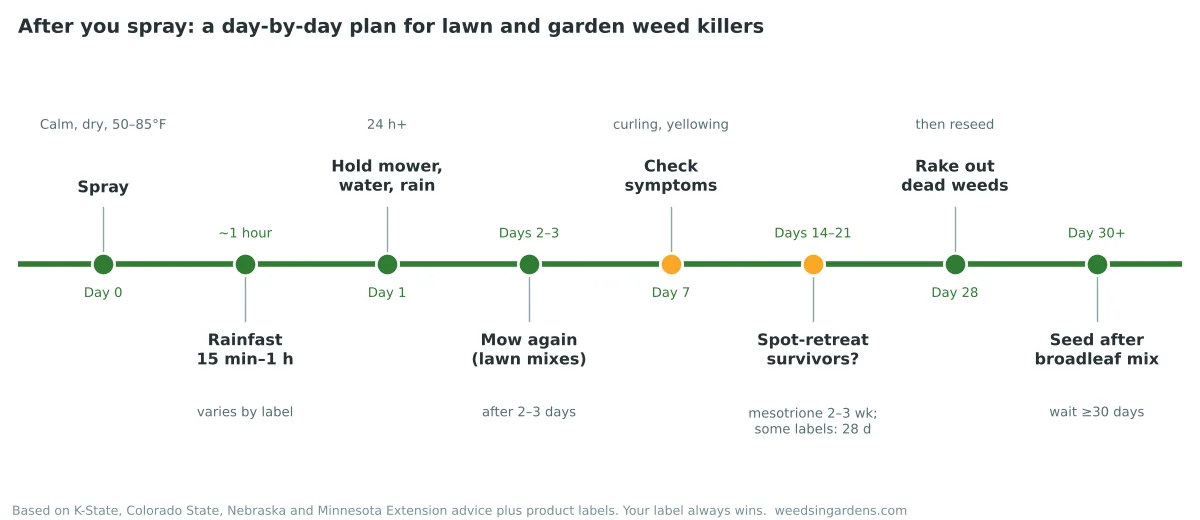
Two rules from Kansas State’s turf program are worth memorising: don’t mow for a few days before or after application, and wait at least 30 days after applying a broadleaf herbicide before seeding treated areas (K-State Turfgrass). If you’re planning a fall renovation, our guide on how to kill weeds before overseeding lays out the timing in more detail.
When Is It Safe to Spray Again?
This is where impatience costs people money and lawns. Re-spraying a weed that’s already dying doesn’t speed anything up; it just doubles the chemical load on your grass and soil.
- Give systemic products their full window. Wait at least 2 weeks for lawn broadleaf mixes and glyphosate before judging results. The University of Minnesota notes that some weeds need repeat applications at 10–20 day intervals (UMN Extension).
- Follow the label’s retreatment interval. It varies a lot. Ortho GroundClear Super says to wait 28 days; the Roundup Concentrate Plus label says to reapply if green patches remain after 7 days; mesotrione guidance calls for a repeat at 2–3 weeks.
- Only treat what’s still green and growing. A weed that’s curled and yellow is already dying. Spot-spray only the plants that look truly unaffected.
- Count your annual maximum. Most labels cap total product per year (the Ortho label, for example, limits the amount per area per year). Track what you’ve used.
If you keep re-spraying the same weed with no effect, the problem may be the product choice, not the timing. Some weeds shrug off common lawn mixes; our post-emergent herbicide guide matches active ingredients to the weeds they actually control.
Natural and DIY Weed Killers: How Fast Do They Work?
Homemade and “natural” options almost all behave like contact killers. They act fast, but they rarely reach the roots.
- Vinegar (acetic acid): burns leaves within hours on a hot, sunny day, but perennial weeds often regrow from the roots. See does vinegar kill weeds for the details and safety cautions on horticultural-strength vinegar.
- Boiling water: kills the tissue it touches immediately and works best on young annual weeds in cracks and paving. Our boiling water for weeds guide covers what it can and can’t do.
- Pelargonic acid and fatty-acid soaps: commercial “organic” contact sprays that brown weeds the same day; expect regrowth on perennials and plan repeat treatments.
- Hand-pulling or hoeing: instant, and for a handful of weeds it’s often faster than any spray once you count the waiting time.
Honestly, for a few weeds in a bed, a hoe beats every bottle on the shelf. Sprays earn their keep when you’re dealing with a whole lawn’s worth of broadleaf weeds or deep-rooted perennials you can’t dig out.
A note from the agronomist’s side
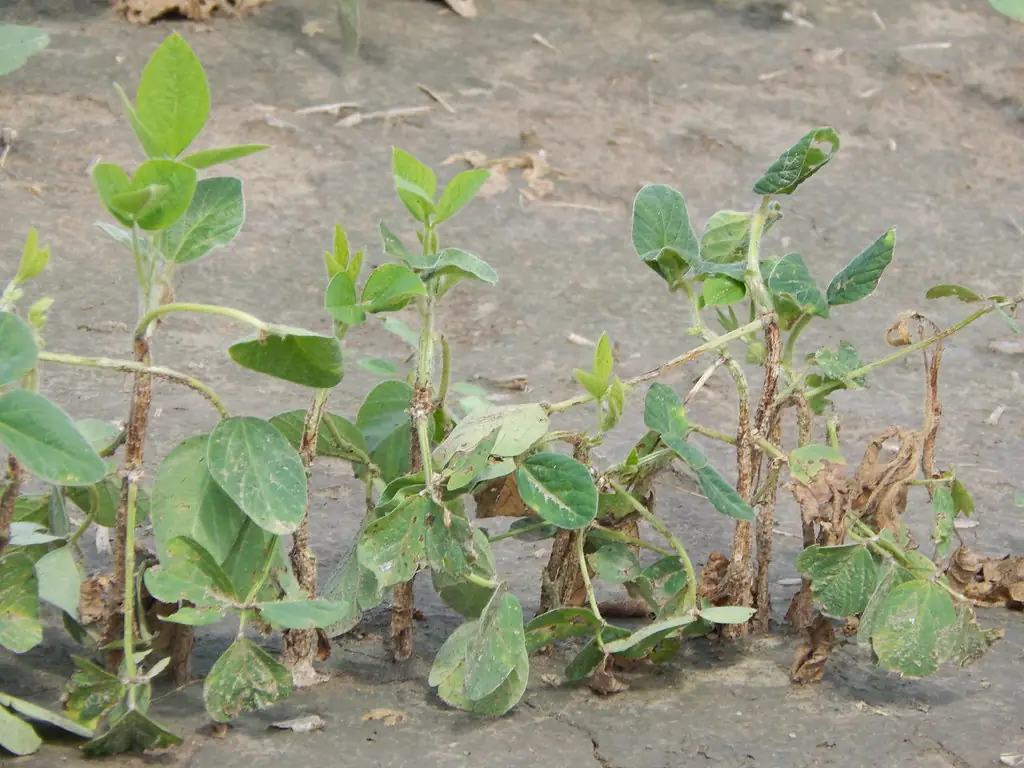
When people ask how long weed killer takes to work, what they really want to know is whether it’s working at all. The most useful thing you can learn is to read symptoms instead of the calendar. Twisting and cupping after a lawn spray, yellowing new growth after glyphosate, bleaching after mesotrione: each of these tells you the active ingredient has entered the plant and found its target. Once you see them, the result is mostly decided, even if the weed is still green.
The second principle is that speed and thoroughness pull in opposite directions. A herbicide that kills leaf tissue in hours has, by definition, destroyed its own transport route to the roots. That’s why the research-backed advice for perennials such as dandelion, plantain or thistle is to use a systemic product and accept the slower timeline. The fast-acting “see results in hours” products often add a contact ingredient mainly so you can see that something happened; the systemic partner is still doing the real work over the following weeks.
Third, the weather in the week after spraying matters as much as the day you spray. Absorption and movement through the plant are physiological processes, so they follow the plant’s growth rate. A weed sprayed in a mild, sunny spell keeps moving herbicide to its roots for days; one sprayed just before a cold snap may sit there half-treated until it warms up. That’s also why mid-fall, when weeds are actively sending sugars down to their roots, is such an effective window for perennial broadleaf weeds, as our fall weed control guide explains. Use these principles and you’ll stop wasting product on re-sprays that were never needed.
FAQ
How long does weed killer take to work on dandelions?
With a lawn broadleaf weed killer containing 2,4-D, dicamba or MCPP, dandelions usually start to twist within 1–2 days and die over about 2–4 weeks. Glyphosate takes a similar time but also kills the surrounding grass.
How long does 2,4-D take to work?
2,4-D usually causes visible curling and twisting within 48 hours, yellowing in about 7–10 days, and full kill in roughly 2–4 weeks, depending on weed size and weather. Follow the product label for rates and temperature limits.
How long does weed killer need to dry before rain?
It depends on the product. Labels range from about 10–15 minutes for some glyphosate and diquat combos to 1 hour for some lawn ready-to-use sprays. Extension services commonly advise no rain or irrigation for 12–24 hours to be safe.
Can I mow after spraying weed killer?
Wait. Extension guidance recommends not mowing for about 2–3 days before and after a lawn broadleaf herbicide, so weeds have enough leaf surface to absorb the spray and time to move it to the roots. Some non-selective labels ask for 7 days.
Why are my weeds not dying after spraying?
The most common reasons are cold or very hot weather, drought-stressed weeds, rain soon after spraying, mowing too soon, large perennial weeds, or a product that doesn’t control that particular weed. Give it at least two weeks before judging.
Does weed killer work in winter?
Most post-emergent weed killers work poorly when weeds aren’t actively growing. Cold weather slows absorption and movement, so results take much longer or fail. Spray on mild days when the label’s temperature range is met.
Sources
- NC State Extension. Photosystem I (bipyridilium) inhibitors: herbicide injury symptoms.
- NC State Extension. Glyphosate: herbicide injury symptoms.
- NC State Extension. Synthetic auxins: herbicide injury symptoms.
- University of California IPM. Herbicide symptoms: EPSP synthase inhibitors (glyphosate).
- Pacific Northwest Weed Management Handbook. Turfgrass: nutsedge and perennial grasses (mesotrione/Tenacity remarks).
- Kansas State University Turfgrass. Broadleaf weeds: chemical control.
- Colorado State University Extension. Broadleaf weed control in lawns.
- Browning, S. (2017). Spring dandelion control. Nebraska Extension in Lancaster County.
- University of Minnesota Extension. Lawn weeds.
- US EPA. Roundup Weed & Grass Killer Concentrate Plus label, EPA Reg. No. 71995-29 (2022).
- Ortho GroundClear Super Weed & Grass Killer label, EPA Reg. No. 73327-19-239.
- BioAdvanced All-in-One Lawn Weed & Crabgrass Killer RTU label, EPA Reg. No. 92564-41 (2023).
- Ou, J., Stahlman, P. W., & Jugulam, M. (2018). Reduced absorption of glyphosate and decreased translocation of dicamba contribute to poor control of kochia at high temperature. Pest Management Science, 74(5), 1134–1142. doi:10.1002/ps.4463
- Bitarafan, Z., et al. (2025). The effect of climate change on glyphosate control of Avena fatua, Brassica napus, and Echinochloa crus-galli. Science of the Total Environment, 983, 179682. doi:10.1016/j.scitotenv.2025.179682