
You finally have a free Saturday in October. The lawn is still green, the dandelions have staged a comeback along the driveway, there’s clover creeping in by the fence, and the garage shelf holds a half-used bag of weed and feed from last spring. One pass with the spreader, two jobs done. Is it really that easy?
Short answer: Fall weed and feed can work well on cool-season lawns such as Kentucky bluegrass, tall fescue and ryegrass, because fall is when both halves of the product line up: perennial broadleaf weeds are pulling sugars (and herbicide) down to their roots, and cool-season grass makes good use of autumn nitrogen. It only works if you apply it to damp leaves on a mild day, keep it dry for 24 hours, and use a product labeled for your grass. It is the wrong choice for St. Augustine lawns, new seedings, and lawns with only a few scattered weeds.
By the end of this guide you’ll know whether your lawn is a good candidate, the exact routine that makes granules stick, which active ingredients you’re actually buying, and when you’d be smarter to split the job into a separate fertilizer and a spot spray.

What fall weed and feed actually is (and what it isn’t)
A weed and feed is simply a fertilizer and a herbicide coated onto the same granule. The University of Arizona’s turf extension puts the first rule plainly: before you buy, check whether the weed-control half is a pre-emergent (it stops seeds from sprouting) or a post-emergent (it kills weeds that are already growing). They’re used in opposite ways.
Most fall weed and feed bags on store shelves are post-emergent broadleaf products. A common example, Scotts Turf Builder Weed & Feed, is a 26-0-2 fertilizer carrying two broadleaf herbicides, 2,4-D and dicamba. The manufacturer’s own directions say it “will not prevent weed seeds from sprouting.” So a fall weed and feed application targets dandelions, clover, plantain and similar weeds you can see now. It does nothing for crabgrass seed that will sprout next spring, and it won’t touch grassy weeds such as nutsedge or bermudagrass.
That distinction matters because the spring bags are often different. Oklahoma State University Extension notes that weed and feeds carrying a pre-emergent need to go down early (before late February in Oklahoma) to stop crabgrass, which is a separate job from fall broadleaf control. If you want seed prevention, read our guide on when to apply pre-emergent instead.
Quick check: which kind is in your bag?
- Post-emergent broadleaf (2,4-D, dicamba, MCPP, MCPA, triclopyr): kills actively growing broadleaf weeds. This is the fall type.
- Pre-emergent (for example prodiamine or dithiopyr in many crabgrass products): forms a barrier against sprouting seeds. It won’t kill weeds already up.
- Winterizer only: fertilizer, no herbicide. See our winterizer timing guide if you only want to feed.
Does fall weed and feed work? Why autumn is its best season
Here’s the part most product pages skip: fall weed and feed has a genuinely good reason to exist in fall, and a much weaker one in spring.
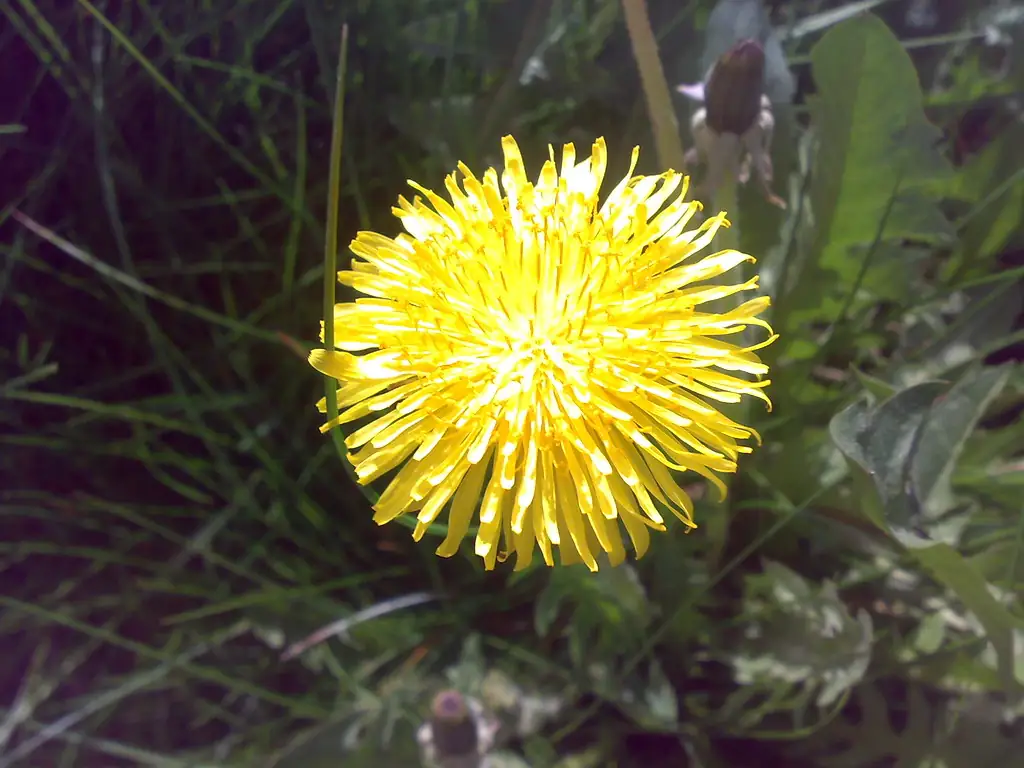
Perennial broadleaf weeds change behavior as days shorten. K-State Research and Extension explains that established dandelions are “actively moving materials from the top portion of the plant to the roots in the fall,” and broadleaf herbicides travel with that flow, killing the plant “from the roots up.” Nebraska Extension makes the same point for dandelion, creeping Charlie and clover: in fall, herbicide reaches the roots instead of just burning the tops off. Iowa State University Extension calls mid-September through October the best time to control broadleaf lawn weeds for this reason.
The fertilizer half lines up too, at least for cool-season grass. Purdue’s turfgrass team says cool-season lawns “should be fertilized mainly in the autumn,” with a September feeding and a later one near the last mowing. Their research summaries link fall nitrogen to better rooting, stored energy reserves, earlier spring green-up and denser turf. Denser turf matters for weeds: Purdue lists “reduced weeds” among the benefits.
So in fall, a cool-season lawn wants nitrogen and the weeds are at their most vulnerable at the same time. That’s the one season when the two-in-one bag isn’t a compromise.
Where it falls short
- It treats everything to hit a few spots. Oklahoma State asks the fair question: why treat healthy grass with a herbicide it does not need? If weeds are patchy, spot treatment uses far less product.
- One formula fits nobody exactly. Most brands make only one weed and feed, so you can’t adjust nutrients to a soil test.
- Granules need to stay on leaves. Broadleaf herbicides are absorbed through leaves, not roots (Iowa State). Granules that bounce off dry leaves or wash off in rain do very little.
- Trees and shrubs can take it up. Oklahoma State warns that tree roots extend well beyond the dripline and many labels say not to apply where roots of desirable trees or shrubs are growing.
Fall weed and feed by grass type: who should use it
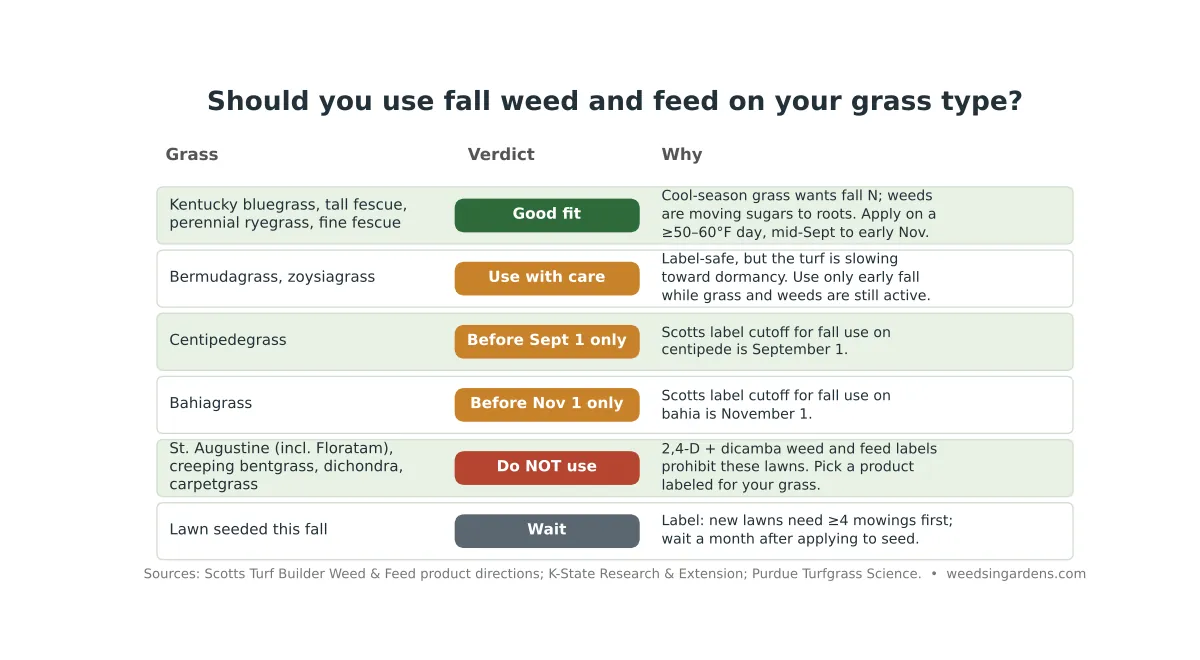
Before you load the spreader with fall weed and feed, find your grass in the chart below. The label, not the brand name, decides what’s safe.
| Grass type | Fall weed and feed? | Key label or extension point |
|---|---|---|
| Kentucky bluegrass, tall fescue, perennial ryegrass, fine fescue | Yes, best fit | Cool-season grass benefits from fall nitrogen (Purdue); weeds translocate to roots (K-State) |
| Bermudagrass, zoysiagrass | Label-approved; early fall only | Use while grass and weeds are actively growing; Scotts lists both as safe |
| Centipedegrass | Only before September 1 | Scotts fall cutoff for centipede |
| Bahiagrass | Only before November 1 | Scotts fall cutoff for bahia |
| St. Augustine (incl. Floratam), creeping bentgrass, dichondra, carpetgrass, lippia | No (2,4-D + dicamba products) | Listed as do-not-use on the Scotts label; choose a product labeled for your grass |
| Any lawn seeded this fall | Not yet | New lawns should be mowed at least 4 times first (Scotts) |
Warm-season lawns deserve a word of caution. These grasses are slowing toward dormancy in fall, and Oklahoma State notes that bermudagrass fertilizer generally shouldn’t go down until May, which is why combination products are a poor seasonal fit for it in early spring. In fall, if you use a label-approved product on bermuda or zoysia, do it early while both grass and weeds are still growing actively, and respect the product’s fall cutoff dates for centipede (September 1) and bahia (November 1). For St. Augustine, choose a product whose label specifically lists it; a standard 2,4-D plus dicamba weed and feed is not one of them.
When to apply fall weed and feed: timing and temperature
Timing is where most fall weed and feed applications go wrong, usually by being too late and too cold, or by landing right before a rainstorm.
The calendar window
Extension advice varies a little with latitude. Iowa State recommends mid-September through October. K-State and Nebraska Extension both point to late October and early November for dandelions in their region. A reasonable rule for most cool-season lawns is mid-September to early November, while the grass is still green and the weeds are still growing.
Two details narrow that window:
- Your fertilizer schedule. Purdue suggests a September feeding at about 1.0 lb nitrogen per 1,000 sq ft once daytime highs are no longer in the 90s °F, and a November feeding of 0.5–1.0 lb N per 1,000 sq ft near the last mowing. A fall weed and feed can stand in for one of these, not be added on top of both.
- The label’s limits. The Scotts product directions say not to apply more than twice a year. If you used it in spring, count that.
The temperature window
| Guideline | Number | Source |
|---|---|---|
| Product application window | Daytime temperatures consistently 60–90°F, weeds actively growing | Scotts Weed & Feed directions |
| Minimum day for fall broadleaf control | 50°F or higher (products work more slowly below this) | K-State Research and Extension |
| Heat limit for liquid broadleaf sprays | Don’t spray if temps are forecast to exceed 85°F within 24 hours | Iowa State University Extension |
| Volatility of 2,4-D and dicamba | Do not volatilize below 80°F; still avoid windy days | Nebraska Extension |
| Wind limit for sprays | Don’t spray when winds exceed 5 mph | Iowa State University Extension |
The practical takeaway: pick a calm, mild stretch of days with weeds clearly growing. Don’t apply on a frosty morning hoping it’ll warm up, and don’t wait until the weeds have stopped growing in late November.
How to apply weed and feed in fall: the 48-hour routine
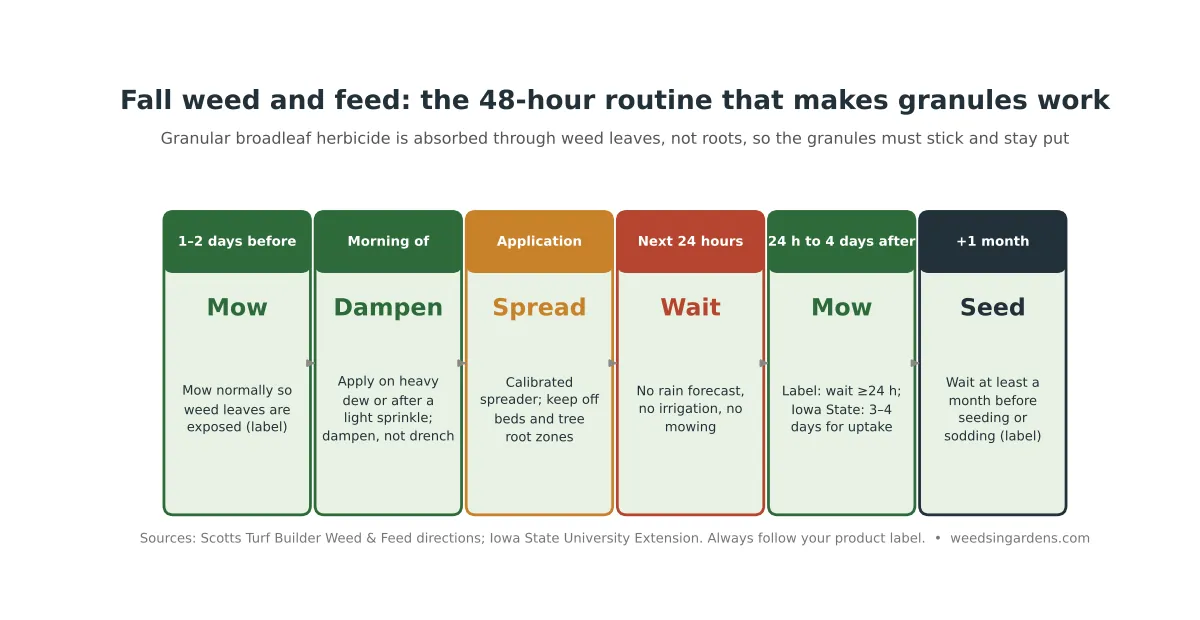
Granular broadleaf products have one job: stick to the weed leaf long enough to be absorbed. Every step below serves that goal.
Step 1: Mow a day or two ahead (but not the same day)
The Scotts directions say to mow a day or two before applying. Iowa State goes further and suggests not mowing for 2–3 days beforehand. The logic behind both is identical: you want plenty of weed leaf surface for granules to land on. If your lawn is short and the weeds are small, lean toward the longer gap.
Step 2: Apply to damp leaves
Apply in early morning on a heavy dew, or water lightly first. The Scotts directions sum it up as “dampen, don’t drench.” The University of Arizona explains why: if you apply first and water afterward, granules can wash down to the soil surface, which “can greatly reduce the weed control response.” (Pre-emergent granules are the opposite; they’re watered in.)
Step 3: Spread carefully
- Use the spreader setting printed on the bag and overlap passes as directed. The Scotts page warns that over-application can cause yellow or brown streaks.
- Prefer a drop spreader near flower beds. Oklahoma State notes that broadcast spreaders throw granules into beds.
- Keep granules off tree root zones as the label directs. Remember those roots reach well past the canopy edge.
- Sweep or blow stray granules from driveways, walks and streets back onto the lawn, as Nebraska Extension recommends, so they don’t wash into storm drains.
Step 4: Keep it dry for 24 hours
Iowa State advises applying when no rain is forecast for 24 hours and not irrigating treated lawns within 24 hours. The Scotts directions match: hold off watering for at least 24 hours and apply when there’s no rain expected the next day.
Step 5: Wait before mowing, and wait longer before seeding
The label says to let the lawn rest at least 24 hours; Iowa State suggests 3–4 days before mowing so the weeds keep absorbing. Then expect patience. Weeds twist and curl within days, but the manufacturer says “a month or more” may be needed for complete control, especially as fall temperatures drop. Don’t seed or sod for at least a month after applying.
Common fall weed and feed mistakes to avoid
- Applying to a dry lawn. Granules roll off and sit on the soil, where foliar herbicides do little.
- Watering it in. That’s the right move for a pre-emergent or plain fertilizer, but the wrong one here.
- Going too late. Once weeds stop growing, the herbicide has nothing to ride down to the roots.
- Using it on new grass. The label wants new lawns mowed at least four times first, and seeding should wait a month after application. If you’re planning a late-fall seeding, read dormant seeding before you treat.
- Doubling up nitrogen. A weed and feed plus a winterizer plus a September feeding can overshoot the fall program Purdue recommends.
- Wrong grass, wrong bag. Using a 2,4-D plus dicamba product on St. Augustine or bentgrass can injure the lawn.
Weed and feed vs. separate fertilizer and spot spray
Fall weed and feed is about convenience. Sometimes convenience wins; often a two-step approach does better for the same effort. Here’s an honest comparison.
| Approach | Best when | Strengths | Drawbacks |
|---|---|---|---|
| Granular weed and feed | Weeds spread across most of a cool-season lawn | One pass; feeds and treats at once; easy to spread evenly | Needs damp leaves and 24 dry hours; treats weed-free turf; fixed nutrient ratio; tree-root risk |
| Fall fertilizer + liquid spot spray | Weeds patchy or limited to edges | Herbicide only where needed; fertilizer can match a soil test; spray coats leaves directly | Two jobs; must respect wind and temperature limits for sprays |
| Fall fertilizer + hand weeding | A handful of weeds, or herbicide-free goal | No herbicide; cheapest in product | Labor; taprooted weeds regrow from root pieces left behind |
| Fertilizer only, treat weeds next fall | Lawn just seeded or overseeded | Protects seedlings | Weeds stay one more season |
Honestly, if you can count your weeds, skip the combo. Feed the whole lawn with a fall fertilizer, then walk the yard with a ready-to-use broadleaf spray. If the lawn is speckled with dandelions and clover from edge to edge, fall weed and feed applied the right way is a perfectly sensible choice.
Herbicide guidance by active ingredient
The brand name on the bag tells you little. The active ingredients tell you what it controls and what limits apply. Iowa State notes that the best broadleaf products combine “2 or 3 of these herbicides as no single compound will control all broadleaf weeds.”
| Active ingredient | Where you’ll see it | What to know |
|---|---|---|
| 2,4-D | Most broadleaf weed and feeds and sprays | Backbone of fall broadleaf control (K-State); usually combined with other actives |
| Dicamba | Scotts Weed & Feed (with 2,4-D); three-way mixes | Combined with 2,4-D to widen the weed range; keep off tree and shrub root zones |
| MCPP (mecoprop) | Three-way products such as Trimec-type mixes | Part of the 2,4-D + MCPP + dicamba combinations K-State lists for fall |
| MCPA | Some combination products | One of the five common broadleaf lawn herbicides (Iowa State) |
| Triclopyr | Liquid spot sprays | Listed by Iowa State among broadleaf lawn herbicides; mainly sold as a spray |
| Carfentrazone combos (e.g. Speed Zone / Weed Free Zone) | Liquid sprays | Quicker response when temperatures are below 50°F (K-State) |
Whichever you choose, follow the label: it is the legal instruction for the product, and it sets the grass types, rates, temperature limits and re-entry rules. For a deeper look at sprays and how they move in plants, see our post-emergent herbicide guide.
Non-chemical options that pair with fall feeding
- Dig the few. A dandelion fork removes scattered taprooted weeds; get as much root as you can.
- Mow high. Taller turf shades the soil and slows weed seedlings.
- Feed the grass, not the weed. A correctly timed fall fertilizer thickens cool-season turf; Oklahoma State notes that a vigorous, healthy lawn “can choke out most weeds.”
- Fix the cause. Weeds like violets, ground ivy and clover point to shade, wet soil or low fertility. Our guide to clover in lawns covers the low-fertility link in detail.
A note from the agronomist’s side
Think of a weed and feed granule as two products forced to share one schedule. With fall weed and feed, the question is never “does it work?” but “do the two schedules overlap on my lawn?” In fall, on cool-season grass, they overlap almost perfectly: the plant physiology favors herbicide movement into weed roots, and the turf physiology favors nitrogen. That’s why extension specialists who dislike combination products in spring are far more relaxed about broadleaf control in fall.
The weak point is delivery, not chemistry. A liquid spray coats leaves; a granule has to land on and cling to one. That makes dew, leaf area and the 24 dry hours afterward more important than the brand you buy. If you remember one rule, make it this: wet leaves going in, dry weather coming out.
The second judgment call is coverage. Blanket-treating a lawn with ten dandelions is a lot of herbicide for very little benefit, and it puts tree and shrub roots at risk for no gain. I’d use the combo only when weeds are spread across most of the lawn. And when results come in, read them as a diagnosis. Weeds that survive a well-timed fall application are usually telling you something about the turf: thin, shaded, compacted or underfed. Fixing that is what keeps the dandelions from coming back.
FAQ
Is fall weed and feed worth it?
For a cool-season lawn with broadleaf weeds spread across most of the yard, yes: fall is when weeds move herbicide down to their roots and when cool-season grass benefits most from nitrogen. If weeds are scattered, a separate fall fertilizer and a spot spray usually works better and uses less herbicide.
When should I apply weed and feed in the fall?
For most cool-season lawns, apply between mid-September and early November while the grass is green and weeds are actively growing. Choose a calm day of at least 50°F (K-State); the Scotts product directions call for daytime temperatures consistently between 60°F and 90°F.
Should I put weed and feed down before rain?
No. Granular broadleaf herbicides must stay on wet weed leaves to be absorbed. Iowa State Extension and the Scotts directions both say to apply when no rain is expected for 24 hours and not to water for 24 hours afterward.
Should I mow before or after weed and feed?
Mow a day or two before applying so weeds are exposed, then wait at least 24 hours before mowing again (Scotts). Iowa State suggests a longer gap of 3 to 4 days after treatment so weeds keep absorbing the herbicide.
Can I use fall weed and feed on St. Augustine grass?
Not a standard 2,4-D plus dicamba product. The Scotts Turf Builder Weed & Feed label says not to use it on St. Augustinegrass, including Floratam. Buy a product whose label specifically lists St. Augustine.
Can I seed after using weed and feed in fall?
Wait at least a month after applying before you seed or lay sod, as the product directions state. If you plan to overseed this fall, seed first and skip the weed and feed until the new grass has been mowed at least four times.
Does fall weed and feed stop crabgrass next spring?
No. Fall weed and feed products are post-emergent broadleaf herbicides; the manufacturer notes they will not prevent weed seeds from sprouting. Crabgrass needs a pre-emergent applied in late winter or early spring.
Sources
- Upham, W. / Melgares, P. (2020). Control broadleaf weeds in lawns now, says K-State horticulture expert. K-State Research and Extension. www.ksre.k-state.edu
- Jauron, R. (2007). Control of Broadleaf Weeds in the Lawn. Iowa State University Extension and Outreach, Yard and Garden. yardandgarden.extension.iastate.edu
- Nebraska Extension (reviewed by J. Fech). Control Broadleaf Weeds in the Fall. University of Nebraska–Lincoln. water.unl.edu
- Oklahoma State University Extension (2021). Herbicide/fertilizer combination may not be best choice. Grow Gardening Columns, Feb. 14, 2021. extension.okstate.edu
- Patton, A. (2011). Fall Fertilization. Purdue University Turfgrass Science. turf.purdue.edu
- Patton, A. (2010). Late Fall Fertilization. Purdue University Turfgrass Science. turf.purdue.edu
- Bigelow, C. (2008). Fall Nitrogen Fertilization Benefits All Cool-Season Turfs. Purdue University Turfgrass Science. turf.purdue.edu
- Kopec, D.M. (2000). Granular Weed Control Products in Lawns. University of Arizona Cooperative Extension, Turf Tips Vol. VII, Issue 5. turf.arizona.edu
- ScottsMiracle-Gro. Scotts Turf Builder Weed & Feed5: product directions and FAQ. scottsmiraclegro.com