
It’s a dry stretch of lawn along the driveway, the bit that never quite fills in. Low, clover-like leaves have crept across it, and they’re dotted with tiny yellow pom-poms no bigger than a pea. Clover? Sort of. It looks like clover, but white clover doesn’t have yellow flowers, and something about it is just a little off. Welcome to the black medic vs clover puzzle.
Short answer: In the black medic vs clover question, the fastest tell is the middle leaflet. Black medic (Medicago lupulina) holds its center leaflet on a short stalk and tips each leaflet with a tiny spur, while white clover’s three leaflets meet at one point and usually carry a pale “V” watermark. Black medic also has bright yellow flower heads that turn into clusters of black, kidney-shaped seed pods, and its stems never root where they touch the soil. It’s an annual (sometimes a short-lived perennial) that thrives in thin, dry, low-nitrogen turf, so feeding and thickening the lawn plus a well-timed triclopyr- or dicamba-based spray beats it far more reliably than 2,4-D alone.
By the end of this guide you’ll be able to tell black medic from white clover, hop clover and the other look-alikes in about ten seconds, understand what its presence says about your soil, and follow a season-by-season plan to clear it, with or without herbicides.
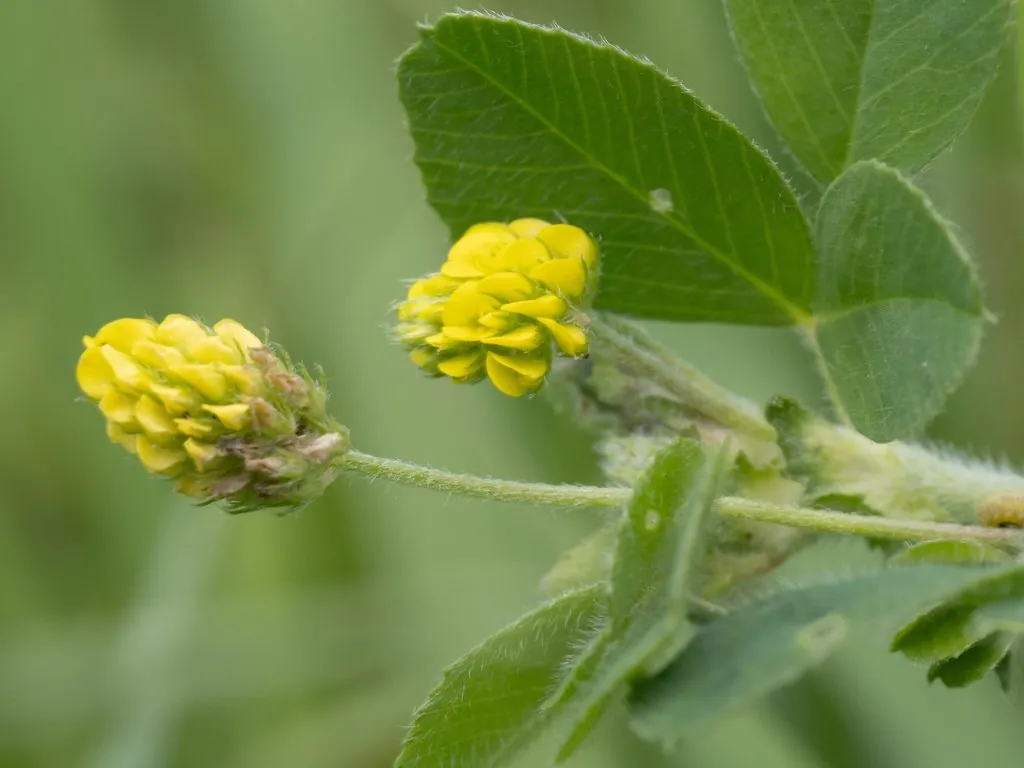
Black medic vs clover at a glance
Most black medic vs clover confusion comes from a family resemblance. Black medic is a legume, like clover, and it’s often called “black clover” or “yellow trefoil” (University of Wisconsin–Madison Extension). But it belongs to the alfalfa genus, Medicago, not the true clover genus, Trifolium. That botanical difference shows up in the leaves, flowers, seed pods and, importantly for you, in how it responds to weed killers.
| Feature | Black medic Medicago lupulina | White clover Trifolium repens | Hop clovers Trifolium campestre, T. dubium |
|---|---|---|---|
| Life cycle | Summer or winter annual; occasionally a short-lived perennial | Perennial | Winter annual |
| Center leaflet | On a short stalk, so it sticks out | Attached at the same point as the side leaflets | Also on a short stalk |
| Leaflet tip | Tiny spur (bristle) at the tip; toothed toward the top | Small notch; often a pale V-shaped watermark | Toothed from mid-blade to tip; no spur |
| Flowers | Bright yellow, ¼–½ inch round heads of up to 50 tiny flowers | White to pale pink, ½–¾ inch globes of 20–40 flowers | Yellow, looser heads that turn brown and papery, like tiny hops |
| Seed pods | Black, coiled, kidney-shaped; one seed each | Small pods hidden in the dried flower head | Hidden inside the brown, dried flower head |
| Stems | Sprawl from a central taproot; never root at the nodes | Creeping stolons that root at the nodes | Upright to sprawling, hairy; no rooting stems |
| Where it wins | Dry, compacted, thin, under-fertilized turf | Under-fertilized lawns in sun or part shade | Sunny, low-fertility sites, roadsides |
Notice the pattern: the only clover that shares black medic’s stalked middle leaflet is hop clover. So if you see yellow flowers and a stalked center leaflet, the contest is really black medic vs hop clover, and the seed pods settle it (more on that below).
How to identify black medic: 5 clues that never fail
Black medic is easy to overlook until it flowers, because its leaves blend in with clover (Utah State University Extension). Run through these five checks and you won’t confuse it again.
1. The middle leaflet sits on its own little stalk
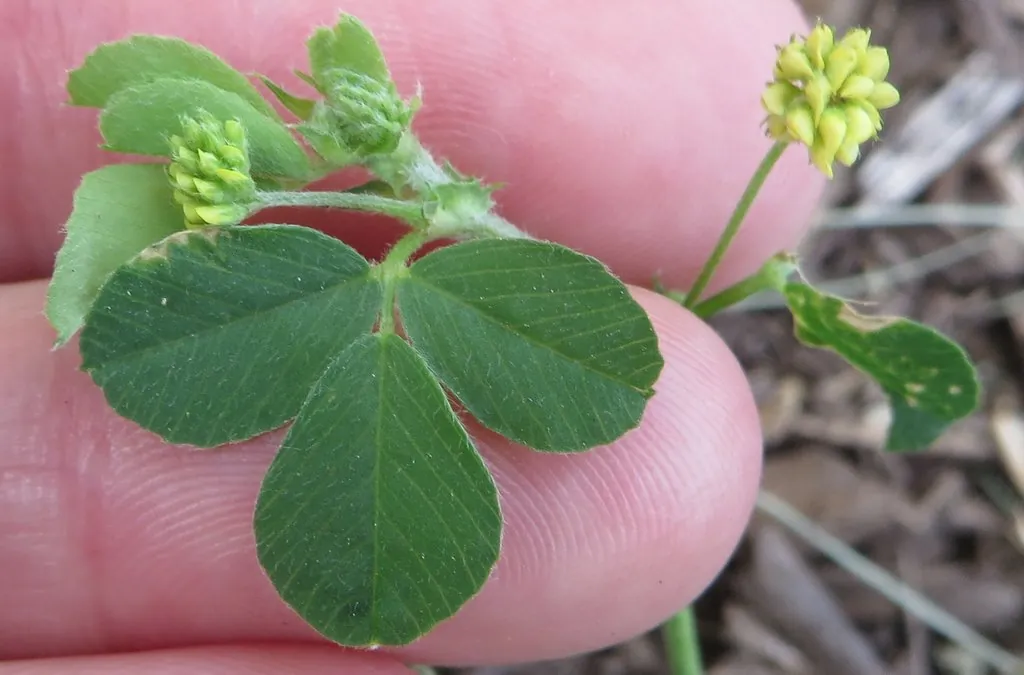
Pinch off a leaf and look closely. On black medic, the center leaflet is held out on an extended stalk, while the two side leaflets sit almost directly on the leaf stem. Penn State Extension calls this the feature that distinguishes black medic from other clovers (Penn State Extension). On white clover, all three leaflets meet at a single point.
2. Each leaflet ends in a tiny spur
Black medic leaflets are oval, about ½ to ¾ inch long, smooth-edged near the base and finely toothed toward the top, with a small spur or tooth at the very tip. The veins are prominent and run in neat, nearly parallel lines. White clover leaflets have a small notch at the tip instead, and often a whitish inverted-V watermark (Penn State Extension, white clover). You’ll also find a pair of small, leaf-like stipules where each black medic leaf joins the stem.
3. Small yellow heads that turn into black pods
The flower heads are compact, rounded yellow clusters about ¼ to ½ inch across, made of 10 to 50 tiny pea-like flowers (UW–Madison). Each individual flower is only about ⅛ inch long. After pollination, the heads become clusters of small, coiled, kidney-shaped pods that turn black when ripe, each holding a single seed. That black seed cluster is where the name comes from, and it’s the single most reliable field clue.
4. A taproot, and stems that never root
Pull a plant and you’ll find one deep taproot with several trailing, slightly hairy stems radiating out from it, sometimes spreading up to 2 feet (UW–Madison). Unlike white clover, those stems don’t root at the nodes. That’s good news: when you pull the crown and taproot, you get the whole plant. Washington State University also notes the stems are four-angled, which you can feel by rolling one between your fingers (WSU Hortsense).
5. Where it grows tells you a lot
Black medic colonizes dry, thin turf, gravel edges and disturbed ground with low soil nitrogen (Utah State). It often turns up where the soil is compacted, such as along curbs and sidewalks (UW–Madison). White clover tolerates more moisture and some shade, so it’s more likely to form patches deeper in the lawn.
Black medic vs hop clover, white clover and other look-alikes
Most misidentifications happen between plants with yellow flowers and three leaflets. Here’s how to separate black medic from each look-alike. If you’ve got several yellow-flowered weeds at once, our guide to weeds with yellow flowers helps narrow them down.
Black medic vs hop clover
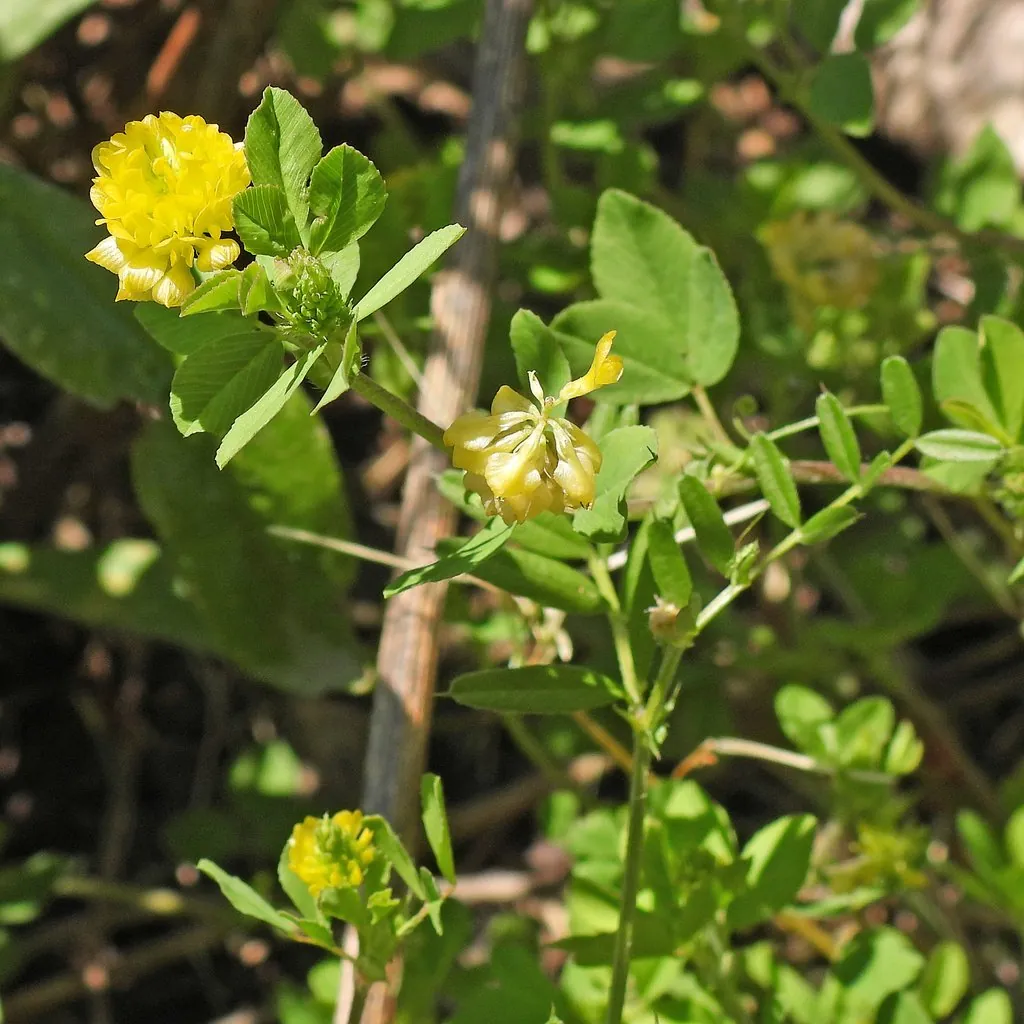
This is the hard one, because large hop clover (Trifolium campestre) also holds its center leaflet on a short stalk (Virginia Cooperative Extension). Look at the flowers instead. Hop clover heads are larger and looser, and as they age the flowers turn brown, fold back and persist, so the head looks like a miniature dried hop cone. Black medic’s mature heads instead become tight clusters of black, coiled pods. Check the leaflet tips too: black medic’s carry that tiny spur. Hop clovers are winter annuals, while black medic is mainly a summer annual.
Black medic vs white clover
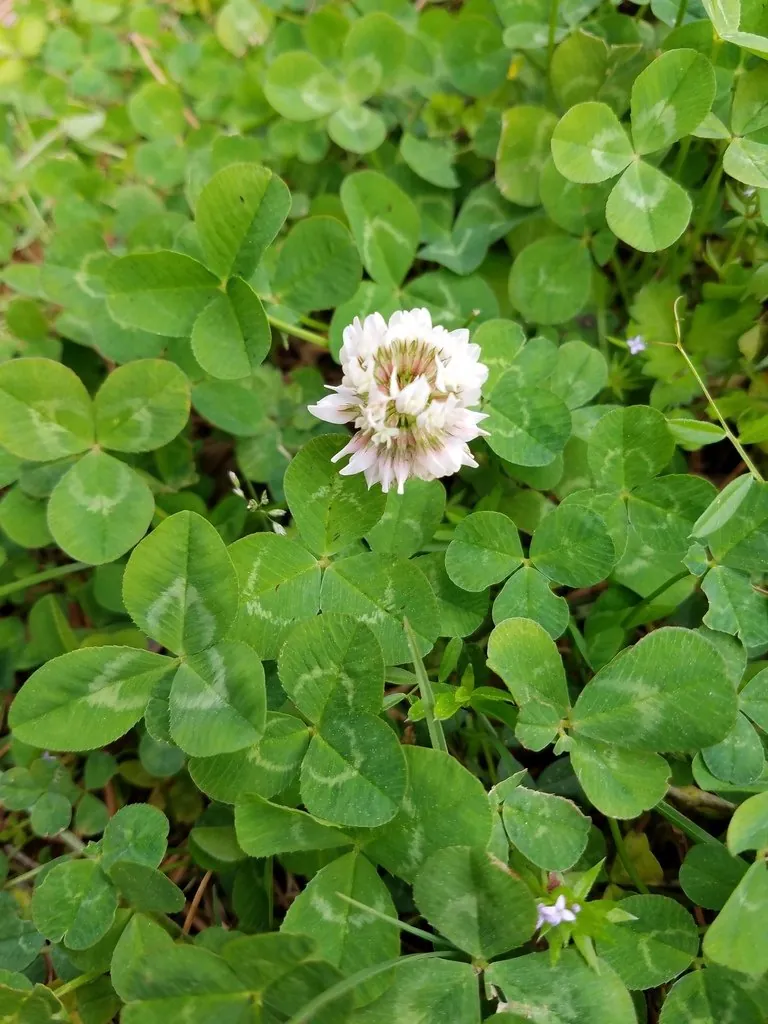
White clover is a perennial that creeps by stolons rooting at every node, so it forms dense, expanding patches that come back each spring (Penn State). It has white to pale pink flower heads, often a watermark on each leaflet, and no stalk on the middle leaflet. If you’re weighing whether to keep white clover rather than kill it, our clover in lawn guide covers both sides.
Black medic vs yellow woodsorrel (oxalis)
Oxalis leaves look clover-like, but each leaflet is heart-shaped with a deeper notch at the top, there are no stipules, and the yellow flowers have five separate, regular petals rather than a pea-like head (UC IPM). If that’s what you have, see how to get rid of oxalis.
Black medic vs California burclover
Burclover (Medicago polymorpha) is black medic’s close cousin and looks very similar above ground. The difference is the pod: burclover’s is light brown, coiled into a spiny bur and holds several seeds, while black medic’s is smooth to hairy, black and single-seeded (UC IPM). Those burs are the real nuisance: UC IPM notes they bother people walking barefoot and cling to clothing and pets.
| What you see | Most likely plant | Confirm with |
|---|---|---|
| Yellow round heads + black coiled pods | Black medic | Spur at leaflet tip; stalked center leaflet |
| Yellow heads that dry brown and papery | Hop clover | No black pods; looser, larger heads |
| White or pinkish heads; stems root at nodes | White clover | Watermark on leaflets; leaflets meet at one point |
| Heart-shaped leaflets; 5-petal yellow flowers | Yellow woodsorrel (oxalis) | No stipules; five separate petals per flower |
| Spiny brown burs | California burclover | Several seeds per bur |
Another yellow-flowered legume that turns up in lawns, birdsfoot trefoil, has its own guide: birdsfoot trefoil in lawns.
Why black medic moves in, and how to get rid of it without chemicals
Here’s the part most guides skip. Black medic isn’t just a weed; it’s a soil report. Like all legumes, it partners with nitrogen-fixing Rhizobium bacteria in root nodules and makes its own nitrogen (Penn State). In a lawn that hasn’t been fed, grass goes pale and thin, while black medic stays green and spreads into the gaps. Utah State puts it plainly: because it produces its own nitrogen, black medic can easily outcompete turf in low-fertility soils (USU). Research on black medic across eastern North America has even found it partners with different nitrogen-fixing bacteria in the north and south of its range, which helps explain how widely it thrives (Harrison et al., 2017).
So whichever side of the black medic vs clover line your weed falls on, the long-term fix is the same: flip that advantage back to the grass.
Feed the lawn properly
Regular fertilization is the most important preventive step, according to Utah State. On sandy soils, a slow-release nitrogen source such as polymer-coated or sulfur-coated urea keeps the grass growing evenly without leaching away (USU). Penn State’s advice for both black medic and white clover is the same: improve turf density through fertilization, regular mowing and grass varieties suited to the site.
Raise the mower to 3 inches or more
Black medic grows flat along the ground, so taller grass shades it out. Utah State and UW–Madison both recommend a mowing height around 3 inches or higher. It’s free, and it helps against most low-growing weeds at once.
Relieve compaction and overseed thin spots
Because black medic loves compacted edges, core aeration helps (UW–Madison). Follow it by overseeding thin areas in spring or fall to close the gaps. If the soil is badly packed, our guide to growing grass seed in compacted soil walks through the fix step by step.
Pull it before it seeds
Hand-pulling works well for small infestations, especially when the soil is moist and plants are young (USU). Since the stems don’t root, getting the crown and taproot removes the whole plant. Timing matters more than effort: black medic sets viable seed even under normal mowing, and that seed can persist in the soil for years (UW–Madison). Clover-type seeds have hard, heat-tolerant coats, so composting won’t reliably kill them (UC IPM). Bag plants that already carry black pods instead of composting them.
In beds, mulch it out
In garden beds, a 3-inch layer of bark or leaf mulch suppresses black medic (USU). Hoeing works too, though tilling brings new seed to the surface, so expect a follow-up flush.
Black medic weed killer: which herbicides work (and which don’t)
If you’ve sprayed a basic 2,4-D product and black medic shrugged it off, you’re not imagining it. Black medic responds differently to herbicides than white clover does, and that’s the most practical reason the black medic vs clover distinction matters.
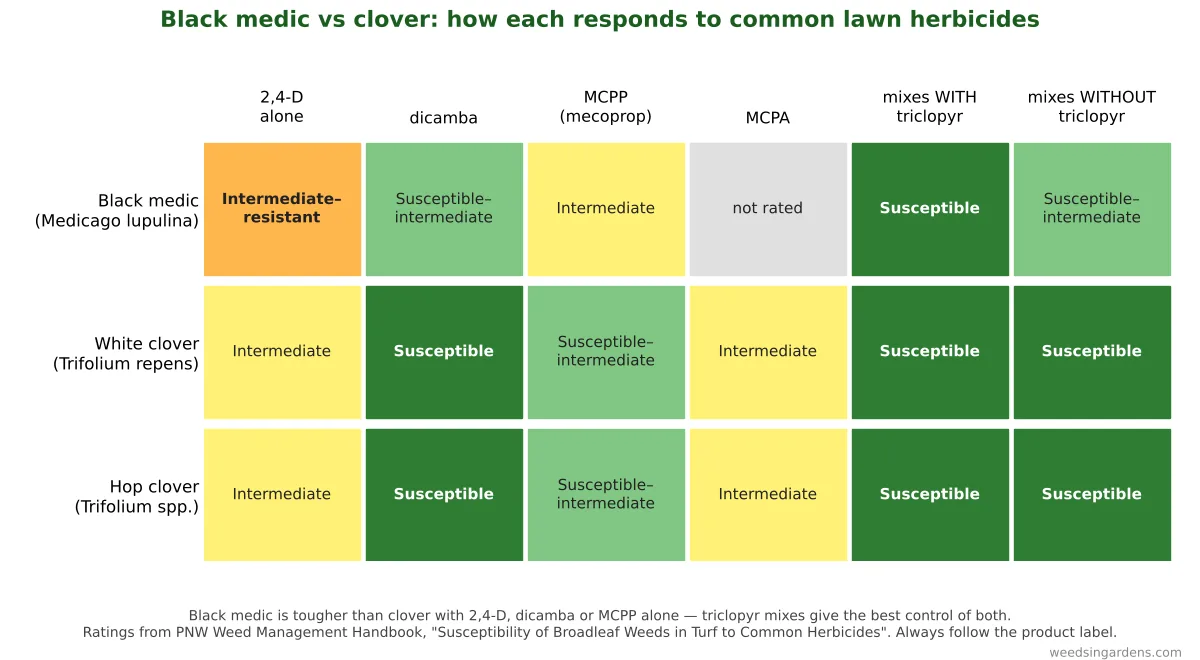
The Pacific Northwest Weed Management Handbook rates black medic as only intermediate to resistant to 2,4-D alone, susceptible to intermediate to dicamba, and intermediate to MCPP. Mixtures that contain triclopyr rate as susceptible (PNW Handbook). White and hop clovers, by comparison, are fully susceptible to dicamba. Virginia Cooperative Extension’s 2026 guide shows the same pattern for combination products: 2,4-D + MCPP rates only intermediate on black medic, while 2,4-D + dicamba, the classic three-way (2,4-D + MCPP + dicamba), and dicamba mixes with triclopyr or penoxsulam all rate susceptible, with spring and fall as the preferred times to treat (VCE 2026).
| Active ingredient(s) | Black medic | Notes and turf-safety limits |
|---|---|---|
| 2,4-D alone | Weak (I–R) | Not enough on its own; fine as part of a mix |
| 2,4-D + MCPP | Fair (I) | Missing the dicamba that makes the difference |
| 2,4-D + MCPP + dicamba (three-way) | Good (S) | Widely sold for home lawns. Dicamba can be absorbed by tree roots, so don’t use it near or under trees (USU) |
| Mixes containing triclopyr | Good (S) | Strong on legumes; check the label for your grass type before using on warm-season turf |
| Fluroxypyr (in mixes) | Good | Penn State lists products with fluroxypyr among the most effective |
| Florasulam | Good | Works in cooler weather, so suits early spring or fall; state restrictions apply (Corteva) |
| Sulfentrazone, quinclorac mixes | Labeled | Utah State lists both among effective options in combination products |
| Clopyralid | Effective, but restricted | Penn State says clopyralid products should not be used on residential lawns |
| Atrazine | Clover-type weeds | One of the few options labeled for St. Augustinegrass and centipedegrass (Clemson HGIC) |
| Glyphosate (non-selective) | Kills it, and grass too | Only for beds, gravel and areas without turf |
| Acetic acid 5%+, pelargonic acid | Burn-back only | Shoots die but plants usually regrow from the crown (USU) |
Spray it right, or don’t bother
- Temperature: Treat broadleaf weeds when air temperatures are between 65 and 85°F (Clemson HGIC). Above roughly 80–85°F, many broadleaf herbicides can injure turf and weeds become harder to kill (University of Nebraska–Lincoln).
- Growth stage: Spray actively growing plants from the seedling to flowering stage, ideally before seed set (UW–Madison).
- Moisture: Don’t spray drought-stressed lawns. Choose a day with no rain expected for 24 hours, and don’t mow right before or after spraying (Clemson HGIC).
- Warm-season lawns: St. Augustinegrass and centipedegrass are sensitive during spring green-up, so wait until the lawn is fully green (Clemson HGIC).
- New lawns: Clemson advises avoiding herbicides on newly seeded lawns until they’ve been mowed four times, then using half rates.
- Always: Read the label for your turf species, rate, spray interval and reseeding interval. The label is the law.
For a deeper look at how these products move through a weed, see our post-emergent herbicide guide.
What about pre-emergents?
Utah State reports that dithiopyr, oxyfluorfen, oryzalin and isoxaben have been shown to prevent black medic. Only some of these are labeled for lawns (oxyfluorfen and oryzalin are generally landscape-bed products), so check the label’s site list. In lawns, a dense, well-fed stand of grass does most of the preventive work for you.
A season-by-season plan for black medic vs clover control
Timing is where black medic and white clover part ways. Black medic is mainly an annual that flowers and sets seed from about April to September (USU), so stopping each year’s plants before they seed is the priority. White clover is a perennial; Penn State notes that it often regrows after spring sprays and that fall applications are usually the most effective (Penn State).
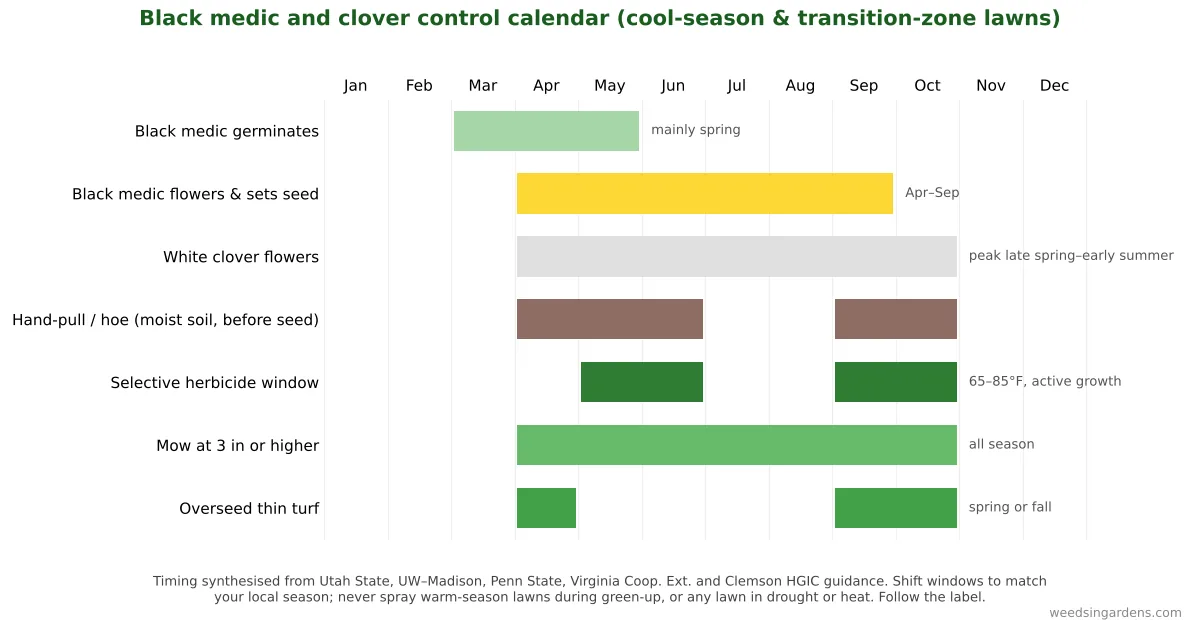
| Season | Black medic | White clover | Lawn care that helps both |
|---|---|---|---|
| Late winter–early spring | Seedlings start to appear; scout dry edges and thin spots | Regrows from crowns | Plan fertilizing; consider a turf-labeled pre-emergent per label timing |
| Mid–late spring | Best time to pull or spray young plants, before flowering | Spot-treat if needed, but expect some regrowth | Raise mowing height to 3 in+; overseed bare spots |
| Summer | Flowering and seed set; pull plants before pods turn black | Peak flowering; bees visit the blooms (UC IPM) | Water deeply in drought; skip herbicides in heat |
| Early–mid fall | Spray any survivors while temperatures are 65–85°F | Best window for herbicide control | Core aerate, overseed and feed cool-season lawns |
| Late fall–winter | Annual plants die back; seed bank waits | Foliage dies back in cold winters | Keep leaves off thin turf and plan next year’s fertility |
Reading this in November? For most northern lawns the fall spray window has closed, and the black medic you see now is near the end of its life. Use the off-season to plan: get a soil test, map the dry and compacted spots where it grew, and be ready to feed, aerate and overseed when the season turns.
A note from the agronomist’s side
The black medic vs clover question is really a question about nitrogen. Both are legumes that make their own, so both win wherever the grass is hungry. The difference is in their strategy. White clover is a long-lived perennial that holds ground with rooting stolons, so you fight it at the root crown, and fall sprays that move into the perennial structures make sense. Black medic is mostly a here-this-year plant that lives and dies by its seed. Kill this year’s plants after they’ve dropped black pods and you’ve won a battle you’ll fight again next spring.
That’s why I’d rank the tools in this order. First, fix fertility and mowing height, because that removes the reason black medic is there. Second, stop seed production, whether by pulling or a timely spray in late spring. Third, choose a product with dicamba, triclopyr or fluroxypyr rather than straight 2,4-D, because the extension ratings show black medic simply isn’t very sensitive to 2,4-D on its own.
One more honest point: a few black medic plants in a lawn aren’t an emergency. Bees visit the flowers (Illinois Wildflowers), and like clover it adds a little nitrogen to the soil. Where it’s spreading across thin turf, though, treat it as the symptom it is and fix the lawn underneath.
FAQ
Is black medic the same as clover?
No. Black medic (Medicago lupulina) is a legume in the alfalfa genus, while true clovers belong to the genus Trifolium. It looks clover-like, but it has yellow flower heads, a stalked middle leaflet with a tiny spur at each leaflet tip, and black, kidney-shaped seed pods.
How do you tell black medic from hop clover?
Both have yellow flowers and a stalked middle leaflet. Hop clover’s flower heads are larger and looser, and they turn brown and papery like tiny hops as they age. Black medic’s heads turn into clusters of black, coiled seed pods, and its leaflets end in a small spur.
What kills black medic but not grass?
Selective lawn herbicides containing dicamba, triclopyr or fluroxypyr, usually as two- or three-way mixes, give good control. 2,4-D alone is weak on black medic. Check that the product is labeled for your grass type and spray at 65–85°F on actively growing plants.
Does black medic mean my soil is poor?
Usually it points to low nitrogen, dry or compacted soil and thin turf. Because black medic fixes its own nitrogen, it outcompetes hungry grass. Fertilizing, aerating, mowing at 3 inches or more and overseeding make the lawn less hospitable to it.
Will black medic come back every year?
It’s mainly an annual that spreads only by seed, and its seed can survive in the soil for years. Expect new seedlings each spring until the seed bank runs down, so keep pulling or treating plants before they form black pods.
Is black medic good for anything?
Yes. It’s a legume that adds nitrogen to the soil, bees visit its flowers, and it was originally introduced to North America as forage. In a lawn, though, it signals thin turf and low fertility.
Can I pull black medic by hand?
Yes, and it’s easier than most weeds because its stems don’t root. Pull when the soil is moist, get the crown and taproot, and bag any plants that already have black seed pods rather than composting them.
Sources
- Abbey, T., Landschoot, P. & Delvalle, T. Lawn and Turfgrass Weeds: Black Medic (Medicago lupulina L.). Penn State Extension, updated 2025. extension.psu.edu
- Abbey, T., Landschoot, P. & Delvalle, T. Lawn and Turfgrass Weeds: White Clover. Penn State Extension. extension.psu.edu
- Caron, M., Beddes, T. & Ransom, C. Black Medic (Medicago lupulina) Identification and Control in Residential Landscapes. Utah State University Extension, 2026. extension.usu.edu
- Mahr, S. Black Medic, Medicago lupulina. University of Wisconsin–Madison Extension, revised 2025. hort.extension.wisc.edu
- UC IPM. Pest Notes: Clovers (Publication 7490). University of California Agriculture and Natural Resources. ipm.ucanr.edu
- Abaye, O. Do you know the hop clovers? Virginia Cooperative Extension, Crop and Soil Environmental News, 2004. sites.ext.vt.edu
- Pacific Northwest Weed Management Handbook. Susceptibility of Broadleaf Weeds in Turf to Common Herbicides. pnwhandbooks.org
- Virginia Cooperative Extension. Pest Management Guide: Home Grounds and Animals 2026, Table 5.9, Broadleaf Weed Control. PDF
- Clemson Cooperative Extension Home & Garden Information Center. Managing Weeds in Warm-Season Lawns. hgic.clemson.edu
- Gaussoin, R. Be cautious with herbicide applications and high temperatures. University of Nebraska–Lincoln Turfgrass Science, 2022. turf.unl.edu
- Washington State University Hortsense. Weeds: Black medic. hortsense.cahnrs.wsu.edu
- Hilty, J. Black Medic (Medicago lupulina). Illinois Wildflowers. illinoiswildflowers.info
- Corteva Agriscience. Is it Large Hop Clover or Black Medic? corteva.com
- Harrison, T.L., Wood, C.W., Borges, I.L. & Stinchcombe, J.R. (2017). No evidence for adaptation to local rhizobial mutualists in the legume Medicago lupulina. Ecology and Evolution 7(12): 4367–4376. doi:10.1002/ece3.3012
Browse more identification guides in our Lawn Weeds category.