
The grass has finally perked up after summer, and then you see it: three-leaf patches spreading through the thin corner by the driveway. One neighbour calls it a weed; another paid to have it seeded. So is clover in lawn a problem to fix, or a free upgrade?
Short answer: clover in lawn is usually a symptom, not a disaster. White clover moves in where turf is thin and short of nitrogen, and once there it adds nitrogen back to the soil, stays green, and feeds bees. Keep it if you want a lower-input lawn and nobody in the house reacts badly to bee stings. Remove it if you need a uniform grass surface or a play area free of bees; in that case, feed the grass properly first and spot-spray the clover in early fall, when control lasts longest.
Good news: there’s no wrong answer here, only a wrong reason. By the end you’ll know what clover is doing in your yard, what it gives back, what it costs, and what to do this fall either way. Every number comes from extension services and field studies, linked so you can check.
Table of Contents
How to recognise white clover (and what gets mistaken for it)
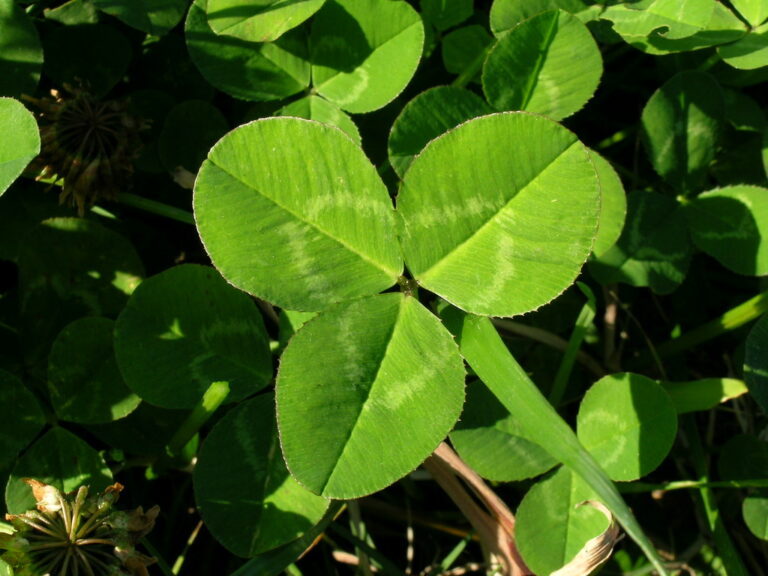
Before you decide anything, make sure it’s actually clover. White clover (Trifolium repens) is a low perennial legume. Penn State Extension describes three oval leaflets, each about ¼ to ¾ inch across, usually marked with a pale, inverted V.
The round white flower heads are ½ to ¾ inch wide and made of 20 to 40 small florets. The stems creep along the soil surface and root wherever a node touches the ground. That’s the trick that turns a single plant into a patch.
Three lawn weeds get called “clover” all the time, and mixing them up can send you down the wrong path:
- Black medic has yellow flower heads and a tiny tooth at the tip of each leaflet; the middle leaflet sits on a short stalk. It is covered in our guide to weeds with yellow flowers.
- Oxalis (yellow woodsorrel) has heart-shaped leaflets that fold up at night and small five-petalled yellow flowers.
- Bird’s-foot trefoil has three leaflets plus two leaf-like stipules and yellow, pea-shaped flowers; see bird’s-foot trefoil in lawns.
For the other white-flowered weeds that often turn up alongside it (chickweed, daisy, hairy bittercress), our photo guide to weeds with white flowers in lawns puts them side by side.
Why clover in lawn keeps spreading
Clover isn’t invading a healthy lawn; it’s filling a vacancy. Every extension source we checked points to the same main cause: low nitrogen. Colorado State University Extension notes that clover “is often found in lawns that have not been adequately fertilized with nitrogen”, and Iowa State University calls its presence “often a sign of low nitrogen fertility”.
Why does that matter? Grass has to find its nitrogen in the soil. Clover makes its own, with the help of Rhizobium bacteria in its root nodules. On lean soil, the legume simply has the advantage.
The second reason is thin turf. Clover seed germinates in cool, moist spring and fall weather, and the creeping stems fill any gap the grass leaves: scalped spots from low mowing, compacted paths, shade, or areas that thinned out in a drought.
Clemson’s Home & Garden Information Center notes that white clover grows best between 50 and 85 °F. That’s why it seems to explode in spring and early fall.
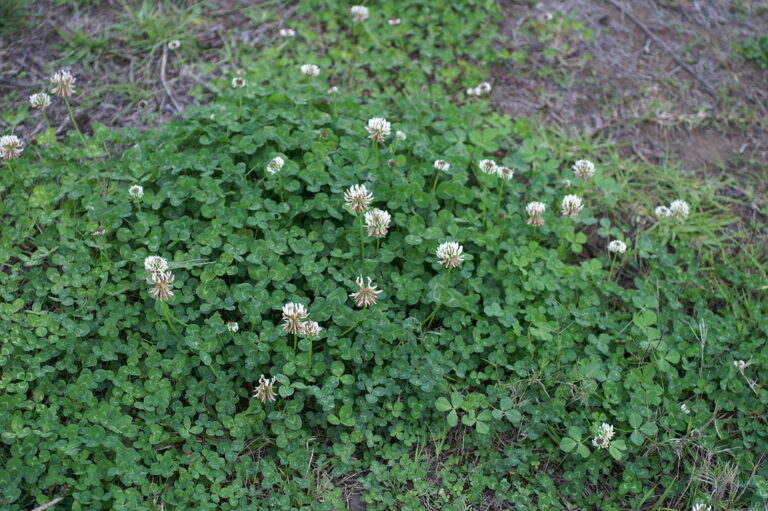
So if the grass itself is struggling, that’s your real starting point. Our guide to why grass won’t grow walks through soil, shade, water and mowing problems that open the door to clover and every other weed.
The case for keeping white clover
It fertilises the grass around it
This is the strongest argument for keeping it, and it isn’t just garden folklore. A 2021 field study at the University of Kentucky (Potter, Redmond, McNamara and Munshaw, Sustainability) grew tall fescue with and without dwarf white clover. Fescue growing with clover had 17–27% more nitrogen in its leaves than fescue grown alone (about 4.1–4.3% versus 3.5%).
The same paper cites earlier work showing clover–grass mixtures can fix 100–200 kg of nitrogen per hectare per year. That works out to roughly 2–4 lb of nitrogen per 1,000 sq ft, which overlaps the whole annual rate usually recommended for cool-season lawns.
Before you cancel the fertiliser order, a reality check: a lawn is rarely half clover, so the saving is smaller. University of Maryland Extension puts it conservatively: a microclover and tall fescue lawn “may reduce one nitrogen application per year”. Less fertiliser also means less nitrogen running off into drains and streams.
It feeds bees for months
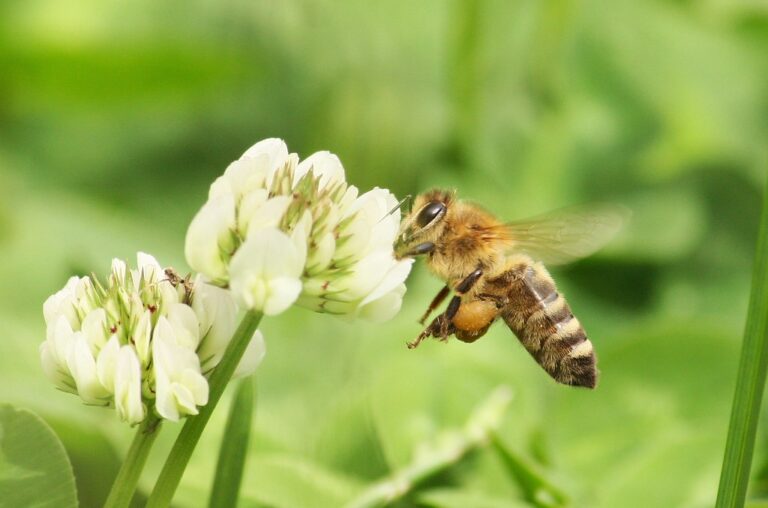
White clover flowers from spring through fall, a long-running food source. In a two-year survey of central Kentucky lawns, Larson, Kesheimer and Potter (2014) collected about 50 species of pollinating insects from dandelions and white clover, including 37 species of bees. Honey bees and bumble bees were the most common visitors to clover, especially in summer, and two of the six bumble bee species found are considered uncommon.
It stays green with little help
Clover needs no nitrogen fertiliser and covers ground that grass has given up on. In the Kentucky study, plots of pure dwarf clover had 82–93% fewer root-feeding white grubs than grass plots. The catch? The same effect did not appear in mixed clover–grass plots, so don’t count on a partly clover lawn to resist grubs.
The case against clover in lawn
Now the other side. University of Maryland Extension lists the drawbacks honestly, and they matter more than most pro-clover articles admit:
- Bees underfoot. Flowering clover means bees at ankle height. For anyone with a sting allergy, or a lawn where children play barefoot, this is reason enough to remove it.
- Summer and winter gaps. In cool-season lawns microclover “does not tolerate high heat and drought”, and its top growth dies back in winter, which can leave bare spots.
- Poor shade tolerance. It will not solve a thin lawn under trees.
- No broadleaf weed killers. “Most broadleaf herbicides labeled for use on tall-fescue will kill microclover”, so dandelions and plantain in a clover lawn have to be dug by hand.
- Uneven look. Clover patches are a different colour and texture from grass and look patchy in a formal lawn.
Keep it or kill it: a quick decision table
Still on the fence? Find the row that sounds like your yard.
| Your situation | Suggested choice | Why |
|---|---|---|
| Low-input lawn, happy with a mixed look | Keep clover | Free nitrogen, green cover, food for bees |
| Children or pets play barefoot; sting allergy in the family | Remove, or mow off flowers | Bees work clover flowers from spring to fall |
| Formal lawn, sports turf or a lawn you want uniform | Remove | Clover patches differ in colour, texture and wear |
| Clover only in a few thin, unfertilised spots | Fix the grass first | Fertilising and overseeding often shrink it without herbicide |
| Lawn full of other broadleaf weeds too | Decide before spraying | Broadleaf herbicides kill clover along with the weeds |
| Heavy shade | Neither thrives | Consider shade-tolerant grass or a groundcover |
How to keep a healthy clover lawn (or add microclover)
Decided to keep it? A little management keeps clover in balance with the grass instead of letting it take over.
- Choose dwarf types for mixed lawns. Microclover cultivars such as ‘Pirouette’ and ‘Pipolina’ were selected for small leaves and a low habit so they blend with turf. Ordinary Dutch white clover has larger leaves and flowers more heavily.
- Seed lightly. Virginia Cooperative Extension’s Fairfax master gardeners, drawing on University of Maryland trials, suggest about 2–3 oz of microclover per 1,000 sq ft when overseeding tall fescue (3–5% of the seed mix by weight). Above about 10% by weight, clover may dominate.
- Keep the soil near neutral. The same source gives pH 6.0–7.0 as the best range for clover and its nitrogen-fixing bacteria.
- Mow high. About 3.5 inches suits tall fescue and still lets microclover grow underneath.
- Cut back on nitrogen. Heavy nitrogen feeding favours the grass and slowly crowds out clover.
- Plan to reseed. Microclover tends to thin out after two or three years and may need overseeding.
If bees are your only worry, there’s a simple middle path: mow off the flowers before the lawn is used for play. Mowing also matters if you ever treat the lawn with an insecticide: a related 2013 University of Kentucky study found that mowing off flowering weeds before or soon after treating for grubs greatly reduces bees’ exposure.
How to get rid of clover in lawn
If it has to go, order matters more than product: strengthen the grass, then spray in fall. Skip step 1 and you’ll likely treat the same patches next year.
Step 1: Make the grass stronger
Start with nitrogen, because spraying alone treats the symptom and leaves the cause in place. For cool-season lawns, Iowa State recommends feeding in late April or early May, mid-September, and late October or early November. Colorado State singles out fall nitrogen as especially useful against clover. If you’re reading this in October, that late-fall feeding is still ahead of you.
Mow at the top of the recommended range for your grass, and overseed thin areas in early fall. Only a handful of young plants? Clemson notes they can simply be dug out before they form a patch. Honestly, a trowel beats a sprayer here.
Step 2: Spot-treat with a selective herbicide
White clover is a broadleaf plant, so selective lawn herbicides can remove it without killing the grass. One thing that won’t help: pre-emergent products do not control it, as Colorado State points out. Active ingredients the extension services list as effective:
- Cool-season lawns (fescue, bluegrass, ryegrass): products containing dicamba, triclopyr, MCPP or MCPA, fluroxypyr, clopyralid or quinclorac, often sold as combinations with 2,4-D (Penn State, Colorado State).
- Warm-season lawns: Clemson lists three-way mixes (2,4-D + dicamba + MCPP) for bermudagrass and zoysiagrass, at reduced rates on centipede and St. Augustine; metsulfuron for bermuda, centipede, St. Augustine and zoysia; and atrazine for centipede and St. Augustine only.
Timing makes the biggest difference, and fall is your best shot. Penn State calls fall treatment the most effective way to control white clover, and notes that spring sprays can be followed by regrowth. Iowa State gives mid-September to early November as the window, so mid-October sits right in the middle of it.
Before you spray, check three things:
- Water first. Spray when the lawn is well watered.
- Skip hot days. Colorado State advises against spraying above 85 °F, and Clemson against spraying above 90 °F or during spring green-up of warm-season grass.
- Expect a second round. An established patch may need a second treatment; follow the label’s re-treatment interval.
If you plan to overseed afterwards, check the label’s waiting period. Clemson suggests at least three weeks between treatment and seeding, and our guide on killing weeds before overseeding covers the timing for other herbicides.
Where this applies: the months above are for cool-season lawns in the Northern Hemisphere. Warm-season lawns follow their own green-up and dormancy, and in the Southern Hemisphere the seasons are reversed. Herbicide registration differs from country to country, so check which products are approved where you live and always follow the label.
A note from the agronomist’s side
On farms, white clover is sown on purpose: grass–clover pastures are a textbook way to cut fertiliser bills. The same biology works in your lawn.
So read clover as a soil report, not an invasion: nitrogen is short and the grass is too thin. Spray without fixing either, and you’ve just cleared space for the next seed to land.
The classic mistake is spraying year after year while hungry, thin turf never gets fixed. A smarter order:
- Test the soil, so you know whether nitrogen (and pH) really is the issue.
- Feed and overseed on the fall schedule above, before reaching for a sprayer.
- Wait a season and look again. Feeding and overseeding often shrink clover without any herbicide.
- Spot-spray only what’s left, in fall, and follow the label.
You may find the clover shrinks to a level you’re happy to live with. If not, the grass is now thick enough to fill the gaps.
Frequently asked questions
Is clover good for your lawn?
For the grass, generally yes. It adds nitrogen that the grass can use, as the Kentucky study measured. Whether it is good for your lawn depends on how you use it and how uniform you want it to look.
Will clover choke out grass?
Not usually. It rarely beats healthy, well-fed turf, and takes over where grass is thin or short of nitrogen. In seeded mixes, keeping microclover under about 10% of the seed weight helps stop it dominating.
Are clover mites caused by clover?
No. Despite the name, clover mites are a separate problem from the plant. Our guide to clover mites explains what does. More lawn weed guides are in the lawn weeds section.
Related guides: Why Do Dandelions Keep Coming Back? Roots, Seeds and How to Stop Them · Bird’s-Foot Trefoil in Lawns: Identification, How It Spreads and Control · Clover Mites: Identification, Damage, Prevention and Control
Sources
- Penn State Extension – Lawn and Turfgrass Weeds: White Clover
- Colorado State University Extension, PlantTalk 1542 – White Clover Control in Lawns
- Iowa State University Extension – How do I control white clover in my lawn?
- Clemson Home & Garden Information Center – White Clover
- University of Maryland Extension – Lawns and Microclover
- Virginia Cooperative Extension, Fairfax Master Gardeners – Tall Fescue/Microclover Lawn
- Potter D.A. et al. (2021) Dwarf white clover supports pollinators, augments nitrogen in clover–turfgrass lawns, and suppresses root-feeding grubs in monoculture but not in mixed swards. Sustainability 13: 11801
- Larson J.L., Kesheimer A.J., Potter D.A. (2014) Pollinator assemblages on dandelions and white clover in urban and suburban lawns. Journal of Insect Conservation