
Short answer: the yellow, pea-flowered “clover” spreading in low patches through your lawn is most likely bird’s-foot trefoil (Lotus corniculatus), a deep-rooted perennial legume that thrives where grass is thin, hungry and dry. It shrugs off mowing and plain 2,4-D, so control it in two moves: raise the mower to 3 in (7.5 cm) and feed nitrogen so the grass can compete, then treat surviving patches in early autumn or spring with a lawn herbicide that combines two or more of 2,4-D, MCPP, MCPA, dicamba and triclopyr. Expect to repeat once, and expect seedlings for years: each pod holds 10 to 50 seeds that stay viable for about a decade.
How to identify bird’s-foot trefoil
The plant gets its name from the seed pods. Three to eight narrow green pods, about 1 in (2.5 cm) long, radiate from the tip of each flower stalk like the toes of a bird’s foot. Before the pods form, the flowers are the giveaway: bright yellow to orange-yellow pea flowers, roughly half an inch (1.2 cm) across, carried in flat clusters of two to eight on a stalk that rises above the foliage. Buds are often tinged red. In the northern United States flowering peaks from late June into July and continues into autumn on mowed plants.
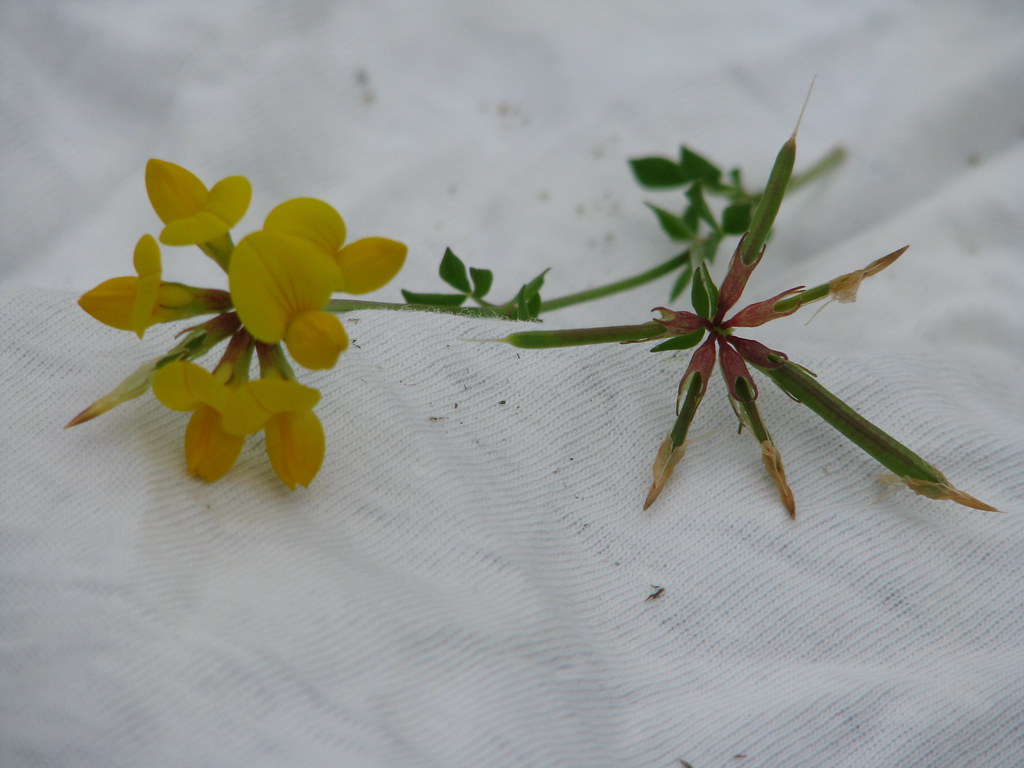
According to Iowa State University Extension, each leaf appears to have five leaflets but actually has three true leaflets at the tip plus two broad, leaf-like stipules where the stalk meets the stem. The leaflets are oval, pointed, ½ to ¾ in (1.3 to 2 cm) long, with smooth margins and a distinct blue-green cast. Stems sprawl and root where they touch soil, so a patch is a mat, not one plant. Below ground is a branched taproot plus short rhizomes, per University of Minnesota Extension, which is why pulling the top off does nothing.
Bird’s-foot trefoil vs black medic, yellow woodsorrel, lesser trefoil and clover
Several lawn plants answer to “yellow flower weed that looks like clover”. Black medic and lesser trefoil are annuals you can largely outgrow; bird’s-foot trefoil and white clover are perennials you have to remove.

| Plant | Leaf | Flower | Seed | Life cycle |
|---|---|---|---|---|
| Bird’s-foot trefoil (Lotus corniculatus) | 3 oval, smooth-edged blue-green leaflets plus 2 leafy stipules at the base (“5 leaflets”) | Yellow to orange pea flowers, 2–8 per stalk, ½ in | Cluster of 1 in pods spread like a bird’s foot | Perennial, taproot, stems root at nodes |
| Black medic (Medicago lupulina) | 3 leaflets, centre leaflet on a longer stalk, tiny tooth at the tip | Tight round heads of 10–30 tiny yellow flowers, ¼–½ in | Small black coiled pods | Mostly annual, shallow taproot |
| Lesser trefoil / yellow suckling clover (Trifolium dubium) | 3 small clover-like leaflets | Small pale-yellow clover heads that turn brown | Tiny pods hidden in the dead flower head | Low annual |
| Yellow woodsorrel (Oxalis stricta) | 3 heart-shaped leaflets that fold at night, sour taste | Five-petalled yellow cups, not pea-shaped | Upright okra-like capsules that fire seed | Annual or perennial |
| White clover (Trifolium repens) | 3 rounded leaflets with a pale inverted-V watermark | White or pinkish round heads | Small pods in the brown head | Perennial, creeping stolons |
The quickest field test, described by Penn State Extension: heart-shaped leaflets mean woodsorrel; a whitish V-mark means white clover; a centre leaflet on a longer stalk with tight little yellow heads means black medic. Pea-shaped flowers plus two extra leaflets at the base of each leaf means bird’s-foot trefoil. (Blue-flowered creepers such as speedwell are covered in our guide to lawn weeds with blue flowers.)
Why it is in your lawn and how it spreads
Bird’s-foot trefoil is a legume. Its roots host Rhizobium bacteria that fix nitrogen from the air, so it grows happily in soil too poor to support dense turf. Penn State notes it turns up as patches in under-fertilised lawns in full sun on droughty soil; Iowa State adds that it tolerates compacted, infertile and poorly drained ground as well as drought and salt, which is why verges and the strip beside a driveway are classic sites. Its low habit means mowing at 2 in (5 cm) removes little of the plant while weakening the grass around it. Trefoil is a symptom of thin, hungry, stressed turf.
It spreads three ways. Seed pods split and twist when dry, flinging seed, and mowers carry seed across the lawn. Prostrate stems root at the nodes and form new crowns. And short rhizomes and a branched taproot let the crown survive winter dieback and resprout in spring. With seed viable for about a decade, a patch that has flowered for a few summers has already banked years of seedlings, which germinate in the cool, moist windows of spring and autumn, exactly when you want grass seed germinating instead.
Weed or wildflower? The balanced view
This plant is not a villain everywhere. In Britain and Ireland it is a native wildflower; the Royal Horticultural Society lists it as a plant for pollinators, a nectar source for bees and a larval food plant for moths. Farmers value it as a non-bloating pasture legume for acidic, wet soils where alfalfa fails, according to Penn State’s forage guide. In a species-rich or low-mow lawn you can simply leave it.

In North America, where it was introduced for forage and roadside erosion control, natural areas are a different matter. The Minnesota Department of Natural Resources describes it forming dense mats that shade out native prairie plants and notes that prescribed burns increase germination; it is not regulated there, but seeding it near prairies is discouraged. The Missouri Invasive Plant Council lists it as an escaped invader, and the Invasive Plant Atlas of the United States records it on regional lists in Kentucky (rated a moderate threat), Wisconsin, Oregon, Virginia and Michigan. The practical position: fine in a meadow, worth controlling in a conventional lawn, never something to sow next to a nature reserve.
How to get rid of bird’s-foot trefoil in a lawn
Step 1: change the conditions that favour it
- Mow higher. Set the mower to 3 to 3.5 in (7.5 to 9 cm) for cool-season grasses. University of Minnesota Extension and the Ask Extension turf specialists both put this first: taller grass shades the low crowns and out-competes seedlings.
- Feed nitrogen. Purdue’s turf program specifically recommends nitrogen fertiliser to reduce trefoil, because legumes only win in low-nitrogen soil. For most cool-season lawns that means a moderate programme of around 2 to 3 lb of actual nitrogen per 1,000 sq ft a year (10 to 15 g per m²), with the largest dose in early autumn. If the grass itself looks pale, see our post on why grass turns yellow.
- Relieve compaction and overseed. Core-aerate in autumn when the soil is moist, then overseed thin areas so grass, not trefoil, fills the gaps. Our guide to preparing compacted soil for grass seed walks through the sequence.
- Water deeply but infrequently in dry spells; trefoil is drought tolerant and your grass is not.
Step 2: hand removal for small patches
For a few plants, dig rather than pull. Purdue and Washington State Extension both stress removing as much below-ground tissue as possible, because the crown and taproot regrow. Use a dandelion fork when the soil is damp and lift the whole rooted mat, including stems rooted at the nodes. The RHS suggests grasping the sprawling stems together and pulling to bring the roots with them, and raking patches up before mowing so the blades actually cut the stems. Fill the hole with soil and seed at once.
Step 3: selective herbicides that actually work
The RHS warns that clovers, trefoils and medicks resist many selective lawn weedkillers, and Kansas State University reports that 2,4-D alone does not control the closely related white clover. What the extension services agree on is a combination product.
| Active ingredients | Notes | Cited by |
|---|---|---|
| 2,4-D + MCPP (mecoprop) + dicamba | The standard three-way lawn weed killer; effective when two or more actives are present | Iowa State, Penn State, Purdue, Washington State |
| Triclopyr, alone or in mixes | Purdue’s pick for tough cases on cool-season grass; Ask Extension suggests it where three-way products struggle; Missouri uses 0.5–1.5 percent solutions for spot treatment | Purdue, Ask Extension, Missouri Invasive Plant Council |
| MCPP + MCPA + dicamba + carfentrazone or triclopyr | Four-way products; carfentrazone speeds visible burn-down | University of Minnesota Extension |
| MCPA or clopyralid | Effective on legumes but need repeat applications; clopyralid is mainly a professional product | University of Minnesota, Minnesota DNR |
| Fluroxypyr (in mixes with triclopyr or 2,4-D) | Rated very effective on woodsorrel and clover by Kansas State; useful where the same patch holds several legume look-alikes | Kansas State (clover and woodsorrel data, not trefoil-specific) |
Timing matters more than product. Minnesota and Missouri both rate spring or autumn applications most effective. Ask Extension prefers late summer to early autumn, when the plant is moving sugars to its roots and carries the herbicide down with them, and warns that sprays on hot, drought-stressed or flowering plants often fail. Plan for two applications three to four weeks apart and a follow-up next spring on regrowth. Spot-spray patches, keep dicamba and triclopyr away from tree roots and ornamentals, and check the label for your grass type; both actives carry restrictions on some warm-season grasses such as St Augustine and centipede.
Reseeding after treatment
Dead trefoil leaves bare patches you will want to seed. Kansas State University trials found that a standard 2,4-D + MCPP + dicamba mix, and combinations built on triclopyr or fluroxypyr, were safe for tall fescue seeded 0 to 14 days after application. Most consumer labels still ask for a three-to-four-week gap in each direction between spraying and seeding, so follow the label in front of you. Our decision guide on killing weeds before overseeding covers the sequencing.
What does not work
- Plain 2,4-D. Leaves curl, the crown regrows. Use a two- or three-way mix.
- Vinegar and other contact burn-downs. They scorch the top growth and leave the taproot and rooted stems intact; see what horticultural vinegar really does.
- Mowing lower. Iowa State notes the plant adapts well to mowing; scalping hurts the grass more than the trefoil. The Minnesota DNR’s advice to mow below 2 in for several years is for prairie restoration, not lawns.
- Burning. Fire stimulates germination of the hard seed.
- Spraying in midsummer heat. Stressed plants take up little herbicide.
When to expect results
Sprayed plants twist and yellow within a week and collapse in two to three; the mat takes about a month to disappear. Judge success the following June, when a patch that is not flowering is dead. Seedlings will keep appearing for several years, so the lasting fix is turf density: a lawn mowed at 3 in and fed properly leaves few gaps, and the odd survivor is a two-minute job with a trowel.
UK versus US notes
In the UK, bird’s-foot trefoil is native and usually a sign of a low-nutrient, well-drained lawn rather than an invader; many gardeners now keep it in a mown meadow strip. Amateur lawn weedkillers sold there are mixes of 2,4-D, mecoprop-P, dicamba or fluroxypyr; apply to actively growing plants within the label’s season and expect a second dose at the interval the label allows. In the US and Canada the plant is introduced and triclopyr or three-way lawn products are widely available; in prairie states such as Minnesota, Wisconsin and Missouri, bin dug plants rather than composting them and avoid “wildflower” or erosion mixes that contain it. In both regions the cultural fixes are identical: mow high, feed nitrogen, overseed.
Related guides: Clover in Lawn: Should You Keep It or Kill It? · Weeds With White Flowers in Lawns: 10 Common Types and How to Identify Them · Weeds With Yellow Flowers in Lawns: 8 Common Ones and How to Identify Them
Sources
- Iowa State University Extension – Control of Birdsfoot Trefoil in the Lawn
- Penn State Extension – Lawn and Turfgrass Weeds: Birdsfoot Trefoil
- Purdue University Turfgrass Science – Birdsfoot Trefoil
- University of Minnesota Extension – Birdsfoot trefoil
- Minnesota Department of Natural Resources – Birdsfoot trefoil (Lotus corniculatus)
- Missouri Invasive Plant Council – Birdsfoot trefoil
- Invasive Plant Atlas of the United States – Lotus corniculatus
- Ask Extension – Kill birdsfoot trefoil in my yard without killing the grass
- Penn State Extension – Three Weeds with Three Leaflets: Trifoliate Look-Alikes
- Kansas State University Turf and Landscape – Seeding after Herbicide Application
- Kansas State University Turf and Landscape – White Clover and Yellow Woodsorrel Control
- Royal Horticultural Society – Clover in Lawns
- Penn State Extension – Birdsfoot Trefoil (forage)