
Short answer: to get rid of oxalis (yellow woodsorrel and creeping woodsorrel), stop it setting seed and remove the runners, not just the leaves. In a lawn, spot-spray a broadleaf herbicide containing triclopyr or fluroxypyr while the plants are young, repeat after 3 to 6 weeks, and thicken the turf so seedlings have no bare soil. In beds, hand-weed before the plants are about 6 weeks old, sift out the pink runners, and cover the soil with 2 to 3 inches of mulch, because oxalis seed needs light to germinate.
Oxalis is hard to beat for one reason: a single plant can make more than 5,000 seeds and throw them several feet, according to UC Statewide IPM. Pull the top and leave a stem piece, and it regrows. The plan below deals with seeds, roots and the gaps that let it in.
Table of Contents
How to identify oxalis in a lawn or bed
Three kinds of oxalis turn up in lawns and garden beds. All have leaves divided into three heart-shaped leaflets and small yellow flowers with five petals. The heart shape is the quickest check: each leaflet has a notch at the tip, as if someone cut a V into it. Clover and black medic leaflets are rounded or oval without that notch.
Another clue is behaviour. Penn State Extension notes that yellow woodsorrel leaves droop and fold at night and open again in daylight. Walk the lawn early in the morning or on a dull evening and the woodsorrel patches look limp and folded while the clover stays flat.
Yellow woodsorrel (Oxalis stricta)
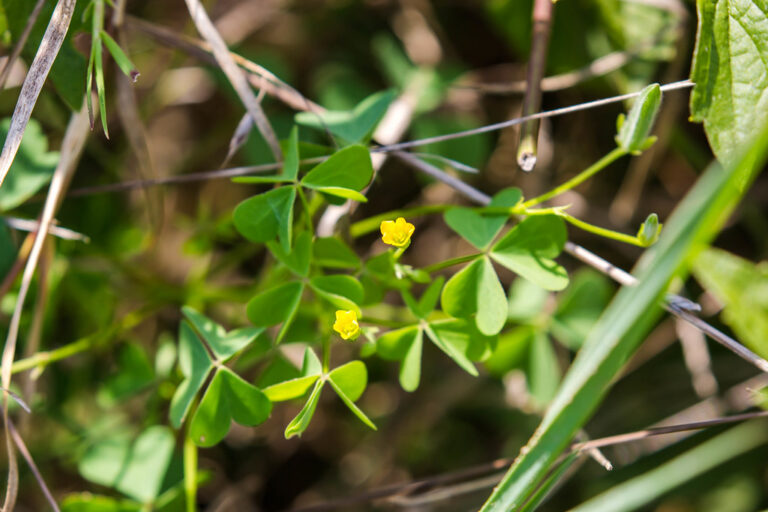
Yellow woodsorrel grows more upright than its relatives, usually 4 to 10 inches tall, per NC State TurfFiles. Leaflets are about 1/4 to 1/2 inch across and light green or reddish-green. Flowers are 1/4 to 1/2 inch wide. Below ground it has a taproot and slender white to pink rhizomes that make new plants at the nodes. It behaves as an annual in some places and a short-lived perennial in others.
Creeping woodsorrel (Oxalis corniculata)
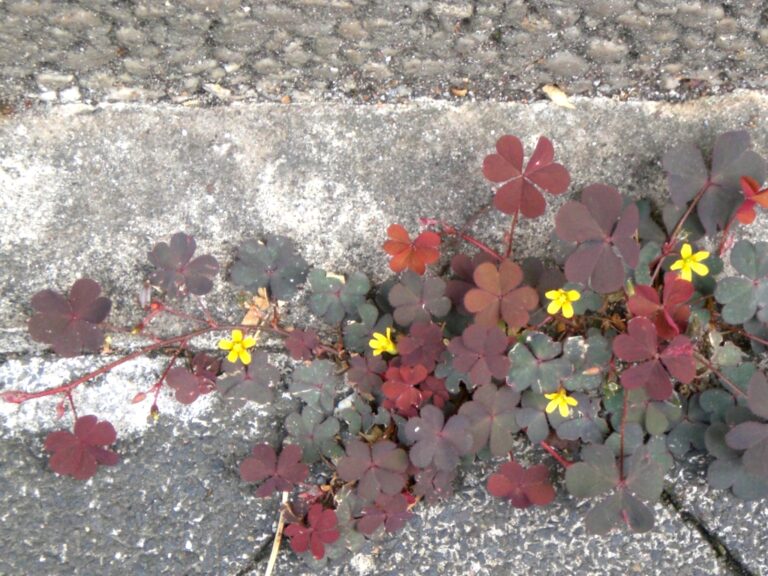
Creeping woodsorrel lies flatter and roots wherever its stems touch soil. Its leaves are often purple or bronze, though green forms are common. It is the one in pavement cracks, greenhouse pots and close-mown lawns: UC IPM reports that creeping woodsorrel survives and sets seed even when mowed as close as 1/4 inch. Mowing lower will not starve it.
Bermuda buttercup (Oxalis pes-caprae)
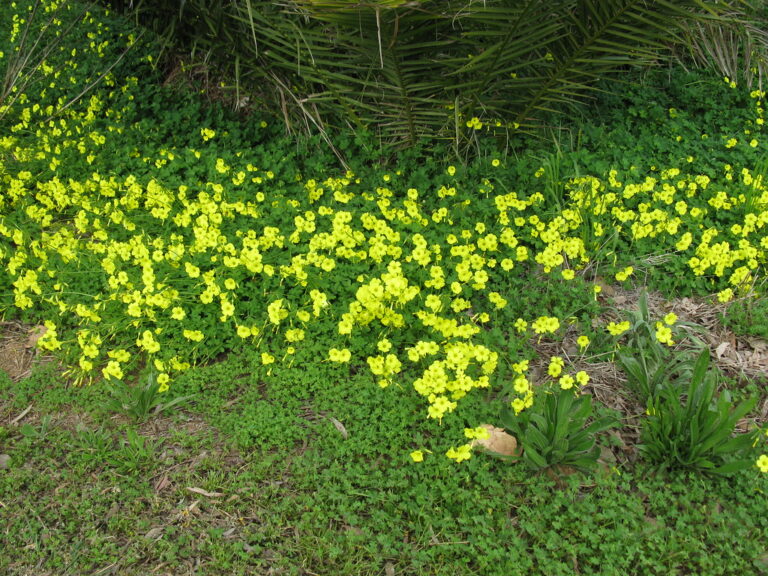
Bermuda buttercup is a bulb-forming oxalis that is a weed in mild-winter areas such as coastal California. Its flowers are much larger, 3/4 to 1 1/2 inches across on stalks 6 to 12 inches tall. It spreads mainly by bulbs: UC IPM says each plant makes about a dozen small bulbs a year, each under 1 inch long. Pulling the leaves leaves the bulbs behind, so it needs a different plan.
Oxalis vs clover vs black medic: comparison table
Most people first notice oxalis because they think their lawn is full of clover. This table sorts the common three-leaflet weeds with yellow or white flowers. For more yellow-flowered lawn weeds, see weeds with yellow flowers in lawns.
| Plant | Leaflets | Flower | Seeds | Spreads by |
|---|---|---|---|---|
| Yellow woodsorrel | Heart-shaped, notched tip; fold at night | 5 separate yellow petals, 1/4–1/2 inch | Upright capsule, 1/3–3/4 inch; explodes | Seed, rhizomes |
| Creeping woodsorrel | Heart-shaped; often purple | 5 yellow petals, smaller | Capsule, 10–50 seeds each | Seed, stems rooting at nodes |
| Bermuda buttercup | Heart-shaped, larger | Yellow, 3/4–1 1/2 inch | Not the main way it spreads | Bulbs and bulblets |
| Black medic | Oval, middle leaflet on a longer stalk | Tiny ball-shaped heads | Black coiled pods | Seed |
| White clover | Round to oval, often a pale V mark | White round heads | Small pods in the head | Seed, rooting stolons |
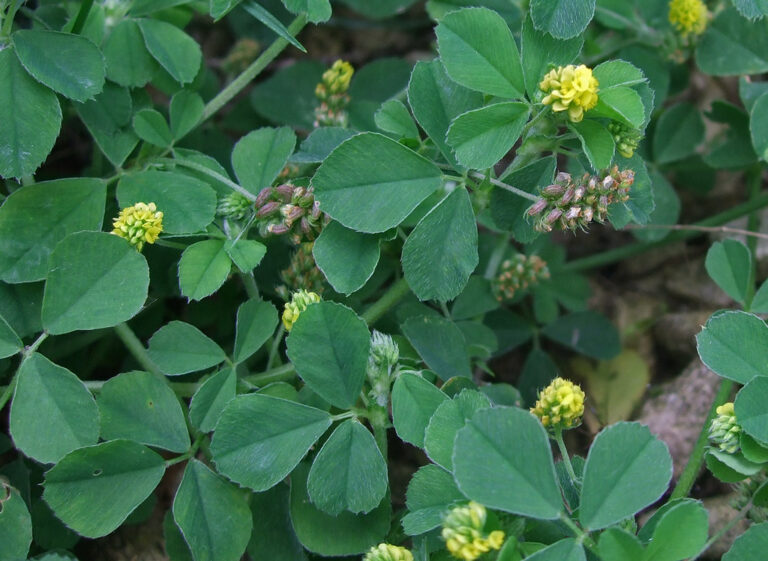
Black medic is the lookalike that fools most people, because it also has small yellow flowers. The difference is the flower: black medic has a tiny round cluster of florets, while woodsorrel has one open flower with five separate petals. If the plant in question turns out to be clover, read whether clover in a lawn is worth keeping before you spray.
Why oxalis keeps coming back
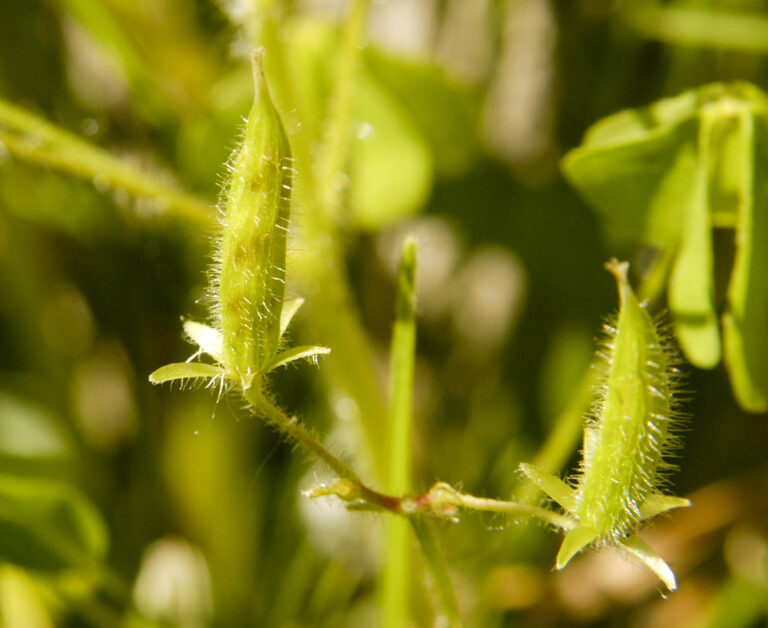
After the flowers fade, the plant forms narrow, upright seed capsules. When ripe they split and fling the seed. Extension services give different distances: up to 10 feet (UC IPM), up to 12 feet (University of Maryland Extension) and up to 16 feet (NC State Extension). Either way, touching a ripe plant while weeding sprays seed across the bed.
The biology works against you in four ways:
- Huge seed numbers. A single plant can produce up to 5,000 seeds in a year, and fresh seed can germinate at close to 100 percent soon after it drops, according to the University of Florida IFAS review of oxalis biology.
- Fast cycle. UC IPM reports that seedlings can begin flowering in about 4 weeks, so several generations fit into one season.
- Wide germination window. Most seed germinates between 50°F and 84°F (UF/IFAS), with an optimum of 60°F to 80°F (UC IPM). That covers most of spring and autumn in temperate gardens.
- Broken pieces regrow. When you pull creeping woodsorrel, UC IPM notes that the taproot or stolons often snap and stay in the soil, and those pieces grow into new plants.
There is one weakness to use: the seed needs light to germinate. Clemson Extension and UF/IFAS both point out that anything that keeps light off the soil surface, such as mulch or dense turf, cuts the number of new seedlings.
How to get rid of oxalis in lawns
In turf you are dealing mostly with yellow and creeping woodsorrel. Control has three parts: kill the plants that are there, stop new seedlings, and close the gaps.
1. Spot-spray with a selective broadleaf herbicide
Many lawn weed killers combine 2,4-D, MCPP and dicamba, and Maryland and Clemson list these for oxalis, but two active ingredients stand out. Kansas State University names triclopyr and fluroxypyr as the effective ones, and UC IPM calls them “extremely effective” on seedling and established creeping woodsorrel in cool-season lawns. Look for them on the label, often combined with other ingredients.
Grass type matters. UC IPM notes that triclopyr alone is not labelled for warm-season lawns, while fluroxypyr is safer there and still very effective. Clemson lists other options for southern lawns, including atrazine and sulfentrazone plus quinclorac, and warns that centipedegrass and St. Augustinegrass are sensitive to some formulations. Read the label for your grass before you buy.
Spray when the weed is young and actively growing, and expect a second pass. UC IPM says a follow-up application 3 to 6 weeks later may be needed for complete control. Spot treatment uses far less product than a blanket spray and is kinder to the rest of the lawn.
2. Use a pre-emergent where seedlings keep returning
Pre-emergent herbicides stop seedlings but do nothing to established plants or their rhizomes. For lawns, Penn State lists dithiopyr, pendimethalin, prodiamine and isoxaben. Clemson notes that most woodsorrel seed germinates in late winter and early spring, so the product must be down before then.
Timing is tighter than people think. In a 2013 Weed Technology study, isoxaben, indaziflam and dithiopyr cut yellow woodsorrel fresh weight by 95 percent or more when applied at the cotyledon to one-leaf stage. By the two- to four-leaf stage, only indaziflam still gave strong control. The trial was run in container nurseries, but the lesson carries over: a pre-emergent applied late does little.
For heavy infestations in California landscapes, UC IPM suggests up to three pre-emergent applications a year, in early fall, midwinter and late spring. Do not use a pre-emergent where you plan to seed grass soon; see killing weeds before overseeding for the waiting periods.
3. Thicken the lawn and clean the mower
Penn State, Clemson and NC State all say the same thing: dense, well-fed turf mowed at the right height leaves little room for woodsorrel seedlings. UC IPM adds a caution for creeping woodsorrel that is already established: extra fertiliser and water make the woodsorrel grow faster too, so feeding alone will not smother it. Use fertility to help grass fill the gaps after you have killed the weed.
UC IPM also recommends washing or blowing off the mower after cutting an infested area, because seed and clippings travel on the deck into clean turf. It takes two minutes and is often skipped.
How to get rid of oxalis in garden beds and pots
In vegetable plots and flower beds you usually cannot spray a lawn herbicide, so the approach is mechanical first.
- Weed early. UF/IFAS reports that hand-weeding works best on plants 6 weeks old or younger, before seed capsules form. Once capsules are present, bag the plants rather than composting them.
- Get the runners out. Loosen the soil with a fork and follow the pink rhizomes or rooting stems. UC IPM advises several weedings, because stem pieces break easily. Moist soil makes this much easier, per the University of Maryland.
- Mulch 2 to 3 inches deep. UC IPM recommends 2 to 3 inches of organic mulch or fabric to keep light off the seed. Thin mulch lets seedlings through; our guide to stopping weeds growing through mulch covers depth and edges.
- Solarize bad patches. For heavily infested bare ground, UC IPM suggests soil solarization for at least 4 consecutive weeks in the hottest part of summer. Moist heat helps: 4 hours at 97°F cut creeping woodsorrel germination by 96 percent in UC’s data.
- Check new plants. Woodsorrel rides in on nursery pots. Pull any seedlings with heart-shaped leaflets out of new pots before you plant them.
For woodsorrel in gravel, paving joints and rock gardens, where there are no crop roots to protect, see killing weeds in rock gardens and gravel beds. Vinegar and other contact sprays scorch the leaves but leave the taproot and runners alive, so expect regrowth; what horticultural vinegar really does explains why.
Controlling Bermuda buttercup
For small patches, UC IPM recommends repeatedly removing the whole plant and sifting the soil for bulbs and bulblets. This is slow work. Glyphosate can be used as a spot treatment in non-planted areas, but UC IPM points out that it is non-selective and will injure turf and ornamentals it touches.
Oxalis control options compared
| Method | Where | Works on | Limits |
|---|---|---|---|
| Triclopyr or fluroxypyr spot spray | Lawns (check grass type) | Seedlings and established plants | Often needs a repeat in 3–6 weeks |
| Pre-emergent (dithiopyr, prodiamine, pendimethalin, isoxaben) | Lawns, some beds | Seedlings only | Must go down before germination; blocks grass seeding |
| Hand-weeding with a fork | Beds, pots, small lawn patches | Young plants with runners | Broken pieces regrow; repeat several times |
| Mulch 2–3 inches | Beds | New seedlings | No effect on established plants |
| Solarization, 4+ weeks | Bare soil in hot summers | Seed near the surface | Needs strong sun; soil out of use |
| Vinegar or boiling water | Paving, gravel | Top growth | Roots and runners survive |
Is oxalis edible or toxic?
Woodsorrel leaves, flowers and green pods have a sharp, lemony taste, and NC State Extension lists them as edible. The same source warns that all parts contain soluble calcium oxalates. The risk is rated low, but eating large quantities can be harmful, and the plant is listed as a concern for cats, dogs and horses, with kidney damage possible if a lot is eaten. Treat it as a small garnish at most, never as a leafy green, and do not eat it from lawns that have been sprayed.
Where this applies
The germination and spraying windows above come mainly from the United States: cool-season lawns in the North and Midwest, warm-season lawns in the South, and California for Bermuda buttercup. In warm-season turf, check that a product is safe for your grass before use. In the tropics and the Southern Hemisphere, woodsorrel follows your own cool, moist season rather than calendar months. Herbicide registrations differ between countries and states, so use only products labelled for your site and grass type where you live.
A note from the agronomist’s side
The mistake I see most often with oxalis is weeding it at the wrong moment. People pull it in midsummer, when every plant is covered in ripe capsules, and the act of pulling throws the next crop across the bed. On farms I have worked with, the plots that stayed clean were the ones weeded every two to three weeks in spring, while the plants were still small and had no pods. Five minutes with a hand fork at that stage saves hours later. If you inherit a heavy infestation, accept that the first season is about stopping seed, not about a perfect bed.
FAQ
What kills oxalis down to the root?
In lawns, a selective herbicide containing triclopyr or fluroxypyr moves into the plant and controls established plants, often with a repeat application. In beds, careful forking out of the taproot and runners over several weedings is the most reliable method without chemicals.
Is oxalis bad for a lawn?
It does no direct harm, but it fills gaps that grass should occupy and spreads quickly by seed. A few plants in a thin lawn are a sign the turf needs thickening. More weed profiles are in our lawn weeds identification hub, and creeping lawn weeds with a different leaf shape are covered in how to get rid of creeping Charlie.
Related guides: Purslane: Weed or Vegetable? How to Identify, Control and Eat It Safely · How to Get Rid of Chickweed in a Vegetable Garden (and Keep It Gone) · How to Get Rid of Creeping Charlie (Ground Ivy) in Your Lawn
Sources
- UC Statewide IPM Program. Creeping Woodsorrel and Bermuda Buttercup: Pest Notes (Publication 7444).
- Penn State Extension. Lawn and Turfgrass Weeds: Yellow Woodsorrel (Oxalis stricta L.).
- Clemson Cooperative Extension, Home & Garden Information Center. Oxalis Control.
- Kansas State University Turf and Landscape. Yellow Woodsorrel (Oxalis stricta) Control.
- University of Maryland Extension. Oxalis (Yellow Woodsorrel) Weeds.
- NC State Extension Gardener Plant Toolbox. Oxalis corniculata.
- NC State TurfFiles. Yellow Woodsorrel.
- University of Florida IFAS Extension. Biology and Management of Oxalis (Oxalis stricta) in Ornamental Crop Production (ENH1253).
- Marble, S.C., Gilliam, C.H., Wehtje, G.R. and Samuel-Foo, M. (2013). Early postemergence control of yellow woodsorrel (Oxalis stricta) with residual herbicides. Weed Technology 27(2): 347–351.