
The yellow flowers you are most likely to find in a lawn belong to eight weeds: dandelion, catsear (false dandelion), yellow woodsorrel (oxalis), black medic, hop clover, birdsfoot trefoil, creeping buttercup and Indian mock strawberry. You can sort them in seconds by looking past the flower to the leaves: a rosette of toothed leaves means dandelion or catsear, three leaflets means oxalis, black medic, hop clover, buttercup or mock strawberry, and five leaflets means birdsfoot trefoil. Each one also hints at what is wrong with the lawn, which matters more for long-term control than the herbicide you choose.
If the flowers in your lawn are blue or violet instead, see our guide to lawn weeds with blue flowers. For weeds that hide among the grass blades without obvious flowers, see weeds that look like grass.
Quick identification chart
| Weed | Flower | Leaves | Life cycle | What it usually tells you |
|---|---|---|---|---|
| Dandelion | Single large head, 100–300 rays, one per hollow stalk | Rosette, deeply toothed, mostly hairless | Perennial, deep taproot | Thin turf; seed blowing in |
| Catsear | Smaller dandelion-like heads on branched, wiry stalks | Rosette, densely hairy, shallow lobes | Perennial, taproot | Thin, dry, low-fertility turf |
| Yellow woodsorrel | Five separate petals, 1/4–1/2 inch | Three heart-shaped leaflets | Annual or perennial | Gaps in the lawn in mid-summer |
| Black medic | Tiny round clusters of up to 50 florets | Three leaflets, middle one on a longer stalk | Annual (sometimes perennial) | Low nitrogen, compaction, drought |
| Hop clover | Larger, looser heads that fade brown and papery | Three leaflets | Winter annual | Dry, infertile, acidic soil |
| Birdsfoot trefoil | Pea-like flowers in a ring of 3–8 | Five leaflets | Perennial | Low fertility, mowing too short |
| Creeping buttercup | Glossy, 5–7 petals, 1/2–3/4 inch | Three lobed leaflets, often pale-spotted | Perennial, runners | Wet, poorly drained soil |
| Indian mock strawberry | Five yellow petals, then red fruit | Three toothed leaflets | Perennial, runners | Shade, moisture, close mowing |
Rosette weeds with dandelion-like flowers
1. Dandelion (Taraxacum officinale)
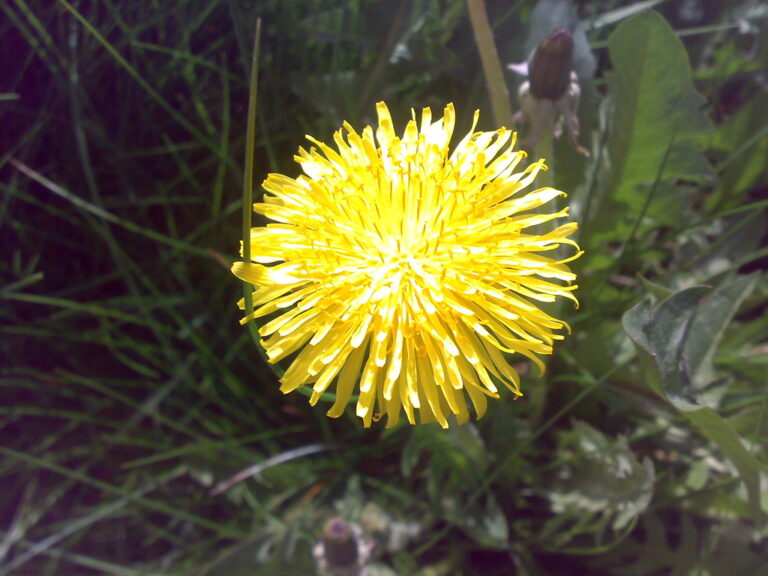
Each dandelion “flower” is a head of 100 to 300 small ray flowers on a single, unbranched, hollow stalk that can reach 6 to 24 inches. The leaves form a flat rosette with deep, backward-pointing teeth. What makes dandelion so persistent is underground: UC IPM reports that the taproot mostly sits in the top 6 to 18 inches of soil and that a root section as short as 1 inch can grow a new plant. That is why a plant snapped off at the surface comes back within weeks.
Control: Mowing does nothing, because the rosette sits below the blade. Hand removal works on a few plants if you use a long, narrow weeding fork after rain and take at least the top several inches of root; expect to repeat it. For a heavy infestation, a selective broadleaf lawn herbicide in early autumn gives the best kill (see the timing section below).
2. Catsear, or false dandelion (Hypochaeris radicata)

Catsear is the plant most people mistake for dandelion. The quickest check is to run your fingers over a leaf: catsear leaves are densely hairy and have rounded, shallow lobes, while dandelion leaves are nearly smooth with sharp teeth. Catsear also sends up one to fifteen wiry, branched flower stalks, each carrying one or more smaller heads, where dandelion has one head per stalk. According to NC State Extension, it blooms from mid-summer into early fall, can reach flowering size about two months after germination, and forms a rosette up to about a foot across.
Control: Dig it out below the crown in early spring, before it flowers. It responds to the same selective broadleaf herbicides as dandelion. Because it colonises thin, dry, poorly fed turf, thickening the grass is what stops it coming back.
Weeds with three leaflets (the clover lookalikes)
Four of the eight weeds here have leaves divided into three, and they are easy to confuse. Look at the leaflet shape and the seed heads.
3. Yellow woodsorrel, or oxalis (Oxalis stricta)

Oxalis is not a clover. Its three leaflets are distinctly heart-shaped and fold down at night or in hot sun, and each flower has five separate petals. After flowering it produces narrow, upright seed capsules that burst when touched. The University of Minnesota turf team notes that a single plant can produce more than 5,000 seeds a year, with 20 to 50 seeds per exploding pod, and that it germinates late, filling bare spots in mid-summer after most other weeds have already emerged.
Control: Standard 2,4-D products are often weak on oxalis. Kansas State University lists products containing triclopyr or fluroxypyr as the effective options. Pull small patches before the pods form, and close the mid-summer gaps by overseeding or keeping the mowing height up.
4. Black medic (Medicago lupulina)
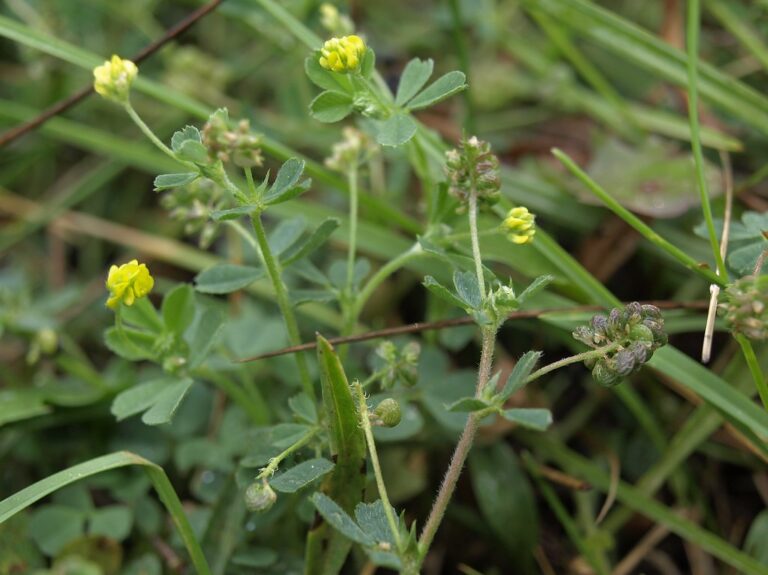
Black medic looks like a small yellow clover. The key feature is the middle leaflet: it sits on a noticeably longer stalk than the two side leaflets. Its flowers are tiny, packed into round clusters of up to 50, and each floret turns into a small, tightly coiled pod that goes black when ripe. It is a legume, so it fixes its own nitrogen, which is exactly why it wins in lawns that are underfed.
Control: University of Nevada, Reno Extension links black medic to low nitrogen, compacted and dry soil, and recommends mowing at about 3½ inches, relieving compaction by aeration and building a thick lawn. Young plants respond to 2,4-D plus dicamba products. The seed lives for several years, so expect a few seasons of seedlings even after the parent plants are gone.
5. Hop clover (Trifolium campestre and T. dubium)

Hop clovers are true clovers with yellow flowers. They are easy to tell from black medic once they flower: large hop clover carries 20 to 30 florets in a looser head, small hop clover 5 to 12, and as the flowers age they turn brown and fold back, so the head looks like a tiny dried hop. Black medic instead forms black, coiled pods. Virginia Tech describes both as winter annuals that tolerate acidic, droughty, infertile and eroded soils.
Control: Because it is a winter annual, hop clover germinates in autumn and dies after setting seed in late spring or early summer. Spray young plants in autumn, or accept it as a short-lived visitor and fix the soil: a soil test, lime if the pH is low, and regular feeding push it out.
6. Creeping buttercup (Ranunculus repens)
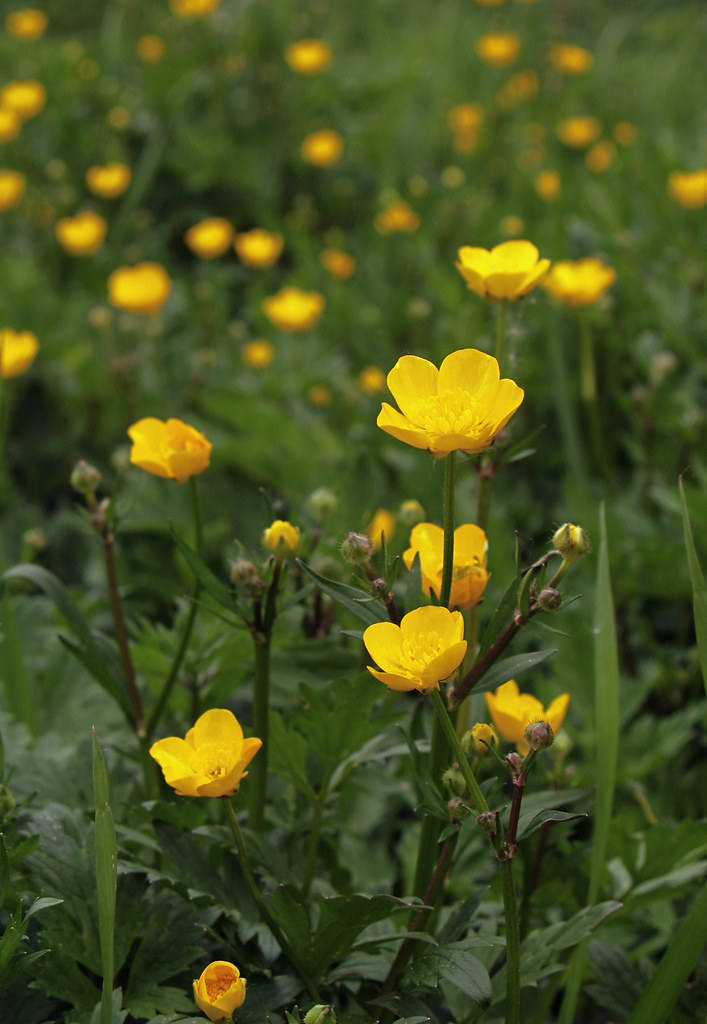
Creeping buttercup has glossy, bright yellow flowers about ½ to ¾ inch across with five to seven overlapping petals. The leaves are divided into three lobed leaflets, the middle one on a short stalk, and are often marked with pale spots. Penn State Extension describes how its runners root at every node along the soil surface, which is how one plant becomes a mat.
Control: This is the wet-lawn weed. Penn State recommends better drainage, less watering and stronger turf first, then a postemergence product combining 2,4-D with dicamba, triclopyr or fluroxypyr. Where it covers a low spot that stays soggy, no spray will hold it back for long until the drainage is fixed.
7. Indian mock strawberry (Potentilla indica, syn. Duchesnea indica)

Mock strawberry looks like a wild strawberry, but its five-petaled flowers are yellow rather than white, and its red fruit is bland and spongy. The leaves have three leaflets with rounded teeth. University of Maryland Extension notes that it tolerates shade and close mowing, prefers moist spots, and spreads by rooted runners that form a chain of new plants.
Control: Hand pull when the soil is moist, or use a selective broadleaf product with 2,4-D, MCPP, dicamba or triclopyr while it is actively growing. Maryland warns against spraying dicamba over the root zone of trees and shrubs, which matters because this weed usually lives under them.
A weed with five leaflets
8. Birdsfoot trefoil (Lotus corniculatus)
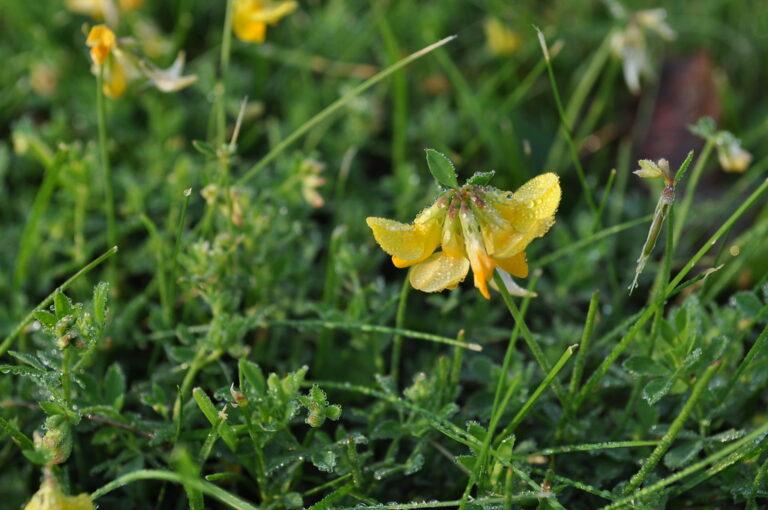
Birdsfoot trefoil has pea-shaped yellow flowers, often streaked with orange or red, held in a ring at the end of a stalk. Count the leaflets: there are five, three at the tip and two at the base of the leaf stalk, which separates it from every clover-type weed above. The seed pods spread out like a bird’s toes. It is a deep-rooted perennial legume that thrives in low-fertility lawns. Our full guide to birdsfoot trefoil in lawns covers how it spreads and the control options in detail.
When to treat yellow-flowered lawn weeds
The yellow flowers appear in spring, which is when most people reach for a sprayer, but spring is not the best time for the perennial ones. In autumn, dandelion and similar perennials move sugars down to their roots for winter, and a systemic herbicide travels with them. University of Illinois Extension calls September an excellent month for broadleaf control and gives these conditions:
- Air temperature between 55°F and 85°F (about 13–29°C).
- No rain expected within 24 hours, and a light breeze of no more than about 10 mph to limit drift.
- Do not mow for a few days before or after spraying, so there is enough leaf to absorb the product.
- Wait at least 30 days after spraying before you sow grass seed, and do not spray a new lawn until it has been mowed three or four times.
Annuals are different. Oxalis and black medic are easiest to kill as young plants in late spring and early summer, and hop clover as seedlings in autumn. If you plan to reseed thin areas this season, read whether to kill weeds before overseeding first, because many broadleaf herbicides delay germination. Many of these weeds also carry through winter as green rosettes; our guide to which weeds survive winter explains which ones.
Always follow the product label, check that it is safe on your grass type (some ingredients injure St. Augustine and centipedegrass), and check local rules, since some countries and cities restrict lawn herbicides. Non-selective home remedies kill the grass along with the weed; see what vinegar really does to weeds before trying it on a lawn.
A note from the agronomist’s side
On farms and trial plots I have worked with, the yellow-flowered weeds were more useful as a soil report than as a problem in their own right. A patch of black medic or hop clover almost always sat where the turf was starving or compacted; buttercup marked the low corner that stayed wet after rain. Spraying those patches cleared them for a season, but the same weeds came back to the same spots until the cause was dealt with. Before buying a herbicide, it pays to note which weed is where, take a soil test from each problem area, and fix fertility, compaction or drainage alongside any spray.
Frequently asked questions
What is the weed with little yellow flowers that looks like clover?
Usually black medic, hop clover or yellow woodsorrel. Heart-shaped leaflets and five-petal flowers mean oxalis; tiny round flower balls and black coiled pods mean black medic; larger heads that dry brown and papery mean hop clover.
How do I tell dandelion from false dandelion?
Feel the leaves. Dandelion leaves are smooth with sharp teeth and each hollow stalk carries one flower. Catsear (false dandelion) leaves are covered in hairs and its stalks branch and carry several smaller flowers.
Are yellow-flowered lawn weeds harmful?
Most are harmless to people and pets in a lawn, and black medic and the clovers feed pollinators and add nitrogen. Buttercups are an exception: they contain irritant compounds and are best kept out of areas grazed by animals. Whether to remove them is a choice about how you want the lawn to look; see also why grass won’t grow in the patches where they take over.
More weed profiles are in our lawn weeds identification hub.
Related guides: How to Get Rid of Oxalis (Yellow Woodsorrel) in Lawns and Garden Beds · Clover in Lawn: Should You Keep It or Kill It? · Why Do Dandelions Keep Coming Back? Roots, Seeds and How to Stop Them
Sources
- UC Statewide IPM Program. Dandelion: Pest Notes.
- NC State Extension Gardener Plant Toolbox. Hypochaeris radicata.
- University of Minnesota Turfgrass Science. Home Lawn Care Newsletter, September 2022 (black medic, yellow woodsorrel).
- Kansas State University Turf and Landscape. Yellow Woodsorrel (Oxalis stricta) Control.
- University of Nevada, Reno Extension. A Northern Nevada Homeowner’s Guide to Identifying and Managing Black Medic.
- Virginia Tech Crop and Soil Environmental Sciences. Do you know the hop clovers?
- Penn State Extension. Lawn and Turfgrass Weeds: Creeping Buttercup.
- University of Maryland Extension. Indian Mock Strawberry.
- University of Illinois Extension, Home, Yard and Garden Pest Newsletter. Fall Is Good Time for Broadleaf Weed Control in Turf.