
After a wet week you walk out with your coffee and there it is: a near-perfect circle of tan mushrooms marching across the lawn, as if someone laid them out with a compass. Or maybe it’s the opposite problem, and you’ve noticed a ring of grass that’s darker and faster-growing than everything around it, with a band of brown, crispy turf just inside. Both are fairy ring in grass, and both start with the same thing: a fungus living in the soil under your feet.
Short answer: Fairy ring in grass is caused by soil fungi (more than 60 species) that feed on buried organic matter such as old roots, stumps, lumber and thick thatch, and grow outward in a circle. You can’t kill the fungus with a quick fix, but you can make the ring disappear: mow off the mushrooms, mask dark green rings with an even feeding, and fix dead rings by breaking up the water-repellent soil, adding a wetting agent and soaking the ring deeply for several weeks. Fungicides help only as a preventive on lawns where rings return year after year.
In this guide you’ll learn how to tell the three types of fairy ring apart in under a minute, why the rings keep coming back, the exact watering-and-aeration routine extension pathologists recommend for dead rings, which fungicide active ingredients actually work (and when they’re a waste of money), and what to do right now in late fall so next summer’s lawn looks even.
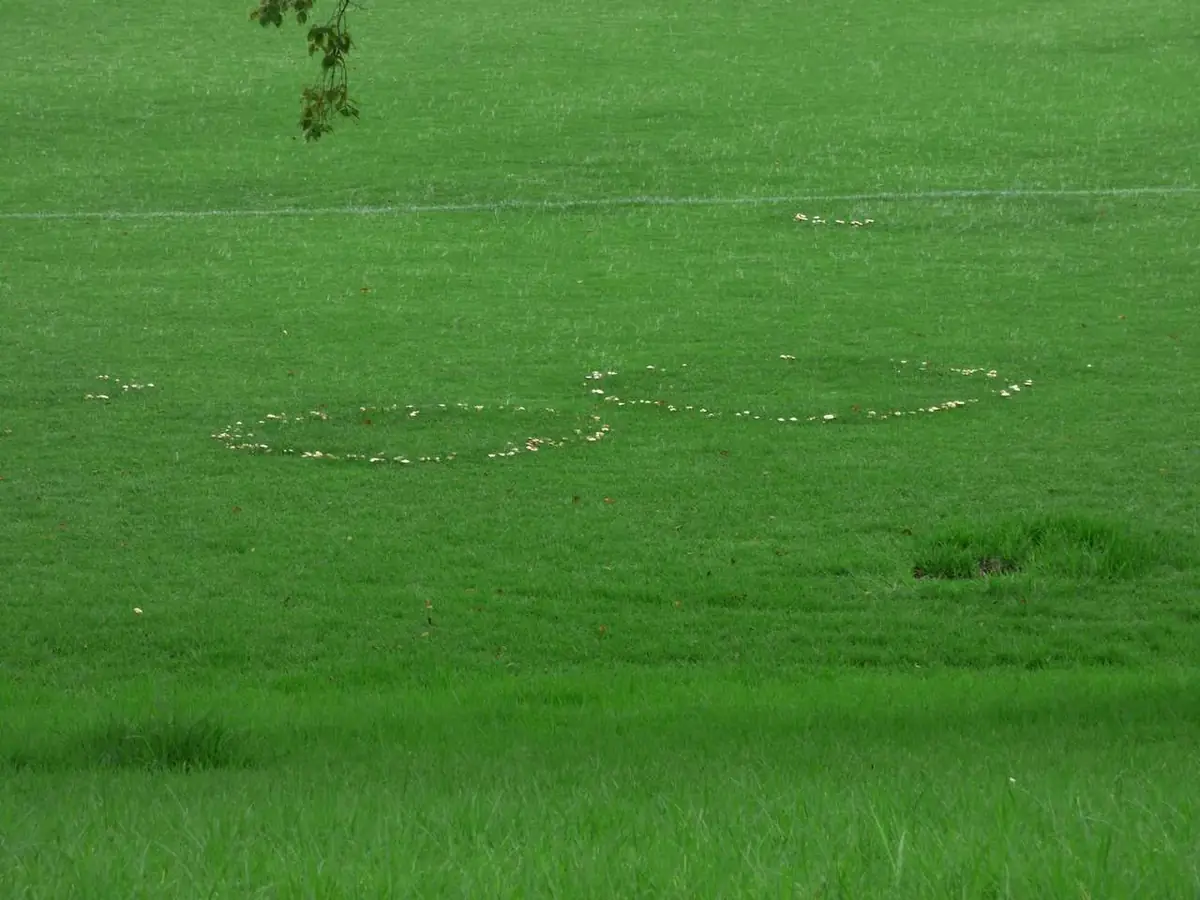
What Is Fairy Ring in Grass (and Why Is It a Circle?)
Fairy rings are not a classic lawn disease. The fungi responsible are basidiomycetes, the mushroom-forming group, and most of them never infect a single blade of grass. They live in the thatch and soil, digesting lignin, cellulose and other organic matter. The damage you see is a side effect of how they change the soil: what it holds, what it releases and how it handles water (University of Georgia Extension).
The circle comes from the way the colony grows. A fungus starts from a single spore or a scrap of mycelium and spreads outward evenly in every direction, a bit like mold spreading across a slice of bread. The center runs out of food and goes quiet, so only the advancing edge is active. That edge is where you see the mushrooms, the dark green band or the dead band (Kansas State Research and Extension).
Rings get bigger every year. The University of Georgia puts the average outward growth at 5 inches to 2 feet or more per year. The RHS says the classic fairy ring mushroom, Marasmius oreades, expands by about 1 foot (30 cm) a year, and in big, undisturbed turf a single colony can last for centuries. Researchers actually use ring diameter to estimate the age of M. oreades colonies (Hiltunen et al., 2021, Genome Biology and Evolution). When two rings meet, they inhibit each other instead of merging, which is why you sometimes see arcs and wavy lines instead of full circles (University of Arkansas).
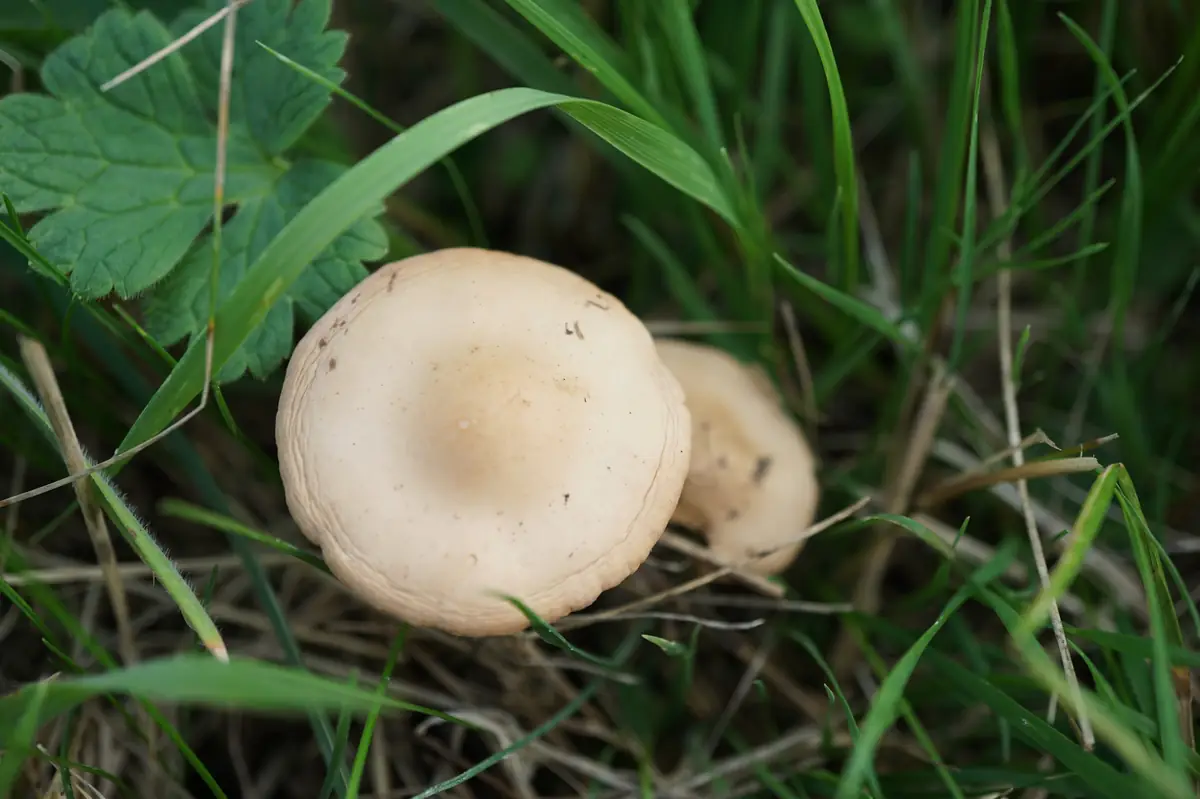
Common fairy ring fungi in US lawns include Marasmius, Chlorophyllum (also sold in older guides as Lepiota), Lycoperdon and Calvatia puffballs, Agaricus, Clitocybe and Tricholoma. Not every mushroom in your lawn is part of a fairy ring, though. If yours are scattered randomly rather than in a curve, read our guide to mushrooms in lawn instead.
How to Identify the 3 Types of Fairy Ring in Grass
This is the step most people skip, and it’s the reason so many fairy ring “treatments” fail. The three types need completely different fixes. Fertilizing a dead ring doesn’t help, and soaking a mushroom ring is pointless. Look at the turf in the band, not just at the mushrooms.
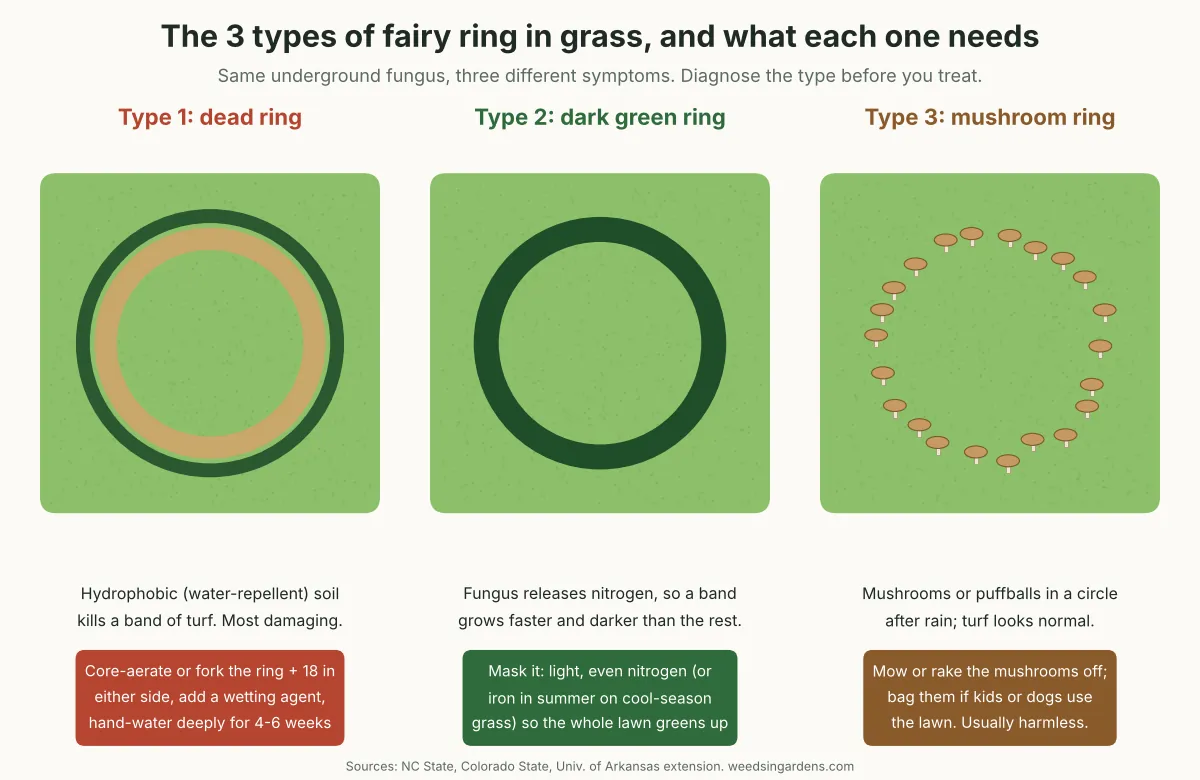
| Type 1 | Type 2 | Type 3 | |
|---|---|---|---|
| What you see | A band of thin, wilted or dead grass, often with a dark green band just outside it | A ring or arc of grass that is darker green and grows faster than the rest | A circle or arc of mushrooms or puffballs; the grass looks normal |
| What’s going on underneath | Fungal mycelium makes the soil and thatch hydrophobic (water-repellent); sometimes ammonium builds to toxic levels | The fungus breaks down organic matter and releases nitrogen and other nutrients | The fungus is fruiting; it’s producing spores, usually after rain |
| When it shows up | Hot, dry summer weather | Hot, dry weather; most obvious in underfed lawns | Wet spells, often spring or late summer and fall |
| How serious | Most damaging: turf can die | Cosmetic | Cosmetic (watch pets and kids) |
| Main fix | Break up the soil, add a wetting agent, deep-soak | Mask with an even feeding | Mow or rake off the mushrooms |
Table synthesized from NC State Extension, Colorado State University Extension and University of Arkansas FSA7539.
The 30-second screwdriver test
Not sure whether a brown ring is Type 1 or plain drought? Push a long screwdriver or soil probe into the brown band, then into healthy turf a couple of feet outside the ring. In a Type 1 ring, the soil under the dead grass is dry and hard while the soil next to it is moist (UF/IFAS). Dig out a small wedge and you may also see, or smell, a dense white, cobweb-like mat of mycelium in the thatch and top few inches of soil. Kansas State notes this white layer is sometimes visible right below the ring.
One more thing to keep in mind: the type can change through the season. A Type 2 ring can turn into a Type 1 ring in a hot, dry spell (UGA Extension), and the same ring can throw up mushrooms after a rainy week in fall. So note what you see each time; it tells you which fix to use at that moment.
Fairy ring look-alikes
- Brown patch or large patch: circular patches too, but the grass blades themselves have lesions, and the patch is brown in the center rather than ring-shaped with healthy turf inside.
- Dog urine spots: a small brown center with a lush green halo; they appear where the dog goes and don’t expand year after year.
If you’re seeing general browning this time of year rather than a clear circle, our guide to lawn turning brown in fall walks through the other causes, and our lawn problems hub covers the rest.
What Causes Fairy Rings in Lawns?
Fairy ring fungi drift in on airborne spores all the time, so the real question is why fairy ring in grass shows up in your lawn and not the neighbor’s. The answer is food and stress. These fungi feed on dead wood and organic matter, and they cause the most visible damage when the grass is already short of water or nitrogen.
| Risk factor | Why it matters | What to do |
|---|---|---|
| Buried stumps, roots, construction lumber | A long-lasting food source; fairy rings are common where trees once stood | Remove woody debris before seeding or sodding |
| Thick thatch | Thatch feeds the fungus and is easily made water-repellent | Core-aerate; dethatch if the layer is thick |
| Under-watering and drought stress | Turns hydrophobic soil into dead turf | Water deeply and less often; hand-water dry rings |
| Low nitrogen | Makes Type 2 dark-green bands stand out | Soil test and fertilize per local recommendations |
| Sandy or light-textured soil | Becomes water-repellent more easily | Wetting agents; topdress with compost |
| Poor drainage, heavy rain | Triggers mushroom flushes (Type 3) | Fix drainage; don’t over-irrigate |
Sources: CSU Extension, NC State, University of Arkansas, UGA.
One honest caveat: some lawns are simply in the wrong spot. The University of Arkansas notes that in home lawns, fairy rings are often seen where trees and stumps once stood. A lot built on a cleared woodlot can grow rings for years while the old roots rot away. You can’t speed that up much, but you can stop the rings from killing grass while it happens.
How to Get Rid of Fairy Ring in Grass: The Plan for Each Type
Here’s the part that surprises people: removing the fungus completely is rarely realistic, and extension pathologists don’t recommend trying in a home lawn. The goal is to make the ring invisible and keep the grass alive. UF/IFAS notes that rings often fade on their own, though it may take up to five years. Most of what follows speeds that up and protects the turf in the meantime.
Type 3 (mushrooms only): mow, rake, move on
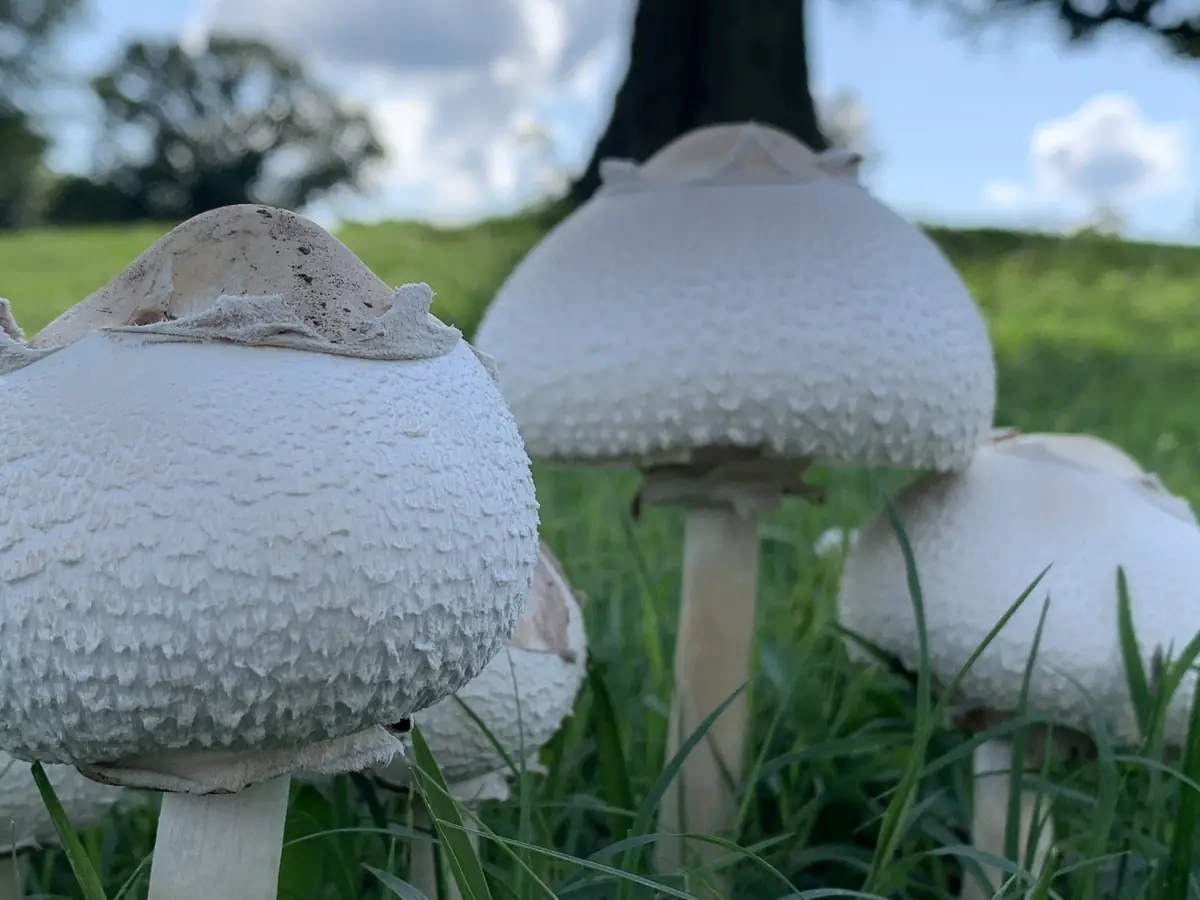
A mushroom ring with healthy grass is the easiest kind. Mow the mushrooms down or rake them up (University of Arkansas). That doesn’t weaken the fungus, but it isn’t hurting your grass either. Do bag them if children or dogs use the lawn, because some fairy ring mushrooms are poisonous, including Chlorophyllum species, which are among the most common fairy ring fungi in southern lawns (UF/IFAS). Never eat a lawn mushroom unless an expert has identified it in person.
Type 2 (dark green ring): mask it
The dark ring is extra nitrogen the fungus has freed up. You can’t take it away, but you can make the rest of the lawn match. A light, even application of nitrogen across the whole lawn greens up the surrounding turf so the ring blends in (NC State). Get a soil test first so you’re correcting a real deficiency rather than guessing.
Use caution on cool-season grass in summer. NC State warns that too much nitrogen in hot weather can lead to more serious diseases, so they suggest iron instead, which darkens the color without pushing soft growth. In fall, a normal fall feeding on cool-season lawns does the masking job on its own.
Type 1 (dead ring): re-wet the soil
This is the one that needs real work. The grass is dying of thirst because water runs off or around the water-repellent layer instead of soaking in. Watering the whole lawn more won’t fix it; you need to get water into the ring itself. Here’s the routine, pulled together from the CSU, Arkansas, UF and NC State recommendations:
- Mark the ring. Flag the dead band and about 18 inches on either side of it. The fungus is active beyond the visible symptoms (CSU Extension).
- Open the soil. Core-aerate the marked area, or for a small ring, push a garden fork or pitchfork in every few inches. This breaks through the water-repellent layer (UF/IFAS).
- Apply a soil wetting agent (surfactant). Use a lawn wetting agent labeled for turf and follow the label rate. It helps water spread through hydrophobic soil instead of beading on it.
- Soak deeply and repeat. Keep the ring area moist for 4–6 weeks (CSU). The University of Arkansas recommends soaking the area to a depth of 1–2 feet at weekly intervals for 4–6 weeks. A soaker hose laid around the ring, or a hose-end root feeder pushed in on both sides of the ring, is the easiest way to do it.
- Water only the ring. Hand-water so you don’t overwater the healthy turf around it (NC State). Overwatered lawns bring their own problems; see our guide to an overwatered lawn.
- Reseed bare spots once the soil wets normally. In fall, overseed cool-season lawns, or plan a dormant seeding if it’s already too cold for germination.
Last resort: dig it out or till it
For a ring that kills grass every summer despite all of the above, there are two aggressive options. The first is excavation. The RHS says removing the turf and soil of the active ring to at least 1 foot (30 cm) deep and replacing it with fresh soil can work in principle, but it’s usually impractical for large rings, and rings tend to come back if buried wood remains (University of Arkansas; UF/IFAS).
The second is tilling. CSU Extension reports some success with stripping the sod in the ring, rototilling the soil in several directions to break up the fungal mat, irrigating to stimulate other soil microbes, and leaving the area bare for at least a month before reseeding. CSU prefers seed over sod here, because fairy ring fungi can come in on sod. If you dig up a chunk of buried lumber or a rotting stump while you’re at it, that’s the real win.
Fungicides for Fairy Ring: What Works and When It’s Worth It
Fungicides are where most homeowners spend money on fairy ring in grass and get the least back. The University of Missouri states plainly that fungicides are not recommended for fairy ring control in lawns, and the University of Arkansas calls them usually not practical for homeowners. Two reasons: first, a curative spray does nothing to the water-repellent soil that is actually killing the grass. Second, more than 60 species cause fairy rings, and they vary in how sensitive they are to fungicides (NC State).
Where they do earn their keep is as a preventive on a lawn that grows the same rings every year. NC State recommends starting a preventive program in spring when mean daily soil temperatures are consistently above 55°F, and UGA puts the window at a 5-day average of 55–60°F at a 2-inch (5 cm) depth.
| Active ingredient (FRAC group) | Example products | Home-lawn use? | Notes |
|---|---|---|---|
| Azoxystrobin (11) | Scotts DiseaseEx (granular); Heritage | Yes: DiseaseEx is sold for home lawns | The Arkansas MP154 guide lists DiseaseEx at 4 lb per 1,000 sq ft, repeated at 14–28-day intervals. Check your bag’s label. |
| Flutolanil (7) | ProStar | Sold mainly to turf professionals | Rated among the most effective in NC State’s fairy ring table |
| Metconazole and other DMIs (3) | Tourney | Sold mainly to turf professionals | Strong on puffball rings; UF warns DMIs can injure bermudagrass |
| Pyraclostrobin (11), triticonazole (3) | Various | Check label | Listed as effective by UF/IFAS |
| Polyoxin D (19) | Affirm | Sold mainly to turf professionals | Lower efficacy rating in NC State trials |
Sources: NC State fungicide table, UF/IFAS LH046, University of Arkansas MP154 Home Lawn Diseases. Listing a product isn’t an endorsement. Always follow the label, which is the law, and check that your grass type and a residential lawn are listed sites.
How to apply a fairy ring fungicide so it actually reaches the fungus
The fungus lives in the thatch and soil, not on the leaves, so a fungicide that dries on the grass blades does almost nothing. NC State reports excellent research results from spraying in 2 gallons of water per 1,000 sq ft and following immediately with 1/8 to 1/4 inch of irrigation, before the spray dries. Missouri adds that if you apply curatively, tank-mix a surfactant. For granular products, water them in right after spreading as the label directs.
- Don’t apply in the heat of the day to drought-stressed turf.
- Don’t use DMI fungicides on bermudagrass unless the label clearly allows it, because of the injury risk UF flags.
- Rotate FRAC groups if you treat more than once a season.
- Keep fungicides off hard surfaces and out of storm drains.
Fairy Ring Treatment Calendar: What to Do This Fall and Next Spring
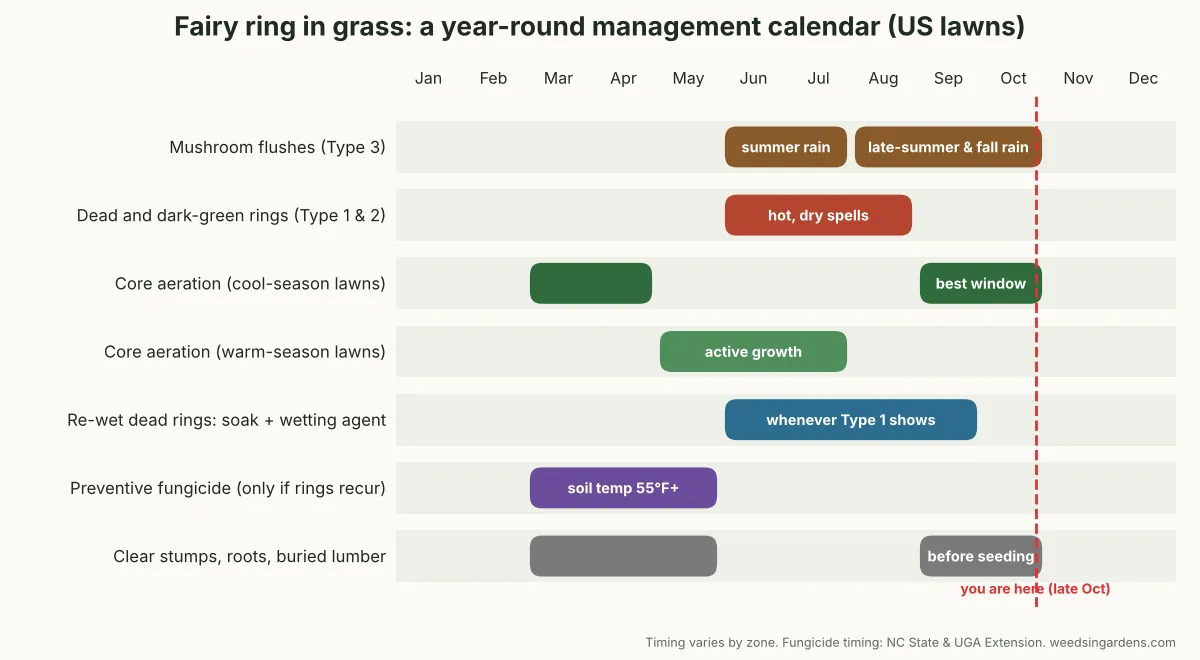
Fairy ring is a summer problem with a fall-and-spring solution. Symptoms peak in hot, dry weather, and mushroom flushes follow rain. The most useful work happens when the grass is actively growing and can recover from aeration. The calendar above shows the full year; here’s the short version for cool-season and warm-season lawns.
| Season | Cool-season lawns (fescue, bluegrass, ryegrass) | Warm-season lawns (bermuda, zoysia, St. Augustine) |
|---|---|---|
| Late fall (now) | Core-aerate rings if the ground isn’t frozen; overseed thin spots or plan dormant seeding; mow off any mushrooms | Grass is going dormant: mark where rings were, dig out any buried wood you find, mow off mushrooms |
| Winter | Nothing to treat; plan stump or debris removal | Same; soil test so you can fertilize correctly in spring |
| Spring | Preventive fungicide only if rings recur, starting at soil temperatures of 55°F or higher; mask Type 2 with balanced feeding | Preventive fungicide only if needed; begin aeration once the grass greens up |
| Summer | Watch for Type 1; re-wet with fork + wetting agent + 4–6 weeks of soaking; use iron, not heavy N, for masking | Core-aerate during active growth; re-wet dead rings; mask Type 2 with nitrogen |
| Late summer–fall | Prime aeration and overseeding window | Mushroom flushes after rain: mow or rake them off |
If you’re cleaning up the lawn for winter anyway, our guides to the last mow of the season and dethatching cover the other jobs that also cut down the thatch fairy rings feed on.
A Note from the Agronomist’s Side
Read the extension literature on fairy ring side by side and the striking thing is how much it agrees. Every university, from Florida to Colorado to the RHS in Britain, ends up in the same place: fairy ring in grass is a soil-water problem wearing a fungus costume. That reframing changes what you spend money on.
Think about it from the grass plant’s point of view. In a Type 1 ring, the roots sit in soil that sheds water like a waxed jacket. You could spray the best fungicide on the market, and the soil would still be water-repellent the next morning. That’s why the recommended fix is mechanical and boring (holes, a wetting agent, slow water, repeated for weeks) and why it works when sprays don’t. If you remember one thing, remember the screwdriver test: dry soil under a dead ring means you water the ring, not the lawn.
The second point is about expectations. A homeowner’s instinct is to eliminate the problem. With fairy ring, eliminating means removing the food source, and that food is often a decades-old root system or the builder’s offcuts under your lawn. You can’t get at those without digging. So the professional mindset is management: keep thatch thin, keep nitrogen and water even so the ring has nothing to stand out against, and re-wet the dead spots before they spread. Do that for two or three seasons and most rings fade into the background.
Finally, a quick word on budget. Of all the options, a garden fork, a bottle of wetting agent and a soaker hose cost the least and fix the most damaging type. Fungicides sit at the other end: priced per application, needed every year, and only preventive. They make sense on high-value turf or for a ring that keeps killing the same strip of grass despite good cultural care. They don’t make sense for a ring of mushrooms that will be gone after the next mow.
Common mistakes that keep fairy rings coming back
- Treating the mushrooms instead of the soil. Picking mushrooms doesn’t weaken the colony; it only prevents spores and protects pets.
- Spraying fungicide curatively on a dead ring. It doesn’t re-wet the soil, which is what’s killing the grass.
- Watering the whole lawn harder. The healthy turf gets soggy, and the hydrophobic ring still stays dry.
- Heavy nitrogen on cool-season grass in summer. It invites worse diseases; use iron for color instead.
- Patching with sod straight away. CSU notes fairy ring fungi can come in on sod; seed is preferred after tilling.
- Leaving the stump. If an old stump or roots are under the ring, it will keep feeding the fungus for years.
FAQ
Is fairy ring in grass bad for your lawn?
Usually not. Type 3 rings (mushrooms only) and Type 2 rings (dark green bands) are cosmetic. Type 1 rings are the harmful kind, because the fungus makes the soil water-repellent and the grass in the band dies of drought stress. Even then, re-wetting the soil usually brings the turf back.
Will fairy rings go away on their own?
Often, yes, but slowly. UF/IFAS says rings may disappear naturally but it can take up to five years. Rings fed by buried stumps or lumber can persist much longer, because the fungus keeps finding food.
Does baking soda, dish soap or vinegar get rid of fairy rings?
No extension source recommends these. Dish soap is not formulated or labeled as a turf wetting agent, and vinegar burns grass. Use a lawn wetting agent labeled for turf, plus aeration and deep watering, which are the methods the research supports.
Are fairy ring mushrooms poisonous to dogs?
Some are. UF/IFAS warns that Chlorophyllum, a common fairy ring mushroom in southern lawns, is poisonous. Because it’s hard to identify mushrooms reliably, mow or rake them up and bag them if dogs or children use the lawn, and call your vet or a poison control center if a pet eats one.
What is the best fungicide for fairy ring?
In NC State’s ratings, flutolanil and several DMI fungicides such as metconazole are among the most effective, and azoxystrobin is also effective. For homeowners, a granular azoxystrobin product labeled for fairy ring is the most accessible option. All of them work best as preventives applied in spring and watered in.
Should I dig out a fairy ring?
Only as a last resort. Removing the turf and soil to at least 1 foot deep and replacing it with clean soil can work, but it’s hard work and the ring often returns if buried wood remains. Try aeration, a wetting agent and deep watering for a full season first.
Can you prevent fairy rings?
You can reduce them. Remove stumps, roots and lumber before seeding or sodding, keep thatch thin with yearly core aeration, water deeply when the lawn is dry, and fertilize based on a soil test. CSU Extension recommends core-aerating at least once a year.
Sources
- NC State Extension, TurfFiles. Fairy Ring in Turf. North Carolina State University.
- Martinez, A., Sosa, S., and Ghimire, B. (2025). Fairy Ring in Turfgrass: Identification and Control in Georgia (Circular 1346). University of Georgia Extension.
- Elliott, M. L., and Harmon, P. F. Fairy Rings (LH046). UF/IFAS Extension, University of Florida.
- Vann, S. Fairy Ring of Turfgrass (FSA7539). University of Arkansas Division of Agriculture.
- University of Arkansas Division of Agriculture. MP154 Arkansas Plant Disease Control Products Guide: Home Lawn Diseases.
- Colorado State University Extension, PlantTalk Colorado. 1400-21 Fairy Rings.
- University of Missouri Extension, Turfgrass Science. Fairy Ring disease profile.
- Kansas State Research and Extension. Fairy Rings in Turfgrass (EP155).
- Royal Horticultural Society. Fairy rings.
- Hiltunen, M., Ament-Velásquez, S. L., and Johannesson, H. (2021). The assembled and annotated genome of the fairy-ring fungus Marasmius oreades. Genome Biology and Evolution, 13(7), evab126.