
You glance out the kitchen window on a cool October morning and something is off. The lawn that looked fine in September now has tan streaks, a few straw-colored circles, or a whole front yard fading to the color of a paper bag. The neighbor’s grass still looks green. Is yours dying?
Short answer: A lawn turning brown in fall is usually caused by one of three things: normal winter dormancy in warm-season grasses such as bermuda and zoysia, a dry fall that pushes grass into drought dormancy, or a fall-active problem such as large patch disease, white grubs or fall armyworms. Uniform browning after the first frost is normal; circles, patches and turf that peels up like carpet are not. The fix depends on which one you have, so diagnose before you spray, seed or fertilize.
This guide walks you through that diagnosis step by step. By the end you’ll be able to read the browning pattern, run two 30-second tests, match what you see to one of eight causes, and know exactly what to do this fall and what to leave until spring.
Why Is My Lawn Turning Brown in Fall? Start With Your Grass Type
Before you look at a single brown blade, answer one question: is your lawn a warm-season grass or a cool-season grass? Almost every fall-browning decision hangs on it.
Warm-season grasses (bermudagrass, zoysiagrass, centipedegrass, St. Augustinegrass, bahiagrass) are built to go brown in winter. University of Georgia Extension notes that their active growth slows at the end of August and the lawn enters dormancy as days shorten and nights cool (UGA Extension). A killing frost then browns the leaf blades. That is not damage; it is the plan.
Cool-season grasses (tall fescue, Kentucky bluegrass, perennial ryegrass, fine fescues) are the opposite. Fall is their best season, so a cool-season lawn turning brown in September or October is telling you something is wrong: usually water, insects, disease or injury.
Not sure which you have? Our guide to identifying the grass types in your lawn shows the leaf and growth-habit differences. Many transition-zone lawns are mixed, which is exactly why some yards go patchy brown in fall: the bermuda is going dormant while the fescue stays green.
| Grass group | Common grasses | Is fall browning normal? | What browning usually means |
|---|---|---|---|
| Warm-season | Bermuda, zoysia, centipede, St. Augustine, bahia | Yes, after the first frosts | Dormancy, or large patch if it shows up as circles |
| Cool-season | Tall fescue, Kentucky bluegrass, ryegrass, fine fescue | No; fall is peak growing season | Drought, grubs, armyworms, brown patch, dog urine or traffic |
| Mixed (transition zone) | Bermuda invading fescue, or zoysia patches | Partly | The warm-season grass is going dormant in patches |
How to Diagnose Brown Grass in Fall: Read the Pattern, Then Test It
Here’s the mistake most people make: they see brown, buy a bag of something, and apply it to the whole yard. The browning pattern alone eliminates half the possible causes, and two quick hands-on tests eliminate most of the rest.
Step 1: Look at the pattern
| What you see | Most likely cause | Go to |
|---|---|---|
| Whole warm-season lawn fades evenly after frost; may look striped for a few days | Normal dormancy | Cause 1 |
| Sunny, sloped or sandy areas brown first; footprints stay visible | Drought stress | Cause 2 |
| Circles 1 to 3+ feet across in zoysia, centipede or St. Augustine | Large patch disease | Cause 3 |
| Irregular tan patches in tall fescue with lesions on the blades | Brown patch disease | Cause 4 |
| Irregular dead areas; turf lifts like a loose rug; skunks or birds digging | White grubs | Cause 5 |
| Large areas brown almost overnight in late summer or early fall | Fall armyworms | Cause 6 |
| Round spots 6 to 12 inches across, often with a dark green ring | Dog urine | Cause 7 |
| Grayish cast after mowing; ragged blade tips; dark footprints after frost | Mowing or traffic injury | Cause 8 |
Step 2: The tug test
Grab a handful of brown grass at the edge of the damage and pull gently. If it resists and the crowns look firm and white or tan at the base, the plant is alive (dormant or stressed). If the turf lifts easily with few or no roots attached, something has eaten the roots, and grubs move to the top of the suspect list.
Step 3: The leaf check
Pick up a few blades from the edge of a patch, where brown meets green. Spots or tan lesions with darker borders point to disease. Torn, shredded tips point to a dull mower blade. Blades chewed away to the stems point to caterpillars. Clean, intact blades that are simply dry and folded point to water stress.
8 Causes of a Lawn Turning Brown in Fall (and the Fix for Each)
Work through these in order. They’re arranged roughly from “relax, it’s normal” to “act this week”.
1. Normal dormancy in warm-season grass
If you have bermuda, zoysia, centipede or St. Augustine and the browning arrived with the first cold nights, you are almost certainly looking at dormancy. Virginia Tech Extension describes how early frosts often don’t blight the whole canopy evenly, leaving a random green-and-brown “leopard” or “zebra” pattern that lasts a few days; later frosts turn the whole lawn uniformly brown and dormant, and there is no cause for concern (Virginia Tech Extension).
What to do: nothing dramatic. The important part is what you don’t do. UGA Extension advises stopping nitrogen on warm-season lawns, because fertilizing in September can delay dormancy and leave the grass open to frost and freeze injury; a final nitrogen feeding is acceptable from August to very early September (UGA). Fall nitrogen also sets bermuda up for spring dead spot. Keep mowing at the normal height until growth stops, and if winter turns very dry, see our notes on watering grass in winter.
If yours is bermuda that looks bleached rather than tan, our article on bermuda grass turning white covers the other causes of pale color.
2. Fall drought and drought dormancy
A cool-season lawn turning brown in fall after a dry September or October catches people out because the air is cool and the lawn “shouldn’t” need water. But cool-season grass is actively growing in fall and still uses it. Drought stress usually starts on south-facing slopes, sandy spots and strips beside driveways and sidewalks, where pavement adds heat.
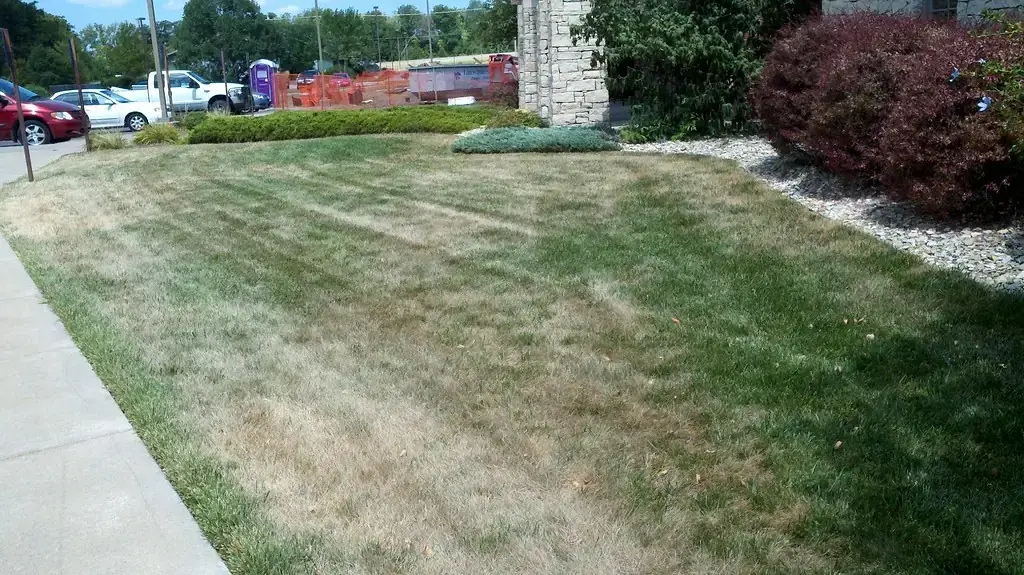
The good news: brown is not dead. NC State Extension notes that turf going brown during drought does not mean it is dead. In one heat and drought experiment, every tall fescue cultivar tested recovered after 40 days without water, and most survived 48 days, regrowing from the crown once watering resumed (NC State TurfFiles).
What to do: either water properly or let it go dormant on purpose, but don’t flip between the two. To keep a dormant lawn’s crowns alive, NC State suggests watering every three to four weeks with at least 0.5 inch. If you’d rather keep it green, water deeply and less often rather than a little every day. Hold off on fertilizer until the grass is growing again; NC State recommends slow-release nitrogen at no more than 0.5 lb N per 1,000 sq ft during recovery. For a full rescue plan, read how a lawn recovers from drought.
3. Large patch disease (warm-season lawns)
If the browning on your zoysia, centipede or St. Augustine lawn shows up as rough circles rather than an even fade, think large patch, caused by the fungus Rhizoctonia solani. NC State Extension lists centipedegrass and seashore paspalum as most susceptible, then zoysiagrass, then St. Augustinegrass; bermudagrass is rarely affected, and fescues and bluegrasses are immune (NC State Extension).
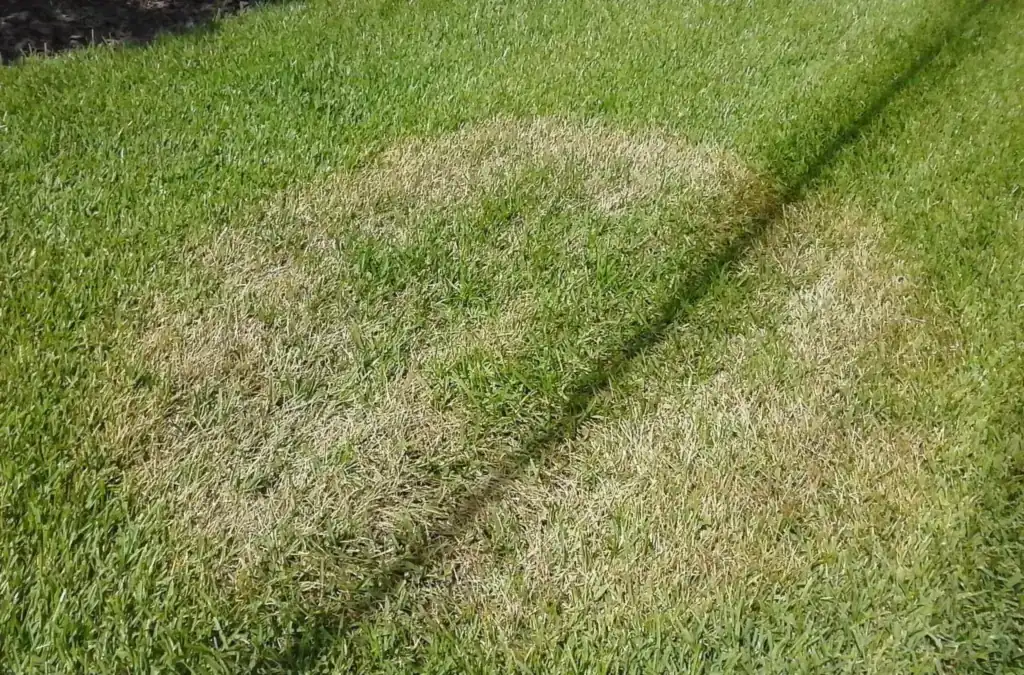
Key ID features from the same publication:
- Patches from about 1 foot to more than 3 feet across, often expanding through fall.
- Tan, yellow, orange or red lesions on the leaf sheaths, near the soil, where the blade wraps the stem.
- No root or crown rot, so the grass stays anchored (unlike grubs).
- Disease starts as soil temperatures drop to 70°F in fall, and symptoms are most obvious in cool, wet fall and spring weather.
What to do: fix the conditions first. NC State advises no nitrogen within 6 weeks before fall dormancy, irrigating only as needed to prevent severe drought stress, and correcting soggy low spots, compaction and thatch. If large patch is a repeat problem, preventive fungicide timing matters more than the product: start on zoysia when soil temperatures fall to 70°F for 5 or more consecutive days, and on centipede and St. Augustine when they fall to 80°F. Two well-timed applications may give season-long control (see the treatment table below). Patches that show up now often stay visible until spring green-up; that’s normal.
4. Brown patch disease (cool-season lawns, early fall)
Brown patch is the cool-season cousin of large patch and is caused by the same fungus group. It is mainly a hot-weather disease, but a warm, humid September can keep it going. NC State reports that it can develop when night temperatures exceed 60°F, is worst when lows are above 70°F and highs above 90°F, and needs leaves to stay wet for at least 10 to 12 hours (NC State TurfFiles).
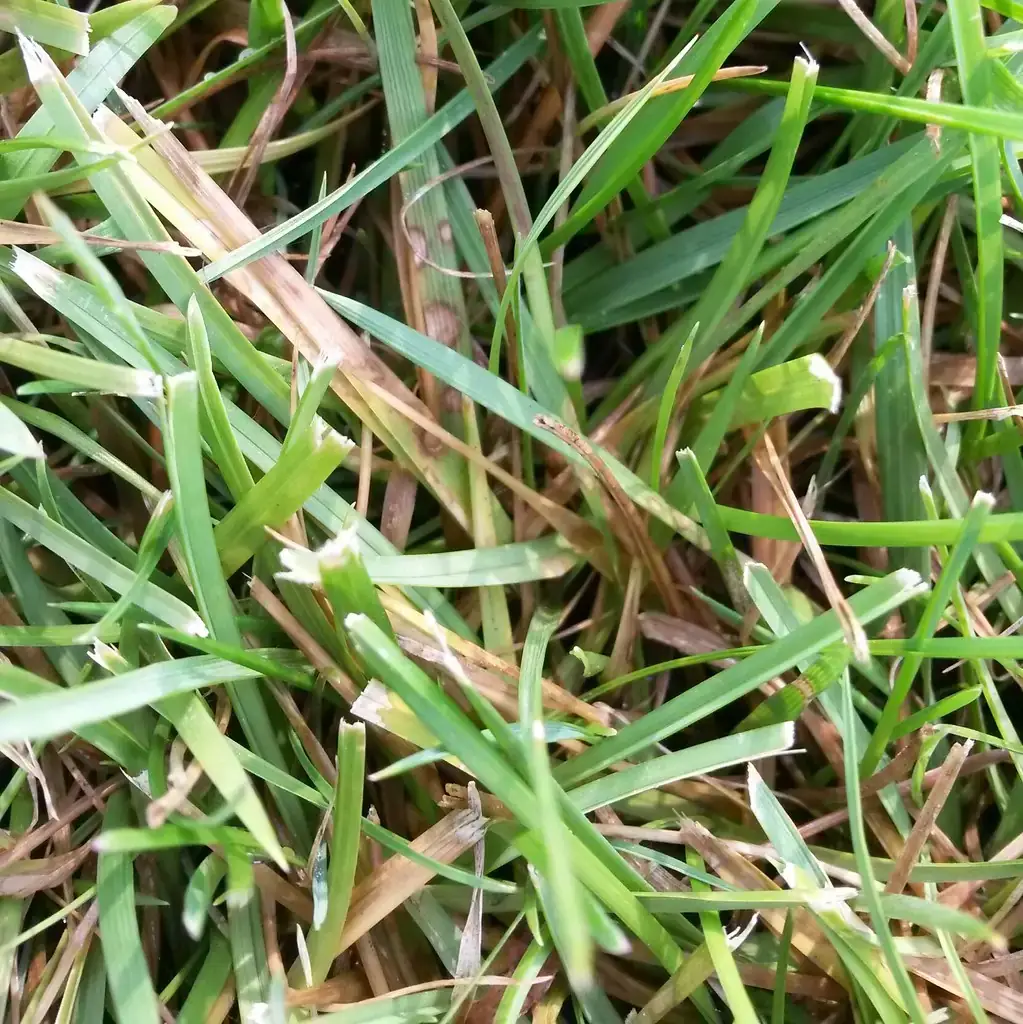
In a home lawn mowed above 1 inch, look for circular brown, tan or yellow patches from 6 inches to several feet across, with the leaves still upright. Tan, irregular lesions with a dark brown border on individual blades are the giveaway.
What to do: once nights drop reliably below 60°F, brown patch stops spreading and the grass usually grows back from the crowns. Help it by watering only in the early morning (never daily, never in the evening) and keeping nitrogen modest; NC State advises no more than 0.5 lb N per 1,000 sq ft when conditions favor disease. Thin areas that don’t fill in can be overseeded while soil is still warm, or seeded later using dormant seeding.
5. White grubs eating the roots
Grubs are the larvae of June beetles, Japanese beetles, European chafers and their relatives. They feed on roots in late summer and fall before cold weather drives them deeper. University of Maine Extension notes that Japanese beetle grubs do most of their feeding in fall, and that damage shows up as wilting or yellowing grass that can turn into large patches of dead turf (UMaine Extension). Skunks, raccoons and crows tearing up the lawn are a strong secondary clue.
How to confirm: cut three sides of a square-foot flap of sod at the edge of the damage, fold it back and count the C-shaped grubs. UMaine gives these damage thresholds per square foot:
| Grub species | Grubs per sq ft before damage is likely |
|---|---|
| May/June beetle | 3 to 4 (up to 10 in well-maintained turf) |
| European chafer | 5 to 8 |
| Japanese beetle | 8 to 10 |
| Oriental beetle | 8 |
| Asiatic garden beetle | 18 to 20 |
What to do: below threshold, water and wait; healthy turf outgrows light feeding. Above threshold in fall, your options are limited. UMaine notes that curative products such as trichlorfon kill at best about 50% of mature grubs, and carbaryl is not consistently effective. Prevention works better: chlorantraniliprole applied about three weeks before grubs start feeding, or beneficial nematodes (Heterorhabditis bacteriophora) applied in late August. Reseed dead areas once the grubs have finished.
6. Fall armyworms
Fall armyworms are the cause behind the “it was green on Friday and brown on Monday” story. University of Kentucky Extension describes lawns turning brown very quickly, sometimes overnight, and looking dead (UK Extension). The caterpillars are grayish to greenish, striped, about 1.5 inches long, with an inverted “Y” on the head. They feed in groups in the early morning and late evening and hide in the thatch by day.
Because they eat leaf blades, not roots, the tug test will show firm, anchored crowns. That’s your quickest way to tell armyworms from grubs.
What to do: UK Extension notes that lawns recover from armyworm damage, although some areas may need reseeding, and that fall rain and cooler weather help cool-season grass come back. The caterpillars disappear after the first frost. If you catch an active infestation early, ask your county extension office for a currently labeled lawn insecticide and follow the label exactly; spraying after the caterpillars have pupated or after frost does nothing.
7. Dog urine spots
Round spots about the size of a dinner plate, often with a dark green ring, in the same corner your dog favors? That’s urine. Colorado State University Extension explains that the damage comes from a high concentration of nitrogen compounds and salts in a small area; at the edges the extra nitrogen acts like fertilizer, hence the green ring (CSU Extension). Spots often look worse in fall simply because the grass is growing more slowly and can’t outgrow them.
What to do: flush the spot with water to dilute the salts. If the grass is dead, CSU advises removing the dead sod plus 0.5 to 1 inch of soil, then reseeding or patching with sod (sod for zoysia or bermuda). Training the dog to use a mulch or gravel area is the only sure prevention. No supplement or lawn spray has been scientifically proven to prevent the spots.
8. Mowing, leaves and foot traffic
Three everyday habits brown a lawn in fall:
- Dull mower blades. UC IPM describes lawns turning grayish soon after mowing, with torn, shredded leaf tips that later turn yellow to brown; injured turf is also more vulnerable to drought and disease (UC IPM).
- Walking on frosted grass. Purdue Extension warns that leaves blacken and then turn brown after foot or vehicle traffic before frost has melted, because ice crystals rupture the plant cells. Early-fall damage recovers in a few weeks; later damage takes longer (Purdue Extension).
- Matted leaves. A heavy layer of tree leaves blocks light and gas exchange. Purdue recommends removing heavy leaf cover by raking or mulching. See leaves on lawn over winter for the details.
These causes are cheap to fix, which is why they are worth ruling out before you buy any product. Several of them also appear in our list of fall lawn care mistakes.
Lawn Turning Brown in Fall? A Month-by-Month Plan
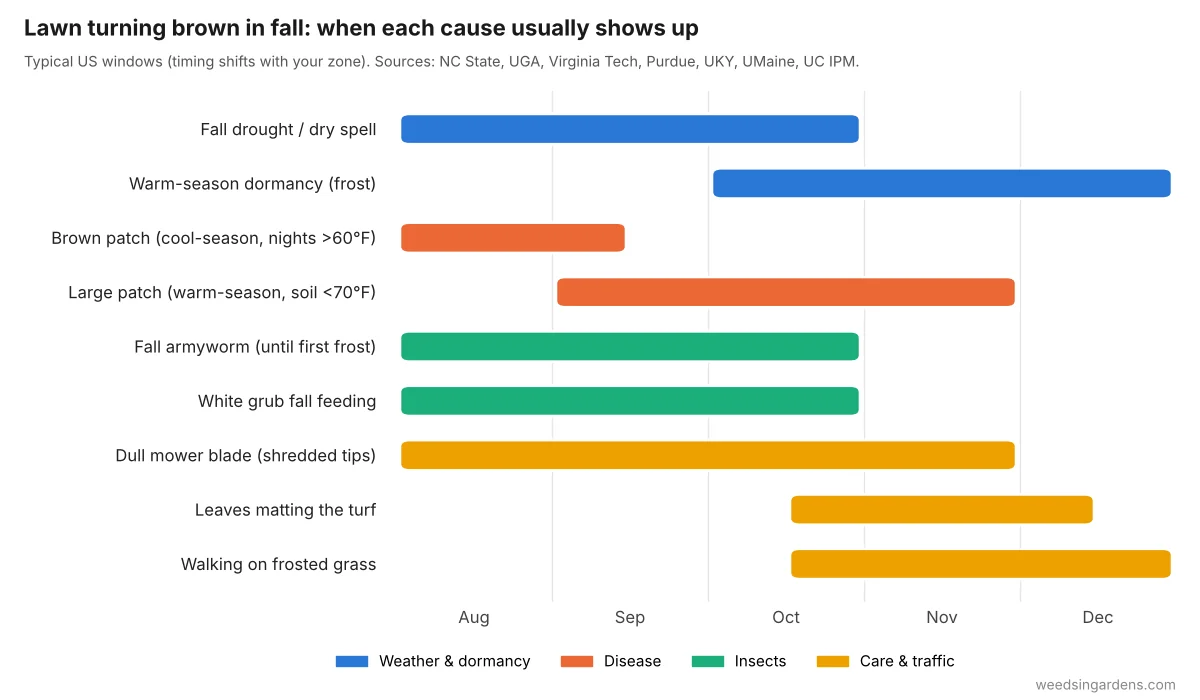
Timing turns a guess into a plan. Use this calendar alongside the chart above; shift it a few weeks earlier in the North and later in the Deep South.
| When | Cool-season lawn (fescue, bluegrass) | Warm-season lawn (bermuda, zoysia, centipede, St. Augustine) |
|---|---|---|
| Late Aug to mid-Sep | Watch for brown patch while nights stay above 60°F; scout for grubs and armyworms; water early morning only | Last nitrogen by very early September (UGA); start large patch fungicide on centipede/St. Augustine when soil reaches 80°F for 5+ days, if it’s a known problem |
| Mid-Sep to Oct | Peak growing season: fix drought, overseed thin areas, keep blades sharp | No nitrogen; start large patch prevention on zoysia when soil reaches 70°F for 5+ days; expect leopard striping after first frost |
| Nov | Remove matted leaves; keep off frosted turf; final mow | Lawn goes uniformly brown and dormant; mark any circles that stay visible so you can check them in spring |
| Dec to Feb | Water only during long dry spells; dormant seeding possible on bare areas | Water dormant turf during long dry spells (at least 0.5 inch every 3 to 4 weeks, NC State); avoid heavy traffic |
| Spring green-up | Reassess patches; repair any that didn’t recover | Patches that green up late or not at all point to large patch or spring dead spot; plan fall prevention |
Treatment Options at a Glance: Products, Timing and Non-Chemical Fixes
Most cases of a lawn turning brown in fall need no product at all. When it does, the active ingredient and the timing matter far more than the brand. Always read the label: confirm the product is labeled for home lawns, for your grass species and for the target problem, and follow its rate, water volume and re-application interval.
| Problem | Non-chemical fixes (do these first) | Active ingredients named by extension (check label) | Timing notes |
|---|---|---|---|
| Large patch | No N within 6 weeks of dormancy; fix drainage, compaction and thatch; avoid overwatering | Azoxystrobin, pyraclostrobin, fluoxastrobin, flutolanil, propiconazole, tebuconazole, triticonazole (NC State) | Preventive: soil at 70°F (zoysia) or 80°F (centipede, St. Augustine) for 5+ days; at least 2 gal water per 1,000 sq ft |
| Brown patch | Resistant tall fescue varieties; early-morning watering only; ≤0.5 lb N per 1,000 sq ft in risky weather | Azoxystrobin, pyraclostrobin, flutolanil, propiconazole, chlorothalonil (NC State) | Preventive when nights consistently exceed 60°F; usually unnecessary by mid-fall |
| Spring dead spot (bermuda) | No late-season nitrogen | Fall fungicide per label (UGA) | Most effective when soil is between 75°F and 60°F, usually late August to mid-September |
| White grubs | Tolerate light populations; let healthy turf outgrow them; beneficial nematodes | Chlorantraniliprole (preventive); trichlorfon or carbaryl (curative, limited effect) (UMaine) | Preventive about 3 weeks before feeding; nematodes in late August |
| Fall armyworm | Water and fertilize cool-season turf appropriately to help regrowth; reseed bare spots | Ask your county extension office for currently labeled lawn insecticides | Only while caterpillars are actively feeding; pointless after frost |
| Dog urine | Flush with water; reseed or sod dead spots; train dog to a mulch area | None proven (CSU) | Any time |
A word on fall broadleaf weed control: if you plan to spray weeds while you’re dealing with brown patches, Purdue notes broadleaf herbicides work best at air temperatures of roughly 50 to 85°F and should stop once turf is dormant. Don’t spray herbicides on drought-stressed or diseased turf; it adds stress to plants that are already struggling. Our fall weed control guide covers timing in detail.
A Note From the Agronomist’s Side
If there’s one idea worth taking from all of this about a lawn turning brown in fall, it’s that brown is a symptom, not a diagnosis. Grass has a very small vocabulary. Thirst, a fungus, a grub chewing roots and a frost-bitten footprint all end in the same tan color, so the color itself tells you almost nothing. The pattern, the timing and what’s happening at the crown tell you everything.
The crown is the part to care about. It’s the growing point at the soil line, and as long as it’s alive, the plant can rebuild every leaf above it. That’s why dormancy and drought are usually survivable and grubs are not: dormancy shuts the leaves down to protect the crown, while grubs cut the crown off from its roots. The tug test is really just a quick crown-and-root check.
The most common expensive mistake I’d caution against is treating a warm-season lawn’s normal dormancy as a problem. Fertilizer, fungicide and “lawn revival” products applied to dormant bermuda or zoysia in October don’t make it green; at best they’re wasted, and late nitrogen is one of the things extension specialists link to large patch and spring dead spot. The second most common mistake runs the other way: assuming a cool-season lawn is “just going dormant” in October, when fescue should be at its greenest of the year.
Finally, be honest about thresholds. A handful of grubs, a few dog spots or a week of leopard striping is not an emergency. Healthy turf with sound mowing, sensible watering and correctly timed fertilizer outgrows a lot of minor fall damage, and that is cheaper and more reliable than any product.
FAQ
Is it normal for grass to turn brown in fall?
It’s normal for warm-season grasses such as bermuda, zoysia, centipede and St. Augustine, which go dormant and turn brown after the first frosts. It is not normal for cool-season grasses such as tall fescue and Kentucky bluegrass, which should be at their greenest in fall; browning there points to drought, insects, disease or injury.
Why is my grass turning brown in October?
In October the most common causes are frost-triggered dormancy in warm-season lawns, a dry spell in cool-season lawns, large patch disease in zoysia, centipede and St. Augustine, and fall feeding by white grubs or armyworms. Check the pattern and do a tug test to narrow it down.
How can I tell if my brown grass is dormant or dead?
Pull gently on a handful of brown grass. Dormant grass stays firmly anchored and has firm crowns at the soil line. Grass that lifts easily with few roots may be dead or grub-damaged. You can also water a small patch thoroughly for a week or two in mild weather: cool-season grass that is only drought-dormant usually shows new green shoots.
Should I fertilize a lawn that is turning brown in fall?
Not until you know why it’s brown. Cool-season lawns benefit from fall fertilizer once they’re growing actively, but warm-season lawns should not get nitrogen after very early September, because it can delay dormancy and raise the risk of large patch and spring dead spot.
Will brown patches in my lawn come back in spring?
Dormant and drought-stressed grass usually greens up again. Large patch areas in warm-season grass often stay visible over winter and recover slowly in spring. Areas killed by grubs, dog urine or severe disease need reseeding or sod.
How long can grass stay brown and dormant without water?
In an NC State experiment, every tall fescue cultivar tested recovered after 40 days without water, and most survived 48 days. To keep dormant crowns alive through a long dry spell, NC State suggests at least 0.5 inch of water every three to four weeks.
Sources
More fall lawn help: browse all our lawn problems guides, or read why grass turns yellow if your lawn is fading rather than browning.
- “Large Patch in Turf.” NC State Extension. content.ces.ncsu.edu/large-patch-in-turf
- “Brown Patch in Turf.” NC State TurfFiles, NC State University. turffiles.ncsu.edu
- “Managing Turfgrass Under Heat and Drought Stress.” NC State TurfFiles. turffiles.ncsu.edu
- “Fall Chores to Ready Warm-Season Lawns for Winter.” University of Georgia Cooperative Extension, Forsyth County. site.extension.uga.edu
- “Frost Damage on Warm-season Turf.” Virginia Cooperative Extension, Virginia Tech. ext.vt.edu
- “Winter Lawn Care Tips.” Purdue University Plant and Pest Diagnostic Laboratory. ag.purdue.edu
- “Brown Lawns Could Mean Fall Armyworm Damage.” University of Kentucky Cooperative Extension. mgcafe.uky.edu
- “White Grubs.” University of Maine Cooperative Extension, Home and Garden IPM. extension.umaine.edu
- “Dog Urine Damage on Lawns: Causes, Cures and Prevention.” Colorado State University Extension. extension.colostate.edu
- “Dull Mower Blade Injury.” UC Statewide IPM Program, University of California. ipm.ucanr.edu