
It’s mid-October. The bare patches you meant to fix in September are still bare, the drought or the dog or the crabgrass won, and the ideal seeding window has quietly closed. Spring seeding sounds like the fallback, but you remember last April: mud, rain and a two-week window before the crabgrass showed up. There’s a third option, dormant seeding, that turf professionals in the North use on purpose, and it barely costs you anything but a bag of seed and a cold afternoon.
Short answer: Dormant seeding means spreading cool-season grass seed after the soil has cooled to about 40°F or below, usually from early November to mid-March in northern states, so the seed sits unsprouted all winter and germinates on its own as the soil warms in spring. Freeze-thaw cycles work the seed into the soil for you. It suits Kentucky bluegrass, tall fescue and fine fescue lawns, needs no watering until spring, and gives seedlings a head start on crabgrass.
By the end of this guide you’ll know exactly when to dormant seed where you live, which grasses and seed rates to use, how to prep the ground in a single afternoon, and what to do in April and May so the seed you paid for actually becomes a lawn.
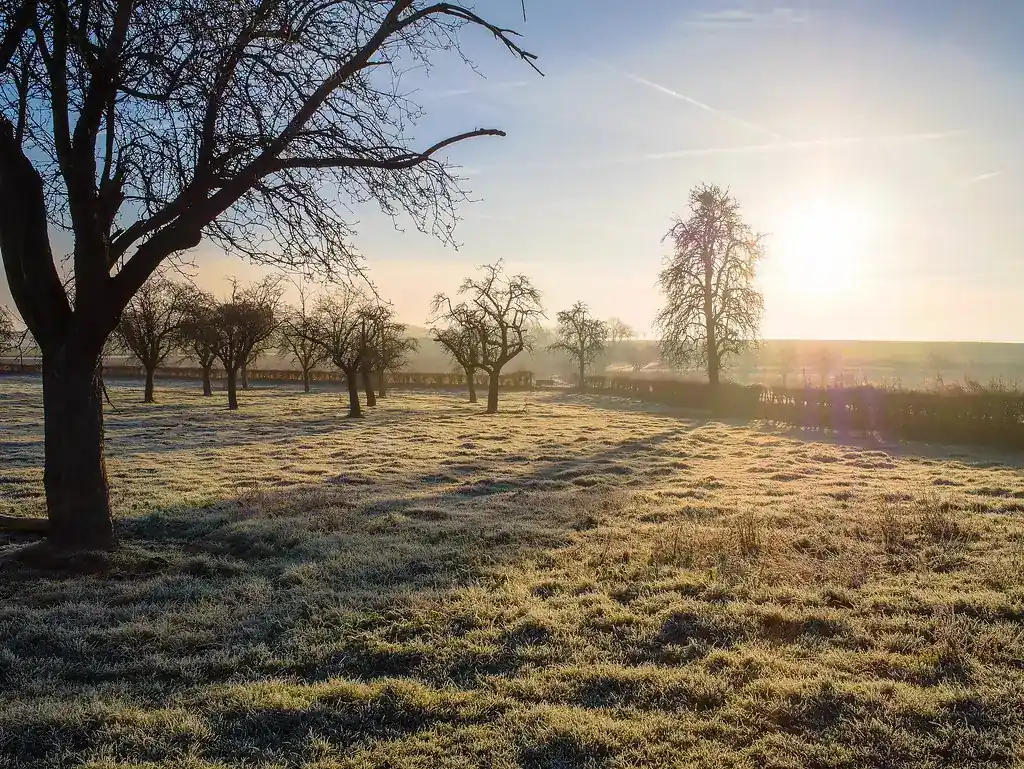
What is dormant seeding, and why does it work?
Dormant seeding is simply timing. Instead of seeding in early fall (the classic best window) or in spring, you seed when it’s too cold for anything to germinate. The seed lies in place through winter, and the first warm stretch of spring triggers it to sprout without you lifting a finger.
Three things make this work better than it sounds:
- Frost does the raking. As wet soil freezes and thaws, it heaves and cracks. Seed falls into those cracks and ends up with the close soil contact it needs. Purdue turf specialists describe these frost crevices as giving seed ideal germination conditions (Reicher and Throssell, Purdue).
- The seed is already there when spring arrives. Spring seeding depends on finding a dry weekend between frozen ground and muddy ground. Dormant seed germinates as soon as conditions allow, so cover develops earlier than with a conventional spring seeding, according to Ohio State sports turf specialist Pamela Sherratt (SportsField Management).
- Seedlings get a head start on weeds and summer. Nebraska Extension notes that grass filling in during cool spring weather helps limit weeds and gives plants more time to build vigor before summer stress (Browning, Nebraska Extension).
There’s also a water bonus. The University of Minnesota turf team points out that this approach doesn’t need watering through the dormant period and may cut irrigation needs during establishment compared with gambling on a dry late summer (Hollman, UMN Turfgrass Science).
When to dormant seed: the 40°F soil rule
The single most common mistake is going too early. If you spread seed during a mild spell in late October, some of it germinates, and those tiny seedlings are the most likely thing on your property to die when the first hard freeze hits.
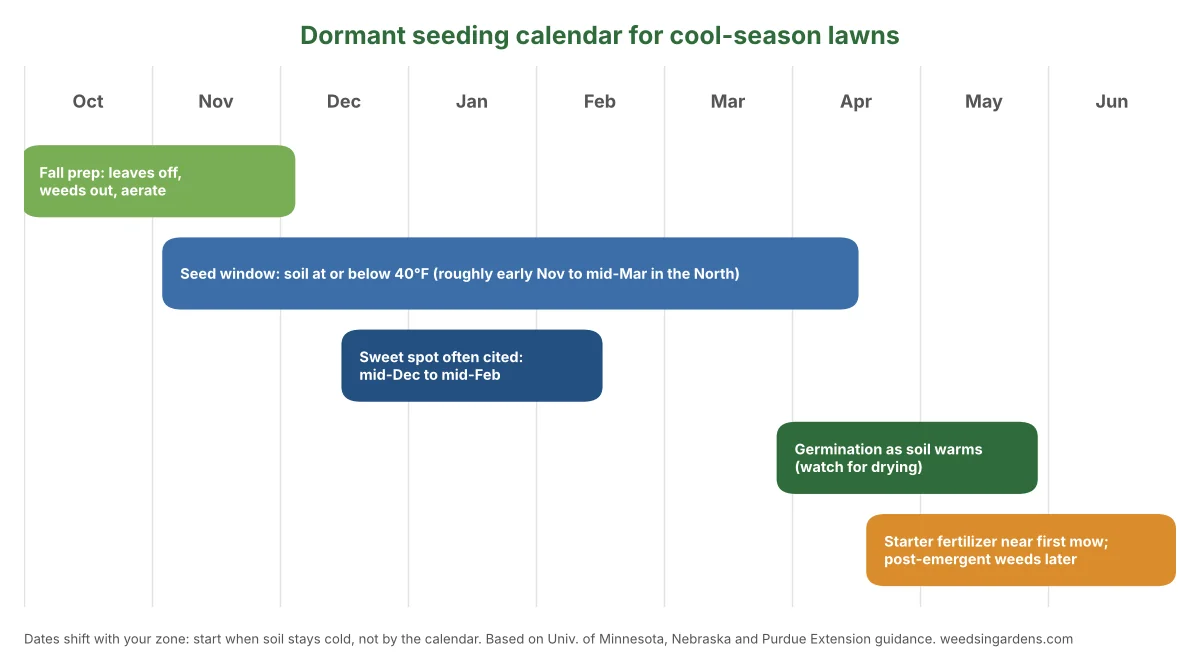
So the trigger is soil temperature, not the calendar. University of Minnesota Extension says to seed when soil temperatures are below 40°F, which is typically early November to mid-March in most of Minnesota (Trappe, UMN Extension). Nebraska Extension uses the same 40°F cutoff and calls mid-December through mid-February the ideal window, with March 15 as the latest date (Browning).
| Region (example source) | Typical dormant seeding window | Notes |
|---|---|---|
| Minnesota (UMN Extension) | Early November to mid-March | Soil below 40°F; earlier seeding gets more freeze-thaw cycles |
| Nebraska (Nebraska Extension) | Mid-December to mid-February ideal; no later than March 15 | Soil 40°F or below; don’t seed onto snow |
| Nebraska (UNL turf trials) | Thanksgiving to Easter | Earlier coverage makes establishment easier |
| Indiana (Purdue) | Thanksgiving to March, or December to February | For tall fescue, Purdue suggests waiting until late December so the soil is cold enough to prevent germination |
Check your local soil temperature at 2–4 inches with a cheap soil thermometer, or use your state extension’s soil-temperature page. When it stays at 40°F or below for a week and the forecast shows no long warm spell, you’re good to go.
What if it’s October and I’m in between?
This is the awkward gap you may be in right now. Purdue’s Aaron Patton notes that tall fescue and perennial ryegrass seeded in late October or November will go into winter underdeveloped and are more likely to winterkill, while Kentucky bluegrass seedlings typically don’t suffer severe winter injury (Patton, Purdue). His advice in that situation: seed only Kentucky bluegrass now and expect little growth before winter, or wait and dormant seed from December to February.
Honestly, for most people the better move in mid-October is to use the next few weeks for prep (weeds, leaves, aeration) and hold the seed until the soil is properly cold.
Which grasses work for dormant seeding?
This is a cool-season grass technique. University of Minnesota Extension says it works with all the cool-season lawn grasses grown there: Kentucky bluegrass, the fine fescues and tall fescue. A mix of several species, chosen for your site’s sun and use, is usually the safest bet (UMN Extension).
| Grass | Fit for dormant seeding | What to know |
|---|---|---|
| Kentucky bluegrass | Good | Slow to germinate and establish, so the early spring start helps. Seedlings tolerate cold better than tall fescue or ryegrass (Purdue). |
| Tall fescue (turf-type) | Good, often the most reliable | UNL turf researchers preferred tall fescue over Kentucky bluegrass for winter seedings. In UMN’s 2023 demo it stayed green and disease-free through late-summer heat and drought. |
| Fine fescues (creeping red, hard, chewings) | Good | Germinated first in the UMN demonstration, visible on April 11 after snowmelt. Good for shade and low-input lawns. |
| Perennial ryegrass | Works, with caveats | Establishes quickly, but in the UMN demo it showed drought stress and crown rust in its first summer. Best as a minor part of a mix. |
| Buffalograss (warm-season) | Possible but risky | UMN warns crabgrass will likely outcompete it; it was included in UNL trials. |
| Bermuda, zoysia, St. Augustine, centipede | Not a dormant-seeding job | Warm-season lawns are seeded or plugged in late spring and early summer, when the soil is warm. |
If you live in the transition zone or the South and grow warm-season grass, this technique isn’t for you. The method relies on cool-season seed sprouting in cool spring soil, which warm-season grasses won’t do.
Dormant seeding vs fall and spring seeding
Early fall is still the gold standard for cool-season lawns. Purdue calls September the optimal seeding month (Patton). But if you missed it, seeding into cold soil usually beats waiting for spring. Here’s the honest comparison:
| Factor | Early fall seeding | Dormant seeding | Spring seeding |
|---|---|---|---|
| When | Late Aug–Sept | Soil ≤40°F, roughly Nov–Mar | As early as the soil can be worked |
| Watering before spring | Daily until established | None | Frequent from the start |
| Weed pressure | Low (cool-season weeds only) | Moderate; seedlings get a head start | High: crabgrass germinates alongside your seed |
| Roots before summer | Excellent | Better than spring | Weak, the biggest risk |
| Crabgrass pre-emergent | Not needed | Most products can’t be used; a few seed-safe options exist | Same restrictions |
| Main risk | Late-summer heat and drought | Warm spell then hard freeze; washout on slopes | Wet soil delays, summer heat kills young grass |
| Labour | Moderate | Low; no winter watering | Moderate to high |
Two caveats keep this honest. In a 2014 Nebraska trial, winter seedings could perform worse than spring seedings when a late spring frost hit after germination (Sousek and Li, UNL). And Nebraska Extension warns that a warm winter or early spring can trigger germination, after which a cold snap can kill the seedlings (Browning). Continuous snow cover is actually your friend here; it keeps the soil cold and steady.
How to dormant seed a lawn in 7 steps
The good news: this is mostly prep you can do on a dry fall afternoon, then one quick trip with the spreader once the soil is cold.
1. Deal with perennial weeds now, not in spring
Creeping Charlie, wild violets and other perennial broadleaf weeds should be controlled in fall before you seed (UMN Extension). Fall is also when systemic herbicides work best on them. See our guides to wild violets in lawn and creeping Charlie. Leave a gap between spraying and seeding: Purdue notes that herbicides generally shouldn’t be applied in the 3–4 weeks before seeding, so check each label’s reseeding interval (Patton).
If you’re renovating a whole lawn, UMN suggests spraying glyphosate in late October and leaving the dead residue in place, because it helps hold the seed over winter.
2. Clear leaves and mow short
Seed has to reach soil. Bag or mulch heavy leaf cover first (our guide to leaves on the lawn over winter covers which to do). Then do your last mow of the season a little on the short side over the areas you plan to seed, so the seed isn’t caught up in the canopy.
3. Open up the soil surface
Pick the method that matches your site:
- Core aeration is the best choice for larger areas. Seed that falls into the holes grows well, and no topdressing is needed (Nebraska Extension). Aim for many holes: UNL turf researchers target roughly 2 × 2 inch spacing, which usually takes several passes.
- Power raking or slit seeding disturbs only the top ¼ inch of soil and improves seed-soil contact. Nebraska Extension advises power raking only where thatch is over ½ inch thick, because it damages existing turf more than aeration.
- Hand raking is enough for small bare patches; just loosen the surface and remove dead grass.
- Minimal prep is a legitimate option too. UMN Extension says soil disturbance isn’t required to improve density, and you can seed directly into dead crabgrass because the decaying stems act as a mulch.
If the ground is hard and compacted, start with our guide on how to prepare soil for grass seed.
4. Wait for cold soil
Hold the seed until the soil is at or below 40°F. Prep can happen in October; seeding usually waits until late November or later.
5. Spread the right amount of seed
Spread the seed on dry ground, at half rate in two directions at right angles, so you don’t get stripes (UMN Extension). A drop spreader is best for larger areas. For small amounts, Nebraska Extension suggests mixing seed with dry sand or sawdust so it spreads evenly. Don’t seed onto snow; the seed needs soil contact.
| Situation | Kentucky bluegrass (lb per 1,000 sq ft) | Tall fescue (lb per 1,000 sq ft) |
|---|---|---|
| New lawn on bare soil | 2–3 | 6–8 |
| Overseeding a thin lawn | 1–2 | 3–4 |
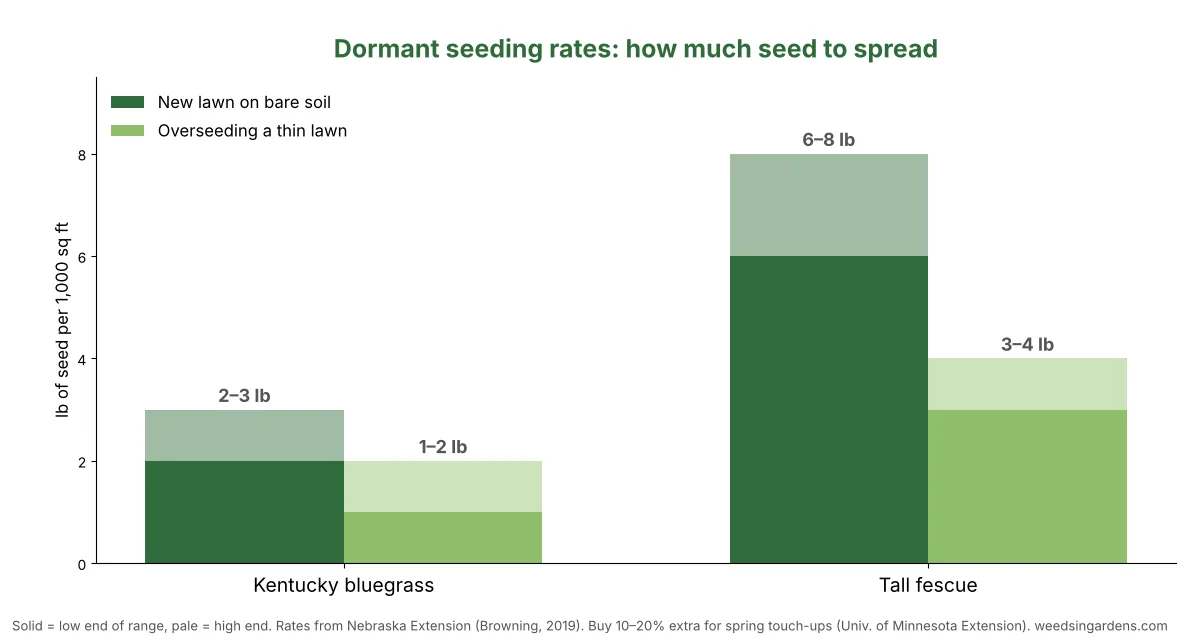
Should you seed heavier because some seed will be lost over winter? The evidence is mixed. A UNL field trial found higher seeding rates weren’t necessary for winter seedings of Kentucky bluegrass, tall fescue or buffalograss (Sousek and Li). Ohio State’s Sherratt suggests 30–50% more for sports fields but warns that excessive rates produce weak, disease-prone seedlings. A sensible middle path for a home lawn is UMN’s: seed at the normal rate and buy 10–20% extra to touch up any gaps in late spring.
6. Protect slopes and bare soil
Bare, sloping ground can wash out in spring thaws. UMN recommends a germination or erosion-control blanket on bare soil, especially on slopes. In UMN’s 2023 demonstration, blankets gave the most consistent establishment, while seed on bare soil did poorly after a mid-April spell of four days above 80°F with wind gusts over 20 mph dried the surface (Hollman). Worried about birds? UMN says it hasn’t observed seed predation by birds; if you are concerned, see our tips on protecting grass seed from birds.
7. Skip the fertilizer for now
Don’t add fertilizer when you sow. Ohio State’s Sherratt is clear: apply only seed, and never fertilize snow-covered or frozen soil because of the runoff risk. Feeding comes later, when there are seedlings to use it.
Spring care for a dormant seeding lawn: water, mow, feed and weeds
Most winter seedings that fail don’t fail in winter. They fail in April, when the seed sprouts and nobody is paying attention yet. Here’s the season-by-season plan.
| When | What’s happening | What you do |
|---|---|---|
| Late fall (Oct–Nov) | Grass slowing down | Control perennial weeds, clear leaves, aerate or rake, final mow |
| Winter (soil ≤40°F) | Seed sits dormant; frost works it in | Spread seed; add blankets on slopes; stay off frozen turf |
| Early spring | Soil warming; first seedlings appear | Check for germination; hand-water if the surface dries out |
| Mid-April to early May | Germination peaks | Keep the top ½–1 inch moist; consider a seed-safe pre-emergent (siduron or mesotrione) |
| First mowing | Seedlings above mowing height | Mow at about 3 inches; apply starter fertilizer |
| Late spring | Gaps visible | Overseed thin spots with your reserved 10–20% seed |
| Early summer | Crabgrass emerges | Post-emergent control after the 2nd–3rd mowing, following the label |
Watering
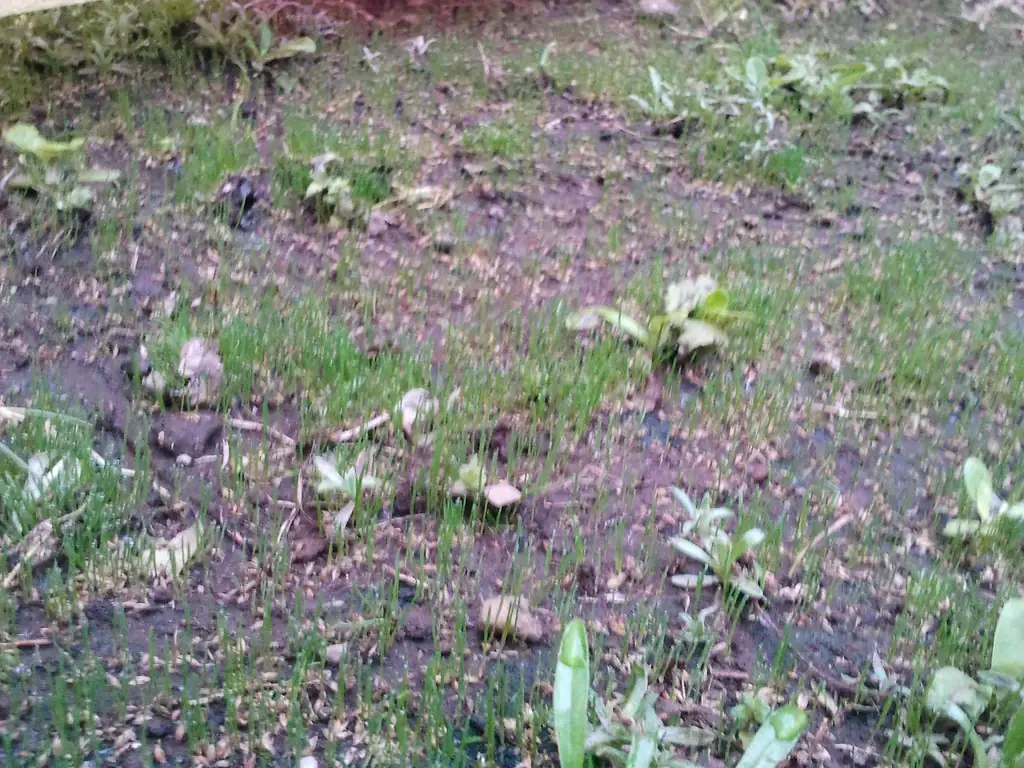
Germination begins as air and soil temperatures rise above 40°F (UMN Extension). Watch closely: if spring turns warm and dry, new seedlings can dry out before your irrigation is even turned on, so hand-water if needed. Nebraska Extension suggests starting in late April and watering lightly 2–4 times a day to keep the top ½–1 inch of soil moist but not saturated (Browning).
Mowing and feeding
Mow once most seedlings are taller than your normal mowing height, ideally keeping the cut at 3 inches or more. Apply a starter fertilizer containing nitrogen and phosphate around the first mowing, especially if your soil test shows low phosphorus (UMN Extension).
Weed control by active ingredient
This is where you need a plan. Most crabgrass pre-emergents (such as prodiamine, dithiopyr and pendimethalin) stop grass seed from establishing too, so UMN says most of them can’t be used on a winter seeding. Purdue advises delaying those standard pre-emergents until new seedlings have been mowed four to eight times, depending on the product (Purdue AY-20). If you rely on them every spring, read our crabgrass control guide before you seed. Seed-safe options do exist:
| Active ingredient (example product) | Use on new seedings | Key label limits |
|---|---|---|
| Siduron (Tupersan) | Pre-emergent safe for new cool-season seedings | Nebraska Extension: apply mid-April to the first week of May at the lower rate, repeat a month later. It only lasts about 3–4 weeks (Purdue). |
| Mesotrione (Tenacity, EPA Reg. 100-1267) | Pre-emergent on bare soil at seeding; also post-emergent | Labeled for Kentucky bluegrass, tall fescue, perennial ryegrass and fine fescue; not for bermudagrass, zoysia or seashore paspalum. Avoid applying above 85°F. Fine fescue has extra label restrictions. |
| Quinclorac (e.g., Drive XLR8) | Post-emergent crabgrass and some broadleaves | UNL: any time on tall fescue; on Kentucky bluegrass, not from 7 days before to 28 days after emergence. |
| Broadleaf herbicides (2,4-D, dicamba, etc.) | Post-emergent only | Wait until seedlings have been mowed at least three times (Purdue). |
Siduron and mesotrione are the two that fit right around germination. Nebraska Extension notes crabgrass and foxtail germinate after several days of soil temperatures at 55°F or above, so time any pre-emergent for that window rather than applying it at seeding time, when it would break down before the weeds arrive (Browning). If crabgrass still breaks through, UMN suggests a post-emergent product in early summer after the second or third mowing.
Common dormant seeding mistakes
- Seeding during a warm spell. Seed that germinates in November or a February thaw rarely survives the next freeze.
- Spreading seed onto snow or a thick leaf layer. The seed never reaches soil.
- Applying your usual spring crabgrass pre-emergent. It can wipe out the seeding you paid for.
- Fertilizing frozen ground. It runs off and feeds nothing.
- Forgetting about it in April. A warm, windy week can dry out new seedlings in days.
- Dormant seeding a dense lawn. Seeding into thick turf is futile (Sherratt); the seed needs bare or thin areas to land in.
A note from the agronomist’s side
Think of this technique as moving the riskiest part of establishment, germination, to the point in the year when the odds are best and your effort is lowest. Seed is a remarkably tough package. Dry, it shrugs off cold. What kills a new lawn is the fragile two-to-six-week window after the root and shoot emerge, and seeding into cold soil parks that window in cool, moist spring weather instead of hot late summer or crabgrass season.
The research tells a consistent story, even though the trials are small. Minnesota’s demonstration plots showed that every common cool-season lawn species can establish this way, that protection (blankets or dead turf left in place) matters more than seeding rate, and that the dangerous moment was a hot, windy week in April, not the winter itself. Nebraska’s trial found that piling on extra seed didn’t help. My reading of that: put your money into soil contact and spring moisture, not a heavier seeding rate.
Species choice is the other lever. If your lawn sees summer drought and you don’t water much, lean on turf-type tall fescue; it was the standout in both the Nebraska recommendations and Minnesota’s late-summer drought. If you want a self-repairing lawn and can accept slower fill-in, include Kentucky bluegrass. A rule of thumb worth keeping: seed when the soil is cold enough that nothing will sprout for weeks, and plan your crabgrass strategy before the seed goes down, not after.
Dormant seeding FAQ
What temperature should it be for dormant seeding?
Soil should be at or below 40°F, measured a couple of inches down, and expected to stay there. University of Minnesota and Nebraska Extension both use the 40°F threshold so the seed won’t germinate until spring.
Is it too late to dormant seed in March?
Not usually in the North. Minnesota Extension gives a window to mid-March, and Nebraska Extension lists March 15 as the latest date. After that, you are effectively spring seeding.
Does dormant seeding actually work?
Yes, for cool-season grasses. University of Minnesota research found Kentucky bluegrass, tall fescue, fine fescue and perennial ryegrass can all establish by dormant seeding. The main risks are a warm spell followed by a hard freeze and seedlings drying out in spring.
Can you dormant seed on top of snow?
It’s not recommended. Nebraska Extension advises against seeding onto snow because the seed needs good contact with soil. Seed bare or frozen ground, then let snow cover it.
Do you need to water dormant seed?
Not over winter. Start watering in spring once seedlings appear, keeping the top ½–1 inch of soil moist with light, frequent watering.
Can I use crabgrass preventer on a dormant seeded lawn?
Most crabgrass pre-emergents will also stop grass seed. Seed-safe options are siduron and mesotrione, used as the label directs. Otherwise, wait and control crabgrass after the new grass has been mowed a few times.
Should I put down starter fertilizer when I dormant seed?
No. Hold the fertilizer until spring, around the first mowing. Applying fertilizer to frozen or snow-covered soil risks runoff and feeds nothing.
More guides for new lawns live in our Seeding & Sod section.
Sources
- Trappe, J. Dormant seeding to establish or improve your lawn. University of Minnesota Extension (reviewed 2025). extension.umn.edu
- Hollman, A. (2023). Investigating dormant seeding as an approach to establish lawns in Minnesota. University of Minnesota Turfgrass Science. turf.umn.edu
- Browning, S. (2019). Dormant Lawn Seeding. Nebraska Extension in Lancaster County. lancaster.unl.edu
- Sousek, M., and Li, L. (2015). How’s and why’s (or why not’s) of dormant seedings. University of Nebraska–Lincoln Turfgrass Program. turf.unl.edu (PDF)
- Patton, A. (2010, updated 2019). Is it too late to seed? What should we do? Purdue University Turfgrass Science. turf.purdue.edu
- Reicher, Z., and Throssell, C. (1998). Seeding a Turf Area in the Spring (AY-20). Purdue Cooperative Extension Service. extension.purdue.edu (PDF)
- Sherratt, P. (2023). Pamela Sherratt on dormant seeding. SportsField Management. sportsfieldmanagementonline.com
- Syngenta. Tenacity Herbicide product label, EPA Reg. No. 100-1267. Always read the current label before use.