
It’s late October and something has been tearing up the lawn overnight. Chunks of sod are flipped over like pancakes, there are little cone-shaped holes everywhere, and a brown patch you blamed on the dry summer lifts up in your hand like a loose rug. Underneath, curled in the soil, are fat, cream-colored, C-shaped larvae. Those are white grubs. Grubs in lawn soil are a feast for skunks and raccoons, and the digging is almost certainly one of them finding the grubs before you did.
Short answer: Grubs in lawn are the root-feeding larvae of scarab beetles such as Japanese beetles, chafers and June beetles. Treat only when a dig test finds more than about 5–10 grubs per square foot, and time it right: preventive products go down from mid-April to early August, curative ones work in August and September, and by October most grubs have stopped feeding, so treating now is wasted money. In fall, the job is repairing the damage and planning next summer’s prevention.
This guide shows you how to confirm grubs (and rule out look-alikes), how many is too many for each species, which active ingredients work in which months, how the organic options really compare, and exactly what to do in your lawn this fall so it greens up properly in spring.
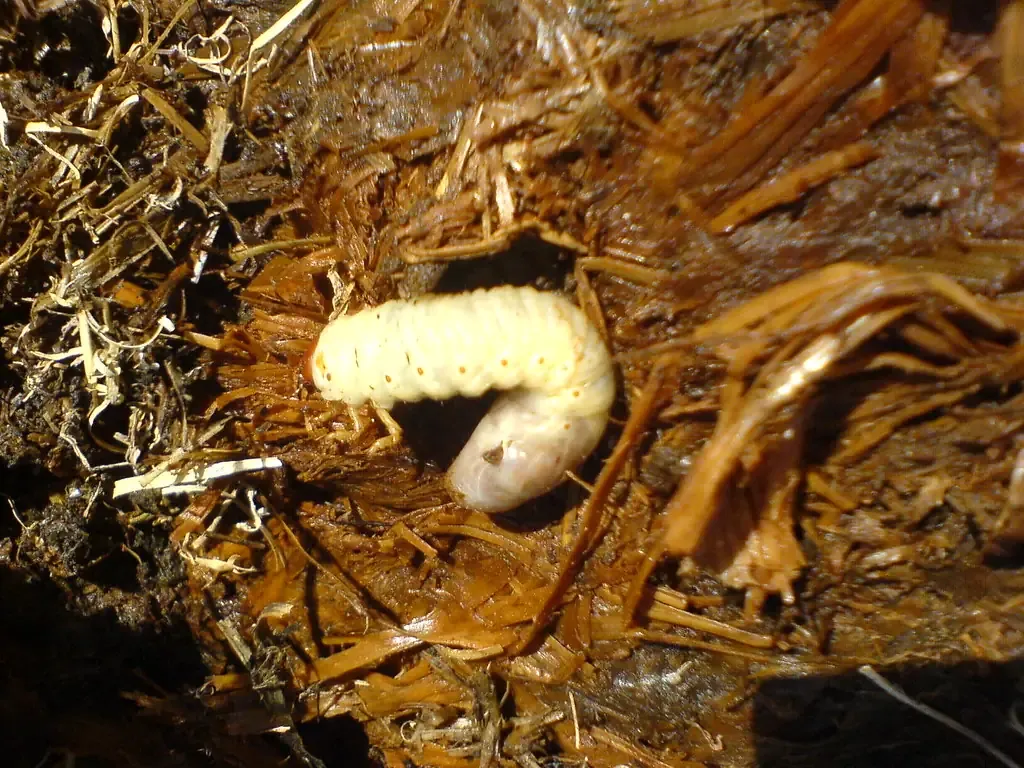
What Are Grubs in Lawn, and Where Do They Come From?
A white grub is the immature stage of a scarab beetle. Cornell’s turfgrass IPM program lists eight species that damage lawns in New York alone, four native (black turfgrass ataenius, green June beetle, May/June beetles and northern masked chafer) and four introduced (Asiatic garden beetle, European chafer, Japanese beetle and Oriental beetle). In Texas, the main lawn species are May/June beetles in the genus Phyllophaga and the southern masked chafer, according to Texas A&M AgriLife.
The adults don’t eat grass at all. The damage comes from the larvae, which live in the root zone and chew the roots off just below the thatch. Because the grass looks fine from above until the roots are mostly gone, many homeowners only discover grubs when the lawn browns in a dry spell or when animals start digging.
The yearly cycle in one paragraph
Most lawn grubs, including the Japanese beetle, have a one-year life cycle. Beetles fly from early to midsummer and females lay eggs in the turf; University of Missouri Extension notes that Japanese beetle eggs hatch in 7–14 days and the young grubs start feeding on roots right away (Missouri G7412). They feed hardest from late July into September, stop feeding in October and overwinter about 6 inches (15 cm) down. When the soil warms to around 50°F in spring, they come back up, feed briefly, pupate and emerge as next summer’s beetles. That timeline is the key to everything else in this article.
How to identify a white grub
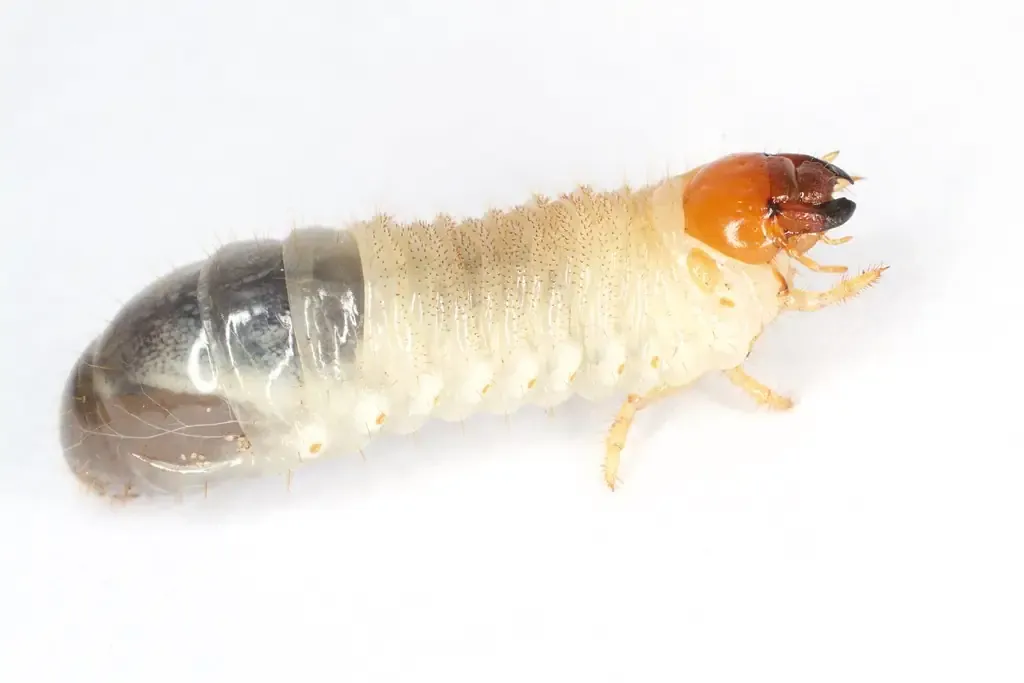
Plenty of soil larvae get mistaken for lawn grubs, and some of them are harmless or even helpful. Look for these features:
- Shape: a curled “C” when resting; it does not stretch out like a worm or caterpillar.
- Color: creamy white body with a darker, often grayish rear end where soil shows through the skin.
- Head: a hard, tan to orange-brown head capsule with strong jaws.
- Legs: three pairs of short legs near the head and none on the rest of the body.
- Size: about 1/8 inch when newly hatched, up to roughly 1 inch for Japanese beetle and chafers, and larger for May/June beetle grubs.
Telling the species apart takes a hand lens: Cornell uses the pattern of spines on the underside of the last abdominal segment (the raster) and the shape of the anal slit. It’s worth the effort, because thresholds and some treatments differ by species, as you’ll see below.
| Larva you dug up | How it looks | Is it a lawn problem? |
|---|---|---|
| White grub (scarab larva) | C-shaped, cream body, brown head, 6 legs | Yes, when numbers pass the threshold |
| Wireworm (click beetle larva) | Straight, stiff, shiny, yellow-brown | Rarely in established turf |
| Cutworm or armyworm | Soft caterpillar with prolegs along the body | Yes, but it eats leaves at the surface, not roots |
| Leatherjacket (crane fly larva) | Gray-brown, legless, tough skin | Occasionally in wet, cool-season lawns |
| Earthworm | Segmented, legless, no head capsule | No, a sign of healthy soil |
Signs of Grubs in Lawn (and What Else Looks the Same)
Damage from grubs in lawn turf is easy to confuse with drought, disease and dog spots. Cornell even captions one of its photos “It looks like drought damage, but this lawn has too many grubs.” These signs together point strongly to grubs:
- Irregular brown or thin patches that keep spreading in late summer and early fall, often in the sunniest part of the yard.
- Spongy turf that feels soft underfoot.
- Sod that lifts like a carpet: grab a handful of brown grass and pull. If it peels up with almost no roots, grubs have eaten them.
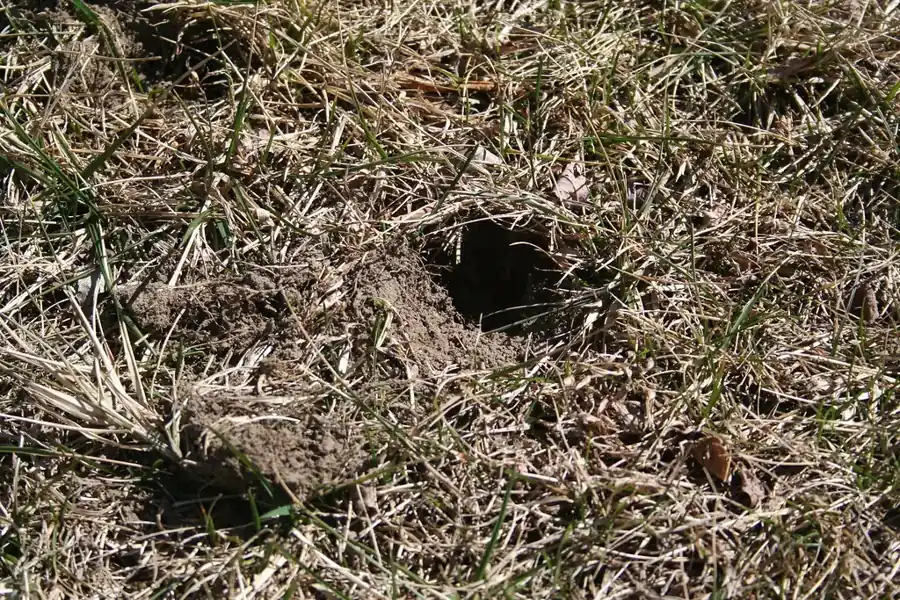
- Animal digging: skunks, raccoons, armadillos, crows and starlings tear up turf to feed on grubs. Cornell notes this predator damage is often worse than the grub damage itself.
- Lots of beetles in summer around porch lights or on roses and lindens, which tells you eggs were laid nearby.
| What you see | Grubs | Drought | Brown patch / fungus | Dog urine |
|---|---|---|---|---|
| Turf pulls up with no roots | Yes | No, roots hold | No | No |
| Recovers after a deep watering | No | Yes, within days | No | Partly |
| Skunk or raccoon digging | Common | No | No | No |
| Circular rings or leaf spots | No | No | Often | Dark green ring around a dead spot |
| C-shaped larvae in top 2 inches of soil | Yes | No | No | No |
If the problem looks more like a fall color change than chewed roots, our guide to a lawn turning brown in fall walks through the other seven usual suspects.
The Dig Test: How Many Grubs Are Too Many?
Finding a few grubs in lawn soil means almost nothing. Nearly every lawn has some, and healthy turf simply outgrows the root loss. The useful question is how many there are per square foot, and you can only answer it with a shovel. Soap or salt drenches that bring caterpillars to the surface won’t work for grubs, Cornell says.
How to sample
- Water the area the day before if the soil is dry; grubs move toward the surface in moist soil.
- Choose the edges of damaged patches plus a few healthy-looking spots, especially sunny areas and places with past damage.
- Cut three sides of a 1-foot square (or take several 4-inch cores with a bulb planter) about 2–3 inches deep, and fold the sod back.
- Break up the soil and roots and count every grub. Repeat in 5–10 spots across the lawn and average the counts.
- Press the sod back and water it; it will reroot.
The best time to dig is August, when the grubs are big enough to see but still small enough to kill easily. Cornell recommends early August in southeastern New York and mid-August upstate.
Treatment thresholds by species
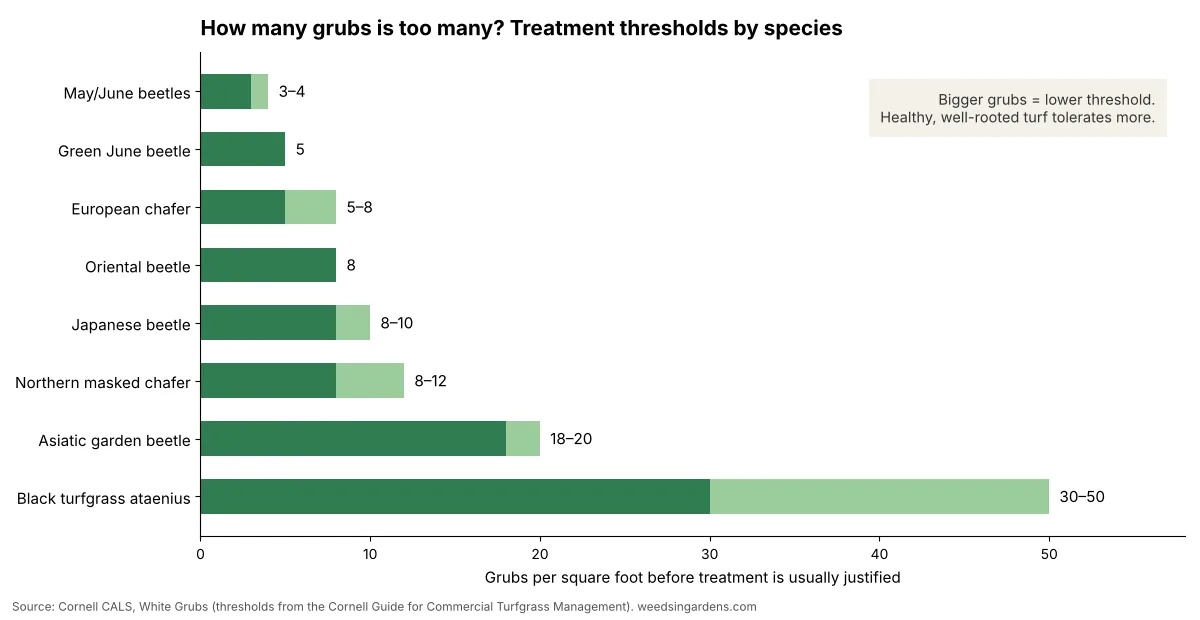
Bigger grubs eat more, so the bigger the species, the fewer it takes to cause visible damage. Here are the thresholds Cornell uses:
| Species | Grubs per sq ft before treatment is warranted | Notes |
|---|---|---|
| May/June beetles (Phyllophaga) | 3–4 | Large grubs; some species take 2–3 years to mature |
| Green June beetle | 5 | Tunnels and leaves mounds; common in the South |
| European chafer | 5–8 | Active about 2 weeks earlier than the others |
| Oriental beetle | 8 | Northeast and mid-Atlantic |
| Japanese beetle | 8–10 | The most widespread species in the East and Midwest |
| Northern masked chafer | 8–12 | Dominant in many transition-zone lawns |
| Asiatic garden beetle | 18–20 | Small grubs; imidacloprid doesn’t control it |
| Black turfgrass ataenius | 30–50 | Tiny grubs; mainly a golf-course pest |
Texas A&M uses a simpler rule of 5–10 grubs per square foot for southern lawns. Two caveats matter. Healthy, well-rooted, well-watered turf tolerates more than these numbers, and if skunks or raccoons are already digging, a lower count may still justify action because the animals do the damage. The good news: Cornell’s research in upstate New York found that home lawns and golf fairways needed an insecticide treatment only about 20% of the time.
When to Treat Grubs in Lawn: Month-by-Month Timing
With grubs in lawn, timing matters more than which product you buy. A preventive insecticide that goes down too early can wear off before eggs hatch, and any insecticide applied after the grubs reach full size in late September does very little. UMass Extension found that once grubs are full grown, usually by mid-September, curative treatments seldom cut populations by more than 50% (UMass Extension).
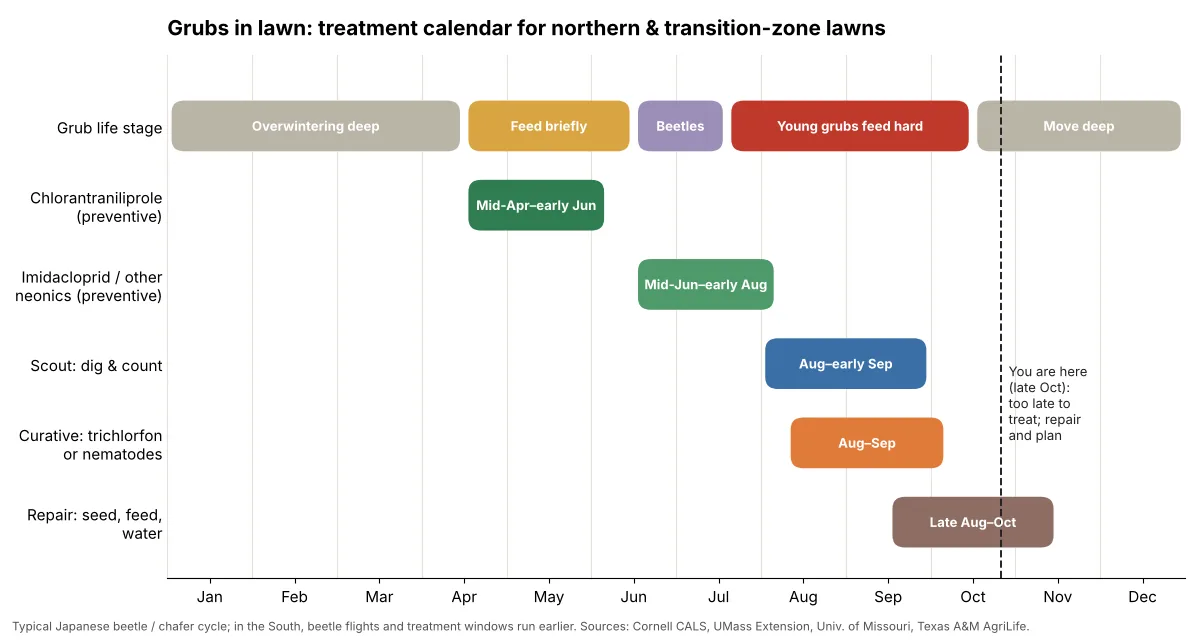
| When you find grubs (or plan) | What’s happening underground | Best move |
|---|---|---|
| Mid-April to early June | Last year’s grubs finishing up; no new eggs yet | Apply chlorantraniliprole if the lawn has a history of damage; it needs 60–90 days to move into the soil |
| Mid-June to early August | Beetles flying, eggs hatching | Apply imidacloprid, clothianidin or thiamethoxam preventively, ideally after the beetle flight peaks |
| August | Small grubs feeding hard | Dig and count. Above the threshold: trichlorfon, beneficial nematodes or imidacloprid |
| September | Grubs near full size | Only trichlorfon or nematodes are still worth trying; results drop late in the month |
| October to November | Grubs stop feeding and move deep | Don’t treat. Repair damage, deter diggers and plan next year |
| December to March | Grubs dormant about 6 inches down | Nothing to treat; order seed and products for spring |
| Spring (March to May) | Grubs feed briefly, then pupate | Usually no treatment; spring feeding rarely causes serious damage |
Cornell’s verdict on October is blunt: it’s really too late to treat this year’s grubs, and treating them is a waste of time and money. Texas A&M similarly advises against spring treatment because spring feeding isn’t significant. In the South everything runs earlier: Texas A&M puts the ideal treatment time in June for South Texas and early July for North Texas, just after the June beetle mating flights end.
How to Get Rid of Grubs in Lawn: Every Option Compared
Products for grubs in lawn fall into two groups. Preventive insecticides sit in the root zone and kill young grubs as they hatch. Curative insecticides kill grubs that are already there, but only work well while the grubs are still small. Whatever you use, follow the label for rate, timing, watering-in and any state restrictions; some states limit certain products on school grounds or require a licensed applicator.
| Active ingredient (example brand) | Type | Application window | Strengths | Limits |
|---|---|---|---|---|
| Chlorantraniliprole (GrubEx, Acelepryn) | Preventive | Mid-April to early June | Controls all common grub species; very low toxicity to people and pets; no activity against bees | Slow; useless as a rescue treatment |
| Imidacloprid (Merit and generics) | Preventive | Mid-June to early August | Inexpensive and widely sold; some effect on small grubs in August | Doesn’t control Asiatic garden beetle; toxic to bees if it reaches flowering weeds |
| Clothianidin, thiamethoxam | Preventive | June to early August | Last longer in soil than imidacloprid | Mostly sold to professionals; same bee concerns |
| Trichlorfon (Dylox) | Curative | August to September | Kills grubs in 1–3 days, then breaks down in 7–10 days | Must be watered in; breaks down fast in alkaline spray water (above pH 7.2) |
| Carbaryl (Sevin) | Curative | August to September | Widely available | Inconsistent on grubs; highly toxic to bees and beneficial insects |
| Beneficial nematodes (Heterorhabditis bacteriophora) | Biological, curative | Late summer to early fall, soil 60°F or warmer | Safe around people, pets and pollinators; can persist | Fragile; need moist soil, evening application, fresh stock |
| Milky spore (Paenibacillus popilliae) | Biological, long-term | Any time grubs feed | Can build up in soil over years | Japanese beetle grubs only; slow and variable |
| Bacillus thuringiensis subsp. galleriae | Biological | When grubs are small and feeding | Labeled for scarab grubs; low toxicity | Works best on young grubs; results vary |
Sources for the table: UMass Extension, Cornell CALS, Texas A&M AgriLife and University of Missouri Extension. Older references also list chlorpyrifos, but its homeowner lawn uses were cancelled by the EPA years ago, so it isn’t an option for you.
Water is half the treatment
Grubs live below the thatch, so an insecticide or nematode that stays on the grass blades does nothing. Texas A&M recommends ¼ to ½ inch of irrigation the day before treatment if soils are dry, to draw grubs up and open the soil, and ½ to 1 inch immediately after a liquid insecticide or nematode application. Granular products don’t need immediate watering, but they don’t work until they’re watered in.
Beneficial nematodes: the best non-chemical option
Insect-parasitic nematodes enter the grub and release bacteria that kill it within a few days. In a multi-year New Jersey study, field strains of Heterorhabditis bacteriophora reduced white grubs by 67% on golf fairways (Koppenhöfer & Sousa, 2024). To give them a fair chance, UC IPM recommends:
- applying when grubs are present and active, in late summer or early fall for white grubs;
- keeping soil temperature at or above 60°F;
- watering before and after, and applying in the evening because light and heat kill nematodes;
- repeating about 2 weeks later for better control (UC IPM).
Milky spore: patience required
Milky spore is often sold as a once-and-done organic fix. The evidence is less exciting. University of Missouri Extension says it controls only Japanese beetle grubs, not masked chafers or other species, can take several years to build up, and gives modest reductions even in good conditions (MU Extension, 2026). That matters because in many lawns Japanese beetle isn’t the main grub: in a Kentucky survey of damaged turf, masked chafers made up about 73% of grubs and Japanese beetles about 26% (Redmond & Potter, 2010).
Common mistakes that waste money
- Treating without digging. Most lawns don’t need a grub product in most years.
- Spraying in October or spring when grubs are deep, full-sized or about to pupate.
- Putting down imidacloprid in April and expecting it to last until the August hatch; UMass found early imidacloprid can wear off too soon.
- Skipping the watering-in step or mixing trichlorfon in hard, alkaline water and letting it sit.
- Hanging Japanese beetle traps. Missouri Extension notes that traps attract more beetles than they catch, raising the number laying eggs in your yard.
- Spraying flowering clover or weeds with neonicotinoids; mow the flowers off first to protect bees.
Grubs in Lawn in Fall: What to Do Right Now
If you’re dealing with grubs in lawn areas in late fall and the turf is chewed up, put the insecticide back on the shelf. The grubs have stopped feeding and are heading down for winter. What you can do now is help the grass recover and set up next season.
1. Put back what the animals dug up
Press flipped sod back into place the same day, tamp it down and water it. Roots can re-knit as long as the soil stays moist and the ground hasn’t frozen. Animals will usually lose interest once grubs move deep for winter, so the digging tends to fade as the soil cools.
2. Reseed bare patches
In cool-season lawns, rake out dead turf, loosen the top inch of soil and seed. If it’s already too cold for seed to sprout before winter, our dormant seeding guide explains how to sow in late fall so the seed germinates first thing in spring. Good soil preparation makes a bigger difference to establishment than seed brand.
3. Feed and water for root regrowth
Cornell research found that fall fertilization helps turf recover from grub damage, so a normal late-season feeding (see when to apply winterizer) is worth doing where local rules allow. Keep the soil moist, not soggy, until the ground freezes, and mow at your usual height.
4. Plan next year’s prevention now
- Mark the areas where you found grubs in lawn soil on a phone photo so you know where to scout and treat.
- If damage was heavy, plan a chlorantraniliprole application for mid-April to early June next year, or a neonicotinoid for mid-June to early August.
- If damage was light, plan an August dig test instead and treat only above the threshold.
- Raise mowing height and avoid summer drought stress; deeper roots tolerate more grubs.
For other fall jobs that make spring weeds and pests worse if you skip them, see our list of fall lawn care mistakes.
A Note from the Agronomist’s Side
Here’s the most useful way to think about grubs: you’re not managing an insect, you’re managing a root system. A lawn with 6 inches of roots can lose the top inch to grubs and barely notice. A lawn with 2-inch roots, scalped short and dried out every July, collapses at half the threshold. That’s why the published numbers come with the warning that healthy turf tolerates more, and why the cheapest long-term grub control is often a taller mowing height and deep, infrequent watering.
The second thing the research makes clear is that “grub control” is really four different decisions in four different months. Prevention is a spring or early-summer decision based on last year’s history. The August dig is a scouting decision. Curative treatment is an August or early-September decision based on counts. Everything after that is repair. The classic way to waste money is to collapse all four into a single panic purchase in October.
Finally, when it comes to grubs in lawn, species matters more than most product labels suggest. Milky spore only works on Japanese beetle, imidacloprid misses Asiatic garden beetle, and May/June beetle grubs can do damage at 3–4 per square foot. If you’re dealing with repeat damage, dropping a few grubs in a jar of rubbing alcohol and taking them to your county extension office for identification is one of the highest-value things you can do. It’s usually free, and it tells you exactly which product and timing will work.
FAQ
Can I treat my lawn for grubs in the fall?
Not usefully after about mid-September. By October the grubs have stopped feeding and moved deeper, and Cornell describes treating them then as a waste of time and money. In fall, repair the turf, reseed bare spots, and plan prevention for next spring or summer.
What is the best time to treat grubs in lawn?
For prevention, apply chlorantraniliprole from mid-April to early June, or imidacloprid from mid-June to early August. For a curative treatment, apply trichlorfon or beneficial nematodes in August, while grubs are still small. In the South, the window starts earlier, around June.
How do I know if I have grubs in my lawn?
Pull on brown turf: if it peels up like a carpet with few roots, dig a 1-foot square about 2–3 inches deep and count the C-shaped white larvae. More than about 5–10 per square foot (fewer for large May/June beetle grubs) usually means treatment is justified.
Do grubs come back every year?
They can, because new beetles lay eggs every summer and adults fly in from neighboring yards. Whether they cause damage depends on numbers and turf health; Cornell research found home lawns needed treatment only about 20% of the time.
Is grub killer safe for dogs?
Chlorantraniliprole has very low toxicity to mammals and needs no signal word on its label. Trichlorfon and carbaryl are more toxic. With any product, follow the label and keep pets off treated turf until it has been watered in and dried.
Does milky spore get rid of grubs?
Only Japanese beetle grubs, and slowly. It can take several years to build up in soil and reductions are often modest. It does nothing to masked chafer or May/June beetle grubs.
What animals dig up lawns for grubs?
Skunks, raccoons and armadillos are the main diggers, along with crows and starlings. Their digging often causes more damage than the grubs themselves, and it usually fades once grubs move deep for winter.
Sources
- Cornell CALS, New York State IPM Program. White Grubs. Life cycle, sampling, species thresholds and monthly treatment guidance.
- Vittum, P. University of Massachusetts Extension. Current Insecticide Approaches for White Grub Control. Preventive and curative timing, residual activity and limitations.
- Benthall, K.B., Althoff, E.R. & Rice, K.B. (2020). Japanese Beetle. University of Missouri Extension, G7412. Life cycle, overwintering depth and trap guidance.
- University of Missouri Extension (2026). Milky Spore and Japanese Beetles: A Long-Term Tool With Limits.
- Reynolds, C., Merchant, M. & Reynolds, D.S. White Grub Identification and Control. Texas A&M AgriLife Extension, SCSC-PU-155. Southern species, timing, thresholds and irrigation.
- UC Statewide IPM Program. Beneficial Nematodes (UC Guide to Healthy Lawns).
- Koppenhöfer, A.M. & Sousa, A.L. (2024). Long-term suppression of turfgrass insect pests with native persistent entomopathogenic nematodes. Journal of Invertebrate Pathology 204: 108123. (via PubMed)
- Redmond, C.T. & Potter, D.A. (2010). Incidence of turf-damaging white grubs and associated pathogens and parasitoids on Kentucky golf courses. Environmental Entomology 39(6): 1838–1847. (via PubMed)