
It’s a crisp October Saturday. The lawn looks fine, the leaves are coming down, and it feels like the season’s work is basically over. So you stop mowing, skip the fertilizer, leave the dandelions for spring, and let the leaves pile up. Then April arrives and the lawn is thin, patchy and full of weeds you never noticed in fall. Those are classic fall lawn care mistakes, and almost every one of them shows up later as weeds.
Short answer: the most costly fall lawn care mistakes are the ones that leave grass thin or weeds well-fed going into winter: mowing too short, skipping (or mistiming) fall fertilizer, waiting until spring to spray perennial weeds, missing the pre-emergent window for winter annuals, and smothering turf under matted leaves. Fix those in September to November and you remove most of next spring’s weed problem before it starts.
This guide walks through the nine mistakes that most often invite weeds, explains why each one backfires, and splits the advice by grass type, because a September job that helps tall fescue can hurt St. Augustinegrass. By the end you’ll have a month-by-month calendar, a herbicide table by active ingredient, and a mid-October triage list for whatever you can still fix this year.
Table of Contents
- Why Fall Mistakes Turn Into Spring Weeds
- 9 Fall Lawn Care Mistakes That Invite Weeds
- Cool-Season vs Warm-Season Lawns: Same Month, Opposite Rules
- Your Fall Weed-Proofing Calendar
- Fall Herbicide Guide by Active Ingredient
- It’s Mid-October: What Can You Still Fix?
- A Note From the Agronomist’s Side
- FAQ
- Sources
Why Fall Mistakes Turn Into Spring Weeds
Weeds are opportunists. They rarely beat healthy, dense turf in a straight fight; they move into gaps. Fall is when your lawn either builds the density that shuts those gaps or loses it.
For cool-season grasses, fall is the main growing season. Purdue’s turf program notes that fall nitrogen feeds root development, energy storage and color retention, and that the payoff shows up the following spring as earlier green-up, denser turf and fewer weeds (Purdue Turfgrass Science). Perennial weeds are doing something similar: in fall, dandelions, ground ivy and Canada thistle move sugars down to their roots to fuel spring regrowth, which is why herbicides applied now travel to the roots too (SDSU Extension).
Meanwhile, winter annuals such as henbit, chickweed and annual bluegrass germinate in cool fall soils and sit quietly as small rosettes until they bolt in late winter. If you want the background on that group, our guide to winter annual weeds explains their life cycle. Put it together and the logic is simple: every fall lawn care mistake either weakens the grass, strengthens the weeds, or both.
9 Fall Lawn Care Mistakes That Invite Weeds
These fall lawn care mistakes are ordered roughly by how often they cause trouble in typical US yards. Each one comes with the reason it backfires and the fix.
1. Mowing too short, or quitting too early
The urge to cut low before winter is strong, and so is the urge to put the mower away the first cool week. Both hurt. Missouri Extension recommends a 3 to 4 inch mowing height for tall fescue and Kentucky bluegrass lawns, and notes that raising the cut from 2.5 to 3.5 inches reduces annual weed populations by up to 80 percent, because taller grass shades the soil where weed seeds need light to germinate (University of Missouri Extension).
The fix: keep mowing at your normal height as long as the grass keeps growing, and never take off more than about a third of the blade at once. In snowy regions a slightly lower final cut can reduce matting, but that’s a modest drop, not a scalp. Our guide to the last mow of the season covers the exact height and timing by grass type.
2. Skipping fall fertilizer on cool-season grass
Many homeowners feed in spring, when the lawn looks hungry, and skip fall, when it doesn’t. For cool-season turf that’s backwards. Purdue recommends about 1.0 lb of nitrogen per 1,000 sq ft in September, once daytime highs are out of the 90s°F, using a mix of quick- and slow-release nitrogen. A second, late-fall application of 0.5 to 1.0 lb goes down in early November, near the last mowing while the grass is still green, using a quick-release source such as urea or ammonium sulfate (Purdue).
The fix: if you missed September, don’t double up now. Make the late-fall feeding on schedule. Our winterizer timing guide explains what that product label actually means.
3. Feeding warm-season grass late in the season
This is the mirror image of mistake 2, and it catches people who copy cool-season advice. Bermudagrass, zoysiagrass, centipedegrass and St. Augustinegrass are slowing toward dormancy in fall. NC State Extension advises against nitrogen in fall and winter because warm-season grasses take it up only while actively growing (NC State Extension, Pender County).
Clemson’s Home & Garden Information Center is slightly more permissive: any late-season nitrogen should go down at least two months before the first average frost (around August 15 in upstate South Carolina, September 1 on the coast), at half a pound or less of actual nitrogen per 1,000 sq ft. Too much late nitrogen pushes soft new shoots that burn through stored carbohydrates and tolerate cold poorly (Clemson HGIC). Winter-injured turf greens up slowly, and slow green-up is an open door for weeds.
The fix: skip nitrogen now on warm-season lawns. If a soil test shows low potassium, Clemson suggests about 1 lb of potash per 1,000 sq ft to support cold tolerance, but only when the test calls for it.
4. Leaving perennial weeds until spring
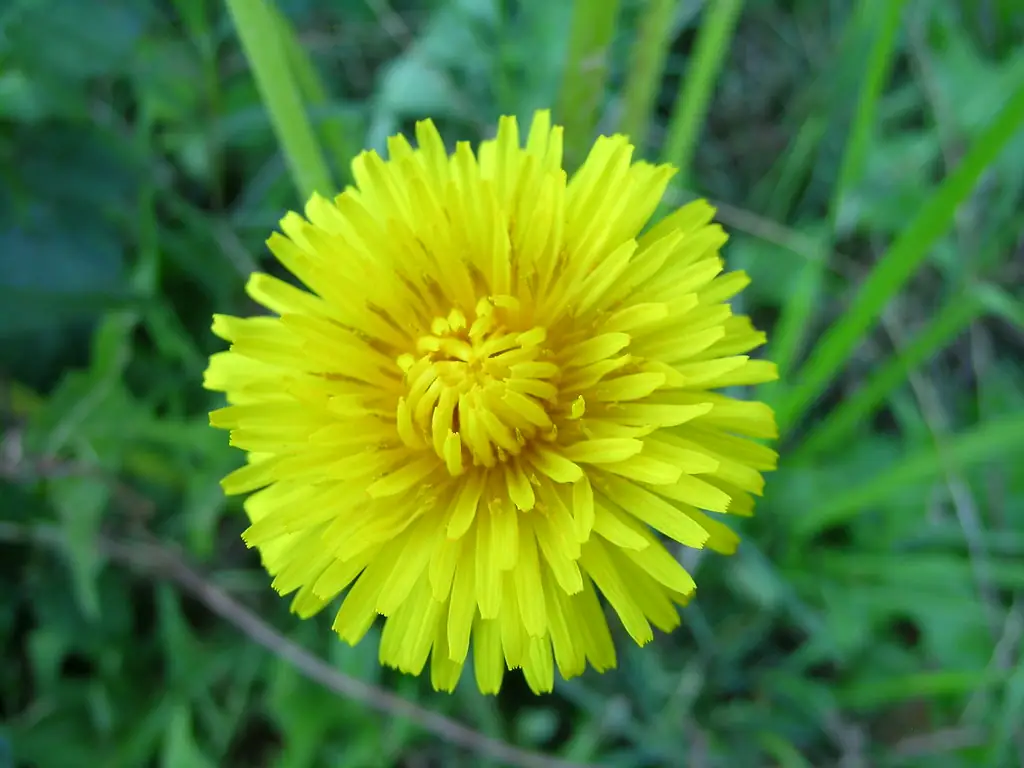
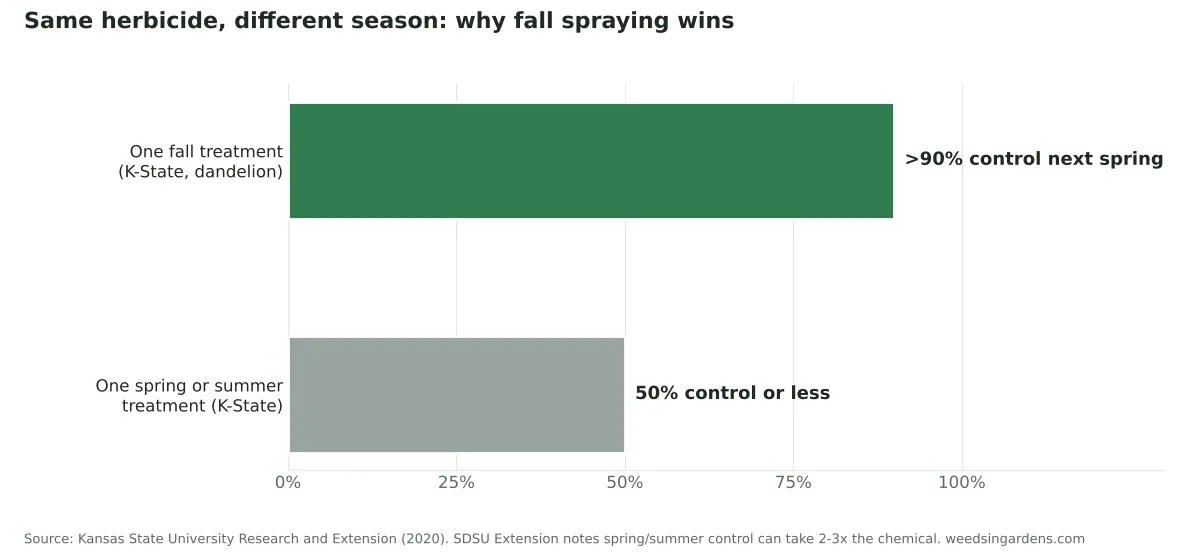
Dandelions look harmless in October, so it’s tempting to deal with them when they flower in April. That’s the least efficient moment. SDSU Extension notes it may take two to three times as much herbicide to control perennial weeds in spring or summer as in fall (SDSU Extension). K-State reports that a single fall treatment on dandelions gave over 90 percent control the next spring, while a single spring or summer treatment gave 50 percent or less (K-State Research and Extension).
The fix: spray perennial broadleaf weeds such as dandelion, plantain, clover, ground ivy and wild violets between mid-September and early November (Purdue Extension AY-9-W). Our fall weed control guide goes deeper on the weeds that respond best.
5. Spraying on the wrong day
Right season, wrong day is still a wasted spray. Herbicides that move to the roots need a weed that is actively growing. Purdue’s guidance is to spray when air temperatures are between 50 and 85°F on a calm day, not to spray when soil moisture is low, and not to mow for at least 3 days before or after treatment. If rain falls within 24 hours and nothing has happened after 10 days, consider a reapplication (Purdue). SDSU adds that daily highs should stay above 55°F for a few days so weeds are actively growing, and that granular products work best on damp grass (SDSU).
Frost cuts both ways. A light frost encourages perennials to move sugars (and herbicide) to the roots, but K-State notes that sustained hard freezes damage the leaves and reduce that benefit. Once the weeds look burned and brown, you’ve usually missed the window for this year.
6. Putting down pre-emergent where you also plan to seed
Fall is the best time to seed cool-season lawns and also a popular time for pre-emergents. The two clash. UGA Extension warns that fall-applied pre-emergence herbicides shouldn’t be used if reseeding or resodding will be needed within several months, because most of them stop grass seed from establishing along with weed seed (UGA Extension B1394).
Post-emergent products are a problem for new grass too. NC State’s turf team says fall-seeded cool-season grass shouldn’t receive herbicides until it is well tillered (NC State TurfFiles), and Purdue advises waiting until new seedlings have been mowed at least three times, or 4 to 6 weeks after sodding (Purdue).
The fix: decide area by area. Thin areas get seed (and a weed-free start, as described in our guide to killing weeds before overseeding). Dense areas can get weed control.
7. Missing the winter-annual pre-emergent window in warm-season lawns
Annual bluegrass (Poa annua), henbit and chickweed don’t appear in spring out of nowhere. They germinated last fall. UGA Extension notes that annual bluegrass germinates once soil temperatures fall below 70°F, so the pre-emergent has to be down in late summer or early fall, before that happens (UGA). A pre-emergent applied in November, after the seedlings are up, does nothing to them.
The fix: if you’ve already missed it, switch to post-emergent spot treatment of the young rosettes this fall and winter, with a product labelled for your grass, and set a reminder for next September.
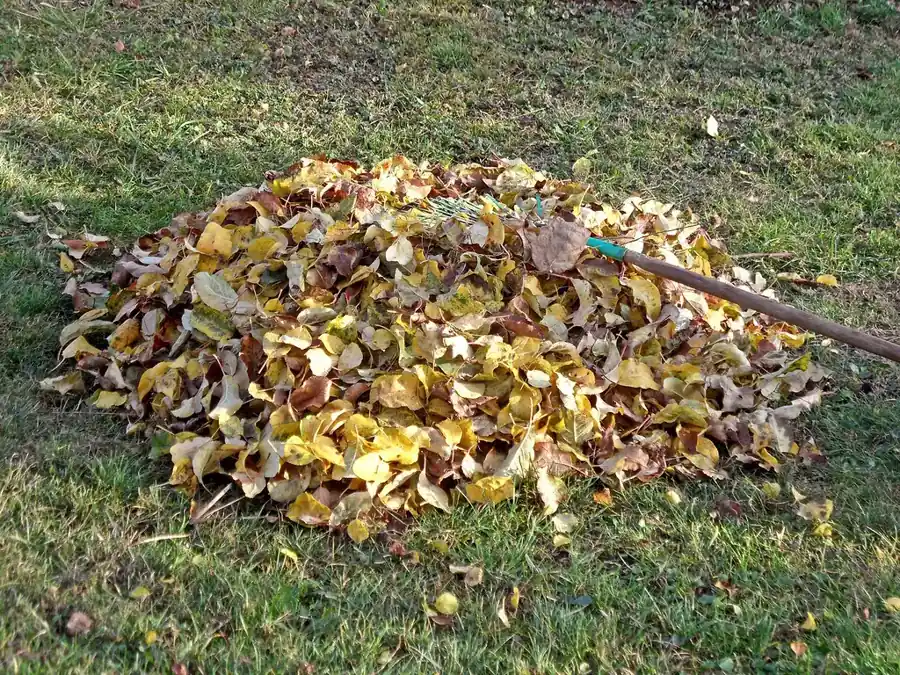
8. Letting leaves mat down on the lawn
A few scattered leaves don’t matter. A wet, solid layer that sits for weeks does: it blocks light during the season when cool-season grass is trying to store energy, and it can thin the stand underneath. Thin spots in fall become bare spots in spring, and bare soil is where weed seeds win. Matted leaves also hold moisture against the turf, which favors snow mold in the North (see our snow mold guide).
The fix: mulch light leaf fall with a mower every week or so. Rake or bag heavy layers. Our article on leaves on the lawn over winter compares the options.
9. Seeding too late, or overseeding the wrong grass
Cool-season seed sown too late in fall germinates slowly in cold soil, and seedlings without enough roots before winter can fail, leaving bare soil for spring weeds. NC State’s turf team puts the ideal window in the North Carolina piedmont between mid-September and early October, a week or two earlier in the mountains, and warns that cool weather reduces tall fescue and Kentucky bluegrass germination if you wait too long (NC State TurfFiles).
Warm-season lawns have the opposite trap. NC State’s Pender County office advises against overseeding with ryegrass except on bermudagrass, and says centipedegrass and St. Augustinegrass are especially harmed by it (NC State Extension). The ryegrass competes with the base grass at spring green-up.
The fix: if you’re past the window in a cool-season area, plan a dormant seeding in late fall instead of seeding now.
Cool-Season vs Warm-Season Lawns: Same Month, Opposite Rules
Most fall lawn advice online is written for northern, cool-season lawns. If you live in the South or transition zone, roughly half of it is wrong for you, and following it is one of the most common fall lawn care mistakes in warm-season yards. This table puts the two side by side.
| Fall task | Cool-season lawns (fescue, bluegrass, ryegrass) | Warm-season lawns (bermuda, zoysia, St. Augustine, centipede) |
|---|---|---|
| Nitrogen | Main feeding season: ~1 lb N/1,000 sq ft in Sept, 0.5–1 lb in early Nov (Purdue) | Avoid fall N (NC State); if any, ≤0.5 lb at least 2 months before first frost (Clemson) |
| Potassium | Only if a soil test shows low K | ~1 lb potash/1,000 sq ft only if a soil test shows low K (Clemson) |
| Mowing height | Keep 3–4 in while growing (Missouri) | Keep at the recommended height; low mowing favors large patch (NC State) |
| Seeding | Best season: mid-Sept to early Oct in the NC piedmont (NC State) | Don’t overseed St. Augustine or centipede with ryegrass (NC State) |
| Pre-emergent | Skip where you’re seeding | Late summer to early fall, before soil drops below 70°F (UGA) |
| Broadleaf herbicide | Mid-Sept to early Nov, 50–85°F (Purdue) | Label-safe products only; no 2,4-D on St. Augustine or centipede (NC State) |
| Main fall disease | Snow mold risk if leaves or tall grass mat down | Large patch; fungicide once soil drops below 70°F if it’s a history (NC State) |
Not sure which you have? Our lawn grass comparison shows how to tell them apart.
Your Fall Weed-Proofing Calendar
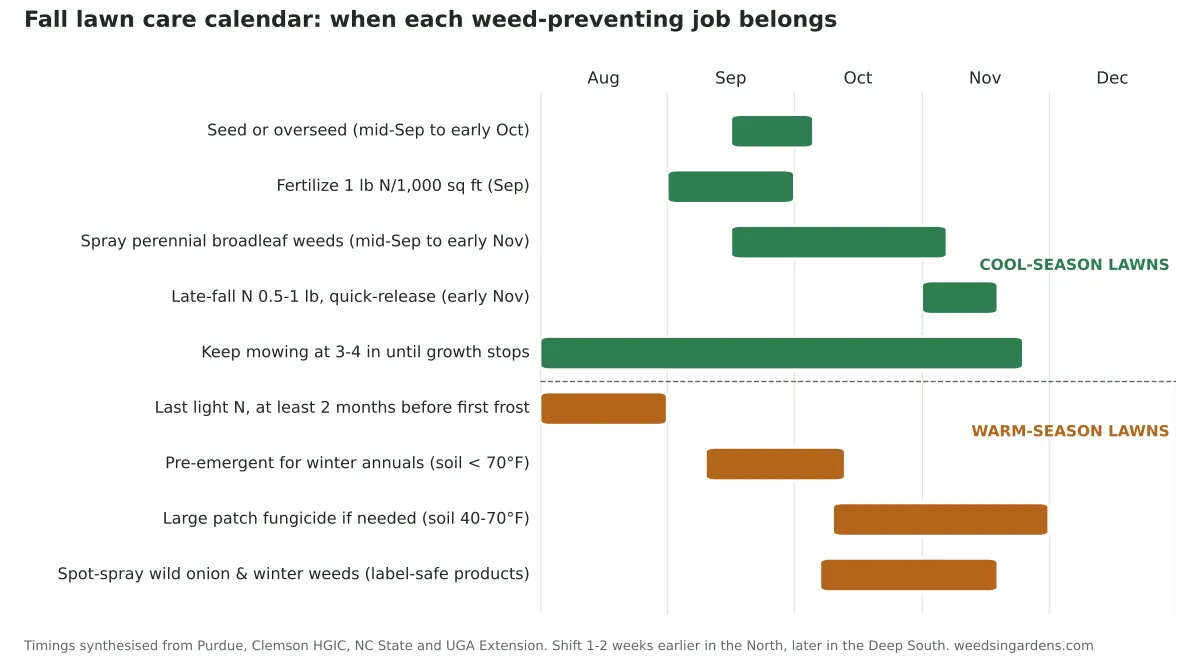
Here is the same information as a timeline. The bars are typical windows for the mid-South and lower Midwest; shift them a week or two earlier in the far North and later along the Gulf Coast, and always let soil temperature and the weather overrule the calendar.
| Month | Cool-season priorities | Warm-season priorities |
|---|---|---|
| Late Aug–Sept | Fertilize (~1 lb N); seed thin areas mid-Sept on; keep mowing tall | Last light N only if it’s 2+ months before first frost; apply pre-emergent for winter annuals before soil drops below 70°F |
| October | Spray perennial broadleaf weeds on 50–85°F days; mulch or rake leaves weekly | Watch for large patch; spot-spray wild onion and young winter weeds with label-safe products |
| November | Late-fall quick-release N near the last mowing; finish weed spraying before hard freezes | No nitrogen; soil test if it’s been 3+ years (NC State) |
| Dec–Feb | Keep leaves and traffic off frozen turf; plan dormant seeding | Second wild onion spray in February (NC State); a second pre-emergent can catch late germinators (UGA) |
Fall Herbicide Guide by Active Ingredient
Product names change; active ingredients don’t. Check the ingredients box on the label, confirm your grass species is listed as tolerant, and follow the label rate and temperature limits. The label is the law.
| Active ingredient(s) | What it’s for in fall | Turf-safety notes | Timing / temperature |
|---|---|---|---|
| 2,4-D + MCPP (mecoprop) + dicamba (three-way) | General broadleaf weeds: dandelion, plantain, clover | Widely labelled for cool-season turf. NC State: don’t use 2,4-D on St. Augustine or centipede | Mid-Sept to early Nov; 50–85°F; no mowing 3 days before or after (Purdue) |
| Dicamba + quinclorac | Field bindweed | Check label for your grass | K-State found this pairing gave the best bindweed control and root weakening |
| Triclopyr | Hard-to-kill broadleaves such as ground ivy and wild violets | Listed by SDSU; labels restrict use on some warm-season grasses | Active growth; daily highs above 55°F for a few days (SDSU) |
| Carfentrazone, sulfentrazone, mesotrione | Often in premixes for faster burndown or tough weeds | Listed by SDSU; grass tolerance varies by product | Follow label |
| Prodiamine, dithiopyr, pendimethalin, bensulide (pre-emergents) | Annual bluegrass and other winter annuals | Don’t use where you’ll reseed or resod within several months (UGA) | Before soil falls below 70°F (UGA) |
| Atrazine / simazine | Annual bluegrass and winter broadleaves in warm-season lawns | Residual only about 4–6 weeks (UGA). NC State: atrazine no more than twice a year, not on soil above pH 7.0 | Follow label |
Prefer to avoid herbicides? For a handful of dandelions, a long-bladed weeding tool after a soaking rain removes most of the taproot. For thin lawns, the strongest non-chemical tool is density: correct mowing height, fall fertilizer on cool-season grass, and timely seeding. The lime for lawns guide covers the soil-test side, since grass struggling with the wrong pH loses ground to weeds.
It’s Mid-October: What Can You Still Fix?
If you’re reading this in mid-to-late October, some windows are closed and some are wide open. Use this decision table to focus your weekend and undo the fall lawn care mistakes that are still fixable.
| If you see… | Grass type | Do this now | Too late for this year |
|---|---|---|---|
| Dandelions, clover, plantain, ground ivy | Cool-season | Spray on a 50°F+ day while leaves are green | Nothing yet; finish before hard freezes |
| Bare or thin patches | Cool-season | Plan dormant seeding later in fall | Regular fall seeding in most of the North |
| Tiny grassy seedlings or henbit rosettes | Warm-season | Spot-spray with a label-safe post-emergent | Pre-emergent for those seedlings |
| Thick, wet leaf layer | Any | Rake or mulch-mow this week | — |
| Lawn still green and growing | Cool-season | Keep mowing at 3–4 in; plan early-Nov feeding | September feeding (don’t double up) |
| Lawn going tan, slowing down | Warm-season | Leave it alone: no N, no ryegrass on St. Augustine or centipede | Any nitrogen this year |
A Note From the Agronomist’s Side
Step back from the individual fall lawn care mistakes and one pattern stands out: almost every fall error comes from treating the lawn as if it were going to sleep. Cool-season grass isn’t. October is closer to its peak than its end, and the roots it builds now decide how well it holds ground against crabgrass and broadleaves in May. When you mow it short, starve it, or bury it under leaves, you’re cutting the budget for next year’s growth.
The second pattern is sugar flow. Perennial weeds and cool-season grasses are both moving carbohydrates downward in fall. That’s why a systemic herbicide works so well now (the weed carries it to its own roots) and why nitrogen works so well now (the grass banks it). The same physiology also explains why warm-season grass behaves differently: it’s shutting down, so nitrogen pushes the wrong kind of growth at the wrong time.
A practical rule of thumb: in fall, favor density over cosmetics. A slightly shaggy, well-fed, leaf-free lawn going into winter will out-compete more weeds next spring than any single herbicide pass. And when the advice you read conflicts, check whether it was written for your grass type and your region. That one question resolves most of the contradictions you’ll find online.
FAQ
What is the biggest fall lawn care mistake?
For cool-season lawns, it is usually skipping fall fertilizer and fall weed control together. Purdue recommends about 1 lb of nitrogen per 1,000 sq ft in September and 0.5 to 1 lb in early November, and fall is when perennial broadleaf weeds are easiest to kill. Miss both and you start spring with thin grass and well-fed weeds.
Is it too late to put weed killer on my lawn in October?
Usually not. Purdue Extension gives mid-September to early November as the window for broadleaf herbicides on cool-season lawns, and K-State calls late October to early November a great time to treat dandelions. Spray on a day that reaches at least 50°F, when weeds are still green and the soil isn’t dry, and follow the label.
Should I fertilize my lawn before winter?
Cool-season lawns (tall fescue, Kentucky bluegrass, ryegrass) benefit from a late-fall feeding around the last mowing while the grass is still green. Warm-season lawns are different: NC State advises against fall nitrogen, and Clemson says any late-season nitrogen should go down at least two months before the first average frost, at half a pound or less per 1,000 sq ft.
Can I put down pre-emergent and grass seed at the same time in fall?
Generally no. UGA Extension warns that fall pre-emergents shouldn’t be used if you’ll need to reseed or resod within several months, because most of them stop grass seed as well as weed seed. Pick one job per area: seed the thin spots, or pre-emerge the healthy turf.
Should I cut my grass short for the last mow of the year?
Not scalped short. Keep cutting at your normal recommended height while the grass grows; Missouri Extension notes that raising the cut from 2.5 to 3.5 inches can reduce annual weeds by up to 80 percent. A modest drop on the final cut is fine for snow-prone cool-season lawns, but never remove more than about a third of the blade at once.
Do I need to rake leaves to prevent weeds?
You need to stop leaves from forming a solid mat. A thick layer shades the grass for weeks, thins it, and leaves bare soil where winter annuals and spring weeds can sprout. Mulching light leaf fall with the mower is fine; heavy layers should be raked or bagged.
When do winter weeds like henbit and annual bluegrass germinate?
Annual bluegrass begins germinating when soil temperatures drop below about 70°F, according to UGA Extension, which is why fall pre-emergents go down in late summer or early fall in warm-season lawns. Henbit and chickweed sprout in the same cool, moist fall weather.
Sources
- Purdue University Turfgrass Science. Fall Fertilization.
- Purdue Extension. Control of Broadleaf Weeds in Home Lawns (AY-9-W).
- South Dakota State University Extension. Fall Weed Control in Lawns.
- Kansas State University Research and Extension, Wild West District (2020). Now Is the Time to Treat Dandelions and Perennial Broadleaf Weeds.
- Clemson Cooperative Extension, Home & Garden Information Center. Winterizing Lawns.
- NC State Extension, Pender County Center (2021). Fall Lawn Do’s and Don’ts.
- NC State University TurfFiles (2023). It Is (Almost) Time for Fall Seeding of Cool-Season Grasses.
- University of Georgia Cooperative Extension. Annual Bluegrass Control in Residential Turfgrass (Bulletin 1394).
- University of Missouri Extension. Mowing Too Short Can Harm Your Lawn.