
Short answer: yes, boiling water for weeds works, but only on part of the problem. It kills the green tissue it touches within minutes, so young annual weeds in patio joints, sidewalk cracks and gravel die in one or two pours. Deep-rooted perennials such as dandelion, bindweed and Bermudagrass lose their tops and regrow from the roots, and Iowa State University Extension advises a second pour 7–10 days later.
Boiling water also kills lawn grass and garden plants just as readily as weeds, so it belongs on hard surfaces, not in beds or turf.
Below: what the research says about how hot water kills plants, which weeds it handles, where it causes damage, how to pour it safely, and how it compares with vinegar, flaming and pulling.
Table of Contents
How boiling water kills weeds
Hot water is a contact treatment. Heat ruptures cell membranes and denatures proteins in the leaves and stems, so the cells leak and collapse. The University of California IPM WeedCUT tool notes that plant tissue can die at temperatures as low as 113°F (45°C) if the exposure lasts long enough; freshly boiled water is far above that, so leaves wilt almost as soon as they are wet.
The key limit is that it only kills what it touches. Iowa State describes boiling water as acting like a contact herbicide: it “won’t eliminate roots or subsurface plant material.” Water cools quickly as it soaks into soil, so buried roots, rhizomes, bulbs and seeds are largely out of reach.
What you see after a pour follows a set pattern. Leaves go limp at once but usually don’t turn brown for one to two days. UC IPM reports that thermal injury peaks around three days after treatment, and after that any surviving plant starts to recover.
Which weeds boiling water kills (and which it doesn’t)
Plant age matters more than anything else. In a field study with white mustard, Hansson and Ascard (2002, Weed Research) found that 340 kJ of heat per square metre cut plant weight by 90% at the two-leaf stage. At the six-leaf stage, the same result needed about three times as much energy. In kitchen terms, one kettle clears a lot more ground if you pour while the weeds are still seedlings.
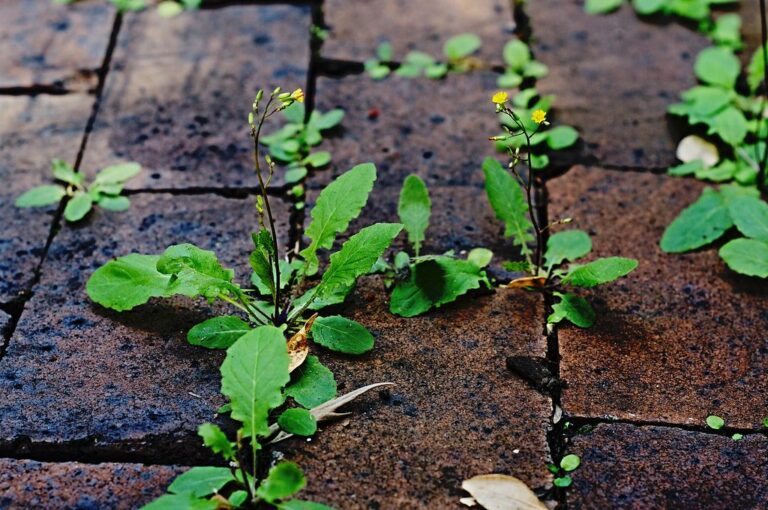
Good targets
- Seedlings and young annual broadleaf weeds (from the seed-leaf stage to a few true leaves): chickweed, young spurge, purslane, bittercress, groundsel. UC IPM rates these as the best responders to heat.
- Weeds in narrow cracks where the water pools around the crown and there’s little soil to cool it.
- Dry patios and paths where nothing you want is growing within splashing distance.
Poor targets
- Taprooted perennials such as dandelion and dock. The top dies, and new leaves come back from the root crown.
- Creeping perennials with rhizomes, stolons, bulbs or tubers: bindweed, Bermudagrass, quackgrass, nutsedge, oxalis. UC IPM lists plants with rhizomes, bulbs or tubers as ones that resprout after heat treatment.
- Established grasses. In a 2021 field comparison of hot water and hot foam, Martelloni and colleagues (Journal of Agricultural Engineering) named Bermudagrass (Cynodon dactylon), large crabgrass (Digitaria sanguinalis) and dandelion among the hardest species to kill. A grass plant’s growing point sits at or below the soil surface, shielded by older leaf sheaths.
- Woody seedlings and older, tough-leaved weeds, which need far more heat per plant.
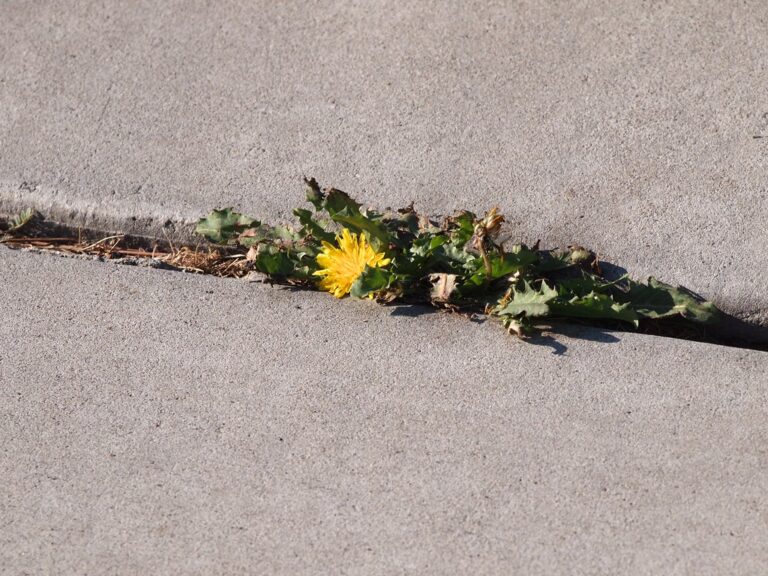
If a crack is full of dandelions or bindweed, dig out what you can first, then pour boiling water for weeds that are still seedlings. See our guides on why dandelions keep coming back and getting rid of bindweed for root-level control.
How often you need to repeat it
One pour rarely finishes the job. Iowa State expects established plants to regrow after several days and suggests treating again 7–10 days later. The research on hot water machines used by cities points the same way:
- On hard surfaces with natural weed growth, Hansson and Ascard found an average interval of about 25 days between treatments. After 3–4 weeks, regrowth of perennial weeds had cancelled out most of the effect.
- A review of non-chemical weed control on hard surfaces (Rask and Kristoffersen, 2007, Weed Research) summarises Dutch results of 3–5 hot-water treatments per year for acceptable control. Where perennials were heavy, one Danish trial needed 11–12 treatments a year.
- On traffic islands kept below 2% weed cover, Rask and co-workers (2013, Weed Research) needed about 3 hot-water treatments a year, compared with 2.5 for glyphosate, 5 for flaming and 5.5 for steam.
- UC IPM suggests 3- to 4-week intervals for steam and hot water during active growth.
For a home patio, a practical rhythm is to pour when the first flush of seedlings appears in spring, again 7–10 days later on anything that greened up, and then about once a month through the growing season.
Where boiling water damages the garden
Boiling water is non-selective. Iowa State warns that it damages desirable plants just as it damages weeds. That rules it out in several places people often try it:
- Lawns. A kettle poured on a dandelion in turf leaves a dead brown patch of grass larger than the weed, and the dandelion often returns from its root before the grass fills in.
- Flower and vegetable beds. Hot water spreads through loose soil and mulch and can scald the crowns and shallow roots of nearby plants. In beds, hand pulling, hoeing and mulch work better; see clearing chickweed from vegetable beds and stopping weeds in mulch beds.
- Next to lawn edges and borders. Water flows off a sloping path into the grass along its edge. Pour slowly and stop before it runs off.
- Around tree bases. Shallow feeder roots and thin bark on young trees are easily scalded.
It is a good fit for sidewalk cracks, patio and paver joints, gravel paths with no plants in them, and driveway edges. For the gravel side of that list, our guide to weeds in rock gardens and gravel beds covers what to do once the seed bank builds up.
How to use boiling water for weeds safely: step by step
Safety comes first. The American Burn Association scald prevention guide lists a full-thickness burn in 5 seconds at 140°F (60°C) and in 1 second at 155°F (68°C). Water just off the boil is well above both, so a splash on bare skin or a trip while carrying a full kettle can cause a serious burn.

- Choose a dry, sunny day. Rask and Kristoffersen’s review reports better results on water-stressed plants and advises against treating in rain or when plants are wet, because water on the leaves takes heat away.
- Treat early. Pour when weeds have two to four leaves, not when they are flowering. As the Hansson and Ascard data show, young plants need roughly a third of the heat.
- Use a kettle with a narrow spout. Iowa State recommends a tea kettle for accurate pouring; a gooseneck kettle is even easier to aim into a crack. Avoid carrying open pots of boiling water across the garden.
- Dress for it. Closed shoes, long trousers and gloves. UC IPM advises gloves and eye protection for hot water and steam work. Keep children and pets indoors while you work.
- Pour slowly and close to the plant. Hold the spout a few centimetres above the crown and soak the whole rosette. Pouring from height splashes.
- Use enough water. In the Martelloni trial, water doses ranged from 0.67 to 8.33 litres per square metre; the higher doses are roughly a full kettle for a patch one metre square. Seedlings in a crack need much less, while a leafy rosette needs a steady pour until it is soaked.
- Check after 2–3 days and again at 7–10 days. Pull the dead tops out of the joints (they come out easily) and re-treat anything that is green again.
Don’t add salt, bleach or vinegar to the kettle. None of them fixes the root problem. Bleach and salt harm the soil and nearby plants; see why bleach is a bad idea for weeds.
Boiling water vs vinegar, flaming and pulling
Boiling water is one of several contact methods. All of them burn off the tops and leave the roots, so the choice comes down to cost, safety and where you’re working.
| Method | Best for | Kills roots of perennials? | Main risk | Repeat needed |
|---|---|---|---|---|
| Boiling water | Seedlings in cracks, pavers, gravel | No | Scald burns; kills any plant it touches | Every 1–4 weeks in the growing season |
| Horticultural vinegar (20% acetic acid) | Small annuals on hard surfaces | No | Eye and skin burns at high strength | Similar to boiling water |
| Flame weeder | Seedlings on paths, stale seedbeds | No | Fire risk near dry mulch and grass | About 5 treatments a year on hard surfaces (Rask et al. 2013) |
| Hand pulling / weeding knife | Taprooted weeds, beds, lawns | Yes, if the whole root comes out | Labour; root fragments regrow | As new seedlings emerge |
| Selective lawn herbicide | Broadleaf weeds in turf | Often, for systemic products | Label limits; drift onto garden plants | Depends on product and weed; follow the label |
For the acid option, our guide on what horticultural vinegar really does goes through concentrations and safety. For cracks that keep filling with spurge, see getting rid of spurge in lawns and sidewalk cracks. All of these sit in our natural and organic weed control section.
Where this applies
The timing advice here is based on temperate-climate research, mostly from Scandinavia, Italy and the US Midwest. In those climates the main flush of annual weeds in paving comes in spring and early summer. In warm climates and the tropics, weeds in hard surfaces germinate for most of the year, so expect to treat more often. In the Southern Hemisphere, shift the months by six. The herbicide options in the comparison table differ by country, so check what is registered where you live and follow the label.
A note from the agronomist’s side
In trial plots and on farms I have worked with, heat treatments of every kind show the same pattern: a dramatic result on day one, and a crop of green shoots from the same crowns two weeks later. The weeds that come back are nearly always perennials with food reserves underground.
Boiling water is good value in a narrow niche: a paved area where seedlings keep appearing and where you’d rather not spray. Treated that way, as seedling control done every few weeks, it works. If you expect it to clear an established patch of dandelions or bindweed, it will disappoint. For those, get the roots out or use a product labelled for that weed, then keep the cracks clear with the kettle.
FAQ
Does boiling water kill weed roots?
Mostly not. It kills the leaves and stems it touches and may kill the shallow roots of small seedlings, but the roots and rhizomes of perennials survive and regrow. Iowa State notes that one application rarely kills whole plants of deep-rooted weeds.
Will boiling water kill grass?
Yes. It scorches lawn grass as readily as weeds, leaving brown patches. Established grassy weeds like Bermudagrass and crabgrass often regrow, because their growing points sit low and are shielded by older leaf sheaths.
Is boiling water better than vinegar for weeds?
They work in the same way (contact kill, no root kill) and suit the same places. Boiling water is cheaper and leaves nothing behind in the soil; horticultural vinegar is easier to carry around a large area. Neither is a long-term fix for perennial weeds.
Related guides: How to Kill Weeds in a Gravel Driveway
Sources
- Iowa State University Extension and Outreach, Yard and Garden: Can I manage weeds with boiling water?
- University of California Statewide IPM Program, WeedCUT: Steaming
- Hansson, D. and Ascard, J. (2002). Influence of developmental stage and time of assessment on hot water weed control. Weed Research 42(4): 307–316.
- Rask, A.M. and Kristoffersen, P. (2007). A review of non-chemical weed control on hard surfaces. Weed Research 47: 370–380.
- Rask, A.M., Larsen, S.U., Andreasen, C. and Kristoffersen, P. (2013). Determining treatment frequency for controlling weeds on traffic islands using chemical and non-chemical weed control. Weed Research 53(4): 249–258.
- Martelloni, L. et al. (2021). Hot foam and hot water for weed control: a comparison. Journal of Agricultural Engineering 52(3).
- American Burn Association: Scald Injury Prevention Educator’s Guide (PDF).