
You’ve seen the recipe a dozen times: a cup of salt, some vinegar, a squirt of dish soap, and the weeds in your driveway cracks are supposedly gone for good. It’s cheap, it’s already in the pantry, and it feels safer than a jug of weed killer. So does it actually work, and what’s the catch?
Short answer: Yes, salt kills weeds. It pulls water out of roots and poisons leaves with chloride. But does salt kill weeds without hurting anything else? No. Salt doesn’t break down. It wrecks soil structure, washes into nearby lawn and beds, and can leave a spot barren for seasons. Use it only on hard surfaces where nothing should ever grow, and never on lawns or garden soil.
By the end of this guide you’ll know how salt kills plants, what dose researchers actually needed, where (if anywhere) it makes sense, what works better, and how to rescue a lawn that has already been salted, by you or by this winter’s ice melt.
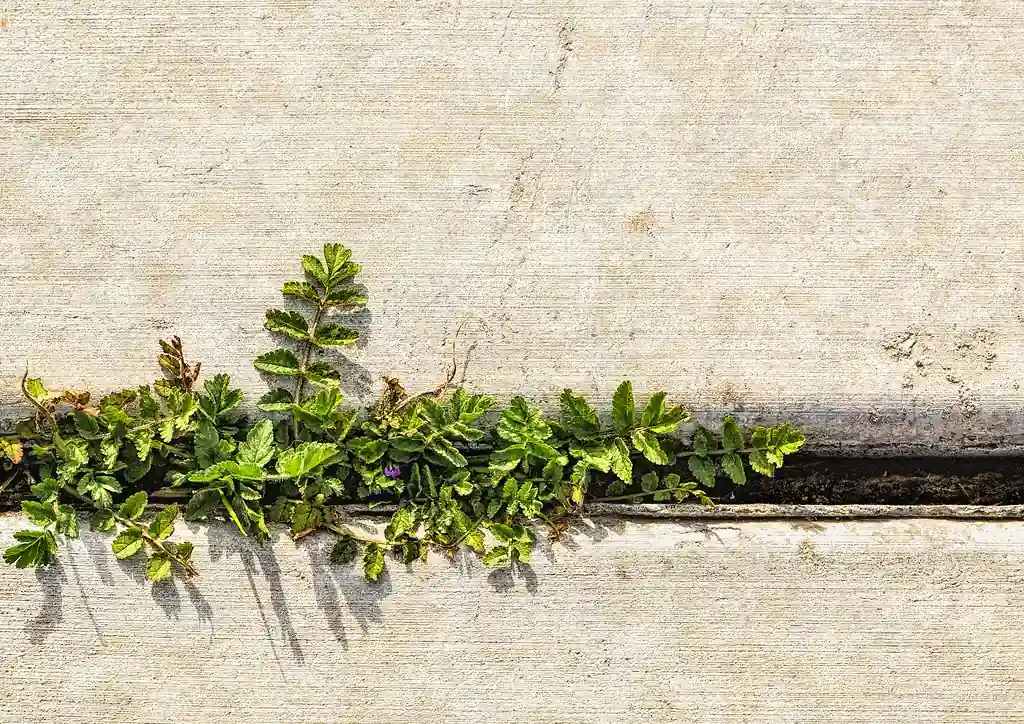
How Salt Kills Weeds (and Why It Doesn’t Stop There)
Table salt and rock salt are both sodium chloride. It dissolves instantly, and once it’s in the soil water it works against plants in three ways at once.
1. It causes “physiological drought”
Salty soil water holds on to its water more tightly than the plant can pull. Roots can sit in moist soil and still dehydrate. Utah State University Extension calls this chemical drought, because salted plants look exactly like plants that haven’t been watered (USU Extension). That’s the wilting and browning you see a few days after salting a weed.
2. Chloride becomes toxic in the leaves
Sodium and chloride split apart in water. Chloride travels up to the leaves, where it interferes with photosynthesis and chlorophyll and builds up until leaf edges burn and shoots die back (UMass Extension). Sodium also crowds out potassium and other nutrients the plant needs.
3. Sodium breaks down the soil itself
This is the part the viral recipes skip. Sodium knocks soil particles apart, so the soil compacts, drains poorly and holds less air. UMass notes the damage can be delayed, with symptoms not appearing until summer or even years later. Illinois Extension adds that salt is mobile: rain and irrigation carry it into nearby beds and lawn, where it injures plants you never meant to touch (Illinois Extension).
Put simply, salt isn’t a weed killer. It’s a soil sterilant that happens to kill weeds first. That difference matters for everything that follows.
Does Salt Kill Weeds Permanently? What the Research Shows
Here’s the surprising part: there is peer-reviewed research on salt as a weed killer, and it tells you a lot about why homeowners struggle with it.
Turf scientists tested granular sodium chloride on seashore paspalum, one of the most salt-tolerant lawn grasses on Earth, because almost no herbicides were labeled for it. The idea was that the paspalum would survive salt doses that kill weeds. Here’s what they found:
| Trial | Salt rate (approx. lb per 1,000 sq ft) | Result |
|---|---|---|
| Goosegrass in seashore paspalum, Hawaii (Brosnan et al. 2009) | 10 lb, repeated weekly | Did not reach effective (>70%) control; goosegrass recovered by 6 weeks |
| Sourgrass in seashore paspalum, Hawaii (Brosnan et al. 2009) | 10 lb, repeated | 92–96% control at 6 weeks; soil salinity rose but stayed below paspalum’s limit |
| Same trial, one heavy dose | 30 lb, once | 84% control one year, only 23% the next |
| Smooth crabgrass, Georgia (McCullough & Raymer 2011) | 20 lb, once | 90–100% control of mature crabgrass |
| Same trial, young crabgrass | 40 lb, once | Needed for excellent control of small, leafy plants |
| Common bermudagrass, same trial | 10–20 lb | More than 20% injury to the lawn grass itself |
Three lessons jump out:
- The doses are huge. Twenty pounds per 1,000 sq ft works out to roughly 9 grams of salt on every square foot. On a home lawn that would be a lot of rock salt, and the soil keeps all of it.
- Results were inconsistent. The same heavy dose gave 84% control one year and 23% the next. Weather, rain and plant size all changed the outcome.
- Ordinary turf got hurt. Common bermudagrass, a fairly salt-tolerant grass, was injured more than 20% at the same rates. Kentucky bluegrass and fine fescues tolerate even less.
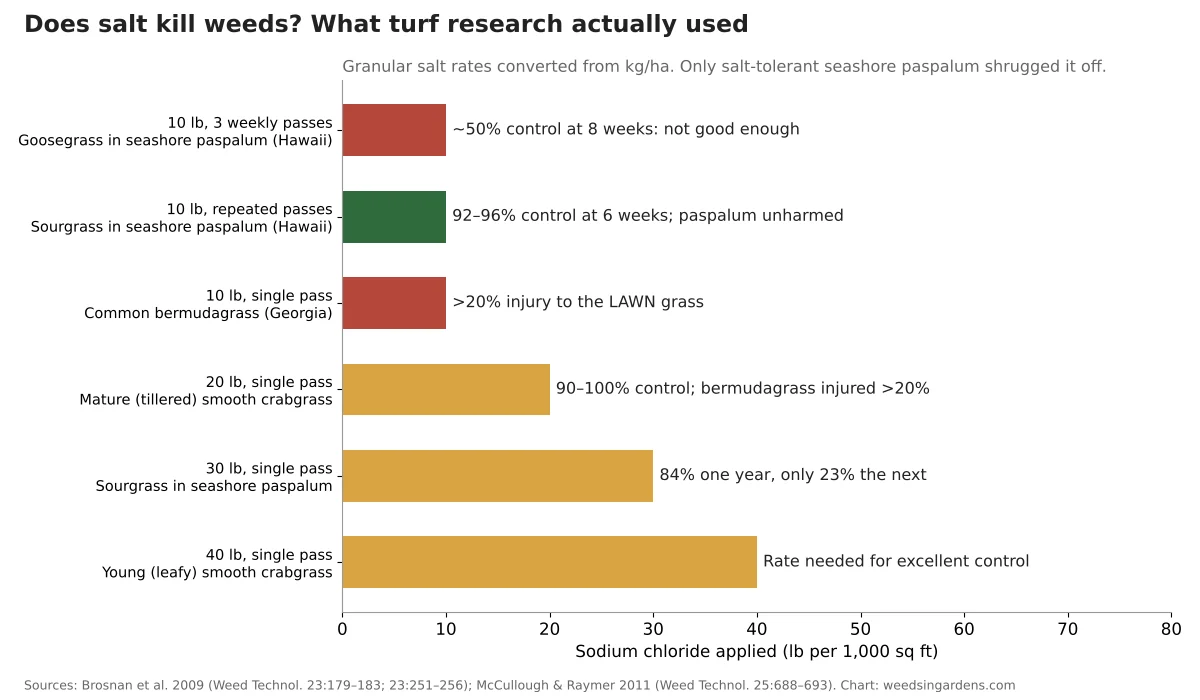
So, does salt kill weeds permanently? It can make a spot permanently bare, but that’s because the soil is poisoned, not because the weed problem is solved. New weed seeds blow in as soon as rain dilutes the salt enough for anything to grow, and the first plants back are often salt-tolerant weeds.
Where Salt Is (Barely) Acceptable and Where It Isn’t
If you’re set on trying salt, location is everything. Use this decision table before you shake a single grain.
| Where the weed is | Use salt? | Why | Better option |
|---|---|---|---|
| Lawn | No | Kills turf around the weed; sodium damages soil for seasons | Spot-treat with a selective lawn weed killer; see post-emergent herbicides |
| Vegetable or flower bed | No | Seeds and seedlings are the most salt-sensitive stage (CSU) | Hand-pull, hoe, mulch, or sheet mulch with cardboard |
| Asparagus patch | No | Old folk practice; eventually harms asparagus and spreads (UNL) | Shallow cultivation and hand-pulling (Iowa State) |
| Cracks in a sidewalk or driveway with lawn alongside | Avoid | Runoff drains straight into the grass edge | Boiling water or a crack weeder |
| Paver joints | Avoid | Rock salt is corrosive to concrete; salt water also reaches bed edges | See weeds between pavers |
| Gravel path or patio with no plants within several feet and drainage away from beds | Possible, sparingly | Only place where ‘nothing should ever grow’ is the real goal | Landscape fabric under gravel, or gravel driveway weed control |
Notice how few rows say “possible.” Even a gravel path drains somewhere. Before using salt, watch where water runs during a hard rain. If it flows toward the lawn, a tree or a bed, salt will follow it.
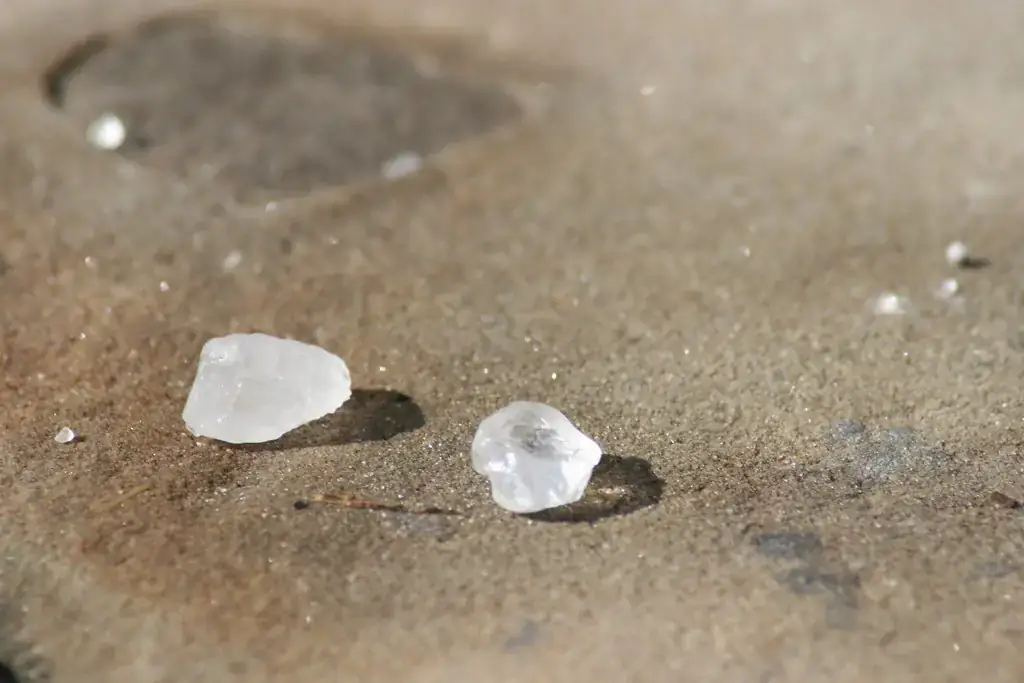
How to Use Salt on Weeds With the Least Damage
If you’ve weighed the risks and have a truly plant-free hard surface, here’s how to limit the harm. None of these steps make salt safe; they just shrink the blast radius.
- Target the weed, not the area. Pinch a small amount of dry salt right at the crown, or dribble a little salt water directly onto the plant. Don’t broadcast it.
- Start with the least you can. More salt doesn’t mean a deader weed, just more sodium left behind. Repeat on survivors rather than dumping extra.
- Pull or cut first. Salt works better on small weeds. Big, established perennials like bindweed usually regrow from deep roots.
- Pick a dry spell. Rain right after application washes salt sideways into the soil around the crack.
- Keep it off concrete you care about. University of Minnesota turf scientists list rock salt as corrosive to concrete and steel (UMN Turfgrass Science).
- Never near trees. Tree roots run far beyond the drip line, and Wisconsin Extension says salt damage typically shows up within thirty feet of salted pavement (UW–Madison Extension).
What about salt, vinegar and dish soap together?
The mix stacks two problems. Kitchen vinegar is usually too weak to be a reliable weed killer, while horticultural vinegar strong enough to work (over 11% acetic acid) can burn skin and eyes, Illinois Extension warns. Adding salt then leaves sodium behind after the vinegar has evaporated. Homemade mixes also come with no label, so there’s no tested rate or safety guidance. Read our tests on whether vinegar kills weeds and whether bleach kills weeds before reaching for any pantry recipe.
And Epsom salt?
Epsom salt is magnesium sulfate, not sodium chloride, so it isn’t the same thing at all. University of Minnesota Extension warns that adding it to soil that already has enough magnesium can harm soil and plants and that spraying it on leaves can scorch them (UMN Extension). That’s not the same as being a reliable weed killer, and no extension source we reviewed recommends it as one.
The Old Asparagus Salt Trick: Why Extension Says Stop
Many gardeners first hear about salt as a weed killer from a grandparent’s asparagus bed. The logic was clever. Asparagus is deep-rooted and tolerates far more sodium than most weeds, so pouring the leftover brine from an ice-cream maker over the patch knocked weeds back (Nebraska Extension).
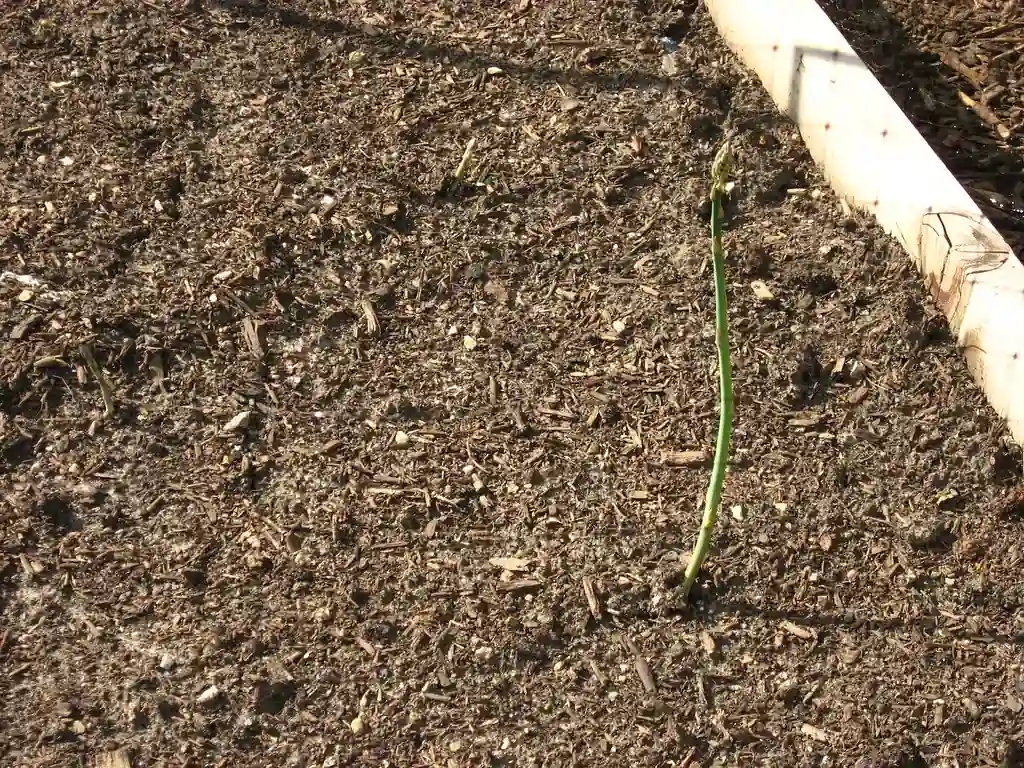
The trouble is the long game. Iowa State Extension says salt isn’t effective on many weeds, especially grasses, and that years of salting build salt levels high enough to damage the asparagus itself (Iowa State Extension). Nebraska adds that salt quickly destroys soil structure, so water stops soaking in, and that it can move into neighboring rows and kill less tolerant vegetables. Their advice is blunt: do not use salt. Shallow cultivation and hand-pulling are the recommended home-garden methods.
Better Ways to Kill Weeds Than Salt
Salt’s appeal is that it’s cheap and “natural.” But the options below are just as easy, and none of them leaves a sodium problem behind. Here’s an honest comparison.
| Method | Best for | Kills roots? | Leaves soil residue? | Effort and cost |
|---|---|---|---|---|
| Hand-pulling / crack weeder | Small numbers of weeds, beds, paver joints | Yes, if you get the root | No | Free; time-consuming |
| Boiling water | Cracks, gravel, young annual weeds | Partly; perennials regrow | No | Free; handle carefully |
| Horticultural vinegar (acetic acid) | Young annual weeds on hard surfaces | Rarely | No lasting residue | Low cost; wear eye protection |
| Mulch or cardboard sheet mulching | Beds and new garden areas | Smothers most annuals | No (adds organic matter) | Cheap; slow (months) |
| Contact organic herbicides (fatty-acid soaps, pelargonic acid) | Cracks, paths, bed edges | No; burns top growth | No lasting residue | Moderate; repeat needed |
| Glyphosate (non-selective, systemic) | Perennial weeds in cracks and paths | Yes, moves to roots | Check label replanting interval | Moderate; follow label, avoid drift onto plants |
| Selective lawn herbicide (2,4-D, dicamba, MCPP mixes) | Broadleaf weeds in lawns | Yes | Check label reseeding interval | Moderate; check turf type and temperature limits on label |
| Rock or table salt | Plant-free hard surfaces only | Sometimes | Yes: sodium stays and spreads | Cheap up front; costly to fix |
For lawns, the right tool is a selective herbicide that kills broadleaf weeds and leaves grass alone. Always follow the label: it tells you which grass types the product is safe on and the temperature range for spraying. Our guides to 2,4-D and the best temperature to spray weeds cover the details.
A quick regulatory note: sodium chloride is on the EPA’s list of active ingredients allowed in “minimum-risk” pesticide products (40 CFR 152.25). That list covers commercial products that meet specific conditions; it isn’t a safety rating for a homemade brine poured on your soil.
Salt-Damaged Lawn? How to Fix It (Including Winter Ice Melt)
Whether you salted weeds a little too enthusiastically or the snowplow left a brown strip along the curb, the repair is the same: get the sodium out and help the soil recover. And with deicing season starting, now is the best time to prevent it.
Signs your lawn or bed has salt damage
- Brown, dead strips along driveways, sidewalks and roads in spring
- Grass that wilts in hot weather even when the soil is moist
- Leaf edges that look scorched on shrubs and perennials, worse on the side facing the pavement (UMass)
- Bare patches where seed refuses to germinate; seedlings are more salt-sensitive than mature plants (Colorado State Extension)
- In dry regions, a white crust on the soil surface
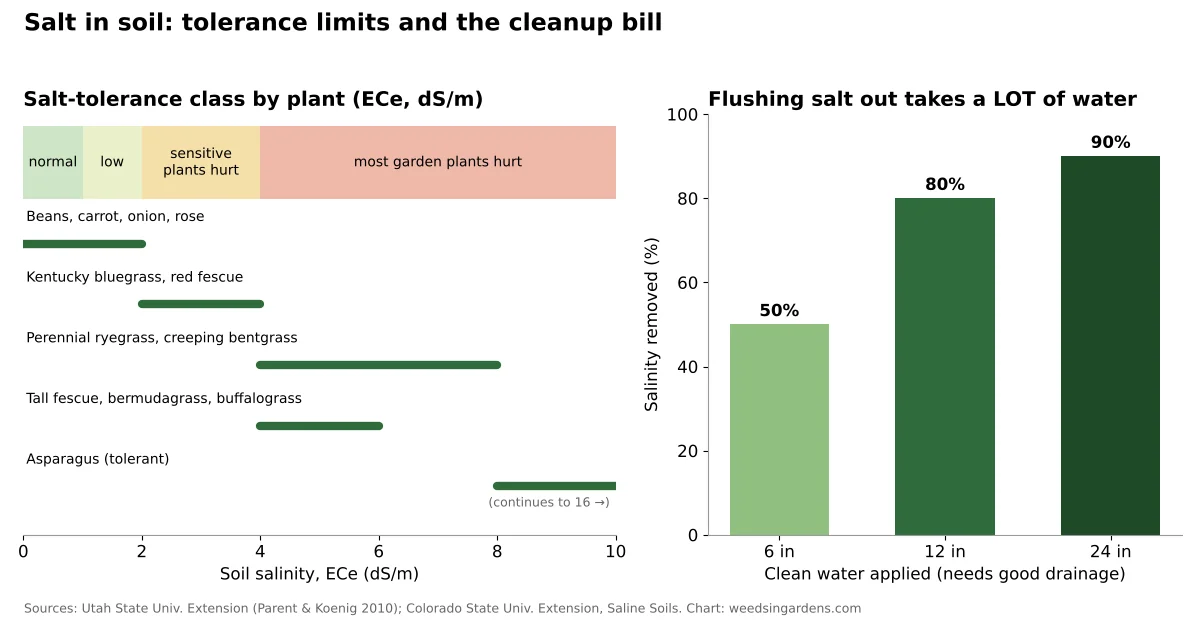
Home kits can’t measure soil salinity. A lab soil test that reports electrical conductivity (ECe) is the only way to know for sure, and it costs only a few dollars per sample, Utah State notes. Readings below 1 dS/m are normal; above 2 dS/m salt-sensitive plants begin to suffer; above 4 dS/m many garden and landscape plants struggle.
Step 1: Flush it out with water
Salt leaves soil only by being washed down past the roots. USU’s rule of thumb: 6 inches of water removes about 50% of the salinity, 12 inches about 80%, and 24 inches about 90%. Apply it over several days, cycling sprinklers on and off so it soaks in rather than running off. For a small spot, that’s a lot of slow hose time, but it’s the only way.
Drainage is the catch. If the soil is compacted or clayey, water runs off instead of carrying salt down. Loosen the soil and add organic matter first; fixing compacted soil covers how.
Step 2: Consider gypsum, with realistic expectations
Gypsum (calcium sulfate) supplies calcium to replace sodium on soil particles, and the Missouri Department of Conservation gives these rates:
| Soil contamination | Gypsum per 1,000 sq ft | How often |
|---|---|---|
| Moderate | 100–200 lb | Every three years |
| Heavy | Up to 700 lb, or 150–200 lb a year | For up to three years |
Wisconsin Extension cautions that gypsum only helps where drainage is good, and roadside soils often drain poorly. Gypsum without water does little; water first, gypsum second.
Step 3: Reseed with tougher grass
Once the soil has been flushed, reseed bare strips. Tall fescue, bermudagrass and buffalograss rank in USU’s high-tolerance group, perennial ryegrass sits in Colorado State’s moderately tolerant group, and Kentucky bluegrass and red fescue are more sensitive. Salt-tolerant doesn’t mean salt-proof, so prevention still matters.
Your year-round salt plan
| When | What to do | Why |
|---|---|---|
| Late fall (now) | Mark lawn edges; plan where shoveled, salty snow will go; buy a lower-impact deicer or sand | Snow piled on turf delivers salt directly to the soil |
| Winter storms | Shovel first, then use as little salt as possible: a 12-oz mug can treat a 20-ft driveway or 10 sidewalk squares (UW–Madison) | Salt loosens ice; more salt doesn’t mean more melting (UMN) |
| Late winter | Be especially sparing | Late-winter salt does more damage than early-winter salt because less of it leaches before spring root growth (UMass) |
| Early spring thaw | Water salt-affected strips deeply as soon as the ground thaws | Flushes sodium before grass and roots wake up |
| Spring | Soil test if strips stay brown; apply gypsum if needed | Confirms salt is the cause before you spend money |
| Late summer–early fall | Reseed bare strips with salt-tolerant grass | Best seeding window for cool-season lawns |
Choosing a gentler deicer
Every deicer can harm turf if overused, but they differ. University of Minnesota turf researchers list these approximate minimum working temperatures: rock salt +15°F, calcium chloride −50°F, magnesium chloride −30°F, calcium magnesium acetate (CMA) +18°F and urea +21°F. Calcium and magnesium chlorides are less harmful to turf than rock salt but cost more; CMA is gentlest on turf but very expensive. Mixing salt with sand for traction cuts the dose, as both UMass and Wisconsin Extension recommend.
A Note From the Agronomist’s Side
When people ask whether salt kills weeds, they’re really asking two questions: will it work? and what will it cost me later? The first answer is “sometimes.” The second is the one that matters.
Most herbicides are designed to break down. Microbes digest them, sunlight degrades them, and they’re gone in days to months. Salt can’t break down. Sodium and chloride are elements, and the only way they leave your yard is by being washed somewhere else. Every handful you apply is a long-term loan against your soil, and rain decides where the bill gets paid.
The research backs this up in a quiet way. The scientists who got good weed control from salt were working on seashore paspalum, a grass that evolved on salty coastlines, and even there results swung widely from year to year. Move the same idea to a Kentucky bluegrass lawn in Ohio and the turf is the most sensitive plant in the system.
My practical rule: if you’d be upset to see nothing at all grow in that spot for the next two years, don’t salt it. For cracks and pavers, a crack weeder and a kettle of boiling water do the same job without leaving anything behind. For lawns, a thick, well-fed turf and a spot treatment with a selective herbicide will always beat a shaker of salt.
FAQ
Does salt kill weeds permanently?
Salt can keep a spot bare for a long time, but only because sodium poisons the soil. The weed problem returns once rain dilutes the salt, and the damaged soil drains poorly. It’s not a permanent weed fix, and it can harm nearby plants as it moves.
Does salt kill weeds but not grass?
Not on ordinary lawns. In university trials, salt rates that controlled crabgrass injured common bermudagrass by more than 20%. Only very salt-tolerant seashore paspalum handled those doses. Kentucky bluegrass and fine fescues are even more sensitive.
How long does it take salt to kill weeds?
Small weeds usually wilt and brown within days as salt dehydrates them and chloride burns the leaves. Deep-rooted perennials often regrow from their roots, so salt rarely finishes them off in one application.
Is salt safe to use in block paving or cracks?
Use it only where no plants grow nearby and runoff drains away from lawns and beds. Rock salt is corrosive to concrete, and salty water runs into joints and bed edges. A crack weeder or boiling water is safer.
Can I use salt and vinegar together to kill weeds?
You can, but extension specialists advise against homemade mixes. Kitchen vinegar is often too weak, strong vinegar can burn skin and eyes, and the salt stays in the soil after the vinegar is gone. Homemade mixes have no label with tested rates or safety directions.
How do I fix soil after using salt to kill weeds?
Flush it with clean water: about 6 inches removes half the salt and 12 inches about 80%, if the soil drains. Gypsum can help on well-drained soil. Test the soil, then reseed with a salt-tolerant grass such as tall fescue.
Sources
- Brosnan, J.T., DeFrank, J., Woods, M.S. & Breeden, G.K. (2009). Efficacy of sodium chloride applications for control of goosegrass (Eleusine indica) in seashore paspalum turf. Weed Technology 23:179–183. doi:10.1614/WT-08-129.1
- Brosnan, J.T., DeFrank, J., Woods, M.S. & Breeden, G.K. (2009). Sodium chloride salt applications provide effective control of sourgrass (Paspalum conjugatum) in seashore paspalum turf. Weed Technology 23:251–256. doi:10.1614/WT-08-128.1
- McCullough, P.E. & Raymer, P.L. (2011). Sodium chloride efficacy for smooth crabgrass (Digitaria ischaemum) control and safety to common bermudagrass and seashore paspalum. Weed Technology 25:688–693. doi:10.1614/WT-D-11-00039.1
- Parent, V. & Koenig, R. (2010). Solutions to Soil Problems I. High Salinity (Soluble Salts). Utah State University Extension.
- Colorado State University Extension. Saline Soils.
- UMass Extension Landscape, Nursery & Urban Forestry Program. The Impact of Salts on Plants and How to Reduce Plant Injury from Winter Salt Applications.
- Spangenberg, B. (2025). Reducing Deicing Salt Damage This Winter. UW–Madison Division of Extension.
- Friell, J. Minimize Turf Damage From Salt This Winter. University of Minnesota Turfgrass Science.
- Missouri Department of Conservation. Ice Melter Damage.
- Iowa State University Extension. Is it a good practice to apply salt to an asparagus planting? (2022).
- Nebraska Extension in Lancaster County. Asparagus Weed Control.
- Wiesbrook, M. / University of Illinois Extension (2018). Homemade herbicide considerations.
- University of Minnesota Extension. Coffee grounds, eggshells and Epsom salts in the home garden.
- U.S. Code of Federal Regulations. 40 CFR 152.25 – Exemptions for pesticides of a character not requiring FIFRA regulation (minimum-risk active ingredients list).