
You kneel down to pull the thing that’s taking over the corner of your lawn, and you realize you’re not even sure what it is. It has round leaves. Or are they heart-shaped? It might be clover. It might be something that laughs at the weed killer you already bought.
Short answer: Lawn weed identification starts with one question: are the leaves wide with a net of branching veins (a broadleaf), narrow with parallel veins on a round or flat stem (a grass), or narrow on a solid, three-sided stem (a sedge)? Then check how the leaves are arranged (opposite pairs, alternate, a flat rosette or three leaflets), the leaf edge, and for grasses, the collar where the blade meets the stem. Those few checks will name most common lawn weeds without a flower in sight.
That matters more than it sounds. Broadleaf, grass and sedge weeds need different products, and several popular weeds shrug off the most common broadleaf herbicide on its own. By the end of this guide you’ll be able to sort any lawn weed into its group, narrow it to a short list by leaf shape, confirm it with one or two telltale features, and pick a control that actually fits it.
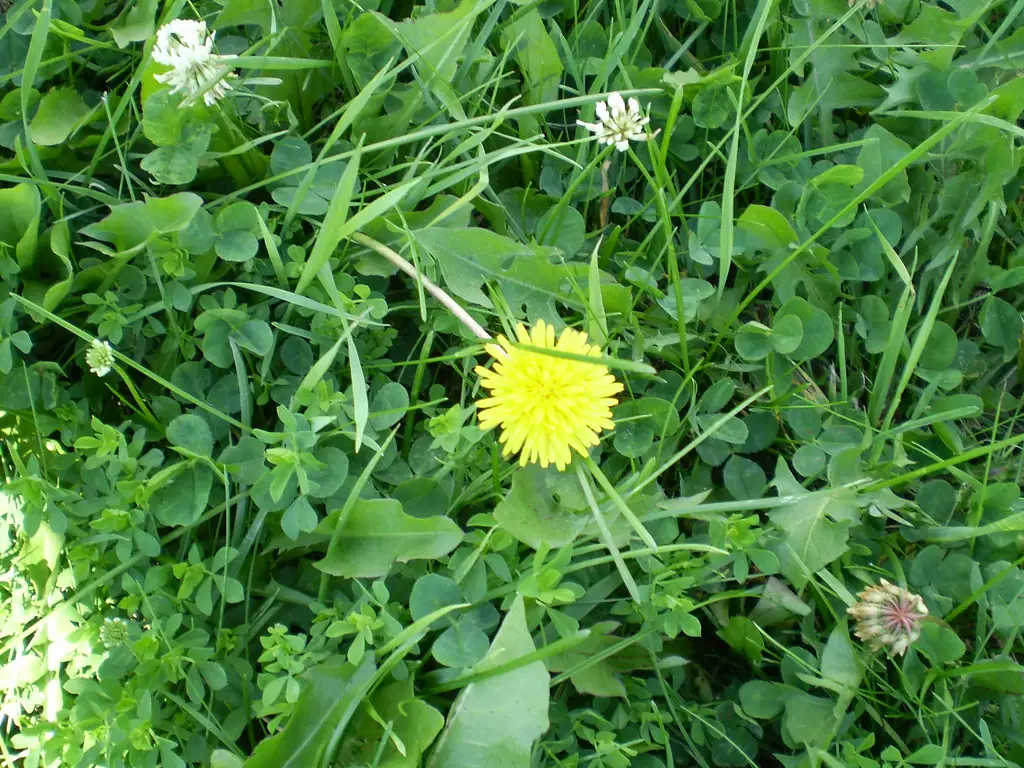
Step 1 of lawn weed identification: sort the weed into one of three groups
Every lawn weed identification key from the extension services starts in the same place. The University of California IPM lawn weed key splits weeds into three groups: broadleaves have wide leaves with veins branching in different directions; grasses have narrow leaves arranged in sets of two on round or flattened stems; and sedges have narrow leaves arranged in sets of three, with stems that are triangular in cross section.
Here’s the field test that settles it in five seconds. Pinch the stem near the base and roll it between your thumb and finger. A grass stem rolls smoothly (or flips flat if the leaf is folded). A sedge stem has three distinct edges. Cornell Weed Identification sums it up with an easy rhyme: sedges have edges.
| Group | Leaf | Veins | Stem | Common lawn examples |
|---|---|---|---|---|
| Broadleaf | Wide; many shapes | Branching net | Varies (round, square, creeping) | Dandelion, clover, ground ivy, plantain, chickweed, henbit, violet, spurge |
| Grass | Long, narrow blade | Parallel | Round or flattened, hollow between nodes | Crabgrass, goosegrass, quackgrass, annual bluegrass, bermudagrass, nimblewill |
| Sedge | Narrow, often glossy and stiff | Parallel | Solid, triangular; leaves in threes | Yellow nutsedge, purple nutsedge |
| Onion family (the odd one) | Narrow, grass-like | Parallel | Grows from a bulb; smells of onion or garlic | Wild onion, wild garlic |
That fourth row is a common trap. Wild onion and wild garlic look like clumps of grass until you crush a leaf. Virginia Cooperative Extension separates them by leaf: wild onion has a flatter, solid blade, while wild garlic has hollow, rounder leaves. If your “grass” smells like a kitchen, it’s one of these, and grass herbicides won’t help.
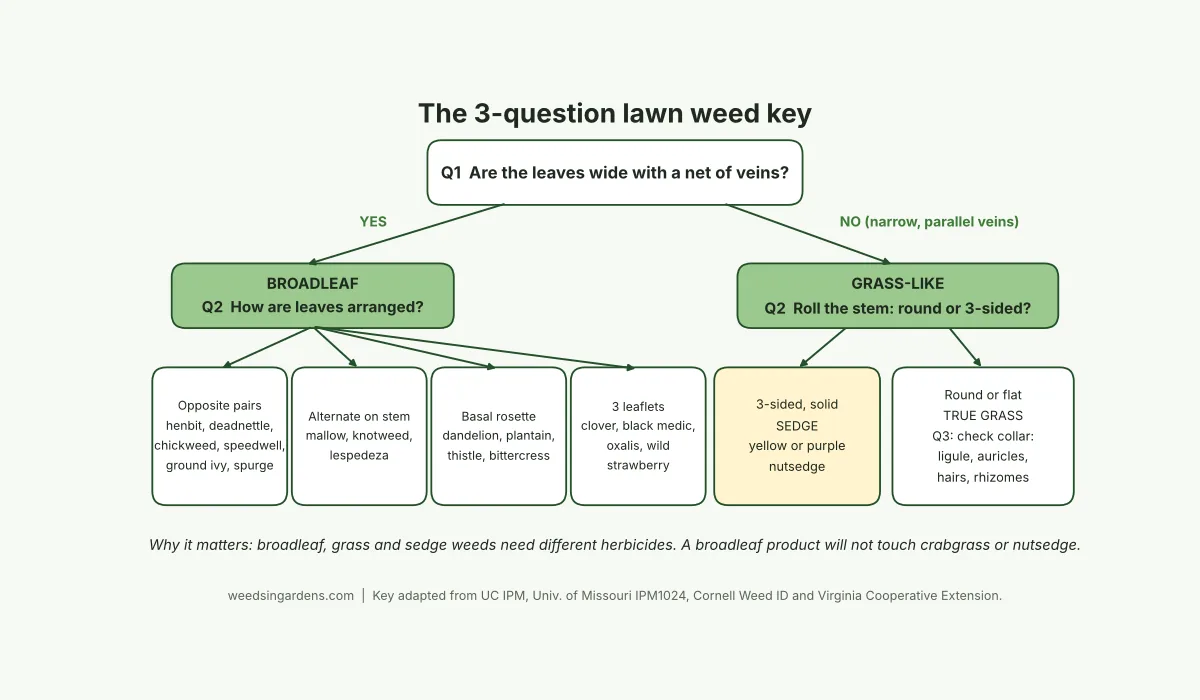
Lawn weed identification by leaf shape: the broadleaf shortlist
Once you know you’re holding a broadleaf, lawn weed identification gets much faster, because leaf arrangement narrows the field. The UC key’s next split is simple: are there two or more leaves at each node (opposite or whorled), or one leaf per node (alternate, or a basal rosette)? Add leaf shape and edge, and you’re usually down to two or three candidates.
Save the chart below as a quick lawn weed identification chart for your phone; the sections that follow explain each pattern.
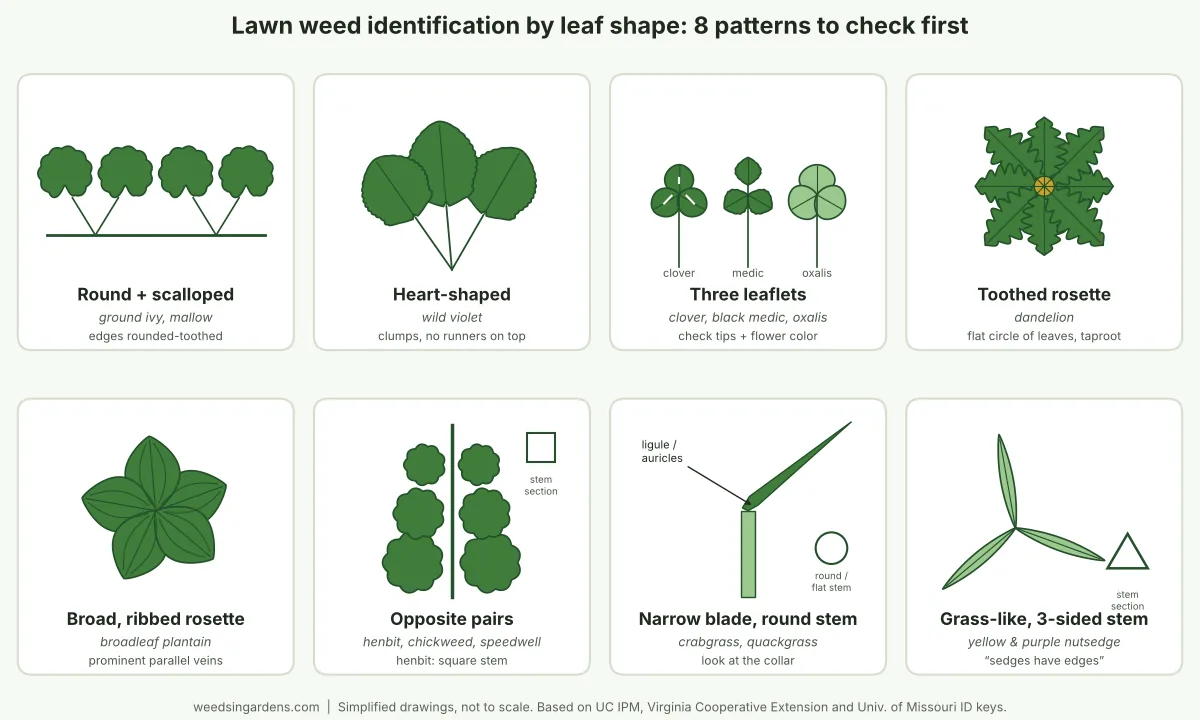
Opposite pairs: henbit, deadnettle, chickweed, speedwell, ground ivy, spurge
Look for leaves set in matching pairs up the stem. Henbit and purple deadnettle both have square stems, which tells you they’re in the mint family. To split them, Virginia Cooperative Extension points to the leaf stalks: deadnettle has short petioles on top and long ones lower down, while henbit’s upper leaves have no petioles and wrap the stem. Deadnettle’s upper leaves also tend to be reddish-purple. Our guide to winter annual weeds covers this whole cool-season crowd.
Common chickweed and mouse-ear chickweed both form low mats of small, paired leaves with tiny white flowers. The tell is the fuzz: mouse-ear chickweed has small, cupped, hairy leaves that are medium to dark green, while common chickweed is light green with little to no hair. Corn speedwell is sneakier still. Its lower leaves are rounded, toothed and opposite, its upper leaves are smaller, pointed and alternate, and the whole plant is covered in soft white hairs, with tiny bright blue flowers.
Ground ivy (creeping Charlie) has round leaves with scalloped edges, square stems, and runners that root at the nodes. Spotted spurge also grows in opposite pairs, but it hugs the ground in a flat summer mat and bleeds milky sap when you snap a stem.
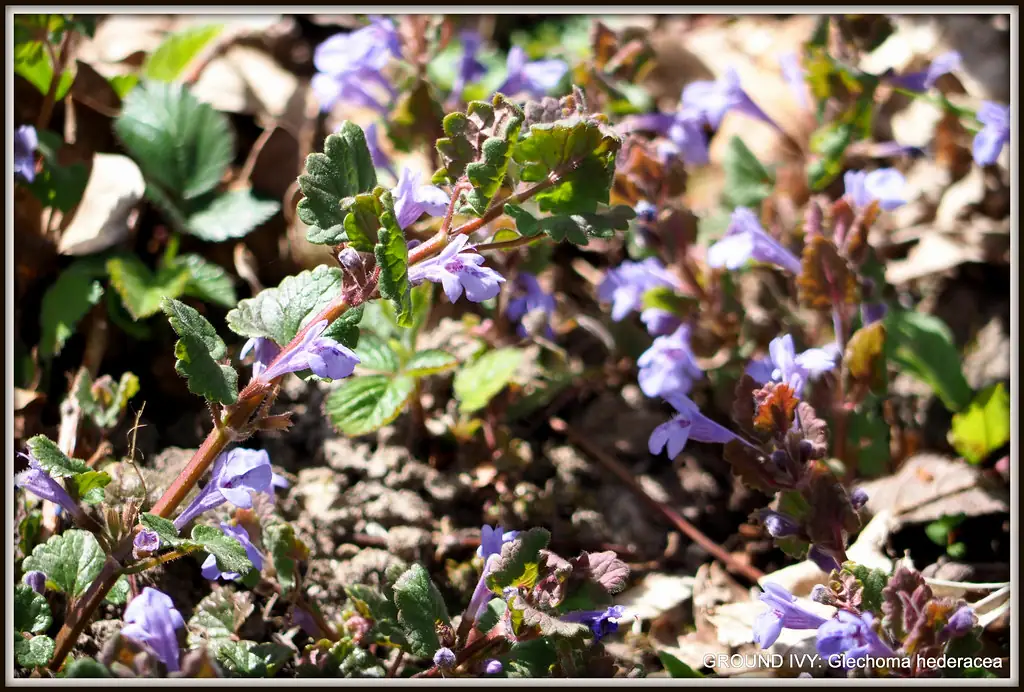
Heart-shaped leaves: wild violet (and how not to confuse it with ground ivy)
Wild violet and ground ivy get mixed up constantly. Virginia Cooperative Extension’s tip is to look at growth habit and leaf shape together: ground ivy sprawls on runners with round, scalloped leaves, while violets grow in clumps from rhizomes and have heart-shaped leaves. Both are stubborn, so it pays to be sure. If you have violets, our creeping Charlie guide explains why the same tough-weed tactics apply to both.
Three leaflets: clover, black medic, oxalis, wild strawberry and lespedeza
This is the group that fools almost everyone. Flowers settle it fastest, but you can usually decide from leaves alone:
- White clover: three rounded leaflets; white, globe-shaped flower clusters. It spreads by creeping stems into patches.
- Black medic: three creased leaflets, and the center leaflet sits on a longer stalk than the other two. Small yellow globe flowers.
- Yellow woodsorrel (oxalis): three heart-shaped leaflets folded along the midline, with yellow flowers that appear singly.
- Wild strawberry: three toothed, hairy leaflets on a perennial that spreads by runners and likes moist shade.
- Lespedeza: small trifoliate leaves on wiry branches spreading flat from a central taproot; a warm-season mat.
If you’re still torn between the first two, our side-by-side on black medic vs clover walks through every difference with photos.
Rosettes: dandelion, plantain, thistle, bittercress and their look-alikes
A rosette is a flat circle of leaves radiating from one point at soil level, with no obvious upright stem until flowering. Dandelions have deeply toothed leaves, milky sap and a deep taproot. Thistles form bigger rosettes with waxier, spiny leaves. Broadleaf plantain has wide, oval leaves with prominent ribbed veins; buckhorn plantain has much narrower leaves and a short, fuzzy flower spike.
Hairy bittercress forms a small rosette of deeply lobed leaves, larger at the base than at the top, with clusters of tiny white flowers. Its speed is the real issue: Virginia Cooperative Extension notes the seeds can germinate in 5 days and the plant can set seed 5 weeks after germination. Dandelion look-alikes such as sow thistle and prickly lettuce bolt into tall stems with several flowers per stem, while a dandelion carries one flower per hollow stalk.
Alternate leaves: mallow and prostrate knotweed
One leaf per node, staggered up the stem, points you toward a smaller group in lawns. Common mallow has round, shallowly lobed leaves on long stalks. Prostrate knotweed forms a wiry, flat mat of small, bluish-green, oval leaves along jointed stems, usually where foot traffic has compacted the soil.
Grassy weed identification: read the collar, not the blade
Grassy weeds are the hardest part of lawn weed identification because their blades all look alike. The University of Missouri grass seedling guide (IPM1024) says most of the useful features sit in the collar region, which you see by gently pulling the blade back from the stem, and it recommends a 10× hand lens. You’re looking for three things:
- Ligule: the small collar projection at the base of the blade. It can be absent, a thin membrane, or a fringe of hairs.
- Auricles: small ear-like flaps that can be absent, short, or long and clasping the stem.
- Bud shape: roll the shoot. Cornell notes that a folded bud only flips side to side, while a rolled bud rolls smoothly.
| Grassy weed | Key ID features | Season clue |
|---|---|---|
| Large (hairy) crabgrass | Hairy blades and stems; flat blades 5–10 mm wide; no auricles; jagged membranous ligule 0.5–2 mm; sprawls and roots at lower nodes | Summer annual; appears as root-zone soil reaches the mid-50s °F |
| Smooth crabgrass | Nearly identical to large crabgrass but lacks hair on leaves and stems | Summer annual |
| Goosegrass | Flat, whitish sheaths (“silver crabgrass”); folded blades 3–8 mm wide; stems radiate like wheel spokes from a white center; short membrane ligule; no auricles | Emerges several weeks after crabgrass; loves compacted soil |
| Yellow foxtail | Upright bunch grass; ligule is a tuft of hair; flat, reddish sheaths; long sparse hairs at the blade base; fuzzy seed head | Summer annual, thin or disturbed turf |
| Quackgrass | Rolled bud; auricles present; short membrane ligule; spreads by rhizomes into colonies | Cool-season perennial, mostly northern US |
| Annual bluegrass (Poa annua) | Light green bunch grass; boat-shaped leaf tips; divided collar; whitish seed heads even at low mowing heights | Cool-season; loves short-cut, compacted, wet spots |
| Japanese stiltgrass | Short, lance-shaped blades with a shiny, off-center midrib | Summer annual; shady edges |
| Bermudagrass vs nimblewill | Bermuda: stolons and rhizomes, hairy ligule, 3–5 finger-like spikes. Nimblewill: wiry, finer stems, membranous ligule, panicle seed head | Warm-season perennials |
Sources: University of Missouri IPM1024 and Virginia Cooperative Extension. For the grass-like plants that cause the most confusion in a mown lawn, see our guide to weeds that look like grass.
Sedges: yellow vs purple nutsedge
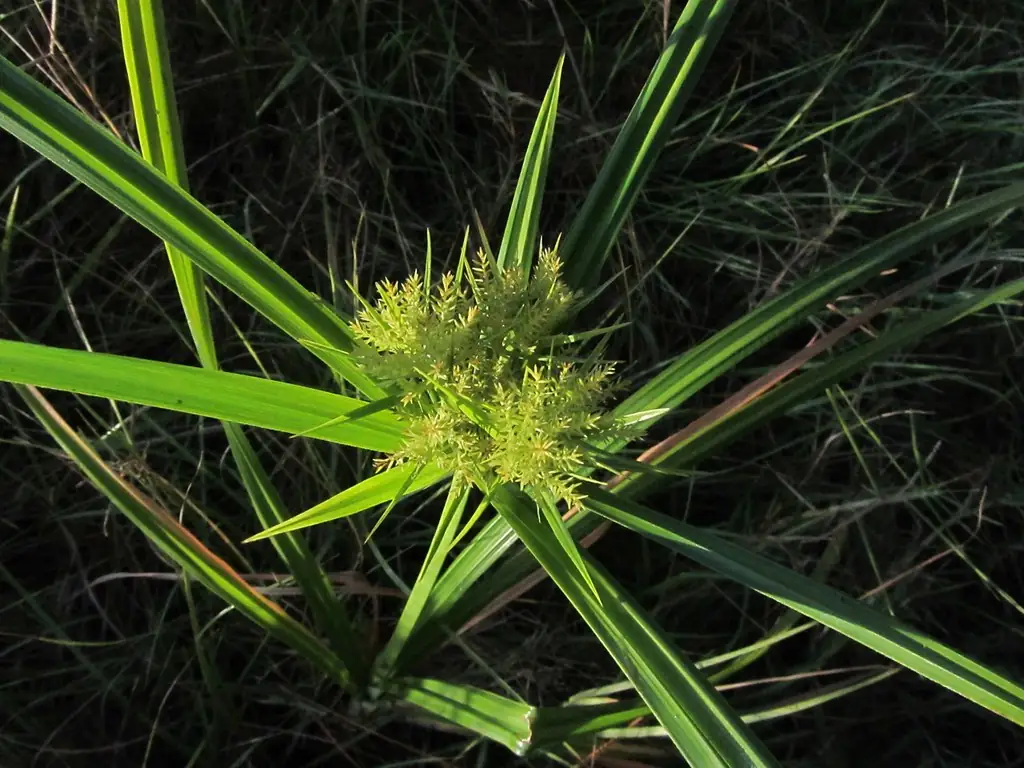
Nutsedge usually shows up as glossy, lighter-green tufts that grow faster than the lawn around them a day or two after mowing. Roll the stem and you’ll feel the triangle. Virginia Cooperative Extension gives three quick ways to tell the two common species apart:
- Flower stalk vs leaves: yellow nutsedge stems are as long as or shorter than the basal leaves; purple nutsedge stems are longer.
- Flower color: yellowish in yellow nutsedge, purplish in purple nutsedge.
- Leaf tip: purple nutsedge leaves taper to a point much more gradually.
The difference matters because purple nutsedge is harder to kill and not every sedge product controls it. Our full yellow and purple nutsedge guide covers tubers, timing and products in detail.
What you’ll see, season by season
Timing is one of the best lawn weed identification clues you have, because each weed group has its own calendar. If a weed is green and thriving in late November, you can rule out most summer annuals straight away.
| Season | What’s showing up | Identification tip | What to do now |
|---|---|---|---|
| Fall (Sept–Nov) | Winter annuals sprouting: henbit, deadnettle, chickweed, speedwell, bittercress; perennials (dandelion, clover, ground ivy, violets) storing food in roots | Seedlings are small; look for opposite pairs and square stems | Prime window to spray cool-season broadleaf perennials while they’re actively growing |
| Winter (Dec–Feb) | Winter annuals as low green mats; wild onion and garlic tufts stand out above dormant turf | Crush grassy tufts: an onion smell means wild onion or garlic | Mark patches; hand-pull small winter annuals on mild days |
| Spring (Mar–May) | Winter annuals flower (purple henbit, blue speedwell, white bittercress); dandelions bloom; crabgrass germinates as soil warms into the mid-50s °F | Flowers make broadleaf ID easiest now | Pre-emergent for crabgrass before it germinates; spot-treat escapes |
| Summer (Jun–Aug) | Crabgrass, goosegrass, foxtail, spurge, lespedeza, nutsedge | Check collars on grasses; roll stems to catch sedges | Treat young grassy weeds and nutsedge early; mow high |
Timing clues from Virginia Cooperative Extension and Kansas State University, which advises that many cool-season annual and perennial broadleaf weeds are best controlled in autumn while they’re actively growing.
Can a lawn weed identification app do this for you?
Apps help, but they’re not a referee. In a University of Maryland Extension test of nine apps on 30 pasture plants photographed in the vegetative stage (no flowers), 61% of images were named correctly on the first suggestion and 74% within the top three. Performance varied widely: PictureThis got 94% right on the first try, Plantum 89%, iNaturalist 79%, PlantNet 66% and PlantSnap only 26%.
A peer-reviewed study in PLOS ONE (Campbell et al., 2023) tested six apps on 38 herbaceous species and found they were better at identifying flowers than leaves, and even the best apps didn’t exceed about 88% accuracy. The authors warn against assuming an app is correct, especially when a plant could be toxic.
So use an app as one part of lawn weed identification, not the whole of it. Photograph a whole plant, then a close-up of one leaf, then the stem or collar. Compare the top three suggestions against the features in this guide. If the app says “clover” but the center leaflet sits on a stalk, trust your eyes: it’s black medic.
Match the control to the weed group
Here’s where good lawn weed identification pays off. A product that wipes out dandelions can leave clover, violets and every grassy weed untouched. These are the active ingredients extension specialists point to for each group. Always read the label: it lists which weeds it controls, which turf species it’s safe on, and the temperature and rain limits.
| Weed group | Active ingredients to look for | Notes from extension sources |
|---|---|---|
| Easy broadleaves (dandelion, broadleaf plantain) | 2,4-D, often in three-way mixes (2,4-D + MCPP + dicamba) | 2,4-D alone does not control white clover, chickweed, purslane, ground ivy or violets very well (K-State) |
| Clover, black medic, chickweed | MCPP; clopyralid; fluroxypyr; dicamba; quinclorac; 2,4-D + triclopyr | Spring or fall while actively growing; carfentrazone mixes act faster on clover and black medic (Univ. of Delaware) |
| Ground ivy, violets | Dicamba-containing mixes, or any product whose label names ground ivy or violets | Both resist many broadleaf herbicides, so check the label; repeat applications are often needed (K-State; Virginia Coop. Ext.) |
| Knotweed, spurge, purslane | Dicamba; dichlorprop combined with 2,4-D | Treat spurge young, early in summer |
| Wild onion and garlic | Ester forms of 2,4-D | Mow just before treating to improve uptake; repeat treatments are normal |
| Crabgrass, goosegrass, foxtail | Pre-emergents in spring; after emergence: quinclorac, fenoxaprop, mesotrione, topramezone | Fenoxaprop may injure some Kentucky bluegrass cultivars in heat; don’t use mesotrione in new fine fescue (Penn State) |
| Nutsedge | Halosulfuron; sulfentrazone | Effective on yellow nutsedge; a repeat 6–10 weeks later may be needed (Univ. of Delaware) |
| Perennial grassy weeds (bermuda, nimblewill, dallisgrass) | Glyphosate spot treatment, then reseed | No selective option in most home lawns: kill the patch and reseed (Univ. of Delaware) |
Kansas State’s label-style rules for broadleaf products are worth taping inside the shed door: spray young, actively growing weeds; skip the job if air temperatures will top 85°F or rain is expected within 24 hours; don’t mow for a few days before or after; wait at least 30 days after treatment before seeding; and don’t treat new grass until it has been mowed three or four times. Our post-emergent herbicide guide goes deeper on product choice and spraying technique.
Non-chemical options that work for every group
Identification also tells you which weeds you can simply out-compete. Virginia Cooperative Extension’s list of turf-strengthening steps applies across the board: soil test every three years, adjust pH, fertilize at the right rate and time for your grass type, overseed thin areas, mow high for your turf, improve drainage, aerate compacted spots, and avoid shallow, frequent watering. Hand-pull rosette weeds after rain when the soil is soft, and pull nutsedge while it still has fewer than five leaves, before it builds tubers.
A note from the agronomist’s side
If you only remember one thing, make it this: lawn weed identification is a sorting job, not a memory test. Botanists don’t recognize thousands of plants at a glance; they ask the same few questions in the same order. Broadleaf, grass or sedge? Opposite, alternate or rosette? Smooth, toothed or lobed? Then the collar, the sap, the smell, the stem shape. Each question cuts the list roughly in half, and four good questions get you a long way.
Weeds are also information. The Virginia extension notes tie specific weeds to specific site problems: annual bluegrass to low mowing, compaction and poor drainage; chickweed and ground ivy to shade and wet soil; nutsedge to wet or over-watered lawns; clover and woodsorrel to low fertility; plantain to low fertility as well. Read those signals and you can fix the condition that’s letting the weed win, not just the weed in front of you.
Finally, be honest about the limits of a leaf. Seedlings, mown plants and drought-stressed plants can all look alike. When it’s close, wait a week for one more leaf or a flower, take the sample to your county extension office, or compare it with two independent references. A week’s patience costs far less than a season of spraying the wrong product.
Common lawn weed identification mistakes
- Calling every grassy weed “crabgrass.” Goosegrass, nimblewill, quackgrass and annual bluegrass all get the label, and each needs a different plan. Check the collar.
- Missing the triangle. Nutsedge is treated with grass products all the time. Roll the stem first.
- Trusting one leaf on a trifoliate weed. Clover, black medic and oxalis need two checks: leaflet stalks and flower color.
- Assuming a broadleaf spray covers every broadleaf. Violets, ground ivy, clover and chickweed resist 2,4-D on its own.
- Identifying in the wrong season. Winter annuals die back in early summer, so a bare patch in July may have been henbit, not a disease.
FAQ
How do I identify weeds in my lawn?
First decide whether the weed is a broadleaf (wide leaves, net veins), a grass (narrow blades, round or flat stem) or a sedge (narrow leaves on a solid, three-sided stem). For broadleaves, check leaf arrangement and edge; for grasses, look at the collar for the ligule and auricles. Those few checks narrow most lawn weeds to two or three candidates.
What lawn weed has round leaves?
Ground ivy (creeping Charlie) has round leaves with scalloped edges on square, creeping stems that root at the nodes. Common mallow also has roundish, shallowly lobed leaves, but they sit one per node on longer stalks. Wild violets have heart-shaped rather than round leaves and grow in clumps.
What lawn weed has heart-shaped leaves?
Wild violet is the classic heart-shaped lawn weed. It grows in clumps from rhizomes and prefers shade. Yellow woodsorrel (oxalis) also has heart-shaped leaflets, but they come in threes like clover.
How can I tell a grassy weed from a sedge?
Roll the stem between your fingers. Grasses have round or flattened stems; sedges like nutsedge have solid, triangular stems with leaves in sets of three. Sedges also look glossier and often grow faster than the lawn after mowing.
Are lawn weed identification apps accurate?
They’re useful but not perfect. A University of Maryland test found nine apps named 61% of vegetative plant photos correctly on the first suggestion and 74% within the top three, with big differences between apps. Apps also do better with flowers than with leaves, so confirm their answer against key features.
When is the best time for lawn weed identification?
Spring is easiest for broadleaves because many are flowering. Fall is the most useful time for perennial broadleaf weeds, because that’s when they’re best controlled. Grassy weeds like crabgrass are easiest to confirm in summer.
Why didn’t my weed killer work on my weeds?
The most common reason is a mismatch between the product and the weed group. Broadleaf herbicides don’t control grasses or sedges, and 2,4-D on its own is weak on clover, violets, ground ivy and chickweed. Heat over 85°F, drought stress or rain within 24 hours can also reduce results.
Sources
- University of California Statewide IPM Program. The UC Guide to Healthy Lawns: Weed key, distinguishing broadleaves, grasses, and sedges; and Identification key to broadleaf weeds in turf.
- Bradley, K. W., & Fishel, F. (2010). Identifying Grass Seedlings (IPM1024). University of Missouri Extension.
- Cornell University Weed Identification. How to Identify Grass-like Plants.
- Virginia Cooperative Extension (2013). Common Turf Weeds. Virginia Tech / Virginia State University (via Prince William County).
- Grev, A. (2025). Snap It or Scrap It: Putting Plant ID Apps to the Test. University of Maryland Extension, Agronomy News 16(8).
- Campbell, N., Peacock, J., & Bacon, K. L. (2023). A repeatable scoring system for assessing Smartphone applications ability to identify herbaceous plants. PLOS ONE 18(4): e0283386.
- Kansas State University Turfgrass. Lawn Problem Solver: Broadleaf Weeds, Chemical Control.
- University of Delaware Cooperative Extension. Weed Control in Turf (fact sheet).
- Penn State Extension. Postemergence Control of Crabgrass and Other Summer Annual Grasses in Lawns.