
Back in August, the shady strip of lawn under the oaks looked oddly lush, with soft, pale-green blades that sprawled instead of standing up. Now it’s late October and the same patch has turned a washed-out tan. The stems lie flat in a thin, wiry mat, and when you rake, they peel away like loose hair. That’s almost certainly Japanese stiltgrass, and the patch you’re looking at has probably just dropped next year’s seed.
Short answer: Japanese stiltgrass (Microstegium vimineum) is an invasive annual grass that lives only one season and comes back from seed. You beat it by stopping seed: put down a pre-emergent such as prodiamine, pendimethalin or dithiopyr in late winter, weeks before your usual crabgrass date. Then pull, trim or spot-spray any survivors before they flower in late summer. Keep that up for a few years and the seed bank in the soil runs out.
This guide shows you how to recognise stiltgrass at any time of year (including right now, when it’s dead), what to do this fall, and which herbicides worked in university trials and which ones didn’t. It also gives you a month-by-month plan, so next year’s patch is smaller than this year’s instead of twice the size.
How to identify Japanese stiltgrass
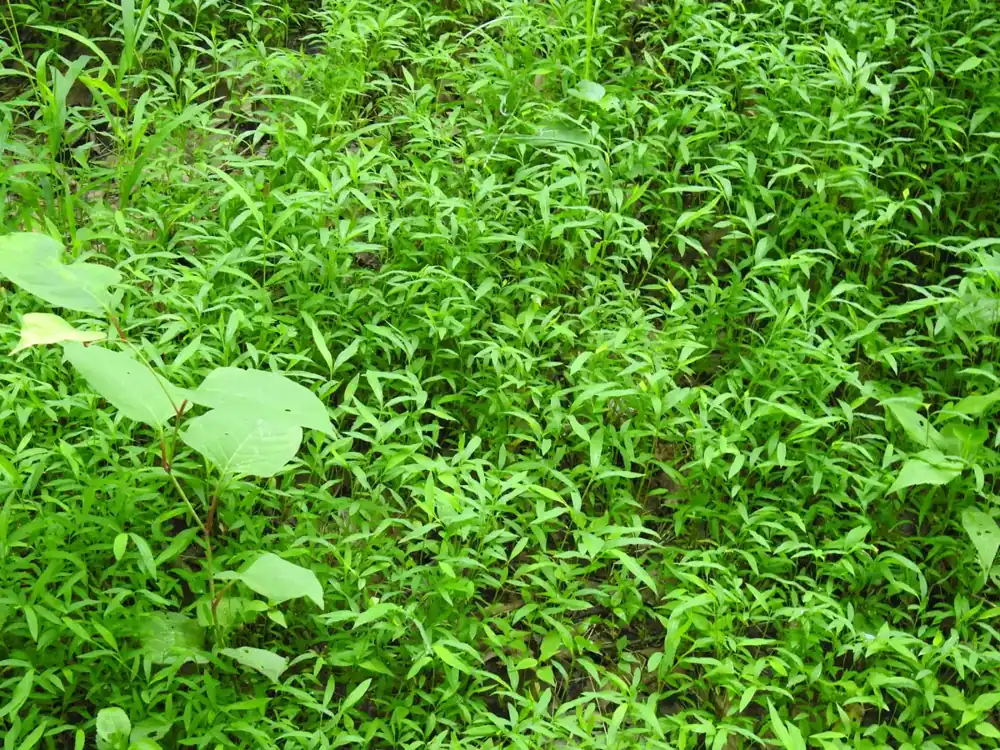
Japanese stiltgrass is easier to identify than most grassy weeds once you know what to look for. Penn State Extension describes it as resembling a miniature bamboo, and that’s the best first impression you’ll get: short, wide, pointed leaves set alternately along thin, branching stems (Penn State Extension, turf).
Key identification features
- Leaves: lance-shaped, pale green, roughly 2 to 4 inches long and about 1/2 inch wide, with pointed or slightly rounded tips. They’re broad and short for a grass.
- Silver stripe: a shiny, silvery midrib runs down the leaf, usually a little off-center. Tilt a leaf into the light to see it.
- Smooth feel: the leaves feel smooth. Most native grass leaves feel rough when you run a finger along them (Penn State Extension, forestry).
- “Stilts”: small prop roots grow down from the lower stem nodes into the soil, which is where the name comes from. The roots are shallow and fibrous, so plants pull out easily.
- Ligule and collar: a very short membranous ligule (about 0.5 mm), no auricles, and hairs at the collar and along the sheath margin (NC State Extension).
- Habit: wiry stems that start upright, then flop over into a dense mat. In unmowed areas they climb over other plants to 3 feet or more; in a mowed lawn they stay low.
- Seedlings: the very first leaf is broad and rounded, which sets young stiltgrass apart from other summer annual grasses in early spring.
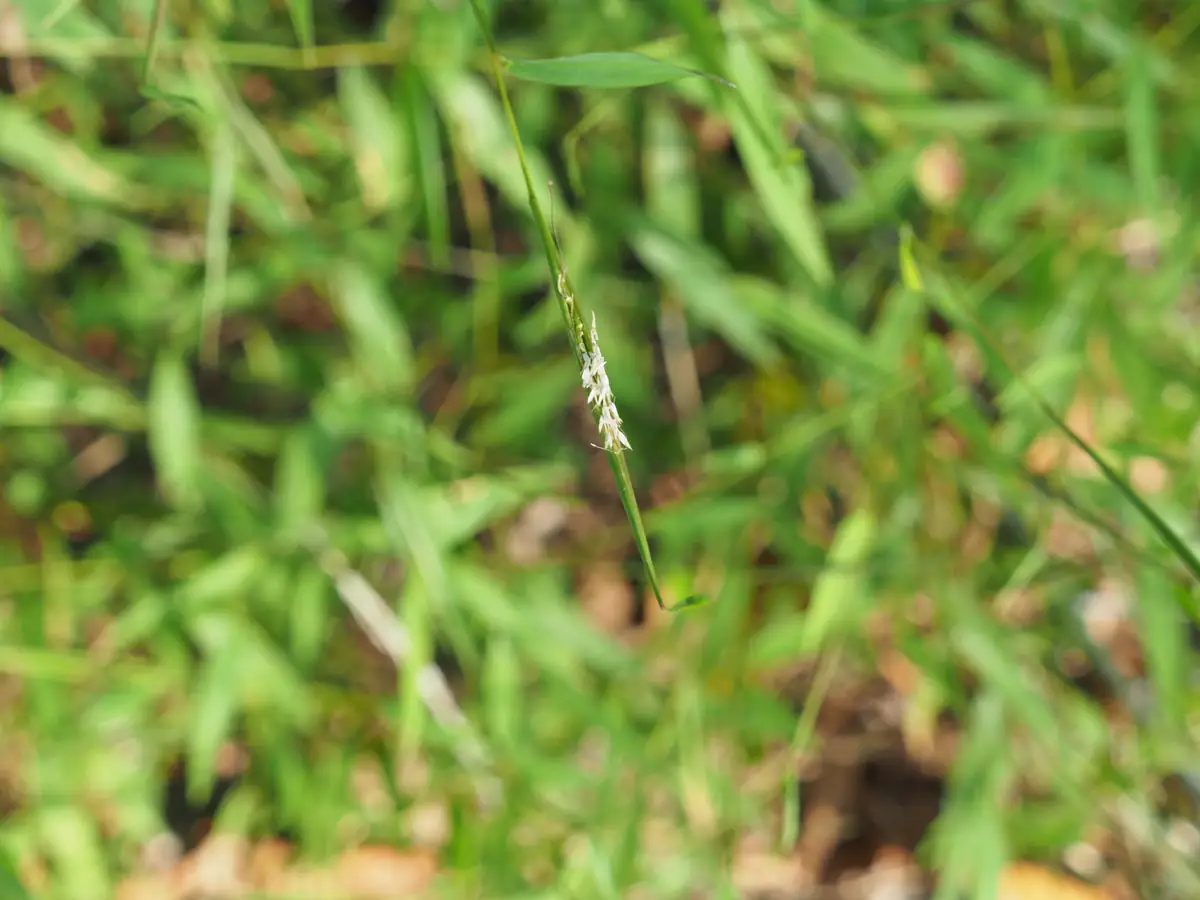
- Seed heads: thin spikes with 1 to 3 branches (rarely up to 6), each about 1 to 2 inches long, appearing from late summer into October.
In fall the plant gives itself away by colour. It turns reddish-purple in early fall, then browns and dies after a run of frosts. The dead, straw-coloured stems stay on the ground through winter and well into the next spring, so a late-October lawn walk is a good way to map where it grew.
Look-alikes: stiltgrass vs crabgrass, nimblewill and others
Penn State lists nimblewill, crabgrass and Pennsylvania smartweed as the plants most often confused with stiltgrass in lawns. In woods and along shady edges, the native whitegrass is the main look-alike. If you’re sorting out several grassy weeds at once, our guide to weeds that look like grass covers the wider group.
| Plant | Leaf | Growth habit | How to tell it from stiltgrass |
|---|---|---|---|
| Japanese stiltgrass | Short (2–4 in), wide, smooth, silver midrib | Sprawling mat; stilt roots at lower nodes; annual | The reference: bamboo-like leaves plus silver stripe |
| Crabgrass | Longer, often hairy blades, no silver stripe | Low clumps that spread from the crown; annual | Hairy, coarser blades; germinates about a month later. See our crabgrass ID guide |
| Nimblewill | Very short, narrow, blue-green blades | Wiry perennial that greens up late in spring | Much narrower leaves; perennial, so it comes back from the same plants |
| Whitegrass (Leersia virginica, native) | Similar shape | Similar shady, moist sites | Flower spike up to 10 in long; dense white hairs at each leaf base |
| Pennsylvania smartweed | Broadleaf with a dark blotch, not a grass | Upright, jointed stems with papery sheaths | Pink flower spikes; no grass collar or ligule |
Why Japanese stiltgrass is so hard to beat
Here’s the surprising part: a Japanese stiltgrass plant itself is weak. Its roots are shallow, it dies every winter, and a single spray of the right product kills it. The problem is the seed, and the calendar.
It spreads by seed in huge numbers
Each Japanese stiltgrass plant produces roughly 100 to 1,000 seeds (Penn State). In a dense stand, NC State reports 16,000 to 50,000 seeds per square meter. Some flowers are self-fertilised inside the leaf sheaths and never open, so a plant can make seed you never see. Those seeds ride on mower decks, shoes, pet fur and running water. That’s why stiltgrass so often shows up first along a woodland edge, a drainage swale or a path, then marches into the lawn.
The seed bank lasts for years
Buried seed stays viable for several years. Penn State’s forestry factsheet says up to five years. NC State says less than seven, and that populations drop quickly once you stop new seed from forming. A USDA Forest Service review notes viable seed in the soil of one North Carolina site for at least three years (USDA FEIS). In practice, that means a multi-year plan: every year you block seed, the reserve in the soil gets smaller.
It germinates before you’d expect
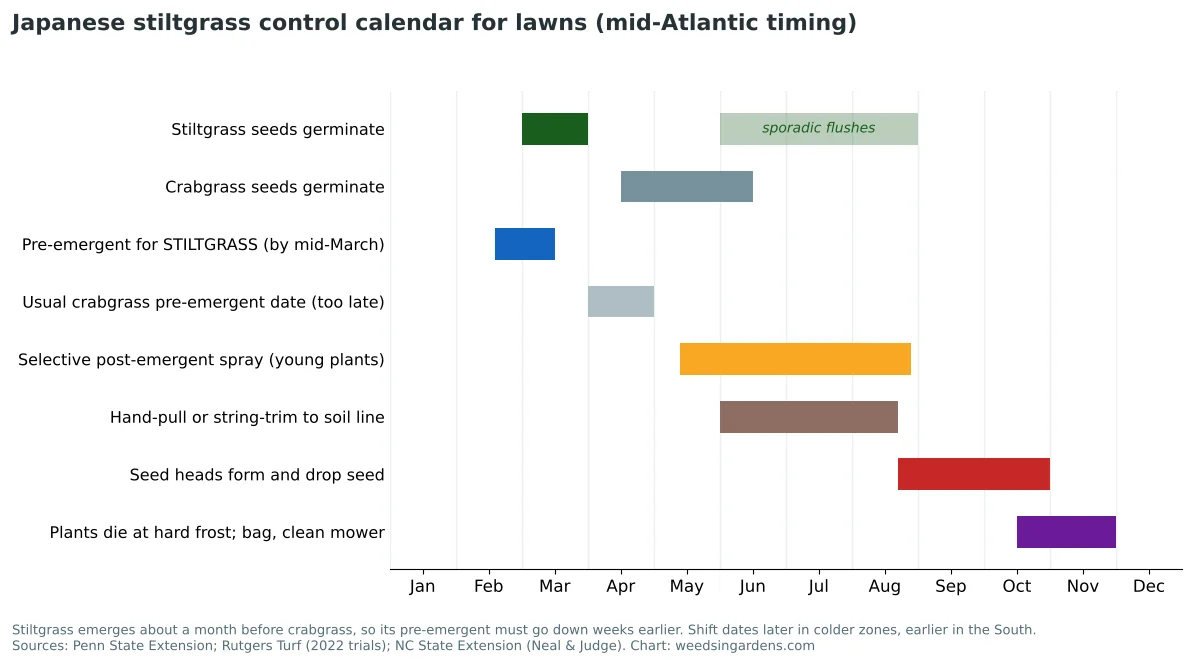
This is the mistake that sinks most homeowners. Stiltgrass is the first summer annual grass to come up, usually in March, about a month before crabgrass. Rutgers turf researchers also point out that the seedlings aren’t killed by frost (Rutgers Turf). If you put down your pre-emergent when the forsythia blooms, the way you would for crabgrass, the stiltgrass is already up and the barrier does nothing to it.
Shade doesn’t stop it
Japanese stiltgrass is unusually shade tolerant. In studies reviewed by the USDA Forest Service, it grew well under just 5% of full sunlight. That lets it fill thin, shady lawn where turfgrass struggles, the very spots where the turf can’t fight back.
What to do about Japanese stiltgrass in fall and winter
If you’re reading this between October and February, the plants are dying or dead and their seed is already on the ground. Spraying now is pointless. But this is the best time to set up next year, and a few jobs make a real difference.
- Map the patches. The tan, matted stems are easy to see now. Mark the Japanese stiltgrass patches on a phone photo or a sketch so you know exactly where to put pre-emergent in late winter.
- Bag, don’t mulch, clippings from infested areas. Penn State recommends bagging and removing clippings where seed heads were present, to stop spreading seed around the yard. Seed-laden material shouldn’t go into a home compost pile that may not get hot enough; our guide on how to dispose of invasive plants explains the options.
- Clean the mower and your boots. Knock debris off the deck and tires before you move from an infested area to a clean one. Mowers are a main way stiltgrass seed moves around.
- Rethink leaf removal at the woodland edge. In a New Jersey forest study reviewed by the USDA, stiltgrass spread 5.45 feet across plots where leaf litter was removed, but only 1.2 feet where litter was left. Leave natural leaf cover in wooded borders. On the lawn itself, shred leaves rather than leaving thick mats; see leaves on lawn over winter.
- Fix thin, shady turf. Thicker turf, more light (thinning low branches) and grass suited to the site all help slow stiltgrass, though Penn State notes they won’t suppress a well-established infestation on their own. Early fall is the best window to overseed thin spots with shade-tolerant fine fescues. Avoid a late-fall dormant seeding in areas you plan to treat, because that seed germinates in spring and a stiltgrass pre-emergent would stop it too.
- Buy your pre-emergent now. You’ll need it in February or early March, earlier than stores usually stock it.
Pre-emergent herbicide: the most important Japanese stiltgrass treatment
For lawns, a properly timed pre-emergent is the single most effective way to control Japanese stiltgrass. It stops seedlings as they germinate, so no plants form and no new seed gets made.
What works
In trials published in Weed Technology, Judge, Neal and Derr found that most crabgrass pre-emergents also control stiltgrass, often better. Prodiamine, pendimethalin, dithiopyr, oryzalin, oxadiazon, trifluralin, isoxaben + trifluralin and benefin + oryzalin gave 87% control or better eight weeks after treatment (Judge et al., 2005). Benefin + trifluralin gave 78%, napropamide 59% and metolachlor only 39%.
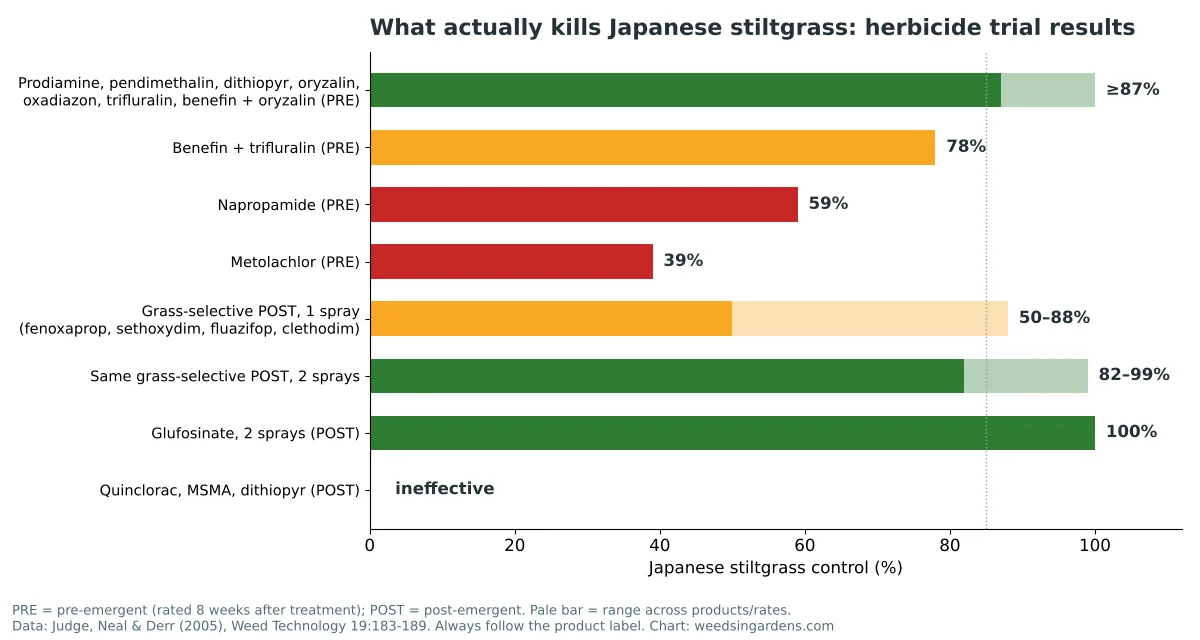
For a home lawn, the practical choices are prodiamine, pendimethalin and dithiopyr. Penn State notes that dithiopyr products were the only lawn pre-emergents listing stiltgrass (often as “Mary’s grass”) on the label when it wrote its turf factsheet, but all three performed well in research. NC State notes that indaziflam is labeled for stiltgrass in landscape beds, though it was less effective in the trials it cites.
When to apply
Timing is everything. Penn State advises applying 2 to 3 weeks earlier than your usual crabgrass date, and its forestry team gives a working deadline of mid-March, or late February in an early spring. Rutgers applied on March 11 in New Jersey and got good control; the same products applied in early May, at crabgrass emergence, failed. NC State puts germination in early to mid-March in central North Carolina.
Pre-emergents also need time to move into the soil. Penn State says they should be in place 2 to 3 weeks before germination, and a light watering after application helps. For the general rules (watering in, splitting applications, overseeding conflicts), see our guide on when to apply pre-emergent.
If you missed the window
Don’t skip the pre-emergent. It still stops later flushes, since stiltgrass keeps germinating sporadically through the season. Rutgers found that tank-mixing a pre-emergent with a low rate of fenoxaprop (Acclaim Extra, 9 fl oz per acre) controlled stiltgrass in early May, when the pre-emergent alone did not.
How to get rid of Japanese stiltgrass that’s already growing
Missed spring entirely? You still have until flowering, because Japanese stiltgrass is easy to kill while it’s young. NC State says stiltgrass is generally well controlled from germination until flowering, with the best results from treatment in early summer.
Hand-pulling and string-trimming
Honestly, for a patch the size of a doormat, your hands are the best tool. The roots are so shallow that plants slide out with a gentle tug, especially after rain. For bigger areas off the lawn, Penn State recommends cutting plants right at the soil line with a string trimmer, because removing all the stem tissue stops regrowth. Ordinary mowing isn’t as effective, since plants regrow from the stem nodes left behind.
Timing matters here too. Penn State suggests waiting until about June, so you don’t just clear space for a second flush of seedlings, and finishing before seed heads appear in late August. NC State adds a warning: once flowers are visible, many seeds will mature even if you mow or pull the plants. Act before you see flowers.
Selective post-emergent herbicides by active ingredient
In a lawn, you need a product that kills stiltgrass without hurting your turf. Penn State names only two post-emergent ingredients labeled for stiltgrass in cool-season lawns: fenoxaprop-p-ethyl (Acclaim Extra) and topramezone (Pylex). For general technique, see our post-emergent herbicide guide.
| Active ingredient | Type | Where it fits | Stiltgrass result in research | Watch out for |
|---|---|---|---|---|
| Fenoxaprop-p-ethyl (Acclaim Extra) | Selective grass killer | Kentucky bluegrass, perennial ryegrass, tall and fine fescue, zoysia (bentgrass with special directions) | 50–88% with one spray; 82–99% with two (grass-selective group) | Not for bermudagrass lawns, which it suppresses. Don’t mow for 24 hours. Avoid drought-stressed turf or temperature extremes |
| Topramezone (Pylex) | Selective, bleaching | Cool-season lawns, per label | Labeled for stiltgrass (Penn State) | Temporary whitening of treated weeds is normal; follow label turf list |
| Sethoxydim, fluazifop, clethodim | Grass-selective | Fine fescue roughs, beds and natural areas; not most lawns | 50–88% one spray; 82–99% two sprays | Kill most lawn grasses. Use in beds, around shrubs or in naturalised areas |
| Glyphosate | Nonselective, systemic | Spot treatment, woods, fence lines | One spray as effective as two | Kills any grass it touches, including turf |
| Glufosinate | Nonselective, contact | Natural areas, beds | 82–85% one spray; complete with two | Damages any green tissue it hits |
| Quinclorac, MSMA, dithiopyr (as post) | Crabgrass post-emergents | — | Ineffective on emerged stiltgrass | Check the label: a quinclorac “crabgrass killer” won’t fix this weed |
Results are from Judge et al. (2005); turf lists come from the Acclaim Extra label on EPA’s site. For spot-spraying, the label gives 0.30 fl oz of product per gallon of water for grass weeds at the 1- to 4-leaf stage and 0.46 fl oz per gallon at 1 to 2 tillers. Young plants are much easier to kill than older, tillered ones. Always read and follow the current label of the product you buy, since rates, turf lists and restrictions can change.
Natural areas and wooded edges
In woods beyond the lawn, Penn State’s forestry team uses prodiamine or pendimethalin pre-emergent in late winter, low rates of glyphosate, or the grass-selective quizalofop, which leaves native grasses like whitegrass and deertongue only briefly affected. Some of these products carry non-crop or forestry restrictions, so match the label to the site. Their bigger point is worth remembering: in heavily deer-browsed woods, stiltgrass keeps returning because deer remove the native plants that would otherwise compete with it. The same pattern shows up with many other invasive weeds.
Season-by-season Japanese stiltgrass control plan
Put it together and a full year of Japanese stiltgrass control looks like this. Dates suit the mid-Atlantic (central North Carolina to southern Pennsylvania and New Jersey, where most of the research was done). Move them later in colder areas and earlier in the Deep South, and watch for the first seedlings rather than trusting the calendar.
| When | What stiltgrass is doing | Your job |
|---|---|---|
| Late Oct–Dec | Seed dropped; plants dying after frost | Map patches, bag clippings, clean mower, thicken thin turf |
| Jan–Feb | Seed waiting in soil | Buy pre-emergent; calibrate spreader |
| Late Feb–mid-March | Germination begins | Apply prodiamine, pendimethalin or dithiopyr; water in lightly |
| March–May | Seedlings with broad, rounded first leaves | Scout weekly; hand-pull escapes; Acclaim Extra + pre-emergent if you missed the window |
| Late May–July | Rapid growth, tillering | Spot-spray young plants with a labeled selective; pull or string-trim edges |
| August | Seed heads about to form | Final pull or trim before flowers appear |
| Sept–Oct | Flowering and seed drop; reddish-purple colour | Mow low patches before flowering if possible; bag clippings |
Expect a declining curve rather than a single knockout. Because the seed bank can last several years, plan on repeating the spring pre-emergent for at least three seasons, then drop to spot treatment once you stop finding seedlings.
A note from the agronomist’s side
Read the extension research side by side and one pattern stands out: stiltgrass control fails on timing far more often than on product choice. The chart above makes the point: almost every common crabgrass pre-emergent works on this weed. People don’t fail because they bought the wrong bag. They fail because they put it down in April, a month after the seed came up.
Think of Japanese stiltgrass as a seed-bank problem, not a plant problem. An annual with a seed bank lasting a few years is beaten by arithmetic. Every year you prevent seed set, the reserve shrinks, and nothing refills it. That’s why pulling a patch in July is worth more than it looks: you’re not just removing this year’s plants, you’re cancelling thousands of seeds that would sit in the soil for half a decade.
The second lesson is about where it comes from. Lawns rarely make their own Japanese stiltgrass. It usually arrives from an infested wood edge, a neighbour’s lot or a ditch, carried by water and equipment. Treat the border as part of the lawn: a pre-emergent strip a few feet into the edge, a cleaned mower, and leaf litter left in the woods rather than raked out. And because a stiltgrass pre-emergent goes down in late winter, it can clash with spring seeding. If you need to overseed shaded areas, do it in early fall, when the new grass has months to establish, and let the spring barrier do its job.
Finally, read the label before you buy a “crabgrass killer”. If the active ingredient is quinclorac, it won’t touch emerged stiltgrass. The grass-selective products that do work are more specialised, and fenoxaprop isn’t a fit for bermudagrass lawns. For a warm-season lawn, pre-emergent timing and hand-pulling carry even more of the load.
Japanese stiltgrass FAQ
What kills Japanese stiltgrass?
In lawns, a pre-emergent such as prodiamine, pendimethalin or dithiopyr applied in late winter prevents it, and fenoxaprop (Acclaim Extra) or topramezone kills emerged plants in cool-season turf. Glyphosate and glufosinate kill it in non-lawn areas. Quinclorac, a common crabgrass post-emergent, does not work.
When should I put down pre-emergent for Japanese stiltgrass?
Apply it 2 to 3 weeks earlier than you would for crabgrass, generally by mid-March in the mid-Atlantic, or late February in an early spring. Stiltgrass usually germinates in March, about a month before crabgrass, and seedlings aren’t killed by frost.
Can you just pull Japanese stiltgrass?
Yes. Its roots are shallow, so plants pull out easily, and hand-pulling works well on small patches. Do it before flowers appear in late summer, because once flowers are visible many seeds will mature even on pulled plants.
Does mowing kill Japanese stiltgrass?
Not on its own. Plants regrow from stem nodes left behind, and in a lawn they simply stay low. Mowing before flowering reduces seed production, and bagging clippings from infested areas limits spread. String-trimming right to the soil line removes all stem tissue and stops regrowth.
How long do Japanese stiltgrass seeds last in the soil?
Several years. Penn State Extension says up to five years, and NC State says less than seven. Populations decline quickly once you prevent new seed, so a three-year program of blocking seed usually makes a big dent.
Is Japanese stiltgrass a perennial?
No. It’s a summer annual that germinates in early spring, flowers in late summer to fall, and dies after hard frost. The tan stems that persist over winter are dead; new plants come only from seed.
Why is Japanese stiltgrass bad?
It’s an invasive non-native grass that forms dense mats in shade, crowds out native plants and thin turf, and produces thousands of seeds per square meter that spread easily on equipment, shoes and water.
Sources
- Abbey, T., Landschoot, P. and Delvalle, T. Lawn and Turfgrass Weeds: Japanese Stiltgrass. Penn State Extension (updated 2026).
- Templeton, S., Gover, A., Jackson, D. and Wurzbacher, S. Japanese Stiltgrass. Penn State Extension (updated 2020).
- Japanese stiltgrass control in turf. Rutgers Turfgrass Science blog, Rutgers University.
- Neal, J.C. and Judge, C.A. Japanese Stiltgrass Identification and Management. NC State Extension, Horticulture Information Leaflet (2013, revised 2023).
- Judge, C.A., Neal, J.C. and Derr, J.F. (2005). Preemergence and postemergence control of Japanese stiltgrass (Microstegium vimineum). Weed Technology 19(1): 183–189.
- Fryer, J.L. (2011). Microstegium vimineum. Fire Effects Information System, USDA Forest Service, Rocky Mountain Research Station.
- Acclaim Extra Herbicide (fenoxaprop-p-ethyl) product label, EPA Reg. No. 432-950. US EPA Pesticide Product Label System.
More guides to grassy lawn weeds: Grassy Weeds.