
Short answer: gravel driveway weeds grow in the dust, leaf litter and silt that settle between the stones, mostly along the edges and down the untracked center strip. Pull or hoe them after rain, flame or scald seedlings, and spot-spray bigger patches with glyphosate, which binds to soil so tree roots don’t take it up. Then stop the next flush with a pre-emergent whose label lists driveways or gravel areas. Avoid “bare ground” soil sterilants near trees, shrubs, lawn edges or slopes: they persist for months to years and move with water into roots.
This guide is about the gravel driveway itself, where you want nothing green at all but still have a lawn, a hedge or trees a few feet away. If your gravel is a planted bed with shrubs or alpines in it, the rules are different; see how to kill weeds in rock gardens and gravel beds.
Table of Contents
Why gravel driveway weeds keep coming back
A new gravel driveway is a poor seedbed. After a few seasons it isn’t. Wind, rain and tires carry fine soil in, leaves break down between the stones, and the top half inch turns into a gritty potting mix that holds water. Weed seed blows in or rides in on tires, and it germinates in that layer, not in the compacted base underneath.
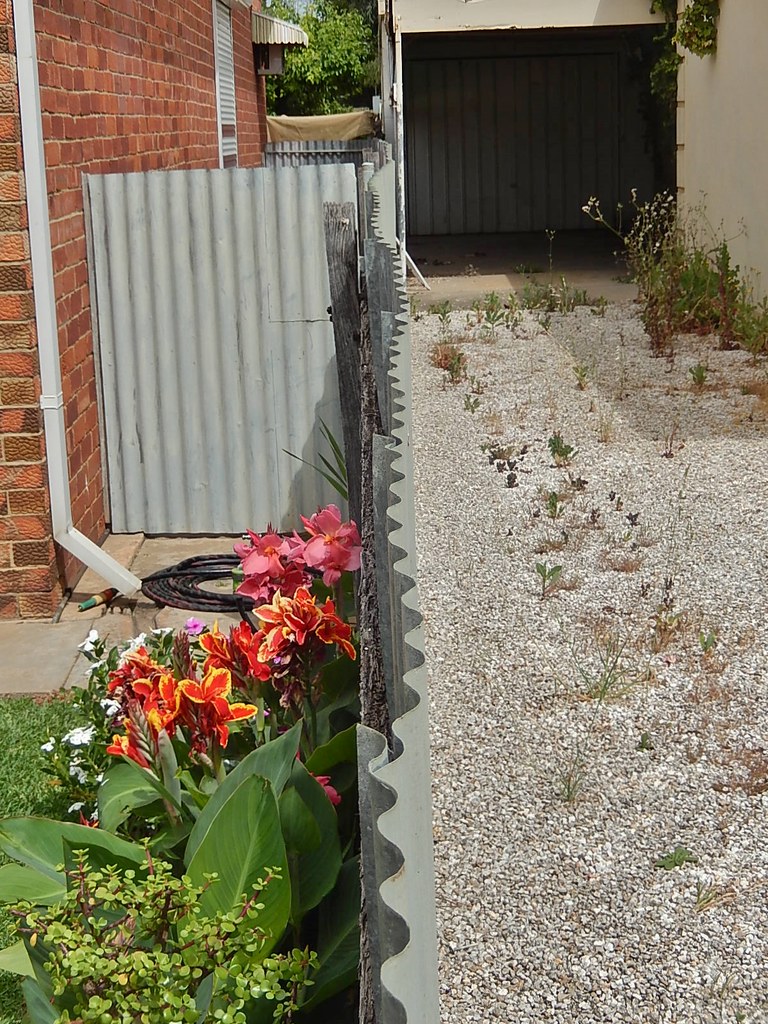
Where the weeds grow tells you why. Tires crush and scuff seedlings in the two wheel tracks, so the strip down the middle and the outer edges fill first. A gravel driveway that has lost its crown also holds puddles, and wet, silty low spots are where grass and weeds take hold. Fixing that shape does more long-term good than any spray, as the section on fixing the driveway explains.
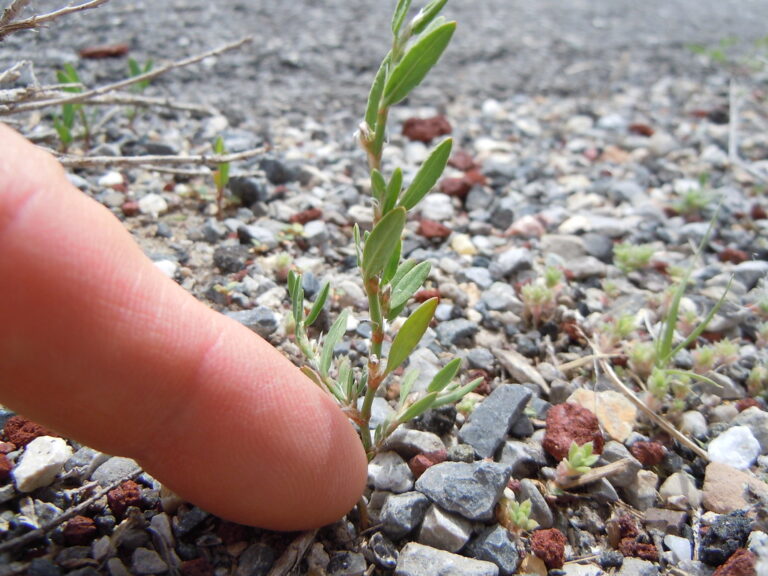
Compaction also selects the weeds. Michigan State University’s turf program calls prostrate knotweed a “supreme indicator weed” of compacted soil and names gravel roadbeds, sidewalk edges and paths as its typical home. It is the earliest-germinating summer annual, its very fine roots work into packed ground, and once established it is hard to control with most herbicides. Catching it young matters.
Which weeds grow in gravel driveways
Before choosing a method, sort your gravel driveway weeds into two groups: shallow-rooted annuals that die if you kill the top and catch them before they seed, and perennials with roots, rhizomes or runners that regrow from below. The table covers the usual driveway weeds and what each one means for control.
| Weed | Type | Where you see it | What works |
|---|---|---|---|
| Prostrate knotweed | Summer annual | Tire tracks, packed edges; one of the first weeds up in spring | Hoe or flame as seedlings; pre-emergent before it germinates |
| Spotted spurge and purslane | Summer annuals | Flat mats in hot, sunny gravel | Pull before seed set; bag purslane, its stems re-root |
| Crabgrass and annual bluegrass | Annual grasses | Center strip and edges with silt | Pre-emergent at the right soil temperature; spot spray |
| Dandelion, plantain | Perennial broadleaves | Edges, low spots | Dig the root, or spot-spray glyphosate |
| Bermuda grass, quackgrass | Creeping perennial grasses | Runners creeping in from the lawn | Edging plus repeated glyphosate spot treatment |
| Field bindweed | Deep-rooted perennial vine | Driveway edges near fences | Repeated treatment over several seasons |
Step 1: Fix the gravel driveway so weeds have less to grow in
Weeds need fines and water. Take away both and you cut the weed load for years. The Maine DEP gravel road maintenance manual, written for private roads, recommends a crown of about ½ inch per foot of width for level ground, up to ¾ inch per foot on steeper sections, and no more than that. On a 12-foot driveway that is a 3-inch rise in the middle. It also advises re-crowning every year, because plowing and traffic flatten the surface.
- Re-grade when the gravel is moist. The same manual advises grading only when the surface material is moist or wet; dry gravel won’t pack back into shape.
- Blow or rake off leaves and clippings. Every leaf that rots between the stones feeds next year’s weeds. Discharge the mower away from the driveway.
- Top up worn areas with clean, angular stone. A fresh layer buries the silty seedbed and seedlings under it.
- Drive the center now and then. Moving your wheel line a little disturbs the strip that never gets touched.
A geotextile under the base is worth installing when you build or rebuild a gravel driveway, because it keeps stone from sinking into the subsoil. It is not a weed barrier, though. Weeds root in the grit that builds up above it, the same reason fabric fails under decorative gravel, as covered in our guide to weeds growing through mulch.
Step 2: Kill the gravel driveway weeds already there
Match the method to the weed and the spot. Near the lawn edge, a hedge or a tree, use methods that act only on what they touch. The open middle of a long drive can take more.
Pull or hoe after rain
University of Illinois Extension’s advice on weeds in the driveway is to pull by hand after a rain has softened the soil, and to use dandelion forks, winged weeders or a hoe for larger areas. On a gravel driveway, a scuffle or stirrup hoe pushed just under the surface cuts seedlings off without dragging stone onto the lawn. It works on annuals, not on bindweed or Bermuda grass, which regrow from what stays below.
Boiling water on small patches
A kettle of boiling water kills young annuals in a few spots near the house, and it leaves no residue. It does little to deep perennials and scalds any lawn grass it runs onto. Our boiling water guide has the details and safety steps. Horticultural vinegar behaves much the same way: it burns tops, not roots.
Flame weeding: wilt, don’t burn
A propane torch is fast on a long gravel driveway, and gravel does not burn. The University of California’s WeedCUT tool on flaming says it works best on broadleaf seedlings from the seed-leaf stage to about six true leaves, or rosettes under 2 inches across. The aim is to wilt the plant by bursting its cells, not to char it. Burning takes longer, works no better and raises the fire risk.
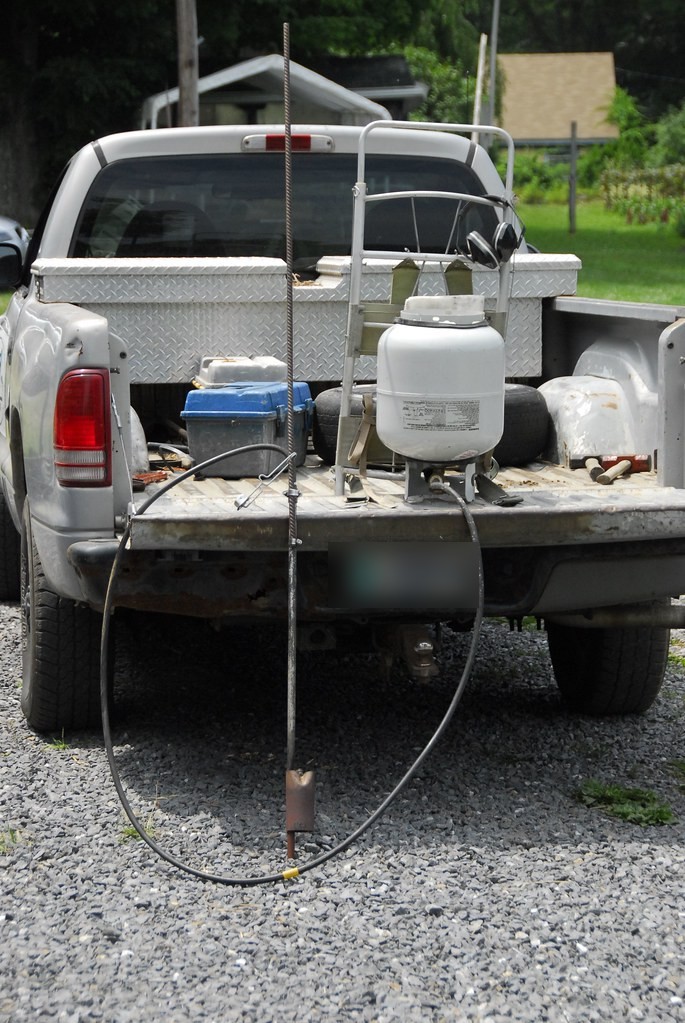
The same source warns that grasses usually regrow after flaming because their growing points sit at or below ground, that thistles need two or more treatments, and that flaming should not be done in dry conditions or near dry thatch, mulch or leaf litter. Keep water on hand, and never flame beside a dry hedge, wooden fence or bark mulch bed.
Spot-spraying glyphosate or glufosinate
Illinois Extension lists glyphosate and glufosinate as non-selective sprays for gravel areas where total vegetation control is wanted, with the catch that neither gives any residual control. That lack of residual is exactly what makes glyphosate the safer chemical near trees. The National Pesticide Information Center notes that it adsorbs tightly to soil, is expected to be immobile, and that plant uptake from soil is negligible.
Safe does not mean careless. Glyphosate still kills any green leaf, sucker or green bark it lands on, so use a coarse spray on a calm day and shield the nozzle near the lawn. The Nebraska Forest Service points out that some products sold under glyphosate brand names contain additional active ingredients that roots can take up. Read the active ingredients box, not the brand name. Our post-emergent herbicide guide covers weather, timing and mixing.
How often you will need to repeat it
No single treatment keeps gravel clean for a season. On traffic islands in a Danish trial, Rask and co-workers (2013) measured how many treatments a year kept weed cover below 2%. Glyphosate needed 2.5 on average, hot water 3, flaming 5, and hot air or steam 5.5. Plan your time around those numbers.
| Method | Best on | Residual effect | Treatments per year (Rask et al. 2013) | Risk to nearby lawn and trees |
|---|---|---|---|---|
| Hand pulling, hoeing | Annual seedlings, taprooted weeds | None | Not tested | None |
| Boiling or hot water | Young annuals, small areas | None | 3 | Scalds grass it runs onto |
| Flaming | Broadleaf seedlings up to 6 leaves | None | 5 | Fire risk near dry material |
| Glyphosate spot spray | Established annuals and perennials | None; binds to soil | 2.5 | Low if kept off green tissue |
| Soil-residual “extended control” products | New seedlings for months | Months to a year or more | Varies by label | High near roots, slopes and lawn edges |
Step 3: Stop the next flush with a pre-emergent
Most gravel driveway weeds are annuals that return from seed, so a pre-emergent does much of the work. Choose one whose label names driveways, walks, patios or gravel areas as a use site, and check that your main weeds are listed. Illinois Extension stresses both points, and adds that warm, wet seasons can break a product down faster than the label’s promised length of control.
Timing matters as much as the product. For summer annuals such as crabgrass and knotweed, apply before soil at 1 to 2 inches reaches the mid-50s °F; our guide on when to apply pre-emergent gives the soil temperatures and a spring and fall calendar. Illinois Extension notes that dichlobenil, one driveway option, is usually applied from late fall to early spring, before summer annuals emerge.
Many “extended control” or “year-long” driveway products combine glyphosate with a residual partner. The Illinois article lists imazapyr, imazapic, diquat, fluazifop, oxyfluorfen and indaziflam among them, giving 4 months to a year of control. It also warns these are not for garden use and that people regularly grab the wrong jug; mark the handle so it never ends up in a bed.
Soil sterilants: the part that kills everything else
Bare-ground herbicides are the reason people search for gravel driveway weed control “without killing everything else.” University of Nevada, Reno Extension’s fact sheet on soil sterilant or bare-ground herbicides describes them as total-kill products that can stay active for long periods, sometimes 10 years or more in arid climates. Most are very water-soluble and move down and sideways through soil, especially on a slope.
The same fact sheet gives the number that matters for a gravel driveway: tree roots can spread three to four times the width of the canopy. A tree 20 feet from a gravel driveway may well have roots under it. Even rinsing a sprayer near desirable plants can kill them, and treated soil that washes or blows elsewhere carries the herbicide with it. One label it quotes restricts use to non-cropland and forbids use where roots of valuable plants may extend.
The damage is often slow. The Nebraska Forest Service lists dicamba, picloram, bromacil and prometon among the herbicides used on driveways and gravel strips that trees take up through their roots, and notes that the worst injury can build over several growing seasons. An older arborist review by Feucht (1988) describes trees beside treated gravel strips and driveways suffering severe injury or death, with conifers often dying back in a spiral pattern.
Before you buy any long-lasting gravel driveway product, check the label for these warning signs:
- Words such as “bare ground,” “total vegetation control,” “extended,” “year-long,” or “kills brush and woody plants.”
- Active ingredients such as prometon, bromacil, tebuthiuron, imazapyr or picloram.
- Statements like “do not apply on or near desirable trees or where their roots may extend.”
- A driveway that slopes toward a lawn, bed, ditch or tree, or sandy soil, where movement is greatest.
If any of these apply, stick to glyphosate spot spraying, a pre-emergent that is labeled for landscape use near ornamentals, and non-chemical methods. It is also illegal to use a product on a site its label does not list.
Keep lawn grass from creeping into the gravel driveway
Some gravel driveway weeds are your own lawn. Bermuda grass, quackgrass and zoysia run into gravel along the edges, and the University of California’s bermudagrass Pest Notes explain why they are hard to stop. Rhizomes usually sit 1 to 6 inches down, but under sidewalks, in sandy soil and against solid structures they can run deeper than 6 inches.
- Install a solid edge. A deep metal, stone or concrete edge between lawn and gravel gives you a clean line to trim and spray along.
- Treat runners in late summer. UC IPM gives late summer as the best time for glyphosate on Bermuda grass, when it is growing actively and not drought stressed. Skip mowing for 2 to 3 weeks before, and wait at least 7 days afterward before digging or trimming.
- Expect regrowth. Deeper rhizomes often survive the first treatment, so repeat on regrowth.
- Smother a wide strip. For a badly invaded edge, UC IPM reports that black plastic left on for at least 6 to 8 weeks in summer controls established Bermuda grass.
A year-round plan for a weed-free gravel driveway
| Time of year | What to do |
|---|---|
| Late winter to early spring | Rake off leaves; re-crown and top up gravel once the surface is moist but not soft; apply a labeled pre-emergent before soil reaches the mid-50s °F |
| Mid to late spring | Hoe or flame the first seedlings, knotweed first; spot-spray dandelions and plantain |
| Summer | Walk the driveway every 2 to 3 weeks and pull spurge and purslane before they seed; no flaming in dry spells |
| Late summer to early fall | Glyphosate on Bermuda grass runners and bindweed; second pre-emergent application for winter annuals |
| Late fall | Clear leaves from the stones; fix puddles and ruts before winter |
Where this applies: the months above fit cool and transition-zone climates in the Northern Hemisphere. In warm, frost-free regions summer annuals germinate earlier and grow for longer, and in the Southern Hemisphere the seasons are reversed, so go by soil temperature and what you see sprouting. Herbicide registrations and allowed use sites also differ between countries and states; an active ingredient named here may not be sold or permitted for driveways where you live.
A note from the agronomist’s side
On farm tracks and trial-station roads I have worked on, the weed strip is almost always a map of where wheels don’t go and where water sits. Spraying gravel driveway weeds every month treats the symptom. A day of re-crowning, clearing silt and shifting the wheel line usually does more than a season of herbicide.
The other lesson is about trees: the damage from a residual product rarely shows the week you apply it. It shows up a summer or two later as thin crowns and dieback, when nobody links it to the driveway. Read the active ingredient, not the promise on the front of the jug.
FAQ
Does landscape fabric under a gravel driveway stop weeds?
Only for a short while. Fabric under the base keeps stone out of the subsoil, but weeds root in the silt and leaf litter that collect on top of it. Keeping the surface clean and crowned does more.
What kills weeds in gravel permanently?
Nothing safe does. Products that keep gravel bare for a year or more are the soil sterilants that can injure trees and lawn at a distance. A pre-emergent twice a year plus spot treatment of escapes is the practical routine.
Can I use weed killer on a gravel driveway near trees?
Yes, if it is a foliage-only product such as glyphosate, kept off green bark, suckers and leaves. Avoid anything with a soil-active residual partner unless its label clearly allows use near trees.
Sources
- University of Illinois Extension, Home, Yard & Garden Newsletter (Wiesbrook, 2020): Controlling weeds in the driveway
- University of Nevada, Reno Extension (Skelly and Donaldson, 2011): What to consider before using soil sterilant or “bare-ground” herbicides, FS-11-69
- Nebraska Forest Service, University of Nebraska–Lincoln: Herbicide damage to trees
- National Pesticide Information Center, Oregon State University: Glyphosate technical fact sheet
- University of California Statewide IPM Program, WeedCUT: Flaming
- University of California Statewide IPM Program: Bermudagrass Pest Notes
- Michigan State University Extension, Turf: Prostrate knotweed
- Maine Department of Environmental Protection: Gravel road maintenance manual (PDF)
- Rask, A.M., Larsen, S.U., Andreasen, C. and Kristoffersen, P. (2013). Determining treatment frequency for controlling weeds on traffic islands using chemical and non-chemical weed control. Weed Research 53(4): 249–258.
- Feucht, J.R. (1988). Herbicide injuries to trees: symptoms and solutions. Journal of Arboriculture 14(9): 215–219.