
You mow, and the shady side of the yard suddenly smells like mint. Look closer and the “grass” under the maple is a carpet of round, scalloped leaves on runners that have crept out into the sunny lawn, rooting as they go. That is creeping Charlie, and if you pulled some last spring, you already know it came straight back.
Short answer: creeping Charlie (ground ivy, Glechoma hederacea) is a creeping perennial in the mint family that roots at every node, so pulling or mowing alone rarely removes it. The most reliable way to get rid of creeping Charlie in a lawn is a broadleaf herbicide containing triclopyr, fluroxypyr or 2,4-D applied in fall (late September to early November in northern US lawns), repeated about a month later, while you fix the shade, wet soil and thin turf that let it in. In garden beds, dig it out and mulch.
The good news: most failures have the same few causes. People spray once in midsummer, trust borax or vinegar, or leave stem pieces behind. By the end of this guide you’ll be able to confirm it’s ground ivy (not henbit or mallow), pick a product that actually performed in university trials, and follow a season plan that stops it coming back.
Table of Contents
How to identify creeping Charlie
Before you buy anything, make sure of what you’re fighting, because the right plan for ground ivy is wrong for its lookalikes. Check four features together. University of Minnesota Extension and Illinois Extension describe the same set:
- Square stems that run along the soil surface and root where the leaves join the stem (the nodes).
- Opposite leaves, round to kidney-shaped, with rounded, scalloped (toothed) edges, each held on a long leaf stalk.
- Smell: crushed or freshly mowed leaves give off a strong minty odour.
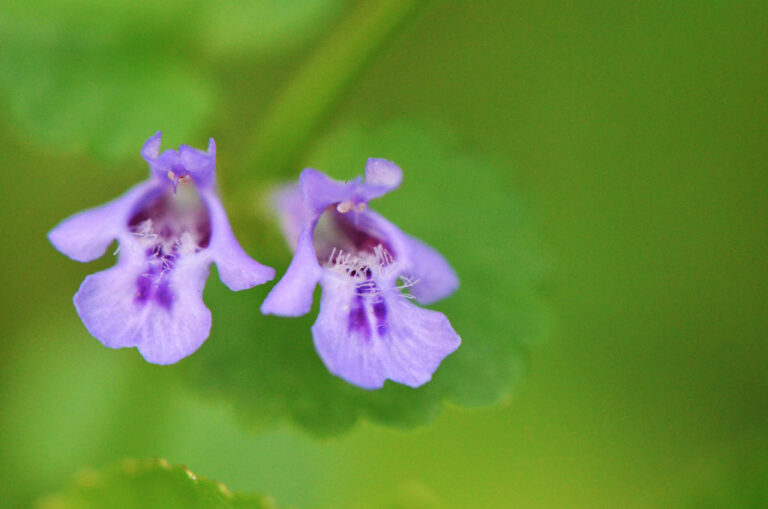
- Flowers: small, funnel-shaped, purplish-blue, from roughly April to June; Purdue Turfgrass Science notes red speckles on the petals.
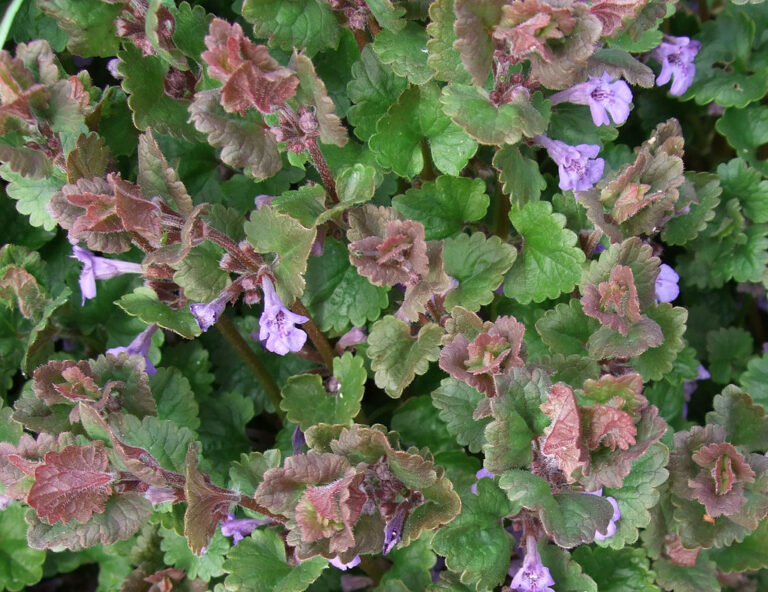
Left alone, ground ivy forms evergreen mats that can spread 1 to 3 feet and stand up to a foot tall in unmown areas (UMN). In a mowed lawn it stays low, which is exactly why it hides so well among the grass.
How it spreads
This is the part that explains every frustrating comeback. Creeping Charlie spreads mainly by stolons (above-ground runners), and also by short rhizomes and by seed; each flower can produce four small nutlets (UMN; UW–Madison Extension).
Because every rooted node can become a new plant, a chopped-up patch is not a dead patch. Pieces left on the soil after raking or hand weeding can re-root. Think of each fragment as a cutting you’ve just planted.
UMN also notes the plant is suspected of being allelopathic, releasing compounds that reduce the growth of neighbouring plants. Whether or not that matters much in a lawn, its dense mats shade out grass seedlings on their own.
Why creeping Charlie takes over a lawn
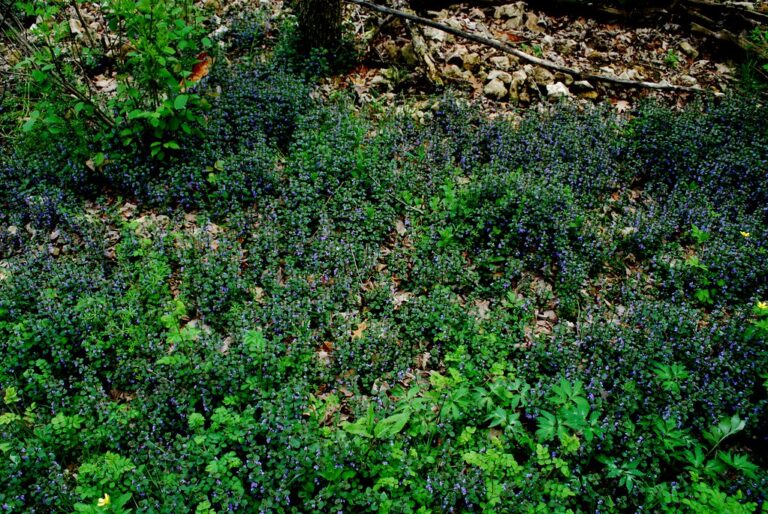
Here’s the uncomfortable truth: creeping Charlie rarely beats healthy grass. It wins where the grass is already losing. Ground ivy thrives in shaded, moist soil where turfgrass is weak, though Purdue adds that it “will grow in full sun” once established, and Illinois Extension describes patches creeping from shade into sunny areas.
The pattern in most lawns is the same. It starts under trees, along north-facing walls or in a low wet corner, then moves outward into thin grass.
If you recognise your yard in any of these, that’s the thing to fix alongside spraying:
- Shade that thins cool-season grass under trees or beside buildings.
- Wet, poorly drained soil, or frequent light watering that keeps the surface damp (see signs of an overwatered lawn).
- Low fertility and thin turf. In a Purdue field study, raising annual nitrogen from 0 to 196 and 293 kg N per hectare (about 4 and 6 lb N per 1,000 sq ft) reduced ground ivy cover by 24% and 32% (Kohler et al., 2004, HortScience).
- Compaction, which weakens grass roots more than it bothers a surface creeper (how to loosen compacted soil).
Creeping Charlie lookalikes: henbit, mallow and others
Several lawn weeds have rounded leaves or purple flowers, and mixing them up wastes a season. Henbit, for example, is a winter annual that dies out in early summer on its own, while ground ivy is a perennial that needs a different plan. For more purple- and blue-flowered weeds, see weeds with purple flowers and lawn weeds with blue flowers.
| Weed | Stem | Leaves | Creeps and roots at nodes? | Life cycle |
|---|---|---|---|---|
| Creeping Charlie (ground ivy) | Square | Round to kidney-shaped, scalloped edges, long stalks, minty smell | Yes | Perennial |
| Henbit | Square | Upper leaves clasp the stem with no stalk | No, stems grow upright from the base | Winter annual |
| Purple deadnettle | Square | Triangular, purple-tinged upper leaves crowded at the top | No | Winter annual |
| Common mallow | Round | Round with sharply toothed edges, long stalks | No, grows from a taproot | Annual or biennial |
| Healall | Square | Oval, smooth or slightly toothed edges | Roots along stems, but leaves are not scalloped | Perennial |
Henbit
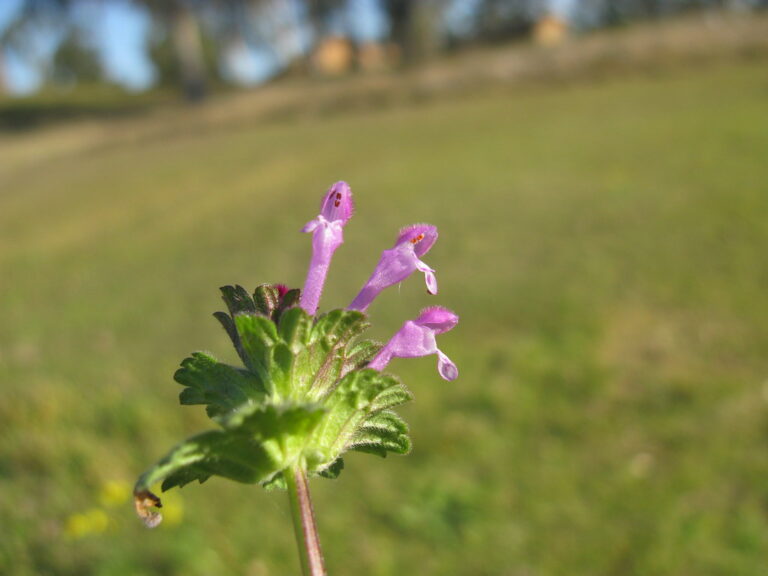
This is the mix-up you’re most likely to make in spring. Purdue’s quick test: henbit stems “do not creep along the ground nor root at nodes.” Its upper leaves wrap around the stem with no leaf stalk, and the flowers are pinker and more upright.
Common mallow
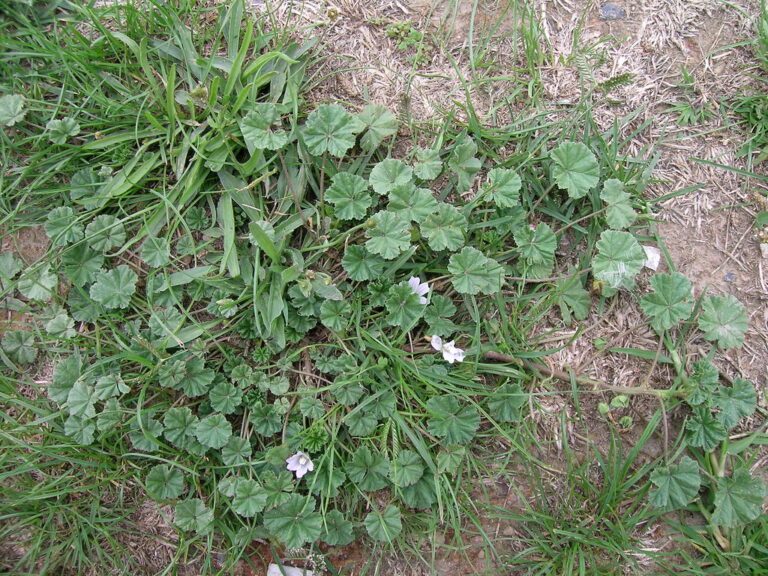
Mallow leaves are round and on long stalks, like ground ivy, but Purdue points out two differences: mallow stems are round, not square, and the leaf edges are more sharply toothed.
Mallow also grows from a single crown and taproot instead of forming a rooted mat, and it does not smell of mint. Tug a stem: one plant from one point means mallow.
Best herbicides for creeping Charlie in lawns
Many bottles promise to kill “ground ivy”, but they don’t all do it equally well, so read the active ingredients, not the front label. Selective broadleaf herbicides kill creeping Charlie without killing lawn grass when used by the label. The active ingredients recommended by extension services are:
- Triclopyr: named by UMN, Iowa State and Purdue as one of the better options; sold alone or in “clover, chickweed and oxalis” lawn products.
- Fluroxypyr: Illinois Extension lists fluroxypyr and triclopyr as the most effective single ingredients.
- 2,4-D, MCPP (mecoprop) and dicamba: the common three-way lawn mix. Purdue rates these mixtures as giving “fair” control.
- Sulfentrazone: often combined with the above (UW–Madison).
Now the twist. Trial results don’t line up perfectly with the general advice, which is worth knowing before you buy. In a multi-site Purdue and University of Tennessee study (Patton et al., 2017), control of ground ivy four weeks after a fall application was:
- 2,4-D amine: 91%
- Aminocyclopyrachlor: 86%
- Fluroxypyr: 79%
- Triclopyr alone: 53%
- 2,4-D + MCPP + dicamba mix: 43%
The authors concluded that the choice of herbicide mattered more than the timing, and that more than one application is likely needed. UMN, by contrast, states that 2,4-D alone is “not very effective.” In practice, products that combine two or more of these ingredients cover both views.
One thing that won’t help much: a preemergence herbicide will not remove existing creeping Charlie. Isoxaben applied in May slowed its spread by 34% over 26 weeks in the Kohler study, and Purdue says it “can slow spread but not eliminate” the weed.
Iron-based (FeHEDTA) products
Want something gentler? Chelated iron (FeHEDTA) products are a lower-toxicity option. In a Purdue trial on Kentucky bluegrass, a single application gave 65% (low rate) and 78% (high rate) control by the end of the study, with no injury to the grass (Amgain et al., 2023). The authors noted that cost may limit their use, and more than one application is normally needed.
When to spray creeping Charlie: fall vs spring
If you’re reading this in autumn, you’re in luck: fall is the preferred window. As the weather cools, ground ivy moves sugars down into its stolons and roots, carrying the herbicide with them right to the parts that cause regrowth.
Iowa State Extension recommends two applications about a month apart, the first in late September or early October and the second a month later. UW–Madison suggests mid to late fall, including after the first frost while the plant is still green.
Spring is the second window. Illinois and UW–Madison recommend spraying when the plant is blooming or just after, roughly April to June, and Illinois advises a follow-up 3 to 4 weeks later. The Patton study found good control in spring too, provided an effective herbicide was used.
Whichever season you pick, the weather on spray day matters as much as the product. Practical conditions from UW–Madison:
- Spray when air temperatures are between the mid-60s and low 80s °F (about 18–28 °C).
- Do not mow for a few days before and after spraying, so there is leaf surface to take up the product.
- Allow at least 24 hours without rain after application.
- Avoid hot, dry summer weather, when uptake is poor and nearby plants are more easily damaged.
Where this applies: the months above are for cool-season lawns (Kentucky bluegrass, fescues, ryegrass) in the northern United States and similar temperate climates. In the Southern Hemisphere, shift them by six months. Warm-season grasses tolerate some of these ingredients poorly, so read which turf species the product label lists; Purdue mentions metsulfuron as an option for warm-season turf. Herbicide registrations differ between countries and states, and the product label is the legal guide.
Does borax, vinegar or pulling kill creeping Charlie?
Borax
You’ve probably seen the borax recipe online. It was popular because early Iowa State work showed some promise, but a later Wisconsin study did not repeat the results. Iowa State Extension now states that borax “is not recommended,” because the gap between the boron plants need and a toxic dose is very small.
The 2023 Purdue trial confirms the problem: high boron rates reached 87% or more ground ivy control, but every boron product caused unacceptable injury to the lawn. Boron also does not break down in soil, so repeated use can leave bare areas (UW–Madison). In other words, you’d be trading a green weed for a brown patch.
Vinegar, clove oil and flame
These look impressive for about three weeks. Purdue tested over-the-counter “natural” options on ground ivy, including a vinegar mix, clove oil, octanoic acid and a flame weeder. Several burned it back by 75–100% within three weeks, but by the next spring the average control was only 22%, and most products injured the turf (Patton et al., 2019).
The reason is simple: contact products kill the leaves and leave the rooted stolons alive. More on this in does vinegar kill weeds?
Hand pulling
Honestly, for a patch the size of a doormat, pulling works if you’re persistent. Iowa State advises doing it after rain or a deep watering, when the runners come up more easily, while noting that some stem and root pieces usually stay behind.
Follow each runner back toward the centre of the patch, and bag the pieces rather than leaving them on the lawn, since they can re-root (UW–Madison). Check the spot again every two to three weeks.
Creeping Charlie in flower and vegetable beds
Beds call for a different approach, because your flowers and vegetables are broadleaf plants too. Do not use lawn broadleaf herbicides in beds; they injure ornamental and vegetable plants (Iowa State). Instead:
- Dig out the patch with a garden fork, lifting the stolons rather than snapping them.
- Sift the top few centimetres of soil by hand for white stem pieces.
- Cover the bare soil with 2–3 inches of mulch so any missed pieces meet a barrier (see how to stop weeds growing through mulch).
- Edge the bed where it meets the lawn so runners cannot creep back in from the grass.
If you use a non-selective herbicide in a bed, spot-treat only the weed and shield nearby plants with cardboard, as Iowa State recommends.
A 5-step season plan to stop creeping Charlie coming back
Herbicide clears the patch; thick turf keeps it clear. UW–Madison warns that ground ivy control is “frequently not totally successful” and may need repeat treatment for several years. So plan on a two-season effort, not a one-weekend job:
- Late summer: improve drainage, core-aerate compacted areas and prune lower tree branches to let in light (UW–Madison, Purdue).
- Late September to early October: first herbicide application.
- Four weeks later: second application on any regrowth.
- Next spring: spot-treat survivors at bloom; overseed bare areas with a shade-tolerant grass in the next late-summer seeding window (kill weeds before overseeding?).
- Ongoing: mow at 2 to 3½ inches (UW–Madison), water deeply and infrequently (Purdue), and fertilize to the grass’s needs. Iowa State suggests 3–4 lb of nitrogen per 1,000 sq ft per year for Kentucky bluegrass lawns, split between spring and fall, and the fall dose matters most: a winterizer applied before dormancy builds the roots that help grass outcompete weeds in spring.
And if a spot is in deep shade where grass never grows well, it’s fair to ask whether the fight is worth it. It may make more sense to switch to a mulched bed or a shade groundcover. Some homeowners tolerate creeping Charlie in these spots, much as others now tolerate clover in the lawn, since it stays green all year and tolerates shade that grass does not.
A note from the agronomist’s side
Read the ground ivy research side by side and one lesson keeps surfacing: the spray gets the credit or the blame, but the site decides the result. A single summer spray on a damp, shaded, underfed lawn looks great for a month. Then it fills back in from the rooted runners that survived, and the product gets blamed.
What works is dull and sequential, and that’s fine. Two fall applications of a product with more than one active ingredient, then an honest look at why the grass lost in the first place. Remember that extra nitrogen alone cut ground ivy cover by up to a third in the Kohler study. If a patch returns in the same spot two years running, treat that as information about light and drainage, not as proof that the herbicide failed.
Frequently asked questions
Does borax kill creeping Charlie?
It can, but not safely. In the 2023 Purdue trial, rates of boron high enough to control ground ivy also caused unacceptable lawn injury, and Iowa State Extension does not recommend it.
Will creeping Charlie killer hurt my grass?
Selective products containing triclopyr, fluroxypyr, 2,4-D, MCPP or dicamba are made to spare lawn grasses listed on the label, but they can injure newly seeded grass and some warm-season species. Check the label for your grass type and for how long to wait before overseeding.
Why is fall the best time to kill creeping Charlie?
In fall the plant moves stored food down into its stolons and roots, and systemic herbicides travel with it, so more of the plant is killed. Two applications about a month apart work better than one.
More lawn weed guides: Lawn Weeds hub.
Related guides: Why Do Dandelions Keep Coming Back? Roots, Seeds and How to Stop Them · Weeds With Purple Flowers in Lawns: 8 Common Ones and How to Identify Them
Sources
- University of Minnesota Extension. Ground ivy (creeping Charlie).
- University of Illinois Extension. Managing creeping Charlie in lawns.
- Iowa State University Extension. Control of ground ivy (creeping Charlie) and Can borax be used to control creeping Charlie?
- University of Wisconsin–Madison Extension. Controlling creeping Charlie.
- Purdue University Turfgrass Science. Ground ivy.
- Kohler, E.A., Throssell, C.S. and Reicher, Z.J. (2004). Cultural and chemical control of ground ivy (Glechoma hederacea). HortScience 39(5): 1148–1152.
- Patton, A.J. et al. (2017). Evaluation of herbicides for ground ivy control at two application timings. International Turfgrass Society Research Journal 13: 692–697.
- Patton, A.J., Braun, R.C. and Weisenberger, D.V. (2019). Single applications of natural postemergence weed control options do not provide effective ground ivy control. Crop, Forage & Turfgrass Management 5: 180101.
- Amgain, N.R., Beck, L.L. and Patton, A.J. (2023). Ground ivy control with boron and iron in Kentucky bluegrass turf. Agrosystems, Geosciences & Environment 6: e20411.