
The beds look clean in November and weeding season feels over. Meanwhile, under the fallen leaves, thousands of tiny green seedlings are settling in to sleep through the cold and explode into flower at the first warmth of spring. What kind of weed germinates when everything else is shutting down for winter? Meet the winter annuals: beat them in fall or fight them all spring.
Short answer: winter annual weeds germinate in fall, sit quietly as small green plants all winter, then flower, set seed and die in late spring. The eight you will meet most are henbit, purple deadnettle, common chickweed, shepherd’s purse, hairy bittercress, Persian speedwell, annual bluegrass and prickly lettuce. Stop them in fall, one of two ways: apply a pre-emergent herbicide in early to mid-September (prodiamine, dithiopyr, isoxaben, pendimethalin or oryzalin), or spray a broadleaf herbicide in late October to early November once most seedlings are up (Purdue Extension). Spraying in spring is a waste: flowering winter annuals die on their own two to three weeks later anyway (Michigan State University Extension).
The pink-purple haze over a lawn in April looks like a spring problem. It is actually a fall problem that went untreated six months earlier. Below: how the winter annual life cycle works, how to identify the eight common ones, and the two fall windows that prevent the whole spring show.
Table of Contents
What winter annual weeds are (and why they fool you)
A winter annual runs its calendar backwards compared with garden weeds like crabgrass. Seeds germinate in fall as soil cools, the seedlings overwinter as tiny rosettes or sprawls under the snow, then bolt, flower and set seed with the first warm weeks of spring, and die as summer heat arrives. Michigan State University Extension puts the punchline plainly: after flowering in spring, winter annuals are usually only two to three weeks from dying (MSU Extension).
That calendar is why winter annual weeds fool so many homeowners. In October the seedlings are half an inch tall and invisible in the grass. In April they flower in sheets and look like an invasion worth spraying, but by then every plant is weeks from natural death and already shedding seed. K-State’s home lawn guide lists the winter annual group that follows this pattern: chickweed, henbit, deadnettle, shepherd’s purse, speedwell, mustards, bedstraw, knotweed and wild lettuce among others (K-State MF2385).
The trigger for germination is cooling soil. Cornell University’s weed ecology profiles show the mechanism for the Lamium species: seed dormancy breaks over hot summer weeks, and germination switches on when day and night temperatures fall to about 68/50°F (20/10°C) (Cornell Weed Ecology). Clemson Extension gives a field-ready version of the same signal: apply fall pre-emergent when nighttime lows hit 55 to 60°F for four consecutive nights (Clemson HGIC).
The 8 usual suspects: identification
All eight of these winter annual weeds are controlled the same two ways (pre-emergent in September, post-emergent in late fall), so a perfect species ID is not required to act. Still, knowing which one dominates tells you how it spreads and how stubborn the seed bank is.
| Weed | Key ID features | Seed output per plant |
|---|---|---|
| Henbit (Lamium amplexicaule) | Square purple-tinged stems; fan-shaped upper leaves that clasp and nearly encircle the stem; pink-purple tubular flowers in whorls | 200 to 2,000 (up to 60,000) |
| Purple deadnettle (Lamium purpureum) | Like henbit, but upper leaves are triangular, maroon-tinged, on short stalks, and do not encircle the stem | About 600 (up to 27,000) |
| Common chickweed (Stellaria media) | Opposite teardrop leaves; a single line of hairs on the stem; small white star flowers; forms mats that root at nodes | 500 to 3,000 (large plants far more) |
| Shepherd’s purse (Capsella bursa-pastoris) | Flat basal rosette of lobed leaves; white four-petal flowers; unmistakable flat heart-shaped seed pods | Around 3,000 (large plants 30,000 to 60,000) |
| Hairy bittercress (Cardamine hirsuta) | Low rosette of rounded leaflets; 3 to 10 inch stems; tiny white cross-shaped flowers; upright needle pods that fling seed several feet | 600 to 1,000 |
| Persian speedwell (Veronica persica) | Round stems (not square); small rounded toothed leaves; sky-blue to white flowers; sprawls in thin turf | Low per plant, but mats colonize fast |
| Annual bluegrass (Poa annua) | Light apple-green grass clumps; boat-shaped leaf tips; whitish pyramid seedheads in spring even in mowed turf | Typically 1,050 to 2,250 |
| Prickly lettuce (Lactuca serriola) | Tough basal rosette; spines on the leaf midrib underside and edges; milky white sap; bolts 1 to 6 ft with yellow flowers | Thousands on tall plants |
Henbit and purple deadnettle are the pair everyone mixes up, and Cornell’s deadnettles profile separates them by one glance at the upper leaves: henbit’s are fan-shaped and clasp the stem, deadnettle’s are maroon, stalked and angled downward. Both are frost-hardy (henbit tolerates down to about 18°F), which is why they stay green under winter snow. More photos and control detail in our guides to getting rid of henbit and getting rid of chickweed.
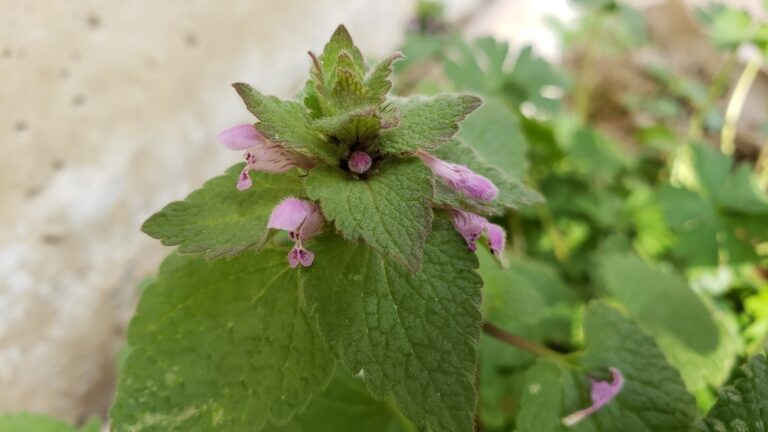
Photo: “Purple deadnettle (Lamium purpureum)” by Gavin Slater via iNaturalist, CC BY 4.0.
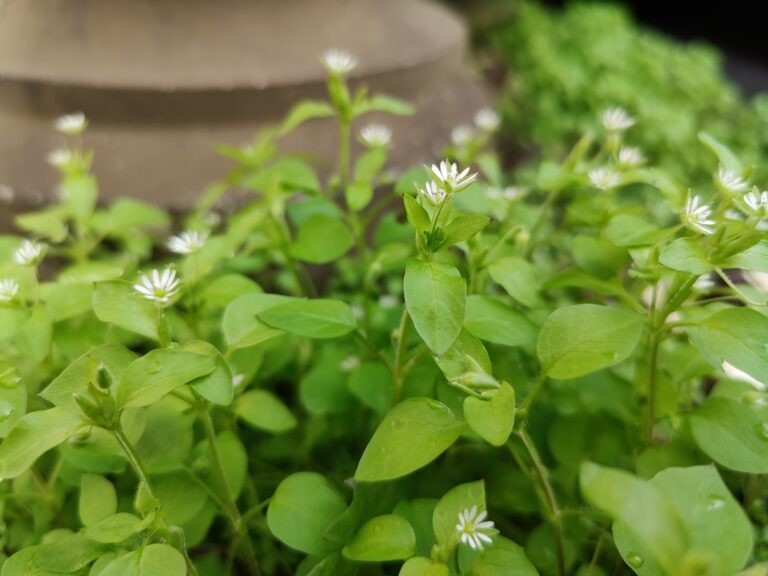
Photo: “Common chickweed (Stellaria media)” by Paul Braun via iNaturalist, CC0 1.0.
Shepherd’s purse announces itself in spring with heart-shaped pods; Cornell notes a large plant can shed 30,000 to 60,000 seeds, and buried seed can survive decades, so every spring plant allowed to flower restocks the seed bank for years. Hairy bittercress is the nursery pot and mulch-bed specialist: NC State Extension describes its upright pods firing seed several feet, which is how one overlooked plant becomes fifty (NC State Extension Plant Toolbox).
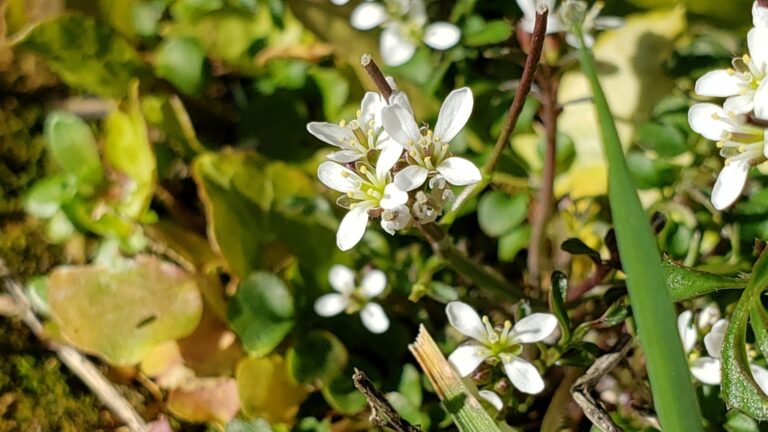
Photo: “Hairy bittercress (Cardamine hirsuta)” by Gavin Slater via iNaturalist, CC BY 4.0.
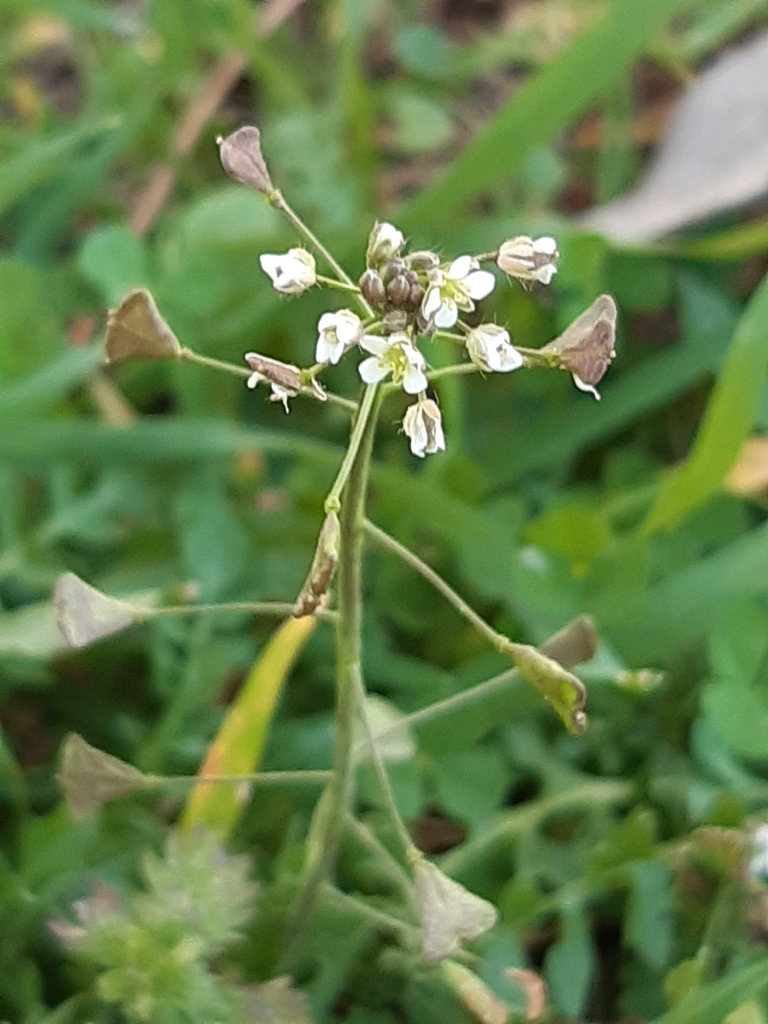
Photo: “Shepherd’s purse (Capsella bursa-pastoris)” by Javier Sánchez Álvarez via iNaturalist, CC BY 4.0.
Annual bluegrass (Poa annua) is the odd one out: a grass, not a broadleaf, so broadleaf sprays do not touch it. Look for light green tufts with boat-shaped leaf tips and whitish pyramid seedheads (Cornell Weed Ecology). It needs the pre-emergent window plus the cultural fixes in our annual bluegrass guide. Prickly lettuce prefers beds, fence lines and dry disturbed corners; the spiny midrib and milky sap give it away instantly (Cornell Weed Ecology).
Why spring spraying fails
Every extension service that addresses winter annual weeds says the same thing about spring spraying. Michigan State: apply herbicide to flowering winter annuals and they will be dead and gone in two to three weeks; do nothing and they will be dead and gone in three weeks. K-State’s horticulture specialist, via Purdue Extension, is just as blunt: spraying henbit or chickweed at the spring flowering stage usually is a waste of time and money; plants may be burned back but rarely killed, and they die on their own as soon as the weather turns hot (Purdue Extension).
Worse, spring spraying attacks the plant after it has already done its damage: flowers pollinated, seed maturing. The only useful spring jobs are mowing to shorten the display, hand pulling before pods shatter, and writing the fall dates on your calendar.
Window 1: September pre-emergent
The cleanest way to stop winter annual weeds is to never let them sprout. Purdue Extension’s plan A: apply a pre-emergence herbicide in early to mid-September. Products labeled for henbit and chickweed include prodiamine, dithiopyr, isoxaben, pendimethalin and oryzalin, and most of the same labels also cover speedwell (Purdue Extension). Our guide on when to apply pre-emergent explains soil-temperature timing in more detail.
- Watch the nights, not the calendar. Clemson Extension’s trigger for the fall application is nighttime lows of 55 to 60°F for four consecutive nights. In the transition zone that typically lands in early to mid-September; farther south it slides later, and Clemson’s own calendar for the Carolina piedmont is September 1 to 15.
- Mow first, then apply. Short turf lets granules or spray reach the soil surface where the barrier forms.
- Water it in. Clemson directs watering in the application with about half an inch of irrigation to activate the barrier in the top layer of soil.
- Do not combine with overseeding. Pre-emergents stop desirable grass seed from germinating too. If the lawn needs seed this fall, skip window 1 and use window 2 instead.
- Mark it down. One application each September, two or three years running, drains the near-surface seed bank of these weeds.
Window 2: late-fall post-emergent spray
Missed September? Purdue’s plan B is a post-emergence broadleaf herbicide in late October or early November, after most winter annual weeds have germinated and while they are still small and easy to kill. A three-way broadleaf product (2,4-D plus MCPP plus dicamba) handles henbit, chickweed, deadnettle, speedwell and the mustards. Clemson notes post-emergence broadleaf herbicides work best with daytime temperatures of 65 to 85°F (Clemson HGIC).
Two honest caveats. First, germination continues in small waves through late fall and winter, so a single late-fall spray misses some seedlings; Purdue is upfront that spring spot-spraying may still be needed for stragglers. Second, this window doubles nicely with perennial weed work: late fall is also the best time to treat dandelions and ground ivy, so many people combine both jobs in one pass. Our fall weed control guide covers the perennial side.
Winter annual weeds in garden beds
Beds and borders are where hairy bittercress, chickweed and shepherd’s purse thrive, because mulch gaps and disturbed soil are exactly what their light-hungry seeds need. LSU AgCenter recommends a two-part defense for beds: refresh mulch and apply a pre-emergence herbicide labeled for ornamental beds in late summer to fall (LSU AgCenter). NC State adds that hand weeding plus adequate mulch is the core bittercress program, since its seed arrives by the podful from neighbors and nursery pots.
When hand pulling chickweed, go slow: its stems root at the nodes, and Cornell notes rooted fragments re-establish readily in cool, moist soil. Pull after rain, trace the runners, and mulch the cleared spot the same day so light-loving seeds in the top inch stay dormant.
Mowing and dense turf: the free control
Winter annual weeds are shade-avoiders and light-lovers. Henbit is shade-intolerant (Cornell), chickweed and shepherd’s purse seedlings are tiny and fragile, and Purdue’s closing advice is that henbit is not competitive in dense, healthy lawns. The same fall fertilizer and mowing-height habits that build turf density, mowing cool-season grass at 3 to 3.5 inches and feeding in fall, quietly suppress next spring’s winter annuals. For existing spring patches, keep the lawn mowed until heat finishes them, as K-State recommends; mowing also removes bittercress flowers before the pods can fling seed (NC State).
What not to do
- Do not spray flowering winter annuals in April expecting value. They die anyway within about three weeks (MSU), and the seed is already set.
- Do not apply fall pre-emergent and overseed the same week. The barrier stops grass seed too; pick one job per fall.
- Do not skip the water-in. A dry granular barrier sitting on thatch protects nothing; give it about half an inch (Clemson).
- Do not use broadleaf lawn spray on annual bluegrass and expect results. It is a grass; only the pre-emergent window and cultural density work.
- Do not till beds in fall “to tidy up”. Tilling exposes buried seed to light and triggers exactly the flush of germination you want to avoid.
- Do not let one shepherd’s purse or bittercress plant shatter its pods. Tens of thousands of seeds per plant is not a metaphor; pull before pods mature.
- Do not assume winter kills them. Henbit, chickweed and shepherd’s purse tolerate hard frosts and overwinter green.
Where this applies
The life cycle is the same everywhere, but the calendar slides. In the South, winter annual emergence concentrates in fall, while on the northern prairies a larger share waits for spring (Cornell). Clemson’s night-temperature trigger (55 to 60°F lows for four nights) travels well: use it locally instead of copying a date. Warm-season lawns going dormant in winter can carry winter annuals openly; check that any pre-emergent or post-emergent product is labeled for your turf species, and time post-emergent sprays for the 65 to 85°F days. In mild-winter coastal climates the weeds grow actively all winter, so the late-fall post-emergent window is wider and more forgiving.
FAQ
When do winter annual weeds germinate?
Mostly September through November, triggered by cooling soil. Cornell’s work pins Lamium germination to day and night temperatures of about 68/50°F, and Clemson translates that into nighttime lows of 55 to 60°F for four consecutive nights. Small waves continue into winter, which is why one late-fall spray rarely gets everything (Purdue).
Do winter annual weeds die in winter?
No, that is the point of the strategy. They overwinter as frost-hardy rosettes: Cornell reports henbit tolerating about 18°F, common chickweed 7°F and shepherd’s purse 10°F. More on who survives the cold in do weeds die in winter.
Is it worth spraying winter annual weeds in spring?
Generally no. Flowering plants are two to three weeks from natural death (MSU), and K-State calls spring spraying of henbit and chickweed a waste of time and money. Mow, hand pull before seed shatters, and plan the September pre-emergent.
Will a fall pre-emergent also stop my grass seed?
Yes. Pre-emergence herbicides form a germination barrier that does not distinguish weed seed from lawn seed. If you overseed this fall, skip window 1 and use the late-fall post-emergent window instead.
What kills henbit and chickweed in fall?
Two options: a September pre-emergent containing prodiamine, dithiopyr, isoxaben, pendimethalin or oryzalin, or a late-October to early-November spray of a three-way broadleaf herbicide (2,4-D, MCPP, dicamba) while seedlings are small (Purdue; Clemson).
Are winter annual weeds edible?
Several are: Cornell notes chickweed as a mild salad herb and shepherd’s purse as a traditional pot herb, and NC State describes hairy bittercress as peppery cress. Only eat plants you have identified with certainty, from ground that has never been sprayed.
Can I just pull winter annual weeds by hand?
Yes, and for light infestations it is the best tool. Winter annual weeds are shallow-rooted and pull easily from moist fall or spring soil. The traps are chickweed’s node-rooting runners (trace and remove the whole mat) and any plant already carrying pods, since shepherd’s purse and bittercress seeds can ripen even on uprooted plants. Bag seed-bearing plants rather than composting them.
More on this season: fall weed control for perennial weeds, henbit, annual bluegrass, and the full weed prevention section.
Sources
- Michigan State University Extension. When to Control Winter Annuals and Perennial Broadleaf Weeds in Turf.
- Purdue Extension, DeKalb County (with K-State Horticulture). Henbit and Chickweed in Lawns.
- K-State Research and Extension. Weed Control in Home Lawns (MF2385).
- Clemson University Home and Garden Information Center. Managing Weeds in Fescue Lawns.
- Cornell University Weed Ecology and Management. Deadnettles (Henbit and Purple Deadnettle) Profile.
- Cornell University Weed Ecology and Management. Common Chickweed Profile.
- Cornell University Weed Ecology and Management. Shepherd’s-Purse Profile.
- Cornell University Weed Ecology and Management. Annual Bluegrass Profile.
- Cornell University Weed Ecology and Management. Prickly Lettuce Profile.
- NC State Extension Gardener Plant Toolbox. Hairy Bittercress (Cardamine hirsuta).
- LSU AgCenter. Controlling Winter Weeds in Beds and Borders.
Featured image: Persian speedwell (Veronica persica) flower, photo by Nash Turley via iNaturalist, CC BY 4.0.