
You pull one strand of something green out of the lawn and it just keeps coming: a foot of stem, then two, with little roots hanging off every joint. Or you notice a patch that’s a slightly different color than the rest of the grass, and every season it’s a little wider. That’s the signature of a weed that travels sideways instead of relying on seed.
Short answer: Most lawn weeds with runners fall into two groups: broadleaf creepers such as creeping Charlie (ground ivy), white clover, creeping speedwell and dollarweed, and grassy creepers such as bermudagrass, nimblewill, creeping bentgrass and quackgrass. Runners above the ground (stolons) root at every node, while runners below it (rhizomes) regrow from fragments, so you have to kill the whole network, not just the leaves you see. That usually means a systemic herbicide matched to the weed and timed to its weak season, repeat treatments, and thickening the turf so nothing re-colonizes the gap.
By the end of this guide you’ll be able to name the lawn weed with runners in your yard from a few quick checks, pick the right active ingredient (or the right non-chemical route), and put each treatment on the calendar when it actually works.
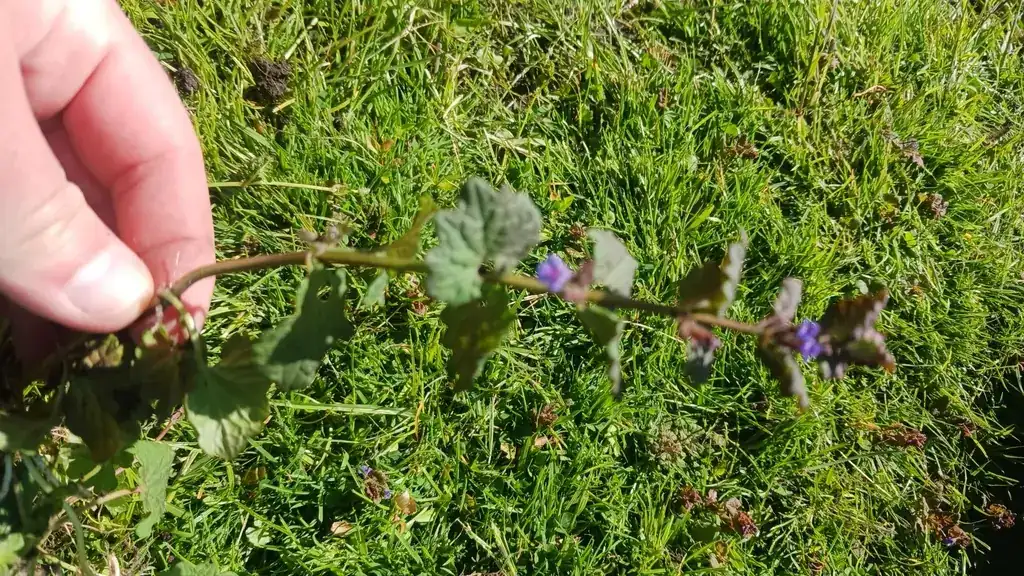
What Counts as a Runner? Stolons vs Rhizomes
“Runner” is the everyday word, but botanists split it in two, and the difference changes how you fight the weed. It’s worth thirty seconds before you buy anything.
- Stolons creep across the soil surface. Each node (the little joint on the stem) can put down roots and send up a new plant. Creeping Charlie, white clover, creeping speedwell and nimblewill all spread this way.
- Rhizomes run underground. You see a scattering of shoots that seem unconnected, but they’re all wired together below the soil. Quackgrass, wild violets and dollarweed spread this way, and bermudagrass does both.
Why it matters: a stolon you miss when hand-pulling simply roots again. A rhizome fragment is worse, because you can’t see it. The University of Minnesota notes that quackgrass rhizomes can reach up to 11 feet long and that new plants grow from pieces of rhizome, which is why digging or tilling often makes things worse (UMN Extension).
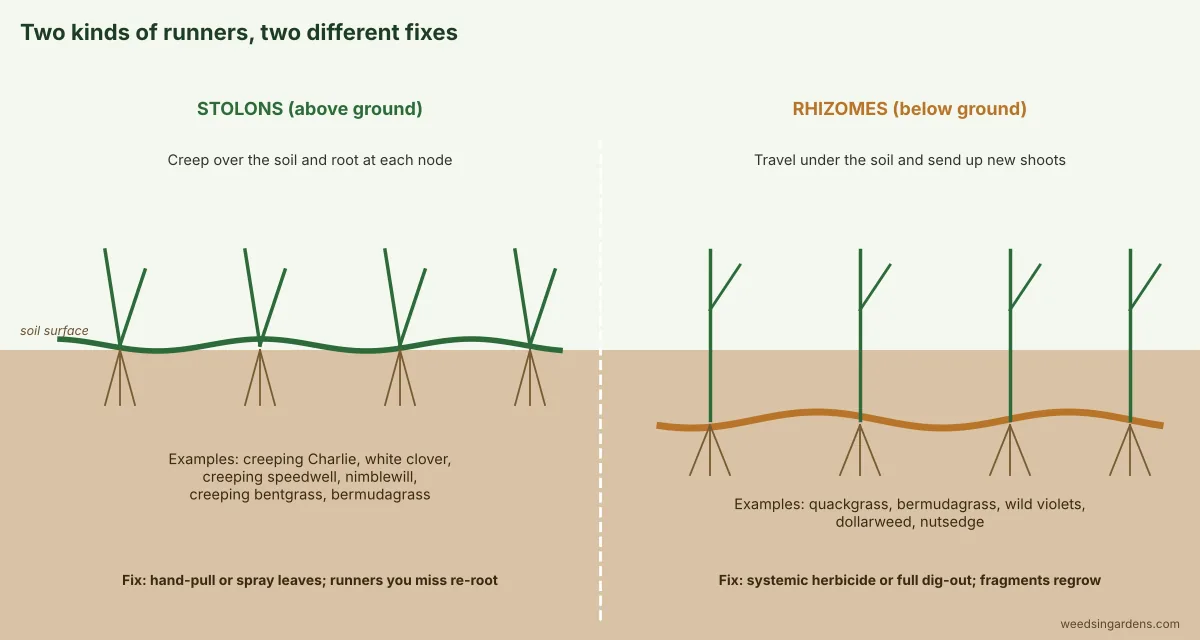
So the first rule is simple. For stolon weeds, thorough removal or a leaf-applied herbicide can win. For rhizome weeds, you need either a systemic product that moves down into the underground stems or a complete dig-out followed by vigilance.
Lawn Weeds with Runners: Quick Identification Table
Start here. Get down at eye level, pull up one stem, and check the leaf shape, the stem, and whether it roots on top of the soil or comes up from below. This table pulls the key features together so you can narrow it down in a minute or two.
| Weed | Type | How it spreads | Fastest ID clues | Best-fit control |
|---|---|---|---|---|
| Ground ivy (creeping Charlie), Glechoma hederacea | Broadleaf perennial | Stolons rooting at nodes | Square stems, round scalloped leaves, minty smell when crushed, small purple funnel flowers in spring | Triclopyr or fluroxypyr in fall |
| White clover, Trifolium repens | Broadleaf perennial | Stolons | Three leaflets, often with a pale chevron; white ball-shaped flowers | Broadleaf herbicide or simply accept it |
| Creeping (slender) speedwell, Veronica filiformis | Broadleaf perennial | Thin creeping stems; fragments root | Small round toothed leaves, thin reddish stems, pale lilac-blue flowers on long stalks | Lawn vigor, digging; tolerant of many herbicides |
| Dollarweed (pennywort), Hydrocotyle spp. | Broadleaf perennial | White rhizomes | Round, glossy, lily-pad-like leaf on a central stalk, up to silver-dollar size; wet spots | Fix watering, then pull or spot-treat |
| Wild violets, Viola spp. | Broadleaf perennial | Thick rhizomes | Heart-shaped leaves, purple, white or blue spring flowers, waxy leaf surface | Triclopyr-based products, repeated |
| Bermudagrass, Cynodon dactylon | Warm-season grass | Stolons and rhizomes | Leaves 1/8 to 1/4 inch wide, fringe-of-hairs ligule, 3 to 5 finger-like seedhead spikes | Fenoxaprop or fluazifop (± triclopyr), or glyphosate spot-kill |
| Nimblewill, Muhlenbergia schreberi | Warm-season grass | Stolons | Thin, wiry, gray-green patches, often circular; greens up late and browns early | Mesotrione, 3 applications |
| Creeping bentgrass, Agrostis stolonifera | Cool-season grass | Stolons | Fine, light green, fluffy or matted patches that lie over when mowed | Mesotrione, repeated in summer |
| Quackgrass, Elymus repens | Cool-season grass | Rhizomes (up to 11 ft) | Clasping, claw-like auricles at the leaf base; grows taller and faster than the lawn | Glyphosate spot treatment, then reseed |
Two more creepers deserve a mention, and you can browse the rest in our lawn weeds library. Creeping woodsorrel spreads on trailing stems and is covered in our guide to getting rid of oxalis, and nutsedge spreads through rhizomes and underground tubers, which we cover in yellow and purple nutsedge.
Broadleaf Lawn Weeds with Runners
Broadleaf creepers are the easier half of the problem, because selective herbicides can remove them from grass. The catch is that they don’t all respond to the same product.
Ground ivy (creeping Charlie)
This is the one most people mean when they search for lawn weeds with runners. Its stolons creep beneath the turf canopy and root extensively along their length, which is exactly why it’s so stubborn (Reicher and Weisenberger, 2007). Look for square stems, rounded leaves with scalloped edges, and a minty smell when you crush a leaf.
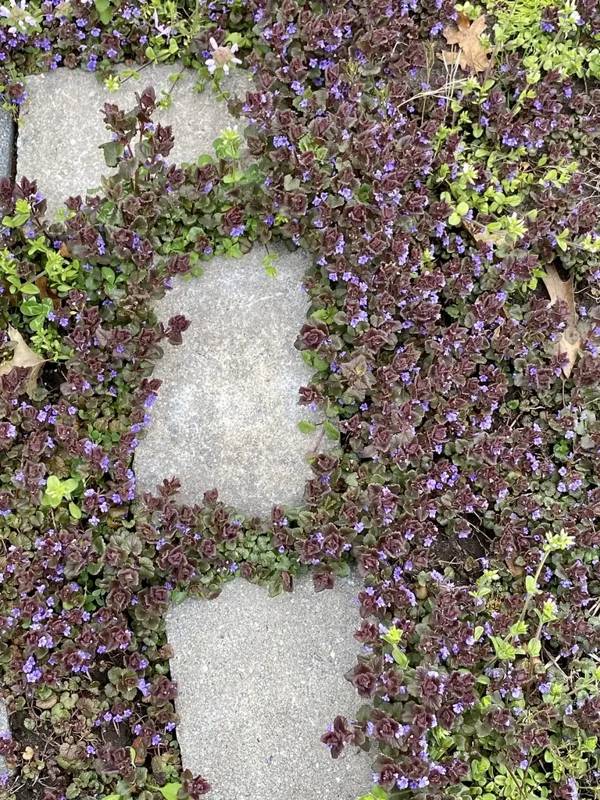
Here’s the part most guides skip: the common three-way mix (2,4-D + MCPP + dicamba) is the weakest choice. In a three-year Purdue field study, triclopyr was the most effective and consistent herbicide on ground ivy: 27 of 36 applications cut its cover to 1% or less, compared with more than 50% in untreated plots. Fluroxypyr was the runner-up, and 2,4-D + MCPP + dicamba gave the poorest control (Reicher and Weisenberger, 2007). For a full walk-through, see our creeping Charlie guide.
White clover
Clover spreads by stolons and is often a sign of low nitrogen. Many homeowners now keep some on purpose for pollinators. If you want it gone, our clover in lawn guide covers the herbicide and fertility options side by side.
Creeping (slender) speedwell
Slender speedwell has thin, reddish creeping stems up to about 20 inches long, small rounded toothed leaves, and pale lilac-blue flowers from April to July (RHS). It rarely produces seed. Instead, mowing scatters pieces of stem that root in new areas, and birds carry stems off when they gather nesting material. Washington State University notes speedwells are tolerant of many herbicides, which makes them hard to control chemically (WSU Hortsense).
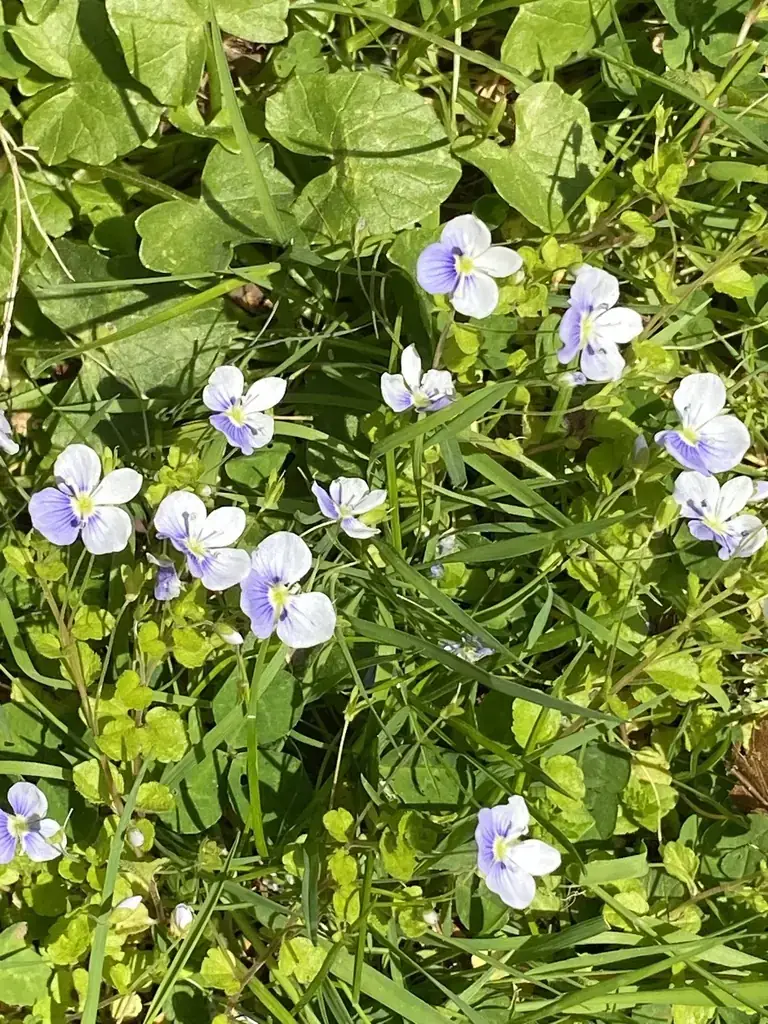
The upside, per the RHS, is that speedwell competes poorly with vigorous grass. Feed in autumn, raise the mowing height a notch, and dig out isolated patches and reseed. Honestly, for a few small patches that’s all it takes.
Dollarweed (pennywort)
Dollarweed is a lawn weed with white rhizomes and round leaves that look like tiny lily pads. UF/IFAS says it usually appears where a lawn is overwatered or naturally wet, so the first fix is to adjust irrigation or improve drainage. Hand-pulling works only if you get the white rhizomes too (UF/IFAS Gardening Solutions). If your sprinklers run on a fixed schedule, read our guide to an overwatered lawn before you reach for a sprayer.
Wild violets
Violets spread through thick rhizomes and have a waxy leaf surface that sheds spray. They need patience and usually more than one treatment. We cover the details in wild violets in lawn.
Grassy Weeds That Spread by Runners
Grass weeds with runners are the hard case. A broadleaf herbicide won’t touch these, and most grass killers can’t tell the weed from your lawn. Correct ID is everything here, so if you’re unsure, compare against our guide to weeds that look like grass.
Bermudagrass in a cool-season or zoysia lawn
Bermudagrass is the most aggressive of the grass weeds with runners because it uses both stolons and rhizomes. UGA describes its leaves as short, 0.125 to 0.25 inches wide, rough-edged and sharply pointed, with a ligule made of a fringe of hairs and a seedhead of three to five slender spikes (UGA Extension B1393). Our bermuda grass identification guide has close-up comparisons.
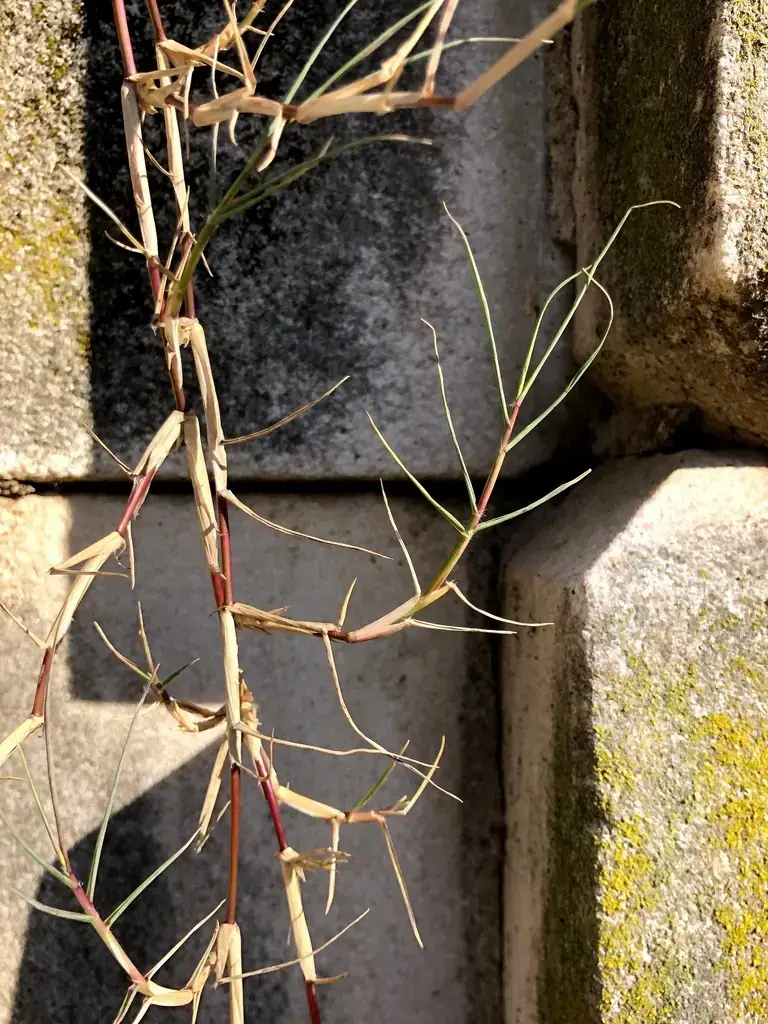
In a bermudagrass lawn, of course, those runners are the point. This section is for bermuda creeping into tall fescue, Kentucky bluegrass or zoysia.
Nimblewill
Nimblewill is a warm-season perennial that spreads by stolons and often forms circular gray-green patches. It greens up late in spring (typically May in Iowa) and browns early in fall, so it shows up as tan spots in a cool-season lawn (Iowa State Extension). It’s most common in thin turf and shade, where Kentucky bluegrass struggles.
Creeping bentgrass
Creeping bentgrass is a stoloniferous golf-green grass that is a common weed in home lawns (Dernoeden et al., 2008). It forms fine-textured, lighter green patches that lie over and look puffy or matted next to the coarser grass around them.
Quackgrass
Quackgrass spreads mainly by rhizomes with sharp points. The quickest ID check is the clasping auricle, a claw-like appendage that wraps around the stem at the base of the leaf. It also grows faster than most turfgrass, so it stands taller a few days after mowing (UMN Extension).
Herbicide Options by Active Ingredient
For lawn weeds with runners, pick the product by the active ingredient on the label, not the brand name or the picture on the bag. Then check the label for two things: that your turfgrass species is listed as tolerant, and the rate. Always follow the label; it’s the legal document, and the safety limits below are only a summary.
| Active ingredient | Runner weeds it targets | Turf safety notes | What the research shows |
|---|---|---|---|
| Triclopyr | Ground ivy, violets; suppresses creeping bentgrass and bermudagrass | Safe on tall fescue in the Maryland/Connecticut trials; repeated high-rate use thinned Kentucky bluegrass; injures bermudagrass at high rates | Most consistent ground ivy control (27 of 36 applications cut cover to 1% or less) |
| Fluroxypyr | Ground ivy | Cool-season turf per label | Cover of 10% or less by June in 15 of 18 applications; Sept 1 to Nov 1 timings worked best |
| Mesotrione | Nimblewill, creeping bentgrass | Iowa State lists bluegrass, perennial ryegrass, tall fescue and fine fescues as tolerant; temporary white tips are normal; one study saw 7 to 14 days of tall fescue injury after each application | 3 to 4 applications gave excellent bentgrass control; 3 applications 2 to 3 weeks apart usually needed for nimblewill |
| Fenoxaprop | Bermudagrass | Tall fescue, zoysiagrass and residential Kentucky bluegrass per UGA; finer zoysias more easily injured | Repeat every 20 to 30 days in summer; adding triclopyr reduces turf injury |
| Fluazifop | Bermudagrass | Commercial and nonresidential turf only | Needs a nonionic surfactant at 0.25% v/v when used alone |
| Glyphosate (nonselective) | Bermudagrass, quackgrass, nimblewill, dollarweed patches | Kills all grass it touches; spot-treat only | Fall applications control bermudagrass better than summer ones; 2 to 3 applications usually needed for nimblewill |
| 2,4-D + MCPP + dicamba | Clover and many broadleaves | Widely labeled on turf; volatile in heat | Poorest ground ivy control in the Purdue trial |
Rules that make any herbicide work better
- Spray actively growing weeds. Drought-stressed weeds build a thicker wax layer that blocks absorption (SDSU Extension).
- Skip liquid sprays if winds are over 5 mph or temperatures are forecast above 85°F within 24 hours (Iowa State Extension). Synthetic auxins such as 2,4-D and dicamba vaporize more readily above 85°F.
- Don’t mow for 2 to 3 days before treating or 3 to 4 days after, so there’s leaf to absorb the product and time to move it to the roots.
- Pick a 24-hour window with no rain and no irrigation. Apply granular broadleaf products to wet foliage, such as morning dew.
- Spot-treat when the weed is in patches. It uses less product and protects the rest of the lawn.
- After glyphosate, wait 7 days before aerating or vertical mowing (UGA).
For a broader primer on selective sprays, see our post-emergent herbicide guide.
Non-Chemical Ways to Stop Creeping Weeds
Herbicides buy you a clean slate against lawn weeds with runners. What keeps it clean is turf that leaves no room. Iowa State and UMN both put it plainly: a dense, healthy lawn is the best long-term defense against runner weeds such as nimblewill and quackgrass.
| Method | Works best on | Time and cost | Watch out for |
|---|---|---|---|
| Hand-pulling with a weeding fork | Young ground ivy, speedwell, dollarweed | Free; slow on big areas | Every stolon or rhizome left behind can regrow |
| Dig out and reseed or patch | Nimblewill, speedwell, small bentgrass patches | Low cost; a weekend for a few patches | Iowa State warns you must remove all stolons |
| Fix irrigation and drainage | Dollarweed, wet-site creepers | Low; mostly a timer change | Treating without fixing the water just invites it back |
| Raise mowing height and feed in fall | Speedwell, clover, ground ivy in thin turf | Low; part of routine care | Slow; works over a season or two |
| Avoid tilling infested soil | Quackgrass and other rhizome weeds | Free | Tilling chops rhizomes into new plants |
| Smother and renovate (kill, then reseed) | Lawns where creepers have taken over | Moderate; a season of bare patches | Plan it so seeding lands in late summer or early fall |
One easy-to-miss source of new runners is what you bring in. UMN advises checking seed mixes and sod and composting properly so quackgrass seed and rhizomes don’t enter the lawn.
When to Treat: A Season-by-Season Plan
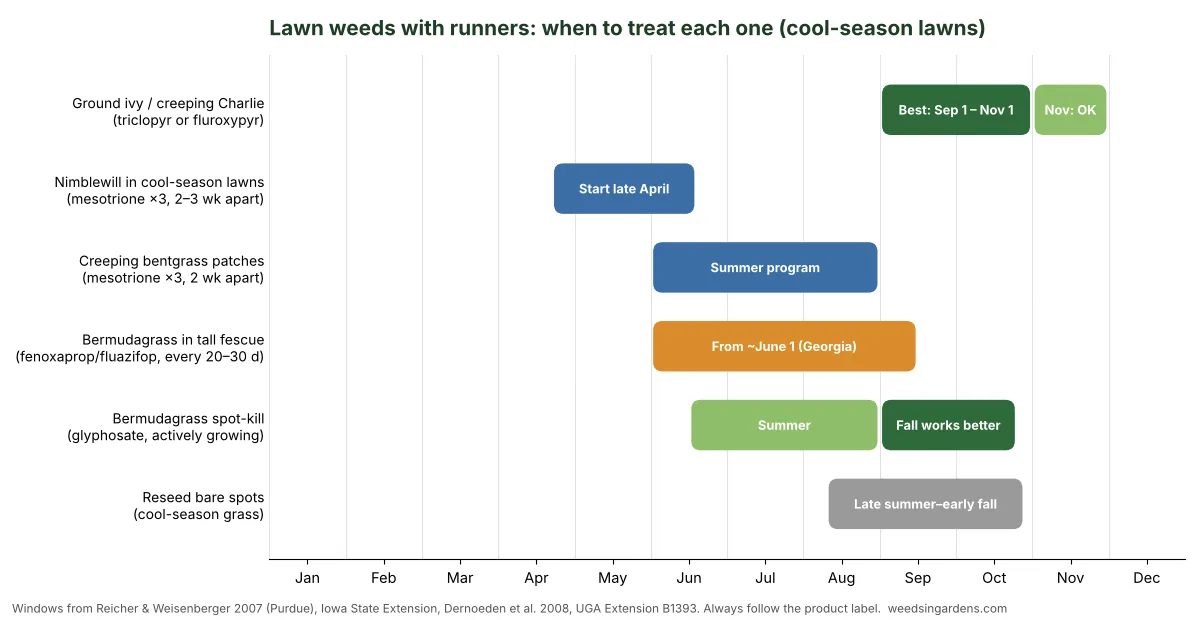
Timing is where most failed treatments of lawn weeds with runners go wrong. Each one has a window when it’s actively growing and moving sugars down into its stolons or rhizomes. Spray then, and the herbicide travels with them.
| Season | Cool-season lawns (fescue, bluegrass, ryegrass) | Warm-season lawns (bermuda, zoysia, St. Augustine) |
|---|---|---|
| Early spring | Mark nimblewill patches as they stay brown while the lawn greens. ID quackgrass by its auricles. | Note dollarweed in wet spots; adjust irrigation before the season ramps up. |
| Late spring | Start mesotrione on nimblewill in late April (3 applications, 2 to 3 weeks apart). | Pull or spot-treat dollarweed while it’s young; follow the label for your grass type. |
| Summer | Mesotrione program for creeping bentgrass; fenoxaprop on bermudagrass in tall fescue from about June 1 (Georgia timing), repeating every 20 to 30 days. Avoid broadleaf sprays above 85°F. | Keep turf dense; spot-treat invaders with products labeled for your species. |
| Early fall | Best window for ground ivy (Sept 1 to Nov 1) with triclopyr or fluroxypyr. Glyphosate spot-kill of bermuda or quackgrass, then reseed. | Spot-kill bermuda in zoysia only with labeled selective products. |
| Late fall | November ground ivy sprays still give good results by the following June. | Lawns go dormant; plan next year’s program. |
| Winter | Plan, sharpen the mower, order seed. | Plan. |
That late-fall line is worth stressing, because it’s good news if you’re reading this in October or November. The Purdue team found that applications after November 1 looked less impressive in December, but by the following June they gave control similar to earlier dates (Reicher and Weisenberger, 2007). Don’t judge a fall spray until spring.
A Note from the Agronomist’s Side
Lawn weeds with runners are really storage problems. A creeping Charlie mat or a bermudagrass patch is one plant with a long supply line, and its stolons and rhizomes are its pantry. When you mow or pull the tops, the plant draws on that pantry to regrow. This is why contact-style treatments and single sprays disappoint, and why every successful program in the research uses repeat applications.
Timing follows the same logic. UGA notes that perennial grasses move more sugars from leaves to underground stems in fall than in spring, and that’s why fall glyphosate controls bermudagrass better than summer applications. The herbicide hitches a ride to the rhizomes. The Purdue ground ivy data point the same way: fall is when broadleaf perennials are stocking up for winter, and that’s when a systemic product reaches the roots.
A practical rule: work from the edges inward. A runner patch grows at its margins, so spray or dig 6 inches or so past the visible edge, where the newest runners are threading under the grass. Then judge the result on regrowth, not on how fast the leaves brown. Iowa State’s advice to confirm regrowth before a second nimblewill application is good practice for every weed in this article.
Finally, be honest about the scale. A few patches call for spot treatment and overseeding. When creepers make up most of a stand, especially grassy ones that no selective product removes cleanly, a planned renovation (kill, wait, reseed in late summer or early fall) is usually cheaper than years of partial fixes. And sometimes the right call is to live with it: clover and even nimblewill have defenders, and as Iowa State puts it, a plant is only a weed when it’s out of place.
FAQ
What is the lawn weed with long runners?
The most common lawn weed with long runners is ground ivy (creeping Charlie), whose square-stemmed stolons root at every node. In grassy weeds, bermudagrass and quackgrass have the longest runners, and UMN notes quackgrass rhizomes can reach 11 feet.
What kills weeds with runners but not grass?
For broadleaf creepers, triclopyr is the most reliable selective choice, and in Purdue research it outperformed 2,4-D + MCPP + dicamba on ground ivy. For grassy creepers, mesotrione (nimblewill, creeping bentgrass) and fenoxaprop (bermudagrass in tall fescue) are selective in tolerant lawns. Always check that the label lists your turfgrass.
Is it better to pull weeds with runners or spray them?
Pulling works for small patches if you remove every stolon or rhizome, because pieces left behind can regrow. For large patches or rhizome weeds, a systemic herbicide applied at the right time is usually more effective. Pair either one with overseeding so the gap fills with grass.
When is the best time to kill creeping Charlie?
Fall. Purdue trials found applications from September 1 to November 1 looked best by December, and even November sprays gave similar control by the following June. Triclopyr was the most consistent product.
What grass weed has runners and turns brown before the rest of the lawn?
That pattern points to nimblewill or bermudagrass, both warm-season grasses that green up late in spring and brown early in fall in a cool-season lawn. Nimblewill is thin and gray-green; bermudagrass has a fringe-of-hairs ligule and finger-like seedheads.
Why do weeds with runners keep coming back?
Because the part you can see is only the top of a connected network. Stolons re-root and rhizome fragments sprout, so a single spray or partial pull leaves a reserve that regrows. Repeat treatments, fall timing and a thicker lawn are what break the cycle.
Sources
- Reicher, Z. J. and Weisenberger, D. V. (2007). Herbicide selection and application timing in the fall affects control of ground ivy. Applied Turfgrass Science 4(1): 1–9. doi:10.1094/ATS-2007-0831-01-RS
- Dernoeden, P. H., Kaminski, J. E. and Fu, J. (2008). Selective creeping bentgrass control in Kentucky bluegrass and tall fescue with mesotrione and triclopyr ester. HortScience 43(2): 509–513. doi:10.21273/HORTSCI.43.2.509
- Jauron, R. How to Control Nimblewill in Lawns. Iowa State University Extension and Outreach, reviewed August 2026. yardandgarden.extension.iastate.edu
- Iowa State University Extension and Outreach. What is the proper way to apply broadleaf herbicides to the lawn? Updated 2022. yardandgarden.extension.iastate.edu
- McCullough, P. E. Bermudagrass Control in Southern Lawns, Bulletin 1393. University of Georgia Cooperative Extension, reviewed June 2024. fieldreport.caes.uga.edu
- University of Minnesota Extension. Quackgrass. extension.umn.edu
- Royal Horticultural Society. Speedwell. rhs.org.uk
- Washington State University Hortsense. Weeds: Speedwells (Veronica spp.). hortsense.cahnrs.wsu.edu
- UF/IFAS Gardening Solutions. Dollarweed. gardeningsolutions.ifas.ufl.edu
- Shaffer, G. Use Caution With Turf Herbicide Applications During Extreme Heat and Drought. South Dakota State University Extension. extension.sdstate.edu