
Wild violets in lawn areas are a native perennial (mostly common blue violet, Viola sororia) that spreads from thick underground rhizomes and from seed pods you rarely notice. The most reliable fix is a selective herbicide containing triclopyr (or fluroxypyr on sensitive southern grasses), sprayed in mid-September to mid-October and repeated at least four weeks later. Expect to need two seasons, and thicken the turf at the same time so violets have less room to come back.
That is the short answer. The longer one matters, because wild violets in lawn settings beat more homeowners than almost any other lawn weed. A waxy leaf shrugs off spray, hidden flowers keep making seed all summer, and the most common label rates sit below the dose that gave good control in research. This guide covers how to confirm you are dealing with violets, why they survive, exactly when and what to spray for your grass type, and what to do if you would rather keep a few.
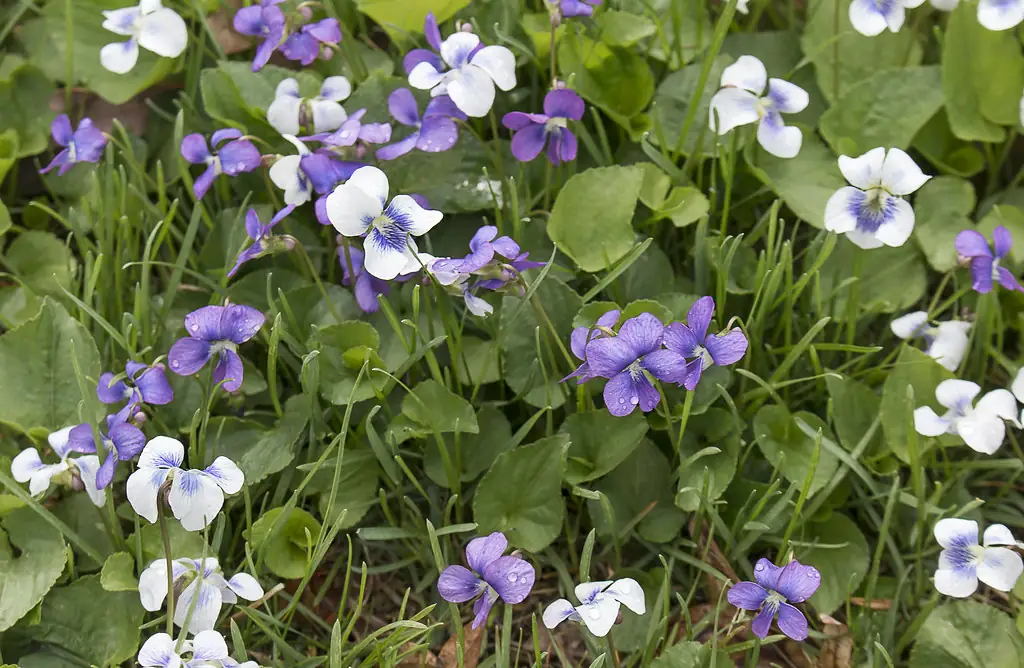
How to Identify Wild Violets in Your Lawn
Before buying anything, make sure the plant really is a violet. Most wild violets in lawn areas of the eastern and central US are common blue violet, but the flower colour varies. Several lawn weeds have rounded or heart-shaped leaves, and the right herbicide differs between them. Extension guides from Penn State and the University of Minnesota agree on these key features:
- Leaves: heart-shaped, pointed at the tip, with rounded teeth on the edge. They are glossy and smooth on top, up to about 3.5 inches long, and often cup inward to form a funnel near the base.
- Growth habit: a low clump or rosette, roughly 3–10 inches tall, with every leaf rising on its own stalk from the ground. There is no creeping, rooting stem above ground.
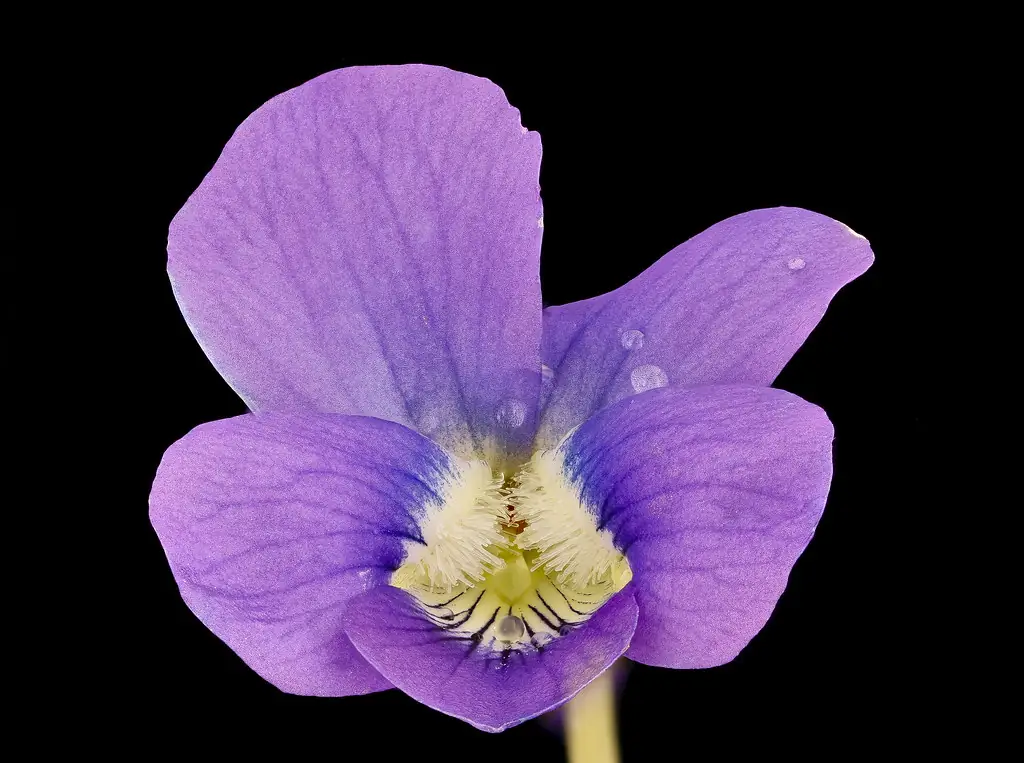
- Flowers: five petals, about 0.5–0.75 inch across, in purple, blue-violet, white or white with a violet centre (the ‘Confederate violet’ form). The two side petals carry white hairs, often called a beard.
- Below ground: short, thick, branching rhizomes, about the size of your little finger according to Purdue. These store food and send up new plants.
- Season: showy flowers in April and May, then small green flowers near the soil that never open but still set seed through summer.
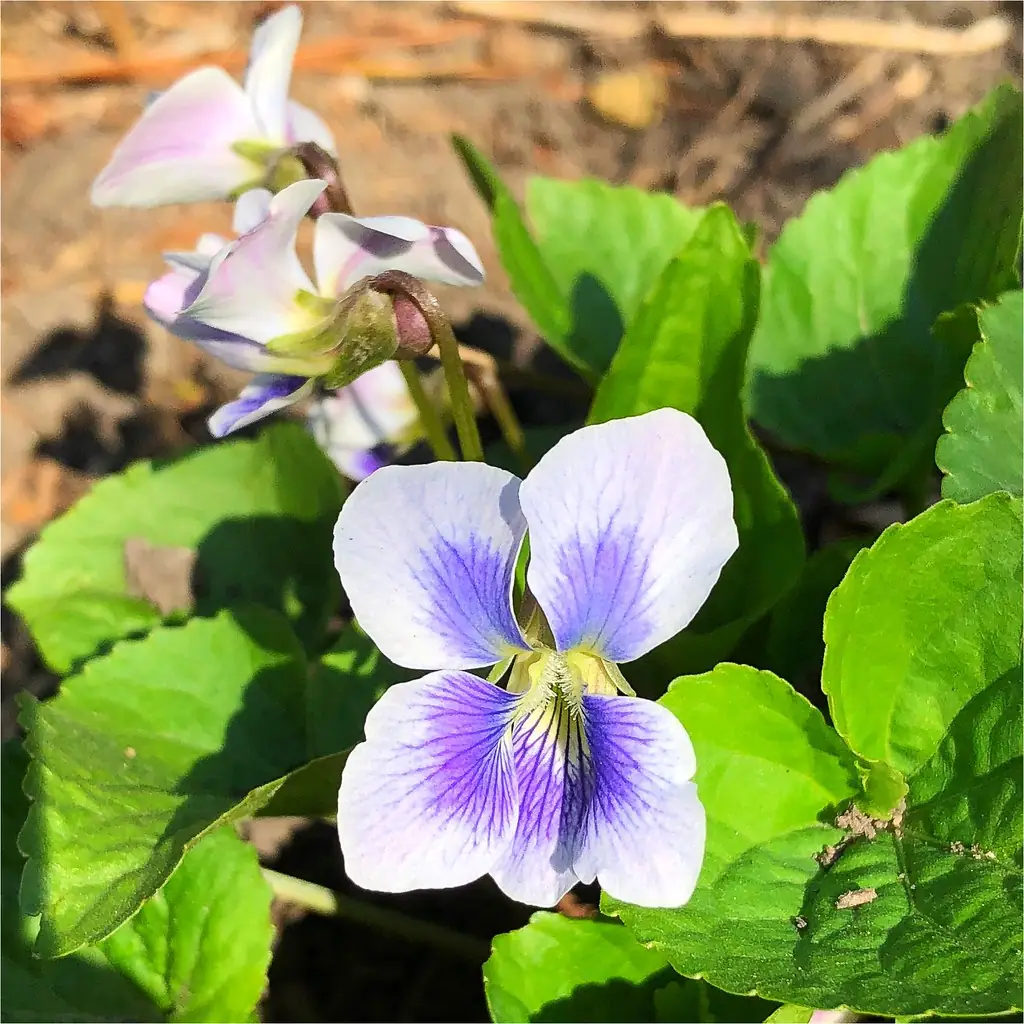
Wild violet look-alikes
The most common mix-up is with creeping Charlie (ground ivy), which often grows in the same shady corners. The table below shows the fastest ways to separate them. If your violets have white flowers and you want a broader comparison, see our guide to weeds with purple flowers.
| Plant | Leaf | Stem and spread | Flower | Quick test |
|---|---|---|---|---|
| Wild violet (Viola sororia) | Heart-shaped, rounded teeth, glossy | Clump; each leaf on its own stalk from thick rhizomes | 5 petals, bearded side petals; spring | No square stem, no mint smell |
| Creeping Charlie (Glechoma hederacea) | Round to kidney-shaped, scalloped | Square stems creep and root at the nodes | Small, funnel-shaped, purple; spring | Crushed leaves smell minty |
| Lesser celandine (Ficaria verna) | Heart-shaped, very glossy | Low clump; disappears after spring | Glossy, bright yellow, star-like | Yellow flowers; toxic, do not eat |
| Garlic mustard (Alliaria petiolata), first-year rosette | Kidney to heart-shaped, coarse teeth | Rosette from a white taproot | White, 4 petals, in its second year | Crushed leaves smell of garlic |
Why Wild Violets Are So Hard to Kill
Purdue turf scientists describe wild violet as a “persistent, perennial, and difficult-to-control” broadleaf weed, and Penn State Extension says repeat applications over more than one season may be needed. Four traits explain why wild violets in lawn turf survive treatments that kill most other broadleaf weeds.
1. A waxy leaf that sheds spray
The leaf surface has a thick, waxy cuticle. Herbicide droplets bead up and less of the active ingredient gets inside the plant, so a product that wipes out dandelions can leave violets looking only slightly twisted.
2. Rhizomes that act as a food bank
The rhizomes store food and carry the plant through winter. If the herbicide burns the leaves but doesn’t move down into the rhizomes, new leaves appear within weeks. This is why digging out the top alone rarely works either.
3. Hidden flowers that keep making seed
After the spring bloom, wild violets produce small flowers close to the soil that never open (cleistogamous flowers). They self-pollinate and form seed pods all summer, according to NC State Extension. As the pods dry, they split and throw seed, and ants carry seeds further because each one has a protein-rich coating. Mowing never touches these flowers.
4. The label-rate gap
This is the part most guides miss. In a 2020 study in Weed Technology, Patton, Weisenberger and Liu at Purdue found that only triclopyr-containing treatments produced strong leaf twisting (80–99% epinasty at 21 days), compared with no more than 28% for other herbicides. Triclopyr at 0.81 kg a.i./ha or more gave 75% or greater control. But the authors note that most commercial triclopyr products deliver no more than 0.56 kg/ha at their highest label rate.
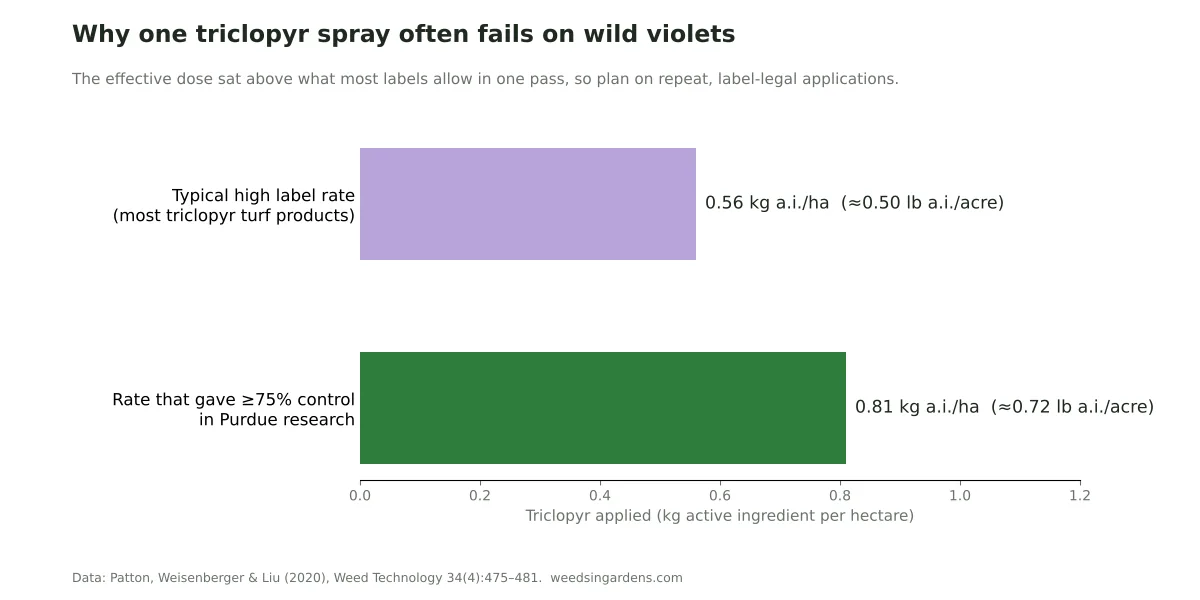
In plain terms, for wild violets in lawn turf, one legal spray of most products is below the dose that worked best in the research. You cannot fix that by mixing a stronger batch, because the label is the law and over-application risks injuring your grass. You fix it with timing and with a planned second application.
When to Treat Wild Violets in Lawn: Fall Is the Window
For perennial broadleaf weeds like violets, autumn is the best time to spray. University of Tennessee Extension says so directly and adds that you should avoid applications in summer heat and drought. Purdue’s recommendation is more specific: treat from mid-September to mid-October. Spring sprays cause visible damage, but long-term control does not compare with fall applications, according to Purdue Turfgrass Science.
The reason fall works so well on wild violets in lawn grass is plant physiology. In fall, violets move sugars from the leaves down into the rhizomes to store for winter. A systemic herbicide applied then rides along with that flow to the parts that actually regrow. In spring the flow runs the other way, up into new leaves and flowers.
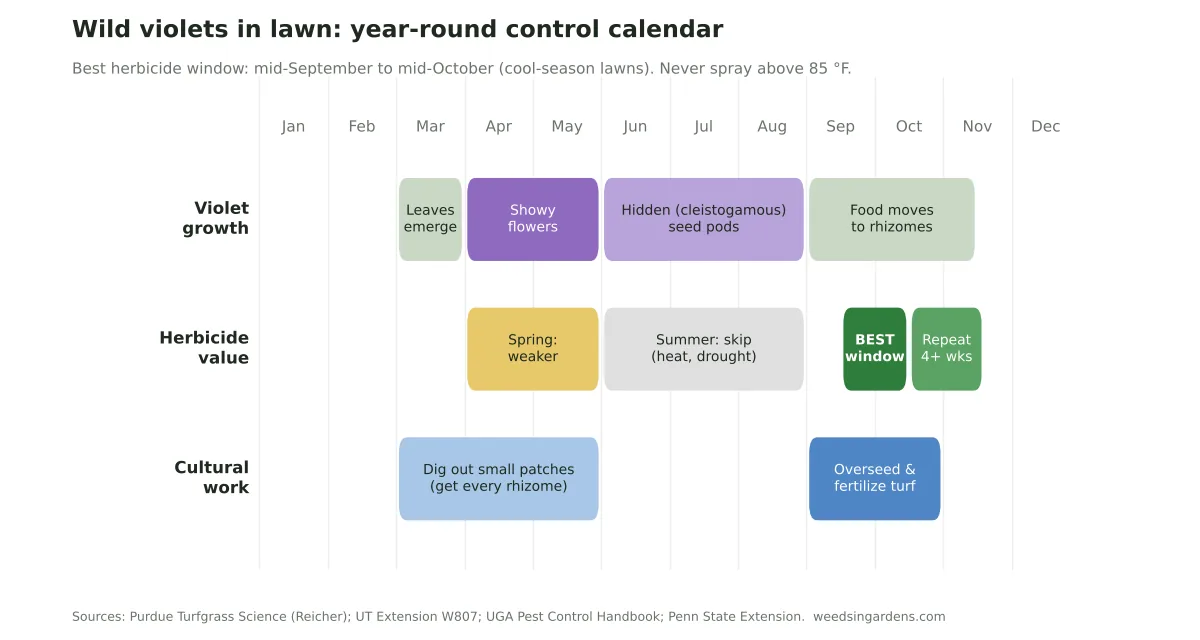
| Season | What the violet is doing | What you should do |
|---|---|---|
| Early spring (Mar–Apr) | New leaves emerge from rhizomes | Dig out small, isolated clumps while soil is moist. Note where the patches are. |
| Bloom (Apr–May) | Showy flowers; easiest time to map patches | Spot-spray only if fall wasn’t possible, then repeat in 3–4 weeks. Expect partial control. |
| Summer (Jun–Aug) | Hidden flowers set seed; growth slows in heat | Skip herbicides, especially above 85 °F or in drought. Mow at the top of the range for your grass. |
| Fall (mid-Sep–mid-Oct) | Food moves down to rhizomes | Main spray. Repeat at least 4 weeks later if green leaves remain and air is still mild. |
| Late fall to winter | Dormant | Plan next year’s follow-up and turf improvements. |
Best Herbicides for Wild Violets by Active Ingredient
When choosing a product for wild violets in lawn grass, look at the active ingredient list on the back of the bag or bottle, not the brand name on the front. Here is how the options compare in the research and extension sources above.
| Active ingredient | Performance on violets | Turf safety | Notes |
|---|---|---|---|
| Triclopyr (e.g. Turflon Ester, many ‘ground ivy and violet’ sprays) | Best single option in Purdue research | Kentucky bluegrass, perennial ryegrass, tall fescue, fine fescue. Some product labels exclude bermuda, zoysia, centipede and bahia | Repeat at least 4 weeks apart on the Turflon Ester label. Do not use on St. Augustinegrass |
| Fluroxypyr (e.g. Spotlight) | Ranked just behind triclopyr by Purdue | Labeled for bermuda, centipede, St. Augustine, zoysia, bluegrass and tall fescue; reduced rates on warm-season grass (UGA) | The best choice for many southern lawns |
| Triclopyr + clopyralid, or triclopyr in 3- and 4-way mixes | Good; repeat treatments needed (UGA) | Check label; some low-rate mixes allowed on St. Augustine or centipede | Adding other auxins didn’t beat triclopyr alone (Patton et al.) |
| 2,4-D, MCPP, dicamba (standard 3-way) | Weak to fair on violets | Most lawns; check label for St. Augustine | No more than 28% epinasty in the Purdue trial |
| Quinclorac (added to a broadleaf mix) | Improves results as a mix partner (Purdue) | Check label; not all grasses tolerate it | Purdue suggested 1 lb product/acre of a 75DF formulation in the mix |
| Carfentrazone or sulfentrazone mixes | Fast burn-down, weak long-term | Most lawns | Useful for quick cosmetic results only |
| Glyphosate | Kills violets | Non-selective: kills grass too | Only for full renovation, then reseed |
Label rules that matter on violets
The Turflon Ester label on file with the US EPA lists a broadcast rate of 1/2 to 1 quart per acre and a minimum of four weeks between repeat applications. It also tells you not to water for 24 hours after spraying, not to reseed for 3 weeks after application, and to wait until new seedlings have been mowed two to three times before treating them. Other products differ, so read yours.
- Temperature: UGA turf guidance says not to spray 2,4-D or triclopyr products when air temperatures are above 85 °F. Spray when weeds are actively growing and the lawn is not drought-stressed.
- Rain and irrigation: pick a dry 24-hour window, and avoid mowing right before or after spraying so there is plenty of leaf to absorb the herbicide.
- Coverage: violets need full coverage of the waxy leaves. A spot sprayer with a fine, even pattern beats a hose-end bottle for scattered patches.
- Nearby plants: triclopyr injures many trees, shrubs and garden plants. Keep drift away from beds, and never spray on windy days.
For a refresher on how selective weed killers work in general, see our guide to post-emergent herbicides.
How to Get Rid of Wild Violets Without Chemicals
You can control wild violets in lawn areas without herbicides, but you have to be honest about the effort involved. Non-chemical methods work for small patches and for preventing new ones. They rarely clear an established colony that covers much of a shady lawn.
Dig them out, rhizomes and all
Penn State says hand removal is ineffective unless you dig out the rhizomes. Use a narrow trowel or a dandelion fork after rain, lift the whole clump, and look for the finger-thick rhizome underneath. Any piece left behind can sprout again, so check the spot later in the season.
Thicken the turf
Dense, healthy grass is the best prevention, according to University of Minnesota Extension. Fall is also the ideal time to overseed cool-season lawns. Because triclopyr products can restrict reseeding for several weeks, sequence the work: spray first, then overseed once the label interval has passed (see how to kill weeds before overseeding).
Fix the shade and moisture
Violets like moist, fertile soil and shade, though they also tolerate sun. Thin low branches to let more light in, correct drainage problems, and in heavy shade consider a shade-tolerant grass such as fine fescue, or a mulched bed where grass will never thrive.
Mowing has limits
Mowing removes flowers but not the low, hidden ones, and violets adapt by growing shorter. Mow at the upper end of the recommended height for your grass so the turf shades the soil.
Or decide to keep some
Common blue violet is native to eastern and central North America and is a larval host for fritillary butterflies, according to NC State Extension. Young leaves and flowers are edible, but only eat plants you have positively identified and have not treated, because toxic lesser celandine looks similar. Many homeowners keep violets in shady edges and borders and only treat them in the main lawn, much as some people now welcome clover in lawns.
A 7-Step Fall Plan to Get Rid of Wild Violets
- Confirm the ID. Check for heart-shaped leaves on individual stalks and no square, creeping stems.
- Know your grass. Cool-season lawns can use triclopyr products. For St. Augustine, centipede or other sensitive warm-season grasses, choose a product labeled for your grass, usually fluroxypyr-based.
- Pick the day. Mid-September to mid-October, air temperature below 85 °F, no rain or irrigation forecast for 24 hours, lawn not drought-stressed.
- Spray thoroughly. Cover every leaf at the label rate for your product. Don’t increase the rate.
- Wait and watch. Leaves should twist and curl over the following weeks (the Purdue study scored twisting at 21 days). Do not mow or dig the patches during this time.
- Repeat. If green leaves remain, make a second application no sooner than the label interval (four weeks for Turflon Ester) while the weather is still mild.
- Rebuild the turf. Overseed bare spots once the reseeding interval has passed, or in spring, and plan a follow-up treatment for survivors next fall.
A Note From the Agronomist’s Side
The research on wild violets points to one clear lesson: success is less about finding a stronger product and more about getting the dose into the rhizome over time. The Purdue dose-response work shows that the amount of triclopyr needed for reliable control sits above what a single label-legal pass usually delivers. Two well-timed fall applications, plus a follow-up the next year, add up to a cumulative dose the plant cannot recover from, while staying inside the label.
It also helps to think of wild violets in lawn turf as an indicator. A lawn full of them is usually telling you about shade, moist soil and thin turf. Herbicides remove the current plants, but if the site still favours violets over grass, seed and leftover rhizomes will fill the gaps again. The lasting fix pairs a fall spray programme with whatever change gives the grass the advantage: more light, better drainage, a better-adapted grass species or, in deep shade, a different ground cover altogether.
[AUTHOR NOTE — replace with your own observation or photo before publishing]
FAQ: Wild Violets in Lawn
What kills wild violets but not grass?
Selective herbicides containing triclopyr give the best control in cool-season lawns such as Kentucky bluegrass, ryegrass and tall fescue. For St. Augustine, centipede and other sensitive warm-season grasses, use a product labeled for that grass, usually one containing fluroxypyr. Always follow the label.
When is the best time to kill wild violets?
Mid-September to mid-October in most cool-season areas. Plants are moving food into their rhizomes, so systemic herbicides travel to the parts that regrow. Repeat at least four weeks later if leaves stay green, and avoid spraying above 85 °F.
Why do wild violets keep coming back after spraying?
Violets have a waxy leaf that reduces herbicide uptake, thick rhizomes that regrow, and hidden summer flowers that keep making seed. Research also shows most single label rates of triclopyr fall below the dose that gave good control, so repeat applications are normal.
Will vinegar or boiling water kill wild violets?
They can burn the leaves, but they do not reach the rhizomes, so violets usually regrow. Both also damage the surrounding grass. For small patches, digging out the whole rhizome works better.
Are wild violets bad for my lawn?
They do not harm grass directly, but they compete for space in thin, shady turf. Common blue violet is a native plant and a host for fritillary butterfly caterpillars, so many people keep them in borders and only control them in the main lawn.
Does Roundup kill wild violets?
Glyphosate kills violets but it also kills grass, because it is non-selective. Use it only for spot renovation of heavily infested areas, then reseed after the label waiting period.
Sources
- Patton, A.J., Weisenberger, D.V. and Liu, W. (2020). Efficacy of triclopyr and synthetic auxin herbicide mixtures for common blue violet (Viola sororia) control. Weed Technology 34(4): 475–481. doi:10.1017/wet.2020.50
- Purdue University Turfgrass Science. Wild Violets. turf.purdue.edu/wild-violets
- Reicher, Z. (2007). Controlling ground ivy and/or violets. Purdue University Turfgrass Science. turf.purdue.edu
- Abbey, T., Landschoot, P. and Delvalle, T. (updated 2025). Lawn and Turfgrass Weeds: Wild Violet. Penn State Extension. extension.psu.edu
- Burley, N. (reviewed 2024). Wild violet. University of Minnesota Extension. extension.umn.edu
- Breeden, G.K. and Brosnan, J.T. (2019). Wild Violet Control in Turfgrass (W807). University of Tennessee Extension. PDF
- University of Georgia. Turf Weed Control: Postemergence (Georgia Pest Control Handbook). PDF
- NC State Extension Gardener Plant Toolbox. Viola sororia. plants.ces.ncsu.edu
- Dow AgroSciences. Turflon Ester herbicide label, EPA Reg. No. 62719-258. US EPA