
You’re standing in the garden centre aisle in October, staring at a pallet of 40-pound bags of lawn lime. Your neighbour swears by it every fall. The bag says it “sweetens” soil and makes grass greener. So you load two bags into the cart and wonder: do I actually need this, and how much am I supposed to put down?
Short answer: Lime for lawns is only worth applying when a soil test shows your pH is below about 6.0. Fall is the best time to apply it, because rain and freeze-thaw cycles work it into the soil over winter, though spring also works. On an established lawn, spread no more than about 50 pounds of ground or pelletized limestone per 1,000 square feet at a time, and split bigger recommendations into applications roughly six months apart.
Table of Contents
That’s the whole rule set in one paragraph. The rest of this guide shows you how to tell whether your lawn needs lime at all, how to turn a soil test number into pounds of product, which lime to buy, and the mistakes that waste money or push your pH too far. By the end, you’ll be able to read a lab report and walk out of the store with exactly the right number of bags.
Does Your Lawn Actually Need Lime? Test Before You Spread
Here’s the uncomfortable truth about lime for lawns: plenty of lawns don’t need it. Purdue’s turfgrass team points out that most Indiana soils under turf don’t need liming, and Ohio State notes that western Ohio soils, formed from calcite-rich glacial deposits, are less likely to be acidic than the sandstone and shale soils in the east (Purdue Turfgrass Science; Ohio State University Extension).
Meanwhile, many Connecticut soils sit around pH 5, according to UConn Home & Garden Education Center, and Maryland soils tend to turn acidic over time (University of Maryland Extension). Same product, completely different need. Geography matters more than habit.
That’s why Ohio State Extension “strongly discourages” yearly applications of lime for lawns made without a soil test. Lime is slow to fix, and if you overshoot, Cornell Cooperative Extension warns that bringing the pH back down is difficult. Their blunt advice: “Do not guess.”
Why yellow grass or moss isn’t proof you need lime
A pale or thin lawn tempts people to reach for lime first. But yellowing has a dozen causes, from nitrogen shortage to overwatering to compacted soil (our guide to why grass turns yellow walks through them). Moss is the same story. It usually points to shade, poor drainage or thin turf, so lime on its own rarely clears it; see our full moss in lawn guide for the real fixes.
In fact, for some warm-season grasses, lime can cause yellowing. UGA Extension explains that centipedegrass prefers an acid soil of pH 5.0 to 6.0, and that iron becomes less available above pH 6.0, turning the grass chlorotic (UGA Extension). Liming a centipede lawn “to green it up” can do exactly the opposite.
How to take a lawn soil sample
A home pH probe tells you the pH, but not how much lime it takes to change it. Ohio State is clear that only a state or commercial lab test gives you a lime requirement. That second number depends on your soil’s buffering capacity, which rises with clay and organic matter (UConn Soil Nutrient Analysis Laboratory). Two lawns at pH 5.5 can need very different amounts of lime.
- Collect several small cores from across the lawn with a trowel or soil probe, skipping odd spots such as old flower beds or where you dumped ashes.
- Sample the root zone at the depth your lab specifies, and strip off the thatch and green tissue.
- Mix the cores in a clean plastic bucket and send about a cup to your state’s land-grant university lab.
- Ask for a lawn or turf recommendation so the report includes a lime rate per 1,000 sq ft.
- Retest every few years: Maryland suggests every three to four years, and Purdue suggests every other year while you’re actively correcting pH.
Late summer through fall is a convenient time to test, since UConn’s lab notes it leaves time for amendments to act before the next growing season.
What Soil pH Do Lawn Grasses Need?
Most lawn grasses are happiest in slightly acidic soil. The exact range quoted varies a little by university, but the message is consistent: somewhere between about 6.0 and 7.0 is the sweet spot for common cool-season lawns, and you rarely need to chase pH 7.
| Grass or situation | Target soil pH | Source |
|---|---|---|
| Most home lawns | 6.0–7.0 | Ohio State Extension; Cornell Cooperative Extension |
| Optimum for turf growth | 6.0–6.8 | University of Maryland Extension |
| Cool-season turf (lime maintenance target) | Mid-6s | UConn Home & Garden Education Center |
| Grasses, vegetables and most ornamentals | 5.8–6.5 | Clemson HGIC |
| Acceptable range: no amendment needed | 6.0–7.5 | Purdue; University of Missouri Extension |
| Centipedegrass | 5.0–6.0 | UGA Extension |
| Turf growth compromised | Below 5.5 | University of Maryland Extension |
Why does pH matter so much? Ohio State explains that nutrient availability drops once pH falls below 6.0. In practice, that means fertilizer you’ve paid for becomes less useful to the grass, and the turf struggles to stay dense. A thin lawn is an open invitation to weeds, which is the real link between lime and weed control. Lime doesn’t kill a single dandelion, but a lawn that can actually use its nutrients fills in faster and leaves fewer gaps.
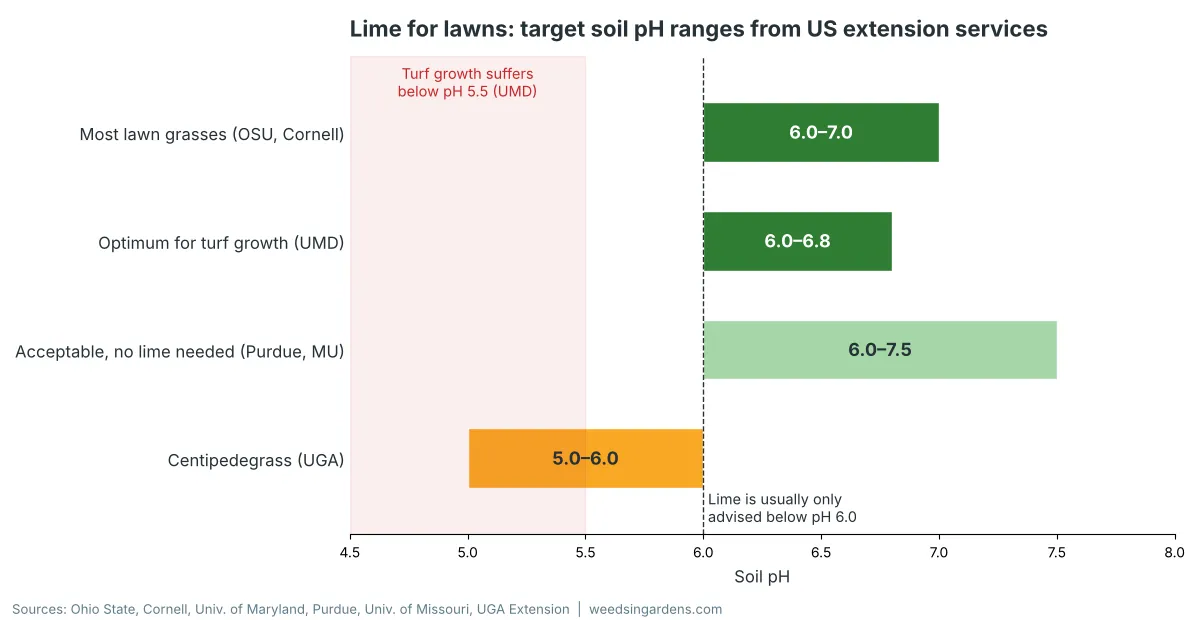
If your test lands anywhere in the green bands above, lime for lawns isn’t your fix: put the bag back on the shelf. Spend that money on a well-timed fall fertilizer or core aeration instead.
When to Apply Lime for Lawns (Fall vs Spring)
You can technically lime any time the ground isn’t frozen. But some timing windows work noticeably better than others, and fall is the one most extension services single out.
The University of Maryland calls fall ideal, because winter freezing and thawing helps work lime down into the soil. UConn agrees that fall is a great time to lime and fertilize. Ohio State recommends spring or fall, when rainfall is most abundant, because lime needs water to react; Clemson notes that “lime reacts slowly in dry soil.”
| Season | Good time to lime? | Why | Watch out for |
|---|---|---|---|
| Early to mid-fall | Best | Rain plus winter freeze-thaw cycles move lime into the root zone (UMD, UConn) | Combine with core aeration for faster results |
| Late fall / early winter | Good, if ground is bare | Still benefits from freeze-thaw | Don’t spread on snow, frost or frozen turf (UMD, OSU) |
| Spring | Good | Abundant rainfall helps lime react (OSU) | Don’t skip fall entirely if you need a second split |
| Summer | Poor | Dry soil slows the reaction (Clemson) | Never lime wilted, drought-stressed turf (OSU) |
| Before seeding or sodding | Ideal for big corrections | Lime can be tilled in at higher rates (MU, Purdue) | Apply months ahead where possible (Cornell, Clemson) |
Lime after core aeration for faster results
Lime is a slow mover. UConn’s soil lab says surface-applied limestone moves only about ½ to 1 inch per year, so it may take several years to raise the pH of an established lawn’s root zone. That’s why Purdue, Ohio State and Missouri all suggest liming right after core aeration. The open holes let lime reach deeper soil right away instead of sitting on top. If you’re planning to aerate this fall, schedule the lime for the same weekend.
Starting a new lawn? Lime first
If you’re renovating, reseeding a big area or laying sod, the soil is open and that’s your one chance to correct pH properly. Maryland recommends incorporating the full soil-test amount before starting a new lawn, and Missouri notes that larger amounts can be tilled in before seeding. Cornell suggests getting lime in three to four months before it’s needed for a substantial pH change. Our guide on preparing soil for grass seed covers the rest of the prep.
How Much Lime to Put on Your Lawn
Rates for lime for lawns always start from a soil test, never from the bag’s generic coverage chart.
This is where most people go wrong, either by guessing “a bag or two” or by dumping a whole year’s correction on at once. The good news is the math is simple once you have a lab report.
Step 1: Convert the soil test number into product
A lab’s lime requirement is usually given as pounds of pure calcium carbonate per 1,000 square feet (or per acre). Real products aren’t 100% pure, so Ohio State tells you to adjust using the calcium carbonate equivalent (CCE) printed on the bag:
Product needed = lime requirement ÷ CCE (with the CCE written as a decimal, so 90% becomes 0.90).
For example, if your report calls for 45 lb of calcium carbonate per 1,000 sq ft and your bag lists a CCE of 90%, you’d need 45 ÷ 0.90 = 50 lb of that product per 1,000 sq ft. Cornell uses the same logic with a slightly different label factor, so always read your own report’s instructions.
Step 2: Respect the per-application cap
On an established lawn, too much lime at once can sit on the leaves and surface and react unevenly. Extension services set a ceiling per application:
| Liming material | CCE (%) | Speed of pH change | Max per application (lb/1,000 sq ft) |
|---|---|---|---|
| Ground limestone (calcitic, “ag lime”) | 70–95 | Slow | 50 |
| Dolomitic limestone | 70–95 | Slow | 50 |
| Pelletized limestone | 70–95 | Fast* | 50 |
| Hydrated lime | 140 | Fast | 20 (hazardous; not advised for lawns) |
| Burned lime (quicklime) | 180 | Fast | 10 (hazardous; not advised for lawns) |
Maryland and Missouri both give the same 50 lb per 1,000 sq ft limit for established lawns. Purdue is more generous, allowing up to 100 lb of agricultural lime per 1,000 sq ft per application on higher-cut turf, and UConn’s lab puts the surface limit at 5–7 lb per 100 sq ft. For a home lawn, 50 lb is the safe, widely agreed number.
Step 3: Split anything bigger
If your recommendation is above the cap, split it. Maryland’s own example: for 85 lb, apply 50 lb now and the remaining 35 lb about six months later. Ohio State says to split the amount and apply at two different times during the year, and UConn notes you can also apply at 30-day intervals when the pH needs a significant lift.
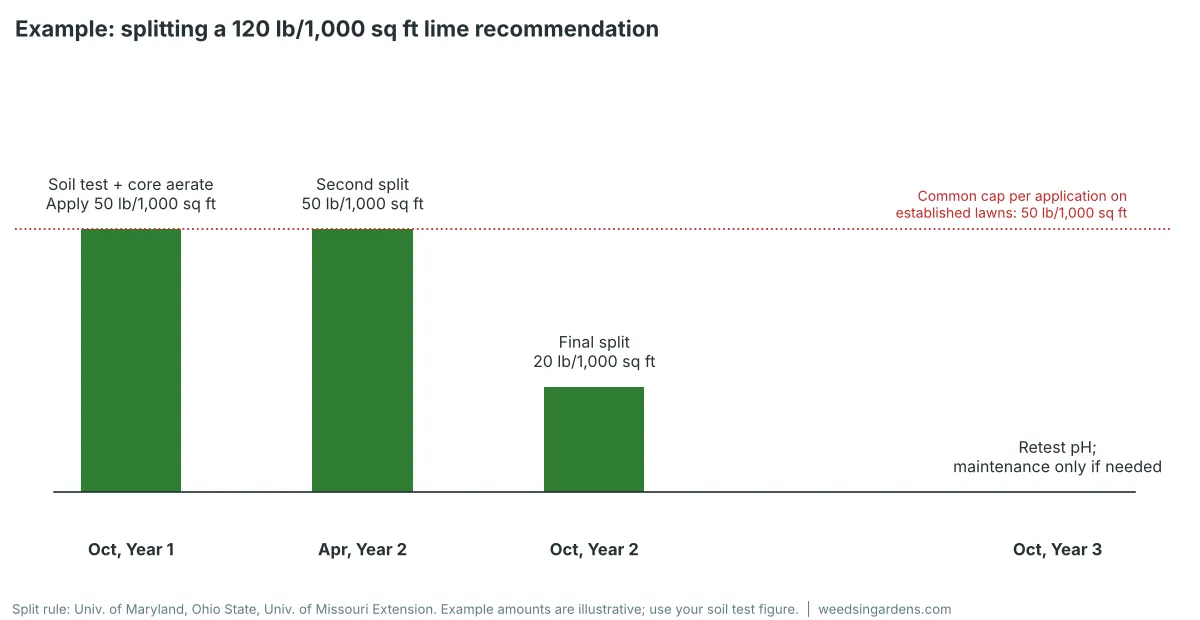
Once the pH reaches the mid-6s, UConn suggests a maintenance rate of about 50 lb per 1,000 sq ft every other year in acidic regions like New England. In less acidic areas you may need nothing at all for years, which is exactly what retesting tells you.
How many bags is that?
Lawn lime is commonly sold in 40- or 50-pound bags, so the arithmetic for a 5,000 sq ft lawn at 50 lb per 1,000 sq ft works out to 250 lb, or five 50-lb bags (six or seven 40-lb bags). Measure your lawn rather than guessing; a 20% error in area is a 20% error in pH correction.
What about wood ash?
Wood ash does raise pH, but it’s weaker and less predictable. University of Missouri Extension says wood ash is about 40% as effective as limestone, so replacing 100 lb of lime takes roughly 250 lb of ash, and repeated use can build potassium to excessive levels. Clemson adds that ash can raise pH sharply in sandy soils. It’s fine for a small, tested area; it’s a poor substitute for lime across a whole lawn.
Which Type of Lime Is Best for Lawns?
Walk down any store aisle and you’ll see four or five kinds of lime for lawns at very different prices. Here’s what you’re really paying for.
| Product | What it is | Best for | Trade-off |
|---|---|---|---|
| Ground agricultural (calcitic) lime | Finely ground calcium carbonate limestone | Most lawns when magnesium is adequate | Powder is dusty and messy in a spreader |
| Dolomitic lime | Calcium plus magnesium carbonate | Soils your test shows are low in magnesium | Adds magnesium you may not need |
| Pelletized lime | Finely ground lime pressed into pellets | Homeowners using a broadcast or drop spreader | Costs more per pound of neutralizing power (OSU) |
| “Fast-acting” lime products | Proprietary blends, often with additives | Small areas, if you follow the label | UConn reports inconsistent study results vs. regular limestone |
| Hydrated or burnt lime | Caustic, chemically processed lime | Not recommended for lawns | Can burn turf; hazardous to handle (UMD, OSU, Purdue) |
| Gypsum | Calcium sulfate | Not a liming material | Changes pH little or not at all (OSU) |
With any lime for lawns, particle size matters more than the brand. Finer grinds raise pH more readily, which is why Maryland notes that powdered lime acts faster but is messier to spread. Pelletized lime is simply fine lime glued into pellets that dissolve with watering, so you get the fine particles without the dust cloud.
Calcitic or dolomitic? Let the soil test decide. If it flags low magnesium, dolomitic lime corrects two problems with one pass. If magnesium is already fine, regular calcitic lime is the cleaner choice.
How to Apply Lime to Your Lawn, Step by Step
Liming is one of the easiest lawn jobs you’ll do all year, provided you get the spreader setting and the coverage right. Uneven lime means patchy pH, and you won’t see the stripes for months.
- Confirm the need. Have your soil test and the per-1,000 sq ft rate in hand. Measure your lawn’s area.
- Pick a calm, dry day when the grass isn’t wilted, frosted or snow-covered (UMD, OSU). Lightly moist soil is fine.
- Core aerate first if you can. It gets lime into the root zone far faster (Purdue, OSU, MU).
- Set your spreader to half the rate. Maryland recommends applying half the lime in one direction (east-west) and the remainder at right angles (north-south) for even coverage.
- Fill the spreader on a driveway or tarp, not on the grass, so spills don’t create hot spots.
- Water it in. Ohio State advises irrigating after application to wash lime off the leaves. Rain does the same job.
- Write it down. Record the date, product and rate, then put a soil retest on your calendar.
Can you lime and fertilize at the same time?
UConn’s fall advice treats liming and fertilizing as part of the same fall routine. Use two separate passes at each product’s own spreader setting, rather than mixing products in the hopper, so each goes on at its correct rate. If your lawn is wet when you’re ready, our guide to fertilizing wet grass covers what to watch for.
How long does lime take to work?
Patience is part of the treatment. Ohio State says pH changes take several months to show up after liming. UConn puts it at about 6 to 18 months depending on conditions, and its soil lab estimates 6 to 12 months or more. Don’t retest three weeks later and add more because the number hasn’t moved; that’s how lawns end up over-limed.
A Note From the Agronomist’s Side
Think of lime for lawns less as a “food” and more as a soil correction, like adjusting the thermostat in a house. You set it once, check it every few years, and only touch it again when the reading drifts. Fertilizer is what you feed the lawn; lime is what lets the lawn actually use that food.
The mistake I’d steer most homeowners away from is liming by calendar. The extension literature is remarkably consistent on this: test first, lime only below about pH 6.0, and cap each application. Those three rules prevent nearly every liming problem. The reasoning is simple. Lime is cheap per bag but slow and hard to undo. Once you overshoot, you’ve traded an easy fix for a hard one, and for acid-loving warm-season turf like centipedegrass, overshooting can trigger iron chlorosis.
The second thing worth understanding is depth. Because surface lime creeps down only about half an inch to an inch a year, a pH reading from the top 3 inches can look fine a year after liming while the deeper root zone is still acidic. That’s why pairing lime with core aeration and splitting the dose is so effective. You’re getting the material to the roots and giving the soil time to respond between doses.
Finally, put lime in its place in your weed strategy. A correctly limed lawn won’t stop crabgrass germinating or kill clover. What it does is remove one of the stresses that keeps turf thin. Dense turf, mowed at the right height and fed at the right time, is still the best long-term weed control you can buy.
Common liming mistakes to avoid
- Applying lime for lawns every year “just because” without a soil test.
- Using a pH probe reading to decide the amount of lime. It can’t tell you buffering capacity.
- Putting down 100+ lb per 1,000 sq ft in one go on an established lawn.
- Liming centipedegrass or other acid-tolerant turf that’s already in its preferred range.
- Using hydrated lime or quicklime on turf.
- Expecting lime to fix moss, weeds or yellowing caused by shade, drainage or nitrogen shortage.
FAQ
When is the best time to put lime on your lawn?
Fall is generally best. The University of Maryland says winter freeze-thaw cycles help work lime into the soil, and Ohio State notes spring and fall rainfall helps it react. Avoid frozen, snow-covered or wilted turf.
How much lime should I put on my lawn per 1,000 square feet?
Follow your soil test. On established lawns, Maryland, Ohio State and Missouri all cap a single application at about 50 lb of ground or pelletized limestone per 1,000 sq ft. Split larger recommendations into applications about six months apart.
Can I put too much lime on my lawn?
Yes. Over-liming raises pH above the grass’s preferred range, which can reduce nutrient availability; Cornell notes that lowering pH again is difficult. For centipedegrass, pH above 6.0 reduces iron availability and causes yellowing (UGA).
How long does it take for lime to work on a lawn?
Several months at minimum. UConn estimates about 6 to 18 months, and surface lime moves only about ½ to 1 inch per year in an established lawn. Core aerating before liming speeds it up.
Should I water after applying lime?
Yes. Ohio State recommends irrigating after application to wash lime off the grass blades and start moving it into the soil. A soaking rain does the same job.
Is pelletized lime better than powdered lime for lawns?
Pelletized lime is easier and cleaner to spread with a home spreader and has the same neutralizing range as ground limestone, but it costs more. Powdered lime is cheaper and reacts readily, but it’s dusty.
Does lime kill weeds or moss?
No. Lime corrects soil acidity; it isn’t a herbicide. It can help grass grow denser when pH is genuinely low, which leaves fewer gaps for weeds, but moss usually needs fixes for shade, drainage and thin turf.
Sources
- University of Maryland Extension. Lime and Lawns.
- Ohio State University Extension. Lime and the Home Lawn (fact sheet HYG-4026).
- UConn Home & Garden Education Center. Fall Is a Great Time to Lime and Fertilize Lawns (2025).
- UConn Soil Nutrient Analysis Laboratory. Soil pH and Management Suggestions.
- Purdue University Turfgrass Science. Changing Soil pH Under Turf.
- University of Missouri Extension. Soil Testing for Lawns.
- University of Georgia Cooperative Extension. Centipedegrass Decline (Circular 1003).
- Clemson Cooperative Extension, Home & Garden Information Center. Changing the pH of Your Soil.
- Cornell Cooperative Extension of Albany County. Liming Acid Soils.
For more seasonal lawn tasks, browse our watering and feeding guides.