
You’re walking across the lawn in late October and notice them again: flat, egg-shaped leaves pressed tight to the soil, each one ribbed like a celery stalk, sitting in exactly the spots where the grass is thinnest. Maybe there are a few skinny brown spikes left over from summer. You’ve mowed over them all season, and they haven’t flinched. Meet plantain weed.
Short answer: Plantain weed is a low-growing perennial that thrives in compacted, low-fertility, thin turf. Mowing won’t touch it because the leaves lie below the blade. The most reliable fix is a fall application of a 2,4-D-based broadleaf herbicide (two- or three-way mixes work best), hand-digging young plants, and then fixing the compaction and thin grass that let plantain in to begin with.
By the end of this guide you’ll be able to tell the three common plantains apart, pick the right timing and product for your lawn type, and make the changes that stop the weed from coming back next year.
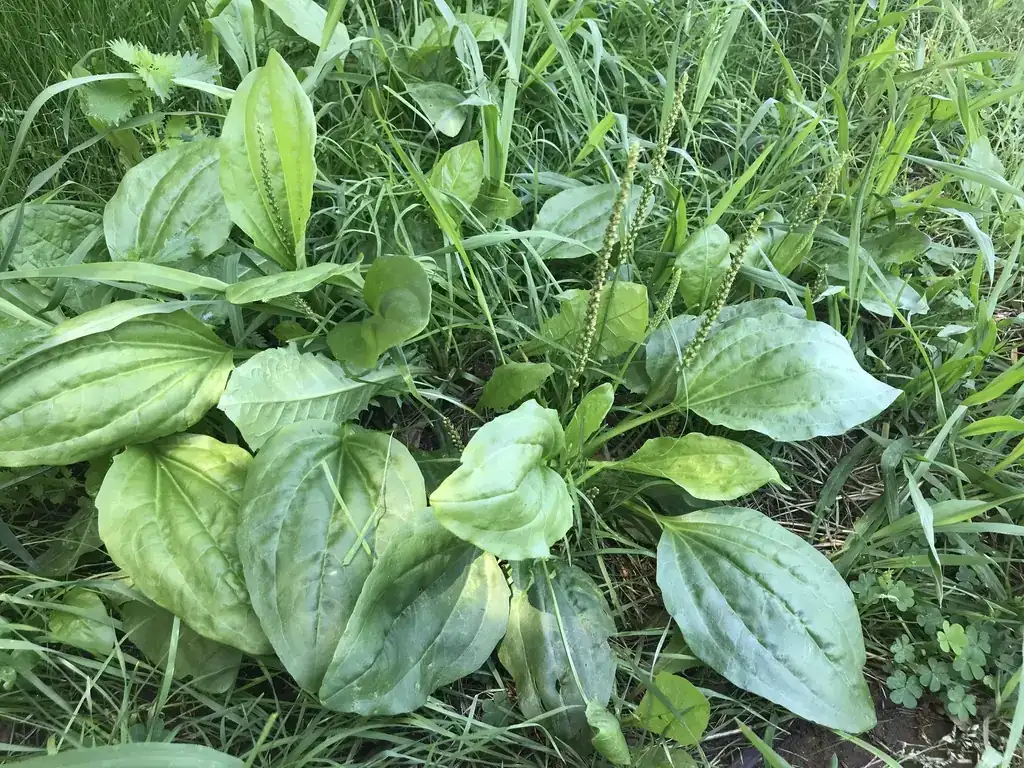
How to identify plantain weed: the three species in US lawns
“Plantain” here has nothing to do with the cooking banana. Lawn plantains are Plantago species, and three of them show up in American turf. All three are perennials, so the same plant comes back every spring from its crown instead of starting from seed each year.
Broadleaf plantain (Plantago major) was introduced from Europe and is the one most people picture. Blackseed plantain (Plantago rugelii) is a native look-alike that’s just as common in many Midwestern and Eastern lawns. Buckhorn plantain (Plantago lanceolata), also called narrowleaf or ribwort plantain, has long, narrow leaves and prefers drier ground.
The good news is that they’re managed in nearly the same way. The one difference worth knowing is root structure: broadleaf and blackseed plantain are anchored mainly by fibrous roots, while buckhorn grows from a short, thick, taproot-like base that has to come out whole if you’re digging.
Plantain weed is one of the easier lawn weeds to identify once you know the clues. Every species forms a basal rosette, a circle of leaves radiating from one central crown at ground level. Every species has prominent, nearly parallel veins running from the base of the leaf to the tip, which is unusual among broadleaf weeds. And every species sends up leafless flower stalks topped with a dense spike of tiny, greenish-white flowers.
Broadleaf plantain
UC IPM describes broadleaf plantain leaves as 2 to 7 inches long, with several veins that parallel the leaf margins. The leaves are oval to egg-shaped, often with wavy edges, and sit on long, trough-shaped stalks (petioles). Flower stalks can reach about 15 inches if left unmown, and the spike covers most of the stalk’s length.
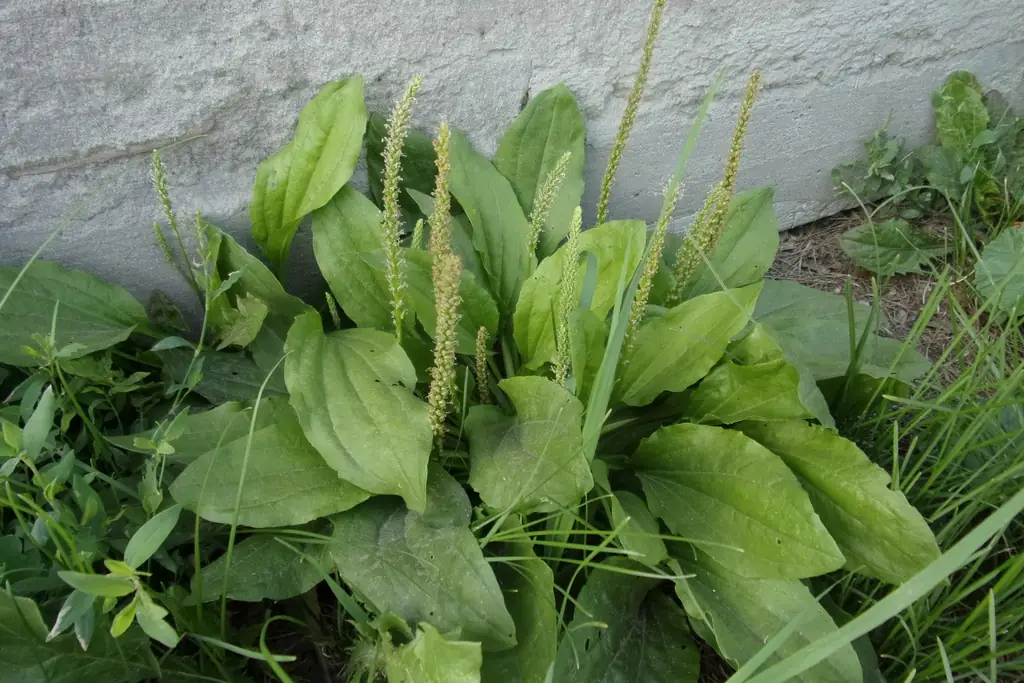
Blackseed plantain
Blackseed plantain looks so similar that most homeowners never separate the two, and for control purposes you don’t need to. If you’re curious, Iowa State University points to two clues: blackseed usually has a red or purple tinge at the base of the leaf stalks, and its seeds are dull black, while broadleaf plantain seeds are shiny and light to dark brown. The seed capsules also differ: broadleaf capsules split around the middle, and blackseed capsules split nearer the bottom.
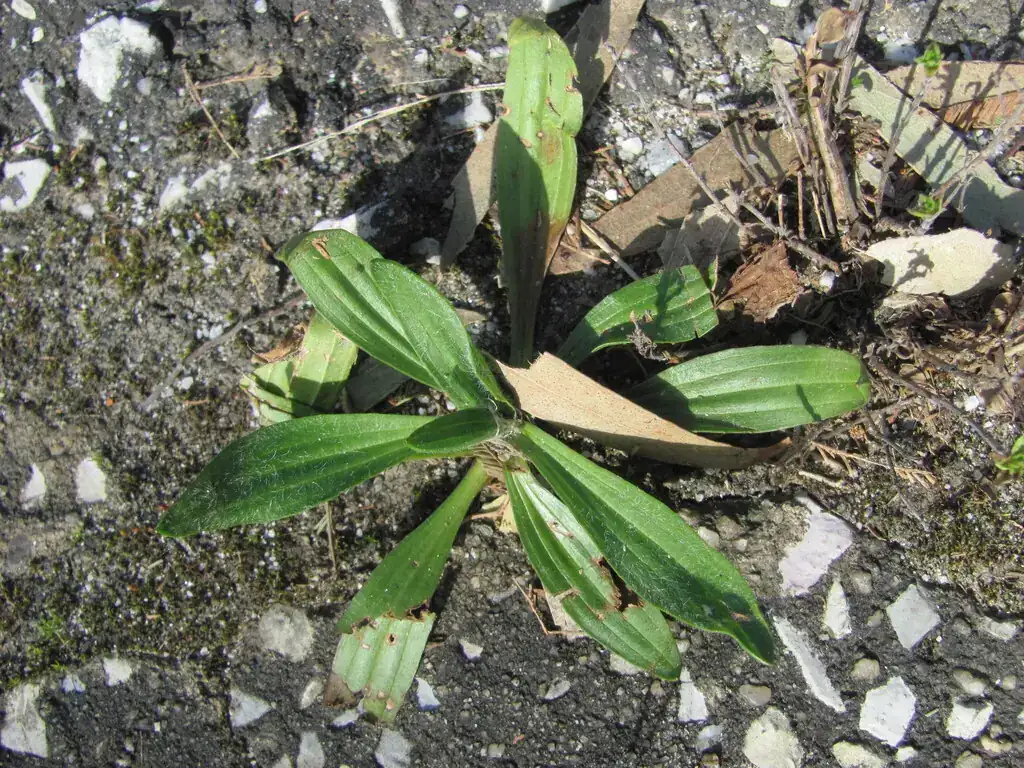
Buckhorn plantain
Buckhorn plantain is the odd one out. Its leaves are long and narrow, 3 to 12 inches long according to UC IPM, with sharp tips and strong parallel ribs. K-State notes they’re often twisted or curled. The crown is covered in tan, woolly hairs, and the flower heads are short, dense and bullet-shaped, held on stalks that can be much taller than the leaves.
| Feature | Broadleaf plantain | Blackseed plantain | Buckhorn plantain |
|---|---|---|---|
| Scientific name | Plantago major | Plantago rugelii | Plantago lanceolata |
| Origin | Introduced (Europe/Eurasia) | Native to North America | Introduced (Europe) |
| Leaf shape | Broad oval to egg-shaped, wavy edges | Broad oval, smooth, usually hairless | Long, narrow, lance-shaped, pointed tip |
| Leaf length | 2–7 in | Up to ~7 in | 3–12 in |
| Leaf-stalk base | Usually green (may be reddish) | Usually red or purple tinged | Woolly tan hairs at the crown |
| Flower head | Long, narrow spike covering most of the stalk | Long, narrow spike | Short, dense, bullet-shaped head |
| Seeds | Shiny, light to dark brown | Dull black | Shiny, dark; sticky when wet |
| Root system | Mainly fibrous | Fibrous | Short, thick taproot-like base |
| Typical site | Moist, compacted, high-traffic soil | Same as broadleaf | Dry, sandy, low-fertility soil |
Table compiled from UC IPM Pest Notes 7478, Iowa State University Extension, UMass Extension and K-State Research and Extension (see Sources).
Plants often confused with plantain
Young dandelions also form rosettes, but their leaves are deeply toothed and their veins branch like a net. Wild violets have heart-shaped leaves on long stalks. Buckhorn plantain seedlings can resemble a grassy weed at a glance, but grass blades don’t grow in a flat rosette from a single crown. If the leaf has a handful of strong, parallel ribs and the whole plant is a flat circle, you’re looking at plantain.
Why plantain weeds take over your lawn
Plantain weed is what weed scientists call an indicator weed. It doesn’t so much invade a healthy lawn as move into conditions the grass can’t handle. That’s the most useful thing to understand about it, because spraying without fixing the cause just resets the clock.
Compacted soil is the big one. UC IPM calls broadleaf plantain an indicator of compacted soil with low fertility, and University of Minnesota Extension notes it tolerates compacted soil and both wet and dry sites. Look at where plantain weeds grow thickest: along paths, beside driveways, at gate openings, and where kids or dogs run the same route. Those are your compaction hot spots.
Low fertility and thin turf come next. K-State finds buckhorn mostly in low-quality turf of low to moderate fertility, and UC IPM calls it an indicator of dry, low-fertility soils. The University of Nebraska–Lincoln lists plantain as an indicator of compacted or heavy soil, low-fertility soil, acid soil and newly seeded areas. (UC IPM also links broadleaf plantain to alkaline soil, so pH alone isn’t a reliable signal. Get a soil test rather than guessing.)
Mowing can’t control it. The leaves lie flat, under the mower blade. Iowa State notes blackseed plantain can survive mowing heights of 0.5 inch or less on golf fairways, so a home mower won’t bother it.
The seed bank is enormous. Extension and master gardener fact sheets put broadleaf plantain’s output at roughly 14,000 to 20,000 seeds per plant, and seeds can stay viable in the soil for up to 60 years. The seeds turn sticky when wet and travel on shoes, paws and mower decks. Even after you kill every visible plant, seedlings will keep appearing wherever there’s bare soil.
| What you see | Likely cause | What to fix |
|---|---|---|
| Plantain along paths, gates and play areas | Soil compaction from traffic | Core-aerate; reroute traffic or add stepping stones |
| Plantain scattered across thin, pale turf | Low fertility | Soil test, then fertilize to the recommendation |
| Buckhorn plantain on sandy, sunny slopes | Dry, low-fertility soil | Deeper, less frequent watering; fertility; drought-tolerant grass |
| Broadleaf plantain in damp, low spots | Wet, heavy soil plus compaction | Improve drainage; aerate; avoid traffic when wet |
| Seedlings in bare patches after a fix | Long-lived seed bank | Overseed promptly so grass fills the gaps |
How to get rid of plantain weeds in your lawn without chemicals
For a handful of plantain weeds, you don’t need a sprayer. The catch is that you have to be thorough and patient.
Hand-dig, don’t just pull
Because broadleaf and blackseed plantain have fibrous roots, they come out fairly easily when the soil is moist. Use a dandelion fork or a narrow weeding knife and lever out the whole crown. For buckhorn plantain, UMass Extension stresses that the short, fleshy taproot must be dug out or the plant regrows. Fall, after a soaking rain, is an easy time to do it.
Be realistic about scale. UC IPM notes that mature plantain is hard to control with hand-pulling, digging or hoeing alone, and that digging out perennial plants has to be done regularly for several years. That’s not a reason to skip it. It’s a reason to catch plants while they’re young and to fill the holes with grass seed right away.
Stop the seed
If you can’t remove everything this year, at least stop new seed. Clip or pull the flower spikes before they ripen, from late spring through late summer. UMass notes that mowing alone may not prevent seed set on some plants, so it’s worth walking the lawn with shears a few times.
In beds, smother the seedlings
In landscape beds, UC IPM reports that 2 to 4 inches of organic mulch can control plantain seedlings on its own. Mulch won’t kill established plants, so dig those out first, then mulch. Our guide to stopping weeds in mulch beds covers depth and materials.
What about vinegar or boiling water?
Household vinegar and boiling water burn the leaves, but plantain regrows from the crown. They’re fine for cracks in paving, where you don’t care about the soil, but they’re the wrong tool for a lawn because they kill the surrounding grass just as readily.
Plantain weed killer: which herbicides work and when
If plantain weed covers a large area, a selective broadleaf herbicide is the practical answer. “Selective” means it targets broadleaf plants and spares grass when used according to the label. The good news is that plantain weed is one of the easier perennial weeds to kill. Iowa State notes that broadleaf and blackseed plantain are much more susceptible to the growth-regulator herbicides used on lawns than many other perennials, because they have fibrous roots rather than a deep taproot like dandelions.
The active ingredients that matter
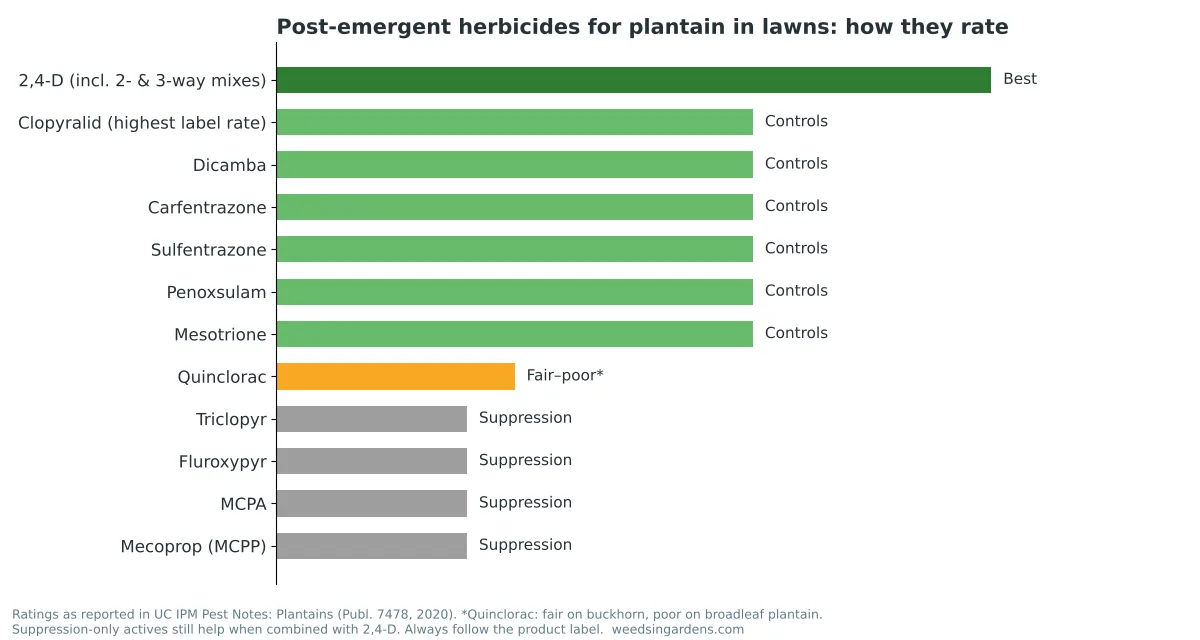
UC IPM rates 2,4-D products as working best on plantain. Other actives that control it include dicamba, carfentrazone, sulfentrazone, penoxsulam and mesotrione, and clopyralid at its highest label rate. Triclopyr, fluroxypyr, MCPA and mecoprop (MCPP) on their own only suppress plantain. Quinclorac gives fair control of buckhorn and poor control of broadleaf plantain.
That’s why the familiar “three-way” mixes (2,4-D + MCPP + dicamba) are such a good fit. UMass Extension says two- and three-way combinations are particularly effective on buckhorn, and Iowa State explains that no single compound controls every broadleaf weed. A mix also picks up the clover, dandelions and chickweed that usually grow alongside plantain.
| Active ingredient(s) | Effect on plantain (UC IPM) | Notes |
|---|---|---|
| 2,4-D, alone or in 2- and 3-way mixes | Works best | The backbone of most homeowner broadleaf products |
| Dicamba | Controls | Common partner in 3-way mixes; avoid spraying near tree and shrub roots |
| Clopyralid | Controls at the highest label rate | Often sold for turf with other actives |
| Carfentrazone / sulfentrazone | Controls | Fast-acting partners; speed up visible burn-down |
| Penoxsulam | Controls | Found in some newer homeowner mixes |
| Mesotrione | Controls (also used pre-emergence) | Check grass-type safety on the label |
| Quinclorac | Fair on buckhorn, poor on broadleaf | Better known as a crabgrass product |
| Triclopyr, fluroxypyr, MCPA, MCPP | Suppression only | Useful in mixes, weak alone |
For a broader look at how these products work, see our guide to post-emergent herbicides or browse all our lawn weed guides.
Timing: why fall wins
Iowa State Extension calls fall (mid-September to early November in Iowa) the best time to control perennial broadleaf weeds, because the plants are moving sugars from their leaves down to their roots for winter. A systemic herbicide applied then rides that flow straight into the crown. UNL adds that applications well into October are still very effective by the following spring. UC IPM agrees that the best post-emergence control of plantain weed comes from a fall application, and notes that repeat applications may be needed.
Spring works too, but it’s second best. K-State lists mid-spring to early summer and mid to late autumn as the windows, both when weeds are actively growing. We cover the bigger picture in fall weed control.
Label rules that protect your grass
Herbicides only work as well as the conditions you spray in. These rules come from UNL and UMass Extension, and your product label always takes priority:
- Spray on a calm, clear day with air temperatures between 50 and 85°F. Above 85°F the risk of injury to cool-season grass rises, and UNL advises avoiding buffalograss above 75°F.
- Don’t mow for 2 to 3 days before and after spraying, so there’s enough leaf to absorb the product and time for it to move inside the plant.
- Choose a day with no rain expected for at least 12 hours (UMass). If it rains within 24 hours and you see no effect after 10 days, UNL says a repeat may be needed.
- Wait until new grass seedlings have been mowed at least three times before spraying, and wait 4 to 6 weeks after laying sod.
- Check the label for your grass type. Some warm-season grasses, such as St. Augustinegrass and centipedegrass, are sensitive to some 2,4-D-based products, so choose a product that lists your turf as tolerant.
- Check the label for the waiting period before you reseed treated areas.
- Spot-treat rather than blanket-spray when plantain is scattered. You’ll use less product and protect the grass and pollinators.
In landscape beds, where selective lawn products aren’t labeled, UC IPM notes that spot treatment with a non-selective systemic herbicide such as glyphosate can control plantain. Keep it off anything you want to keep.
Pre-emergents for the seed bank
UC IPM lists atrazine, indaziflam, isoxaben and mesotrione as pre-emergence options for plantain seedlings. Several of these are restricted to certain grass types or to professional use, so read the label carefully. For most homeowners, thick turf is a cheaper “pre-emergent” than any product. Plantain seed germinates when soil reaches about 50°F (UC IPM), and it needs light, so dense grass that shades the soil surface is a very effective barrier.
Keep plantain weed from coming back: fix the lawn, not just the weed
This is where most plantain weed control either sticks or fails. Kill the weeds but leave the compaction and thin grass, and the 60-year seed bank refills the gaps within a season or two.
Relieve compaction. Core aeration pulls out plugs of soil so air, water and roots can get in. University of Nevada, Reno Extension lists aerating, mowing high and watering properly as the cultural fixes for broadleaf plantain. Do it when your grass is growing strongly: early fall for cool-season grass and late spring to early summer for warm-season grass. Our guide to growing grass in compacted soil walks through the steps.
Feed to a soil test. Low fertility shows up in nearly every extension description of plantain. A soil test tells you whether you need nitrogen, phosphorus, potassium or a pH correction. K-State names fertilization as the key cultural control for buckhorn.
Mow high. UNL recommends 3.0 to 3.5 inches for Nebraska lawns, and removing no more than one-third of the blade at a time. Taller grass shades the soil, and plantain seed needs light to germinate.
Overseed the gaps. Every plantain you remove leaves a bare circle. Seed it promptly. If you’ve used a herbicide, wait the interval on the label first. Our checklist for killing weeds before overseeding shows how to sequence the two.
Change the traffic. If plantain traces a footpath, the lawn is telling you people walk there. Stepping stones or a mulched path often solve the problem for good.
A season-by-season plan for plantain weed control
Here’s how the pieces fit together over a year in a typical cool-season lawn. In warm-season lawns, spray in spring once the grass has fully greened up and is actively growing, and avoid the summer heat and the dormant months.
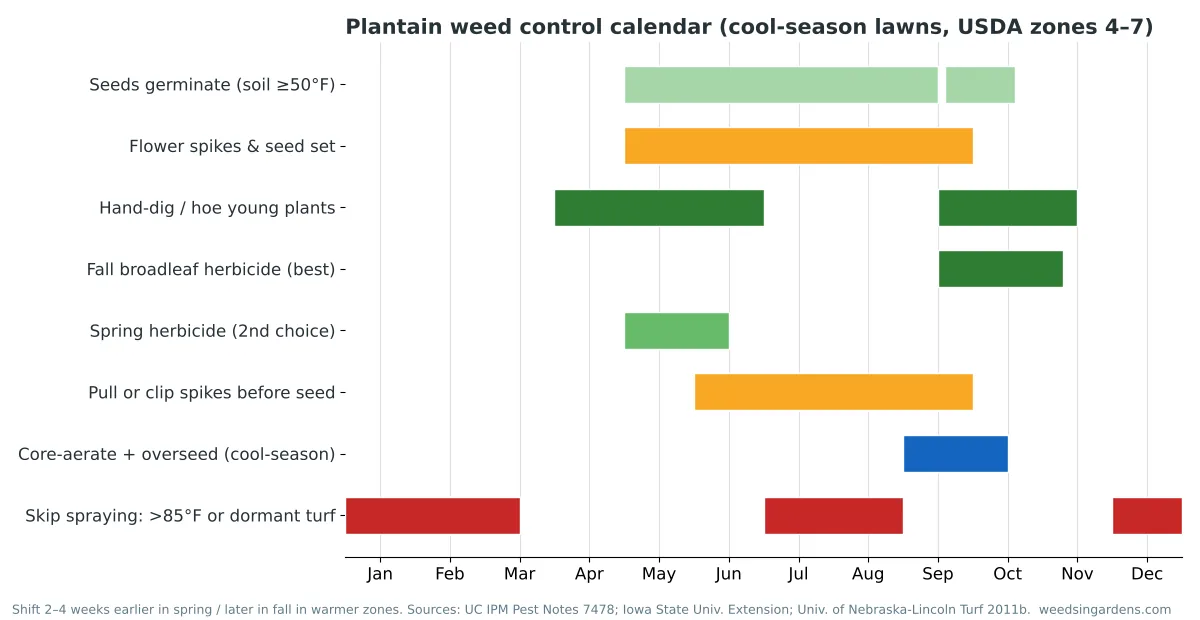
| Season | What plantain is doing | What you should do |
|---|---|---|
| Early spring (Mar–Apr) | Crowns resprout; first flushes of seedlings as soil warms past 50°F | Dig out young plants while roots are small; soil-test bare or thin areas |
| Late spring (May–Jun) | Rapid leaf growth; flower spikes begin | Spot-spray if needed (second-best window); start clipping spikes |
| Summer (Jul–Aug) | Flowering and seed set; spreading in dry or compacted ground | Don’t spray in heat over 85°F; keep mowing high; water deeply |
| Early fall (Sep) | Plants storing food in their crowns | Core-aerate compacted areas; overseed cool-season lawns |
| Mid fall (late Sep–Oct) | Moving sugars to roots | Main herbicide window; spot-treat survivors; fertilize |
| Late fall–winter (Nov–Feb) | Semi-dormant rosettes | Note where plantain grew; plan traffic changes for spring |
Is plantain weed edible or useful?
Before you go to war, it’s worth knowing that plantain weed has a long history as a useful plant. NC State Extension describes broadleaf plantain as a nutritious wild edible that’s high in calcium and vitamins A, C and K. Young, tender leaves can be eaten raw, and older, stringier leaves can be cooked. NC State also cautions that eating large quantities can lower blood pressure.
The leaves were traditionally used on bites, stings, cuts and sore feet, which is why “plantain for bee stings” is such a common search. A review in the Journal of Ethnopharmacology (Samuelsen, 2000) summarized plantain’s traditional uses and studied compounds, including its wound-healing and anti-inflammatory uses. Traditional use isn’t proof of a medical effect, though, so see a doctor for anything more than a minor sting.
Two practical warnings if you forage. Only harvest from lawns you know haven’t been treated with herbicides or fertilizers, and stay away from roadsides and areas pets use. And be 100% sure of the plant’s identity before you eat anything wild.
A note from the agronomist’s side
Plantain weed is one of the most honest weeds in your lawn. It isn’t aggressive the way creeping Charlie or nutsedge are. It has no runners and no underground tubers, and a 2,4-D product kills it quite easily. If it keeps returning, it’s because the conditions underneath are still in its favor. I’d treat a plantain patch the way a doctor treats a symptom: deal with it, but look for what’s causing it.
Here’s the reasoning I’d apply. Plantain’s flat rosette and tough leaves are built to handle trampling, and its fibrous roots cope with dense soil that grass roots struggle to penetrate. When the soil is compacted, grass thins and plantain wins on its home ground. Spraying removes the plant but leaves the advantage in place. Aeration and overseeding remove the advantage. That’s why I’d always pair the two in the same fall: aerate and overseed in late summer or early fall, and spot-spray the survivors once the new grass has been mowed a few times, or the following spring if the seedlings are too young.
The seed bank is the other thing to plan around. With seeds that can stay viable for decades, you won’t get to a lawn with zero plantain weeds in one season, and you don’t need to. The realistic goal is a lawn dense enough that the occasional seedling gets shaded out before it forms a rosette. A few plants a year, dug out by hand, is a sign of success, not failure.
Finally, a word on product choice. Because plantain is so sensitive to 2,4-D, there’s rarely a reason to reach for the strongest or most expensive mix. A standard three-way product, spot-applied in October at label rates, is usually all it takes. Save triclopyr and fluroxypyr for the tough customers like ground ivy and clover.
Frequently asked questions about plantain weed
What kills plantain weeds but not grass?
A selective broadleaf herbicide containing 2,4-D, ideally a two- or three-way mix such as 2,4-D + MCPP + dicamba, kills plantain without harming most lawn grasses when used at label rates. UC IPM rates 2,4-D products as working best on plantain. Check that the label lists your grass type, especially for St. Augustinegrass, centipedegrass or buffalograss.
Is plantain weed bad for your lawn?
Plantain doesn’t damage grass directly, but it crowds out turf in thin spots and its flat rosettes leave bare circles when it dies back. More importantly, it’s a sign of compacted, low-fertility soil, the conditions that also weaken your grass.
When is the best time to kill plantain weeds?
Fall is best. Iowa State Extension recommends mid-September to early November for perennial broadleaf weeds, because the plants are moving sugars into their roots and carry the herbicide down with them. Spray when air temperatures are between 50 and 85°F.
Does pulling plantain weeds work?
Yes, for small numbers, if you remove the whole crown. Broadleaf plantain has fibrous roots that lift out easily from moist soil. Buckhorn plantain’s short taproot must be dug out completely or it regrows. Expect to repeat the job for a few seasons because of the long-lived seed bank.
Why do I have so much plantain in my yard?
Plantain thrives where grass struggles: compacted soil along paths and play areas, low-fertility soil and thin turf. Each plant can produce thousands of seeds that stay viable for decades. Fix the compaction and thicken the grass, and plantain loses its advantage.
Is plantain weed edible?
Yes. NC State Extension describes broadleaf plantain as a nutritious wild edible. Young leaves can be eaten raw, and older leaves can be cooked. Large quantities may lower blood pressure, and you should never eat plants from lawns treated with herbicides or fertilizers.
What’s the difference between broadleaf and buckhorn plantain?
Broadleaf plantain has wide, oval leaves and long, narrow flower spikes. Buckhorn plantain has long, narrow, lance-shaped leaves, woolly hairs at the crown and short, bullet-shaped flower heads. Buckhorn prefers dry, sandy soil, and broadleaf prefers moist, compacted ground. Both respond to the same fall herbicide program.
Sources
- Reiter, M. (2020). Pest Notes: Plantains. UC Statewide IPM Program, Publication 7478. University of California Agriculture and Natural Resources. ipm.ucanr.edu/home-and-landscape/plantains/
- Hartzler, B., & Anderson, M. Blackseed and broadleaf plantain. Iowa State University Extension and Outreach, Integrated Crop Management. crops.extension.iastate.edu/encyclopedia/blackseed-and-broadleaf-plant
- UMass Extension. (2011). Buckhorn Plantain in Lawns. University of Massachusetts Amherst. www.umass.edu/agriculture-food-environment/home-lawn-garden/fact-sheet
- Proctor, C., & Reicher, Z. (2011). Broadleaf weed control in home lawns (Turf 2011b). University of Nebraska–Lincoln. turf.unl.edu/sites/unl.edu.ianr.agronomy-horticulture.turf/files/media
- Iowa State University Extension. (2021). When is the best time to apply a broadleaf herbicide to the lawn? Yard and Garden. yardandgarden.extension.iastate.edu/faq/when-best-time-apply-broadleaf
- K-State Research and Extension. Buckhorn Plantain. Lawn Problem Solver, Kansas State University. www.k-state.edu/turf/resources/lawn-problem-solver/problem-solver/weed
- Donaldson, S., & Hanson Mazet, W. (2010). A Northern Nevada Homeowner’s Guide to Identifying and Managing Broadleaf Plantain (FS-10-17). University of Nevada Cooperative Extension. extension.unr.edu/4h/pub.aspx?PubID=3370
- University of Minnesota Extension. Broadleaf plantain. Weed identification. apps.extension.umn.edu/garden/diagnose/weed/broadleaf/basal/broadplant
- Purdue Landscape Report. Spotlight on Weeds: Broadleaf plantain (Plantago major). Purdue University. purduelandscapereport.org/article/spotlight-on-weeds-broadleaf-plantai
- NC State Extension. Plantago major. North Carolina Extension Gardener Plant Toolbox. plants.ces.ncsu.edu/plants/plantago-major/common-name/cuckoos-bread
- Wenks, C. T. Broadleaf Plantain. Fairfax County Master Gardeners Association (citing the Virginia Cooperative Extension Pest Management Guide). fairfaxgardening.org/wp-content/webdocs/hometurf/Broadleaf%20Plantain.
- Samuelsen, A. B. (2000). The traditional uses, chemical constituents and biological activities of Plantago major L. A review. Journal of Ethnopharmacology, 71(1–2), 1–21. pubmed.ncbi.nlm.nih.gov/10904143/