
You reach behind the compost bin for a stray flowerpot, and something bites the back of your hand. No insect, no thorn. Just a tall, dark green plant with saw-edged leaves, and a burn that’s already turning into a row of small white bumps. By evening your knuckles are still tingling.
Short answer: that plant is almost certainly stinging nettle (Urtica dioica), a perennial that spreads by seed and by shallow creeping rhizomes and forms dense patches in rich, moist soil. The sting is unpleasant but usually fades within hours. To get rid of a patch, dig out the rhizomes or cut the regrowth again and again, smother what’s left, and keep a systemic herbicide as a spot-treatment backup. One-off mowing or rototilling tends to make it worse.
By the end of this guide you’ll be able to confirm the ID without touching it, tell it from the two look-alikes that share its habitat, treat a sting properly, choose a removal method that suits your patch, and decide whether to keep a corner of it for the kitchen and the butterflies. It’s one of the few weeds worth that second thought.
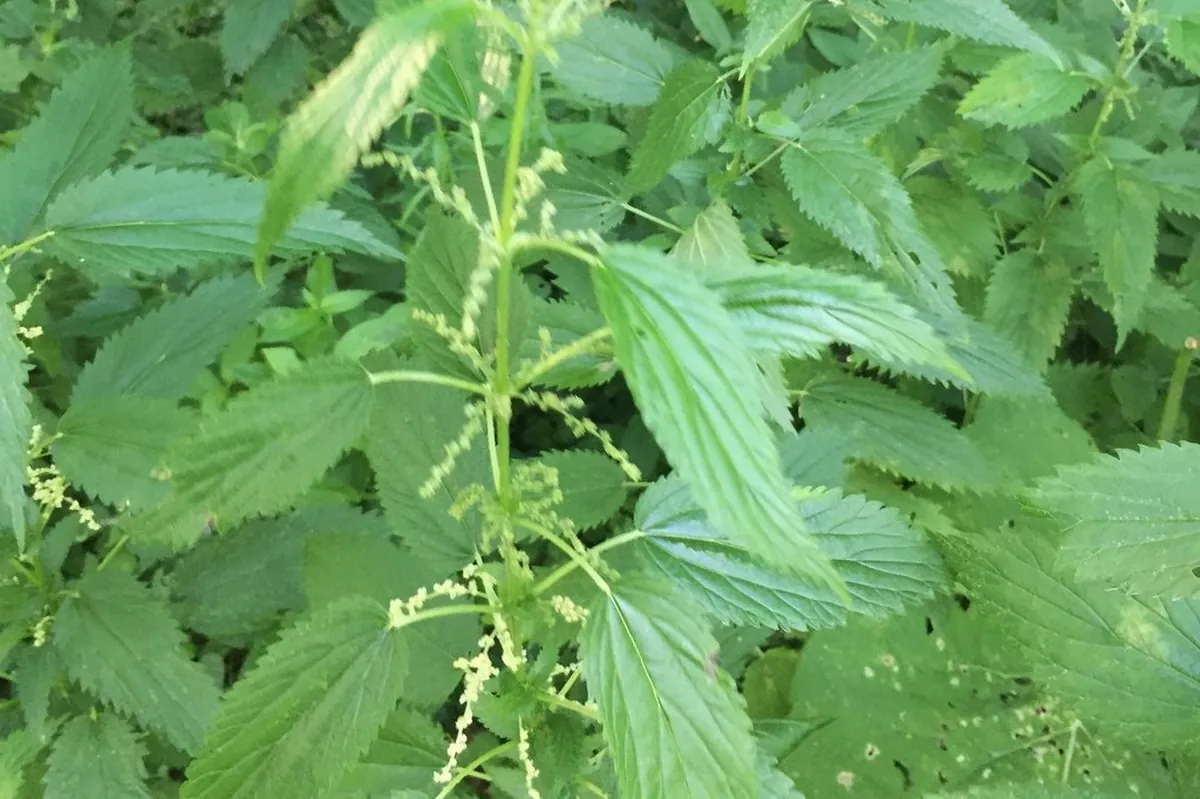
What stinging nettle is and how to identify it
Here’s the surprise: over most of North America, this isn’t a foreign invader. The American subspecies (Urtica dioica subsp. gracilis) is native across most of the continent, while the European subspecies turns up mainly near the east and west coasts, according to Minnesota Wildflowers. That matters for how hard you go after it, and we’ll come back to it.
It also tells you something about your soil. NC State Extension says the plant generally grows on deep, rich, moist soil and does poorly in drought, and the USDA Forest Service notes that foresters use it as an indicator of high soil fertility. So nettles gather where the ground is fed and damp: around compost heaps, old manure piles, chicken runs, ditch banks and the shady back fence.
Key ID features
- Height and habit: upright, usually unbranched stems in a colony. The Forest Service gives 3.3 to 6.6 feet; UC IPM gives 3½ to 10 feet for full-grown plants.
- Leaves: in opposite pairs, lance-shaped to narrowly oval, coarsely toothed, 2½ to 5 inches long, with 3 to 5 veins fanning out from the base (UC IPM).
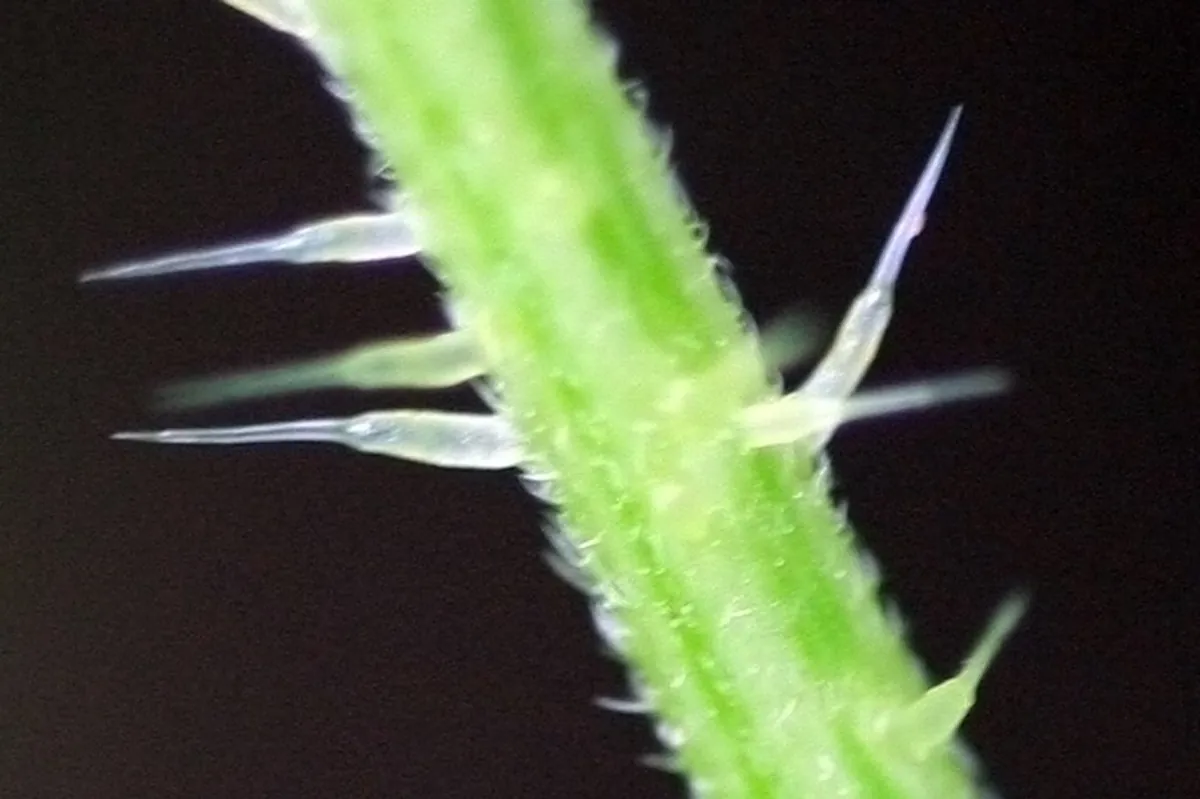
- Stems: square in cross-section, per WSU Hortsense, with long stinging hairs mixed with shorter, harmless ones.
- Flowers: small, whitish-green and easy to miss, hanging in stringy clusters from the points where leaf stalks meet the stem. Male and female flowers sit in separate clusters.
- Roots: a mat of shallow, creeping rhizomes. Pull one stem and you’ll usually find it tied to its neighbours.
The safest field test needs no touching at all: look for opposite, toothed leaves on a square stem, with drooping green tassels at the leaf joints. If all three are there, keep your gloves on.
Stinging nettle look-alikes
Three relatives cause most of the confusion, and two of them matter because one stings just as hard and the other doesn’t sting at all.
| Plant | Leaf arrangement | Leaf shape and size | Stings? | Other clue |
|---|---|---|---|---|
| Stinging nettle (Urtica dioica) | Opposite | Narrow, lance-shaped, 2½ to 5 in long | Yes | Perennial colony, often 3 ft or taller, sun or shade |
| Wood nettle (Laportea canadensis) | Alternate | Broad, egg-shaped, up to 6 in long and 4 in wide | Yes | 2 to 4 ft tall; rich, moist, shady woods and stream bottoms |
| False nettle (Boehmeria cylindrica) | Opposite | Lance-shaped to oval, typically about 4 in long | No stinging hairs | Flower spikes point upward, ½ to 3 in long, instead of drooping |
| Burning nettle (Urtica urens) | Opposite | Small, ½ to 2 in long | Yes | Annual, only 5 in to 2 ft tall; a weed of gardens and vegetable beds |
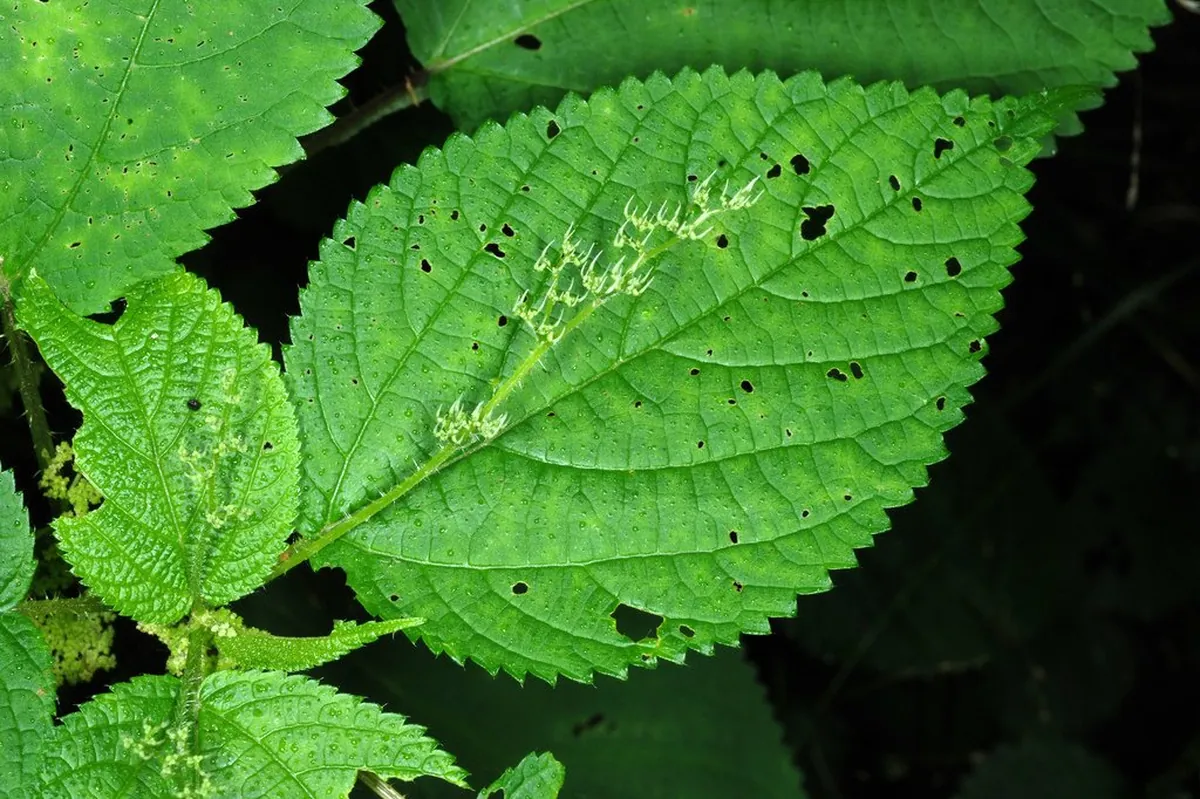
Burning nettle is the one that changes your plan. UC IPM points out that it’s an annual that can set seed within five weeks of germinating, so you beat it by hoeing before it flowers, not by chasing rhizomes. Nettle stings are also a different thing from an urushiol rash; if the reaction shows up a day later as weeping blisters, compare the plants in our guide to poison ivy vs Virginia creeper.
Why it stings, and what to do when it gets you
Each stinging hair is a tiny glass-like needle. UC IPM describes a hollow tube with a hard, round bulb at the tip and a softer reservoir at the base. Brush against it and the bulb snaps off, the point goes into your skin, and the pressure squeezes the contents in. It’s a hypodermic syringe, built by a plant.
What’s in the syringe is still being worked out. UC IPM says the contents aren’t fully known but include active amounts of acetylcholine and histamine. A study in Annals of Botany on a related Asian nettle found oxalic acid and tartaric acid were the compounds that produced long-lasting pain in lab tests, which may explain why the tingle outlives the redness. UC IPM notes that tingling can persist for more than 12 hours after the visible marks have gone.
One more difference from poison ivy: this is an irritant reaction, not an allergy. In UC IPM’s words, nettles affect everyone equally. You don’t build up to it, and you don’t get a free pass.
Sting first aid
- Don’t rub or scratch. Both Healthdirect Australia and Health New Zealand say this plainly.
- Wash with soap and water as soon as you can. If there’s no water, wipe the area clean with a cloth.
- Cool it with a damp cloth or an ice pack.
- For itching and swelling, the two health services mention antihistamines, and Health New Zealand also lists hydrocortisone cream. Ask a pharmacist or doctor before starting a new medicine.
- Skip the dock leaf if it’s a hike away. The RHS says the old remedy may simply be a placebo and that washing with soap and water will help ease the stinging.
Healthdirect says a sting usually gets better after a few hours, though symptoms may last up to 36 hours in very sensitive people, and it advises seeing a doctor if the pain hasn’t improved after 2 hours. Trouble breathing, swelling of the tongue or throat, faintness or collapse are signs of a severe reaction: call emergency services (911 in the US) straight away.
How to get rid of stinging nettle without chemicals
Start here, because the authorities do. UC IPM says nettles in home gardens and landscapes are best controlled with cultural and mechanical methods, and the RHS goes further and says there’s no need for a weedkiller at all. Whichever method you choose, dress for it: long sleeves, long trousers and thick rubber or leather gloves.
First, though, a number that explains why half-measures fail. The Forest Service review reports that a single shoot growing in full sun can produce 10,000 to 20,000 seeds (500 to 5,000 in shade), that the seed can germinate 5 to 10 days after it matures, and that a piece of rhizome planted in late summer can spread across an 8.2-foot circle by the following year. Seed and rhizome. You have to block both.
1. Dig out the rhizomes (small patches)
For a patch you can cover in an afternoon, a border fork is the quickest cure. The RHS says most nettle roots sit in the top 8 inches of soil, so you aren’t digging to Australia. Loosen the soil, lift, and tease out the rhizomes in long pieces. UC IPM is blunt about why: leave the rhizomes behind and the plants regrow.
2. Cut it down, then keep cutting (large patches)
This is where the advice seems to clash. A University of California weed report rates mowing and cutting as poor control and warns the plant regrows rapidly if mowed early in the season; the Forest Service adds that mowed nettle sends up numerous bushy shoots. Yet the RHS says regular cutting will weaken and eventually kill the plants.
Both are right. They’re describing different amounts of effort. One or two cuts a year just prunes the patch. Cutting every flush of regrowth, so the rhizomes keep spending reserves on new shoots and never get repaid, is what wears it down, and the RHS warns that this is likely to take more than one growing season. Honestly, if you can’t commit to that, pick another method.
3. Smother it
Cut the stems to the ground, lay cardboard over the whole patch, and pile about 8 inches of bark or wood chips on top. That’s the RHS recipe, and the catch is patience: keep the soil covered for a few years, topping up as the mulch settles. Overlap the cardboard generously, the same way you would to stop weeds in mulch beds, because shoots will find every gap at the edges.
4. Stop the seed
Even if you do nothing else this year, cut the patch before the green tassels ripen. WSU Hortsense calls mowing to prevent seed production a very effective means of management, and UC IPM notes that close mowing can prevent fruit from developing. This won’t shrink the patch, but it stops it founding new ones.
5. Hoe the seedlings
Nettle seed germinates in spring (UC IPM). Seedlings have no rhizomes yet, so a sharp hoe on a dry, breezy day finishes them. This is also the whole treatment for annual burning nettle.
6. In lawns, just mow and thicken the turf
Nettle in a lawn is nearly always creeping in from an unmown edge. WSU Hortsense says flatly that it’s not a problem in healthy established turf, and that mowing regularly at the right height for your grass helps keep it out. A lawn mower is “regular cutting” by default. Fix the thin, shady strip along the fence and the nettles lose their doorway.
Two mistakes that make a patch bigger
- One pass with a rototiller. UC IPM, the Forest Service and the RHS all warn that cultivation chops and spreads the rhizomes, and each fragment can become a plant. Tillage only works when it’s repeated: the UC weed report says it likely needs to be repeated for several years.
- Composting the roots. The RHS advises against putting rhizomes or seed in a home compost bin, which may not get hot enough to kill them. Bag them, or follow our guide on how to dispose of invasive plants. Leafy tops cut before flowering are fine to compost.
Herbicides for stinging nettle: what works, by active ingredient
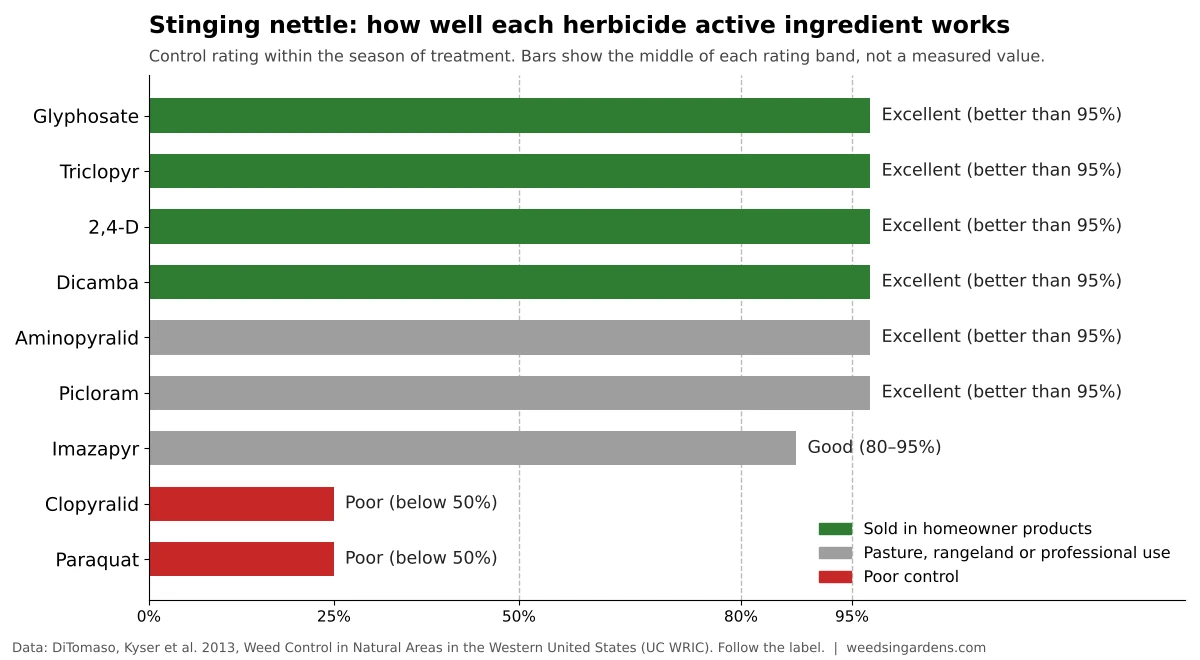
If the patch is too big to dig and you don’t have years to smother it, a systemic herbicide is method number seven. Think of it as a spot treatment on regrowth, not a blanket spray. And read the fine print on any roundup of “nettle killers”: most are guessing. The best published comparison is the University of California weed report, which rates each active ingredient from field research.
| Active ingredient | UC rating for stinging nettle | Where a homeowner can use it | Watch out for |
|---|---|---|---|
| Glyphosate | Excellent (better than 95%) | Beds, fence lines, bare ground. WSU lists it for landscape and bare-ground areas. | Non-selective: it injures any green plant it touches, lawn included. WSU: spot treatments only. |
| Triclopyr | Excellent | Broadleaf and brush killers for rough grass and fence lines. | Spares most grasses, but some lawn species are sensitive. Check the label for your turf type. |
| 2,4-D and dicamba (often sold with MCPP as a three-way mix) | Excellent (each) | Lawns. WSU lists 2,4-D + MCPP + dicamba for turf areas. | Drift and vapour can damage nearby vegetables and ornamentals. Respect the label’s temperature limits. |
| Clopyralid | Poor (below 50%) | Not worth using for nettle. | A reminder that “broadleaf killer” doesn’t mean “kills every broadleaf”. |
| Aminopyralid, picloram, imazapyr | Excellent or good | Pasture, rangeland and professional products, not home gardens. | Long soil activity; leave these to licensed applicators. |
Two cautions on that table. The ratings cover control within the season of treatment, so “excellent” means the top growth dies, not that every rhizome is gone. And UC IPM’s home-garden advice lists only isoxaben, oxadiazon and oxyfluorfen for nettles, all restricted to licensed applicators, which is its way of steering homeowners back to the fork and the mower. For how these product types differ, see our post-emergent herbicide guide.
How to spray so it actually works
- Mow first, spray the regrowth. An Extension educator answering a nettle question suggests mowing a dense stand and treating once regrowth starts. Fresh leaves take up herbicide well, and you’re not wading through shoulder-high stingers.
- Spray when it’s growing. The same answer says glyphosate can go on whenever plants are actively growing, with temperatures consistently above 50°F, and that it’s most effective on perennials in fall.
- Wait before judging. Glyphosate can take up to 14 days to show full effect; wait 2 to 3 weeks before re-treating, and expect that more than one application may be needed.
- Mind the water. Nettles love stream banks and ditches. Many garden herbicides can’t legally be used on or beside water, so check the label and choose digging or smothering there.
- Follow the label. It’s the law, and it carries the rate, the protective gear and the turf species each product is safe on.
A season-by-season plan
Nettle rewards good timing. The plant sends up new shoots from its rhizomes each spring, flowers from late May into October (Forest Service figures for the American subspecies), and holds its seed until frost. Line your work up against that rhythm and each job gets easier.
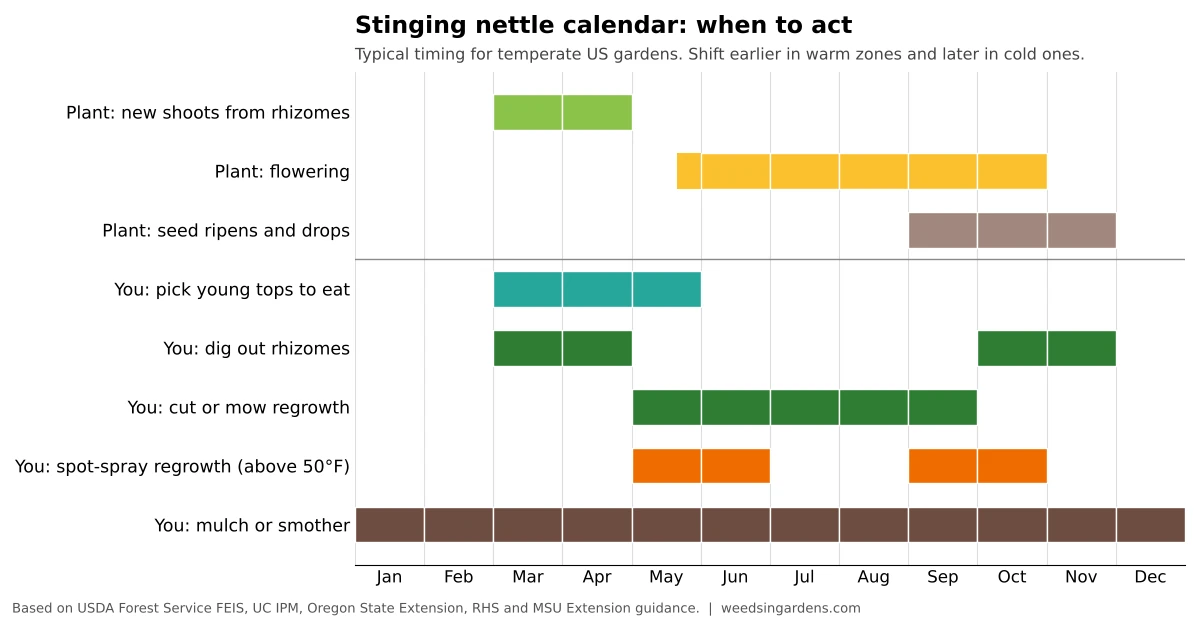
| Season | What the plant is doing | What you do |
|---|---|---|
| Early spring | New shoots rise from the rhizomes; seedlings germinate | Dig small patches while the soil is soft. Hoe seedlings. Harvest young tops if you want to eat them. |
| Late spring to summer | Rapid growth, then flowering | Cut before the tassels ripen, then cut every flush of regrowth. Spot-spray regrowth if you’ve chosen herbicide. |
| Early fall | Still green; seed ripening | Best window for a systemic spot spray on regrowth. Cut and bag any seeding stems. |
| Late fall to winter | Seed drops at frost; tops die back | Lay cardboard and deep mulch over cut patches. Dig rhizomes where the ground isn’t frozen. |
| Next year | Survivors resprout from missed rhizomes and from seed | Patrol in spring and repeat. Seed can stay viable for years, so one clean season isn’t the finish line. |
If you’ve fought mugwort or tried to get rid of thistle, this will feel familiar: creeping perennials are beaten by the second and third visit, not the first.
Before you remove it all: wildlife and kitchen uses
This is the part that makes nettle different from most weeds on this site. UC IPM advises that, because stinging nettle is native in the western US, it should only be controlled where it causes economic or health problems. NC State lists it as a larval host for red admiral, eastern comma and question mark butterflies. A patch behind the shed, cut before it seeds, costs you nothing and feeds quite a lot. For more plants in this grey zone, browse our useful weeds section.
There are honest downsides. A patch beside a path or a play area is a hazard, and the Forest Service notes that nettle pollen is a major contributor to summer hay fever. If either applies, remove it without guilt.
Eating stinging nettle safely
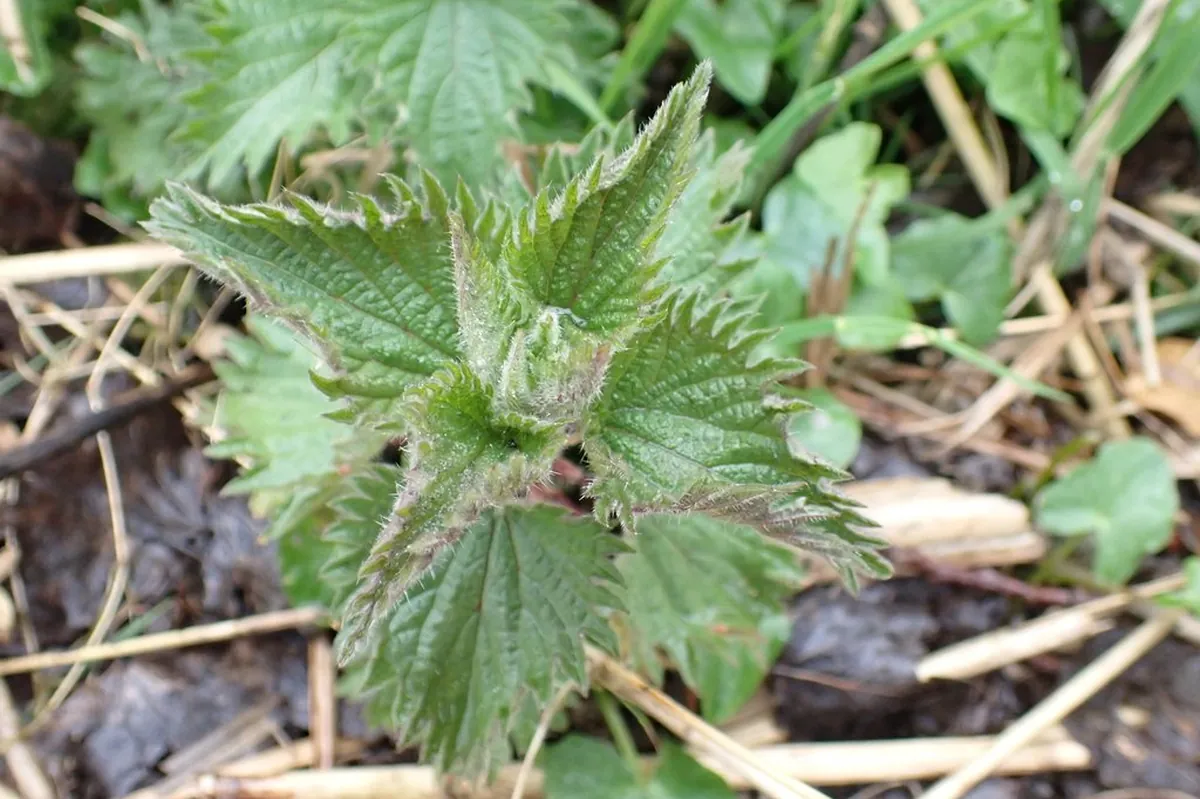
Cooked nettle is a real vegetable, not a survival food. Oregon State University Extension publishes a full guide to gathering and preparing it, and a 2013 study in the International Journal of Food Science found that a 100-gram serving of blanched or cooked nettle can supply 90% to 100% of daily vitamin A and is a good source of calcium, iron and protein. The Oregon State method, in short:
- Gear up: long sleeves, long pants and long rubber kitchen gloves; clip with sharp scissors.
- Pick early: in early spring, before the plant flowers. For less bitterness, choose leaves no more than 3 inches wide from plants no taller than 3 feet. Once flowers appear, the greens turn tough.
- Blanch: stir into water at a rolling boil for 1½ to 2 minutes, then into an ice bath. Blanching destroys the stinging hairs. About 4 to 5 cups of fresh nettles make 1 cup blanched.
- Or dry: at 95° to 115°F until crisp, for tea. Dry or blanch nettles before use; never eat them raw.
- Then cook: use the blanched leaves in almost any recipe that calls for spinach or kale.
Two cautions of our own. Never harvest from a patch that has been sprayed. And think about where it’s growing: the Forest Service review notes the plant tolerates metal-contaminated soil and grows abundantly on it, so roadsides, old industrial ground and the drip line of a painted old building are poor places to pick dinner. Nettle is also sold as a herbal remedy; that’s a question for your doctor or pharmacist, not a weed guide.
A note from the agronomist’s side
Read a nettle patch as a message before you treat it as a problem. This plant is a specialist of fertile, moist ground, so a dense stand usually marks a spot where nutrients have been piling up: an old manure heap, a leaking compost bay, a ditch that catches runoff from a fertilised lawn. Kill the nettles and leave that enrichment in place, and the bare, fertile soil will simply invite the next vigorous coloniser. The lasting fix is to give the ground a new job. Turf that’s mown, a planted and mulched bed, or a dense ground cover all hold the space that nettle would otherwise take back.
The second principle is about arithmetic, not chemistry. A rhizomatous perennial lives on stored reserves. Every method above, whether fork, mower, mulch or sprayer, works by draining that store faster than the leaves can refill it. That’s why timing and repetition matter more than which tool you pick, and why the “excellent” herbicide ratings and the “poor” mowing rating can mislead in opposite directions: a single spray that browns the tops can leave live rhizomes, and a mower used every time regrowth appears can finish a patch that one cut would only have thickened.
And the third: match the effort to the harm. A native plant that feeds butterfly caterpillars and makes a decent soup deserves a different standard from knotweed. Clear it from paths, play areas and beds without hesitation. In the far corner, a contained patch that’s cut before seeding is a reasonable thing to live with.
Stinging nettle FAQ
How do I get rid of stinging nettle permanently?
Remove or starve the rhizomes. Fork out small patches, getting as much of the creeping root as you can. For big patches, cut every flush of regrowth or smother the area under cardboard and about 8 inches of mulch for a few years. A systemic herbicide spot-sprayed on regrowth is a backup. Expect to follow up for more than one season.
Will mowing kill stinging nettle?
Occasional mowing won’t; the plant resprouts with bushy shoots. Regular cutting, such as normal lawn mowing or cutting every time regrowth appears, weakens and eventually kills it, though the RHS says this usually takes more than one growing season. Mowing before seeds ripen also stops it spreading.
What is the best weed killer for stinging nettle?
A University of California weed report rates glyphosate, triclopyr, 2,4-D and dicamba as excellent on stinging nettle, and clopyralid as poor. Glyphosate is non-selective and suits beds and fence lines as a spot treatment; 2,4-D, MCPP and dicamba mixes are the lawn option. Always follow the product label.
How long does a stinging nettle sting last?
Usually a few hours. Healthdirect Australia says very sensitive people may have symptoms for up to 36 hours, and UC IPM notes tingling can persist for more than 12 hours. Wash with soap and water, cool the skin and don’t scratch. See a doctor if pain hasn’t improved after 2 hours, and call emergency services for breathing trouble or swelling of the throat.
Is stinging nettle edible?
Yes, once it’s cooked or dried. Oregon State University Extension advises picking young leaves in early spring before flowering, wearing gloves, and blanching in boiling water for 1½ to 2 minutes, which destroys the stinging hairs. Use it like spinach. Don’t eat it raw or pick from sprayed or contaminated ground.
Is stinging nettle invasive?
It’s weedy rather than foreign in most of North America. The American subspecies is native across most of the continent, while the European subspecies is introduced. It still spreads aggressively by seed and rhizomes in rich, moist soil, and UC IPM suggests controlling it only where it causes health or economic problems.
What is the difference between stinging nettle and wood nettle?
Look at how the leaves attach. Stinging nettle has narrow, lance-shaped leaves in opposite pairs. Wood nettle has broad, egg-shaped leaves, up to 6 inches long and 4 inches wide, arranged alternately up the stem, and it prefers shady, moist woods. Both sting, so wear gloves either way.
Sources
- Schellman, A. E., & Shrestha, A. Pest Notes: Burning and Stinging Nettles. UC ANR Publication 74146, UC Statewide IPM Program.
- DiTomaso, J. M., Kyser, G. B., et al. (2013). Stinging nettle (Urtica dioica) weed report, from Weed Control in Natural Areas in the Western United States. UC Weed Research and Information Center.
- Carey, J. H. (1995). Urtica dioica. Fire Effects Information System, USDA Forest Service, Rocky Mountain Research Station.
- Washington State University Extension. Hortsense: Weeds: Stinging nettle (Urtica dioica).
- RHS Advice Team. Stinging nettles. Royal Horticultural Society.
- Macy, D., Hyde, G., Brixey, J., & Davis, O. (2022). Wild Edibles: Stinging Nettle. Oregon State University Extension Service, EM 9373.
- NC State Extension Gardener Plant Toolbox. Urtica dioica, Laportea canadensis and Boehmeria cylindrica.
- Minnesota Wildflowers. Urtica dioica (Stinging Nettle).
- Fu, H. Y., Chen, S. J., Chen, R. F., Ding, W. H., Kuo-Huang, L. L., & Huang, R. N. (2006). Identification of oxalic acid and tartaric acid as major persistent pain-inducing toxins in the stinging hairs of the nettle, Urtica thunbergiana. Annals of Botany, 98(1), 57–65. doi:10.1093/aob/mcl089
- Rutto, L. K., Xu, Y., Ramirez, E., & Brandt, M. (2013). Mineral properties and dietary value of raw and processed stinging nettle (Urtica dioica L.). International Journal of Food Science, 2013, 857120. doi:10.1155/2013/857120
- Healthdirect Australia (reviewed March 2025). Stinging plants.
- Health New Zealand. Stinging nettles.
- Ask Extension (Michigan State University Extension educator). Answer on controlling stinging nettle with glyphosate.