
It’s a crisp October weekend and the fence line has caught fire: one vine has turned scarlet, another has gone red and orange, and they’re tangled together up the trunk of the same old oak. You want them gone before the leaves drop, but you also don’t want to spend next week scratching. So which one is which?
Short answer: In the poison ivy vs Virginia creeper question, count the leaflets. Poison ivy has three leaflets, with the middle one on a longer stalk; Virginia creeper has five leaflets radiating from one point. Then confirm with the stem: poison ivy climbs with dense, dark, hairy-looking aerial roots, while Virginia creeper climbs with branched tendrils tipped with sticky discs. Poison ivy berries are waxy and whitish; Virginia creeper berries are blue-black.
That sounds simple, and most of the time it is. But young Virginia creeper shoots can carry only three leaflets, both vines blaze red in fall, and in winter there are no leaves to count at all. This guide brings together the advice of several university extension services so you can identify either vine in any season, know which one can actually hurt you (and your dog), and remove whichever one you don’t want without spreading the problem.
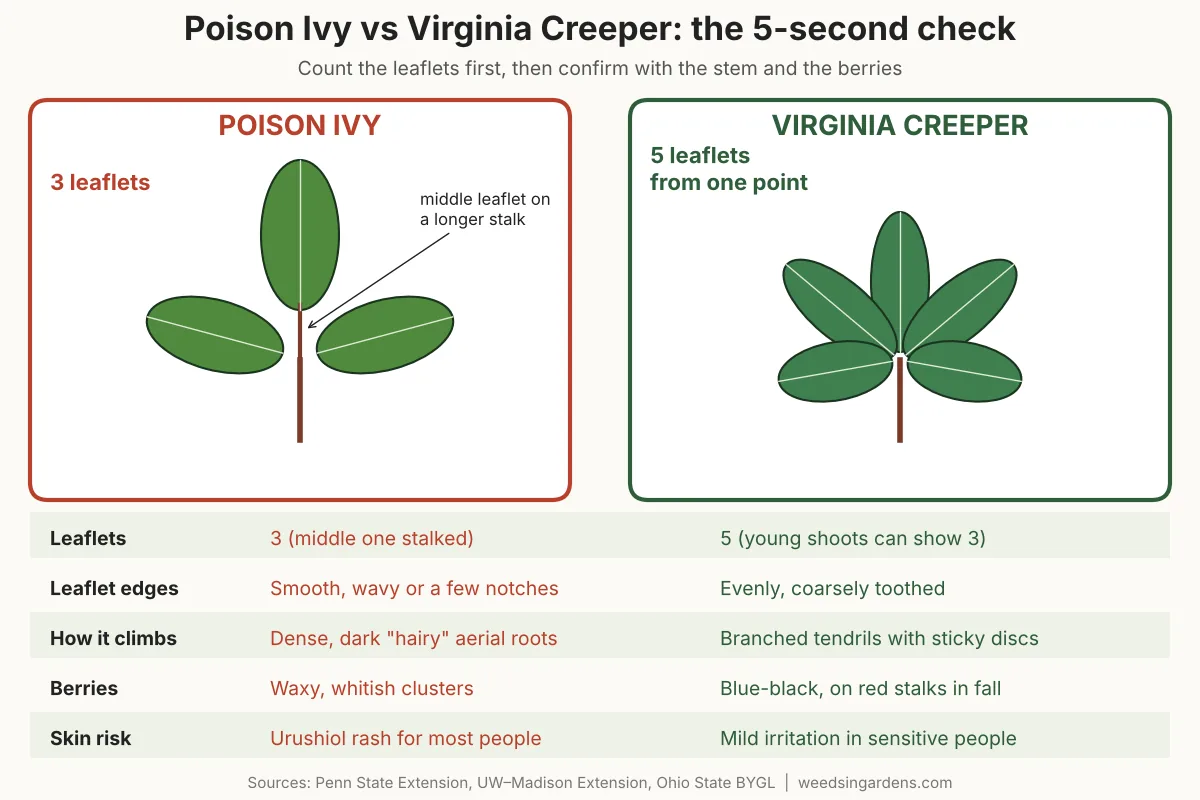
Poison Ivy vs Virginia Creeper: The Quick Comparison
Here’s the side-by-side most people need. Read across a row and you’ll usually have your answer in seconds. The two vines are not even close relatives: poison ivy (Toxicodendron radicans) belongs to the cashew and sumac family, while Virginia creeper (Parthenocissus quinquefolia) is in the grape family, according to Ohio State University Extension.
| Feature | Poison ivy | Virginia creeper |
|---|---|---|
| Leaflets per leaf | Always 3 | Usually 5 (young growth can show 3) |
| Leaflet arrangement | Middle leaflet on a noticeably longer stalk | All 5 leaflets spread from one central point, like fingers on a hand |
| Leaflet edges | Highly variable: smooth, wavy, or with a few coarse notches | Coarsely and fairly evenly toothed, at least on the upper half |
| How it climbs | Dense, dark aerial rootlets that make the stem look hairy | Branched tendrils ending in adhesive discs (holdfasts) |
| Flowers | Tiny, greenish-white, late spring to early summer | Inconspicuous greenish-white clusters, late spring to early summer |
| Berries | Waxy, whitish to cream clusters in fall | Blue-black berries about ¼ inch across, on stalks that turn red in fall |
| Fall color | Red, orange and yellow | Bright red to purple; one of the first vines to color |
| Skin risk | Urushiol oil causes an allergic rash in most people | Sap contains needle-like oxalate crystals that can irritate sensitive skin |
| Family | Anacardiaceae (cashew/sumac family) | Vitaceae (grape family) |
Sources for the table: Penn State Extension, the University of Wisconsin–Madison Extension, Ohio State and Mississippi State University Extension. The old rhymes still earn their keep: “Leaves of three, let it be; leaves of five, let it thrive,” and “Hairy vine, no friend of mine.”
How to Identify Each Vine Up Close
A quick glance works on a mature vine in summer. When you’re about to put your hands on something, though, slow down and check three things: the leaf, the stem and the fruit. Each one is a separate line of evidence, and two out of three agreeing is a lot safer than one.
Poison ivy: key ID features
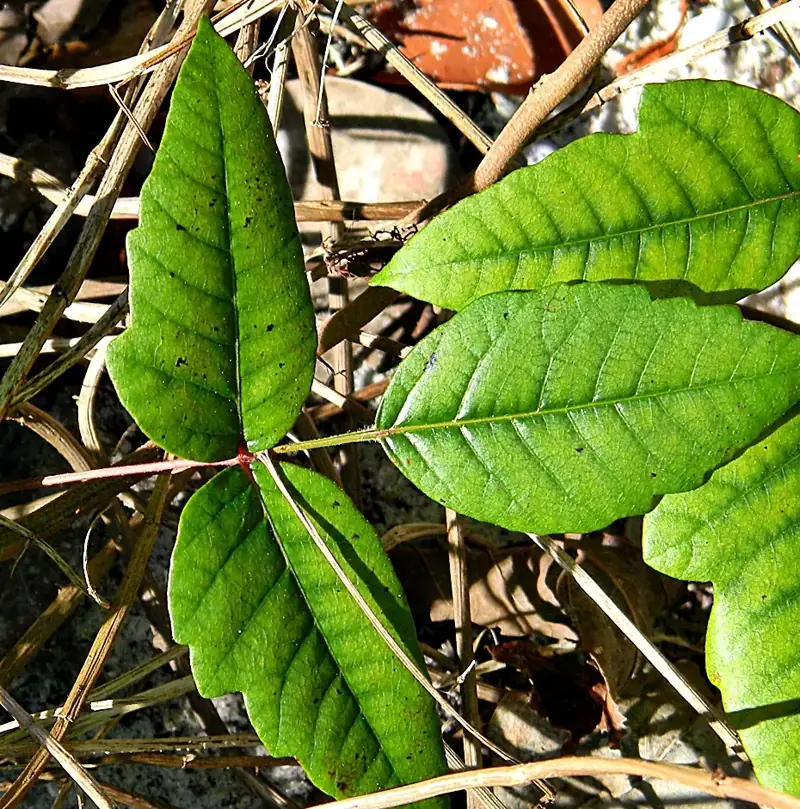
- Three leaflets, always. Mississippi State Extension stresses that leaf shape changes from plant to plant and even on the same plant, but the count of three stays the same.
- A longer middle stalk. The center leaflet sits on its own short stalk, while the two side leaflets attach almost directly. Ohio State’s version of the rhyme: “Longer middle stem, stay away from them.”
- Unpredictable edges. Leaflets can be shiny or dull, smooth-edged, wavy or coarsely notched, and one side of a leaflet is often notched while the other is smooth (Penn State).
- Three growth forms. It can run along the ground, stand up as a shrub (up to about 6 feet), or climb as a vine reaching 60 to 150 feet into trees, according to NC State Extension.
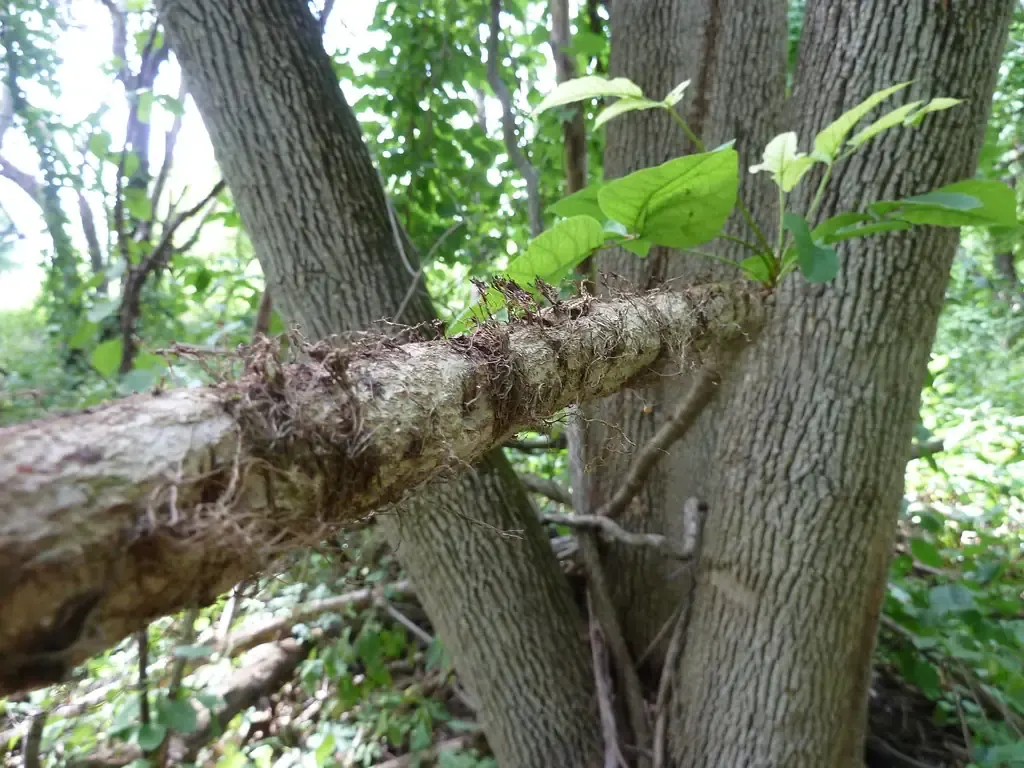
- Hairy rope stems. Climbing vines are densely covered in dark aerial rootlets that grip bark. NC State describes the bark as dark gray and densely covered in aerial roots.
- Waxy whitish berries. Clusters of small, cream-to-white berries form in early autumn and often hang on after the leaves fall.
Virginia creeper: key ID features
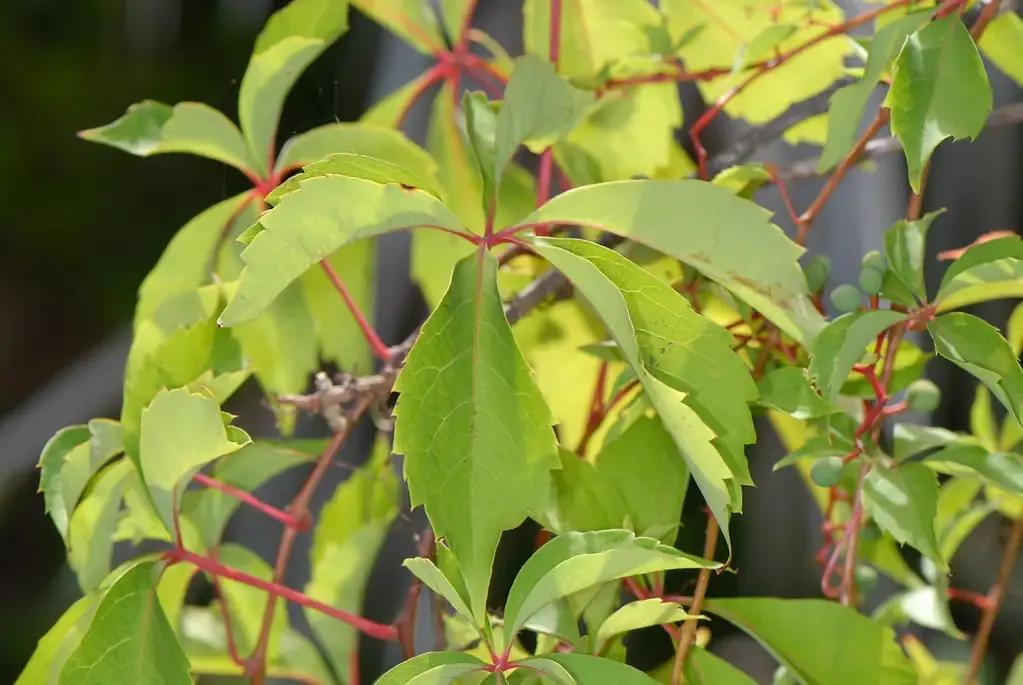
- Five leaflets from one point. The species name quinquefolia literally means “five leaves.” Each compound leaf can reach about 6 inches long on a slender stalk 6 to 8 inches long (UW–Madison).
- Toothed, pointed leaflets. Edges are coarsely toothed or serrated, tips are pointed, and each leaflet tapers to its base.
- Tendrils with suction-cup tips. Small branched tendrils grow opposite the leaves and end in adhesive discs that glue themselves to bark, brick or stone. Ohio State compares them to octopus suckers.
- Vigorous growth. The vine can climb 30 to 50 feet and, per UW–Madison, grow as much as 20 feet in a single year. On the ground it forms a groundcover about a foot high, rooting where its nodes touch soil.
- Blue-black berries on red stalks. Berries ripen from green to blue-black in late summer or early fall, and the little stalks holding them turn orange-red to red.
If you’re still unsure, look for the tendrils. Poison ivy never makes tendrils with discs. A single disc-tipped tendril on the stem in your hand is the most decisive clue in the whole poison ivy vs Virginia creeper puzzle.
When the Simple Rules Fail: 5 Common Mix-Ups
Most bad rashes come from confident mistakes, not careless ones. These are the situations where the “leaves of three” rule can lead you astray.
1. Young Virginia creeper with only three leaflets
Both UW–Madison and Ohio State note that leaves on young Virginia creeper vines or new spring growth can have just three leaflets. That’s exactly when people mistake a harmless seedling for poison ivy. The fix: look further along the same stem. Mature leaves nearby will show five, and the leaflets will all be toothed and attached at one point rather than having a stalked middle leaflet.
2. Both vines on the same tree
Penn State and Ohio State both point out that the two vines often grow side by side, even intertwined on one trunk. Birds eat the berries of both and drop the seeds under the same perching trees. So finding Virginia creeper doesn’t clear the tree. Check every stem that enters the canopy, especially the thick hairy ones hugging the bark.
3. Virginia creeper’s own aerial roots
Here’s a detail that trips up even careful gardeners. NC State Extension notes that mature Virginia creeper bark can develop aerial roots along its surface too, bright orange-brown while growing quickly. The difference is degree and texture: poison ivy’s rootlets are dense, dark and fibrous enough to make the whole vine look like a furry rope, while Virginia creeper’s are sparser and come with disc-tipped tendrils.
4. Boston ivy and other three-leaflet look-alikes
Boston ivy (Parthenocissus tricuspidata), Virginia creeper’s cousin, can produce leaves with three leaflets, and Mississippi State admits it’s “hard to tell from its poisonous brother.” Its mature leaves are usually three-lobed rather than divided, and it also climbs with disc-tipped tendrils. NC State also lists boxelder (Acer negundo) seedlings among the plants most often confused with poison ivy. Our guide to bindweed vs morning glory uses the same feature-by-feature approach for another confusing pair of vines.
5. Poison oak and poison sumac
These aren’t harmless look-alikes; they’re relatives with the same oil. Mississippi State describes oakleaf forms of poison ivy and poison oak as low shrubs with leaflets shaped like white oak leaves, still in threes. Poison sumac is different again: a shrub or small tree up to 25 feet with 7 to 13 leaflets per leaf, usually in swamps and wet bottomlands. Treat all of them like poison ivy.
If you can’t tell after checking leaf, stem and fruit, assume it’s poison ivy. Being wrong in that direction costs you a pair of gloves; being wrong in the other direction can cost you two weeks.
Poison Ivy vs Virginia Creeper: Season-by-Season ID Plan
Each season hides some clues and reveals others. Instead of relying on one feature year-round, switch to whichever clue is most reliable right now. The chart and table below summarize what to check, month by month.
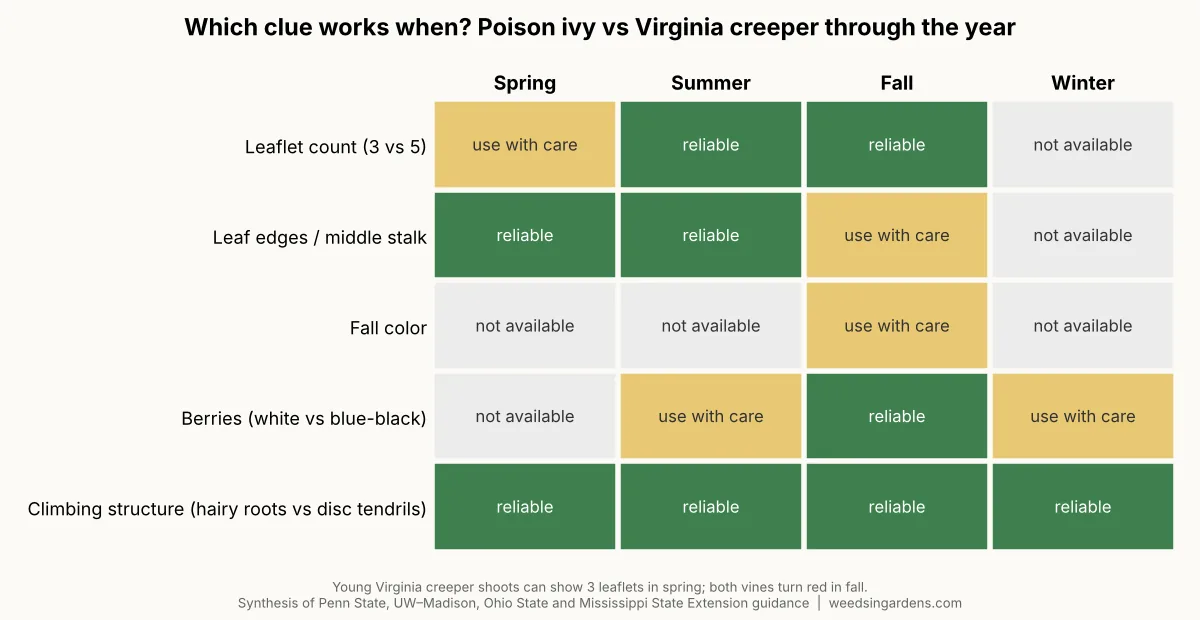
| Season | What you’ll see | Best clue to use | Watch out for |
|---|---|---|---|
| Spring (Mar–May) | New poison ivy leaves are often reddish; new Virginia creeper leaves are bronze, purplish or red-tinged | Middle leaflet stalk; toothed vs variable edges | Young Virginia creeper shoots with 3 leaflets |
| Summer (Jun–Aug) | Both vines fully green; poison ivy often glossy, Virginia creeper dull green above | Leaflet count (3 vs 5) and tendrils | Dense mixed tangles in shrubs and hedges |
| Fall (Sep–Nov) | Both turn red; Virginia creeper is often first and goes red-purple, poison ivy turns red, orange or yellow | Berries: whitish vs blue-black on red stalks | Relying on color alone; it can’t separate them |
| Winter (Dec–Feb) | Bare vines; poison ivy berries may persist | Hairy aerial roots vs disc tendrils; lingering white berries | Dead-looking poison ivy vines that still carry urushiol |
Right now, in October, berries are your friend. Mississippi State notes that once the leaves have dropped, poison ivy’s waxy white berries are an easy way to spot the plant. That makes late fall a great time to walk your property and flag every poison ivy vine for removal, as covered in our fall weed control guide.
Can Virginia Creeper Give You a Rash? Safety for People and Pets
Virginia creeper’s reputation as the “safe” look-alike is mostly deserved, but it isn’t entirely harmless. Knowing the real risk of each vine helps you decide how much protective gear you need.
Poison ivy: urushiol is the problem, and it lasts
All parts of poison ivy, including leaves, stems, flowers, berries and especially roots, contain urushiol, the oil behind the rash. Penn State notes that the plant stays poisonous even after it dies. Ohio State cites an American Skin Association estimate that about 85% of Americans are allergic to poison ivy, poison oak and poison sumac, and adds that urushiol can stay active on surfaces such as tools and clothing for months to years.
- Wash exposed skin with warm water, an oil-cutting soap and a washcloth as soon as possible; Ohio State notes that washing within about 5 minutes can lessen or prevent a reaction.
- Pets, tools, clothes and shoes can all carry the oil to your skin. Penn State recommends washing clothes in hot water with a strong degreasing detergent, and cleaning tools with soap and water followed by 70% alcohol.
- Never burn poison ivy. Smoke carries urushiol and can cause serious lung and eye problems (Penn State; NC State).
Virginia creeper: a milder irritant, but berries are toxic
UW–Madison explains that Virginia creeper’s tissues and sap contain raphides, microscopic needle-like calcium oxalate crystals that can cause contact dermatitis, including skin irritation and blisters, in sensitive people. That’s a mechanical and chemical irritation, not the immune-system allergy that urushiol triggers, so most people handle the vine without trouble. If you have sensitive skin, gloves are still a good idea.
The berries are a different matter. UW–Madison calls them inedible to humans and moderately toxic to most mammals because of their oxalic acid content, and the Pet Poison Helpline warns that eating the berries or foliage can cause severe gastrointestinal distress in pets. Birds, on the other hand, eat them freely. If you have a dog that eats everything, pull or prune fruiting vines within reach. Poison ivy is less of a direct danger to dogs, but their fur readily transfers urushiol to you.
How to Remove Poison Ivy and Virginia Creeper (Safely)
Before you reach for a sprayer, ask whether you need to remove both. Virginia creeper is a native vine that feeds songbirds and gives some of the best fall color in the landscape. The University of Georgia suggests simply pruning it back where it’s manageable. Poison ivy near paths, play areas or doors is another story: that one should go.
Decision table: what to do with each vine
| Situation | Poison ivy | Virginia creeper |
|---|---|---|
| Seedlings in beds or lawn edges | Pull when soil is moist, with gloves and a plastic bag over your hand; bag and trash it | Hand-pull or dig when soil is moist |
| Vine climbing a tree | Cut the vine near the ground and paint the fresh stump with triclopyr or glyphosate; leave the upper vine to die in place | Cut near the ground and paint the stump, or simply prune it to keep it in bounds |
| On a house, gutter or painted wall | Cut and treat the base; remove dead vine later with full protection | Remove early; NC State warns its holdfasts can ruin painted surfaces and damage gutters, shutters and wiring |
| Large groundcover patch | Spot-spray regrowth with a labeled product; expect a multi-year job (Penn State) | Spot-treat or mow repeatedly; resprouts from rooted nodes |
| Mixed tangle in shrubs | Cut-stump treatment avoids spraying shrub foliage | Prune; treat only if it’s smothering the shrub |
Herbicide options by active ingredient
Both vines are woody perennials, so the goal is to move herbicide down into the roots. Leaf burn alone just buys you a few weeks. The products below are standard extension recommendations; always read and follow the label for your site, rate and grass type.
- Triclopyr (brush killers and some poison ivy products). In a Weed Technology field study, triclopyr treatments controlled Virginia creeper 93–98% eleven months after application, compared with 63% for glyphosate. It’s selective, so grass generally tolerates it, but many warm-season turf species are sensitive; check the label before using it in a lawn.
- Glyphosate (non-selective). It kills grass and anything else it touches, so use it as a cut-stump paint or a careful spot treatment. UGA recommends painting freshly cut stems with a 41%-or-stronger glyphosate product at full or half strength, then treating regrowth once shoots are 6 to 12 inches long with about a 5% solution (roughly 7 ounces of a 41% product per gallon of water).
- 2,4-D (broadleaf herbicide). The same Weed Technology study found 88–90% control of Virginia creeper with 2,4-D, so lawn broadleaf products containing it can help with creeping runners in turf.
Timing matters as much as the product. UGA notes that cut-stem treatments work better in fall, when the plant is moving sugars down to its roots. That’s now. University of Idaho Extension adds a useful reality check: foliar herbicides are often disappointing on established Virginia creeper, and cut-stump treatment of older vines is more dependable (Jacobsen, University of Idaho Extension). For a full, step-by-step poison ivy plan, see our guide on how to kill poison ivy for good, and for more on spray products in general, our post-emergent herbicide guide.
Non-chemical options
- Pulling and digging: works best after rain, when roots slide out whole. Penn State suggests putting a heavy plastic bag over your gloved hand, pulling the plant, then turning the bag inside out over it.
- Repeated cutting: NC State lists repeated mowing as a way to wear down poison ivy, and the same principle (starving the roots by removing leaves again and again) applies to Virginia creeper.
- Goats: Penn State notes that goats love poison ivy and can clear large hillside patches.
- What not to do: don’t compost or burn poison ivy, and don’t use a string trimmer on it, since it sprays oil onto your clothes and skin. Bag it and put it in the trash. Our article on how to dispose of invasive plants covers safe disposal in more detail.
A Note from the Agronomist’s Side
The reason poison ivy vs Virginia creeper confuses so many people is that they’ve converged on the same lifestyle. Both are native woody vines that start in the shade, climb toward the light, and depend on birds to plant their seeds. Birds perch in the same trees and fence lines, so the two vines end up growing together. Wherever you find one, you should expect the other.
That’s also why I’d push you away from single-feature ID. Leaf count is a great first filter, but it fails on juvenile Virginia creeper. Fall color fails completely. The climbing structure is the most reliable trait because it reflects a genuine difference in how each plant is built: grape-family vines climb with modified shoots (tendrils), while poison ivy anchors with roots. Biology like that doesn’t change with the season or the plant’s age.
On control, the Weed Technology numbers are worth taking seriously. Glyphosate’s weaker result on Virginia creeper (63% versus 93–98% for triclopyr) fits what you’d expect from a sprawling vine that roots wherever its nodes touch soil: it’s hard to get enough product into a sprawling, multi-rooted plant through the leaves. That’s the logic behind cut-stump treatment. You deliver concentrated herbicide straight into the vascular tissue, right where it can travel to the roots, and you use far less product overall.
Finally, a word on priorities. Poison ivy around your house is a health hazard, and removing it is entirely justified. Virginia creeper is mainly a management question: it can damage siding and gutters, and its berries aren’t pet-friendly, but on a fence or a woodland edge it’s an excellent wildlife plant. If you’re tidying a landscape full of truly invasive weeds, spend your effort there first.
FAQ: Poison Ivy vs Virginia Creeper
How can you tell poison ivy from Virginia creeper quickly?
Count the leaflets. Poison ivy has three, with the middle leaflet on a longer stalk; Virginia creeper usually has five spreading from one point. Confirm with the stem: poison ivy has hairy aerial roots, while Virginia creeper has tendrils with sticky discs.
Is Virginia creeper poisonous to touch?
Not in the way poison ivy is. Virginia creeper has no urushiol, but its sap contains needle-like calcium oxalate crystals (raphides) that can irritate the skin of sensitive people, according to University of Wisconsin–Madison Extension. Wear gloves if your skin reacts easily.
Can Virginia creeper have three leaflets?
Yes. Young vines and new spring shoots sometimes have only three leaflets, which is a major cause of confusion. Check older leaves on the same stem for five leaflets, and look for disc-tipped tendrils, which poison ivy never has.
Are Virginia creeper berries poisonous to dogs?
Yes. The berries contain oxalic acid, and the Pet Poison Helpline warns that eating the berries or foliage can cause severe gastrointestinal upset in pets. Contact your vet or a pet poison hotline if your dog eats them.
How do you identify poison ivy vs Virginia creeper in winter?
Look at the bare stem. A vine covered in dense, dark, hair-like rootlets is poison ivy; a vine with branched tendrils ending in small discs is Virginia creeper. Lingering waxy white berries also point to poison ivy. Remember that dead poison ivy still contains urushiol.
Do poison ivy and Virginia creeper turn red in fall?
Both do, so color won’t separate them. Virginia creeper is usually one of the first vines to color and turns bright red to purple, while poison ivy turns red, orange or yellow. Check berries instead: whitish for poison ivy, blue-black for Virginia creeper.
What kills both poison ivy and Virginia creeper?
Triclopyr is the most effective single active ingredient for both woody vines, especially as a cut-stump treatment in fall. Glyphosate also works as a stump paint but is less effective as a foliar spray on Virginia creeper. Always follow the product label.
Sources
- Koeneke, M. A. (2025). Virginia Creeper and Poison Ivy Identification with Control. Penn State Extension.
- University of Wisconsin–Madison Extension. Virginia Creeper, Parthenocissus quinquefolia. Wisconsin Horticulture.
- Scheckelhoff, B. (2020). Woodland Wonders: A Tale of Two Vines. Buckeye Yard & Garden onLine, The Ohio State University.
- Strickland, B. Identifying Poison Ivy (IS0642). Mississippi State University Extension Service.
- NC State Extension Gardener Plant Toolbox. Toxicodendron radicans (Eastern Poison Ivy) and Parthenocissus quinquefolia (Virginia Creeper).
- Richardson, R. J., Marshall, M. W., Uhlig, R. E., & Zandstra, B. H. (2009). Virginia creeper (Parthenocissus quinquefolia) and wild grape (Vitis spp.) control in Fraser fir. Weed Technology, 23(1), 184–187.
- Czarnota, M. Control troublesome vines in your landscape. University of Georgia CAES Field Report.
- Jacobsen, T. War on Weeds: Virginia creeper. University of Idaho Extension (via Post Register Farm & Ranch).
- Pet Poison Helpline. Virginia Creeper.