
It’s late fall. The lawn has slowed down, the leaves are mostly raked, and then you notice them: skinny, dark-green spikes poking up above the grass in tidy clumps, growing faster than anything else in the yard. You mow, and the whole street smells like a pizza kitchen. A week later, they’re back.
Short answer: In the wild onion vs wild garlic question, the fastest test is the leaf. Snap one and look at the cut end: wild garlic (Allium vineale) has round, hollow leaves like a drinking straw, while wild onion (Allium canadense) has flat, solid leaves. Both are cool-season perennials that grow from bulbs, and both are controlled the same way in lawns: repeat herbicide treatments in fall and late winter, combined with a thicker, healthier turf (University of Georgia; Cornell CALS).
By the end of this guide you’ll be able to tell the two apart in ten seconds, rule out the look-alikes that aren’t alliums at all, pick an herbicide that’s safe for your type of grass, and time it so you hit the bulbs instead of just trimming the tops.
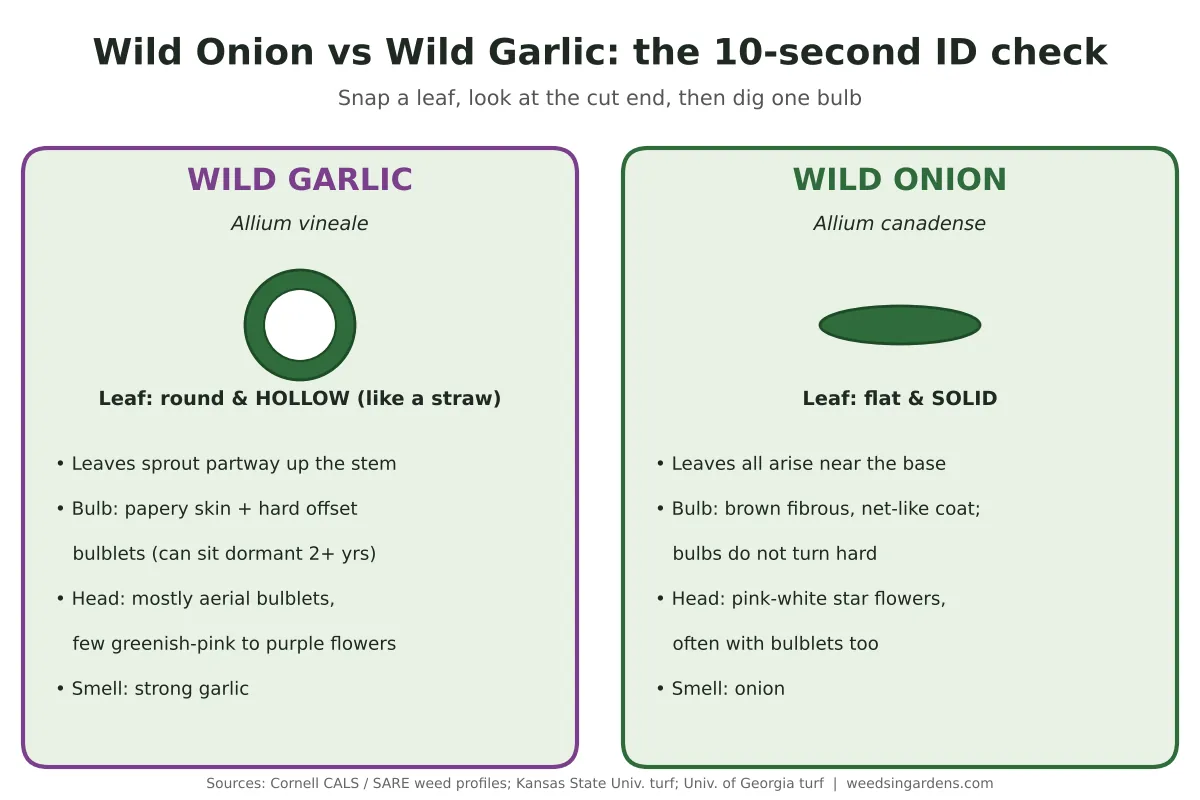
Wild Onion vs Wild Garlic: The Key Differences at a Glance
From the street, these two weeds are almost impossible to tell apart. Mississippi State University Extension calls them “almost indistinguishable from a distance,” and both release the same alliaceous smell when crushed (MSU Extension). Up close, though, four features settle it.
| Feature | Wild garlic (Allium vineale) | Wild onion (Allium canadense) |
|---|---|---|
| Leaf cross-section | Round and hollow | Flat and solid |
| Where leaves attach | Partway up the flowering stem, to about half its height | Near the base of the plant |
| Bulb coat | Thin, membranous/papery skin | Brown, fibrous, net-like (reticulate) coat |
| Offset bulbs | Several offset bulblets, flattened on one side; some turn hard and dormant | No hard, dormant offsets; bulbs stay soft |
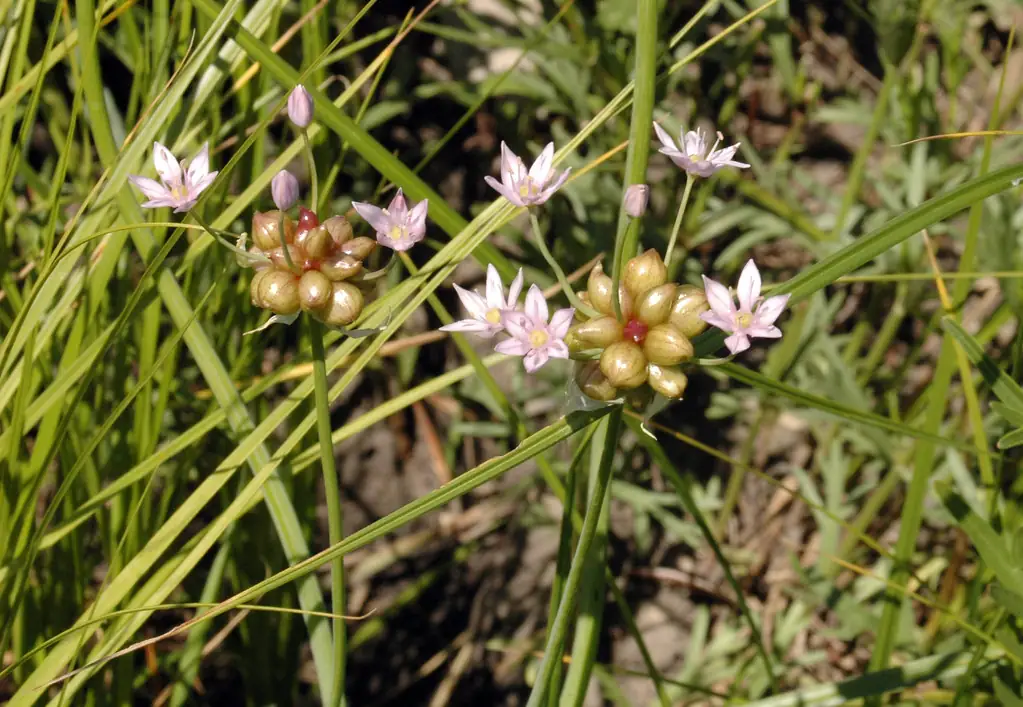
| Flower head | Mostly aerial bulblets with a few greenish-white, pink or purple flowers | Pink-white star-shaped flowers, often mixed with bulblets |
| Smell | Strong garlic | Onion |
| How common in lawns | Far more prevalent in Tennessee lawns, per UT Extension | Often grows on the same sites |
That last row of the wild onion vs wild garlic comparison matters more than it looks. University of Tennessee Extension notes that wild garlic is “far more prevalent” than wild onion in Tennessee lawns (UT Extension). So if you’re in the South or Mid-Atlantic and you haven’t checked yet, the odds lean toward garlic.
How to Identify Wild Garlic and Wild Onion Step by Step
You don’t need a hand lens. You need one leaf, one trowel and about a minute. Here’s the order that settles wild onion vs wild garlic fastest.
1. Snap a leaf and look at the cut end
This is the single most reliable field test. Wild garlic leaves are slender, round and hollow; wild onion leaves are flat and solid when cut (Cornell CALS). Kansas State University describes the onion’s shoots as “more flat in cross section” (K-State). If you can blow through it like a tiny straw, it’s garlic.
2. Follow the leaves down
On wild garlic, leaves sheath the flowering stem up to about half the plant’s height. On wild onion, the leaves arise near the base of a solid flowering stem (UGA). In a mown lawn you won’t always see a flowering stem, so treat this as a back-up clue.
3. Dig up one bulb
Push a narrow trowel down beside a clump and lift it. Wild garlic’s central bulb wears a thin membrane and usually carries small offset bulblets, flattened on one side. Wild onion’s bulb has a fibrous, net-like coat and no offset bulblets (UGA; K-State). That net-like coat looks a bit like the husk on a coconut, just much finer.
4. Check the flower head in spring
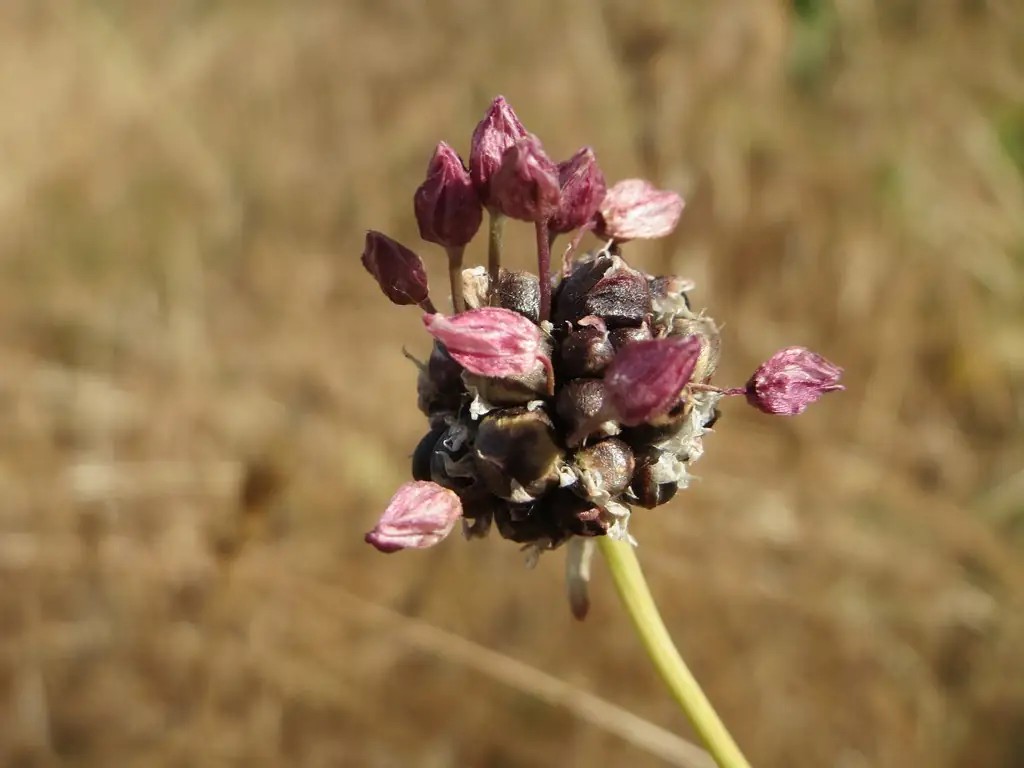
Wild garlic’s head is mostly a cluster of small, teardrop-shaped aerial bulblets, sometimes topped with a few maroon, pink or greenish-white flowers. Each bulblet may sprout a thin green leaf right on the head (Cornell). Wild onion tends to show more obvious pink-white, star-shaped flowers, but it can carry bulblets too, so the head alone isn’t a safe ID (K-State).
Look-alikes that are not onions or garlic
Two plants regularly get lumped in with “onion grass,” and neither smells like onion. Star-of-Bethlehem (Ornithogalum umbellatum) has white star flowers and a prominent white stripe down the middle of each leaf, and it lacks the onion-family odor (Cornell). Death camas (Zigadenus/Toxicoscordion species) has grass-like, V-shaped leaves and is poisonous in all its parts (Montana State University Extension).
The rule is simple: no onion or garlic smell, no allium. Once you’ve settled wild onion vs wild garlic, a quick check for impostors is still worth it. If you’re dealing with a grassy-looking weed that fails both the smell test and the hollow-leaf test, our guide to weeds that look like grass will help you narrow it down, and nutsedge is another frequent suspect (see yellow and purple nutsedge).
Why Wild Garlic and Onion Keep Coming Back
If you’ve pulled these weeds before and watched them return, you didn’t do anything wrong. The plant’s whole strategy is built around surviving exactly that.
Wild garlic makes four kinds of bulbs. Plants too young to flower form a terminal bulb. Flowering plants usually form one large soft offset bulb that sprouts in fall, plus one to four hard offset bulbs that can stay dormant for two or more seasons before producing new plants. On top of that come the aerial bulblets on the flower head. Seed production is rare in much of the US, so nearly every new plant comes from a bulb or bulblet (Cornell CALS).
Kansas State adds that both species make hard and soft bulblets: soft ones sprout in autumn, while hard ones overwinter and sprout in spring and early summer (K-State). Put those together and you get a weed with staggered emergence. Whatever you spray this November, some bulbs underground haven’t even woken up yet.
That’s why every credible extension source talks about control over years, not weeks. Expect a big drop in year one and a mop-up in years two and three.
- Hand-pulling snaps the leaves and leaves the bulb behind. Penn State Extension calls pulling “not effective” for this reason (Penn State).
- Mowing alone won’t kill it. It can reduce vigor and bulb production, but the plants are adapted to low mowing (UT Extension; MSU).
- There’s no pre-emergent fix. Penn State notes that no pre-emergent herbicides work against these bulb weeds (Penn State).
- Contaminated fill soil is a common way they arrive, and they’re more of a problem in poorly drained soils (K-State).
When to Treat: A Season-by-Season Plan
Timing is the difference between killing bulbs and giving the weed a haircut. Both species sprout from underground bulbs every fall, grow through winter, form new bulbs and bulblets in spring, then die back and sit dormant through summer (MSU; UT Extension). Your two best windows sit on either side of winter.
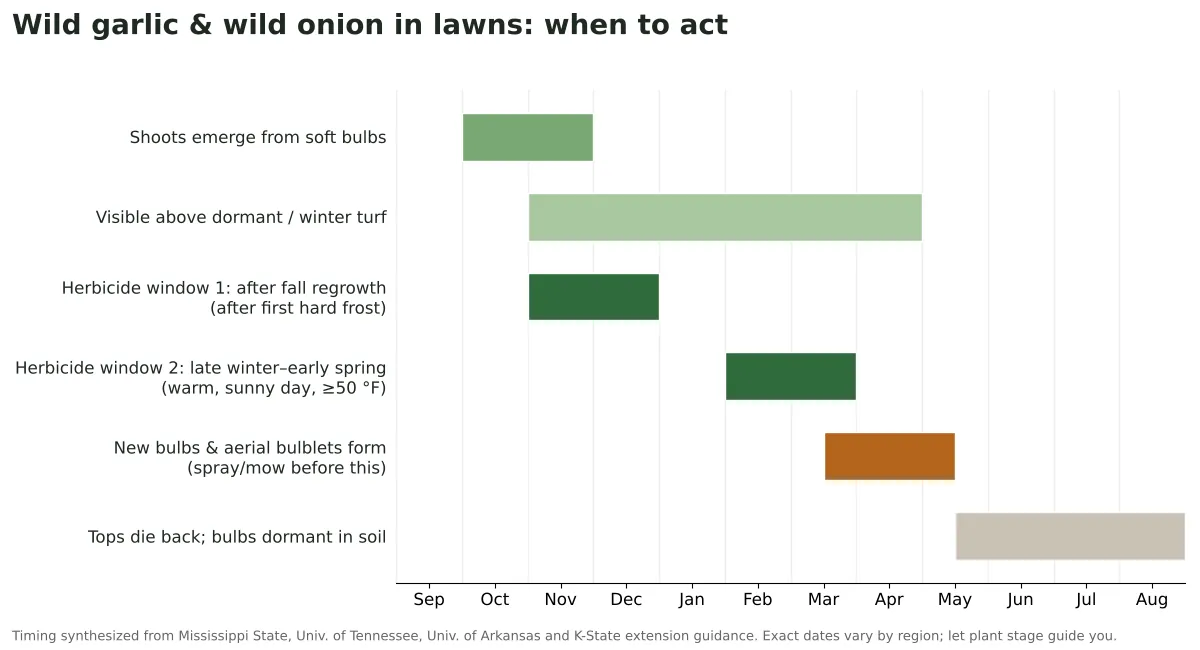
| Season | What the weed is doing | What you should do |
|---|---|---|
| Early fall (Sep–Oct) | Soft bulbs sprouting | Fix thin turf: overseed cool-season lawns, correct drainage. Don’t spray yet; let shoots emerge. |
| Late fall (Nov–Dec) | Actively growing above the turf | First herbicide treatment after fall regrowth, following the first hard frost (UT). Arkansas recommends a November start for 2,4-D-based programs. |
| Winter (Dec–Jan) | Slow growth; very visible in dormant warm-season lawns | Spot-dig small clumps when soil is moist. Hold sprays for warmer spells. |
| Late winter–early spring (Feb–Mar) | Rapid growth before bulb formation | Second treatment on a warm (at least 50°F), sunny day with good soil moisture (Arkansas). |
| Mid-spring (Apr–May) | Forming new bulbs and aerial bulblets | Mow before heads form to cut bulblet production. Late sprays are less useful. |
| Summer (Jun–Aug) | Tops gone; bulbs dormant | Nothing to spray. Build turf density for fall. |
One more detail from the University of Arkansas: if you rely on 2,4-D or three-way products, plan on three applications: November, the following March, and again the next November (University of Arkansas). That’s the realistic pace for the cheaper products.
Best Herbicides for Wild Garlic and Wild Onion in Lawns
These weeds count as broadleaves, so many broadleaf lawn products work on them. But they don’t all work equally well. Mississippi State rated the common options using research by Small and colleagues published in HortTechnology in 2019 (MSU Extension; Small et al., 2019). The table below summarizes that rating along with turf safety. Always check that your grass is on the label before you buy.
| Active ingredient(s) | Est. control | Generally labeled safe on | Avoid on / caution |
|---|---|---|---|
| Metsulfuron | Excellent | Bermuda, centipede, St. Augustine, zoysia, seashore paspalum | Not recommended on perennial ryegrass; possible tall fescue injury |
| Metsulfuron + sulfentrazone | Excellent | Bermuda, centipede, St. Augustine, zoysia, tall fescue | Carpetgrass, seashore paspalum, perennial ryegrass |
| Imazaquin | Excellent | Bermuda, centipede, St. Augustine, zoysia, seashore paspalum | Cool-season grasses (tall fescue, ryegrass) |
| Sulfosulfuron | Excellent | Bermuda, centipede, St. Augustine, zoysia, seashore paspalum | Cool-season grasses |
| 2,4-D + dicamba + MCPP or MCPA (three-way) | Good | Most cool- and warm-season grasses (check label) | St. Augustine and centipede with some formulations; carpetgrass |
| Carfentrazone + 2,4-D + MCPP + dicamba | Good | Bermuda, centipede, St. Augustine, zoysia, cool-season grasses | Carpetgrass |
| 2,4-D alone | Fair | Bermuda, zoysia, tall fescue, perennial ryegrass | Centipede (not recommended); St. Augustine (possible injury) |
| Dicamba alone / halosulfuron | Fair | Most turf species | Better used for other weeds |
Spray tips that make a real difference
- Add a non-ionic surfactant. The waxy, upright leaves shed spray. K-State recommends a non-ionic surfactant, wetting agent or sticker with any spray, and MSU says the sulfonylurea products need one for satisfactory control. Arkansas uses 0.25% non-ionic surfactant with metsulfuron (K-State; Arkansas).
- Mow first, then spray. This is the rare weed where it helps. Mowing immediately before application can improve uptake (K-State; UT Extension).
- Then don’t mow for two weeks so the herbicide can move down to the bulb (UT Extension).
- Watch the thermometer. Days below 55°F can delay control, and days above 85°F raise the risk of turf injury. Most labels favor 55–80°F (MSU). For metsulfuron in late winter, Arkansas says at least 50°F and sunny.
- Pick ester 2,4-D if you use 2,4-D. The University of Arkansas notes ester formulations are more effective on garlic, and that 2,4-D-sensitive grasses like centipede and St. Augustine shouldn’t be treated unless dormant (Arkansas).
For a deeper look at how these products work and how to apply them safely, see our guide to post-emergent herbicides.
The dormant warm-season shortcut
If you have zoysia or another warm-season lawn that’s fully brown and dormant, K-State notes that glyphosate can be used on wild onion and garlic before spring green-up. It is not recommended for cool-season grasses, which stay green and would be killed (K-State). Make sure the turf is completely dormant, and follow the label.
How to Get Rid of Wild Garlic in a Lawn Without Chemicals
Maybe you have kids and pets on the lawn, or only a dozen clumps. You can still win; it just takes more patience.
Dig, don’t pull
University of Tennessee Extension recommends digging plants out with a thin trowel when the soil is somewhat moist (UT Extension). Go straight down beside the clump, lever up the whole bulb cluster, and bag it. Don’t drop it in the compost; loose bulblets can survive and sprout.
Mow before the heads form
Mowing when flower stalks are lengthening but not yet full height prevents or reduces aerial bulblet production, though the plant will still make offset bulbs at its base (Cornell). In a lawn, your regular early-spring mowing does much of this for you.
Thicken the turf
Mississippi State lists turf density as “critical” to suppressing winter-emerging weeds like wild garlic and onion, alongside picking a grass that suits your shade and soil (MSU). K-State adds that correcting drainage helps lawn grasses compete (K-State). If you’re dealing with soggy spots, our overwatered lawn guide covers the fixes.
Or simply wait it out
Penn State points out an honest option most guides skip: the foliage is mainly a visual problem early in the season, and with natural die-back and mowing it disappears by summer (Penn State). If a few clumps don’t bother you, you can let them be.
Common Mistakes That Keep Onion Grass Coming Back
| Mistake | Why it fails | Do this instead |
|---|---|---|
| Yanking plants by the leaves | Leaves snap off; bulbs stay in the soil | Dig the whole clump with a trowel in moist soil |
| One spray and done | Hard bulbs sprout later, sometimes years later | Treat fall and late winter, and repeat next season |
| Spraying without surfactant | Waxy, upright leaves shed droplets | Add a non-ionic surfactant if the label allows |
| Mowing a day after spraying | Removes leaves before the herbicide reaches the bulb | Mow just before you spray; then wait 2 weeks |
| Using metsulfuron or imazaquin on tall fescue or ryegrass | Risk of serious turf injury | Use a three-way product labeled for cool-season grass |
| Spraying in late spring | New bulbs are already formed | Spray Nov–Dec and Feb–Mar instead |
| Applying a pre-emergent | Doesn’t control bulb weeds | Save pre-emergents for annual weeds |
If you’re already planning a fall program for other weeds, wild garlic fits neatly into it. See our fall weed control guide and the rundown of winter annual weeds that often grow alongside it, like henbit. You’ll find more look-alikes in our lawn weeds section.
A Note from the Agronomist’s Side
Here’s a useful way to think about this weed. For control purposes, wild onion vs wild garlic matters less than you’d expect: both respond to the same products and timing. What matters is the bulbs. You’re not really fighting the plant you see. You’re fighting a bank account of bulbs underground, and every spring the plant makes deposits. Every treatment you make is a withdrawal. The job is to keep withdrawing faster than the plant can deposit, and to keep that up until the account runs dry.
That framing explains almost every recommendation in this guide. Fall and late-winter sprays work because that’s when the leaves are actively sending sugars down to the bulb, so the herbicide hitches a ride. Spring sprays disappoint because new bulbs are already forming. Mowing before you spray helps because a fresh cut opens a path through that waxy cuticle. And the multi-year timeline isn’t a sign of failure. It’s the hard, dormant offsets doing exactly what they evolved to do.
My rule of thumb: if you can count the clumps, dig them. If you can’t, pick the strongest product your grass type tolerates, add a surfactant, and commit to two treatments a year for two to three years. Pair that with thicker turf, and the population usually becomes a non-issue. Skip the thicker turf, and you’ll be back here next November.
One safety note for pet owners: wild garlic and onion are alliums, and the ASPCA lists garlic as toxic to dogs, cats and horses, with signs including vomiting and red blood cell damage (ASPCA). Most dogs don’t seek it out, but if yours grazes on lawn plants, dig out the clumps where it plays.
FAQ
Wild onion vs wild garlic: how can you tell them apart?
Snap a leaf. Wild garlic leaves are round and hollow, while wild onion leaves are flat and solid. You can confirm by digging a bulb: wild onion has a fibrous, net-like coat, while wild garlic has a papery skin and small offset bulblets (University of Georgia; Cornell).
What kills wild garlic in the lawn permanently?
Metsulfuron, imazaquin, sulfosulfuron and metsulfuron + sulfentrazone gave excellent control in Mississippi State’s ratings, and three-way 2,4-D products gave good control. Because hard bulbs sprout over several years, plan on repeat treatments in fall and late winter for two to three seasons, and always follow the label for your grass type.
When is the best time to spray wild onions?
Spray in late fall after the plants regrow (after the first hard frost) and again in late winter or early spring, before new bulbs form. Choose a sunny day of at least 50°F; most labels favor 55–80°F. Mow just before spraying and wait two weeks before mowing again.
Is wild garlic in the lawn safe for dogs?
Wild garlic is an allium, and the ASPCA lists garlic as toxic to dogs, cats and horses. Most dogs don’t eat it, but if yours grazes on lawn plants, dig out the clumps in its play area.
Will pulling wild onions get rid of them?
Usually not. The leaves snap off and the bulb stays in the ground. Digging the whole clump with a narrow trowel when the soil is moist works much better for small patches.
Does vinegar or boiling water kill wild garlic?
They can burn the leaves, but they don’t reach the bulbs, so the plant regrows. For small numbers, digging is more effective; for large patches, a selective lawn herbicide applied at the right time is the reliable route.
Is onion grass the same as wild garlic?
“Onion grass” is a common name used for both wild garlic and wild onion. In many southern and mid-Atlantic lawns, the plant people call onion grass is actually wild garlic, which UT Extension says is far more prevalent in Tennessee.
Sources
- University of Georgia, GeorgiaTurf. Wild Garlic (Allium vineale).
- Cornell University CALS Weed Science. Weed Profiles: Wild Garlic.
- Kansas State University Turfgrass. Lawn Problem Solver: Wild Onion and Garlic (Allium spp.). Updated 2026.
- McCurdy, J. (2020). Controlling Wild Garlic in Mississippi Lawns. Mississippi State University Extension, Publication 3511.
- Small, Z.D., McCurdy, J.D., Begitschke, E.D., & Richard, M.P. (2019). Herbicides for Control of Wild Garlic in Turfgrass. HortTechnology 29(6): 838–841.
- University of Tennessee Extension, Smith County. Controlling Wild Garlic in the Lawn.
- University of Arkansas Division of Agriculture. Turfgrass Weed Control Database: Wild Garlic.
- Abbey, T. (2025). Wild Onion and Wild Garlic. Penn State Extension.
- Montana State University Extension, Powder River County. Native Forbs Are Blooming, Including Death Camas (2020).
- ASPCA Animal Poison Control. Garlic: Toxic and Non-Toxic Plants.