
Short answer: the most reliable way to get rid of henbit is to control it in fall, right when it germinates. In lawns, apply a fall pre-emergent (prodiamine, dithiopyr, isoxaben or pendimethalin) or spray a 2,4-D-based broadleaf herbicide in late fall while seedlings are still small. In garden beds, pull or hoe young plants and cover bare soil with 3 inches of mulch. Henbit is a winter annual, so every plant you stop before it flowers in spring is up to 200 seeds that never reach your soil.
Henbit (Lamium amplexicaule) shows up exactly when the garden slows down: it sprouts from September onward, stays green all winter and covers thin turf with pink-purple flowers in early spring. Below is how to confirm the ID (and tell it from purple deadnettle), why fall is the window that matters, and the season-by-season plan to get rid of henbit with and without herbicides.
Table of Contents
How to identify henbit
Henbit is a low, sprawling member of the mint family with square (four-sided) stems that are sparsely hairy and green to purplish. According to the Purdue Landscape Report, the features to check are all in the leaves and flowers:
- Upper leaves clasp the stem. They are rounded, deeply lobed and attach directly without a leaf stalk, so each pair looks like a ruffled collar around the stem.
- Lower leaves have short stalks and rounded, scalloped edges. All leaves are hairy.
- Flowers are small, tubular and pinkish-purple, arranged in whorls where the upper leaves meet the stem. In Indiana they open mainly in April, but can appear from March to November.
- Habit: stems sprawl along the ground, then the tips rise 4 to 12 inches. Plants are easy to pull when small.
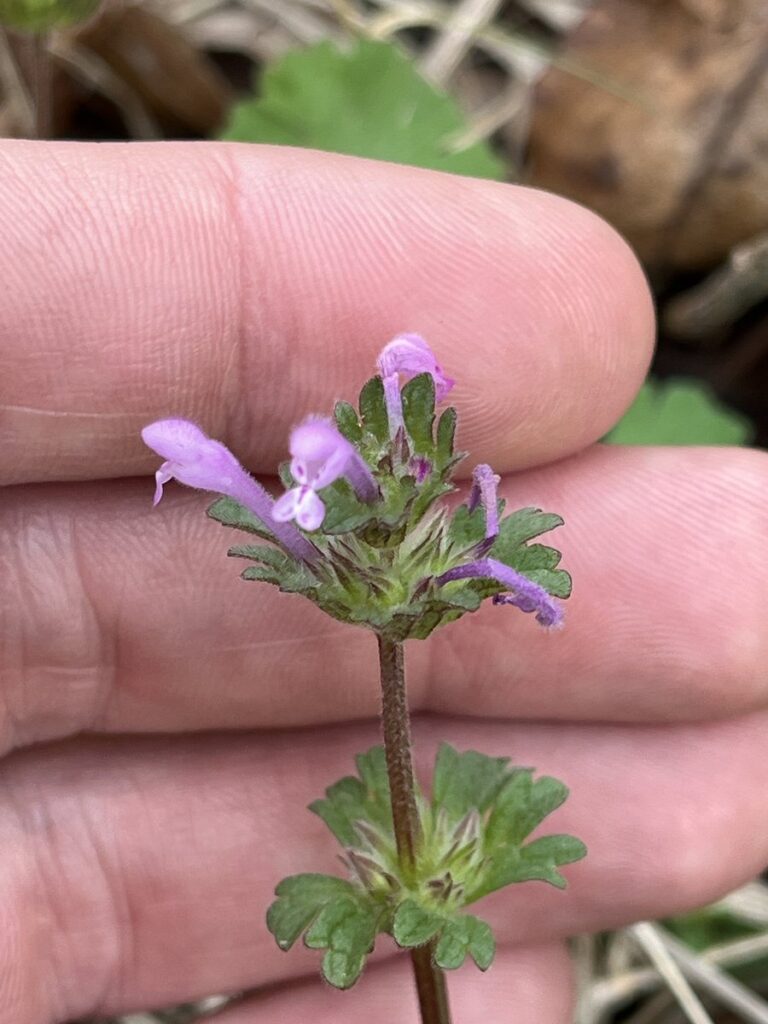
Photo: “Henbit (Lamium amplexicaule) flowers and clasping leaves” by kent ozment via iNaturalist, CC0 1.0.
If your weed has purple flowers and you are not sure of the species, compare it with the plants in our guide to weeds with purple flowers.
Henbit vs purple deadnettle and creeping Charlie
Purple deadnettle (Lamium purpureum) is henbit’s close cousin and grows in the same places at the same time. The control plan is identical, so mixing them up costs you nothing. Telling them apart takes one look at the upper leaves: deadnettle’s are triangular with short stalks and a reddish-purple tinge, while henbit’s are rounded, more deeply lobed and stalkless (Purdue Landscape Report; University of Kentucky AGR-226). Everything below about how to get rid of henbit works on it too.
| Feature | Henbit (L. amplexicaule) | Purple deadnettle (L. purpureum) | Creeping Charlie (G. hederacea) |
|---|---|---|---|
| Life cycle | Winter annual | Winter annual | Perennial |
| Upper leaves | Rounded, deeply lobed, no stalk, clasp the stem | Triangular, short stalks, purple-tinged | Round to kidney, scalloped, on long stalks |
| Stem | Square, green to purple | Square, purple | Square, creeping, roots at nodes |
| Flowers | Pink-purple, tubular, in whorls | Pink-purple, tubular, in whorls | Blue-violet, in spring |
| Best control window | Fall, pre- or post-emergent | Fall, pre- or post-emergent | Fall post-emergent |
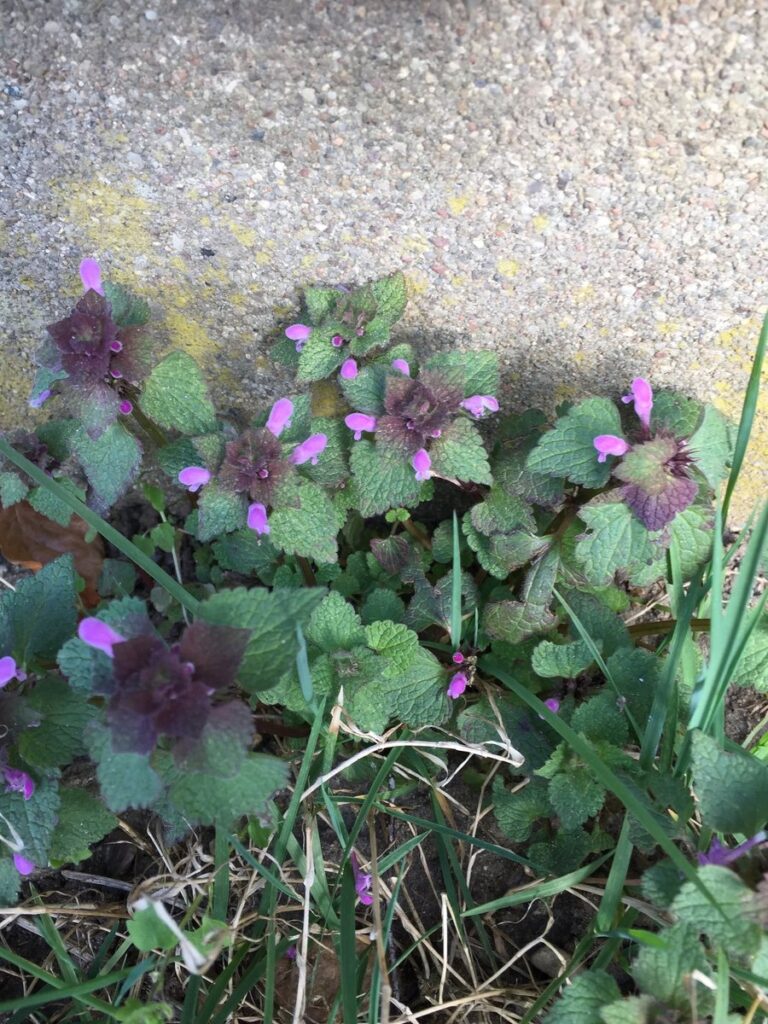
Photo: “Purple deadnettle (Lamium purpureum)” by Peter Eriksen via iNaturalist, CC BY 4.0.
The third look-alike, creeping Charlie (ground ivy), is a different story. It is a perennial that creeps and roots at the nodes, so hand pulling rarely finishes the job. See our guide to getting rid of creeping Charlie if the plant keeps coming back after you pull it.
Life cycle: why fall is the control window
Henbit is a winter annual. Seeds germinate in fall, the plant survives winter as a small green rosette, then flowers and sets seed in spring before dying as temperatures climb in late spring and early summer (Purdue Landscape Report). In Arkansas, germination starts in September as soon as the fall rains begin and the nights cool off, and plants are mostly visible from February to June in the South (University of Arkansas Extension).
Two practical consequences follow:
- Fall is when you stop it cheaply. A pre-emergent applied as germination begins, or a post-emergent spray while seedlings are small and actively growing, prevents the whole spring infestation.
- Spring control is damage limitation. By the time henbit carpets a lawn in April it is only weeks from dying on its own, and spraying then is far less effective (K-State Horticulture). Spring work is about stopping seed set, not saving the spring lawn.
Why henbit keeps coming back
- Seed numbers: each plant produces 40 to 200 seeds, and the seed can stay viable in soil for up to 5 years (Wisconsin Horticulture, UW-Madison Extension). Skip a year of control and the seed bank refills.
- Rooting stems: pieces of stem can root at the nodes on moist soil, so pulled plants left lying on wet ground can re-establish.
- Weak turf invites it: henbit is mainly a problem in thin, weak lawns and open garden soil (Purdue; Arkansas). Dense grass and mulched beds leave it no room.
- It shrugs off winter: henbit stays green and keeps growing through cold that stops the grass, which is why it is a step ahead every spring. More on that in do weeds die in winter?
How to get rid of henbit without herbicides
No single pass clears henbit for good, because the seed bank outlives the plants. The methods below use its weak points: shallow roots, shallow seed and a need for open, cool, moist soil. Together they are how to get rid of henbit without reaching for a sprayer.
1. Hand pulling and hoeing
Henbit has a shallow root system and pulls or hoes out easily when small, as Wisconsin Horticulture notes. Hoe or hand weed on a dry day so severed plants shrivel instead of re-rooting, and do not leave pulled plants on moist soil. In lawns, mow regularly and rake out the sprawled stems. Whatever you do, finish before flowers open: stems in bloom can still ripen viable seed after pulling. For a small patch caught before bloom, this alone can get rid of henbit in one season.
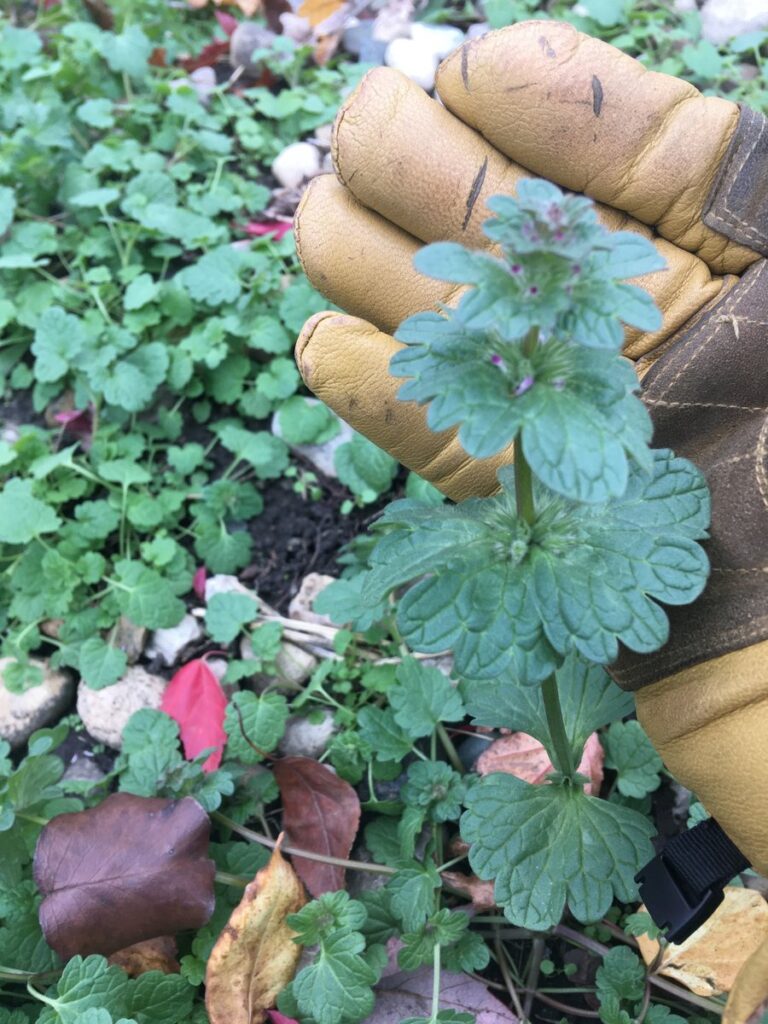
Photo: “Henbit (Lamium amplexicaule)” by Mike D. via iNaturalist, CC0 1.0.
2. Mulch beds 3 inches deep
A 3-inch layer of mulch blocks the light henbit seed needs to germinate. Purdue, Wisconsin and Arkansas Extension all recommend about 3 inches in landscape beds. Apply it in late summer or early fall, before the September flush. If seedlings appear on top of the mulch, our guide to stopping weeds in mulch beds covers that situation.
3. Thicken the turf
Henbit moves into lawns that are thin, closely mown and underfed. Raise the mowing height, feed the grass on a proper schedule and overseed bare patches so the turf can crowd seedlings out. The same open turf that lets henbit in also invites annual bluegrass (Poa annua) and chickweed, its number one companion weed, so dense grass solves several problems at once. Mind the timing conflict: a fall pre-emergent also stops grass seed, so if you plan to overseed, read how to kill weeds before overseeding before you spray anything. Dense turf is the quiet way to get rid of henbit for good: seedlings find no open ground to germinate in.
Herbicides that work on henbit
The products below are named by generic active ingredient. Availability and registration differ by country and state, so confirm that henbit and your turf species are on the label, and follow the label rates and safety directions exactly.
Fall pre-emergent (September)
K-State recommends applying a pre-emergent in early to mid-September, just before germination begins. Active ingredients labeled for henbit and chickweed include prodiamine, dithiopyr, isoxaben and pendimethalin. Timing matters more than the brand: the trigger is soil temperature, and our guide to when to apply pre-emergent in spring and fall explains how to read it. Remember that a fall pre-emergent also stops desirable grass seed from germinating, so do not combine it with overseeding (University of Kentucky AGR-226).
Post-emergent in late fall or early spring
If seedlings are already up, K-State advises waiting until late October to early November, after most henbit has germinated, then spraying with a 2,4-D-containing broadleaf product. Pick a day of at least 50°F; these products work below that but kill more slowly. Three-way herbicides (2,4-D plus mecoprop plus dicamba) are the standard lawn products for henbit and purple deadnettle, according to the University of Kentucky. Our explainer on post-emergent herbicides covers selective versus non-selective products. If spring spot treatment is needed, spray early, in March before much growth; control gets poor once plants flower.
Garden beds and non-lawn areas
In landscape beds, spot treatment with glyphosate is the common choice for henbit and deadnettle (University of Kentucky AGR-226); shield nearby ornamentals and keep the spray off their foliage. For an organic burn-down, Purdue lists pelargonic acid and acetic acid (at least 5%) products, and notes that eugenol (clove oil) products show some promise. Burn-down products scorch top growth without killing roots, which our review of whether vinegar kills weeds explains in detail, so plan to repeat or combine them with mulch.
Season-by-season henbit control plan
In the end, how to get rid of henbit comes down to the calendar. This plan puts lawns and garden beds side by side.
| Season | Lawns | Garden beds |
|---|---|---|
| Late summer to early fall (Sept) | Apply fall pre-emergent as the soil cools; skip it if you plan to overseed | Mulch beds 3 inches deep before the germination flush |
| Late fall (Oct to Nov) | Spray a three-way broadleaf product on a day of 50°F or warmer while seedlings are small | Hand pull or hoe seedlings on a dry day |
| Winter | Nothing needed; map the infested areas for next fall | Pull any plant showing flower buds during mild spells |
| Early spring (March) | Early spot spray only, before flowering; after that, wait for die-off | Pull or hoe before flowers open; bag flowering plants |
| Late spring to summer | Plants die on their own; plan fall overseeding for the bare spots | Clear dead stems and top up mulch |
Where this applies: the timings above are for temperate Northern Hemisphere climates, where henbit behaves as a winter annual. In mild-winter regions it can germinate over a longer window, and in the Southern Hemisphere you shift the months by six. Herbicide registrations differ between countries and states.
A note from the agronomist’s side
In variety trial plots, henbit is the weed that tells you which plots were left bare over winter. The clean plots in spring are never the ones that were sprayed most; they are the ones that had a crop, a cover or a mulch on the soil in September. Bare autumn ground is an open invitation, and henbit accepts it every time. Covering that ground is most of how you get rid of henbit before it starts.
When I walk a lawn with a homeowner in April, the pink haze of henbit flowers is the most visible thing there and the hardest to fix that month. The real fix was six to eight weeks earlier. If you take one date from this guide, make it your September pre-emergent date, and write it on the calendar now. That single date does more to get rid of henbit than anything you can spray in April.
FAQ
Will henbit come back every year?
Yes, if it sets seed. Henbit is a winter annual, and Wisconsin reports its seed can survive in soil for up to 5 years. Two or three seasons of fall control, with no new seed allowed, shrinks the seed bank fast enough to get rid of henbit for good.
Is henbit bad for my lawn? Does it kill grass?
It does not kill grass directly, but it competes hard in thin turf through the cool months, then dies by early summer and leaves bare soil behind. Those bare patches are where summer annual weeds move in next.
When is it too late to spray henbit?
Once plants flower in spring. K-State notes that spring chemical control is much less effective than fall treatment, so after bloom the ways to get rid of henbit are mowing, hand weeding and marking your calendar for fall.
Can I overseed and use a fall pre-emergent for henbit?
No. The University of Kentucky points out that a fall pre-emergent also stops desirable grass seed from germinating, so you choose one job or the other. Overseed the thin lawn this year, then use the pre-emergent next fall.
Henbit vs purple deadnettle: what is the difference?
Look at the upper leaves. Henbit’s are rounded, deeply lobed and clasp the stem without a stalk. Purple deadnettle’s are triangular, purple-tinged and have short stalks. Both are winter annuals controlled the same way, in fall.
More on winter annual weeds: how to get rid of chickweed, how to control annual bluegrass, and the full lawn weeds section.
Sources
- Purdue Landscape Report. Spotlight on Weeds: Henbit (Lamium amplexicaule).
- University of Arkansas Extension. Plant of the Week: Henbit.
- Wisconsin Horticulture, UW-Madison Division of Extension. Henbit, Lamium amplexicaule.
- K-State Horticulture and Natural Resources. Problem: Henbit and Chickweed.
- University of Kentucky Cooperative Extension. Identification and Control of Henbit and Purple Deadnettle, AGR-226.
- NC State Extension Gardener Plant Toolbox. Lamium amplexicaule.