
Short answer: the purple-flowered weeds you are most likely to find in a lawn are henbit, purple deadnettle, ground ivy (creeping Charlie), wild violet, healall, common vetch, red clover and Canada thistle. The first two are winter annuals that die on their own by early summer, so they need a different plan from the six perennials and legumes on the list. Check three things to tell them apart: whether the stem is square, whether the leaves clasp the stem or sit on stalks, and whether the plant spreads by runners, rhizomes or seed.
Most of these weeds have flowers that fall somewhere between pink, violet and blue, and people describe the same plant in different ways. If a weed on this page doesn’t match yours, also check our guides to lawn weeds with blue flowers and weeds with yellow flowers, or browse the lawn weeds hub.
Quick identification chart
| Weed | Life cycle | Flower | Feature that settles the ID | Best time to treat |
|---|---|---|---|---|
| Henbit | Winter annual | Pink-purple tubes in whorls | Square stem; upper leaves wrap around the stem with no stalk | Fall, while seedlings are small |
| Purple deadnettle | Winter annual | Pink-purple, half hidden in leaves | Triangular upper leaves on stalks, tinted red-purple | Fall, while seedlings are small |
| Ground ivy (creeping Charlie) | Perennial | Blue-purple funnels, April–June | Round scalloped leaves, minty smell, runners that root at nodes | Late September to early November |
| Wild violet | Perennial | Five petals, ½–¾ inch | Glossy heart-shaped leaves from thick rhizomes | Spring bloom and fall, repeated |
| Healall (self-heal) | Perennial | Violet two-lipped flowers in a dense head | Square hairy stem; flowers packed at branch tips | Fall or spring, when actively growing |
| Common vetch | Winter annual | Purple to magenta pea flowers | Paired leaflets and tendrils at the leaf tip | Spring, before pods ripen |
| Red clover | Short-lived perennial | Pink-purple globe, ¾–1 inch | Three leaflets with a pale V-shaped mark | Fall |
| Canada thistle | Perennial | Lavender-pink heads, about 1 inch tall | Spiny wavy leaves; patches spread from deep roots | Mid–late spring and again in late summer/fall |
Mint-family weeds: roll the stem between your fingers
Four of the eight weeds belong to the mint family (Lamiaceae). They all have square stems and paired (opposite) leaves, which you can feel by rolling a stem between finger and thumb. Once you know you have a mint-family weed, the leaves tell you which one.
1. Henbit (Lamium amplexicaule)
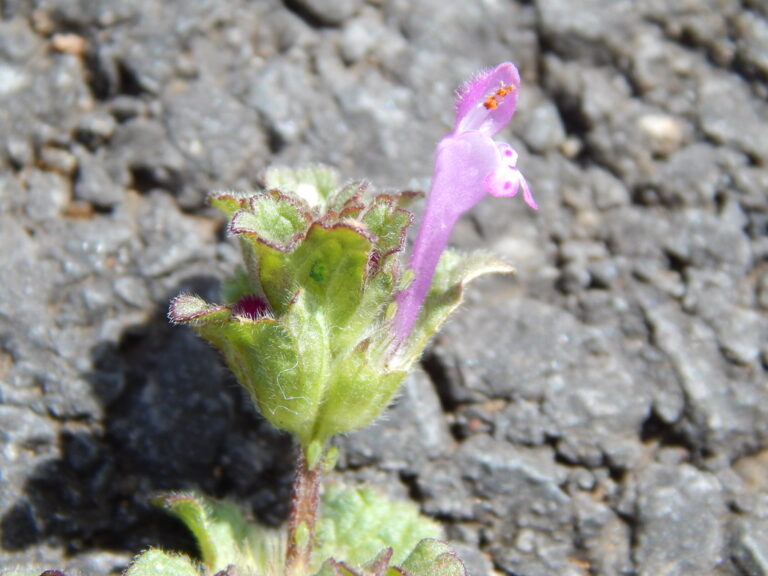
Henbit has rounded, scalloped leaves. The upper ones have no stalk and wrap around the stem, so the plant looks like a stack of tiers. The flowers are small pink-purple tubes with darker spots on the lower lip, arranged in whorls. Purdue University’s turf program describes it as a winter annual that germinates in fall, survives the winter as a small plant, flowers mainly in April and then dies as temperatures rise in late spring or early summer. Alabama Extension gives its maximum height as about 15 inches.
Control: Purdue lists 2,4-D, dicamba, fluroxypyr and triclopyr as effective, and says the best time to spray is autumn, while plants are small. Spraying in spring is usually unnecessary because the plants die in summer anyway. A pre-emergent herbicide applied in late summer to early fall stops the next crop.
2. Purple deadnettle (Lamium purpureum)

This is henbit’s close relative and the two often grow together. On purple deadnettle, the upper leaves are more triangular, sit on short stalks and turn distinctly red to purple near the top of the plant. Clemson’s Home & Garden Information Center uses this upper-leaf difference as the main way to separate the two. The flowers are less conspicuous than henbit’s because they are tucked between crowded leaves. It can reach about 18 inches, slightly taller than henbit. Timing and products are the same as for henbit.
3. Ground ivy, or creeping Charlie (Glechoma hederacea)
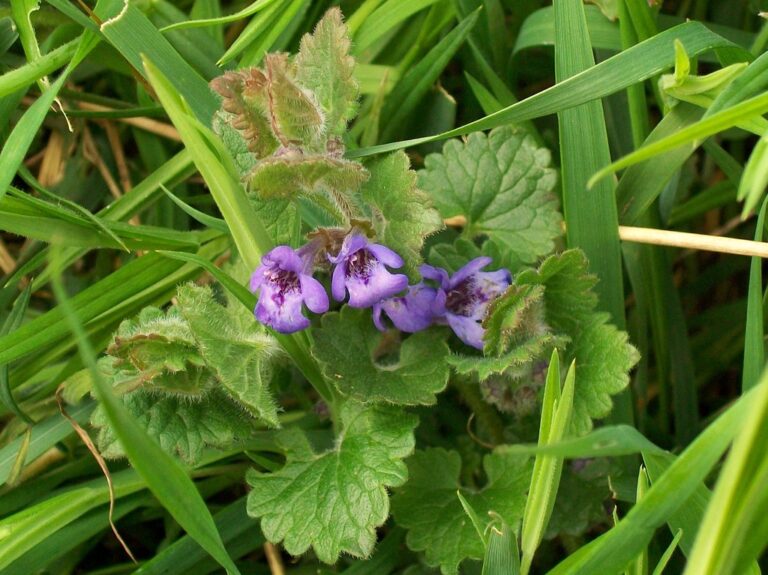
Ground ivy is the one that forms mats. It has round to kidney-shaped leaves with rounded teeth, square stems that creep and root at every node, and small blue-purple funnel-shaped flowers from April to June. Crush a leaf and it smells of mint. University of Illinois Extension notes that it does best in shady lawns on damp, fertile soil. Our blue-flowered weeds guide has more close-ups.
Control: Illinois Extension found fluroxypyr and triclopyr the most effective active ingredients, and says products containing them on their own work better than combination products. Iowa State University recommends two fall applications, the first in late September or early October and the second about a month later. In flower beds, pull it after a soaking rain and remove every stem piece, because each node can root. Skip borax: Iowa State no longer recommends it. Results were inconsistent between studies, and the gap between the amount of boron plants need and the amount that harms them is small.
4. Healall, or self-heal (Prunella vulgaris)

Healall is a perennial with hairy square stems and pairs of elliptic to lance-shaped leaves. The lower leaves have long stalks and the upper ones have none. The giveaway is a dense, club-like head of pale violet to purple two-lipped flowers at the tip of each branch (University of Georgia turfgrass team). Before you spray, check that the lawn herbicide lists healall on its label. Small patches in a dense lawn do little harm, and many gardeners leave them.
A rosette weed: wild violet (Viola spp.)
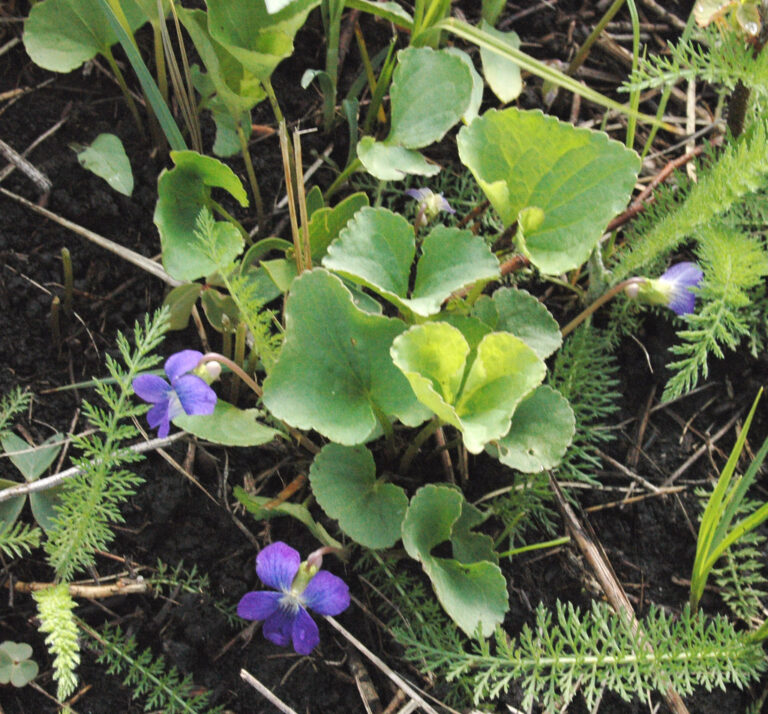
Wild violets form low rosettes of glossy, hairless, heart-shaped leaves with toothed edges, up to 3.5 inches long. The five-petalled flowers are ½ to ¾ inch across and may be purple, violet, blue or white (Penn State Extension). Underneath are thick, branching rhizomes that store food and send up new plants, and this is why pulling rarely works unless you dig out the whole rhizome.
Control: Penn State rates triclopyr products as the best option. It also warns that the waxy leaf surface and the rhizomes mean you may need repeat applications through the season and over several years. Violets tolerate both sun and shade. A denser lawn slows their spread but rarely eliminates an established patch.
Legumes: vetch and red clover
Both plants fix nitrogen, which is part of why they thrive in lean, under-fertilised lawns. Pea-type flowers and compound leaves identify them as legumes.
5. Common vetch (Vicia sativa)
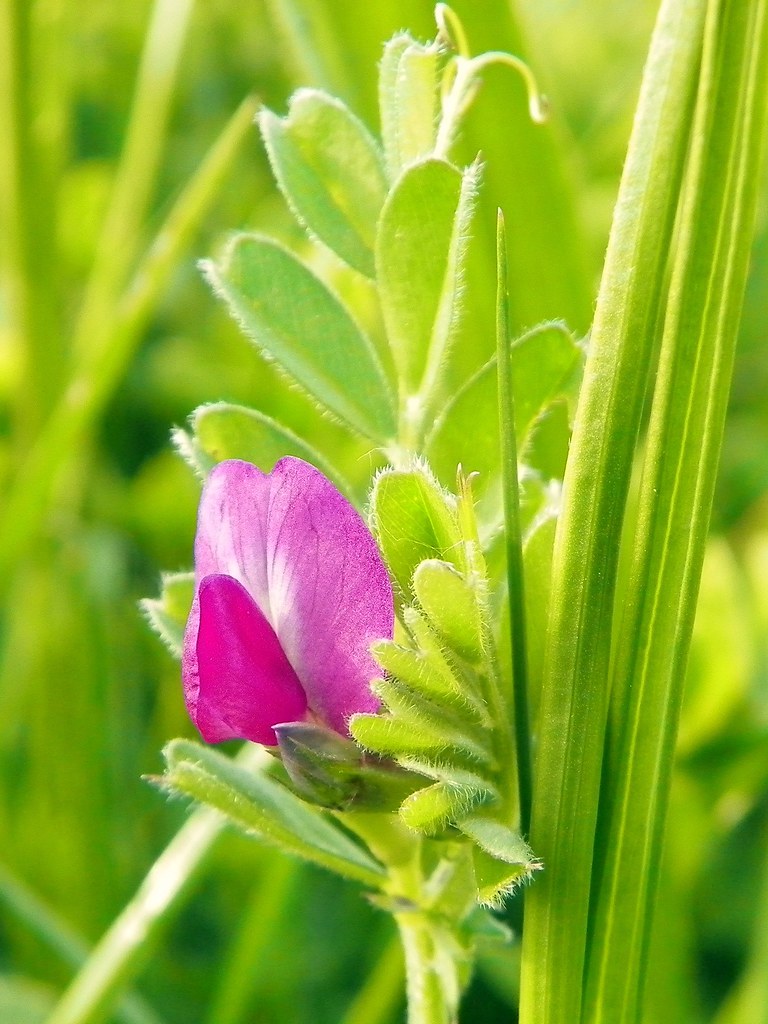
Vetch has compound leaves with four or more narrow leaflets, and older leaves end in curling tendrils that let it climb through grass. Flowers are purple to magenta and pea-shaped. NC State TurfFiles classifies it as a winter annual that invades thin turf, especially on moist soil. Clemson HGIC adds three practical points: the pods turn from green to black and hold 5 to 12 seeds each, the seeds can remain viable for up to five years, and pre-emergent herbicides do not control it well. Dig it out or spot-spray a labelled broadleaf product in spring before the pods ripen. The taproot snaps easily, so use a tool rather than your fingers.
6. Red clover (Trifolium pratense)

Red clover has three oval leaflets up to 2 inches long, usually marked with a white or pale green inverted V (chevron). The stems are somewhat hairy, and the flowers form globe-shaped pink to purplish-pink heads ¾ to 1 inch across. It is a short-lived perennial that blooms from late spring into early summer and sometimes again in late summer or fall (Penn State Extension). Penn State lists dicamba, clopyralid, fluroxypyr, quinclorac and triclopyr as effective against it, and says fall applications usually work better than spring ones.
The spiny one: Canada thistle (Cirsium arvense)
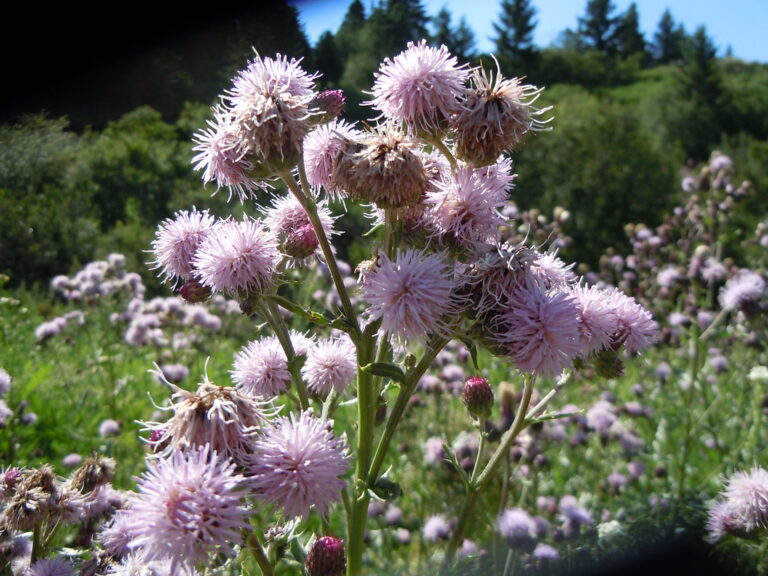
Canada thistle is mostly a problem at lawn edges, in new lawns and in rough grass. Its flower heads are pink, pinkish-purple or lavender, about 1 to 1.5 inches tall and ½ inch wide. The leaves are oblong with wavy, spiny edges, and they attach directly to the stem. The roots are what make it hard to get rid of. Penn State Extension reports roots reaching 6 feet or more deep and about 15 feet sideways, with buds that send up new shoots across the patch.
Control: Penn State recommends spraying twice a year, once in mid to late spring after the shoots emerge and again in late summer or fall. Clopyralid products are the regional standard. Mowing rough stands only once or twice a year gives the plant time to regrow and refill its roots, so if you rely on mowing, mow frequently. Bag or bin flowering stems rather than composting them. Our guide on disposing of invasive plants explains why.
When to treat purple-flowered lawn weeds
The flower colour matters less than the life cycle:
- Winter annuals (henbit, purple deadnettle, vetch): they germinate in fall and die in early summer. Apply a pre-emergent in late summer to early fall, or spot-spray small seedlings in autumn. Spraying a purple carpet in April kills plants that were about to die anyway. See do weeds die in winter? for the full winter-annual cycle.
- Perennials (ground ivy, violet, healall, red clover, Canada thistle): fall is the main window. For ground ivy, Illinois and Iowa State both advise a second application three to four weeks after the first. Expect to repeat treatments the following year for violets and thistle.
- Before reseeding: most broadleaf herbicides have a waiting period before you can sow grass seed. Our guide to killing weeds before overseeding covers the timing.
Always read the product label for your grass type. Some products named by the extension services, such as atrazine and metsulfuron, are labelled only for certain warm-season grasses (Clemson HGIC) and will injure cool-season lawns.
A note from the agronomist’s side
When a lawn turns purple in early spring, most people reach for a sprayer. In most lawns, that early purple is henbit and deadnettle, and they will be gone by June without any help. The more useful question is why the lawn had bare soil for their seeds to germinate in last autumn. Winter annuals, vetch and clover almost always point to thin, hungry turf. Ground ivy and violets point to shade and damp soil. Spending on seed, fertiliser at the right time and a higher mowing height usually does more over two seasons than spending on herbicide. On farms I have worked with, the fields that stayed clean were the ones where the crop closed its canopy early, and lawns work the same way.
Frequently asked questions
What is the small purple flowering weed in my lawn in spring?
If it has square stems and appears in early spring, it is almost certainly henbit or purple deadnettle. If it creeps along the ground and smells of mint when crushed, it is ground ivy. Wild violets have heart-shaped leaves and no square stem.
Is henbit the same as purple deadnettle?
No. They are two species in the same genus. Henbit’s upper leaves wrap around the stem with no stalk, while purple deadnettle’s upper leaves are triangular, stalked and tinted purple. They are controlled in the same way.
Does borax kill creeping Charlie?
Results were inconsistent between university trials, and too much boron damages lawns and garden plants. Iowa State Extension no longer recommends it. Triclopyr or fluroxypyr applied in fall works more reliably.
Related guides: How to Get Rid of Creeping Charlie (Ground Ivy) in Your Lawn · Weeds With White Flowers in Lawns: 10 Common Types and How to Identify Them · Lawn Weeds With Blue Flowers: Identification Guide With Control Tips
Sources
- Purdue University Turfgrass Science, Henbit
- Alabama Cooperative Extension System, Henbit and Purple Deadnettle Identification and Control
- Clemson Home & Garden Information Center, Henbit and Narrowleaf Vetch, Common Vetch
- University of Illinois Extension, Managing Creeping Charlie in Lawns
- Iowa State University Extension, Control of Ground Ivy (Creeping Charlie) and Can borax be used to control creeping Charlie?
- University of Georgia Turfgrass, Healall
- Penn State Extension, Wild Violet, Red Clover and Canada Thistle
- NC State TurfFiles, Common Vetch