
Short answer: most blue flowers in a lawn belong to one of four groups, and the flower shape tells you which. A tiny four-petalled flower (1/8 to 1/3 inch, 3 to 8 mm) with one petal smaller than the other three is a speedwell (Veronica), the commonest blue lawn weed in the US, UK and Canada. A two-lipped tubular blue-violet flower on a square stem is ground ivy (creeping Charlie) or a mint-family cousin. A five-petalled flower on its own stalk above heart-shaped leaves is the common blue violet. A bright blue flower with two big petals and one small white one is Asiatic dayflower. Control follows the name: speedwells and ground ivy need a product containing triclopyr (or a triclopyr or dicamba mix), not plain 2,4-D; ground ivy is sprayed in fall; violets are the hardest and need repeat triclopyr treatments over more than one season. Blue-eyed grass, which also shows up in lawns, is a native wildflower and does not need killing.
Start with the flower, not the colour
“Blue” is a loose word: speedwells run from sky blue to lilac, ground ivy and violets are blue-violet to purple, and henbit is pink yet constantly reported as blue. Petal count and stem shape sort nearly every case:
- 4 petals, one smaller, flower under 1/2 inch (13 mm), round stems: a speedwell.
- Two-lipped tube at the leaf joints, square stem: mint family: ground ivy (stalked round leaves), henbit (leaves clasping the stem) or bugleweed (upright spike above glossy rosettes).
- 5 petals, one flower per leafless stalk, heart-shaped leaves: common blue violet.
- 3 petals, two large blue and one small white, fleshy stem: Asiatic dayflower.
- Daisy-like, 1 to 1.5 inches (2.5 to 4 cm), every ray tipped with 5 teeth: chicory.
- 5 rounded petals with a yellow eye, about 3/8 inch (1 cm): forget-me-not.
- 5 flat pinwheel petals on a trailing evergreen stem: periwinkle (Vinca).
- 6-pointed star with a yellow centre on what looks like a grass blade: blue-eyed grass, a native.
Quick identification table
| Weed | Flower | Leaves | Habit and life cycle | Flowers |
|---|---|---|---|---|
| Corn speedwell (Veronica arvensis) | 1/8 in (3 mm), 4 petals, deep blue | Oval, toothed, hairy, 1/2 to 3/4 in | Winter annual, prostrate then upright | Early spring to summer |
| Persian / field speedwell (V. persica) | 1/3 in (8 mm), 4 petals, sky blue, white base | Oval, toothed, sparsely hairy | Winter annual, sprawling; gone by summer | Late winter to spring |
| Germander speedwell (V. chamaedrys) | About 1/2 in (12 mm), bright blue, white eye | Triangular-oval, coarsely toothed, hairy | Perennial, creeping stems to 16 in (40 cm) | March to July |
| Slender speedwell (V. filiformis) | 1/3 in (8 mm), pale lilac-blue, single on thread-like stalks | Tiny, kidney-shaped, scalloped | Perennial mat, thin reddish stems to 20 in (50 cm) | April to July |
| Ground ivy (Glechoma hederacea) | 1/2 in tubular, 2-lipped, blue-violet, clustered at leaf joints | Round to kidney-shaped, scalloped, stalked, minty smell | Perennial, square stems rooting at nodes, mats 1 to 3 ft | Early spring to early summer |
| Common blue violet (Viola sororia) | 1/2 to 3/4 in (13 to 19 mm), 5 petals, violet to white | Heart-shaped, glossy, hairless, to 3.5 in | Perennial clumps from thick rhizomes | April to May |
| Henbit (Lamium amplexicaule) | Long pink-purple tubes in whorls | Round, deeply scalloped, clasping the stem | Winter annual, upright square stems | Late winter to May |
| Asiatic dayflower (Commelina communis) | 1/2 to 1 in (13 to 25 mm), 2 blue petals + 1 small white | Lance-shaped, parallel veins, clasping | Summer annual, fleshy sprawling stems | June to October |
| Chicory (Cichorium intybus) | Up to 1.5 in (4 cm), many toothed rays | Dandelion-like rosette, 3 to 10 in | Perennial taproot, stems to 4 ft (1.2 m) | Midsummer to autumn, mornings only |
| Forget-me-not (Myosotis spp.) | 3/8 in (1 cm), 5 petals, blue, yellow eye | Oblong, hairy, 1 to 3 in | Biennial or short-lived perennial, heavy self-seeder | April to May |
| Bugleweed (Ajuga reptans) | Blue-violet, 2-lipped, on 4 to 6 in spikes | Glossy oval rosettes, often bronze | Perennial, stolons creep from beds into turf | Spring to early summer |
| Periwinkle (Vinca minor) | Under 1 in (2.5 cm), 5 flat pinwheel petals, lavender-blue | Evergreen, leathery, elliptical, 1 in | Trailing evergreen vine, roots at nodes | Spring, sporadic later |
| Blue-eyed grass (Sisyrinchium angustifolium) | 1/2 in, 6 pointed tepals, yellow centre | Grass-like, flattened, 6 to 8 in tall | Native perennial, iris family | April to June |
Speedwells (Veronica): the most common blue lawn weed
Four speedwells cause nearly all the trouble. Two are winter annuals that germinate in cool, moist weather in fall or early spring, flower, seed and die back in summer heat. Two are creeping perennials that build a permanent mat. The distinction matters because a pre-emergent stops the annuals and does nothing to the perennials.
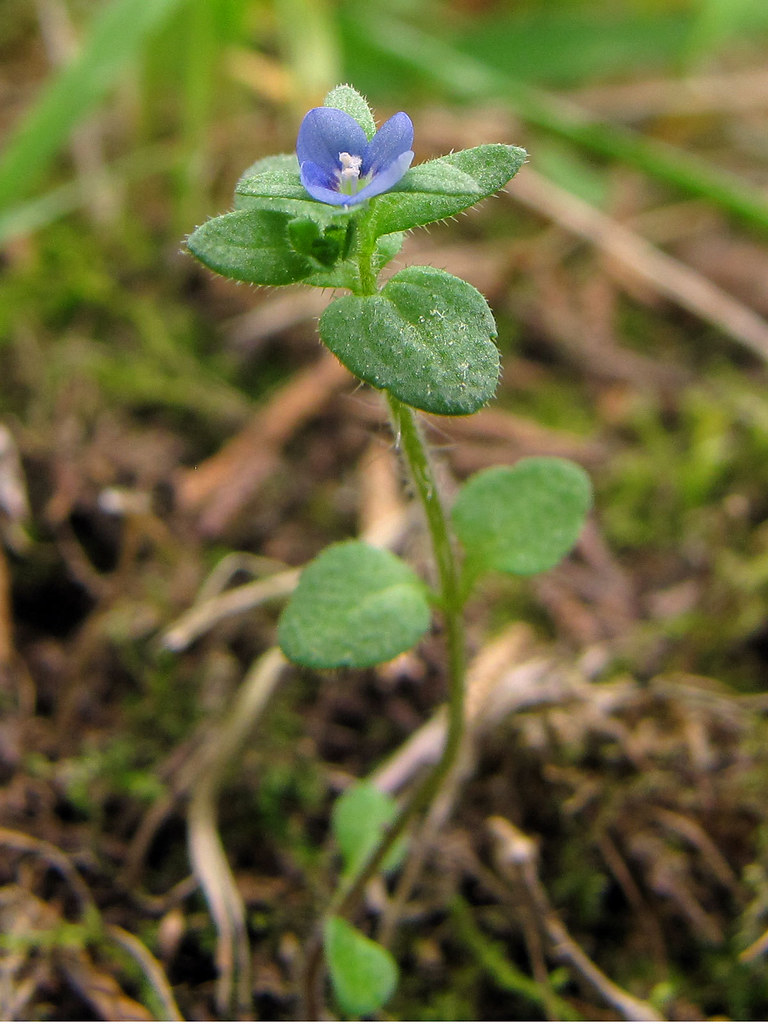
Corn speedwell (Veronica arvensis)
The one that carpets thin, dry lawns in April. Stems start flat then turn upright; the lower leaves are oval, toothed and hairy, 1/2 to 3/4 inch (1.3 to 2 cm) long; the flowers sit singly in the leaf axils, tiny, deep blue with darker stripes, followed by hairy heart-shaped pods. According to Penn State Extension it is a winter annual that germinates in late summer, fall or spring, tolerates sun or shade, wet or dry soil, and forms large dense patches wherever turf is thin. It dies out in summer and returns from seed the next spring.
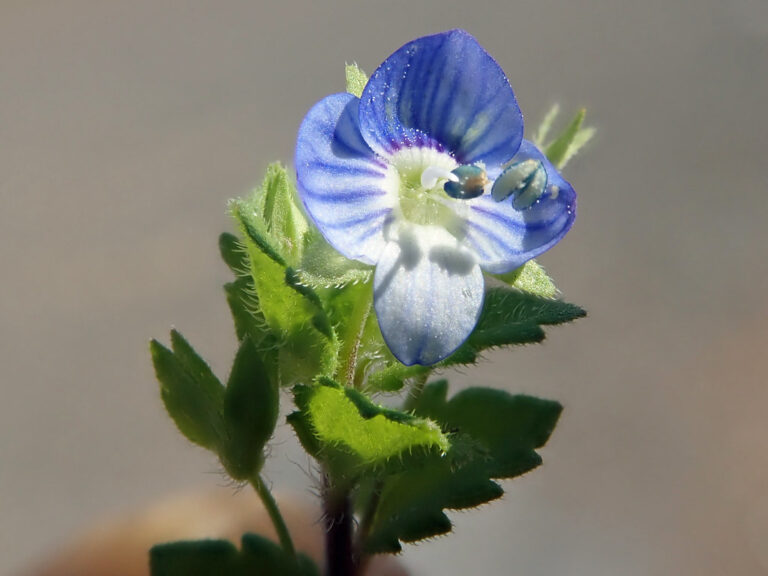
Persian, common field or birdseye speedwell (Veronica persica)
Larger and showier: flowers about 1/3 inch (8 mm) across, light blue with dark stripes and a white centre, one per stalk, the lowest petal clearly smaller. It sprawls rather than stands. Penn State’s field speedwell fact sheet notes it favours moist soil, thin turf and lawn edges near beds and paths, and fades in summer. The heart-shaped pod with two diverging lobes is a reliable check.
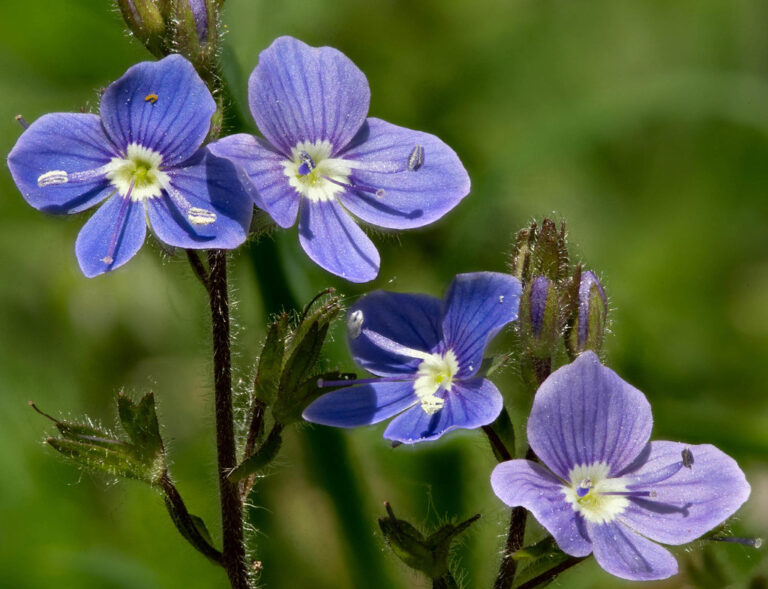
Germander speedwell (Veronica chamaedrys)
A perennial with the brightest blue of the group: flowers about 1/2 inch across with a white eye, in loose spikes, on hairy stems the RHS describes as crimson and up to 16 inches (40 cm) long, flowering March to July. Leaves are triangular-oval, coarsely toothed and stalkless. Common in UK, Irish and north-eastern North American lawns, especially shaded or damp ones.
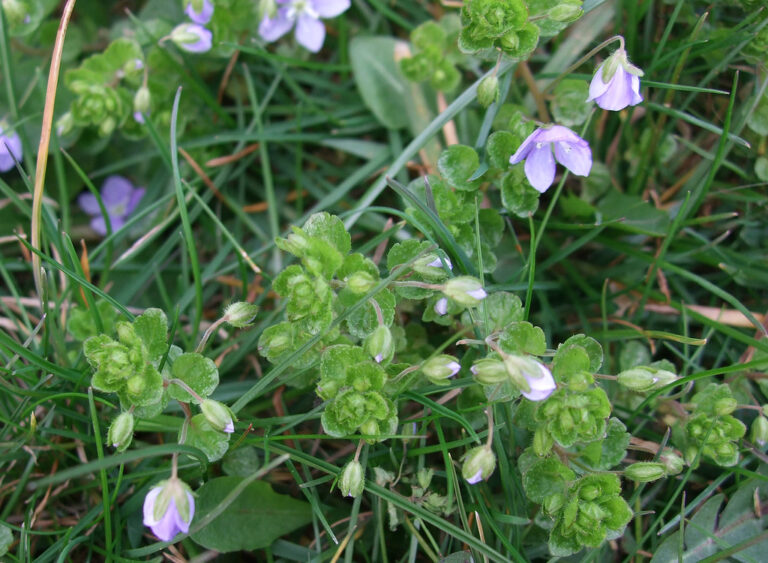
Slender speedwell (Veronica filiformis)
The lawn specialist. A garden escape that rarely sets seed in Europe or North America and spreads entirely by stem fragments, forming a flat bright-green mat of tiny kidney-shaped leaves with one pale lilac-blue flower on a hair-thin stalk from each leaf joint, April to July. The RHS points out that mowing scatters sections of stem that root elsewhere and that birds carry pieces off for nests, which is how one patch becomes twenty. It also says speedwells are resistant to most lawn weedkillers, so a dense, higher-cut sward is the first defence and small patches are best dug out and reseeded.
Controlling speedwells
- Thicken the turf. Speedwells exploit thin, low-cut, under-fed grass. Raise the mowing height, feed in autumn and spring, and overseed bare areas in early fall. If the grass is thin because of shade or compaction, that is the real problem; our guide to why grass won’t grow runs through the causes.
- Annual speedwells: a pre-emergent containing prodiamine, dithiopyr or pendimethalin in late summer stops fall germination, per Penn State. Post-emergence, UMass Extension says triclopyr and dicamba are especially effective: spray on actively growing plants, do not mow for 2 to 3 days either side, and choose a day with no rain for 24 hours. Mow when the first flowers appear so plants do not seed.
- Perennial speedwells: pre-emergents do nothing. Use a lawn product containing triclopyr (in the UK, a fluroxypyr-based lawn weedkiller whose label names speedwell) in spring while the mat is in full growth, and expect to repeat. Rake the mat hard first so the spray reaches the stems, and bag clippings for a few weeks afterwards.
Ground ivy / creeping Charlie (Glechoma hederacea)
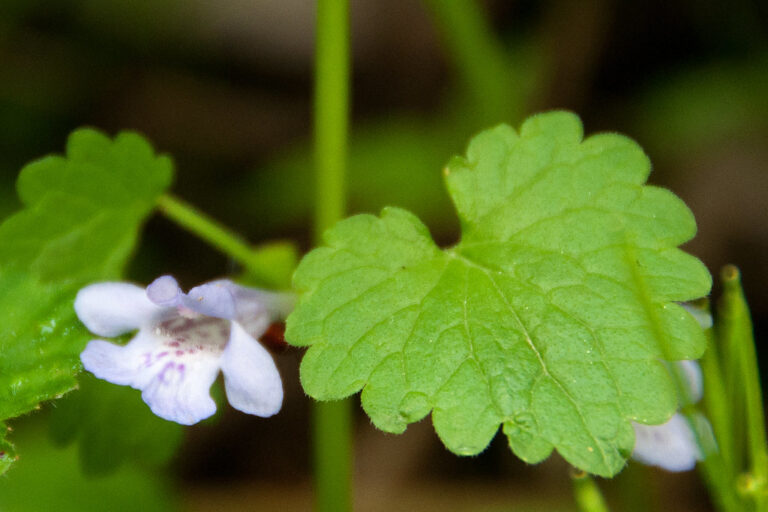
Round to kidney-shaped scalloped leaves on square stems that creep along the surface and root at every node; a crushed leaf smells strongly minty. The blue-violet tubular flowers come in clusters of two or three at the leaf joints from early spring to early summer. University of Minnesota Extension describes evergreen mats 1 to 3 feet across in damp, shaded, nutrient-poor ground, and notes that a big infestation usually signals compacted or poorly drained soil.
Control is a fall job. Minnesota says products containing triclopyr are the ones that work, that 2,4-D alone is ineffective, and that autumn applications are most effective because the plant is moving sugars, and the herbicide with them, into its roots. Iowa State Extension puts the window at late September to early November and calls for two applications, the first in late September or early October and the second a month later, plus 3 to 4 lb of nitrogen per 1,000 sq ft per year so the grass can close the gaps. Hand-pulling works on small patches after rain if you get every rooted node.
Common blue violet (Viola sororia)
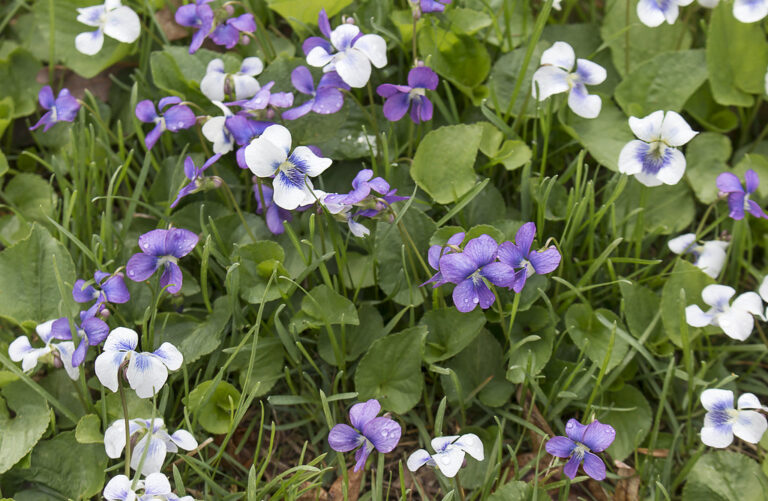
Heart-shaped, glossy, hairless leaves up to 3.5 inches (9 cm) long and five-petalled flowers 1/2 to 3/4 inch across in April and May, each on its own stalk. Colour runs from deep violet to white; the “Confederate violet” with a white face and blue centre is the same species. Underground are thick branching rhizomes that store food and push up new crowns all season, so pulling the tops achieves nothing.
This is the hardest weed on the list. Penn State Extension explains that a thick waxy cuticle limits herbicide uptake, and that even triclopyr, the best active for it, may need repeat applications through the season and over several years. Illinois Extension rates triclopyr above dicamba, 2,4-D and MCPP and recommends spraying mid-spring to early summer and again mid to late fall, always on actively growing plants. A spreader-sticker helps the spray wet the glossy leaves. For a few clumps, dig out the whole rhizome. If a shady corner will never grow good grass, a violet lawn there is a reasonable choice; the plant is native to eastern North America and feeds fritillary caterpillars.
Henbit and purple deadnettle: the “blue” weeds that are really pink
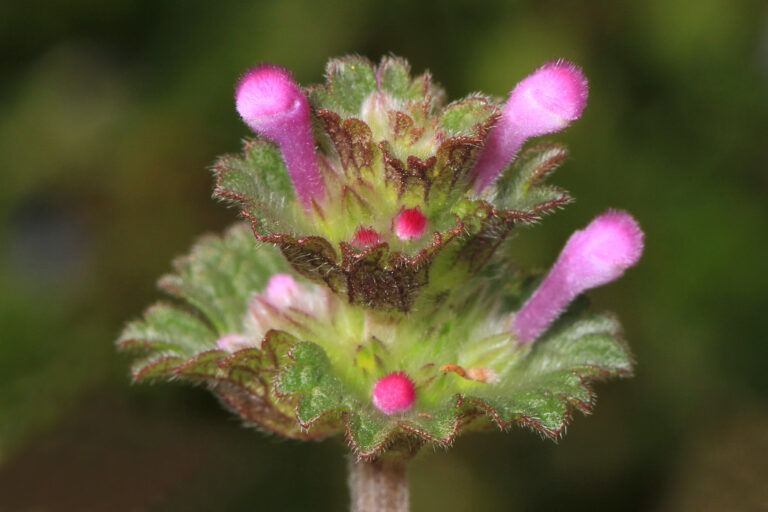
In March and April thin lawns turn purple with henbit (Lamium amplexicaule) and purple deadnettle (L. purpureum), both winter annuals in the mint family. Penn State Extension separates the three look-alikes: henbit has round, deeply scalloped leaves clasping the stem with no stalk and long-tubed pink flowers; deadnettle has stalked heart-shaped leaves that turn burgundy at the top and shorter pink flowers; ground ivy has stalked round leaves, blue-purple flowers and creeps as a perennial. Henbit and deadnettle die on their own by late May. To pre-empt them, Penn State gives a pre-emergent in early September or a broadleaf spray in late autumn; the logic in which weeds survive winter applies, because the seed is set in spring and fall prevention beats spring cure.
Asiatic dayflower (Commelina communis)
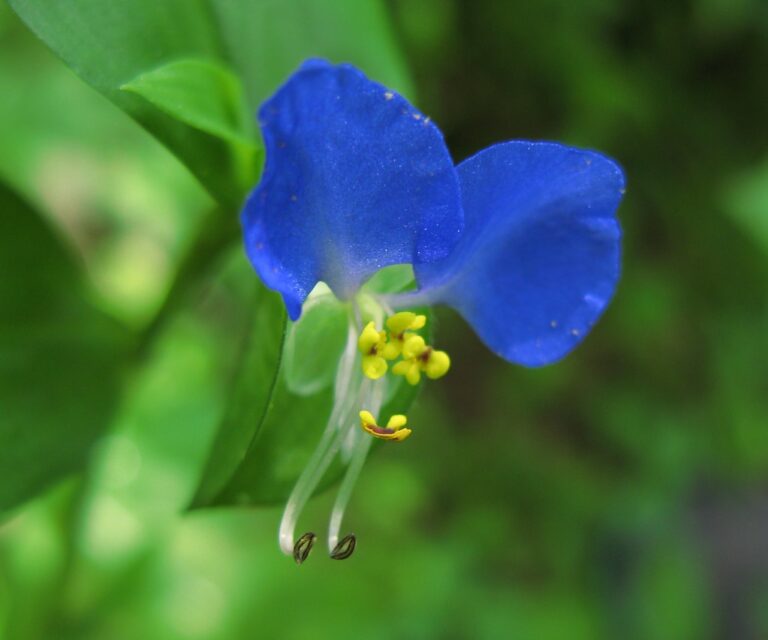
A flower 1/2 to 1 inch wide with two large, intensely blue petals above one small white one, each lasting a single day, from June until frost. Stems are fleshy, sprawl and root at the nodes; the lance-shaped leaves have parallel veins and clasp the stem, because this is a monocot related to spiderwort, not a broadleaf. University of Maryland Extension lists it as a non-native annual of ditches and low wet ground and advises hand-pulling before plants get large, removing every stem fragment, and improving drainage. Being a monocot matters: broadleaf lawn herbicides do little to it, and Purdue weed scientists report it is poorly controlled even by glyphosate, which needed three applications in trials to reach 80% control. Mow it close, pull it after rain, and fix the wet spot.
Chicory (Cichorium intybus)
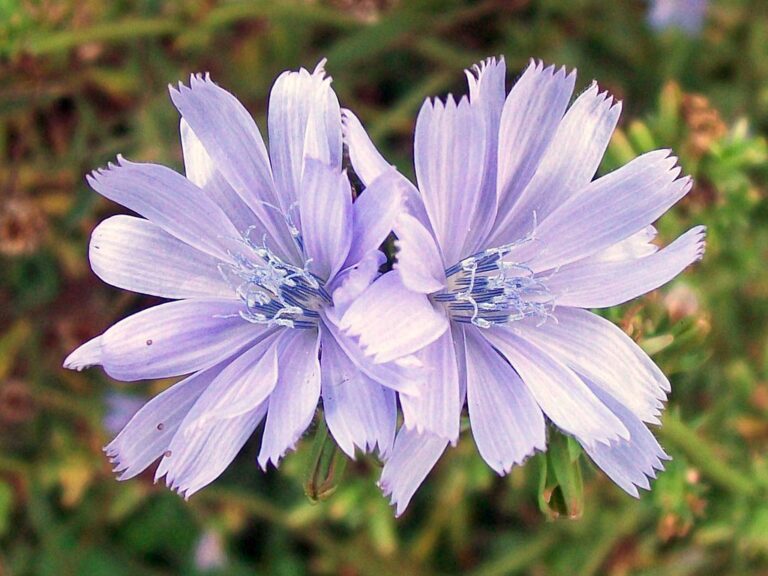
The sky-blue roadside flower of July and August: up to 1.5 inches across, many strap-shaped rays each squared off with five teeth, and, as Wisconsin Horticulture Extension notes, open for a single morning. It is a perennial with a large fleshy taproot and milky sap; in its first year it is only a dandelion-like rosette of lobed leaves 3 to 10 inches long, and that is how it slips into lawns. Under regular mowing it rarely flowers, so you meet it as a tough rosette on compacted, sunny ground near verges and gravel. Dig it with as much root as possible, or spot-treat with a selective broadleaf herbicide; 2,4-D mixes handle it far better than the weeds above.
Forget-me-not (Myosotis spp.)
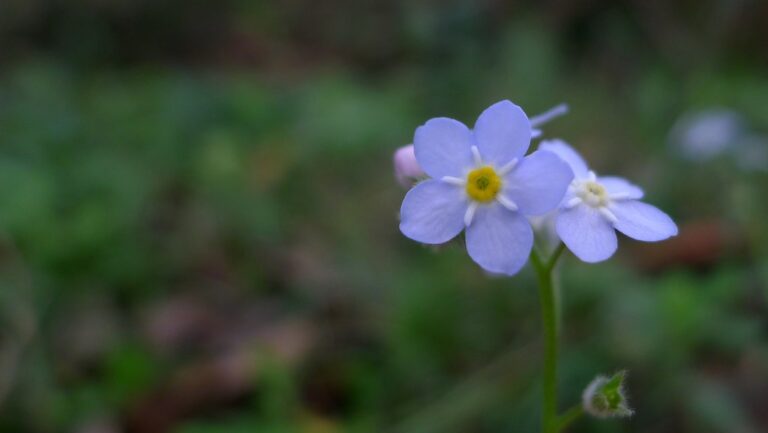
Flowers about 3/8 inch (1 cm) across, five rounded blue petals around a yellow or white eye, in curled sprays above hairy oblong leaves, April to May. Woodland forget-me-not (M. sylvatica) is the garden plant that jumps into lawn edges; field forget-me-not (M. arvensis) is the smaller weedy annual of thin turf. Both persist only by seed and seed very freely: NC State Extension calls the self-seeding “sometimes aggressive” and notes it is a listed noxious weed in some Midwestern states. Mow or pull before seed sets in late May and it is gone within two seasons; any standard broadleaf lawn herbicide kills it.
Bugleweed (Ajuga reptans)
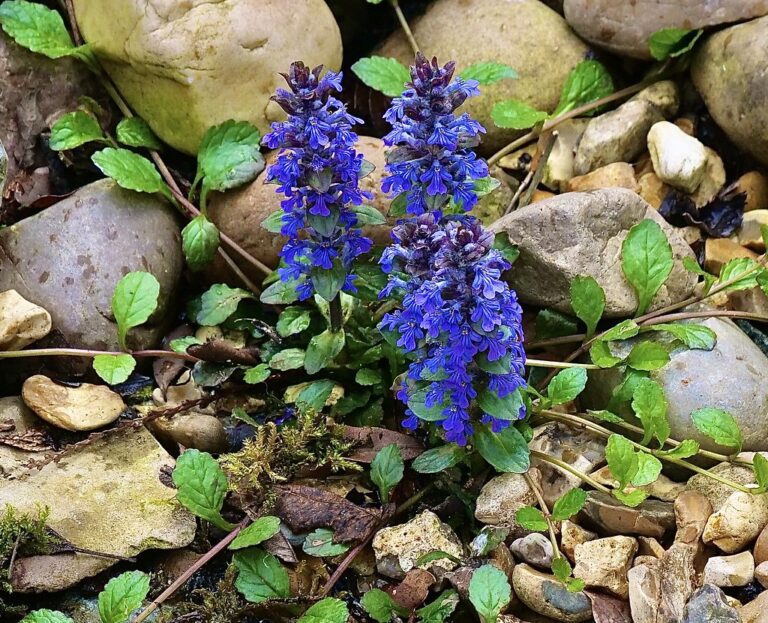
A planted groundcover that walks. Glossy oval leaves, often bronze in cultivars, in tight rosettes, with dense 4 to 6 inch spikes of blue-violet lipped flowers in spring. It spreads by stolons, and NC State Extension warns against planting it beside lawns or perennial beds because removal becomes a problem. In turf it behaves like a bigger ground ivy, surviving mowing as flat rosettes. Dig it out following each runner, or treat as for ground ivy with a triclopyr product in autumn, and put a hard edge between bed and grass.
Periwinkle (Vinca minor)
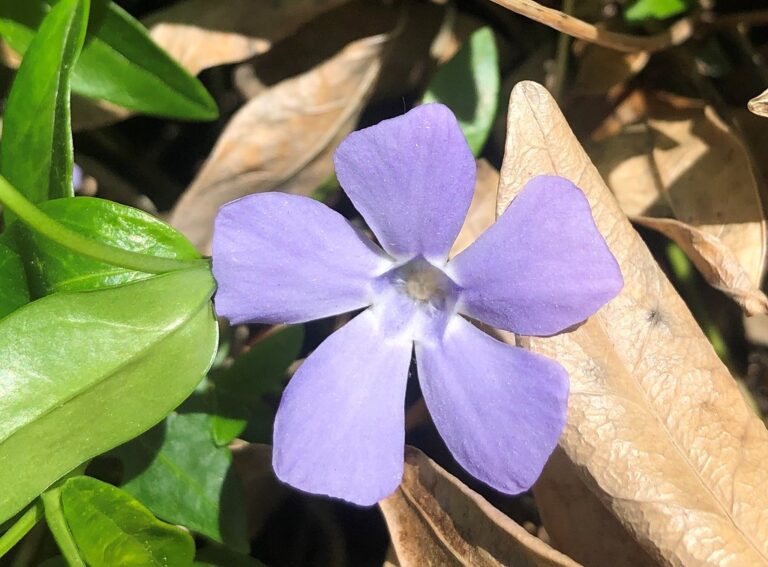
Another escaped groundcover: trailing wiry stems with paired leathery evergreen leaves about 1 inch long, and lavender-blue flowers under 1 inch across with five flat petals set like a pinwheel, mainly in spring. NC State Extension records that the stems root at the nodes to form a dense mat that “can spread aggressively into adjacent lawns, gardens and natural areas”, and that it is listed as invasive in North Carolina and on several other states’ lists. Mowing alone will not remove an evergreen, semi-woody vine: cut the runners at the lawn edge, fork out the rooted pieces, keep a mown or edged strip between bed and turf, and never dump the pieces where they can root (see how to dispose of invasive plants).
Blue-eyed grass (Sisyrinchium): the one to keep
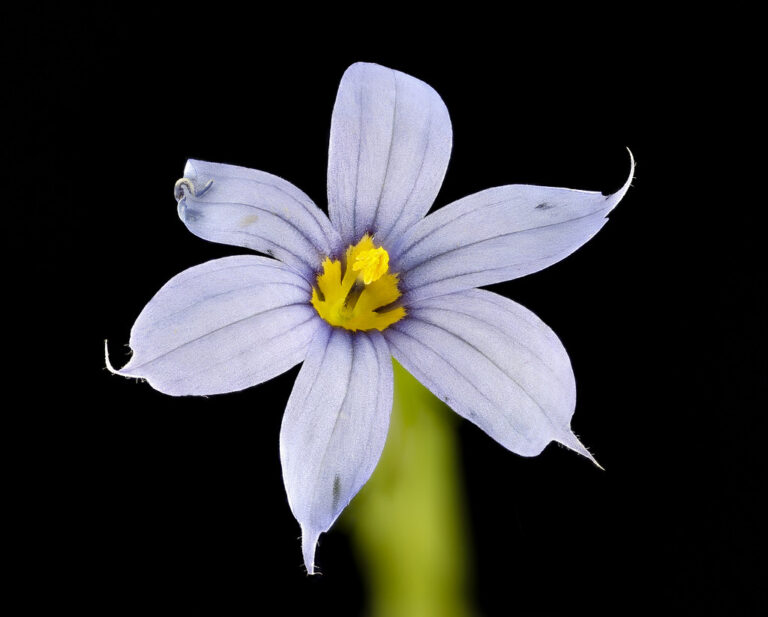
Six pointed blue tepals around a yellow centre, apparently growing out of a blade of grass: this is blue-eyed grass, a native North American perennial in the iris family. Clemson Extension notes it looks so much like a coarse-bladed turfgrass that it goes unnoticed until it flowers in April at 6 to 8 inches tall. It is not aggressive, feeds early pollinators and is sold as a garden plant. Where it bothers you, correct mowing height, deep infrequent watering and core aeration keep it in check; there is no reason to spray it.
Which herbicide for which blue weed
| Weed | Best timing | Selective actives that work (per extension sources) | What does not work |
|---|---|---|---|
| Corn and Persian speedwell | Pre-emergent late summer; post-emergent in spring while growing | Prodiamine, dithiopyr or pendimethalin (pre); triclopyr, dicamba, sulfentrazone, some 2,4-D mixes (post) | Spraying after seed set in June |
| Germander and slender speedwell | Spring, in active growth; repeat | Triclopyr; fluroxypyr-based lawn products where labelled | Pre-emergents; plain 2,4-D; unbagged mowing |
| Ground ivy | Late September to early November, two sprays a month apart | Triclopyr, or a 2,4-D + MCPP + dicamba three-way | 2,4-D alone; spring-only spraying |
| Common blue violet | Mid-spring to early summer and mid to late fall, for two or more years | Triclopyr (best); dicamba, 2,4-D, MCPP weaker | Pulling tops; single applications |
| Henbit, deadnettle | Pre-emergent early September; post-emergent late fall or early spring | Any broadleaf lawn herbicide; pre-emergents | Spraying in May when already dying |
| Asiatic dayflower | Summer, while small | Hand-pulling with all fragments; drainage | Most broadleaf products; single glyphosate spot-sprays |
| Chicory, forget-me-not | Spring rosette stage | Digging; standard 2,4-D based products | Leaving the chicory taproot |
| Ajuga, periwinkle | Any time the ground is soft | Digging out runners; hard edging; triclopyr on ajuga in fall | Mowing alone |
| Blue-eyed grass | Not needed | Mowing height, aeration | Herbicides (it is a native) |
Read the grass list on the label. Many triclopyr products are not cleared for St. Augustine, centipede or bermudagrass, and none should go over tree and shrub root zones. If you intend to reseed thin patches after clearing weeds, the waiting periods are in our guide on killing weeds before overseeding.
Mistakes that keep blue weeds coming back
- Spraying ground ivy or violets once in May and calling it done. Spring sprays burn tops; fall sprays reach roots. Diary the second application.
- Reaching for plain 2,4-D. Fine for chicory and forget-me-not, nearly useless on speedwell, ground ivy and violet.
- Mowing a slender speedwell mat without bagging. Every cutting can root.
- Ignoring why the turf was thin. Speedwell and ground ivy are symptoms of shade, compaction, low fertility and scalping. Mow higher, feed in fall, aerate and overseed, or the same weeds return in the same places.
Related guides: How to Get Rid of Creeping Charlie (Ground Ivy) in Your Lawn · Weeds With Purple Flowers in Lawns: 8 Common Ones and How to Identify Them
Sources
- UMass Extension – Speedwells in Lawns
- Penn State Extension – Lawn and Turfgrass Weeds: Corn Speedwell
- Penn State Extension – Common Field Speedwell (Veronica persica)
- Royal Horticultural Society – Speedwell
- University of Minnesota Extension – Ground ivy (creeping Charlie)
- Iowa State University Extension – Control of Ground Ivy (Creeping Charlie)
- Penn State Extension – Lawn and Turfgrass Weeds: Wild Violet
- Illinois Extension – Managing Violets
- Penn State Extension – Dead Nettle, Henbit and Ground Ivy: Three Look-alike Weeds
- University of Maryland Extension – Asiatic Dayflower
- Purdue Weed Science – Asiatic Dayflower: Pretty But Hard to Control (PDF)
- Wisconsin Horticulture Extension – Chicory, Cichorium intybus
- Clemson HGIC – Weed of the Month: Blue-eyed grass
- NC State Extension Plant Toolbox – Vinca minor