
You’re halfway down the lawn with a weeding fork, a bucket of yellow heads and long brown roots at your feet, when a neighbor leans over the fence and says her grandmother used to cook those. You look at the bucket. You look at the compost bin. And you wonder whether you’ve been throwing away dinner for years.
Short answer: the best-supported dandelion uses are in the kitchen. The leaves, flower buds, flowers and roots of common dandelion (Taraxacum officinale) are all edible, and only the bitter flower stem is left out. Young greens go into salads or the pot, the flowers into fritters and wine, and the roots are roasted as a coffee alternative. The medicinal claims are much weaker: the U.S. National Center for Complementary and Integrative Health says there’s no compelling scientific evidence that dandelion treats any health condition.
By the end of this guide you’ll know what each part of the plant is good for, when to pick it so it doesn’t taste like aspirin, what a cup of the greens really contains, which dandelion uses are backed by evidence and which run ahead of it, and how to keep a few plants for the kitchen without handing them the whole lawn.
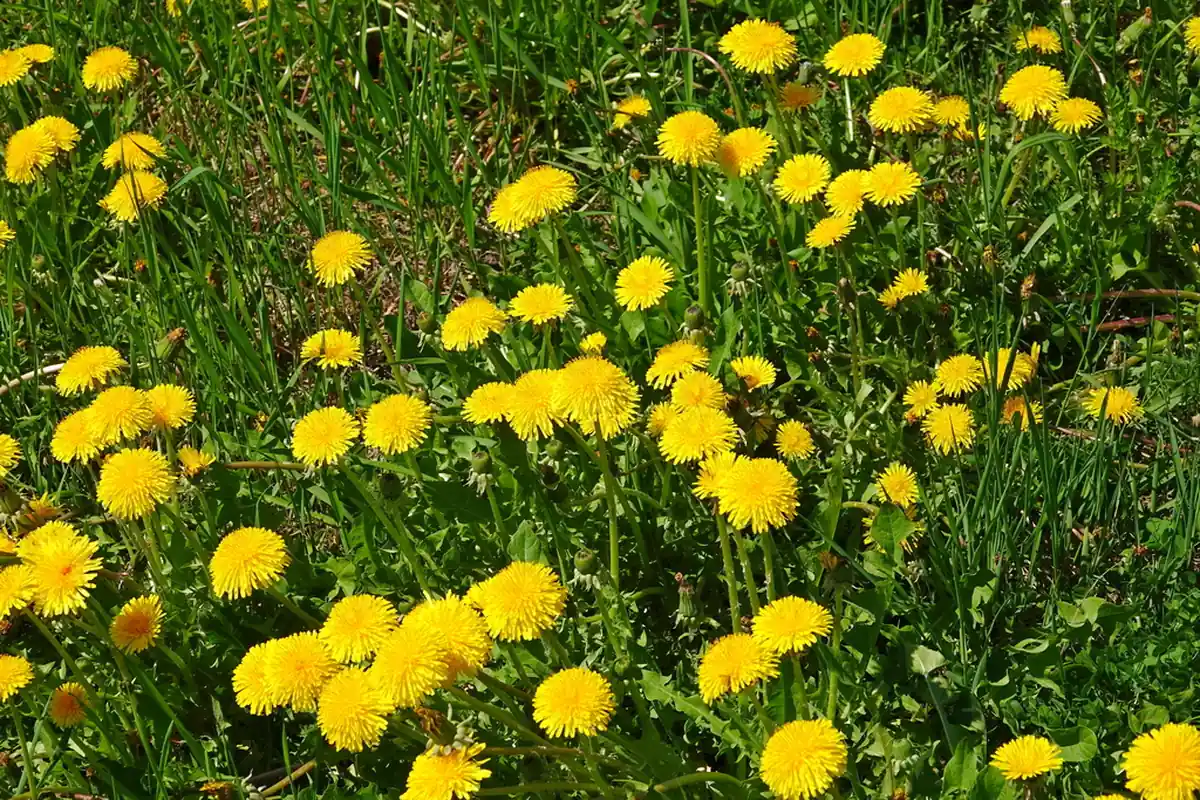
Dandelion uses at a glance: 9 things the plant is good for
Most lists of dandelion benefits mix cooking tradition, folk medicine and wishful thinking in one breath. It helps to pull them apart. The table below sorts nine common uses by how well each one is backed up, so you can see which are safe bets and which are hopes.
| # | Use | Part | How solid is it? |
|---|---|---|---|
| 1 | Salad green | Young leaves | Solid. A long-established food; extension services publish recipes |
| 2 | Cooked green | Older leaves | Solid. Boiling, with one change of water, tames the bitterness |
| 3 | Fritters, pancakes, baking | Open flowers | Solid. Remove the green base first |
| 4 | Wine, tea and jam | Flowers and leaves | Solid as a food tradition; nothing medicinal about it |
| 5 | Root vegetable | Roots dug in early spring | Solid, though digging them is hard work |
| 6 | Coffee alternative | Dried, roasted roots | Solid. Caffeine-free and a taste of its own |
| 7 | Early nectar and pollen for insects | Flowers | Real but limited. Helpful as part of a mixed diet, poor as the only pollen |
| 8 | Loosening compacted ground | Taproot | Plausible. NC State notes the taproot can break up compact soils |
| 9 | Herbal remedy (digestion, liver, ‘water pill’) | Leaf and root extracts | Weak. Very little human research; one small pilot study on urination |
If you came here because the things keep reappearing rather than because you want to eat them, the companion guide on why dandelions keep coming back covers the roots, the seeds and the control timing. This article is about the other choice: putting them to work. The dandelion uses below start with the surest ones.
Dandelion uses in the kitchen: leaves, flowers and roots
Dandelions weren’t always a lawn problem. Michigan State University Extension notes that they were first cultivated in Roman times and were carried to North America by early colonists who valued them as food and medicine. The name itself is kitchen-garden French: dent de lion, lion’s tooth, for the jagged leaf edge.
So which parts do you actually eat? According to University of Wisconsin–Madison Extension, the leaves, buds, flowers and roots are all edible. Michigan State adds the one exception: the flower stem, whose milky sap is too bitter to bother with.
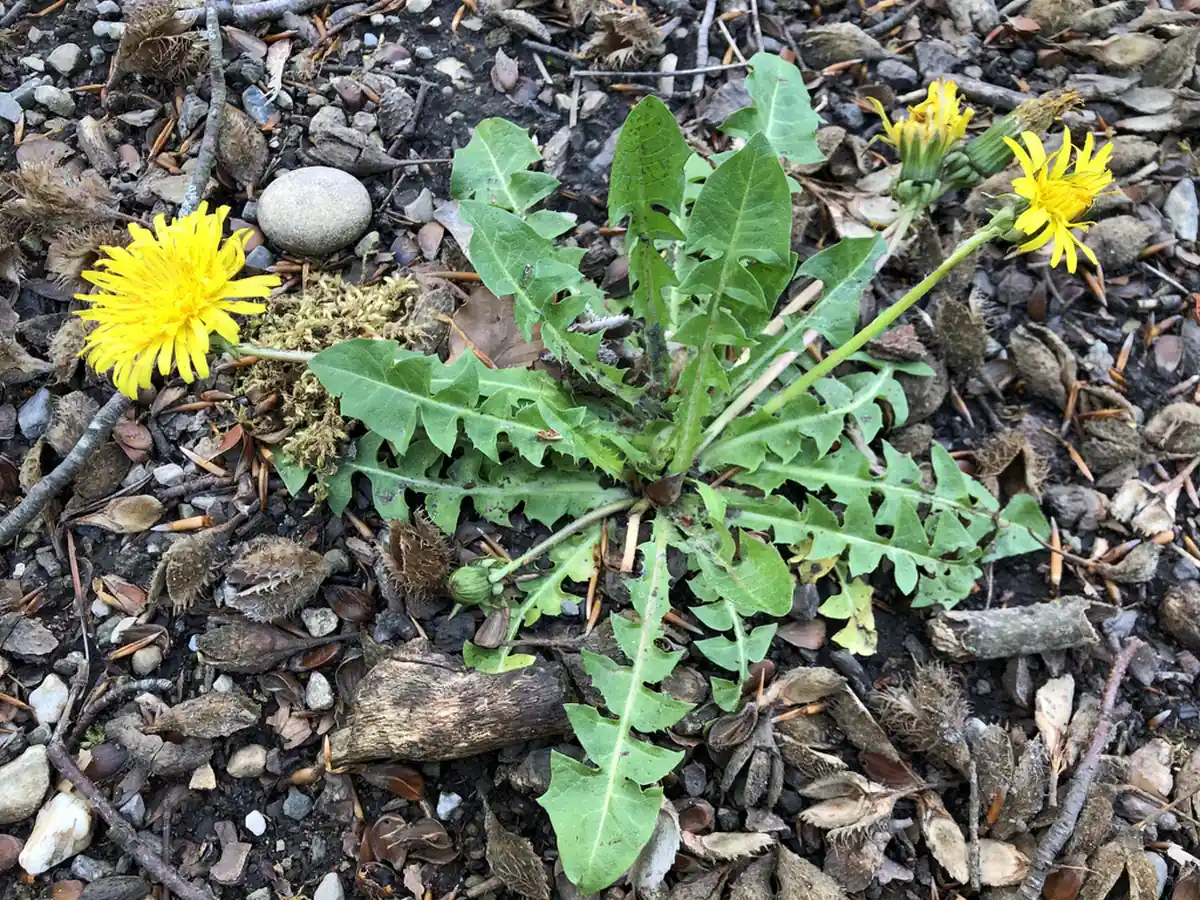
Leaves: pick early or pay for it
Timing is the whole game with dandelion greens. Wisconsin’s horticulturists say the leaves are best when young and tender and are most flavorful in early spring, before the first flower buds appear. After that they get steadily more bitter, and heat and dry soil push the bitterness further.
That gives you two ways to use them. Young leaves are good raw, torn into a salad with something sweet or fatty to balance them. Older leaves are better cooked, which is the NC State Extension advice too. The University of Maine’s bulletin on wild greens describes the classic method: boil until tender, change the water once to mellow the tang, then finish with butter or lemon juice.
One shopping note. If you’d rather grow greens than forage them, check the seed packet. Wisconsin points out that the ‘Italian dandelion’ sold in catalogs is really a type of chicory, a different plant with a similar leaf.
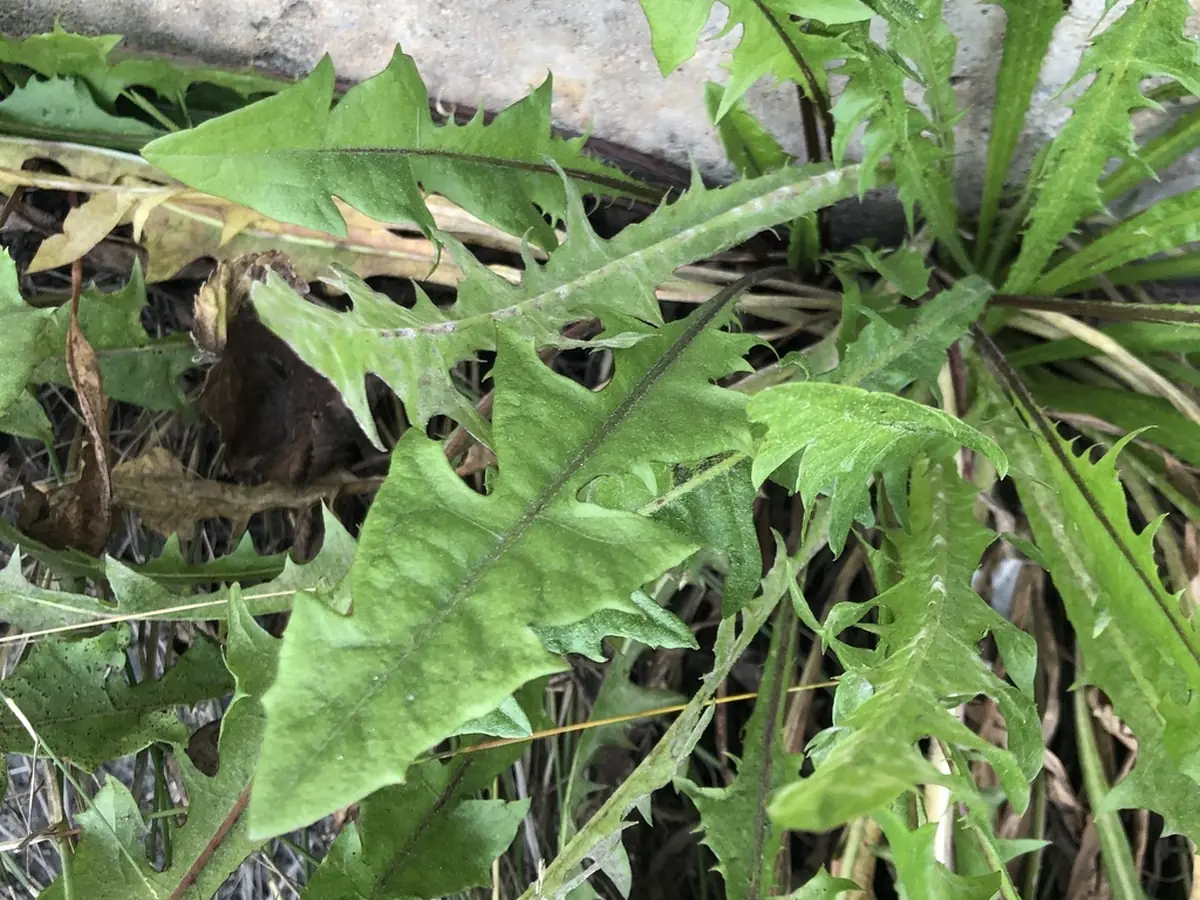
Flowers: fritters, baking and wine
The flowers are the mild, slightly sweet part. Michigan State lists pancakes, fritters, cookies, quick bread, drinks and wine among their uses, and Wisconsin notes the blossoms can be eaten fresh and are sweetest early in the season.
Two details decide whether a batch works. First, pick big, plump heads that are fully open, and use them straight away, because the flowers close quickly once they’re picked. Second, pull or cut the yellow petals away from the green base (the calyx). That green cup is bitter, and leaving it on is the usual reason a first attempt at dandelion fritters disappoints.
Roots: a vegetable, a tea and a coffee stand-in
Roots take the most effort. Wisconsin says they can be eaten as a vegetable if they’re dug in early spring, and Florida’s extension service describes the flavor as similar to a turnip. Expect a workout: the taproot is usually 6 to 12 inches long and can reach 3 feet.
The better-known use is roasted root ‘coffee’. NC State records that dried, roasted dandelion root was used as a coffee alternative during the Second World War. Michigan State’s method is simple enough to follow at home:
- Wash the roots thoroughly and chop them.
- Dry the pieces in the oven at 250°F.
- Roast at 350°F until toasty but not burned.
- For a root tea, simmer for 20 minutes, then strain.
Go easy on quantity at first. Wisconsin cautions against eating too many roots, since they’re reported to act as both a diuretic and a laxative.
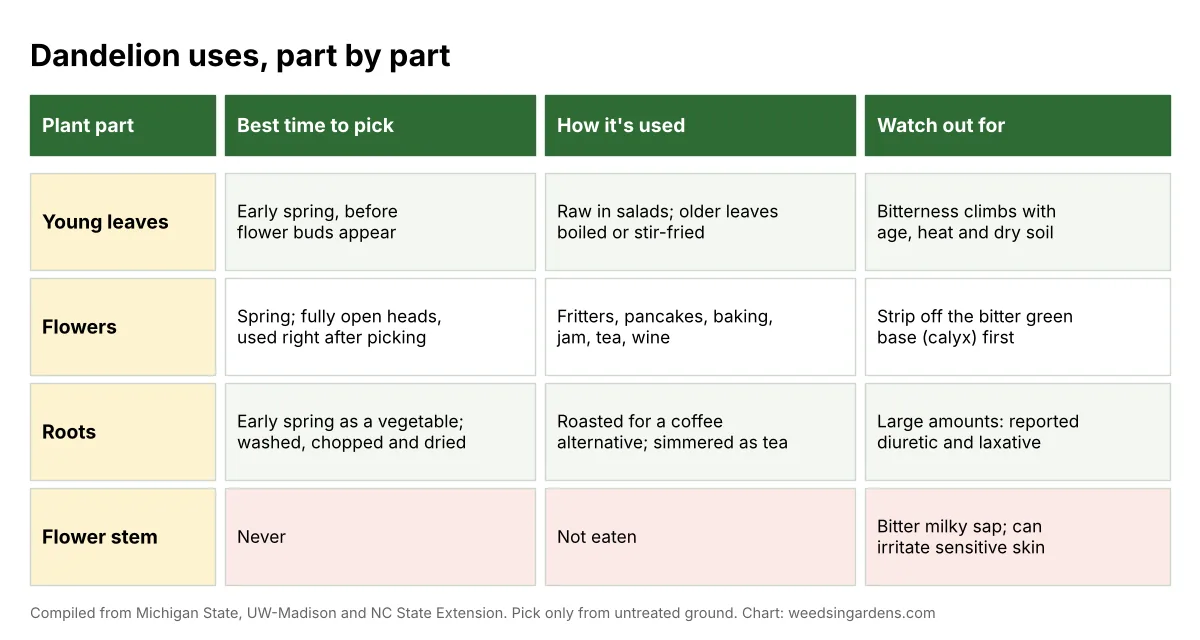
What’s actually in dandelion greens
Here’s where a lot of articles get carried away. Dandelion greens are a good leafy vegetable. They aren’t a multivitamin, and the numbers show exactly where they shine and where they’re ordinary.
A cup of chopped raw greens has about 25 calories. Set against the FDA Daily Values used on food labels, the figures from University Hospitals nutrition tables look like this:
| Nutrient | In 1 cup chopped, raw | FDA Daily Value | Share of Daily Value |
|---|---|---|---|
| Vitamin K | 150.5 mcg | 120 mcg | about 125% |
| Vitamin C | 19.3 mg | 90 mg | about 21% |
| Vitamin E | 2.6 mg | 15 mg | about 18% |
| Iron | 1.7 mg | 18 mg | about 9% |
| Calcium | 103 mg | 1,300 mg | about 8% |
| Fiber | 1.9 g | 28 g | about 7% |
| Potassium | 218 mg | 4,700 mg | about 5% |
| Folate | 14.9 mcg | 400 mcg DFE | about 4% |
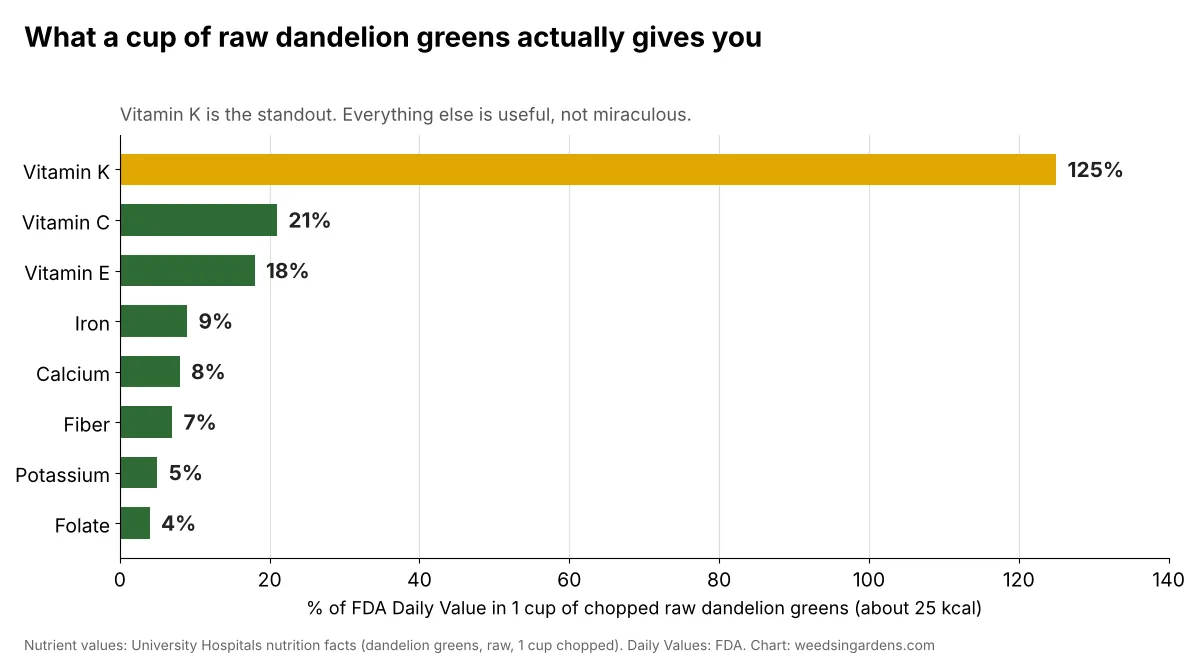
Vitamin K is the headline: one cup covers more than a day’s worth. The same cup also carries about 1,627 mcg of beta-carotene and 3,656 mcg of lutein plus zeaxanthin, the yellow-orange pigments that dark leafy greens are known for. Cooking doesn’t strip the value out either. Maine’s bulletin lists 3.5 ounces of boiled greens at 33 calories, 2 grams of protein, 18 mg of vitamin C and 1.8 mg of iron.
Two honest corrections to things you’ll read elsewhere. Dandelion greens are sometimes credited with vitamin B12, but the nutrient table lists 0 mcg, as you’d expect from a plant. And the iron and calcium are respectable for a leaf, yet a cup supplies under a tenth of the Daily Value for each. Eat the greens because they’re a tasty, free, dark leafy vegetable. That’s reason enough.
Medicinal dandelion uses: what the evidence actually shows
This is the section where it pays to slow down, because the claims are large and the evidence is small.
Dandelion has a long history in folk medicine. NCCIH notes that the flowers, leaves and root have been used in traditional Mexican and other North American medicine, and that dandelion products are promoted today for things like indigestion and joint pain. Its summary of the science is blunt, though: very little research exists on this herb, and there’s no compelling scientific evidence supporting its use for any health condition. Laboratory studies have looked at dandelion extracts for anti-inflammatory, antioxidant and antiviral properties, but those are test-tube findings, and they’re a long way from showing a benefit in people.
The one human study people quote
The ‘natural water pill’ reputation rests largely on a single pilot trial. In 2009, Clare, Conroy and Spelman gave 17 volunteers 8 mL of a fresh dandelion-leaf extract three times in one day and compared their urination with their own baseline days. Urination frequency rose significantly in the five hours after the first dose, and the ratio of urine output to fluid intake rose after the second. The third dose changed nothing.
The authors called the result promising and said further studies were needed. That’s a fair reading. Seventeen people, one day and a concentrated extract can’t tell you what a mug of dandelion tea does for blood pressure, swelling or ‘detox’, and nobody should swap a prescribed diuretic for it.
Who should be careful
Eating dandelion as food is a different matter from taking it as a supplement. NCCIH considers dandelion in the amounts commonly found in food likely safe, and says less is known about larger amounts. It flags a few groups who should check with a doctor or pharmacist first:
- People on certain medicines. There are theoretical reasons to suspect interactions with diabetes drugs, anticoagulants, antiplatelet drugs and water pills. The vitamin K figure in the table above is worth mentioning to whoever manages your prescription if you take a blood thinner whose dose depends on steady vitamin K intake.
- Anyone pregnant or breastfeeding. Little is known about the safety of amounts greater than those found in foods.
- People with eczema or plant allergies. Dandelion applied to the skin may trigger a reaction in people with atopic dermatitis, and the evidence is conflicting on whether people sensitive to ragweed, chrysanthemums, marigolds and daisies also react to dandelion.
- People with a latex allergy. The University of Florida’s extension service advises them to avoid eating the plant, because the sap contains natural latex.
None of this is medical advice for your situation. If you take regular medication, ask before you add any herbal product, dandelion included.
Do dandelions really help bees?
Every spring the same plea goes round: leave the dandelions for the bees. It’s half right, and the half that’s wrong matters if you care about pollinators.
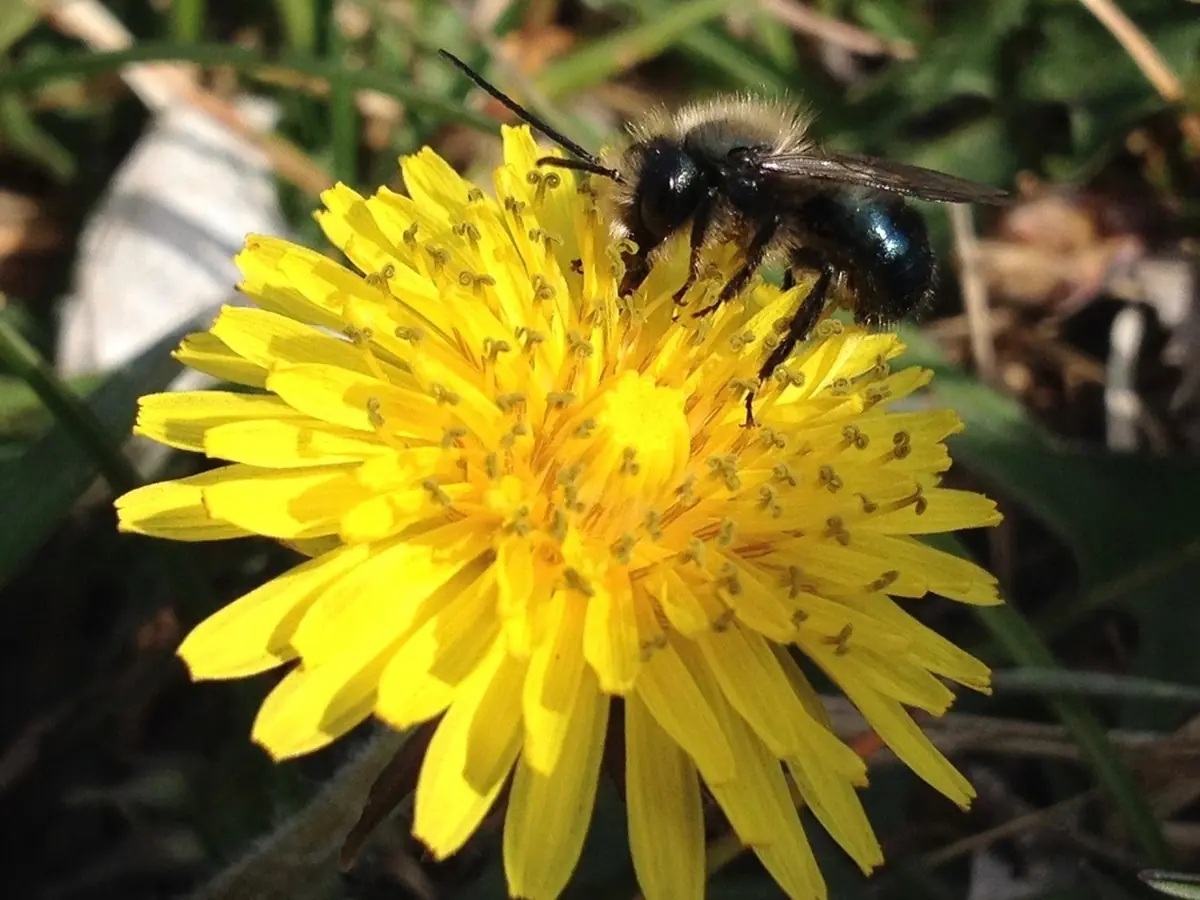
The true part first. Dandelions flower early and heavily. Wisconsin’s extension horticulturists call them a potentially important nectar source early in the season when few other flowers are blooming, and NC State says the same of both nectar and pollen. Florida adds that butterflies and moths visit the blooms and that caterpillars of many species feed on the leaves.
Now the catch. Dandelion pollen is poor food on its own. Back in 1987, Loper and Cohen analysed it against honey bee requirements and found it low in valine, isoleucine, leucine and arginine, which they linked to its reported poor brood-rearing performance. In a 2002 experiment, bumblebee micro-colonies fed only dandelion pollen (17.2% protein, against 27.5% for cherry-family pollen) raised no offspring at all. And in a 2026 study, small carpenter bees reared on dandelion pollen developed more slowly and ended up smaller than those given poplar pollen, while a 50:50 mix produced intermediate results.
Put together, the picture is clear enough. A dandelion is a decent snack bar and a bad sole supermarket. Leaving some to flower does feed insects, especially for nectar. But if helping bees is the goal, the bigger win is variety: early-flowering trees and shrubs, spring bulbs, clover and native perennials alongside whatever dandelions you tolerate.
How to harvest dandelions safely
The plant itself is low-risk. NC State rates it as having low-severity poison characteristics, limited to skin irritation from the sap in susceptible people. The real hazards come from where it’s growing and from picking the wrong plant. Five rules cover nearly all of it.
- Never pick from treated ground. Michigan State’s rule is to harvest only from areas you know haven’t been treated with chemicals, fertilizers or herbicides. That rules out any lawn that’s had weed-and-feed or a broadleaf spray, and any lawn whose history you don’t know. If you’re not sure what’s been applied, the guide to post-emergent herbicides explains what those products are.
- Skip roadsides, paths and pet areas. Maine’s bulletin says to pick well away from major roads; Michigan State adds pathways, animal and pet areas, and high-traffic spots.
- Be sure it’s a dandelion. A true dandelion has all its leaves in a ground-level rosette and carries one flower head on each hollow, leafless, unbranched stalk. NC State lists cat’s ear, sow thistles, chicory and common groundsel among the plants often confused with it. A branched or leafy flower stalk means you’ve got something else; the roundup of weeds with yellow flowers can help you sort them out.
- Wash everything. Rinse leaves, flowers and roots well, and refrigerate what you don’t use right away.
- Wear gloves if your skin reacts. The sap can cause contact dermatitis in susceptible people, and you’ll handle a lot of it when digging roots.
Start small the first time you eat any wild green. A few leaves in a mixed salad will tell you whether you like the taste and whether it agrees with you.
Keeping a few dandelions without losing the lawn
You can have a kitchen patch and a tidy lawn. What you can’t do is let the patch go to seed. Florida’s extension service puts the output at up to 20,000 seeds per plant, each on its own parachute, so a relaxed week in late spring undoes a year of weeding.
| If you want… | Do this |
|---|---|
| Spring salad greens | Leave a few plants in a bed or lawn corner you never spray; pick leaves before flower buds show |
| Flowers for fritters or wine | Pick fully open heads and use them at once; picking also removes the future seed heads |
| Roasted-root coffee | Dig whole roots from untreated ground; a loosened, watered bed gives up roots far more easily than a compacted lawn |
| Flowers for insects but no spread | Let them bloom, then deadhead or mow before the white seed heads form |
| No dandelions at all | Dig out the full taproot or spot-treat, and thicken the turf so seedlings can’t establish |
If you decide the lawn should be dandelion-free, don’t try to combine that with harvesting. Wisconsin notes that the broadleaf herbicides in weed-and-feed products will kill actively growing dandelions, and those same products are the reason treated lawns are off the menu. Fall is the most effective season for that kind of work; the fall weed control guide walks through the timing. Always read and follow the product label for your grass type, rate and temperature limits.
Dandelion isn’t the only lawn weed with a second life in the kitchen. Purslane, stinging nettle and broadleaf plantain all have their own guides, and there are more in the useful weeds section.
A note from the agronomist’s side
From a plant-science point of view, the dandelion’s usefulness and its weediness are the same set of traits seen from two sides. A deep taproot stores carbohydrate through winter. That’s why the plant can flower so early, why the root is worth roasting, and why a snapped root grows back. The bitter milky sap that protects the leaves from grazing is what makes old greens unpleasant, and it’s why every traditional recipe starts with young leaves or a change of cooking water.
The bitterness timeline makes sense once you think about what the plant is doing. In early spring it’s pushing out soft new leaves as fast as it can. Once flowering starts and the weather turns hot and dry, the leaves toughen and their bitter compounds become more concentrated. So the extension advice to pick before buds appear is plant physiology, and it holds from Maine to Wisconsin.
On the health claims, it’s worth applying the same standard you’d apply to a herbicide label. A test-tube result tells you a compound can do something in a dish. It doesn’t tell you the dose, the form or whether it works in a person. Dandelion has plenty of the first kind of evidence and almost none of the second. That doesn’t make the plant useless. It means the dandelion uses worth your time are the edible ones.
A sensible rule of thumb for homeowners: decide lawn by lawn, not plant by plant. Pick one area that never gets sprayed and treat it as the edible patch, and manage the rest of the lawn however you like. Mixing the two is where people end up either eating something they shouldn’t or resenting a weed they could have enjoyed.
Dandelion uses FAQ
What are dandelions good for?
Mostly food. Young leaves are eaten raw or cooked, flowers go into fritters, baking, tea and wine, and roots are eaten as a vegetable or roasted as a coffee alternative. The flowers also give early nectar to insects. Health claims are weak: the U.S. NCCIH says there is no compelling scientific evidence that dandelion helps any health condition.
Can you eat dandelions straight from your yard?
Yes, if the yard has not been treated. Only harvest from ground you know has had no herbicide, weed-and-feed or other chemicals, and avoid roadsides, paths and areas pets use. Wash everything well. If you don’t know a lawn’s spray history, don’t eat from it.
Which part of the dandelion is not edible?
The flower stem. Michigan State University Extension notes the whole plant is edible except the stem, whose milky sap is bitter. The green base under the flower is also bitter, so it is usually removed before cooking the petals.
When is the best time to pick dandelion greens?
Early spring, before the first flower buds appear. University of Wisconsin-Madison Extension says leaves are most flavorful then and become more bitter later in the season, and that heat and dry soil add to the bitterness. Older leaves are better boiled, with one change of water.
Is dandelion root coffee real coffee?
No. It is a caffeine-free drink made from dandelion roots that are washed, chopped, dried at 250 degrees Fahrenheit and roasted at 350 degrees until toasty. It was used as a coffee alternative during the Second World War. The flavor is its own thing, roasted and slightly bitter.
Is dandelion tea good for you?
It is fine as a drink for most people, but don’t expect a treatment. Research in humans is very limited. One 2009 pilot study in 17 volunteers found a leaf extract increased urination for a few hours. If you take diabetes medicine, blood thinners or water pills, or are pregnant or breastfeeding, ask a health professional first.
Should I leave dandelions for the bees?
Leaving some helps, mainly for early nectar, but dandelions are not enough on their own. Studies show their pollen is low in several amino acids bees need, and bumblebee colonies fed only dandelion pollen raised no young. A mix of early-flowering trees, shrubs, bulbs and clover does more for pollinators.
Sources
- National Center for Complementary and Integrative Health (NIH). Dandelion: Usefulness and Safety. Last updated November 2024.
- Venema, C. (updated from Jarvie, M.). Is a dandelion food or a weed? Michigan State University Extension, June 2025.
- Mahr, S. Dandelion, Taraxacum officinale. Wisconsin Horticulture, Division of Extension, University of Wisconsin–Madison.
- NC State Extension. Taraxacum officinale (Dandelion, Lion’s Tooth). North Carolina Extension Gardener Plant Toolbox.
- Fuller, D. and Calder, B. Bulletin #4060, Facts on Edible Wild Greens in Maine. University of Maine Cooperative Extension.
- Stevenson, C. Weekly “What is it?”: Dandelions. UF/IFAS Extension Escambia County, April 2021.
- University Hospitals. Nutrition Facts: Dandelion greens, raw, 1 cup, chopped.
- U.S. Food and Drug Administration. Daily Value on the Nutrition and Supplement Facts Labels. Content current as of March 2024.
- Clare, B.A., Conroy, R.S. and Spelman, K. (2009). The diuretic effect in human subjects of an extract of Taraxacum officinale folium over a single day. Journal of Alternative and Complementary Medicine 15(8): 929–934. doi:10.1089/acm.2008.0152 (via PubMed).
- Loper, G.M. and Cohen, A.C. (1987). Amino acid content of dandelion pollen, a honey bee (Hymenoptera: Apidae) nutritional evaluation. Journal of Economic Entomology 80(1): 14–17. doi:10.1093/jee/80.1.14
- Génissel, A., Aupinel, P., Bressac, C., Tasei, J.-N. and Chevrier, C. (2002). Influence of pollen origin on performance of Bombus terrestris micro-colonies. Entomologia Experimentalis et Applicata 104: 329–336. doi:10.1046/j.1570-7458.2002.01019.x
- Stephen, K.W. and Rehan, S.M. (2026). Macronutrient composition in pollen affects development and survival in wild bees. Physiological Entomology 51: 350–362. doi:10.1111/phen.70029
This article is for general information and is not medical advice. Talk to a health professional before using any herbal product, especially if you take medication.