
Short answer: purslane (Portulaca oleracea) is both. It is one of the most persistent summer weeds in vegetable beds and thin lawns, and it is also a leafy vegetable eaten raw or cooked in many cuisines. If you want it gone, remove it before it flowers, carry the stems out of the bed, and cover bare soil. If you want to eat it, confirm the ID (smooth, fleshy leaves and clear sap, never milky), pick from unsprayed ground, and keep portions moderate because the leaves are high in oxalate.
Which way you go depends on where it grows. Below is how to identify common purslane, how to tell it from toxic spurge, why it keeps coming back, how to control it in lawns and beds, and how to eat it safely.
Table of Contents
How to identify purslane
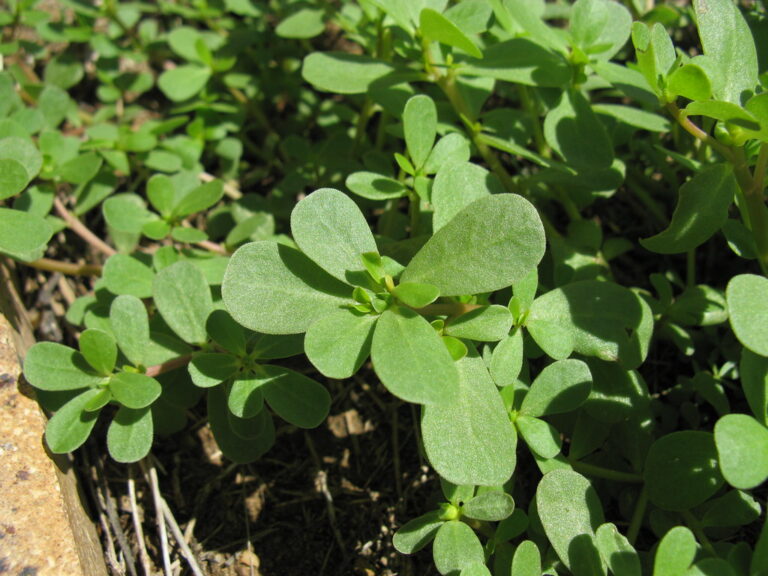
Common purslane is a summer annual succulent. It hugs the ground, forming mats that the University of Maryland Extension describes as “less than 1 ft. tall”, and single stems commonly reach about 12 inches long, according to UC IPM.
- Stems: thick, smooth (no hairs), and red, pink or green, radiating from a central taproot.
- Leaves: fleshy, paddle- or wedge-shaped, 1/2 to 2 inches long, with no leaf stalk (UC IPM). Penn State Extension notes they grow opposite each other or in clusters.
- Flowers: small, yellow, five petals, about 3/8 inch across, and they open only in sunshine.
- Sap: clear and watery. The stems are more than 90% water, according to West Virginia University Extension.
The flowers are easy to miss. On cloudy days they stay closed, so a patch can look flowerless while it is already setting seed.
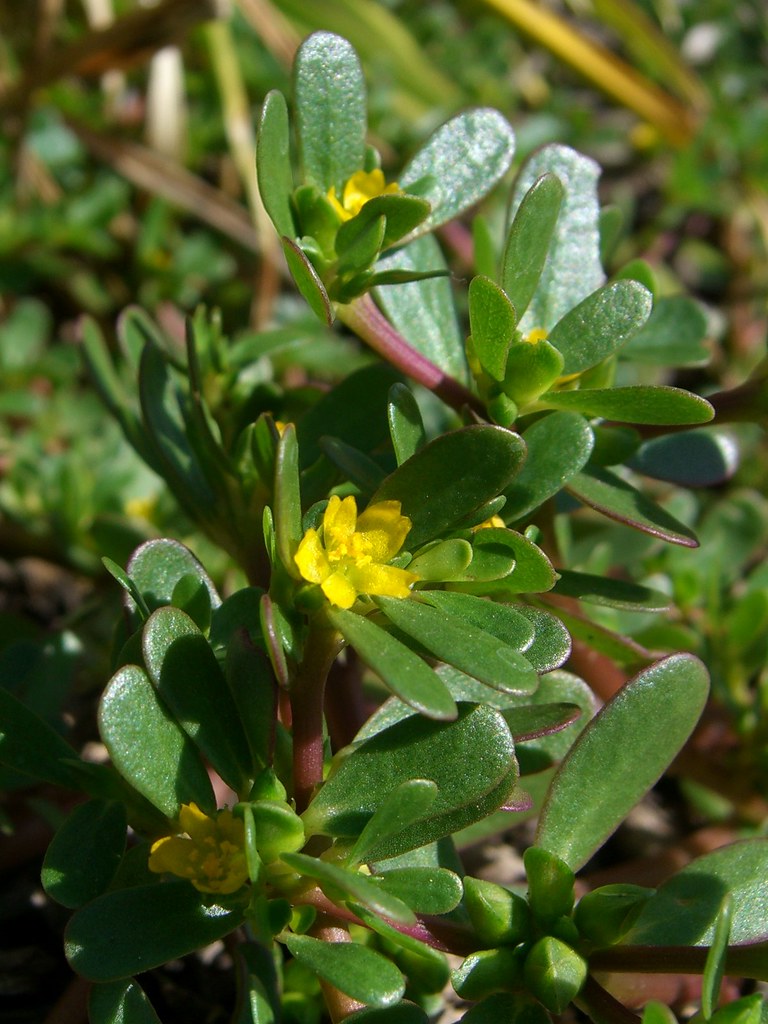
Seed capsules
Each flower becomes a tiny capsule whose top comes off “like the lid on a cookie jar” (UC IPM). Inside are reddish-brown to black seeds only 1/64 to 1/32 inch across. Once you know this lid, you can check any plant in a few seconds: if lids are popping off, the plant has already dropped seed.

Purslane vs spurge: the lookalike that matters
The plant most often confused with purslane is spotted spurge (Euphorbia maculata). The two grow in the same hot, bare spots and both sprawl flat. Spurge is not edible. UC IPM’s spurge Pest Notes say broken stems “secrete a milky, poisonous sap” that irritates the eyes and skin.

| Feature | Common purslane | Spotted spurge |
|---|---|---|
| Sap when a stem is snapped | Clear, watery | White, milky |
| Stem | Thick, smooth, succulent | Thin, wiry, often hairy |
| Leaves | Fleshy, 1/2 to 2 in, rounded tip | Small and thin, often with a red-purple spot |
| Flowers | Yellow, five petals | Tiny, inconspicuous |
| Edible? | Yes, in moderation | No |
The snap test settles it: break a stem and look for white sap. If you see any, it is a spurge. Our spurge control guide covers the spurges in detail, and Euphorbia hirta is a tropical relative with the same milky sap. If you pull both weeds together, sort them before anything goes to the kitchen.
Why purslane keeps coming back
Three traits make this weed hard to get rid of:
- Huge seed numbers. A single plant may produce 240,000 seeds (UC IPM), and WVU Extension gives a figure of over 200,000 per plant.
- Long seed life. Seeds “may germinate even after 5 to 40 years” (UC IPM), so one season of seed rain can feed decades of weeding.
- Stems that re-root. Hoed or pulled stems “can remain moist and viable for several days” and root again to form new plants (UC IPM). Seeds can also keep ripening for about a week on a pulled plant.
Speed matters too. The plant flowers a few weeks after it germinates, and Utah State University Extension says seeds follow within about 3 weeks of the flowers. Germination starts once soil reaches about 60°F (UC IPM), and WVU puts the optimum near 30°C (86°F), which is why a new flush appears after every summer watering.
In a post on the UC Weed Science blog, UC Davis weed scientist Steven Fennimore adds two useful numbers. The seeds germinate best from the surface and from very shallow soil, less than 1/4 inch deep. And uprooted plants 1 to 3 weeks old could not produce viable seed, while plants 4 to 6 weeks old could. So the first three weeks after emergence are your window.
Purslane control methods compared
| Method | Works best for | Key detail |
|---|---|---|
| Hand pulling | Small patches, vegetable beds | Pull before flowering, when soil is moist; remove every stem piece |
| Hoeing on a dry, sunny day | Seedlings in rows | Rake stems off the bed or they can re-root |
| Organic mulch | Perennial and shrub beds | At least 3 inches deep (UC IPM, USU) |
| Black plastic or straw over newspaper | Vegetable beds | WVU recommends thick (6-mil) plastic |
| Soil solarization | Heavily infested beds before planting | Clear plastic for 4 to 6 weeks in the hottest months (UC IPM) |
| Dense turf | Lawns | Purslane invades thin, bare, compacted spots |
| Pre-emergent herbicide | Lawns with a yearly problem | Must go down before soil warms; follow the label |
| Post-emergent broadleaf herbicide | Established lawn infestations | Treat young plants; succulent older plants are tougher |
How to get rid of purslane in vegetable and garden beds
This weed loves the loose, bare, frequently watered soil of a vegetable bed. The cool-season counterpart is chickweed; purslane takes over once summer heat arrives. A plan that works:
- Pull or hoe weekly in early summer. Aim to catch plants in their first three weeks, before any flowers.
- Take the stems out. Put them in a bag or a hot compost pile, not on the soil surface. On moist ground they re-root within days.
- Do not leave pulled plants lying with flowers. Seeds can still ripen on them for about a week.
- Cover the soil. Mulch between rows with straw over newspaper, or use black plastic. Because the seeds germinate from the top 1/4 inch, anything that blocks light at the surface cuts emergence sharply.
- Water with drip, not sprinklers. Wetting only the crop row leaves dry paths where fewer seeds germinate.
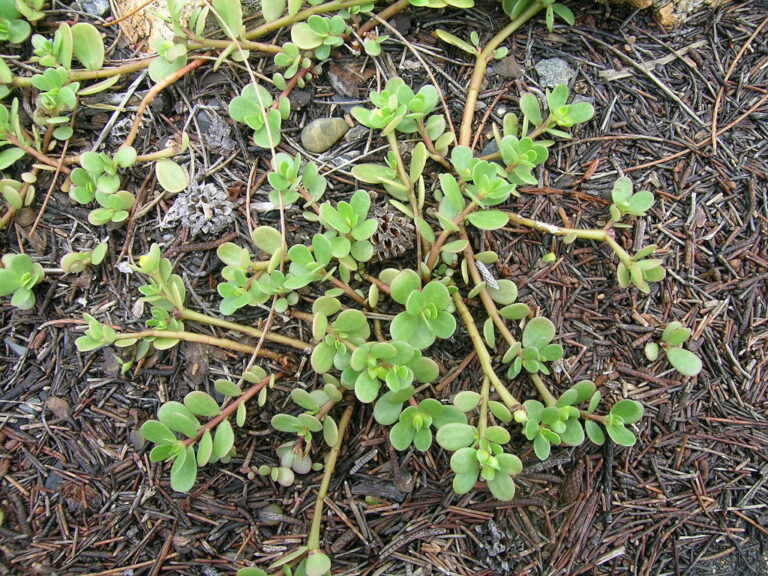
In ornamental beds, keep organic mulch at least 3 inches deep and top it up when it thins. Our guide on stopping weeds growing through mulch explains why thin mulch backfires, and weeds in gravel and rock gardens covers weeds in stone.
For a bed that is badly infested before planting, solarize it: water, cover with clear plastic sealed at the edges, and leave it for 4 to 6 weeks in the hottest part of summer. UC IPM notes this works best in July and August in California.
How to control purslane in lawns
In lawns, this weed is a sign of thin turf. Maryland Extension notes it thrives in sandy, compacted, low-nutrient soils in hot, dry weather and in newly seeded turf. It usually shows up along paths, driveways and bare edges, where the grass is weakest.
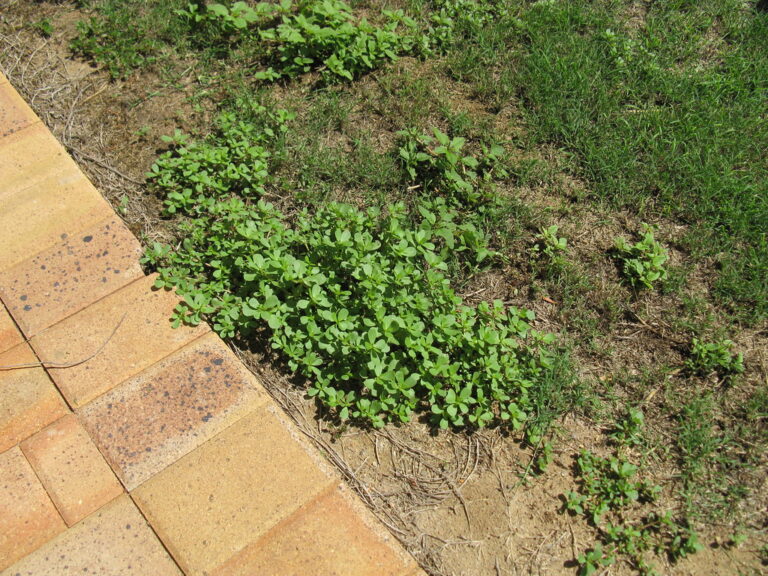
The long-term fix is thicker grass: seed or sod bare patches at the right time for your grass type, feed and mow at the proper height. Penn State recommends establishing turf in late summer or fall so that it is dense before the next summer.
Where it returns every year, extension services list these herbicide options for lawns:
- Pre-emergent: dithiopyr, pendimethalin, prodiamine or isoxaben (Penn State), applied before the soil warms in late spring. Most of these also stop new grass seed, so do not use them where you plan to overseed.
- Post-emergent: broadleaf products containing 2,4-D, MCPP (mecoprop), dicamba or triclopyr (Maryland Extension), often sold as three- or four-way mixes. Penn State adds fluroxypyr and MCPA combinations. Maryland warns not to apply dicamba over the root zones of trees and shrubs.
Treat plants while they are young and actively growing, and follow the label’s interval if a repeat application is needed. Always read the label for your grass type and temperature limits.
Eating purslane safely
The plant is sold as a vegetable in many markets and is called verdolaga in Spanish. UC IPM describes it as “an excellent crunchy salad plant” with a “sweet, yet acidlike flavor”. Both leaves and tender stems are eaten raw in salads, or cooked in soups, stews and stir-fries.
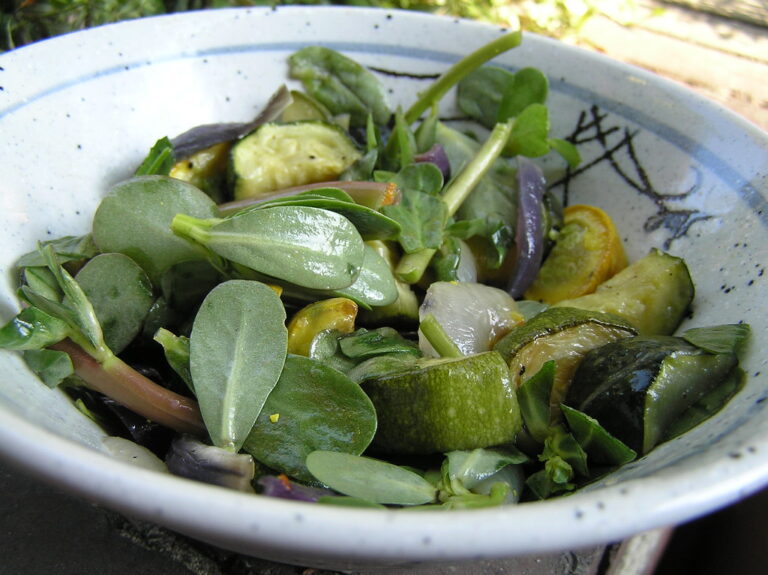
The nutrition claims are real but often inflated. A 1992 study by Simopoulos and colleagues in the Journal of the American College of Nutrition measured, per 100 g of fresh leaves:
- about 300–400 mg of alpha-linolenic acid, a plant omega-3;
- 26.6 mg of vitamin C and 12.2 mg of alpha-tocopherol (vitamin E);
- 1.9 mg of beta-carotene and 14.8 mg of glutathione.
In that study common purslane had more omega-3 than spinach, the comparison green, though plant omega-3 is not the same as the EPA and DHA in fish.
The oxalate caution
Purslane leaves are high in oxalate. Moreau and Savage (2009) measured about 1,073–1,234 mg of oxalate per 100 g of dry leaf, and the earlier studies they cite report 113–235 mg per 100 g of fresh leaves. About half was soluble oxalate, the form the gut absorbs; mixing the raw leaves with yoghurt cut the soluble share from 53% to 10.7%. The same compounds explain the sour taste of oxalis.
Practical rules for eating it:
- Eat it as one vegetable among many, not in large daily portions.
- If you have had kidney stones or have kidney disease, ask your doctor before adding high-oxalate greens.
- Only harvest from ground you know has not been sprayed with herbicides or treated with lawn products, and avoid roadsides and dog-walking areas.
- Do the milky-sap test on every stem if spurge grows nearby.
- Keep pets from grazing on it: the ASPCA lists purslane as toxic to dogs, cats and horses because of its soluble calcium oxalates.
This section is general information about a garden plant, not medical or dietary advice.
Where this applies
The timings here are for temperate climates with a cold winter, where the weed is a summer annual that germinates from late spring to midsummer. In the tropics and subtropics it can germinate in any warm month, so weekly weeding has to continue year-round. In the Southern Hemisphere, shift the months by six. Herbicide registration and product names vary by country and state, so check your local label before using any of the chemicals named above.
A note from the agronomist’s side
The most common purslane mistake is, ironically, the tidy one. A bed gets hoed clean on a warm morning, the cut stems are left lying between the rows, and after the next watering many of them root again. Purslane stores so much water in its fleshy stems that a “dead” piece can survive for days on moist soil, which is exactly why extension guides tell you to rake the pieces off and remove them.
The second mistake is waiting for the plants to “get big enough to pull”. By the time a mat is easy to grab, its capsules are already opening. Hoe in the first three weeks, rake the pieces off, and the seed bank starts to shrink. And if you like the taste, grow a clean patch on purpose where you can pick it without worrying about spurge or spray.
Frequently asked questions
Is purslane a weed or a vegetable?
Both. Botanically it is the same species. In a lawn or vegetable bed it behaves as a fast, seed-heavy summer weed; in the kitchen it is a leafy vegetable, and UC IPM notes it is grown as a minor crop in the United States.
Does purslane come back every year?
The plant itself dies with frost, but it returns from seed. With up to 240,000 seeds per plant and seeds that can survive for decades, it comes back wherever it was allowed to seed.
Can you compost purslane?
Only in a hot compost pile. Stems re-root and seeds can ripen after pulling, so add plants without flowers, or bag seeding plants and put them out with household waste.
For other summer weeds with yellow flowers, see our yellow-flowered lawn weeds guide, and browse the garden and bed weeds section for more identification guides.
Related guides: How to Get Rid of Spurge in Lawns, Garden Beds and Sidewalk Cracks · How to Get Rid of Chickweed in a Vegetable Garden (and Keep It Gone) · How to Get Rid of Oxalis (Yellow Woodsorrel) in Lawns and Garden Beds
Sources
- UC IPM (Cudney, Elmore and Molinar). Common Purslane, Pest Notes Publication 7461. University of California.
- Fennimore, S. A. (2021). Purslane weed seed biology. UC Weed Science blog.
- University of Maryland Extension. Purslane.
- Penn State Extension. Lawn and Turfgrass Weeds: Common Purslane.
- West Virginia University Extension. Common Purslane.
- Utah State University Extension. Common Purslane, Ornamental Pest Guide.
- UC IPM. Spotted Spurge, Pest Notes Publication 7445.
- Simopoulos, A. P., Norman, H. A., Gillaspy, J. E. and Duke, J. A. (1992). Common purslane: a source of omega-3 fatty acids and antioxidants. Journal of the American College of Nutrition 11(4).
- Moreau, A.-G. and Savage, G. P. (2009). Oxalate content of purslane leaves and the effect of combining them with yoghurt or coconut products. Journal of Food Composition and Analysis 22(4): 303–306.
- ASPCA Animal Poison Control. Purslane.