
It started as a few red, asparagus-like shoots by the back fence. By July they were bamboo-like canes taller than you, with broad heart-shaped leaves shading out everything beneath. You cut it down; three weeks later it was back, thicker than before. Now the first frost is coming, and you want to know whether Japanese knotweed removal is something you can actually finish.
Short answer: Japanese knotweed removal works best with a systemic herbicide applied late in the season, when the plant is pulling sugars down into its rhizomes. Glyphosate sprayed onto the foliage from August until the first hard frost, or injected into hollow stems from late July through September, gives the most reliable control. Plan on at least three growing seasons of follow-up, because no single treatment kills the whole rhizome network (RHS; King County Noxious Weed Control Program).
Digging, repeated cutting and heavy covering can work too, but only on small patches and only if you stick with them for three to five years. The fastest way to make the problem worse is to dig, mow or chop the plant and leave fragments behind.
By the end of this guide you’ll be able to confirm you’re dealing with Japanese knotweed and not a look-alike, choose the right removal method for your patch size, time it to the month, and dispose of the debris without starting new colonies. If you’re new to invasive plants in general, our overview of introduced invasive weeds is a useful companion.
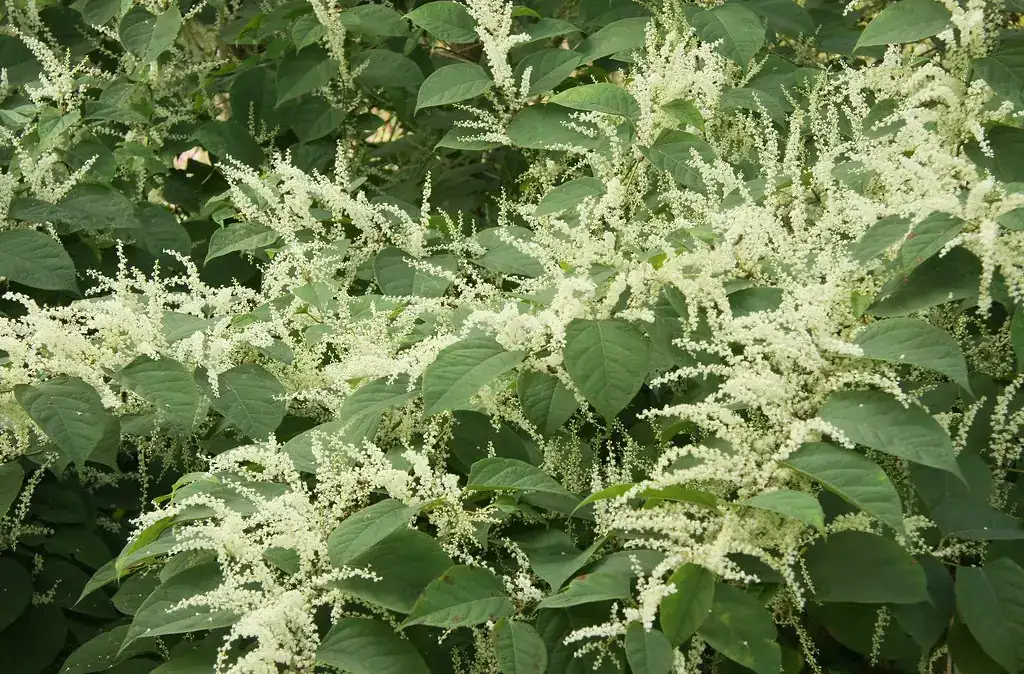
How to Identify Japanese Knotweed (and Its Look-Alikes)
Before you commit to three years of Japanese knotweed removal, make sure it is knotweed. Japanese knotweed (Reynoutria japonica, also listed as Fallopia japonica or Polygonum cuspidatum) has close relatives, giant knotweed and the hybrid Bohemian knotweed, that behave the same way and are treated the same way (Penn State Extension).
Key ID features
- Height and habit: dense thickets of canes up to about 11 feet tall, spreading from underground rhizomes.
- Stems: hollow, jointed and bamboo-like, green with darker red or purple speckles and swollen nodes. Leafy stems zigzag from node to node.
- Leaves: alternate, spade- to heart-shaped, up to about 6 inches long, with a squared-off base. Giant and hybrid knotweed leaves can reach a foot long and have a rounded or curved base.
- Flowers: in late summer, fingerlike sprays of small creamy-white flowers, 3 to 4 inches long, from the leaf joints.
- Spring shoots: bright red to purple, with furled, triangular leaves at the tips.
- Winter: canes die back at the first hard frost and often stand through winter as brown, hollow sticks.
All of the above comes from Penn State Extension’s fact sheet; the winter die-back note is from the King County knotweed best management practices.
| Plant | Stems | Leaves | How to tell it apart |
|---|---|---|---|
| Japanese knotweed | Hollow, jointed, red-speckled; soft and wet when cut | Spade-shaped, squared base, up to ~6 in | Dies back to brown canes every winter |
| Giant / Bohemian knotweed | Same hollow canes, often taller | Larger (up to ~1 ft), rounded or heart-shaped base | Treat exactly like Japanese knotweed |
| Running bamboo | Woody, hard canes | Slender, papery, grass-like | Leaves stay green year-round |
| Broad-leaved dock | No tall canes | Rosette of basal leaves from a taproot | One central crown, not many single stems |
If your canes are woody and the leaves are long and grassy, read our guide to running vs clumping bamboo instead; the control plan is different.
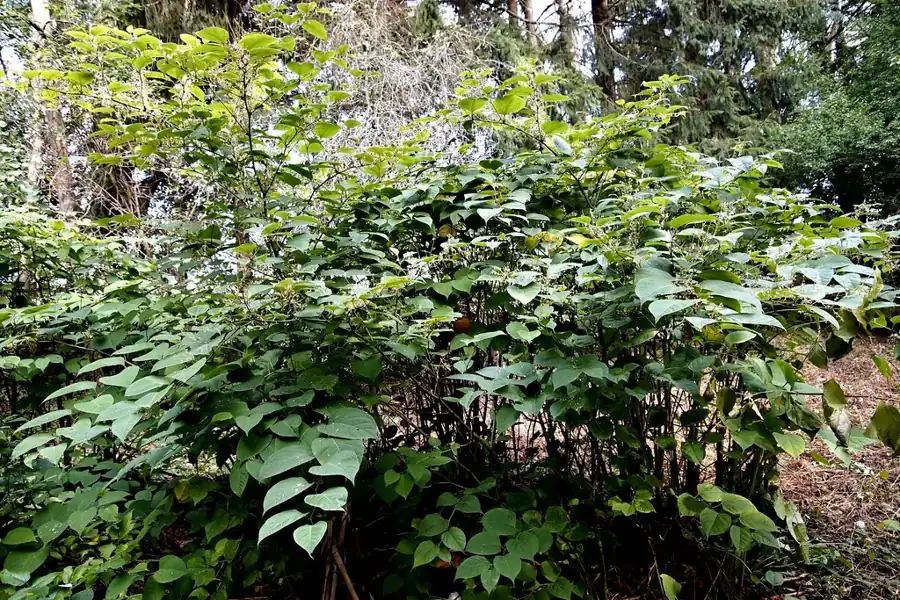
Why Japanese Knotweed Removal Is So Hard
In Japanese knotweed removal, the canes are the easy part. The real plant is underground: a web of thick rhizomes that store energy and send up new shoots wherever they are broken. Penn State Extension notes that every rhizome fragment can form a fully functional clone of the parent plant, and that cut stems lying on moist soil can root too. King County puts the minimum size of a fragment that can start a new colony at about ½ inch (1 cm), and the RHS gives the same figure.
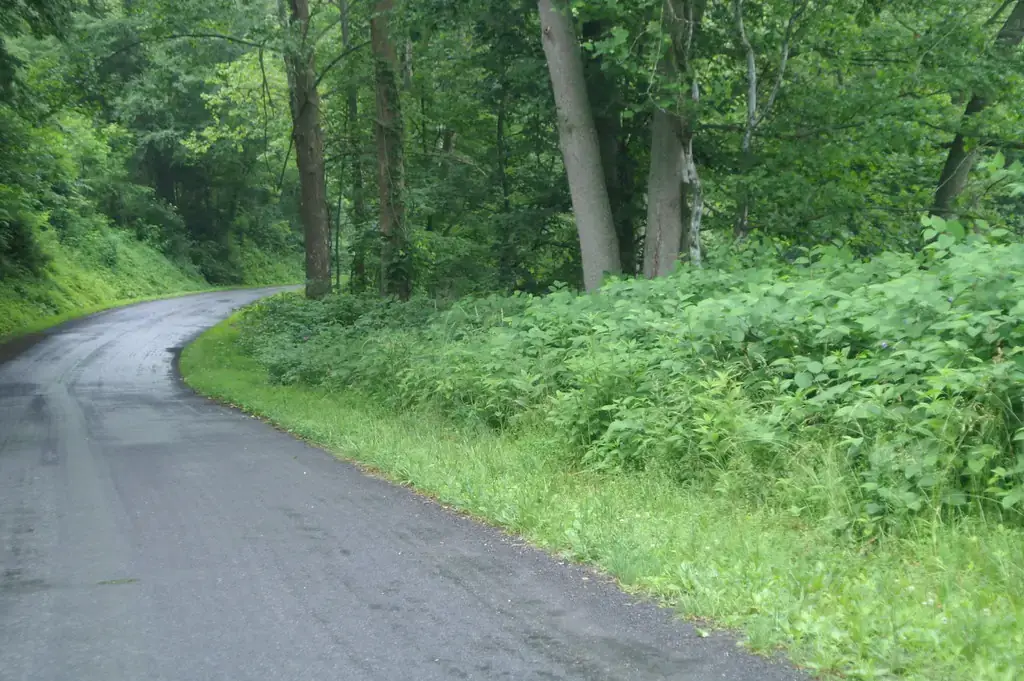
Those rhizomes are long-lived. The Missouri Department of Conservation describes them as very durable and able to survive for decades, and notes that knotweed is commonly moved to new sites in fill dirt and spread along roads by routine mowing.
How far do the roots really go?
You may have heard the “7-metre rule”: that knotweed rhizomes reach about 23 feet from the visible plant. A 2018 study in PeerJ by Fennell, Wade and Bacon examined records from UK sites and found that was an overestimate for most stands. Small stands had an average horizontal rhizome extent of 1.4 m (about 4.6 ft) and none went beyond 4 m (about 13 ft). In large stands, 75% of records were 2.5 m (about 8 ft) or less. The deepest rhizome recorded was 3.2 m (about 10.5 ft).
Practically, that means you should search for new shoots well beyond the canes. King County recommends checking at least 20 feet out from the centre of the patch, but you don’t need to treat your whole yard as contaminated. The same study found no evidence that knotweed damages sound buildings more than other plants of similar size, which is reassuring if a patch is near your house.
| Fact | Number | Source |
|---|---|---|
| Smallest rhizome fragment that can regrow | About ½ in (1 cm) | King County; RHS |
| Average rhizome spread, small stands | 1.4 m (≈4.6 ft); none over 4 m | Fennell et al. 2018 |
| Rhizome spread, large stands | 75% within 2.5 m (≈8 ft) | Fennell et al. 2018 |
| Deepest rhizome recorded | 3.2 m (≈10.5 ft) | Fennell et al. 2018 |
| How far to scout for new shoots | At least 20 ft from the patch centre | King County |
| Minimum time to eradicate with weedkiller | At least 3 growing seasons | RHS |
Japanese Knotweed Removal Methods Compared
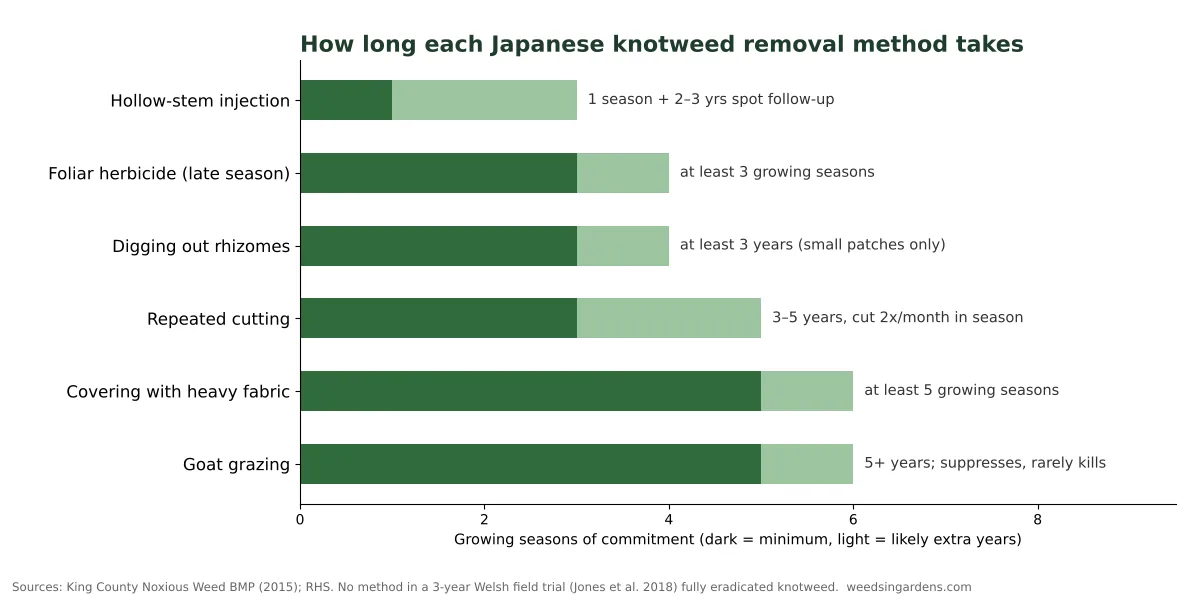
The most useful evidence on which methods work comes from a three-year field trial in South Wales led by Jones and colleagues (2018). They tested 19 treatments on 58 plots of 225 m² at three sites, including several herbicide programmes and a physical treatment of covering with heavy plastic and hand-pulling escaping shoots. None of the methods fully eradicated the knotweed in three years, but repeated glyphosate applications gave the greatest control. The authors suggest either a summer plus autumn foliar spray, or a single autumn treatment by stem injection or foliar spray.
That matches the advice from US extension services. Here’s how the main options stack up for a homeowner:
| Method | Best for | When | What it costs you | How well it works |
|---|---|---|---|---|
| Foliar glyphosate spray | Most patches, small to large | Aug to first hard frost | Low product cost; a sprayer and calm days | Most reliable overall; needs ≥3 seasons |
| Hollow-stem injection | Patches you can walk into; near desirable plants | Late Jul to end Sep | Injection tool; slow, every cane treated | About 95% control in year 1 (King County) |
| Cut, then spray regrowth | Tall stands or near water | Cut in June, spray 6–8+ weeks later | Two visits instead of one | Good, as long as you wait before spraying |
| Digging out rhizomes | Tiny, new patches (under ~50 stems) | August, repeated | Very heavy labour; disposal problem | Works only with ≥3 years of follow-up |
| Repeated cutting | Small patches where herbicide isn’t an option | Twice a month Apr–Aug, monthly to frost | Dozens of visits a year | Slow starvation over 3–5 years |
| Heavy covering | Isolated patches on open ground | Lay in early spring | Fabric or plastic plus regular checks | Needs at least 5 growing seasons |
Mowing deserves a special mention. King County found mowing is not an effective control on its own and can spread knotweed along road verges, because the mower scatters stem pieces. Goats can suppress the plant, but they eat everything else too and rarely kill it outright.
How to Get Rid of Japanese Knotweed With Herbicide
For chemical Japanese knotweed removal, timing matters more than product choice. In late summer and fall, knotweed sends sugars down to its rhizomes to store for winter, and a systemic herbicide goes with them. That’s why Penn State’s management calendar centres on late-season glyphosate, and why King County found that later treatments in the July–October window were generally more effective than earlier ones, with late August to early September the best time for a single spray.
Always read and follow the product label. It is the legal rate, and concentrations differ between brands. For a broader primer on how these products move through a plant, see our guide to post-emergent herbicides.
Herbicide options by active ingredient
| Active ingredient | How well it controls knotweed | Key cautions |
|---|---|---|
| Glyphosate | First choice for homeowners; translocates to rhizomes; no soil activity (Penn State) | Non-selective: kills any grass or plant it touches. Use an aquatic-labelled product within reach of water |
| Imazapyr | Highly effective; King County rates it the most effective on knotweed | Strong soil activity; can injure nearby trees through their roots (Penn State). Mostly for professionals and open sites |
| Triclopyr, 2,4-D | Burn the leaves but have limited effect on rhizomes (Penn State) | Don’t use triclopyr near water or in wetlands (Missouri Dept. of Conservation) |
| Picloram | Listed as effective by Missouri Dept. of Conservation | Restricted-use and soil-persistent; not for wetlands or near water; licensed applicators only |
Foliar spray (the standard approach)
- Spray when the plant is actively growing and has reached the bud to early-flower stage, and keep going until the first hard frost (King County).
- King County lists glyphosate at a 2% to 5% solution plus surfactant as directed on the label, based on a product containing about 48% active ingredient. If your product is a different strength, the label’s percentage applies.
- Wet the leaves evenly with a coarse spray; don’t drench to run-off.
- Knotweed is a big late-season nectar source for honey bees, so spray early or late in the day when bees are less active, and aim at stems and leaf undersides rather than the flowers.
- Expect strange regrowth next spring. The RHS warns that glyphosate-treated knotweed often comes back as short, bushy, small-leaved shoots that look nothing like the original plant. Treat those too.
Cut first, spray later (for tall or streamside stands)
Spraying 10-foot canes is awkward and risks drift. Penn State suggests cutting in June: the knotweed regrows to only 2 to 5 feet, which you can spray accurately. The catch is the wait. Penn State says to allow at least eight weeks after cutting before spraying, and King County says at least six weeks or about 3 to 6 feet of regrowth. Spray too soon and there isn’t enough leaf to carry the herbicide down to the rhizomes.
Hollow-stem injection (precise, low drift)
Injection puts a measured dose of glyphosate directly into each cane, so nothing drifts onto your shrubs or lawn. According to King County, it typically gives about 95% control in the first year when done between late July and the end of September. It has limits:
- Only stems thicker than about ½ inch can be injected, so thin stems need spot-spraying.
- Every cane must be treated, which is slow on a big stand.
- You must stay within the label’s per-acre maximum. King County’s example: at 3 ml per cane and a 7.5-quart-per-acre label limit, you can inject only about 2,375 canes per acre.
- Plan on two to three years of spot-spraying or digging the smaller regrowth afterwards.
Knotweed in or next to a lawn
There’s no selective lawn herbicide that kills knotweed rhizomes. Broadleaf lawn products like 2,4-D or triclopyr will scorch the leaves but leave the rhizomes alive (Penn State), and glyphosate will kill any turf it lands on. Where shoots come up through grass, use a wick wiper or paint glyphosate onto the knotweed leaves only. King County lists wick-wiping at a much stronger 33% to 75% concentration, or as the label directs. Wear gloves and eye protection, because this method brings you closer to the product. Expect to reseed any small dead spots.
Non-Chemical Japanese Knotweed Removal and Safe Disposal
If you can’t or don’t want to use herbicide, it’s still possible to remove knotweed. You’re simply trading chemistry for time and persistence. King County sums up the mindset with Soll’s “four T’s”: be timely, tenacious, tough and thorough.
Digging
Digging only makes sense for small, young patches. King County recommends digging in August and repeating it for at least three consecutive years, starting to look for new sprouts a week after each dig. Established roots may run 7 to 10 feet deep and rhizomes can be large and woody. Sift the soil for fragments, and don’t rototill: chopping rhizomes into pieces just multiplies the plants.
Repeated cutting
Cutting starves the rhizomes by forcing them to spend reserves on new shoots that never get to photosynthesise for long. King County’s regime is to cut stems at ground level twice a month or more from April through August, then at least monthly until the first frost, for three to five consecutive years, keeping regrowth under about 6 inches. One warning: repeated cutting produces lots of thin stems, which makes later stem injection harder, so choose one path and stick with it.
Covering (smothering)
Cut the canes to the ground, then cover the area with heavy geotextile fabric or thick black plastic extending at least 7 feet beyond the outermost stems. Weigh it down with rocks or blocks, and every two to four weeks in the growing season, stomp down the regrowth pushing up beneath it and check the edges for escapes. King County says to leave it in place for at least five growing seasons, longer on wet soil or large patches.
Disposing of knotweed without spreading it
- Never compost it. Both the RHS and King County warn that rhizomes stay viable for a long time in a compost pile.
- Bag it for the trash, or dry stems on a tarp or hard surface well away from soil and water. King County notes rhizomes dry very slowly, so burning them usually isn’t practical.
- Don’t move soil from a knotweed patch, and never accept fill dirt of unknown origin. The Missouri Department of Conservation names fill dirt as a common way knotweed reaches new sites.
- Clean tools, boots and mower decks before leaving the patch.
- Check local rules. Some towns run invasive-plant drop-off programmes, and knotweed may be regulated in your state.
Our step-by-step guide on how to dispose of invasive plants covers bagging, solarising and local drop-off options in more detail.
Your Season-by-Season Japanese Knotweed Removal Plan
Because Japanese knotweed removal is a multi-year job, it helps to think in seasons rather than weekends. The calendar below brings together the timing advice from Penn State, King County and the Welsh field trial.
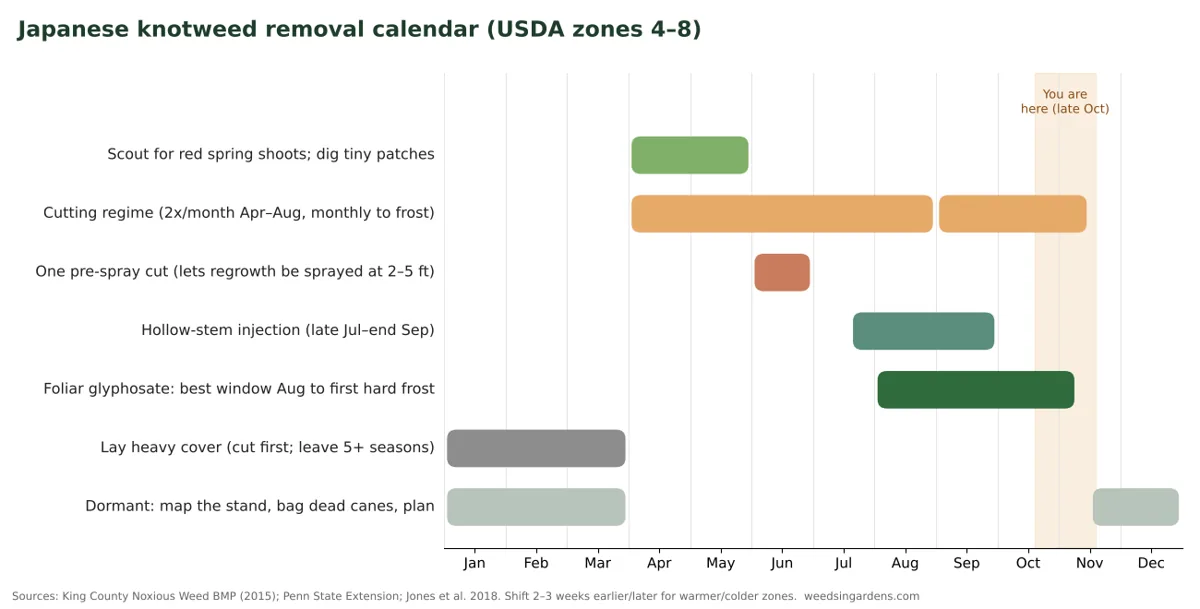
What to do right now (late October)
If your knotweed still has green, healthy leaves and you haven’t had a hard frost, you are still inside the treatment window. King County and Penn State both run their spray windows up to the first hard frost, so a careful foliar application now can still reach the rhizomes. Once frost has browned the leaves, stop: dead leaves can’t carry herbicide anywhere. Use the dormant months to:
- Photograph and measure the stand so you can track progress next year.
- Cut and bag the dead canes so that spring shoots are easy to see and reach.
- Flag the outer edge of the patch, plus a 20-foot scouting ring around it.
- Choose your method for next season and buy any tools in advance (sprayer, injection gun, heavy fabric).
A realistic multi-year plan
| Year | Main goal | Key actions |
|---|---|---|
| Year 1 | Knock the rhizomes back hard | Optional June cut; foliar glyphosate Aug to first hard frost, or stem injection late Jul to Sep |
| Year 2 | Treat the weird regrowth | Expect short, bushy, small-leaved shoots in spring (RHS); spot-spray or wick-wipe them late in the season |
| Year 3 | Mop up and scout wider | Spot-treat survivors; scout 20 ft beyond the old patch edge; dig tiny isolated sprouts |
| Years 4–5 | Confirm it’s gone | Check monthly in the growing season; replant the area with dense, desirable cover |
Biological control may help one day. The knotweed psyllid (Aphalara itadori), a tiny sap-feeding insect, was approved by USDA APHIS for release in 2020 after earlier releases in the UK (2010) and Canada (2014). Cornell’s IPM programme notes that its effectiveness in the US hasn’t been determined yet, so it isn’t a homeowner option for now (Cornell IPM).
A Note From the Agronomist’s Side
When people struggle with Japanese knotweed removal, the cause is almost always timing, not the product. A knotweed stand is basically a giant underground battery. In spring it spends stored energy to build canes; by late summer the canes are paying that energy back into the rhizomes. If you spray in May, you burn off the leaves the plant was going to drop anyway, and the battery stays charged. Spray in late August or September and the herbicide travels down with the sugar flow, into the part of the plant that actually matters.
The second lesson is about disturbance. Every cut, dig or mower pass that leaves fragments behind is a chance to start a new plant. That’s why the extension advice is so insistent on bagging debris and keeping equipment out. When in doubt, do less disturbing and more targeted treating.
Finally, set your expectations by the evidence. A three-year, 19-treatment trial (Jones et al. 2018) didn’t eradicate knotweed with any method, yet it did show that well-timed glyphosate drives it down steadily. Judge success by a shrinking, weaker stand each year, not a bare patch after one spray. Once the knotweed is down to scattered shoots, plant dense, competitive ground cover or turf so there’s no open ground left for it to reclaim. For similar persistence-based approaches to other tough perennials, see how we handle killing poison ivy and removing English ivy.
FAQ
How do you get rid of Japanese knotweed permanently?
Apply glyphosate to the foliage from late August until the first hard frost, or inject it into each hollow stem from late July to September, following the label. Then spot-treat regrowth for at least two more seasons. The RHS says eradication with weedkiller usually takes at least three growing seasons.
What is the best time of year for Japanese knotweed removal?
Late summer to fall. King County found later treatments in the July to October window worked better than earlier ones, with late August to early September best for a single spray. Penn State’s Japanese knotweed removal calendar is also built around late-season glyphosate.
Can I dig out Japanese knotweed myself?
Only for small, young patches of roughly 50 stems or fewer. Dig in August, remove every rhizome piece you can find, bag the debris and repeat for at least three years. Fragments as small as half an inch can regrow.
Does cutting Japanese knotweed kill it?
A single cut does not. Repeated cutting twice a month from April to August, then monthly until frost, for three to five years can exhaust the rhizomes, according to King County. One cut in June is useful before spraying the regrowth at least six to eight weeks later.
Will vinegar, salt or boiling water kill Japanese knotweed?
No research-based source recommends them. Contact treatments only burn the leaves and don’t reach the deep rhizomes, and salt damages soil. Penn State notes that even triclopyr and 2,4-D, which burn leaves well, have limited effect on knotweed rhizomes.
Can I put Japanese knotweed in my compost or yard waste?
No. Rhizomes and stems stay alive in compost. Bag it for the trash or dry it on a hard surface away from soil and water, and check whether your town has an invasive-plant drop-off.
Is Japanese knotweed dangerous to my house?
A 2018 PeerJ study found no evidence that knotweed causes more structural damage than other plants of similar size, and found that rhizomes usually spread less than 4 m from small stands. It can still exploit existing cracks, so treat patches near buildings promptly.
Sources
- Penn State Extension. Japanese Knotweed (Templeton, Gover, Jackson and Wurzbacher). https://extension.psu.edu/japanese-knotweed
- King County Noxious Weed Control Program. Best Management Practices: Invasive Knotweeds (July 2015). kingcounty.gov knotweed BMP (PDF)
- Royal Horticultural Society. Japanese knotweed. https://www.rhs.org.uk/weeds/japanese-knotweed
- Missouri Department of Conservation. Japanese Knotweed Control. https://mdc.mo.gov/trees-plants/invasive-plants/japanese-knotweed-control
- Jones D, Bruce G, Fowler MS, Law-Cooper R, Graham I, Abel A, Street-Perrott FA, Eastwood D (2018). Optimising physiochemical control of invasive Japanese knotweed. Biological Invasions. doi:10.1007/s10530-018-1684-5
- Fennell M, Wade M, Bacon KL (2018). Japanese knotweed (Fallopia japonica): an analysis of capacity to cause structural damage (compared to other plants) and typical rhizome extension. PeerJ 6: e5246. doi:10.7717/peerj.5246
- Cornell CALS Integrated Pest Management. Japanese knotweed psyllid. cals.cornell.edu