
You bought the house partly for that shady corner of the yard, all glossy green leaves and no mowing. Three summers later the “groundcover” has swallowed the hostas, crept under the fence and climbed twenty feet up the old maple, and the trunk now looks like a green pillar. You pull a handful and it snaps off at the surface, roots still in the ground. Now you’re wondering how to get rid of English ivy before it takes the rest of the yard.
Short answer: To get rid of English ivy, first cut every vine climbing a tree at ground level and again at about shoulder height, then pull the ivy off the bottom of the trunk and leave the upper vines to die in place. Next, hand-pull or roll up the groundcover when the soil is moist and bag it, and spot-spray regrowth in spring, when the ivy has 2 to 5 new leaves, with a concentrated glyphosate or triclopyr product, following the label. Expect to follow up for at least a year.
English ivy (Hedera helix) is one of the toughest weeds a homeowner can inherit, because its thick, waxy leaves shrug off most quick fixes. This guide pulls together research and advice from NC State, Clemson, Oregon State and the University of Maryland so you’ll know exactly how to get rid of English ivy on trees, on the ground and on walls, which herbicides the research actually supports, and when each step works best.
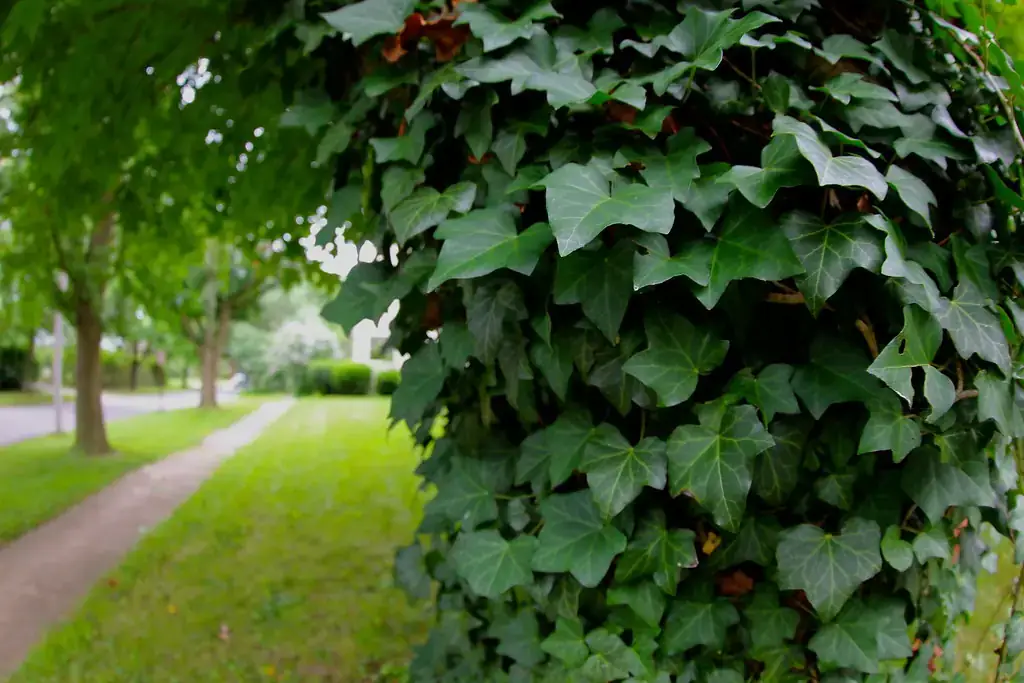
How to Identify English Ivy (Juvenile vs Adult Growth)
Before you start pulling, make sure the vine really is English ivy. That matters because the best method depends on the plant: Virginia creeper and poison ivy need different handling (see our guide to poison ivy vs Virginia creeper), and wild ginger or periwinkle in the same bed may be worth keeping.
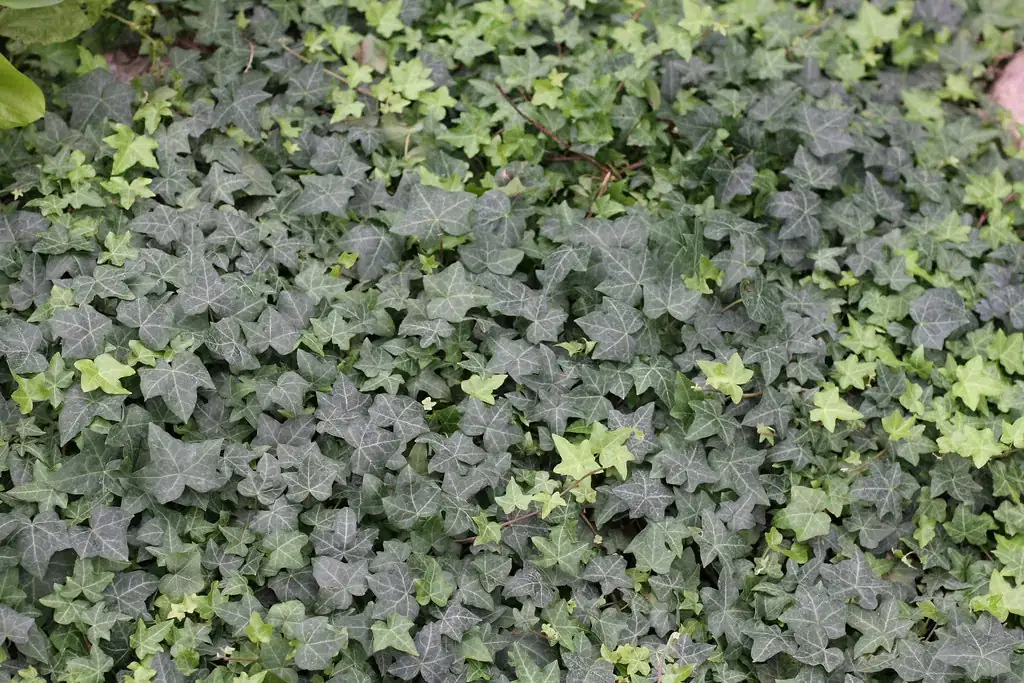
English ivy is an evergreen, woody vine with two distinct life stages. The juvenile stage is what you see on the ground; the adult stage only develops once the vine climbs into the light, and that’s the stage that flowers and makes seed.
| Feature | Juvenile (groundcover) stage | Adult (climbing) stage |
|---|---|---|
| Leaves | Dark green, waxy, alternate; usually 3–5 lobes, often with pale veins | Unlobed, oval to heart- or spade-shaped, on upright stems |
| Growth habit | Dense mat about 9 inches tall that spreads indefinitely | Climbs trees and walls; can reach 90 feet |
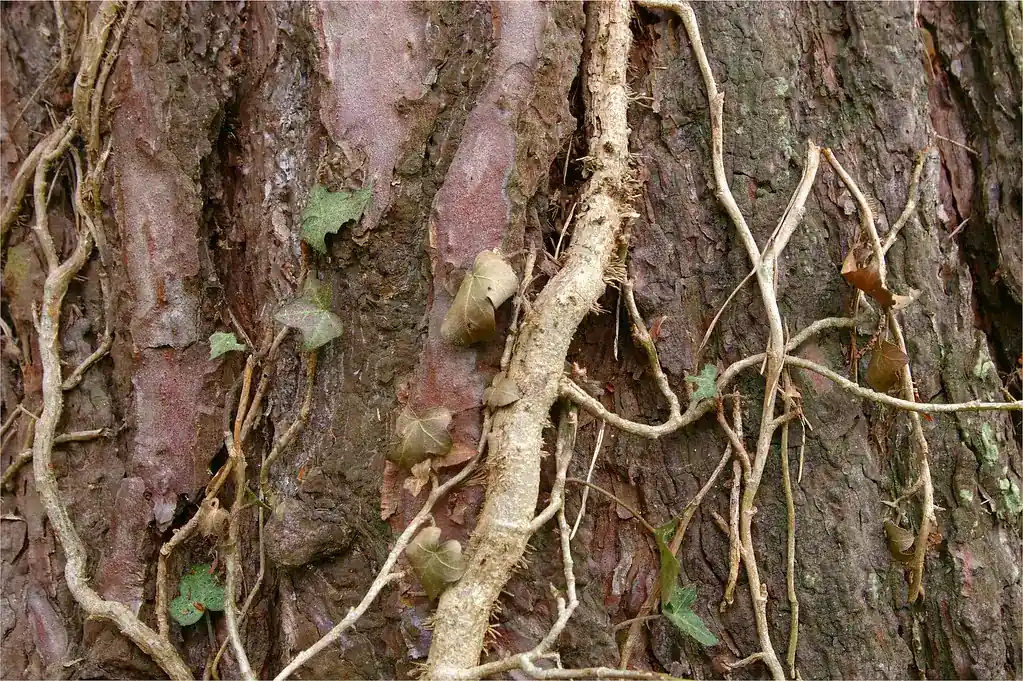
| How it holds on | Roots along trailing stems wherever they touch soil | Hairy aerial rootlets that cement stems to bark, brick or wood |
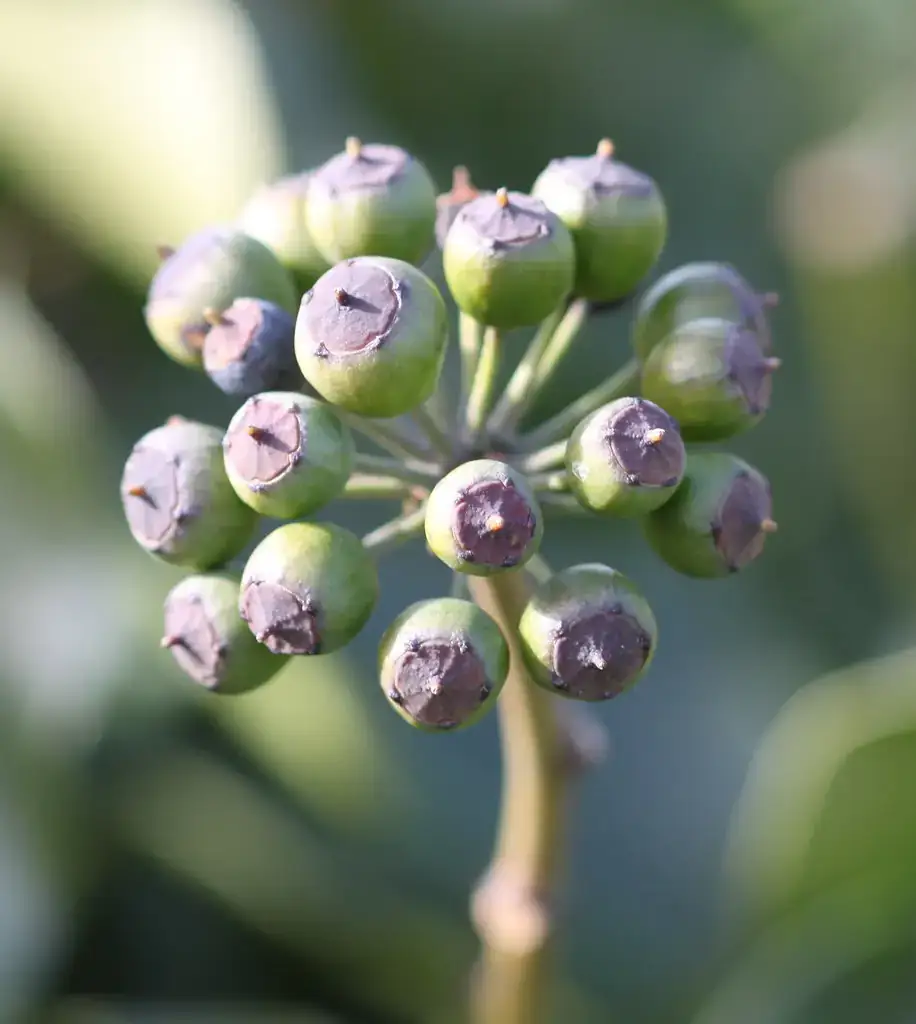
| Flowers | Usually none | Round clusters of small greenish-yellow flowers, summer to fall |
| Fruit | None | Dark purple to black berries, ripening late winter to spring; spread by birds |
Sources for the table: Virginia Cooperative Extension, University of Maryland Extension, Clemson HGIC and Oregon State University Extension. One more clue: English ivy has a single leaf per node and no tendrils. If you see leaflets in threes or fives, or coiling tendrils, you’re looking at a different vine.
Why English Ivy Is Worth the Effort to Remove
It’s tempting to leave ivy alone because it looks tidy. Here’s why extension specialists consistently say otherwise.
- It harms trees. University of Maryland Extension notes that heavy vines loosen bark and hold moisture against the trunk, encouraging decay, and that ivy-laden trees are more likely to come down in wind, snow and ice. As the vine climbs into the canopy it shades the tree’s own leaves.
- It hosts a tree disease. The same source reports that English ivy acts as a reservoir for bacterial leaf scorch, a disease of maples, oaks and elms.
- It spreads beyond your yard. Once ivy reaches the adult stage, birds eat the berries and drop the seeds far away, which is why it invades woodlands. That’s the main reason it appears on lists of introduced invasive weeds.
- It damages buildings. Clemson HGIC warns that the aerial rootlets can damage stucco, wood and brick mortar, and the dense foliage traps moisture and shelters pests.
- It’s mildly toxic. According to N.C. Cooperative Extension, the sap can irritate skin and the berries and leaves can cause stomach upset if eaten by people, pets or livestock. Wear gloves and long sleeves when you pull it.
The single most valuable step is stopping the climbing vines, because that’s where flowers and berries form. Even if you can’t clear the ground this year, cutting every vine on every tree stops seed production and protects the trees.
How to Get Rid of English Ivy on Trees (Step by Step)
Vines on trees are the priority when you work out how to get rid of English ivy, and the good news is that you don’t need any chemicals to kill them. Once a climbing stem is cut off from its roots, everything above the cut dies. Here’s the method Clemson HGIC and NC State Extension describe, arranged as a sequence.
- Gear up. Gloves, long sleeves, safety glasses, hand pruners or loppers, a small pruning saw for thick vines, and a large flat-bladed screwdriver or pry bar.
- Make the top cut. At a comfortable height (Clemson suggests “several feet up the trunk”), cut every vine all the way around the tree. Thick, old vines can be several inches across, so use a saw and cut slowly so you don’t nick the bark.
- Make the bottom cut. Cut the same vines as close to the ground as you can.
- Remove the section in between. Slide the screwdriver under each vine and pry it away, then pull the cut sections off the trunk.
- Clear a ring on the ground. Pull the groundcover ivy back from the base of the trunk so new runners can’t simply climb up again. A clear ring a few feet wide is a sensible target: the wider it is, the longer it takes runners to reach the trunk again.
- Leave the upper vines alone. NC State notes the vines left on the tree “will die and eventually fall off.” Ripping them down can tear bark and bring down branches.
According to Clemson, you can do this at any time of year, and the dead vines dry out faster in hot, dry weather. Expect the leaves above the cut to brown within a few weeks; the woody stems can cling for a year or more.
Should you also paint the cut stumps? For vines on trees, the cut alone stops the climbing part. But the rooted stub at the bottom will resprout, so if you’re not planning to pull the ground ivy, treat those stubs as described in the herbicide section below. N.C. Cooperative Extension recommends spraying fresh cuts with a 50% triclopyr solution within three minutes of cutting.
Ivy on a house wall or fence
The same “cut and wait” logic applies to walls. Cut each stem at the base and leave the upper growth to dry for several weeks; dried rootlets let go more easily than living ones, which reduces the chance of pulling off chips of mortar or paint. Pull gently downward, never outward. Expect small rootlet stubs to remain on the surface; a stiff brush removes most of them. If the mortar is already crumbling, it’s worth having a mason look at the wall before you pull.
How to Get Rid of English Ivy Groundcover Without Chemicals
If you want to know how to get rid of English ivy naturally, the honest answer is: by hand, and more than once. English ivy stems are “not deeply rooted,” as Clemson puts it, so long runners lift out in one piece, but every forgotten stem segment can root again.
Pulling and rolling
- Work on moist soil. Pulling is easiest after rain has softened the ground (Clemson).
- Cut the mat into strips. NC State suggests cutting the vines into sections first, then pulling each section free. Many people then roll the strips up like a carpet, which keeps stems together.
- Chase the roots. Oregon State University Extension advises removing “as much of the root as possible” while disturbing the soil as little as you can.
- Work in late fall or winter. Both Clemson and Oregon State point out that winter work spares dormant perennials and native plants growing among the ivy.
Be realistic about the time involved. Oregon State estimates that complete manual removal can take 300 to 1,300 hours per acre in forested sites. On a typical suburban bed it’s a matter of weekends, not years, but it still rewards steady work over a single heroic afternoon.
Mowing and smothering
Mowing alone can work, but only if you treat it like a lawn: NC State says you must mow the whole infestation frequently to “starve out” the plants. In practice, mowing is more useful as a set-up step, because it forces soft new growth that absorbs herbicide far better than old leaves.
Smothering with cardboard and a thick layer of mulch is a reasonable follow-up once most of the ivy is gone, because it blocks light for any fragments you missed. On its own, though, it’s unreliable over a deep ivy mat, since runners simply grow out at the edges. Our guide to stopping weeds in mulch beds covers how to keep the new layer clean.
Disposal: don’t compost it casually
N.C. Cooperative Extension warns that ivy can sprout new plants from cuttings, so pulled material should be bagged and removed. Oregon State suggests letting piles dry completely before disposal. Check your local rules for yard waste, and see how to dispose of invasive plants for safe options.
English Ivy Killer: Which Herbicides Actually Work
If you’re deciding how to get rid of English ivy with a spray, this is where most people go wrong. Its waxy cuticle stops many sprays from getting in, so a product that flattens dandelions may barely mark ivy. The research below points to a few active ingredients, and to timing, as what really matters. Always read and follow the product label, which is the legal guide to where and how a product can be used.
| Active ingredient | How it’s used on ivy | Rate reported by extension sources | What to know |
|---|---|---|---|
| Glyphosate (non-selective) | Foliar spray on new spring growth | 4% solution of a 41% product, about 5.1 oz per gallon (NC State); 2–3% (Clemson) | Most effective in NC State trials. Kills any green plant it hits, including lawn grass |
| Glyphosate (cut surface) | Painted on freshly cut stems | 25% solution (Oregon State) | Useful where spray drift is a concern |
| Triclopyr (selective, spares grasses) | Foliar spray | 2–5% solution with 3–5 new leaves (Clemson); 2% plus 0.5% non-ionic surfactant (N.C. Coop. Ext.) | Less effective than glyphosate in NC State and Virginia Tech research. Do not apply above 85°F |
| Triclopyr (cut stump) | Sprayed on fresh cuts of vines | 50% solution within 3 minutes of cutting (N.C. Coop. Ext.) | Works any time the ground isn’t frozen |
| 2,4-D amine | Foliar spray, two applications | Two applications gave complete control in Virginia Tech pot trials (Derr 1993) | Injures many broadleaf ornamentals; limited to sites without sensitive plants |
| Aminopyralid, fluroxypyr | Tested in research only | n/a | Ineffective on English ivy (Auburn and Clemson studies) |
Some details make a big difference. NC State found that formulation matters: buy a concentrate with glyphosate as the only active ingredient, because fast-acting add-ins such as pelargonic acid or diquat can reduce glyphosate’s effectiveness, and diluted ready-to-use sprays performed worse. The same publication notes that adding a surfactant “may help, but is not necessary.”
Temperature matters too. Clemson recommends spraying glyphosate when air temperatures are above 55 to 60°F, and N.C. Cooperative Extension says foliar sprays work year-round once temperatures have stayed around 55–60°F for several days. For a broader look at how these products move through plants, see our guide to post-emergent herbicides.
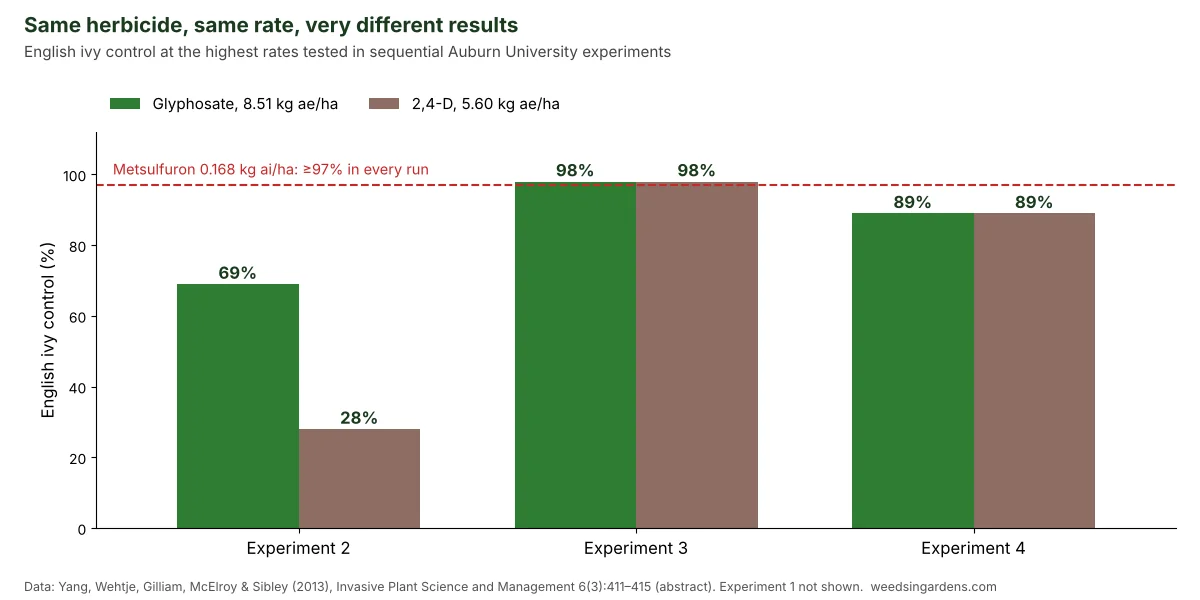
The chart above explains why one spray rarely finishes the job. In four sequential experiments, Auburn University researchers found the highest glyphosate rate controlled English ivy anywhere from 69% to 98%, and 2,4-D from 28% to 98%, depending on the run. Only metsulfuron gave at least 97% control every time and prevented regrowth, but it is mainly sold for professional, pasture and forestry use and can injure many trees and ornamentals, so it’s not a homeowner shortcut. Check the label carefully before considering it.
Protect your trees and lawn while spraying
- Keep spray off tree trunks, exposed roots and the leaves of shrubs. Clemson warns that glyphosate can penetrate the bark of many landscape trees.
- Use triclopyr instead of glyphosate where ivy grows into lawn grass, since it spares most turfgrasses; still check that your grass species is listed on the label.
- Cover perennials with buckets or spray before they emerge in spring.
- Spray late in the evening when pollinators are less active (Clemson), and never before rain.
What about vinegar or boiling water?
Household vinegar and boiling water are contact killers: they scorch leaves but don’t move into the roots. On ivy, the waxy leaves deflect much of the vinegar, and the rooted stems resprout. NC State also found that burning foliage off first reduces how well glyphosate works afterwards, so these quick fixes can actually set you back. Our guide to whether vinegar kills weeds explain the limits in more detail.
Best Time to Kill English Ivy: A Season-by-Season Plan
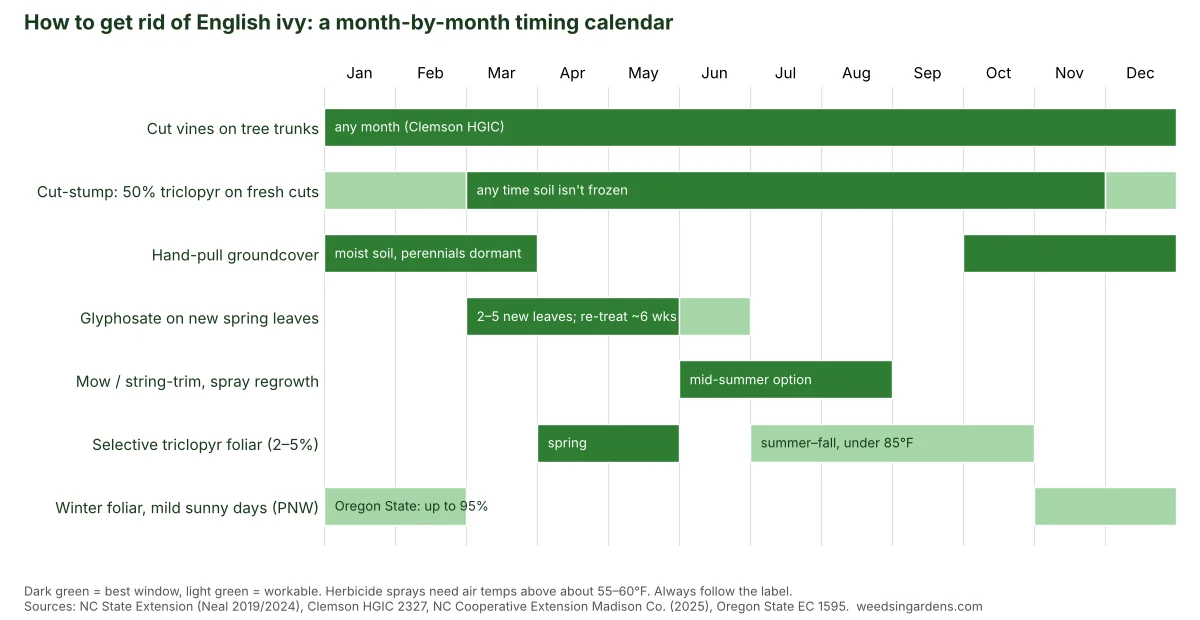
Knowing when to act is half of knowing how to get rid of English ivy. Timing is the reason some people fight ivy for years while others clear it in two seasons. English ivy is most vulnerable in spring, when new leaves haven’t yet built up their wax. NC State recommends spraying glyphosate when the ivy has 2 to 4 new leaves and re-treating about 6 weeks later if regrowth appears; Clemson uses the slightly wider window of 3 to 5 new leaves.
| Season | What to do | Why it works |
|---|---|---|
| Fall (now) | Cut every vine on trees; pull and bag groundcover on moist soil; treat cut stubs with triclopyr while temperatures allow | Cutting can be done in any season, and fall cuts stop next year’s berries |
| Winter | Keep pulling while perennials are dormant; in mild climates, spot-spray on sunny days above about 55°F | Oregon State reports winter foliar sprays of 2–5% glyphosate or triclopyr gave up to 95% control, better than growing-season sprays, with less injury to dormant natives |
| Spring | Spray regrowth at 2–5 new leaves; re-treat about 6 weeks later | New leaves lack a thick waxy cuticle, so they absorb herbicide best |
| Summer | Mow or string-trim, then spray the soft regrowth; or simply keep pulling | NC State notes mid-summer control improves when you mow first |
| Following year | Walk the area every few weeks and pull or spot-treat every sprout | Oregon State expects follow-up for 1 year or more |
Common mistakes that keep ivy coming back
- Spraying old, hardened summer leaves and expecting one application to finish the job.
- Using a weak ready-to-use spray or a “fast-acting” blend instead of a single-ingredient concentrate.
- Pulling vines down from the tree canopy instead of cutting them at the base.
- Composting pulled ivy in an open pile where stems can root.
- Leaving the soil bare after removal, which invites the next weed. Replant instead.
What to plant after English ivy
Bare shade is an open invitation, so plan a replacement. University of Maryland Extension suggests native alternatives such as foamflower (Tiarella cordifolia), lady fern (Athyrium filix-femina) and wild ginger (Asarum canadense), and Virginia creeper as a native vine. If the area will become lawn again, read our guide to preparing soil for grass seed first.
A Note from the Agronomist’s Side
Look at the research as a whole and one theme stands out: English ivy isn’t resistant to herbicides so much as protected from them. The thick cuticle on mature leaves is a physical barrier, which is why every source points to young spring leaves, mowing first, or winter sprays on sunny days. When results vary from 28% to 98% with the same product and rate, as they did in the Auburn experiments, it tells you that the condition of the leaf matters as much as what’s in the sprayer.
That’s why, if you ask how to get rid of English ivy with the least wasted effort, I’d rank the steps in this order of value: cut the climbing vines first, because it protects trees and stops seed for the cost of a pair of loppers; remove as much of the mat as you can by hand; and then use herbicide as a precision tool on regrowth, when the plant is at its weakest. Spraying a dense, decades-old mat in July is the least efficient way to spend your money and your weekend.
A note on triclopyr: the research is mixed. NC State and Virginia Tech found it weaker than glyphosate as a foliar spray, yet a Clemson forestry trial (Clemson Extension Forestry and Wildlife) found that a 20% triclopyr basal-bark mix with a penetrant killed most treated vines, though effects took more than three months to show. My reading is that triclopyr earns its place where you need to spare grass, or on fresh cuts, but glyphosate on spring growth remains the stronger foliar choice where nothing else will be hit. Either way, patience is part of the method: judge results after a full season, not a week.
FAQ: How to Get Rid of English Ivy
What kills English ivy permanently?
No single treatment is reliably permanent. The most reliable way to get rid of English ivy for good combines cutting vines on trees, hand-pulling the groundcover, and spot-spraying regrowth in spring when it has 2 to 5 new leaves with a concentrated glyphosate or triclopyr product, following the label. Plan to follow up for at least a year.
Will cutting English ivy at the base kill it?
Cutting kills everything above the cut, so vines on trees and walls die once severed. The rooted stub below the cut will resprout, so pull it out or treat the fresh cut with a 50% triclopyr solution within three minutes, as N.C. Cooperative Extension recommends.
Does vinegar kill English ivy?
Not reliably. Vinegar only burns the leaves it touches, the waxy ivy leaves shed much of it, and the roots survive to resprout. NC State also found that burning foliage first reduces how well glyphosate works later.
Is it OK to leave English ivy on trees?
Extension specialists advise removing it. University of Maryland Extension notes that heavy vines encourage bark decay, make trees more likely to fall in storms, and harbor bacterial leaf scorch. Cut the vines at the base and at shoulder height and let the rest die in place.
When is the best time to spray English ivy?
Spring, when new growth has 2 to 5 leaves and the waxy coating hasn’t fully formed. Spray when temperatures are above about 55 to 60°F and re-treat about six weeks later if needed. Oregon State also reports good results from winter sprays on sunny days in mild climates.
How long does it take to get rid of English ivy?
It depends on the method. Leaves on cut tree vines brown within weeks, but clearing a groundcover usually takes one to two growing seasons. Oregon State advises follow-up treatments for a year or more to catch resprouts.
Is English ivy toxic to dogs and cats?
Yes. N.C. Cooperative Extension describes English ivy as toxic to people, pets and livestock; eating the leaves or berries can cause stomach upset, and the sap can irritate skin. Keep pets away from piles of pulled ivy.
Sources
- Neal, J. (2019, reviewed 2024). Controlling English Ivy in Urban Landscapes. NC State Extension.
- Williamson, J. (reviewed 2021). English Ivy Control (HGIC 2327). Clemson Cooperative Extension Home & Garden Information Center.
- Oregon State University Extension Service (2008). Invasive Weeds in Forest Land: English Ivy, Hedera helix (EC 1595-E).
- Carignan, C. (2018). About English Ivy. University of Maryland Extension.
- Niemiera, A. X. (reviewed 2024). English Ivy, Hedera helix (3010-1478NP). Virginia Cooperative Extension.
- Duckett, P. (2025). On the Lookout for Non-Native Invasive Plants: English Ivy. N.C. Cooperative Extension, Madison County Center.
- Yang, Q., Wehtje, G., Gilliam, C. H., McElroy, J. S., & Sibley, J. L. (2013). English Ivy (Hedera helix) Control with Postemergence-Applied Herbicides. Invasive Plant Science and Management, 6(3), 411–415.
- Derr, J. F. (1993). English Ivy (Hedera helix) Response to Postemergence Herbicides. Journal of Environmental Horticulture, 11(2), 45–48.
- Peairs, S. English Ivy Control: Basal Bark Treatment Research & Existing Recommendations. Clemson Extension Forestry and Wildlife.
Herbicide rates above are summarized from extension publications for educational purposes. Product concentrations differ between brands, so always mix and apply according to the label on the product you buy, and check local rules before spraying near water.