
You’re clearing the fence line on a cool October afternoon, and there it is again: that glossy, three-leaved vine, now flushed red and orange, winding through the shrubs and up the trunk of your favorite maple. You pulled some of it in June. You got the rash to prove it. And it came back anyway.
Short answer: The secret of how to kill poison ivy for good is to kill the roots, not just the leaves. The most reliable way to do that is with a systemic herbicide containing triclopyr or glyphosate, sprayed on the leaves while they’re still green or painted at full strength onto freshly cut stems, followed by a second treatment of any regrowth. Small seedlings can be dug out with the roots. Whatever method you choose, never burn the plants, never compost them, and treat every leaf, stem and root as toxic, because they are.
This guide pulls together the advice of several university extension services into one plan for how to kill poison ivy around a home landscape. By the end, you’ll be able to identify poison ivy with confidence (and tell it apart from its harmless look-alikes), pick the right method for vines on trees, patches in your lawn, or plants tangled in your shrubs, and time the work so it actually reaches the roots, including what you can still do this fall.
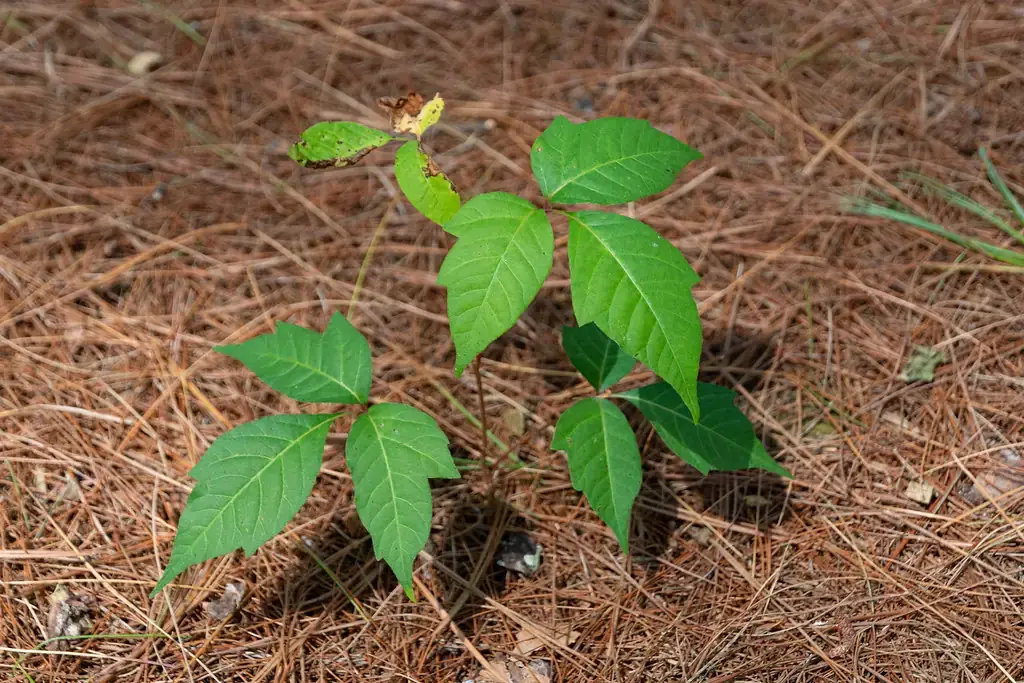
How to identify poison ivy before you touch anything
You can’t kill what you can’t recognize, and you definitely don’t want to hand-pull a Virginia creeper by mistake and then grab the real thing barehanded. Poison ivy (Toxicodendron radicans) is a native, woody perennial that grows three ways: as a low groundcover, as a free-standing shrub, or as a vine that can climb to the top of a tall tree, according to Penn State Extension. That shape-shifting is exactly why people miss it.
Key ID features
| Feature | What to look for |
|---|---|
| Leaves | Compound leaf with three leaflets. The middle leaflet sits on a noticeably longer stalk; the two side leaflets have very short stalks or none. |
| Leaflet edges | Smooth, wavy, or coarsely notched. One side of a leaflet is often toothed while the other side is smooth. |
| Color through the year | Reddish new leaves in spring, shiny or dull green in summer, bright red, orange or yellow in fall. |
| Climbing stems | Older vines are covered in dark aerial rootlets that make the stem look like a hairy rope clinging to bark, fences or walls. |
| Flowers and fruit | Small, inconspicuous greenish-white flowers in early to mid-summer, followed by clusters of waxy, greenish-white berries about the size of currants. |
| Where it grows | Fence lines, woodland edges, under trees where birds perch, and inside shrubs and groundcovers. |
Those features come from the Purdue Extension poison ivy guide, Penn State and Clemson’s Home & Garden Information Center. The old rhyme still holds: leaves of three, let it be. Just remember that the rhyme alone also flags several harmless plants.
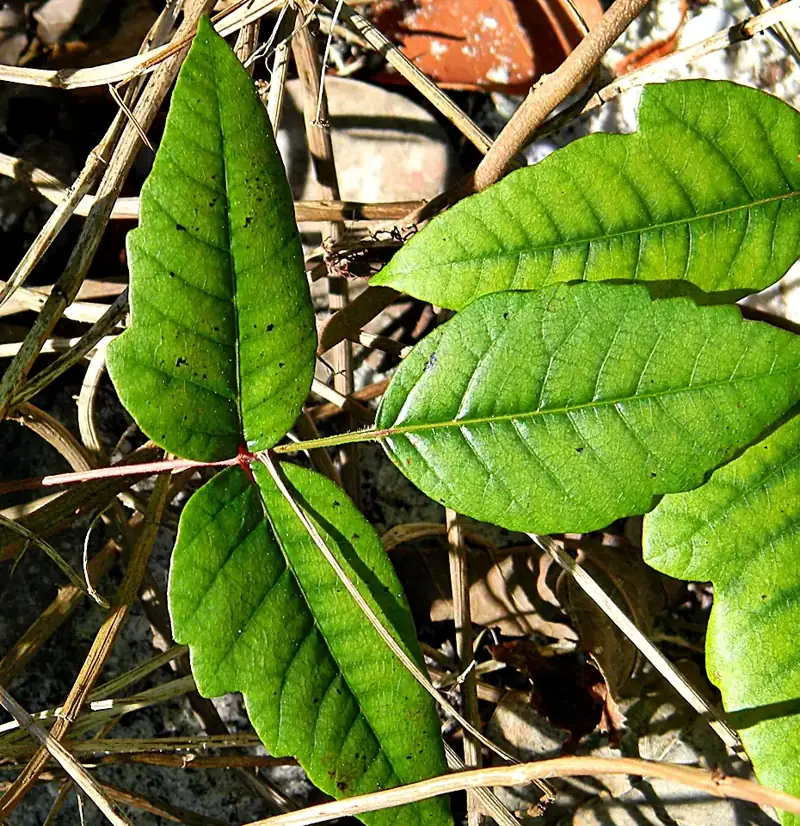
Look-alikes that are safe to handle
- Virginia creeper (Parthenocissus quinquefolia): five leaflets, not three, and dark blue berries. It often grows right beside poison ivy, so check every vine.
- Boston ivy: young leaves can have three leaflets, but each leaflet has its own stalk; mature leaves are three-lobed rather than separated.
- Fragrant sumac: three leaflets, but none of them is stalked, and the berries are red and fuzzy rather than whitish.
- Tree seedlings: Penn State warns that young red maple seedlings are easy to confuse with poison ivy in spring.
- Poison oak (Toxicodendron pubescens): not harmless. It’s a close relative that grows more upright, with rounded, oak-like lobes and fuzzy leaf surfaces. Treat it exactly like poison ivy.
If you aren’t sure, assume it’s poison ivy until you’ve counted leaflets and checked the stalks. Our guide to telling apart look-alike vines uses the same leaf-by-leaf approach for other climbers.
Protect yourself first: urushiol is the real enemy
Here’s the surprising part: killing the plant doesn’t make it safe. The rash comes from urushiol, an oil found in the leaves, stems and roots, and it stays active in dead plants too. Penn State notes that dead plants and roots can still cause reactions for years, and Clemson’s fact sheet says the oil can remain active on tools, clothing and pet fur for months. That’s why so many people get a rash in winter from “dead” vines.
Gear and habits that prevent the rash
- Long sleeves, long pants, socks, closed shoes and eye protection.
- Disposable nitrile gloves under heavy-duty work gloves. Clemson suggests long plastic bread or newspaper bags over each hand, peeled off inside-out when you’re done.
- Wash exposed skin quickly. Clemson notes that the oil starts binding to skin within about 30 minutes, and that rubbing alcohol dissolves it better than plain water.
- Clean tools with warm water and detergent while wearing fresh gloves, then wipe pruner blades with rubbing alcohol. Wipe down the seat of your car or mower, too.
- Wash work clothes separately from the family laundry.
A rash usually appears 12 to 48 hours after contact, but it can take up to two weeks, according to Clemson. If you develop a severe reaction, especially on your face or after breathing smoke, see a doctor.
Disposal: never burn, never compost
Burning poison ivy releases urushiol in smoke, which can injure your eyes, skin and lungs. Every extension source we reviewed is firm about this. Don’t put it in the compost or the yard-waste bin either. Iowa State Extension recommends bagging it for the trash, burying it at least a foot deep, or leaving it to dry and decay in place where no people or pets go. For more on bagging and landfill rules, see our guide on how to dispose of invasive plants.
How to kill poison ivy with herbicides: what actually reaches the roots
Poison ivy spreads by underground rhizomes and by seed, which birds happily drop under every tree and fence. Cut off the top and the roots simply send up new shoots. That’s why the products that work are systemic: they’re absorbed by the leaves or a fresh cut and carried down into the root system. Contact sprays, including vinegar and most “natural” weed killers, burn what they touch and leave the roots alive.
Before you buy anything, know this: according to Penn State, Bayer reformulated its residential Roundup products in 2022, and none of the US lawn-and-garden Roundup products now contains glyphosate. So read the active ingredient on the label, not the brand name. Products sold as “poison ivy killer” or “brush killer” usually contain triclopyr, often mixed with glyphosate or 2,4-D.
Herbicide options by active ingredient
| Active ingredient | Type | How well it works on poison ivy | Best timing | Watch out for |
|---|---|---|---|---|
| Triclopyr | Systemic, selective (broadleaves only) | Rated the most effective by Purdue Extension | After leaves fully expand in spring until before leaves change color in fall | Spares most grasses, but some warm-season lawns are sensitive (see the lawn section). Not active in soil. |
| Glyphosate | Systemic, non-selective | Effective, but usually needs repeat applications | From 2 weeks before to 2 weeks after full bloom (early summer); a 2% solution is the usual foliar mix | Kills or injures any green plant it touches, including grass. Not active in soil. |
| 2,4-D (amine) | Systemic, selective | Works on actively growing plants | Late spring to early summer, when growth is rapid | Volatile and drift-prone; keep away from vegetables, grapes, tomatoes and ornamentals. |
| Triclopyr + 2,4-D (brush-killer mixes) | Systemic, selective | Strong on woody vines | Leaves fully expanded, before fall color | Purdue advises using it only where drift is not a factor. |
| Glufosinate | Mostly contact | Burns tops; rarely kills established roots (Penn State) | Seedlings only | Expect regrowth from roots. |
| Acetic acid (20–30% horticultural vinegar) | Contact | Browns leaves, roots survive (Penn State) | Young shoots; repeat every 2–3 weeks | Caustic: label signal word is often DANGER. Household 5% vinegar doesn’t control poison ivy. |
N.C. State’s Burke County Extension likewise points to flowering as poison ivy’s weakest point for herbicides. Timing data come from Clemson HGIC 2307; effectiveness ratings from Purdue and Penn State. Whatever product you choose, the label is the law: follow its mixing rate, protective-equipment and re-entry instructions exactly.
Step by step: spraying the leaves (foliar method)
- Pick a calm, cool, dry day. Iowa State advises calm winds and cool temperatures to prevent drift. Check the label’s rain-free period.
- Protect nearby plants. Cover them with buckets, boxes or plastic sheeting. Remember that anything that kills poison ivy can kill your shrubs too.
- Wet the leaves thoroughly, but not to runoff. Purdue stresses thorough coverage of the leaves.
- Leave the vines alone afterwards. Let them die in place; tearing them out spreads urushiol and removes the leaves that are pulling herbicide down to the roots.
- Be patient, then repeat. Clemson notes it can take several weeks to know whether the roots are dead. Re-treat any new leaves that appear.
Penn State adds one important caveat: drought-stressed plants absorb herbicide poorly, so spray after a good rain rather than at the end of a dry spell. For a broader look at choosing between selective and non-selective products, see our post-emergent herbicide guide.
When to do it: a season-by-season plan
Knowing how to kill poison ivy is only half the job; timing is the other half. Use the calendar and table below to match each method to the season.
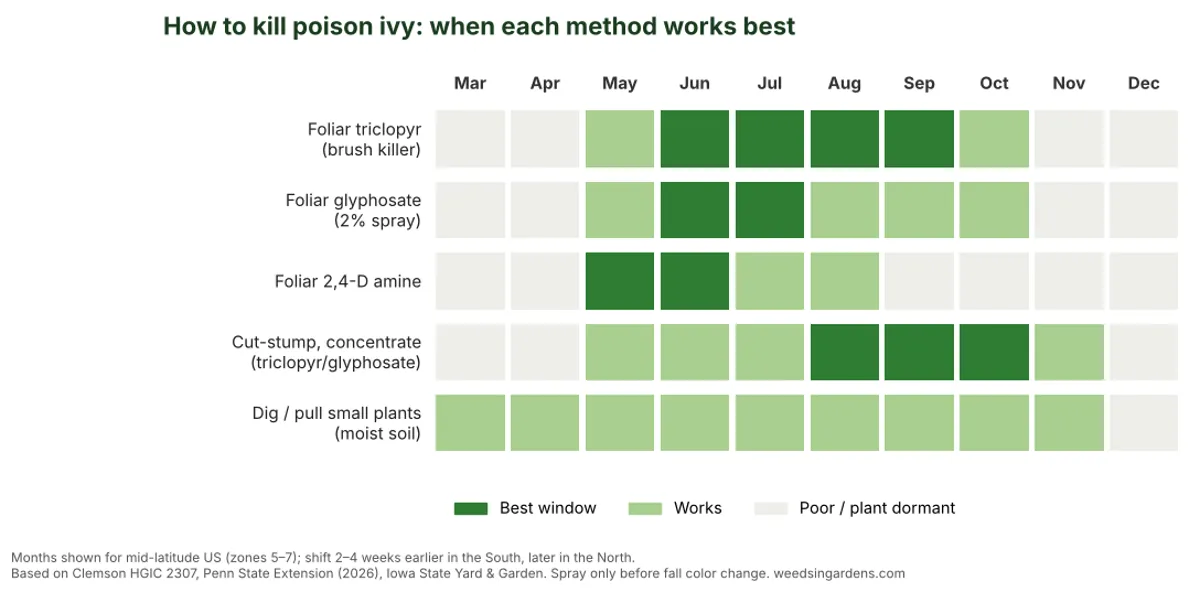
| Season | What poison ivy is doing | Your best move |
|---|---|---|
| Early spring | Reddish new leaves unfolding; sap moving upward | Dig seedlings in moist soil. Skip cut-stump work: Penn State says it works poorly while sap is flowing up. |
| Late spring to early summer | Leaves fully expanded, then flowering | Prime foliar window: 2,4-D amine and glyphosate around bloom, triclopyr any time leaves are fully out. |
| Mid to late summer | Green, actively growing | Triclopyr foliar sprays; start cut-stump treatment on vines in trees. |
| Early fall (leaves still green) | Sending sugars down to the roots | Excellent for cut-stump treatment (Penn State, Iowa State). Triclopyr foliar sprays still work until color changes. |
| Mid to late fall (leaves red or falling) | Shutting down | Foliar sprays lose effectiveness once leaves color. Cut-stump treat any stems you can still reach, then mark the spots for next season. |
| Winter | Dormant, leafless, still toxic | Map the vines (look for hairy ropes on trunks). Don’t handle bare vines without full protection. |
Right now, in late October, many northern yards are already in that red-leaf stage. If your poison ivy still has plenty of green leaves, a triclopyr spray can still work. If the leaves have colored or dropped, switch to cut-stump treatment and plan a foliar follow-up for late spring. It’s the same logic we use in our fall weed control plan: fall is when perennial weeds move food, and herbicide, down to their roots.
How to kill poison ivy vines on trees with the cut-stump method
Spraying a vine that’s 30 feet up a tree isn’t realistic, and spraying the foliage near the trunk risks the tree itself. For big, established vines, the cut-stump method is the most precise tool you have, and late summer through autumn is when it works best, says Penn State, because the plant is moving nutrients from the leaves down into the roots.
- Make a “window cut.” Cut the vine near ground level, then make a second cut about a foot higher and remove that section so the two ends can’t reconnect. Don’t damage the tree’s bark.
- Treat the stump immediately. Penn State says to apply herbicide within 15 minutes, while the tissue is still alive and absorbing. Brush away sawdust first.
- Use concentrate, not ready-to-use spray. Penn State recommends a concentrated systemic product, usually 20 to 45%. Iowa State specifies at least 20% glyphosate or more than 8% triclopyr. Paint or dab it on with a foam brush or squeeze bottle until the cut surface is wet, without runoff.
- Leave the upper vine to die on the tree. Pulling it down damages the bark and showers you with urushiol-laden rootlets. The dead vine will weather away over time.
- Check the base for sprouts. Iowa State notes that multiple treatments are often needed. Cut and treat again, or spray the new leaves.

This is also the best method when poison ivy is tangled through roses, hollies or foundation shrubs. You cut only the poison ivy stem, treat only that stem, and nothing drifts onto the plants you want to keep.
Poison ivy in your lawn, beds and fence lines
Poison ivy rarely survives regular mowing in the middle of a lawn; it creeps in from the edges, under trees and along fences. Where it does reach the turf, your product choice depends on your grass type.
In the lawn
Selective broadleaf products are the safe route in turf, because they don’t kill grass. Penn State notes that 2,4-D is a common lawn-weed ingredient that controls poison ivy and recommends waiting several days before mowing so it can move through the plant. Triclopyr lawn products are another option, but read the grass list carefully. For example, the label summary for one widely sold 8% triclopyr lawn concentrate says it is not for use on Bahia, Bermuda, Centipede, Kikuyu or St. Augustine lawns, and should not be applied when the air temperature is above 90°F.
| Your lawn | Safer choice for poison ivy patches | Avoid |
|---|---|---|
| Cool-season (tall fescue, Kentucky bluegrass, ryegrass) | Selective broadleaf products containing triclopyr or 2,4-D, applied as spot treatments | Glyphosate, unless you plan to reseed the spot |
| Warm-season (St. Augustine, centipede, Bermuda, Bahia, zoysia) | Check the label for your exact grass. Spot-treat by painting leaves or using cut-stump at the lawn edge | Triclopyr products that exclude your grass; spraying above the label’s temperature limit |
| Lawn edge next to beds or trees | Cut-stump treatment or careful leaf painting | Broadcast sprays and drift-prone 2,4-D esters |
In flower beds and shrub borders
Here, overspray is your biggest risk. Use the cut-stump method, or put on a chemical-resistant glove with a cotton glove over it, dip the cotton glove in the diluted herbicide, and wipe it only onto poison ivy leaves. It’s slow, but it puts the product exactly where you want it. Clemson’s guidance is the same in spirit: when poison ivy grows among plants you want to save, cut it back and paint the herbicide only on the freshly cut stems.
Along fences and woodland edges
This is where poison ivy builds the biggest root systems, and also where you usually have the most room to spray. A triclopyr brush killer applied while the leaves are fully green is the most efficient option here. Expect to come back for regrowth the following season, and keep an eye out for new seedlings under trees and fences, since birds keep planting them.
Non-chemical ways to kill poison ivy (and the hacks that don’t work)
Maybe you garden organically, your poison ivy sits next to a stream, or you’d simply rather not spray. You can still learn how to kill poison ivy without chemicals. It just takes more persistence, and more exposure to the oil, so gear up every time.
| Method | Works for | How long it takes | Honest verdict |
|---|---|---|---|
| Hand-pulling or digging | Small plants and seedlings | One session, plus follow-up for missed roots | Best done after a soaking rain (Iowa State). Dig several inches deep with a fork, because root bits resprout (Penn State). |
| Repeated cutting to ground level | Patches where digging is impractical | Several growing seasons | Clemson: cut whenever green growth appears, every week or two, starting in spring. The roots eventually starve. |
| Smothering (cardboard, landscape fabric, black plastic) | Localized patches | At least one full growing season | Effective if edges are sealed; shoots find gaps (Penn State). |
| Wood mulch, 3–6 inches | Preventing seedlings | Ongoing | Suppresses new seedlings, but established plants push through (Penn State). |
| Goats | Large, rough areas | Repeated browsing | Goats eat the leaves without harm but not the roots, and they eat your plants too (Penn State). |
Don’t mow or string-trim poison ivy if you can avoid it. Penn State warns that mowing scatters leaf fragments laced with urushiol across the area, and string trimmers can throw sap into the air.
Skip the homemade weed-killer recipes
Social media loves vinegar, salt and dish-soap sprays. They don’t kill poison ivy roots, and some of them do lasting harm. Household vinegar at 5% acetic acid won’t control a perennial like poison ivy. Salt stays in the soil and can injure nearby trees and turf for years, and mixing bleach with vinegar releases chlorine gas, according to Penn State. We’ve weighed these claims against the research in our articles on whether vinegar kills weeds and whether bleach kills weeds. The short version: neither one is a root killer.
A note from the agronomist’s side
If you take one idea about how to kill poison ivy from this guide, make it this: poison ivy is a root problem wearing a leaf costume. Most failed attempts follow the same pattern. Someone attacks the visible part (pulling, mowing, burning, a vinegar spray) and the rhizomes, which hold the plant’s real energy reserves, simply rebuild. Any plan that doesn’t move a systemic herbicide into those roots, or starve them over several seasons, is just pruning.
Timing follows from the same physiology. In spring, sugars flow up from the roots to build new leaves, so whatever you put on a cut stem has to fight that current. From late summer into fall, the flow reverses as the plant stores food for winter, and the herbicide rides along. That’s why Penn State and Iowa State both favor late-season cut-stump work, and why Clemson’s foliar windows end once leaves change color: a leaf that’s shutting down isn’t exporting much of anything.
There’s also a longer-term reason to deal with poison ivy early rather than tolerate it. In a field experiment in North Carolina’s Duke Forest, Mohan and colleagues (2006, PNAS) found that poison ivy grown under elevated carbon dioxide grew far more vigorously and produced a more allergenic form of urushiol. Whatever that means for future decades, the practical lesson is simple: a small patch dealt with this year is much easier than a mature vine colony in five years.
Finally, be realistic about repeat work. Two treatments in a season, followed by a quick inspection the next spring, is normal, not a sign you did it wrong. Count it as a win when the regrowth gets smaller each time.
FAQ
What kills poison ivy permanently?
Systemic herbicides that reach the roots: triclopyr (rated most effective by Purdue Extension), glyphosate, or triclopyr mixed with 2,4-D. Spray fully expanded green leaves, or paint concentrate onto freshly cut stems within 15 minutes. Expect to treat regrowth at least once.
What is the best time of year to kill poison ivy?
For leaf sprays, from full leaf-out in late spring until just before the leaves change color in fall; glyphosate works best around flowering in early summer. For cut-stump treatment of large vines, late summer through autumn is best, because the plant is moving food down to its roots.
Can I kill poison ivy in the fall?
Yes. If leaves are still green, a triclopyr spray will still be absorbed. Once leaves have turned red or dropped, switch to cutting the stems and painting them with concentrated herbicide, and plan a follow-up spray next season.
Does vinegar kill poison ivy?
Not permanently. Household vinegar (5% acetic acid) does not control poison ivy, and 20–30% horticultural vinegar only burns the leaves and stems; the roots survive and resprout, according to Penn State Extension.
How do I kill poison ivy without killing my grass?
Use a selective broadleaf product such as 2,4-D or triclopyr, and check that your grass is listed on the label. Some triclopyr lawn products are not for St. Augustine, centipede, Bermuda, Bahia or kikuyu lawns. Avoid glyphosate on turf unless you plan to reseed.
Is dead poison ivy still dangerous?
Yes. Urushiol stays active in dead stems, leaves and roots, and on tools and clothing, for months to years. Handle dead vines with the same gloves and long sleeves you would use for live plants, and never burn them.
How long does it take for poison ivy killer to work?
Leaves may wilt within days, but it can take several weeks to know whether the roots are dead, according to Clemson Extension. Leave sprayed vines in place during that time so the herbicide keeps moving to the roots.
Sources
- Penn State Extension. Manage Poison Ivy Safely. Updated July 19, 2026.
- Shaughnessy, D., Polomski, B., & Williamson, J. Poison Ivy (HGIC 2307). Clemson University Cooperative Extension, Home & Garden Information Center. Revised 2006.
- Lerner, B. R., & Legleiter, T. Poison Ivy (HO-218-W). Purdue Extension Consumer Horticulture, 2015.
- Steil, A. How to Control Poison Ivy. Iowa State University Extension and Outreach, Yard and Garden. Reviewed April 2024.
- Teasley, D. Controlling Poison Ivy. N.C. Cooperative Extension, Burke County Center, 2020.
- Mohan, J. E., Ziska, L. H., Schlesinger, W. H., Thomas, R. B., Sicher, R. C., George, K., & Clark, J. S. (2006). Biomass and toxicity responses of poison ivy (Toxicodendron radicans) to elevated atmospheric CO2. Proceedings of the National Academy of Sciences, 103(24), 9086–9089.
- Ortho. Weed B Gon Chickweed, Clover & Oxalis Killer for Lawns Concentrate (8% triclopyr): product use directions and label summary.