
It’s late fall. The vegetable garden is finished, the lawn has stopped growing, and there’s a stack of flattened moving boxes in the garage. You’ve seen the before-and-after photos: lay cardboard over the grass and weeds, pile mulch on top, and by spring the patch is soft, dark and weed-free. Does it really work, or does the grass just push through?
Short answer: Yes, you can kill weeds with cardboard. A single overlapped layer of plain brown cardboard, soaked and covered with 3–5 inches of wood chips or compost, blocks the light that grass and annual weeds need, and most of them die over winter. The cardboard takes about 4–6 months to break down, so late fall is the ideal time to start for spring planting. It won’t kill deep-rooted perennials like bindweed, quackgrass or nutsedge, and it isn’t the best long-term mulch, so think of it as a one-time bed-starting tool.
This guide pulls together advice from Oregon State, NC State, Clemson, UC and Maryland Extension, plus the published research on cardboard and soil air. By the end you’ll know exactly how to lay it, how thick to go, which weeds will laugh at it, when wood chips alone are the smarter choice, and what to do if something pokes through in April.
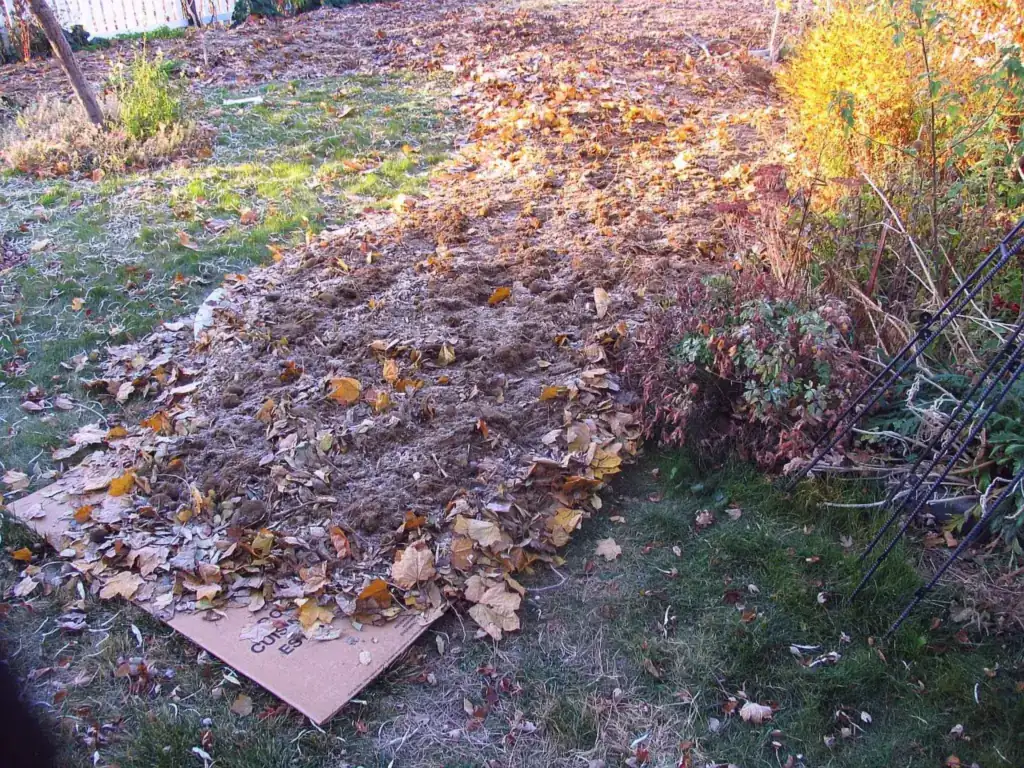
Can you kill weeds with cardboard? How smothering works
Weeds are plants, and plants starve without light. Oregon State University Extension describes sheet mulching as a cardboard or paper barrier that smothers existing weeds and the seeds in the soil “denying them access to sunlight required for photosynthesis and growth” (OSU Extension). Clemson’s Home & Garden Information Center says the same thing more bluntly: cardboard “blocks the light that the unwanted plant needs” (Clemson HGIC).
Here’s the part people miss when they try to kill weeds with cardboard. Covered grass doesn’t die in a day. It keeps burning the sugars stored in its crowns and roots, trying to grow toward light that never comes. Short-lived plants with small reserves, such as lawn grasses and annual weeds, run out fast. Perennials with big storage roots or tubers can wait you out, which is why the list of weeds in the next section matters so much.
There’s research behind the method too, not just garden lore. A 2020 meta-analysis in Agronomy pooled data from 66 studies on biodegradable mulches and found that paper-based mulches reduced weed density and biomass by 85.7% (±9.2%), and were particularly useful against Cyperus (nutsedge) weeds (Tofanelli & Wortman 2020). Those trials used purpose-made paper mulch films in farm fields, not old shipping boxes, but the principle is identical: an opaque paper layer stops most weeds.
Honestly, the cardboard itself is the easy part. Whether you succeed depends on three things: overlaps with no gaps, enough mulch on top, and starting early enough.
What cardboard can and can’t kill
Before you lay a single box, walk the area and identify what’s growing there. Oregon State’s Master Gardener guide is explicit: remove persistent weeds such as blackberry, bindweed and thistle first, because “sheet composting will not smother these weeds” (OSU Master Gardener handout). The OSU Extension publication adds morning glory and quackgrass to that list (OSU Extension).
| What’s growing there | Will cardboard kill it? | Why | What to do instead or first |
|---|---|---|---|
| Cool-season lawn grass (fescue, bluegrass, ryegrass) | Usually yes | Shallow crowns, limited reserves | Mow low, then cover; check edges in spring |
| Annual weeds (chickweed, henbit, crabgrass seedlings) | Yes | Small seedlings need light; seeds near the surface stay dark | Cover before they set seed |
| Winter annuals in rosette stage (bittercress, speedwell) | Yes | Low rosettes are easily smothered | Pull any that have flower stalks first |
| Bermudagrass and other creeping grasses | Often not fully | Rhizomes and stolons travel sideways to the edges and through gaps | Dig out runners, wide overlaps, and keep checking edges |
| Field bindweed, morning glory | No | Deep, food-rich roots outlast the cover (OSU) | Dig or spot-treat while actively growing, then sheet mulch |
| Quackgrass | No | Aggressive rhizomes (OSU) | Dig out rhizomes first |
| Canada thistle, blackberry | No | Deep perennial roots (OSU) | Remove or treat first |
| Yellow and purple nutsedge | Unreliable | Sharp shoots pierce many mulches; tubers survive 1–3 years (UC IPM) | Treat young plants before the 5-leaf stage; hand-remove survivors |
Nutsedge deserves a special warning. UC IPM notes that nutsedges “will emerge through various types of mulches” and that plastic mulches don’t control them because the sharp leaf tips punch through (UC IPM Nutsedge Pest Notes). If you know you have it, read our guide to yellow and purple nutsedge before you start.
Not sure whether that vine is bindweed? Our bindweed vs morning glory guide shows the differences, and both need the same “remove first” treatment.
How to kill weeds with cardboard, step by step
The steps below combine the Oregon State, UC Master Gardener (Placer County), NC State and Clemson instructions into one plan. Where they disagree on a number, both figures are given so you can pick what suits your site.
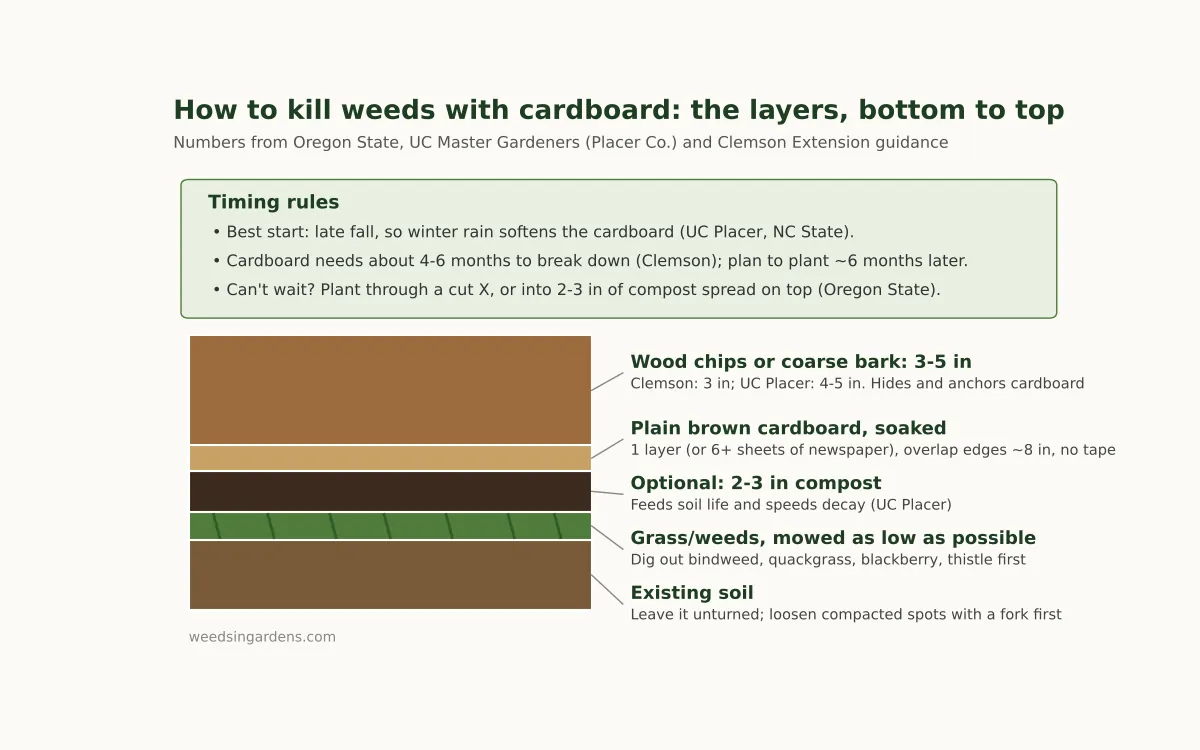
1. Mow or scalp as low as you can
Cut the grass and weeds right down. UC Master Gardeners recommend mowing on the very lowest setting (UC Master Gardeners, Placer Co.). Short vegetation lies flat, so the cardboard sits tight to the ground with no tents of air and light underneath. Leave the clippings in place; they rot under the cover.
2. Remove the tough perennials
Dig out bindweed, quackgrass, thistle and blackberry crowns, and pull runners of creeping grasses back from the edges. Be thorough here. This is the one step cardboard can’t do for you.
3. Loosen hard spots and add compost (optional)
Oregon State suggests loosening compacted soil with a spading fork to improve drainage (OSU). UC Placer adds a 2–3 inch layer of compost under the cardboard to feed soil life (UC Placer). If a soil test calls for lime, OSU’s Master Gardener sheet sets it out before the cardboard goes down (OSU MG handout). Don’t till; the whole point is to leave buried weed seeds buried.
4. Prepare the cardboard
Use plain brown corrugated cardboard, not glossy, shiny or printed boxes, and pull off all tape, labels and staples (OSU). Clemson points out that tape and labels contain plastic, and that coloured inks can contain heavy metals (Clemson HGIC). Big appliance boxes are best because they leave fewer seams.
5. Lay it with generous overlaps
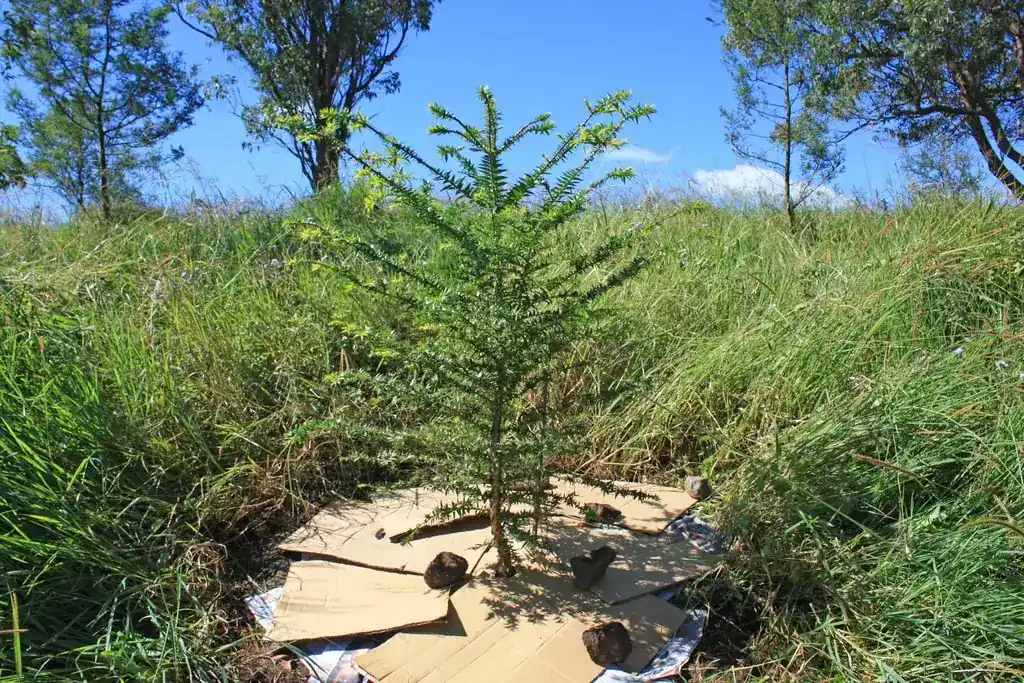
One layer of cardboard is enough; if you use newspaper, go to six or more sheets thick (OSU MG handout; UC Placer). Overlap the edges by at least 8 inches, because, as OSU puts it, weeds “will find any opening, no matter where or how small” (OSU). Run the cardboard right up to the edges and tuck it around existing shrubs, leaving a little space at the trunk.
6. Soak it
Wet the cardboard thoroughly. Soaking helps water get through and starts decomposition (OSU). Clemson warns that dry cardboard is “hydrophobic to a certain degree,” which can keep water away from plant roots (Clemson HGIC).
7. Cover it with 3–5 inches of mulch
Clemson recommends a 3-inch layer of medium to coarse mulch, anchored with sod staples (Clemson HGIC); UC Placer uses 4–5 inches of wood chips or bark (UC Placer). The mulch weighs the cardboard down, keeps it moist so it breaks down, and hides it. Bare cardboard blows around, dries out and looks like a recycling bin exploded in your yard.
8. Keep it moist and wait
If rain is scarce, water the area so the layers stay damp (UC Placer). Then be patient: Clemson says cardboard takes four to six months to break down (Clemson HGIC).
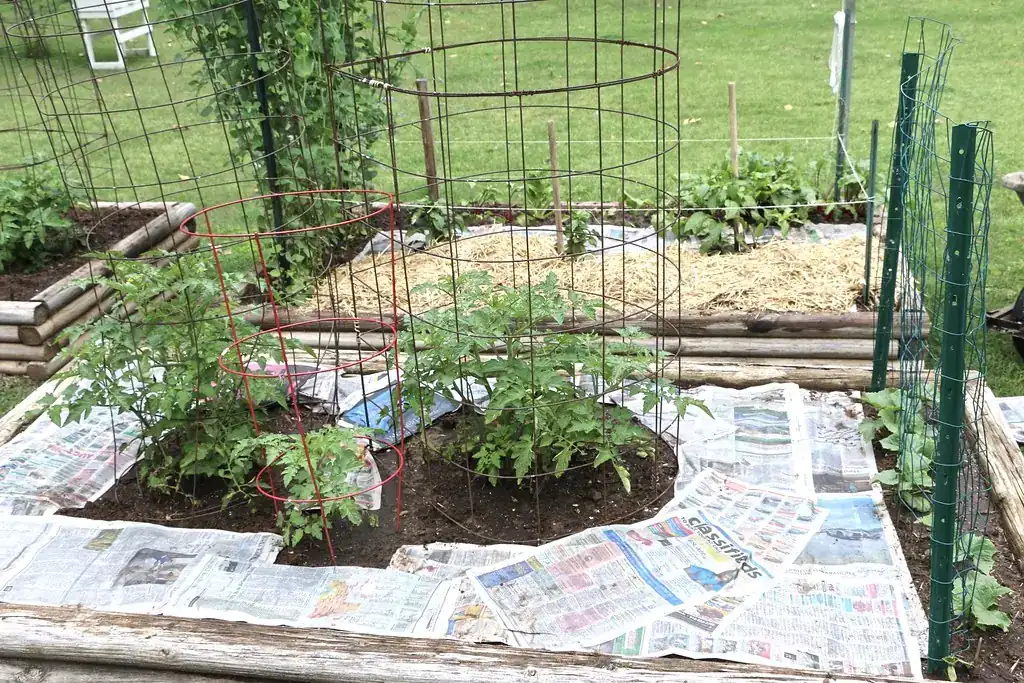
When to lay cardboard: a season-by-season plan
If you want to kill weeds with cardboard in time for spring planting, timing is everything. It decides whether you’re planting into soft, dark soil in spring or hacking through soggy cardboard. UC Master Gardeners strongly suggest sheet mulching in late autumn so winter rain helps break it down (UC Placer). NC State puts it simply: sheet mulch in November and you’ll be ready to plant in May (NC State Extension Gardener). Oregon State advises starting 5–6 months before you want the bed (OSU MG handout).
| When you start | What happens | When you can plant | Watch out for |
|---|---|---|---|
| Late fall (Oct–Nov) — best | Grass is slowing; winter rain and snow keep the layers wet and softening | Spring (about April–May) | Wind lifting edges before mulch goes on |
| Winter (Dec–Feb) | Works wherever the ground isn’t frozen solid; decay is slow in cold soil | Late spring to early summer | Less time before weeds wake up |
| Spring (Mar–May) | Weeds are actively growing and push hard at gaps | Late summer or fall, or plant into compost on top | Edges and seams; keep re-covering |
| Summer (Jun–Aug) | Heat speeds decay, but cardboard dries out fast | Fall | Watering needed to keep it moist (UC Placer) |
Can’t wait six months? Oregon State gives two shortcuts. You can spread 2–3 inches of compost or garden soil on top and plant straight into it, or cut through the cardboard to set plants in (OSU MG handout; OSU). Transplants do far better than seeds here, because tiny seedlings can’t push roots through half-rotted cardboard.
Fall also gives you free materials. Shredded leaves make an excellent carbon layer on top of the cardboard; our guide to leaves on the lawn over winter explains how to shred them.
Is cardboard bad for soil? Air, water, termites, PFAS and alternatives
Search for cardboard mulch and you’ll find two camps: permaculture fans who call it magic, and horticulture professors who say it doesn’t belong on soil. The evidence sits in between.
Soil air
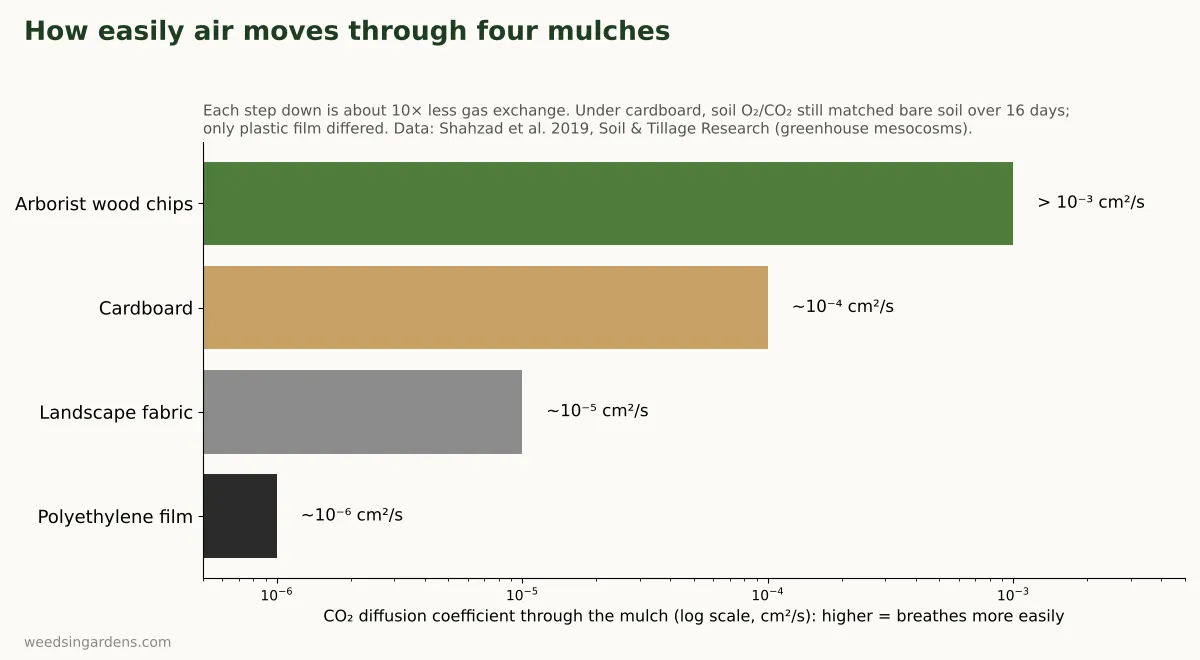
The best data come from a 2019 greenhouse study in Soil & Tillage Research (co-authored by Chalker-Scott). Carbon dioxide moved through wood chips at more than 10⁻³ cm²/s, through cardboard at about 10⁻⁴, through landscape fabric at about 10⁻⁵, and through polyethylene film at about 10⁻⁶ (Shahzad et al. 2019). That’s a tenfold drop at each step. Yet over the 16-day test, CO₂ and O₂ levels in the soil under cardboard were not significantly different from bare soil; only plastic film changed them. The authors still concluded wood chips gave the best gas permeability and cautioned that the lower diffusion of other mulches could matter in biologically rich landscape soils.
In plain terms: a single layer of cardboard that rots away in a season is very unlikely to suffocate your soil. Permanent, stacked or repeatedly renewed cardboard is a different story, which is why it makes a better one-time bed starter than a forever mulch.
Water
Dry cardboard sheds water, and Clemson notes this matters most while establishing larger trees and shrubs and during dry spells (Clemson HGIC). Oregon State adds that cardboard limits the flow of water and air into the soil, which can stress existing plants whose roots sit under it, especially if it’s thick (OSU). The fix is simple: soak it, cover it, and don’t use it as a permanent layer over tree roots.
Termites
Chalker-Scott warns that termites love cardboard and prefer paper to wood (Garden Professors). In termite country, keep sheet mulch well away from your house foundation.
PFAS and inks
Some cardboard can carry PFAS (“forever chemicals”). Maryland Extension notes that one study found PFAS in cardboard and that it’s most likely in food packaging, while information on shipping boxes is lacking (UMD HGIC). University of Maine Extension’s Caragh Fitzgerald adds perspective: uncoated corrugated cardboard is less likely to contain PFAS, any present is likely diluted by the soil, and in a small garden the contribution may be very small compared with other sources (UMaine News, 2024). The practical rule: use plain brown shipping boxes, skip pizza boxes, food cartons and anything glossy or waxed, and choose wood chips if you’d rather avoid the question entirely.
Cardboard vs. other ways to smother weeds
Cardboard is only one of several smothering tools. Here’s how it compares with the alternatives homeowners usually weigh up.
| Method | How it kills weeds | Key numbers | Best for | Main drawback |
|---|---|---|---|---|
| Cardboard + 3–5 in mulch | Blocks light | Breaks down in ~4–6 months (Clemson) | Turning lawn into a new bed | Needs good overlaps; won’t stop deep perennials |
| Newspaper + mulch | Blocks light | 6+ sheets thick (OSU, UC Placer) | Small beds, around existing plants | Fiddly to lay; blows away when dry |
| Wood chips alone, deep | Blocks light; chips stay porous | 8 in (UMD Extension) to 12 in (Chalker-Scott) | Big areas; no cardboard handy | Needs a lot of chips |
| Landscape fabric | Blocks light | Long-lasting, until soil builds up on top | Paths, under gravel | Weeds root into mulch on top; hard to remove |
| Clear or black plastic | Light blocking or heat | Lowest gas exchange of the mulches tested (Shahzad et al. 2019) | Short-term bed prep | Must be removed; soil gases changed under film |
| Herbicide, then plant into dead turf | Kills roots chemically | Follow the label | Large lawns, creeping grasses | Chemical use; label waiting periods |
Two of those rows deserve a closer look. Maryland Extension’s Home and Garden Information Center suggests wood chips as a good alternative to cardboard, noting that “an 8-inch layer will kill vegetation” (UMD HGIC via Ask Extension). Linda Chalker-Scott, the WSU Extension urban horticulturist behind the Garden Professors blog, recommends 12 inches of arborist wood chips over mown grass, arguing it restricts light but not water and oxygen (Garden Professors).
If you’re tempted by fabric instead, read our honest look at landscape fabric pros and cons first. For a full sod removal, see how to remove old sod.
When weeds come back through cardboard: troubleshooting and herbicide options
Even when you kill weeds with cardboard correctly, some regrowth is normal, especially along edges and seams. Colorado State’s Alison O’Connor told one homeowner that cardboard may not fully kill the grass, and patches can come back, so it’s wise to have a plan for them (CSU via Ask Extension).
| If you see this in spring | Likely cause | Do this |
|---|---|---|
| Grass poking up along a seam | Overlap too small or cardboard shifted | Pull it, slip in a new piece with an 8-in overlap, re-cover |
| Grass creeping in from the lawn edge | Rhizomes or stolons travelling sideways | Cut a clean edge with a spade; consider a buried edging strip |
| Sharp, shiny, triangular-stemmed shoots | Nutsedge from tubers | Remove before 5 leaves; see herbicide notes below |
| Twining vines with arrow-shaped leaves | Bindweed regrowing from deep roots | Keep pulling or spot-treat; it won’t starve quickly |
| Tiny seedlings on top of the mulch | Wind-blown seed germinating in the mulch | Hand-pull or hoe; top up coarse mulch |
| Cardboard still intact and dry | Too little moisture or mulch | Soak, add mulch; plant through a cut X |
Top-of-mulch seedlings are unavoidable. Clemson notes that coarse mulches like large bark chips or pine straw resist weed seeds better than fine ones, so a coarse top layer makes life easier.
Herbicide options by active ingredient
If you’re happy to use chemistry on the tough survivors, use it before you lay cardboard or as spot treatments afterwards. Always read and follow the label; it’s the law, and it sets the rates, temperatures and waiting periods.
- Glyphosate (non-selective, systemic): the usual pre-treatment for bindweed, quackgrass and creeping grasses. It works only on green, actively growing leaves, so spray in late summer or early fall before you sheet mulch, not on dormant plants in winter. UC IPM notes that on nutsedge it gives only limited suppression and needs repeat applications on young, actively growing plants (UC IPM). Read our weed killer timeline guide before planting into treated ground.
- Halosulfuron, sulfentrazone, mesotrione (selective, nutsedge-active): UC IPM advises applying nutsedge herbicides before the fifth-leaf stage (UC IPM). Check that the product is labelled for the site (lawn vs. ornamental bed).
- Herbicide-then-plant method: CSU’s suggestion for lawn conversion is to kill the turf, mow it short and plant into the dead sod, which then acts as mulch under wood chips (CSU). For broader options, see our post-emergent herbicide guide.
Non-chemical option for survivors: keep cutting or pulling them every time they green up. Each new flush of leaves uses root reserves before it can refill them, so persistence wins eventually.
A note from the agronomist’s side
Here’s the way I’d frame cardboard for any homeowner: it’s a light switch, not a herbicide. It turns the lights off over the weeds, and anything without enough stored food in the dark dies. Everything else in the method, the overlaps, the soaking, the mulch depth, the fall timing, is about keeping the lights off long enough and making sure the cardboard rots away on schedule.
That framing also explains the failures. Bindweed, quackgrass and nutsedge carry months of fuel underground, so a season of darkness is a nuisance to them, not a death sentence. With those weeds, the cardboard isn’t the control; removal or a well-timed systemic herbicide is, and the cardboard just stops the seed bank from joining in.
On the soil-health debate, the published numbers are more reassuring than the internet arguments. A single, wet, mulched layer that disappears within a growing season is a short interruption. The real risk is treating cardboard as a permanent mulch and stacking it year after year. Use it once to kill weeds with cardboard and start the bed, then switch to wood chips, shredded leaves or compost to keep weeds down from then on. If you have access to free arborist chips, the deep-chip method skips the cardboard question entirely.
Finally, think about the weed seeds that will arrive next year from neighbours, birds and wind. No smother method stops those. A coarse top mulch and a quick hand-weeding round every few weeks will, and our guide to stopping weeds in mulch beds covers that maintenance.
FAQ
How long does it take to kill weeds with cardboard?
Most lawn grass and annual weeds die within a few months under a soaked, mulched layer of cardboard, but plan on about six months before planting. Clemson Extension says cardboard takes four to six months to break down, and NC State notes that sheet mulching in November gets a bed ready for May.
Can I put cardboard directly on top of weeds?
Yes. Mow or flatten the weeds as low as possible first, then lay the cardboard directly on them with 8-inch overlaps. Pull or dig out tough perennials such as bindweed, quackgrass and thistle first, because cardboard won’t smother them.
How many layers of cardboard do I need to kill weeds?
One layer of plain corrugated cardboard is enough if the edges overlap well and it’s covered with 3–5 inches of mulch. If you use newspaper instead, use six or more sheets. Thicker stacks of cardboard take longer to break down and block more water.
Do I need to wet the cardboard?
Yes. Soaking it helps water reach the soil and speeds decomposition. Dry cardboard is partly water-repellent, so it can keep moisture from plant roots, and it blows away easily.
Will cardboard kill Bermuda grass or nutsedge?
Not reliably. Bermudagrass spreads by runners that travel to the edges and through gaps, and nutsedge shoots can pierce many mulches while its tubers survive one to three years. Dig them out or treat them while they are actively growing, then sheet mulch and watch the edges.
Is cardboard safe to use in a vegetable garden?
Plain brown, uncoated corrugated cardboard with the tape and labels removed is the safest choice. Avoid glossy, waxed, printed or food-contact cardboard such as pizza boxes, which are more likely to carry PFAS. If you would rather avoid the question, deep wood chips smother weeds without cardboard.
Can I plant right away after laying cardboard?
Yes, with transplants. Cut an X through the cardboard and plant into the soil below, or spread 2–3 inches of compost on top and plant into that. Seeds are better left until the cardboard has broken down.
Sources
- Oregon State University Extension Service. Sheet mulching and lasagna composting with cardboard (EM 9559).
- Oregon Master Gardener Association, Clackamas County, with OSU Extension. 10-Minute University: Sheet Mulching.
- Brennan, M. (2020, updated 2022). Smart Gardening: Sheet mulching. NC State Extension Gardener.
- Jordan, J. (2025). How to Use Cardboard in the Landscape: Benefits and Drawbacks. Clemson Cooperative Extension Home & Garden Information Center.
- UC Master Gardeners of Placer County. How to Kill Your Lawn by Sheet Mulching. University of California ANR.
- University of Maryland Extension HGIC (2023). Ask Extension #851588: cardboard, PFAS and wood chips.
- O’Connor, A. (2024). Ask Extension #878902: Using cardboard for yard conversion. Colorado State University Extension.
- University of Maine (2024). Newsletter on PFAS from Extension’s Fitzgerald cited by BDN.
- Wilen, C.A. (2024). Pest Notes: Nutsedge. UC IPM Publication 7432.
- Shahzad, K., Bary, A., Collins, D., Chalker-Scott, L., et al. (2019). Carbon dioxide and oxygen exchange at the soil-atmosphere boundary as affected by various mulch materials. Soil & Tillage Research 194:104335. doi:10.1016/j.still.2019.104335.
- Tofanelli, M.B.D., & Wortman, S.E. (2020). Benchmarking the agronomic performance of biodegradable mulches against polyethylene mulch film: a meta-analysis. Agronomy 10(10):1618. doi:10.3390/agronomy10101618.
- Chalker-Scott, L. Cardboard does not belong on your soil. Period. The Garden Professors (WSU Extension).