
It starts with one odd patch. Maybe it’s a tan circle the size of a dinner plate, maybe the grass blades look dusted with orange powder, or maybe you notice pinkish threads on the leaf tips after a wet week. You type “what’s wrong with my lawn” into your phone, and the pictures that come back all look a bit like yours. That’s the problem with lawn fungus types: a dozen different diseases can make grass turn brown, and the fix for one can be a waste of money for another.
Short answer: The most common lawn fungus types in US lawns are brown patch, dollar spot, red thread, rust, leaf spot, snow mold and summer patch on cool-season grasses, and large patch, spring dead spot, gray leaf spot and take-all root rot on warm-season grasses. You tell them apart by the size and shape of the patch, the leaf lesions, any visible fungus (threads, powder, cottony growth), your grass type and the weather. Most are triggered by a specific temperature range plus long periods of wet leaves or soggy soil, so correcting water, nitrogen, mowing and thatch fixes more cases than fungicide does.
By the end of this guide you’ll be able to rule out the look-alikes (drought, dog urine, grubs), match your symptoms to the right disease with one table, know which ones are active right now in late fall, and pick a fungicide by active ingredient only when it will actually pay off.
First, make sure it’s really a lawn fungus
Here’s the surprising part: disease is usually not the reason a lawn turns brown. Ohio State’s turfgrass pathologists open their disease chart with the reminder that the main reasons for brown grass are adverse weather and improper maintenance, and Oregon State University’s Solve Pest Problems guide says plainly that diseases are not the most common cause of lawn damage. Insects and dog urine can look almost identical to disease.
So before you buy anything, spend five minutes on these checks:
- Tug test. Grab a handful of the brown grass and pull. If it lifts like a loose carpet and you see C-shaped white larvae, it’s insects, not fungus. Our guide to grubs in lawn walks through the count.
- Footprint test. Walk across the patch. If your footprints stay pressed in for minutes and the soil is dry, the grass is drought-stressed, not infected.
- Shape and location. Sharp, round spots with a deep green ring around them where a dog regularly goes are urine burn. Damage that follows the sprinkler pattern, a slope or a reflective wall points to water or heat.
- Look for the fungus itself. Pathologists separate signs (the fungus you can see: red threads, orange powder, cottony white growth, mushrooms) from symptoms (the grass’s reaction: lesions, tan patches, thinning). A sign is the strongest clue you’ll get.
- Check the leaf. Pick a blade from the edge of the patch. Lesions with a defined border, a banded spot or a dark margin mean an infectious disease. Uniformly straw-colored blades with no spots usually mean stress.
If the brown showed up as the weather cooled this fall, read our checklist on why a lawn turns brown in fall too, because dormancy and late-season stress fool a lot of people. And if the soil squelches under your feet, start with the signs of an overwatered lawn, since constant wetness is the common thread behind most of the diseases below.
Lawn fungus types at a glance: identification table
Use this table of lawn fungus types to narrow things down fast. Find your grass type first, then match the patch size and the clue you see on the leaves. The grasses and weather conditions come from Ohio State University’s Lawn and Sport Turfgrass Disease Information Chart, with warm-season details from UGA and NC State Extension.
| Disease (fungus) | Grasses most affected | What it looks like | Weather that triggers it |
|---|---|---|---|
| Brown patch (Rhizoctonia solani) | Tall fescue, perennial ryegrass | Tan to brown patches 6 in to 2 ft, often a darker outer edge; irregular leaf lesions | Hot and wet: days above 80°F, nights mid 60s °F and up |
| Dollar spot (Clarireedia, formerly Sclerotinia) | Kentucky bluegrass, bentgrass, fine fescue, ryegrass | Tan spots 1–6 in; light tan leaf lesions with dark edges that band across the blade; white cobwebby growth on dewy mornings | Moderate days, 60°F to low 80s, long leaf wetness, dry soil |
| Red thread (Laetisaria fuciformis) | Perennial ryegrass, fine fescue | Pink to reddish patches 2–12 in; pink or red threads on leaf tips | Moderate temperatures, wet foliage; worse in nitrogen-starved lawns |
| Rust (Puccinia spp.) | Perennial ryegrass, Kentucky bluegrass | Yellow flecks that become orange, raised pustules; the powder rubs off on shoes | Moderate temperatures, wet leaves, dry soil, slow growth |
| Leaf spot / melting out (Drechslera, Bipolaris) | Kentucky bluegrass | Small dark spots with lighter centers; crowns rot and turf thins | Leaf spot cool and wet (spring, fall); melting out hot and dry (summer) |
| Pythium blight (Pythium spp.) | Perennial ryegrass, bentgrass, young turf | Greasy, dark spots that collapse quickly; cottony gray-white growth | Very hot and wet: days high 80s–90s °F, nights 70°F+ |
| Summer patch / necrotic ring spot | Kentucky bluegrass, fine fescue | Wilted spots 1–3 in that grow into rings or crescents, often with a green center | Warm weather with swings between wet and dry soil; compacted, poor soils |
| Pink snow mold (Microdochium nivale) | Bentgrass, ryegrass, Kentucky bluegrass | Bleached, matted patches that look slimy when wet | Cool, wet winter and spring; no snow required |
| Gray leaf spot (Pyricularia) | Perennial ryegrass; St. Augustine and tall fescue in the South | Tiny dark flecks; leaves wither fast; large areas die | Long hot, humid spells in late summer and fall |
| Large patch (Rhizoctonia solani) | Zoysia, St. Augustine, centipede | Circles 3–26 ft with orange or yellow edges; dark, water-soaked sheath lesions | Thatch at 50–70°F with 48+ hours of moisture |
| Spring dead spot (Ophiosphaerella spp.) | Bermudagrass (sometimes zoysia) | Sharp-edged, bleached circles at spring green-up; black roots and rhizomes | Infects in fall when soil drops below 70°F; damage shows in spring |
Two clues do most of the work when you sort lawn fungus types. Patch size separates the small-spot diseases (dollar spot, red thread) from the big-patch ones (brown patch, large patch). Then your grass type cuts the list roughly in half, because the warm-season diseases rarely show up on a fescue lawn and vice versa.
Cool-season lawn diseases (fescue, bluegrass, ryegrass)
If you’re in the northern half of the country, or anywhere with a tall fescue lawn, these are the lawn fungus types you’re most likely to meet. Notice how many are tied to wet leaves, which is why watering time matters so much.
Brown patch
Brown patch is the classic hot-weather disease of tall fescue and perennial ryegrass. Ohio State lists the trigger as days in the 80s to mid 90s °F with warm nights in the mid 60s and up, plus abundant water and wet soils. Patches run from about 6 inches to 2 feet across, and on humid mornings you may see gray-white fungal growth at the edges. Too much nitrogen, overwatering and poor air flow all make it worse.
Dollar spot
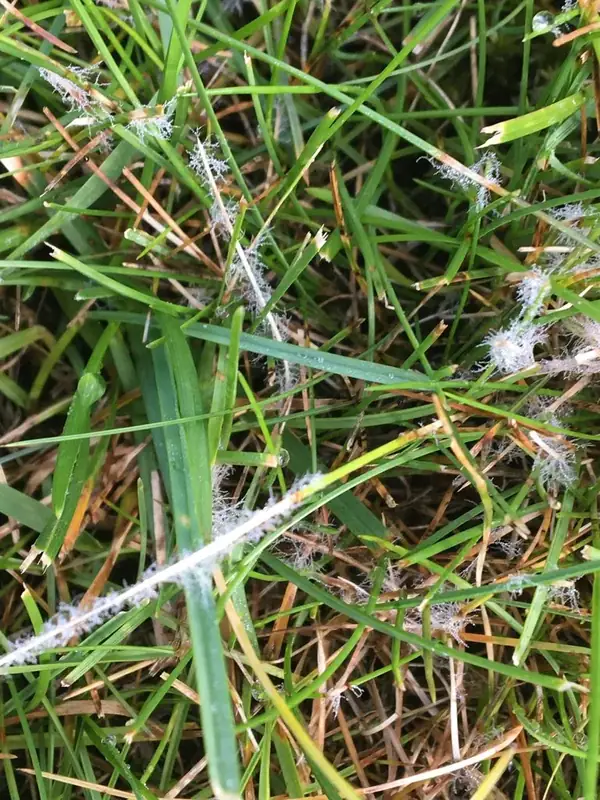
Dollar spot makes small, round, tan spots, 1 to 6 inches across, that can merge into bigger blotches. The giveaway is on the blade: a light tan lesion with dark edges that runs across the leaf like a band. Ohio State ties it to moderate days (60°F to low 80s), long periods of wet leaves and dry soil, and lists nitrogen deficiency as a key cause. That’s why a hungry lawn often gets dollar spot while a well-fed neighbor doesn’t.
Red thread and pink patch
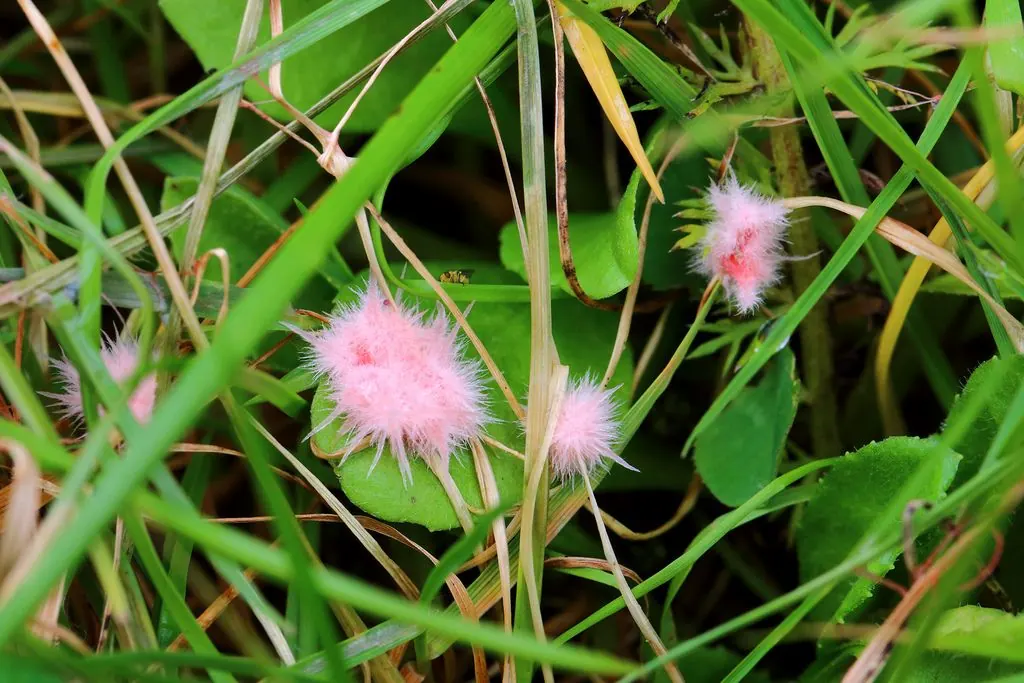
Red thread is easy to name once you’ve seen it: pink or red, thread-like strands of fungus sticking out of the leaf tips, in tan or pinkish patches 2 to 12 inches wide. It favors perennial ryegrass and fine fescue in moderate, wet weather. The fix is usually nutrition, not fungicide. Ohio State’s first recommendation is a complete fertilization program that avoids nitrogen and phosphorus deficiencies.
Rust
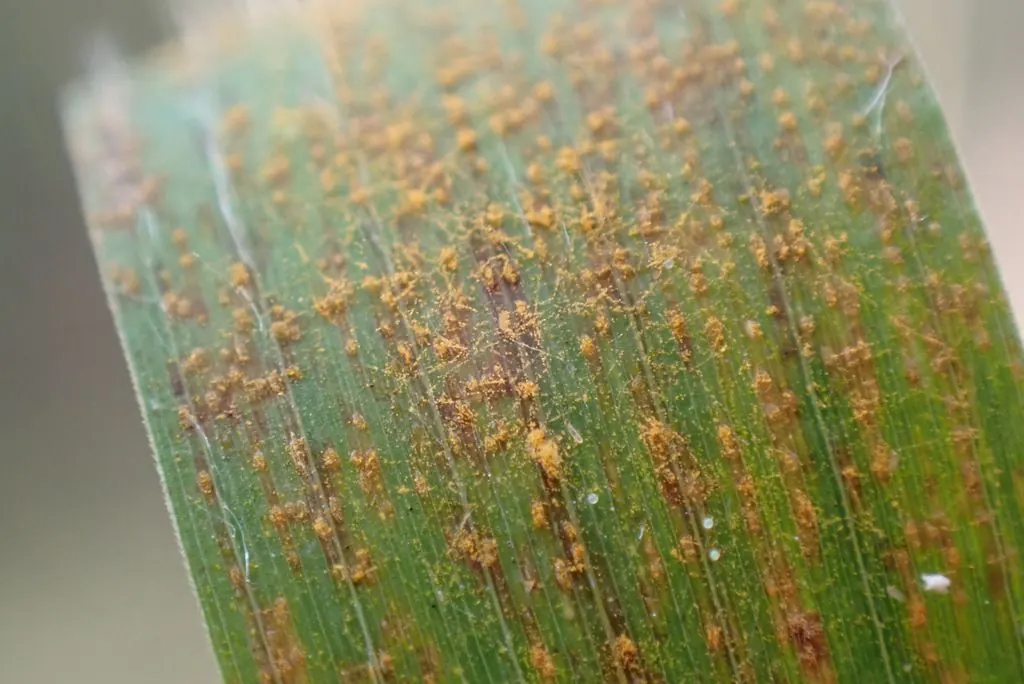
Rust shows up as yellow flecks that turn into raised orange pustules. Walk through a rusty lawn in white shoes and you’ll see the spores on them. Ohio State notes that it hits perennial ryegrass and some Kentucky bluegrass varieties when leaves stay wet but soil is dry, because the grass grows too slowly to outpace the fungus. Feeding and watering to restart growth is usually enough.
Leaf spot and melting out
These two are the same group of fungi at different stages, and Kentucky bluegrass is the main target. In cool, wet spring and fall weather you get leaf spot: small dark spots with lighter centers. If the infection moves down into the crowns during summer heat, the turf thins out and “melts out.” Ohio State recommends raising the mowing height, mowing often, avoiding excess nitrogen and avoiding frequent watering.
Pythium blight
Pythium is technically a water mold, not a true fungus, but it behaves like the worst kind of lawn fungus. Spots look dark and greasy, often with cottony white growth, and the turf can die within days. It needs very hot, wet conditions: days in the high 80s to 90s °F and nights of 70°F or more, usually in low, poorly drained spots. It’s uncommon on mature, high-mown lawns, but new seedings are vulnerable.
Summer patch and necrotic ring spot
These root diseases of Kentucky bluegrass and fine fescue start as dark, wilted spots that look like drought stress, then grow into rings, crescents and streaks, often with a green center. Ohio State says they’re most common on sodded lawns with poor site preparation and compacted or debris-filled soil, and that they’re hard to manage with fungicides. Keeping soil pH between 6 and 7, avoiding low mowing and thatch buildup, and watering when dry are the main tools.
Snow molds
Pink snow mold (also called Microdochium patch) leaves bleached, matted patches that look slimy when wet, and it doesn’t need snow at all: cool, wet winters with saturated, unfrozen soil are ideal. Gray snow mold needs long-lasting snow cover. Our full guide to snow mold on grass covers both in detail, including what to do this fall to head them off.
Warm-season lawn diseases (zoysia, St. Augustine, centipede, bermuda)
Southern lawns have their own lawn fungus types, and the timing catches people out: several of the worst warm-season diseases are cool-weather diseases that strike as the grass goes into or comes out of dormancy.
Large patch
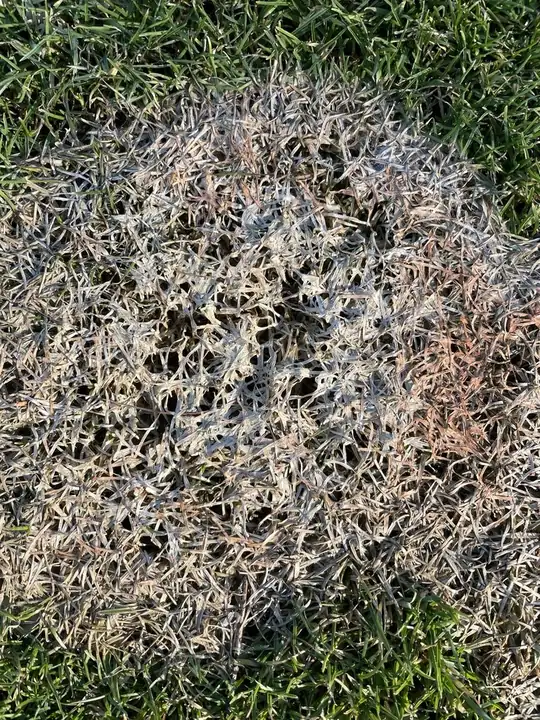
UGA Extension calls Rhizoctonia large patch the most common and severe disease of warm-season grasses, including centipede, zoysia, bermuda and St. Augustine. It’s the same fungus that causes brown patch in fescue, but it works in cool weather. UGA’s disease update lists the conditions as thatch temperatures of 50–70°F with continuous moisture for at least 48 hours. Patches range from 3 to 26 feet across, with bright yellow or orange grass at the edge and water-soaked, reddish-brown or black lesions on the leaf sheaths.
NC State’s turf pathology team notes that infection starts in fall when soil temperatures drop below 80°F on St. Augustine and below 70°F on the other warm-season grasses, and that bermudagrass rarely suffers much damage. Symptoms often show up the following spring at green-up and fade once soil warms above 70°F.
Spring dead spot
Spring dead spot is the bermudagrass disease you plant the seeds of in fall and see in spring. According to UGA Extension Circular 1012, the fungi infect when soil temperatures fall below 70°F (late September or early October in Georgia) and keep working as long as soil stays above 50°F. They don’t kill bermuda outright. They rot roots, rhizomes and stolons, so the grass dies from winter cold. At green-up you see sharp-edged, bleached circles with black, sparse roots, often filled with weeds later.
UGA is honest about the timeline: complete control in one season is uncommon, and it typically takes two to four years of good cultural practices plus fungicides to get acceptable control.
Gray leaf spot
Gray leaf spot hits perennial ryegrass in the North and St. Augustine and tall fescue in the Southeast. It starts as tiny dark flecks and can kill large areas quickly during long hot, humid spells in late summer and fall. Ohio State recommends resistant varieties, moderate fertilization and watering so leaves stay wet for the shortest time possible.
Take-all root rot
Take-all root rot (Gaeumannomyces graminis var. graminis) shows up as yellowing, thinning patches in St. Augustine and other warm-season lawns, with short, dark, rotted roots. It’s a root disease, so foliar sprays do little. University of Arkansas Extension lists products for it with a split schedule of two fall applications (September–October) and two in spring (April–May), which tells you this is a disease you manage over seasons, not days.
Harmless lawn fungus types you can mostly ignore
Not every fungus in your grass is a problem, and lawn fungus types that look dramatic are often the least harmful. Some of the most alarming-looking ones are cosmetic.
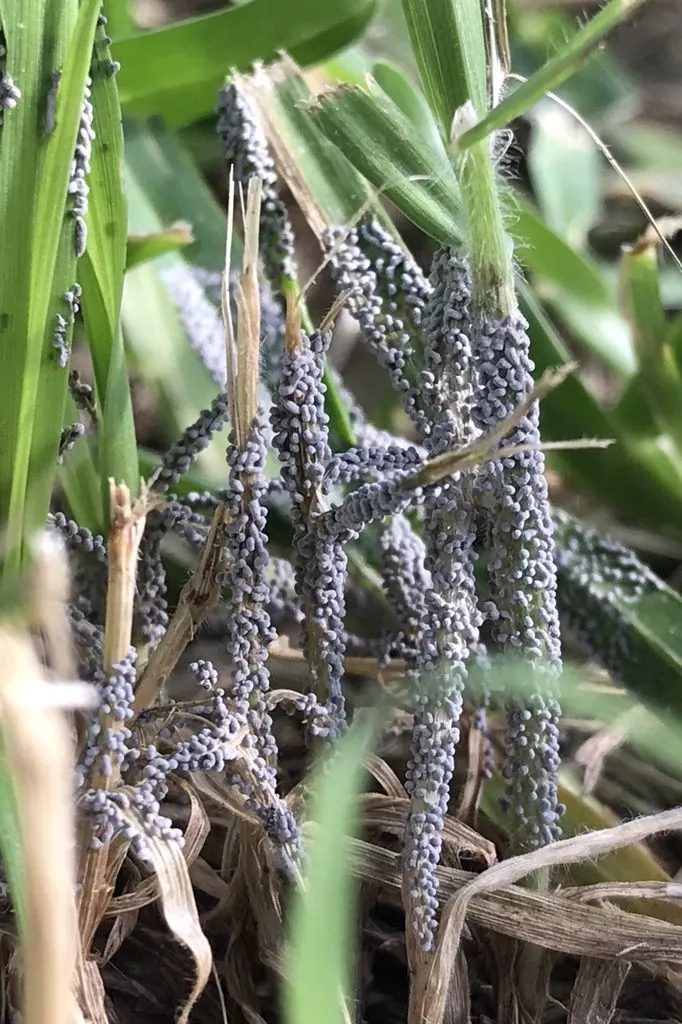
- Slime mold. Pin-head balls of gray, white, yellow or purple that coat grass blades after warm, wet weather. Ohio State calls it a cosmetic problem that causes no injury: rake, mow or hose it off.
- Mushrooms and toadstools. These are fruiting bodies of fungi breaking down buried wood, roots and thatch. They’re a sign of rich soil, not a sick lawn, though some are toxic to pets. See our guide to mushrooms in lawn.
- Fairy rings. Circles of dark green grass, mushrooms or dead turf caused by soil fungi. Most are harmless; the type that makes soil water-repellent needs work. Our fairy ring guide explains all three types.
- Powdery mildew. A white or gray powdery coat on Kentucky bluegrass and fine fescue in shade with poor air flow. It thins the stand but rarely kills it; more light and air is the real cure.
How to treat lawn fungus: timing, cultural fixes and fungicides
Every extension source in this guide says the same thing: fix the conditions first, then consider fungicide. Ohio State’s chart lists cultural steps as the first line of defense and puts fungicide in a footnote. The reason is simple. Most turf fungicides protect healthy grass from new infection; they don’t bring dead grass back, and the disease will return if the wet, hungry or compacted conditions stay.
When lawn fungus types strike: a seasonal plan
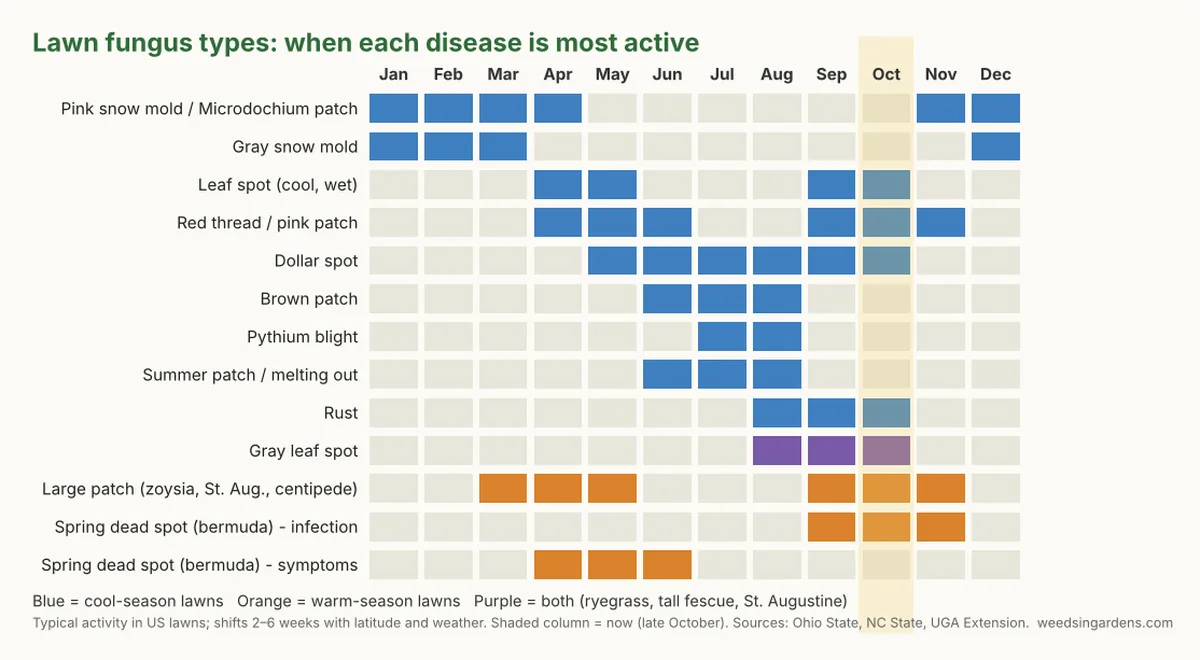
Use this calendar to plan. Right now, in late October, cool-season lawns are in the window for leaf spot, red thread, rust and the start of snow mold season, while warm-season lawns are in the infection window for large patch and spring dead spot.
| Season | Cool-season lawns: watch for | Warm-season lawns: watch for | What to do |
|---|---|---|---|
| Fall (Sep–Nov) | Leaf spot, red thread, rust, dollar spot (early fall) | Large patch and spring dead spot infection | Fertilize cool-season grass on schedule; do not apply nitrogen to warm-season grass in fall; fall fungicide only on lawns with a history of large patch or spring dead spot |
| Winter (Dec–Feb) | Pink and gray snow mold | Large patch keeps spreading in mild coastal areas | Keep mowing until growth stops, rake leaves off, avoid snow piles |
| Spring (Mar–May) | Snow mold damage, leaf spot, red thread | Large patch at green-up; spring dead spot circles appear | Rake out matted patches, fertilize when grass is actively growing, reseed or let stolons fill in |
| Summer (Jun–Aug) | Brown patch, Pythium, summer patch, dollar spot, melting out | Gray leaf spot on St. Augustine | Water deeply in early morning only; avoid heavy summer nitrogen on cool-season grass; raise mowing height |
Cultural fixes that work against almost every type
- Water early, deeply and less often. Nearly every disease above needs long leaf wetness. Water before sunrise so leaves dry fast, and skip evening watering. UGA notes most lawns need only about an inch a week, soaking soil 6–8 inches deep.
- Feed right, not heavy. Too much nitrogen fuels brown patch, Pythium and large patch; too little invites dollar spot, red thread and rust. A soil test tells you what your lawn actually needs.
- Mow at the right height with a sharp blade. Low mowing favors large patch and melting out. UGA’s heights: St. Augustine 2–3 in, zoysia, centipede and common bermuda 1–2 in.
- Break up compaction and thatch. Core aeration and thatch control improve drainage and root health. Our dethatching guide helps you decide if your lawn needs it.
- Open up shade and air. Pruning low branches and shrubs speeds drying and helps with brown patch, red thread and powdery mildew.
- Choose resistant grass. Ohio State lists resistant varieties for dollar spot, red thread, rust and gray leaf spot; UGA notes more cold-tolerant bermudas get less spring dead spot.
Fungicides by active ingredient
If a disease keeps coming back despite good care, or you have a high-value lawn, a fungicide can earn its keep. The table below lists homeowner products by active ingredient, from University of Arkansas Extension’s Home Lawn Diseases table and Ohio State’s residential turf fungicide list. Always read and follow the label: it’s the law, and it sets the rate, the grasses it’s safe on, the re-application interval and how long people and pets stay off.
| Active ingredient (FRAC group) | Example homeowner products | Labeled for (examples) | Notes |
|---|---|---|---|
| Azoxystrobin (11) | Scotts DiseaseEx | Brown patch, large patch, fairy ring, gray leaf spot, take-all, summer patch | Granular; label allows reapplying at 14–28 day intervals |
| Propiconazole (3) | Ferti-lome Liquid Systemic Fungicide II, BioAdvanced Fungus Control for Lawns | Dollar spot, rust, red thread, brown patch, summer patch, take-all, spring dead spot | Liquid label: take-all twice in Sep–Oct and twice in Apr–May |
| Myclobutanil (3) | Ferti-lome F-Stop Liquid | Dollar spot, rust, red thread, powdery mildew, summer patch | Repeat every 2–4 weeks or at first sign of new disease |
| Thiophanate-methyl (1) | Scotts Lawn Fungus Control, Bonide Infuse | Dollar spot, brown patch, large patch, gray leaf spot, pink snow mold | Don’t apply in wind over 10 mph (Scotts label note) |
| Potassium bicarbonate (none) | GreenCure | Powdery mildew | Contact product; start at first sign |
Three rules make fungicides work better. First, apply early: NC State points out that spring sprays for large patch help most right as symptoms appear but won’t work as a fast cure once damage is done, and that fall applications are more effective. Second, rotate FRAC groups (for example, alternate a group 3 with a group 11) so the fungus doesn’t become resistant. Third, don’t treat the harmless types: slime mold, mushrooms and most fairy rings don’t justify a spray.
A note from the agronomist’s side
If you take one idea from this page, make it this, because it applies to all lawn fungus types: a lawn disease is a three-way meeting between a fungus, a grass that can catch it and weather that suits it. Plant pathologists call it the disease triangle. The fungus spores are almost always present in your soil and thatch, so you rarely win by trying to kill the fungus. You win by removing one side of the triangle, and the side you control best is the environment: how long leaves stay wet, how much nitrogen is in the plant, how well the soil drains.
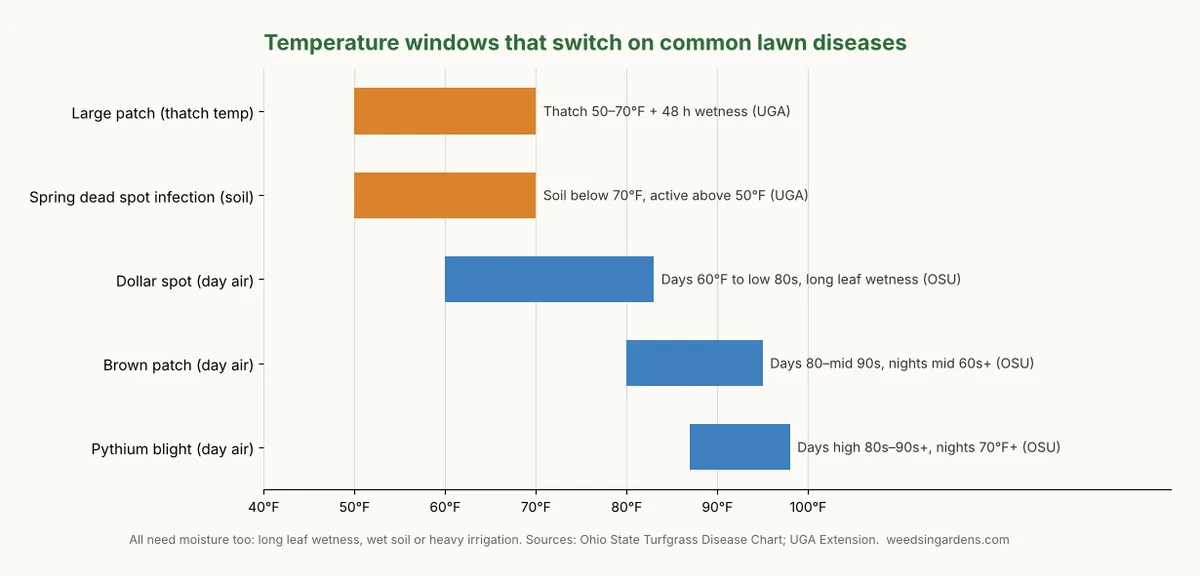
That’s also why the same fungus behaves so differently. Rhizoctonia solani is a hot-weather problem on tall fescue (brown patch) and a cool-weather problem on zoysia and St. Augustine (large patch). The pathogen didn’t change; the grass did. Warm-season grass slows down in fall and spring, it can’t outgrow the infection, and the fungus gets ahead. Read the temperature chart above that way, and the lawn fungus types stop looking random: it’s a guide to when your particular grass is most vulnerable.
Nitrogen is the other lever, and it cuts both ways. Lush, soft growth from heavy feeding is perfect food for brown patch and Pythium, while a starving lawn can’t regrow fast enough to shrug off dollar spot, red thread or rust. When the extension charts tell you both “avoid excessive nitrogen” and “avoid nitrogen deficiency” for different diseases, they’re describing the same target: steady, moderate growth matched to the season. A soil test and a calendar get you there more cheaply than a cabinet of fungicides.
Finally, be patient with diagnosis. A sample in a zip-top bag taken from the edge of an active patch, where green meets brown, gives your county extension office or plant disease clinic the best chance of a correct answer. A wrong guess costs more than a lab fee.
FAQ
What are the most common lawn fungus types?
For cool-season lawns, the most common are brown patch, dollar spot, red thread, rust, leaf spot and snow mold. For warm-season lawns, large patch, spring dead spot, gray leaf spot and take-all root rot are the main ones. Your grass type, the patch size and the weather narrow it down quickly.
How do I know if my lawn has fungus or something else?
Look for signs of the fungus itself, such as pink threads, orange powder, cottony growth or leaf lesions with defined borders. If grass pulls up like carpet, suspect grubs; if footprints stay pressed in on dry soil, suspect drought. Oregon State notes disease is not the most common cause of lawn damage, so rule out water, insects and dog urine first.
Will grass grow back after lawn fungus?
Often, yes. Many leaf diseases and pink snow mold leave the crowns alive, so the grass recovers once conditions change. Root diseases are slower: spring dead spot patches fill in only as bermuda stolons creep back, and UGA says full control can take two to four years. Bare areas that don’t recover in a few weeks of good growing weather should be reseeded or patched.
What is the best fungicide for lawn fungus?
There’s no single best one, because each active ingredient covers different lawn fungus types. Azoxystrobin is a strong choice for brown patch and large patch, while propiconazole and myclobutanil cover dollar spot, rust and red thread. Identify the disease first, then pick a product whose label lists it, and rotate FRAC groups.
Can you put fungicide down in fall?
Yes, when the disease is active in fall. NC State says fall fungicide applications for large patch in warm-season lawns are most effective once soil temperatures are consistently between 80 and 70°F, and spring dead spot programs are also fall-based. For cool-season lawns, fall is when a snow mold preventive is applied on lawns with a history of it.
Is lawn fungus treatment safe for dogs?
It depends on the product, so the label is your guide. Labels state how long people and pets must stay off the treated area, usually until the spray has dried or the granules are watered in. Store products out of reach and keep pets indoors during application.
Does lawn fungus spread from yard to yard?
Spores and infected clippings can move on mowers, shoes, water and wind, and UGA notes the spring dead spot fungi spread mainly through infected plants and soil moved by equipment, people, animals and running water. Washing the mower deck after cutting an infected lawn is a cheap precaution.
Sources
- Rimelspach, J. W., Hicks, T. E. and Boehm, M. J. Lawn & Sport Turfgrass Disease Information Chart. Department of Plant Pathology, The Ohio State University, 2012. turfdisease.osu.edu (PDF)
- Rimelspach, J. W. and Hicks, T. E. Fungicides for Ohio Residential Turfgrass. The Ohio State University, 2019. turfdisease.osu.edu (PDF)
- Smith, S. Home Lawn Diseases (fungicide table), MP154. University of Arkansas Cooperative Extension Service, 2021. uaex.uada.edu (PDF)
- Martin, M. and Butler, L. Cool Spring Weather Extends Large Patch Injury on Warm-Season Turf. NC State Extension Turf Pathology, updated 2024. turfpathology.ces.ncsu.edu
- Bist, V. Lawn Disease Update: Rhizoctonia Large Patch. UGA Cooperative Extension, Dougherty County, October 2025. extension.uga.edu
- Martinez, A. and Waltz, C. Identification and Control of Spring Dead Spot in Georgia, Circular 1012. University of Georgia Cooperative Extension, reviewed 2022. fieldreport.caes.uga.edu
- Oregon State University Extension. How to Manage Plant Diseases in Lawns. Solve Pest Problems, updated April 2026. solvepestproblems.oregonstate.edu