
You’re walking the shady side of the yard and there they are: tiny, glossy red berries sitting on top of a low mat of three-part leaves, right in the grass. They look like wild strawberries. Your kid wants to eat one, your dog is already sniffing them, and you’re wondering whether this is a gift from nature or a weed that’s quietly taking over the lawn.
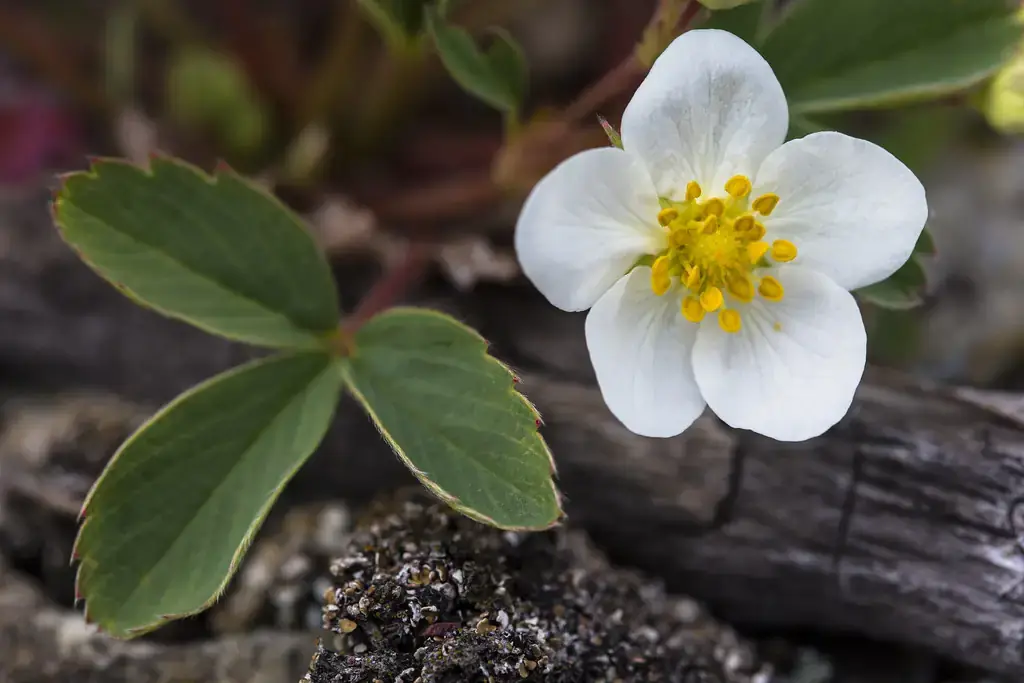
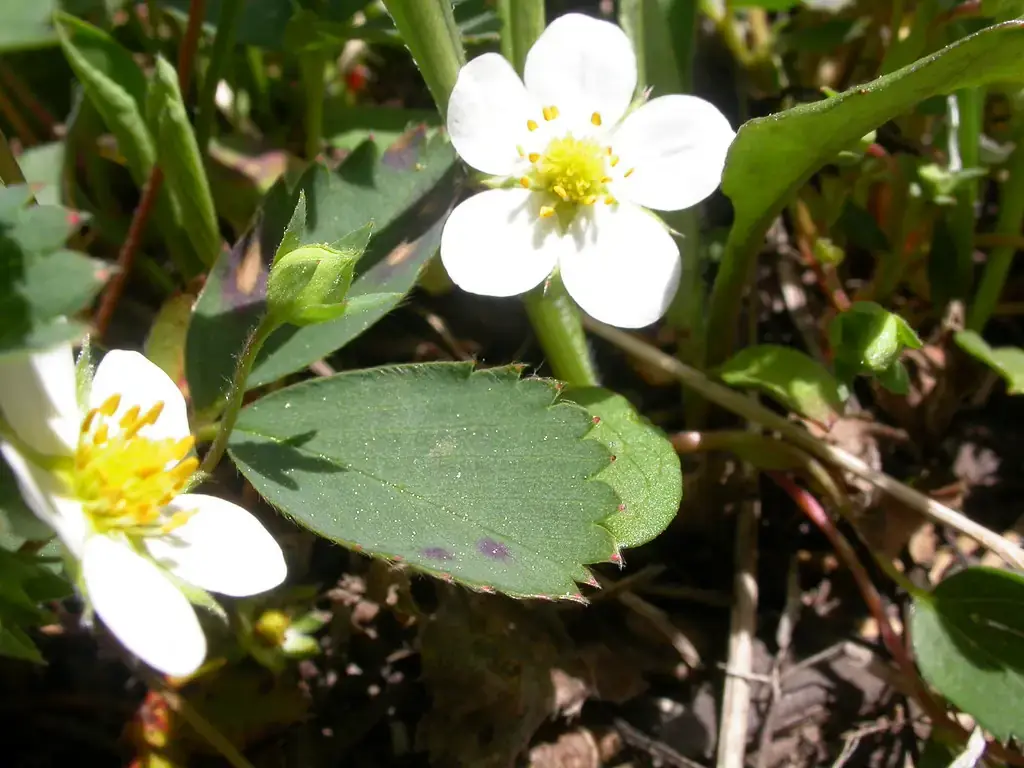
Short answer: If the flowers are yellow and the berries point straight up, you have mock strawberry (Potentilla indica, formerly Duchesnea indica), not true wild strawberry. Wild strawberry (Fragaria virginiana) has white flowers and sweet berries that nod or hang under the leaves, while mock strawberry fruit is dry and almost flavorless. Mock strawberry isn’t poisonous, but it’s an introduced Asian ground cover that spreads by runners into thin, shady, damp turf. Thickening the grass, fixing drainage and spot-treating in fall with a triclopyr- or dicamba-based lawn herbicide is the most reliable way to get rid of it.
By the end of this guide you’ll be able to tell mock strawberry from wild strawberry (and its yellow-flowered cinquefoil cousins) in under a minute, know what’s safe for kids and pets, and follow a realistic plan to clear it from your lawn, with or without herbicides.
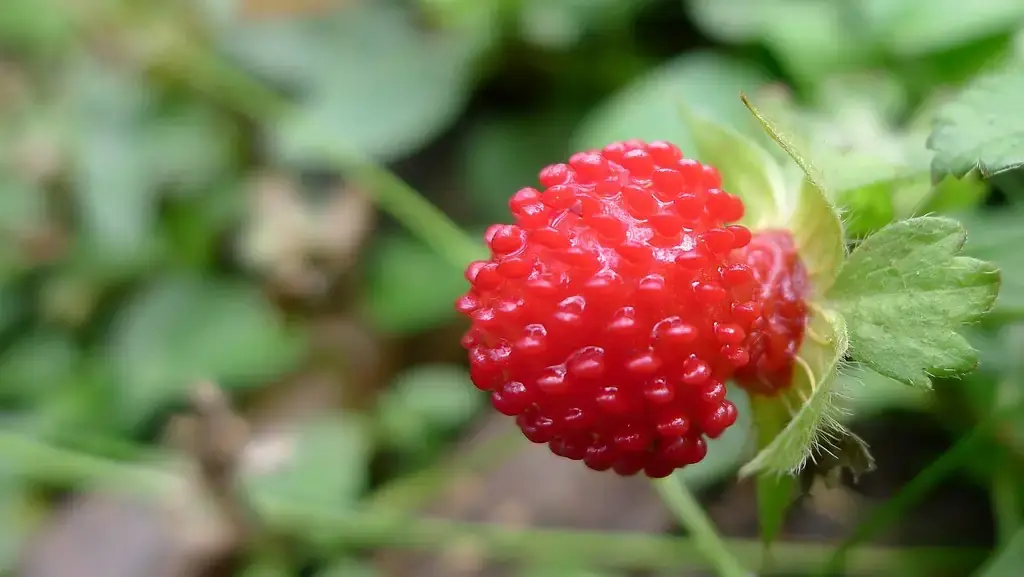
Mock strawberry vs wild strawberry at a glance
Here’s why this matters: the two plants look nearly identical when they’re just leaves and runners, and many people pull up a native wild strawberry they’d have loved to keep, or let a mock strawberry colony spread because they assume it’s the real thing. Once one of them flowers or fruits, though, the difference is obvious.
| Feature | Mock strawberry (Potentilla indica) | Wild strawberry (Fragaria virginiana) |
|---|---|---|
| Flower color | Yellow, 5 petals | White, 5 petals |
| Flower arrangement | Single flower on its own stalk from a leaf node | Small clusters on one stalk, often shorter than the leaves |
| Bracts behind the flower | 5 leafy, 3-lobed bracts, larger than the sepals | No 3-lobed bracts |
| Fruit position | Held upright, very visible | Nods or hangs, often hidden under leaves |
| Fruit texture and taste | Round, about ½ inch, dry, spongy, bland | Juicy, sweet, “choice wild edible” |
| Seeds (achenes) | Bumpy surface | Sit in shallow pits on the berry |
| Leaflet teeth | Rounded (blunt) teeth all around the edge | Pointed teeth on the upper two-thirds to three-quarters; tip tooth smaller than its neighbors |
| Bloom period | April to August, sporadic later | April to May |
| Origin | Eastern and southern Asia; introduced ornamental | Native to much of North America |
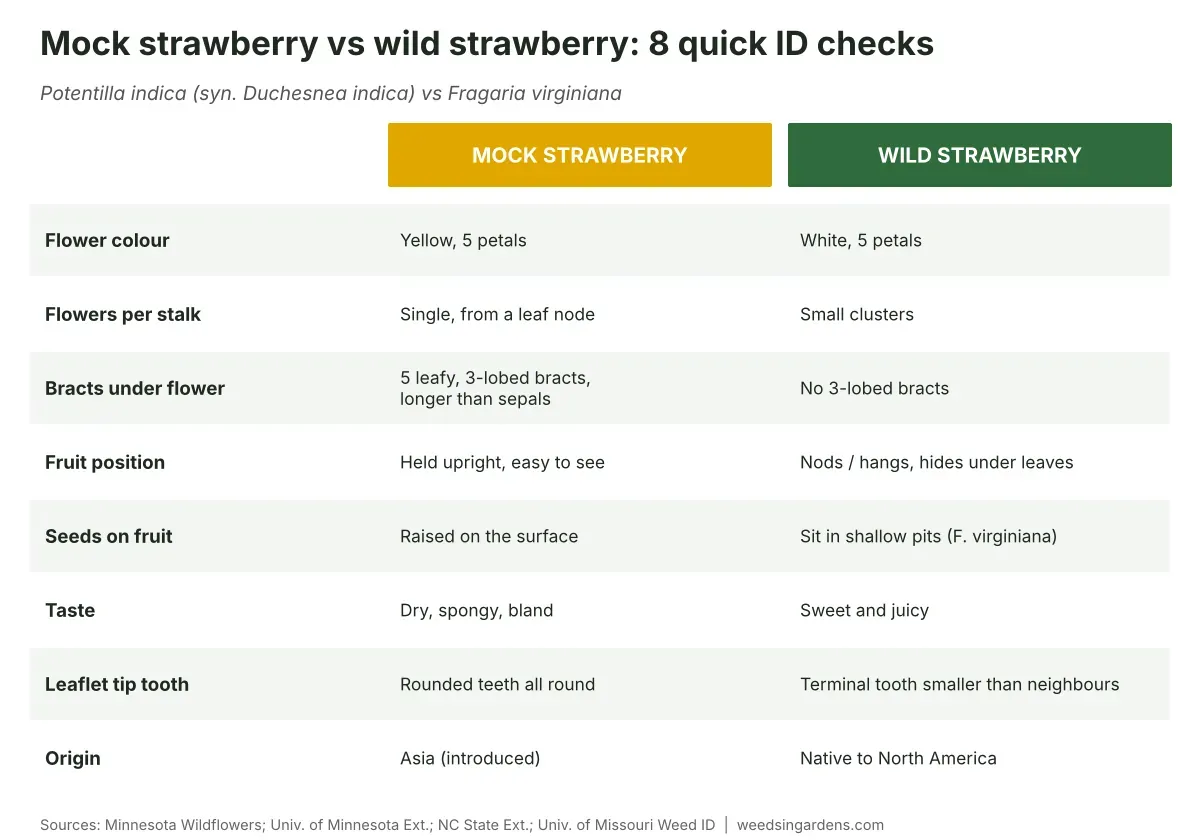
If you only remember one thing, remember this: yellow flower, upright berry = mock strawberry; white flower, hanging berry = wild strawberry. The rest of the table is how you confirm it when there are no flowers or fruit to look at.
How to identify mock strawberry
Mock strawberry also goes by Indian strawberry, Indian mock strawberry, false strawberry and yellow-flowered strawberry. It’s a member of the rose family, and botanists moved it from Duchesnea into Potentilla (the cinquefoils), which is why you’ll see both names. NC State Extension describes it as low and fast-growing, typically 4 to 8 inches tall but able to spread about 3 feet, and in leaf all year.
Leaves
Each leaf has three leaflets on a long, hairy leaf stalk. The University of Missouri weed guide gives leaflets as ¾ to 3 inches long and ⅓ to 1½ inches wide, oval to elliptical, with rounded teeth (crenate edges) and very short leaflet stalks of 1 to 6 mm. LSU AgCenter notes that leaf edges can be tinged red to purple, especially in cool weather. The leaves often stay green through winter, which is part of why mock strawberry is so noticeable in a dormant lawn.
Flowers
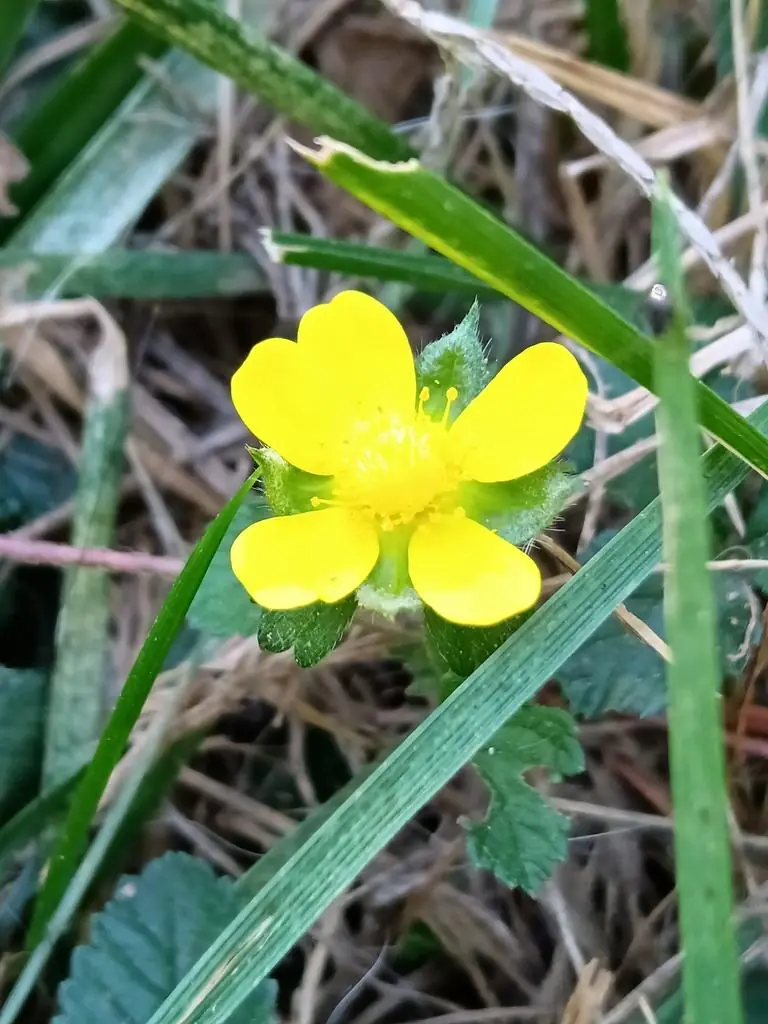
Look for single, bright yellow flowers about ½ to ¾ inch across, each on its own bare stalk from a leaf node. The giveaway is behind the petals: Minnesota Wildflowers describes five short, leaf-like bracts, each 3-lobed, around the base of the flower, and the Missouri Department of Conservation notes these toothed bracts are larger than the sepals. Wild strawberries don’t have them.
Fruit
The berry is round, roughly ½ inch across, bright red and covered in tiny red seeds that give it a bumpy, beaded look. It’s held upright on its stalk, which the University of Minnesota Extension calls the easiest field mark, because the fruit sits up “away from the ground” where you can see it from a standing position. Fruit shows up mostly April to June and sporadically into September.
Runners and roots
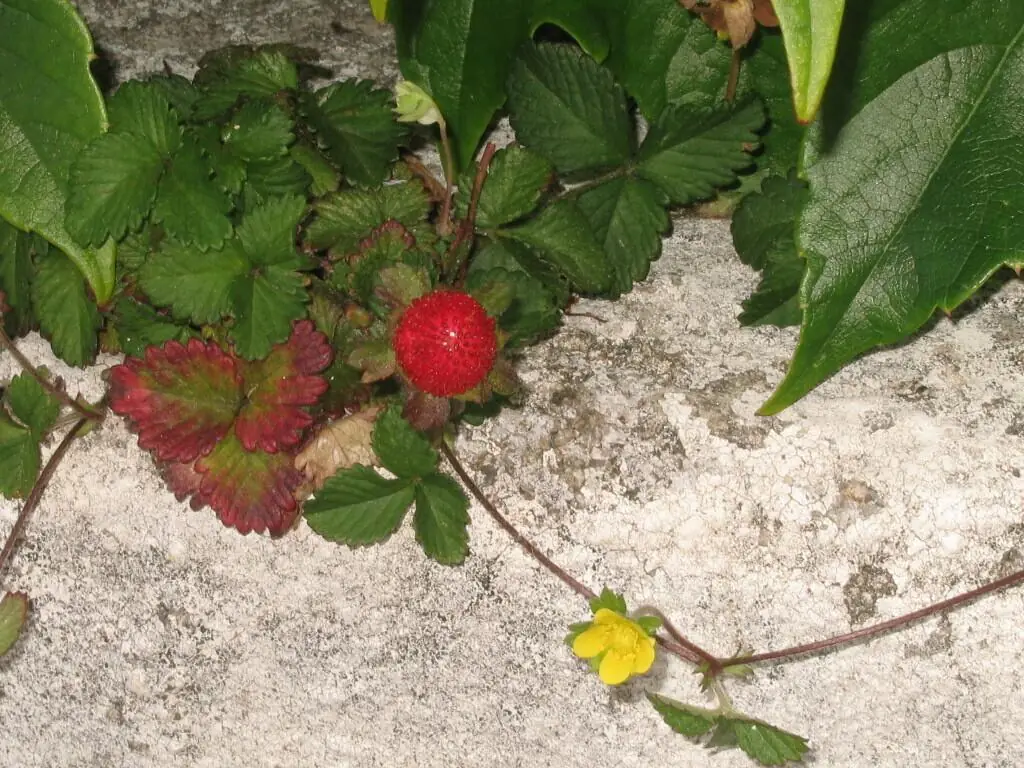
Mock strawberry spreads by hairy, above-ground runners (stolons) that root at the nodes and tips and start new crowns, so one plant becomes a chain of plants. Seedlings start producing stolons by about the fifth leaf, according to the Missouri guide. It also reproduces by seed, which birds and other animals can move around. If you’ve already met other creepers, our guide to lawn weeds with runners shows how it compares with creeping Charlie, white clover and violets.
Other look-alikes: cinquefoils and barren strawberry
Yellow flowers alone don’t confirm mock strawberry. Common or oldfield cinquefoil (Potentilla simplex) and sulfur cinquefoil (Potentilla recta) also have five yellow petals, but they carry five leaflets per leaf instead of three and never produce a red berry, as both the Missouri and University of Georgia guides point out. Count the leaflets and you’ve solved it. For a broader line-up, see our guide to weeds with yellow flowers.
How to identify wild strawberry (so you don’t pull the good one)
Wild or Virginia strawberry (Fragaria virginiana) is native, feeds bees and wildlife, and is one of the two parents of the garden strawberry. It’s also low and runner-forming, so the leaves alone can fool you. Minnesota Wildflowers lists these features:
- White flowers, ½ to ¾ inch wide, usually several open at once in a cluster on a stalk that’s often shorter than the surrounding leaves.
- Bluish-green leaflets about 1 to 1½ inches long, coarsely toothed and finely hairy.
- A small tip tooth. On each leaflet, the tooth at the very tip is much smaller than the teeth on either side and doesn’t extend beyond them. This is the best leaf-only clue.
- Teeth only toward the tip. The Missouri guide notes the pointed teeth are confined to the upper two-thirds to three-quarters of the leaflet.
- Fruit with seeds in pits. The berries are globe-shaped, with the seeds sunk into shallow pits, and they hang rather than point up.
Woodland strawberry (Fragaria vesca) is a second native with white flowers; its flower stalks usually rise above the leaves and its berries are more cone-shaped with raised seeds, per Minnesota Wildflowers. Both natives are worth keeping in beds or as a no-mow ground cover, and both have white petals, so the flower color test still works.
| If you see… | It’s probably… | What to do |
|---|---|---|
| Yellow flower + 3 leaflets + upright red berry | Mock strawberry | Remove from lawns and beds; follow the control plan below |
| Yellow flower + 5 leaflets, no berry | A cinquefoil | Treat as a broadleaf lawn weed if it’s in turf |
| White flower + hanging, juicy red berry | Wild or woodland strawberry | Keep it in beds or naturalized areas, or move it out of the lawn |
| Leaves only, no flowers | Check the leaflet tip tooth | Rounded teeth all round = mock; tiny tip tooth with pointed teeth near the end = wild |
Is mock strawberry edible, poisonous or harmful to dogs?
This is the question most people search first, so here’s the plain answer: mock strawberry isn’t considered poisonous. The University of Georgia turf team describes the fruit as “not poisonous but not palatable,” NC State Extension calls it edible but “bland and dry,” and NC State’s Plant Toolbox tags the plant as non-toxic for dogs, cats and horses.
So if your toddler or dog eats a berry, the likely outcome is a disappointed face, not a trip to the vet. That said, a couple of sensible cautions apply:
- Be sure of the ID. The safety statements above apply to mock strawberry only. Don’t eat any wild berry you can’t identify with confidence.
- Think about what’s been sprayed. A lawn berry may carry herbicide, fertilizer or pet waste residue. Don’t eat fruit from treated turf, and keep pets off sprayed areas until the product label says it’s safe.
- Don’t expect a strawberry. Even people who forage tend to describe the fruit as watery and tasteless. Wild strawberries are the ones worth picking.
Honestly, the bigger “harm” from mock strawberry is to your lawn and, in some regions, to native plants. The University of Minnesota Extension lists it as an invasive species that can displace natives, and the Missouri Department of Conservation notes that some states consider it invasive.
Why mock strawberry takes over your lawn
Mock strawberry rarely invades a dense, healthy stand of grass. It moves in where the turf has already given ground. Understanding why tells you exactly what to fix, and skipping this step is the most common reason it comes back after spraying.
- Shade. LSU AgCenter says it’s most common where turf is thin in moderately shady areas, and NC State notes it spreads most aggressively in semi-shade.
- Moist, poorly drained soil. UMD Extension notes it likes moist areas, and NC State TurfFiles recommends improving surface drainage, aerating and watering infrequently to reduce encroachment.
- Low mowing. UMD Extension says it tolerates close mowing. Its leaves sit below the blade, so scalping the grass helps the weed more than it hurts it.
- Low fertility and thin turf. Gaps in the canopy let light reach the runners, and every gap is a place for a new crown to root.
There’s useful research behind this. In an old, weakened tall fescue lawn study published in Weed Science, Gray and Call (1993) found that mock strawberry survival was highest in plots mowed at about 6 cm (roughly 2.4 inches) and not fertilized, and lowest in plots that were heavily fertilized and not mowed. The fertilizer treatments supplied about 0.49 kg of nitrogen per 100 m² (close to 1 lb N per 1,000 sq ft) in spring and fall, or twice that. In plain terms: a well-fed, tall, dense grass canopy shades mock strawberry out.
You won’t let your lawn go unmowed, of course, but the lesson carries over. Feed cool-season grass at recommended rates, mow at the top of your grass type’s range, and fix the conditions (shade, wet spots, compacted soil) that keep the turf thin.
How to get rid of mock strawberry in your lawn
The winning formula is the same one that works for wild violets and creeping Charlie: remove what’s there, weaken what’s left, and make the lawn too thick for it to return. Here’s how to do each step well.
1. Pull or dig small patches (any time the soil is moist)
For a few square feet, hand removal is honestly all it takes. UMD Extension recommends pulling or using a weeding tool as soon as you notice an infestation, ideally when the soil is moist so the roots come out. Follow each runner back to its crown and lift it, then check for rooted nodes along the runner. Bag plants that are carrying fruit rather than composting them, since the seeds can survive.
2. Fix the growing conditions
- Raise the mower. Mow at the upper end of the range for your grass. LSU lists 2.5 to 3 inches for St. Augustinegrass and 1 to 2.5 inches for centipedegrass and zoysiagrass; cool-season lawns are typically kept taller.
- Water deeply but less often so the surface dries between waterings, as NC State recommends.
- Aerate compacted or soggy areas and improve surface drainage. Our guide on when to aerate after rain explains the timing.
- Thin tree canopies or switch to shade-tolerant grass where the lawn is chronically thin. In deep shade, a mulched bed or a native ground cover may be the better long-term answer.
- Overseed bare spots in early fall (cool-season lawns) so new grass fills the gaps you created by removing the weed. If you’re spraying first, our guide to killing weeds before overseeding covers the waiting periods.
3. Spot-treat with a selective broadleaf herbicide
For established patches mixed into turf, a selective post-emergent lawn herbicide is the practical tool. UMD Extension recommends spot-treating actively growing weeds with a product containing 2,4-D, MCPP (mecoprop), dicamba or triclopyr. Mock strawberry is a perennial with a waxy leaf and a network of runners, so don’t expect one pass to finish it. Plan on a repeat application at the label’s interval.
| Active ingredients (common product type) | Expected response* | Notes |
|---|---|---|
| 2,4-D + dicamba | Intermediate | Common two-way mix; may need repeat treatment |
| 2,4-D + MCPP | Resistant to intermediate | Weakest option; skip if you have a choice |
| 2,4-D + MCPP + dicamba (“three-way”) | Intermediate | Widely sold; works best in fall on active plants |
| 2,4-D + dicamba + triclopyr | Intermediate | Triclopyr adds strength on tough, waxy perennials |
| 2,4-D + dicamba + penoxsulam | Intermediate | Newer cool-season mixes |
| Metsulfuron; metsulfuron + dicamba; metsulfuron + sulfentrazone | Listed option (LSU) | Used on southern warm-season turf; check that your grass is on the label |
| Thiencarbazone + iodosulfuron + dicamba | Listed option (LSU) | Southern turf product; label lists tolerant grasses |
| 2,4-D + dicamba + MCPP + carfentrazone | Listed option (LSU) | Carfentrazone speeds visible burn-down |
Read that table honestly: no common lawn mix rates as “susceptible” on this weed, which is exactly why cultural fixes matter. For a deeper look at how these products work, see our guide to post-emergent herbicides.
Label, turf and temperature rules that make or break the result:
- Check your grass is on the label. Labels differ by turf species. Southern lawns (St. Augustinegrass, centipedegrass) need a product whose label explicitly lists them, often sold as “Southern” formulations, and check the label’s waiting period before treating newly seeded grass.
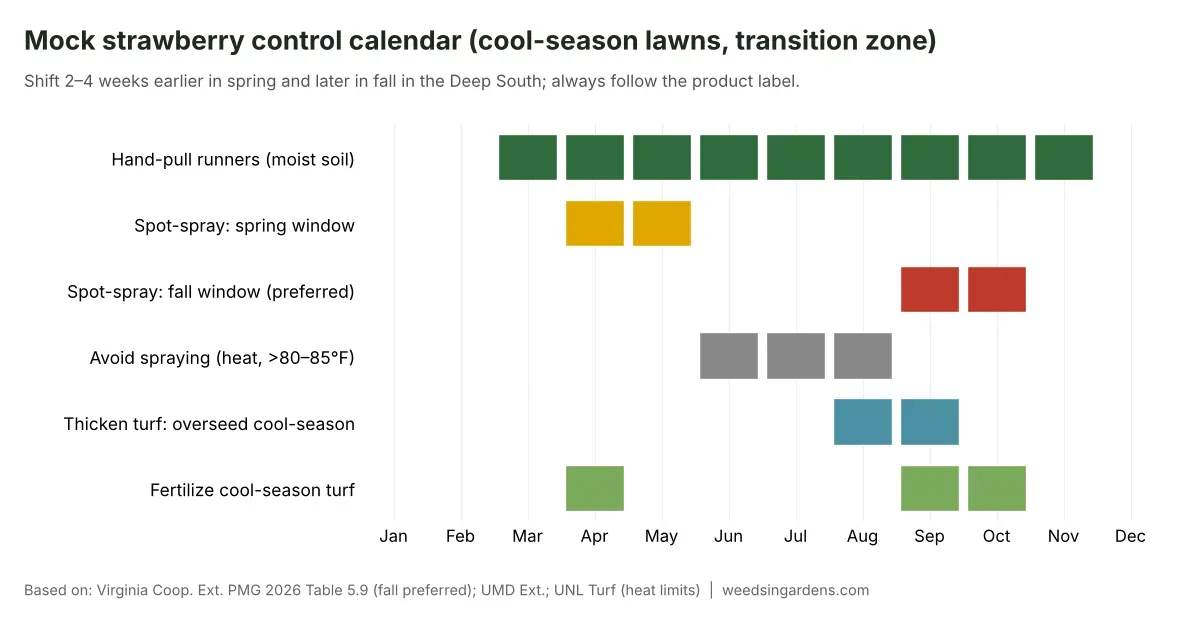
- Mind the temperature. Nebraska turf specialist Roch Gaussoin notes that herbicides generally work best on vigorously growing plants at 70 to 85°F, and that when air temperatures exceed 80 to 85°F many post-emergent broadleaf herbicides can injure turf and shouldn’t be applied (UNL Turfgrass Science).
- Protect trees and shrubs. UMD warns not to spray dicamba products over the root zone of trees and shrubs, because roots can take it up.
- Spray when it’s actively growing, not drought-stressed or dormant, and many labels advise skipping mowing for a day or two before and after so there’s plenty of leaf to absorb the product.
4. Time it: fall first, spring second
Virginia Cooperative Extension lists fall as the preferred time to treat wild-strawberry-type weeds in cool-season lawns. In fall, perennials move sugars down into their crowns and runners for winter, so a systemic herbicide travels with them. A spring application on actively growing plants is the backup, and summer heat is the time to stop spraying and focus on mowing height and watering.
| Season | What to do | Why |
|---|---|---|
| Early spring | Hand-pull new crowns; fertilize cool-season turf lightly | Small plants are easy to lift; grass gets a head start |
| Mid- to late spring | Spot-treat actively growing patches (backup window) | Leaves are fully out and plants are growing |
| Summer | Mow high, water deeply and infrequently; avoid spraying above 80–85°F | Heat raises turf-injury risk and lowers control |
| Early fall | Overseed thin areas; begin fall spot treatments | Grass establishes well; weeds are moving reserves down |
| Mid-fall | Repeat treatment per label interval; fertilize cool-season turf | Best control window; denser turf for spring |
| Winter | Note where green mock strawberry patches show in the dormant lawn | Easy to map patches for next season |
5. In flower beds and natural areas
Selective lawn herbicides aren’t meant for mixed beds. Here, dig out the plants, then cover the area with 2 to 3 inches of mulch so runners have nowhere to root; our guide to stopping weeds in mulch beds covers the details. In larger areas you plan to replant, smothering with cardboard and mulch for a season is a low-cost option. If you’d like a ground cover with berries, replace it with native wild strawberry instead.
Common mistakes that keep it coming back
- Mowing lower to “shave it off.” It tolerates close mowing; your grass doesn’t.
- Spraying once in July. Hot weather means weaker control and more turf injury.
- Using 2,4-D + MCPP alone. It’s the weakest of the common mixes on this weed.
- Leaving bare soil. Every gap you create by killing a patch is an invitation for runners to return. Overseed or mulch it.
- Pouring on vinegar or boiling water. These burn the leaves but rarely kill rooted perennial runners and they damage nearby grass, as our vinegar test explains.
A note from the agronomist’s side
Mock strawberry is a textbook “indicator weed.” Its presence is less about the weed itself and more about the conditions it’s reporting: not enough light reaching the soil surface, soil that stays damp, and a grass canopy that’s too short or too hungry to compete. Treat the weed without treating the report, and you’re simply clearing space for the next colony.
The Gray and Call study is worth a second look because it overturns a common assumption. People often expect mowing to weaken a creeping weed. For low, flat plants like mock strawberry, mowing barely touches them; what hurts them is shade from taller, well-fertilized grass. That’s why the most effective long-term “herbicide” for this weed is a dense turf canopy at the right height.
It’s also why the herbicide ratings look modest. Phenoxy herbicides like 2,4-D move best in plants that are actively translocating, and a stoloniferous perennial spreads its reserves across many rooted nodes. Expect partial control from one application, plan a follow-up, and use fall, when the plant itself is pulling sugars downward, to your advantage.
Finally, a word on identification. Because the native wild strawberry is valuable for pollinators and wildlife, it’s worth taking 30 seconds to check flower color or the leaflet tip tooth before you spray. A patch of the real thing in a bed or at the lawn’s edge is a feature, not a problem.
FAQ
What is the difference between mock strawberry and wild strawberry?
Mock strawberry (Potentilla indica) has yellow flowers, leafy three-lobed bracts behind each flower, rounded leaf teeth and dry, tasteless berries that point upward. Wild strawberry (Fragaria virginiana) has white flowers in small clusters, pointed teeth with a tiny tip tooth, and sweet berries that hang down under the leaves.
Are mock strawberries poisonous to humans or dogs?
No. University extension sources describe the fruit as not poisonous but bland and unpalatable, and NC State Extension lists the plant as non-toxic for dogs, cats and horses. Don’t eat berries from lawns that have been sprayed, and only eat wild berries you can identify with certainty.
What kills mock strawberry but not grass?
Selective broadleaf lawn herbicides containing 2,4-D, dicamba, MCPP or triclopyr, usually as three- or four-way mixes. Virginia Cooperative Extension rates most mixes as intermediate, so a repeat treatment is often needed. Fall is the preferred timing. Use a product labeled for your grass and avoid spraying above 80–85°F.
Is mock strawberry invasive?
It’s an introduced Asian plant. The University of Minnesota Extension lists it as invasive and asks for reports, and the Missouri Department of Conservation notes that some states consider it invasive. In lawns it acts as an aggressive perennial weed in shady, moist, thin turf.
How do you get rid of mock strawberry naturally?
Hand-pull or dig plants when the soil is moist, following each runner back to its crown. Then raise your mowing height, water less often, improve drainage, fertilize and overseed so the grass shades it out. In beds, remove the plants and mulch 2 to 3 inches deep.
Can you eat mock strawberries?
Technically yes; the fruit is edible but dry, spongy and nearly flavorless. Most people find it disappointing. Native wild strawberries, which have white flowers, are the ones worth picking.
Is mock strawberry a good ground cover?
It tolerates shade and mowing and stays green much of the year, but it spreads aggressively by runners into lawns and over small plants and is considered invasive in some areas. A native ground cover such as wild strawberry is a better choice.
Sources
- University of Minnesota Extension. Mock strawberry. Gupta, A., Rager, A. and Weber, M. M. Reviewed 2019.
- NC State Extension TurfFiles. Indian Mock Strawberry. Yelverton, F. Updated October 10, 2022.
- NC State Extension Gardener Plant Toolbox. Potentilla indica (Indian Strawberry, Mock Strawberry) and Fragaria virginiana (Wild Strawberry).
- University of Missouri, Division of Plant Sciences. Indian Mock-strawberry, Weed ID Guide.
- University of Maryland Extension. Indian mock strawberry. Updated March 2, 2023.
- LSU AgCenter. Indian Mock Strawberry, Louisiana Home Lawn Series.
- University of Georgia, GeorgiaTurf. Indian Mockstrawberry.
- Virginia Cooperative Extension. Pest Management Guide: Home Grounds and Animals 2026, Table 5.9 Broadleaf Weed Control (ENTO-634P).
- Gray, E. and Call, N. M. (1993). Fertilization and mowing on persistence of Indian mockstrawberry (Duchesnea indica) and common blue violet (Viola papilionacea) in a tall fescue (Festuca arundinacea) lawn. Weed Science 41(4): 548–550. doi:10.1017/S0043174500076293.
- Gaussoin, R. (2022). Be cautious with herbicide applications and high temperatures. University of Nebraska–Lincoln Turfgrass Science.
- Minnesota Wildflowers. Potentilla indica (Mock Strawberry), Fragaria virginiana (Wild Strawberry) and Fragaria vesca (Woodland Strawberry).
- Missouri Department of Conservation. Indian Strawberry (Mock Strawberry) and Wild Strawberry field guides.
More lawn weed guides: Lawn Weeds.