
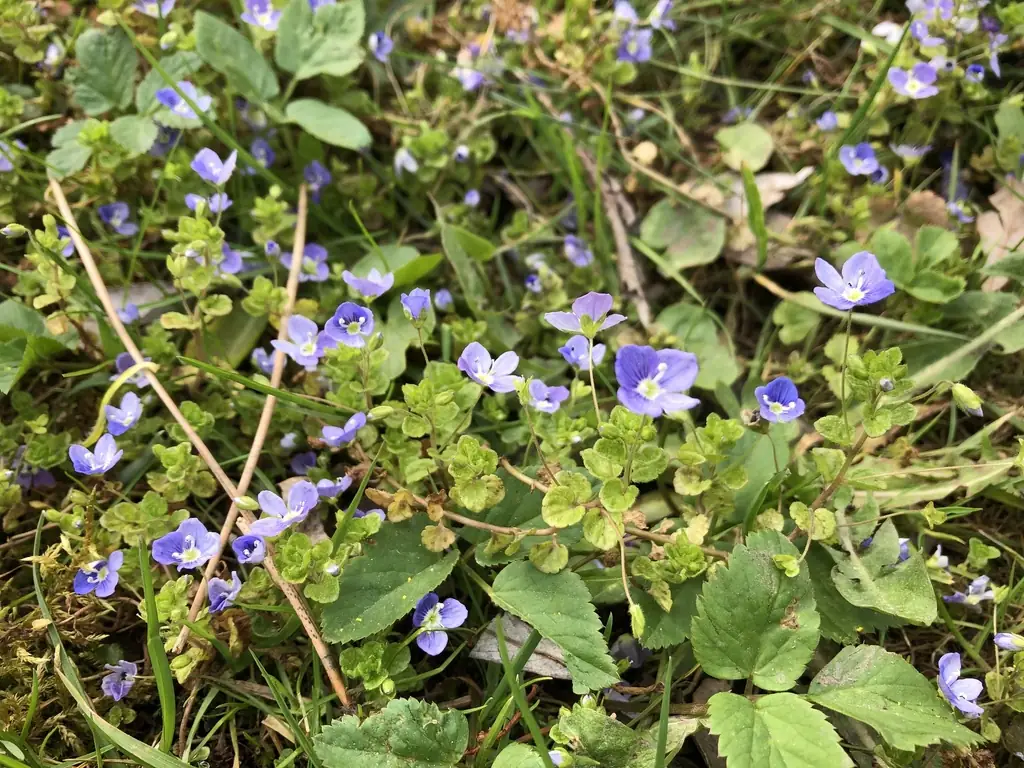
Speedwell in lawn grass usually announces itself in early April. The lawn is finally greening up, except for one stretch by the fence where hundreds of tiny sky-blue flowers have appeared almost overnight. They’re pretty, honestly. Then you look closer: the grass underneath is thin, the little plants are knitting into a mat, and the weed-and-feed you spread last fall didn’t seem to touch them.
Short answer: Speedwell in lawn is usually one of a few low-growing Veronica species: corn, Persian or ivyleaf speedwell, which sprout in fall and flower in spring, or slender speedwell, a creeping perennial that spreads from mower-cut fragments. Standard 3-way lawn sprays (2,4-D, MCPP and dicamba) give poor control of speedwell. What works is a denser, taller lawn plus a product containing triclopyr, carfentrazone or sulfentrazone on young plants in fall or early spring, quinclorac for slender speedwell in tolerant grasses, and a pre-emergent before the late-summer germination flush.
This guide shows you how to get rid of speedwell in lawn grass for good: how to identify which species you have (it changes the plan), why your weed killer probably failed, every control option with its turf-safety limits, and a month-by-month calendar you can start using this week.
The 7 fixes that actually work, at a glance:
- Identify the species first: annual speedwells and slender speedwell need different plans.
- Pull, hoe or dig out small patches, then reseed the gap.
- Raise your mowing height and bag clippings wherever slender speedwell grows.
- Thicken the turf with well-timed fertilizer and overseeding.
- Spot-spray young plants in fall or early spring with a product that names speedwell on the label (triclopyr, carfentrazone or sulfentrazone mixes).
- Use quinclorac for slender speedwell in grasses that tolerate it.
- Apply a pre-emergent before the late-summer germination flush to stop annual speedwells.
How to Identify Speedwell in Lawn (and Tell the Species Apart)
Speedwells are small broadleaf weeds in the plantain family. They’re easy to overlook in fall and winter, when they’re just low tufts of scalloped leaves, and impossible to miss in spring, when the blue flowers open. A few features are shared by every species you’ll meet in a lawn:
- Four petals, usually blue to violet with darker stripes and a pale center.
- Exactly two stamens and a single style sticking out of each flower, according to Penn State Extension.
- Flat, heart-shaped seed pods on most of the annual species.
- Leaves opposite on the lower stem and alternate near the stem tips.
- Low, sprawling stems, often finely hairy.
The species matters because of one big split: most lawn speedwells are winter annuals that die in summer and return from seed, while slender speedwell is a perennial that survives year after year and spreads from stem pieces. Use this table to sort out which one you’ve got.
The speedwells you’re most likely to find
| Species | Life cycle | Leaves | Flowers | Tell-tale clue |
|---|---|---|---|---|
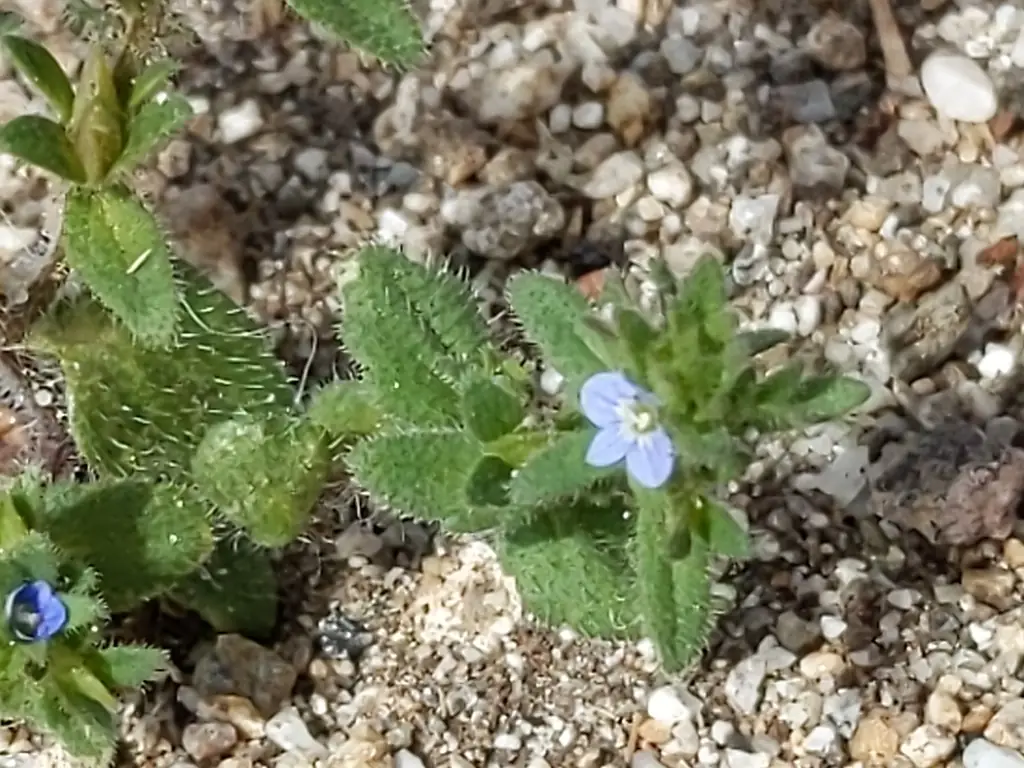
| Corn speedwell Veronica arvensis | Winter annual | Smallest of the group; hairy; rounded and toothed low on the stem, narrow and pointed higher up | Tiny, bright blue, almost stalkless (stalk under 1 mm) | Fuzzy, upright little plant in thin, sunny turf |
| Persian (bird’s-eye) speedwell V. persica | Winter annual | Oval, about ½–¾ inch, toothed, sparsely hairy | About ⅓ inch, light blue with dark stripes and a white base, on long stalks | Heart-shaped pod with widely spread lobes |
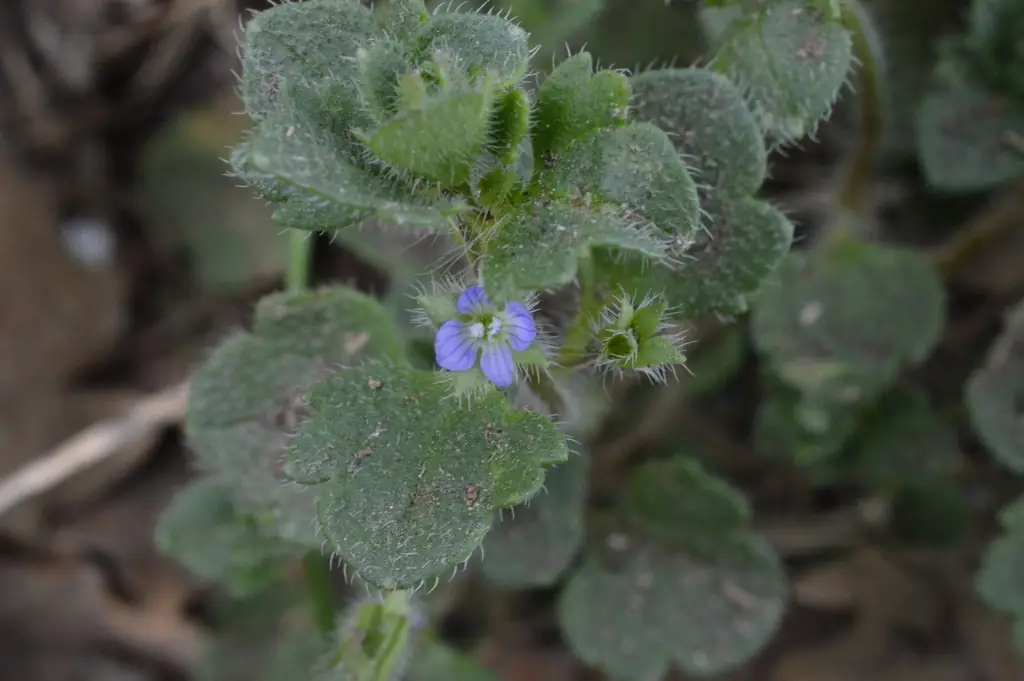
| Ivyleaf speedwell V. hederifolia | Winter annual | Thick, densely hairy, with 3–5 lobes like a miniature ivy leaf | Small, pale blue, on stalks | The lobed “ivy” leaf; common in shade |
| Purslane speedwell V. peregrina | Annual | Smooth or slightly sticky, somewhat fleshy, narrow | White | Succulent look; no fuzz |
| Slender (creeping) speedwell V. filiformis | Perennial | Small, rounded and scalloped; stems root at the nodes | Pale blue to blue-violet on long, thread-like stalks | Dense mats in irrigated, often shady lawns that return every year |
| Common speedwell V. officinalis | Perennial | Hairy, toothed, opposite | Light blue, in short dense spikes from the leaf axils (May–July) | Creeping hairy stems on dry, stony, acidic soil |
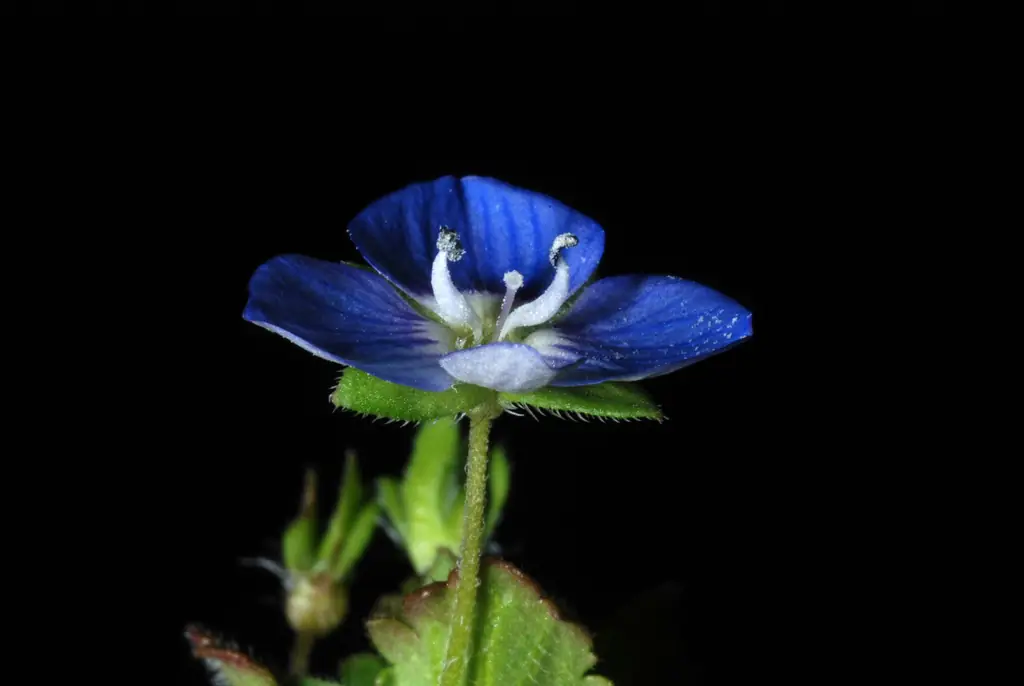
If the flowers are larger and sit on obvious stalks, you’re probably looking at Persian speedwell. If they’re tiny and tucked tight against hairy upper leaves, it’s corn speedwell. NC State’s turf weed scientists note that Persian and ivyleaf speedwell are both easier to control than corn speedwell.
Speedwell look-alikes
A few other blue- or purple-flowered lawn weeds get mistaken for speedwell. Creeping charlie (ground ivy) has square stems, a minty smell when crushed and two-lipped purple flowers. Henbit also has square stems, but its flowers are pink-purple tubes. Common chickweed has small white flowers with five deeply split petals. If you want a wider line-up, our guide to weeds with blue flowers compares the usual suspects side by side.
Why Speedwell Takes Over a Lawn
Speedwell in lawn turf is rarely the root problem. It’s a symptom, and reading the symptom correctly is what makes the fix stick.
Thin turf. NC State describes the annual speedwells as weeds that quickly invade thin turf, especially where soil moisture is good, and notes that shade can encourage them. Like other winter annual weeds, they germinate in fall or winter, sit semi-dormant through the cold (growing during warm spells), then flower and set seed in spring before dying as temperatures rise in late spring and early summer.
Bare soil and light. At least some speedwell seed depends heavily on light. In a classic germination study, seeds of purslane speedwell reached 98–100% germination in light but never germinated to high percentages in darkness (Baskin and Baskin, 1983). That’s the science behind the advice you’ll hear everywhere: a thick canopy of grass shades the soil surface and keeps many weed seeds from sprouting.
Low fertility. UMass Amherst points out that low nitrogen can lead to high speedwell populations, simply because underfed grass competes poorly.
Your mower (for slender speedwell). Slender speedwell was brought into the United States as a rock-garden plant as early as 1930 and escaped into lawns, according to a Michigan State University turf report. It spreads faster in shade, thrives in irrigated lawns, and in cool weather mowers drag cut pieces to new spots where they root easily. The RHS adds that birds spread the stems in spring when they collect nesting material, and that slender speedwell rarely produces seed.
Why Your Weed Killer Didn’t Work on Speedwell
If you sprayed a typical hardware-store lawn weed killer and the speedwell shrugged, you’re not imagining it. Speedwell in lawn turf tolerates many of the most common lawn herbicides. Washington State University says this plainly, and the RHS goes further, calling speedwells resistant to many lawn weedkillers.
The clearest numbers come from the Virginia Cooperative Extension 2026 Pest Management Guide. In its broadleaf weed table, corn and Persian speedwell are rated resistant (usually under 50% control) to 2,4-D + dicamba, 2,4-D + MCPP, and the classic 3-way mix of 2,4-D + MCPP + dicamba. Adding triclopyr to the mix lifts the rating only to intermediate: good control at times, often needing higher label rates or repeat treatments. The same products give good control of common chickweed. That’s why one spray can clean up the chickweed and leave the speedwell standing.
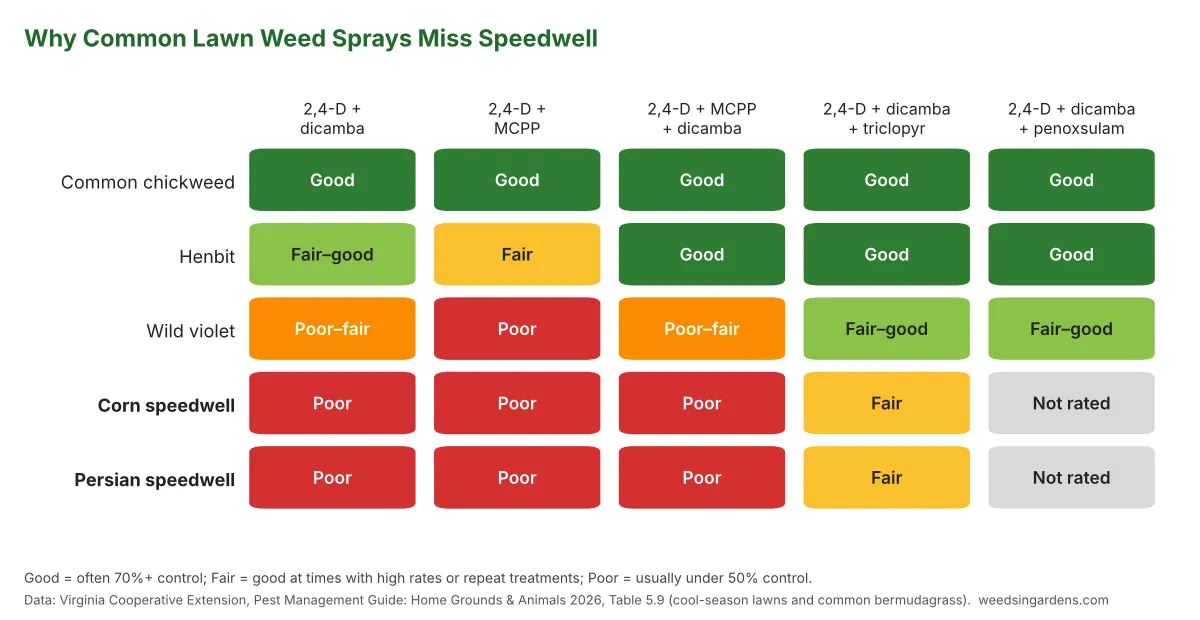
Two other mistakes make it worse:
- Spraying flowering annuals in late spring. By then, corn and Persian speedwell are mature and close to dying naturally. You spend money on a plant that’s about to quit, and its seed is already on the way.
- Treating slender speedwell once. The Michigan State report notes that slender speedwell tolerates 2,4-D and has varying tolerance to MCPP and dicamba. Any stem pieces that survive can root again.
A note on Dacthal (DCPA): old advice you can ignore
Older guides often recommend Dacthal (DCPA) for slender speedwell. Skip it. The U.S. EPA finalized the cancellation of all DCPA products on October 22, 2024, after finding risks to unborn babies of exposed pregnant women. The order bars sale and distribution, and existing stocks may not be used. Most turf uses had already been voluntarily cancelled in December 2023.
How to Get Rid of Speedwell Without Herbicides
For a handful of plants, or a lawn that’s mostly healthy, non-chemical control of speedwell in lawn areas is quick and works well. Annual speedwells have shallow roots, so they come out easily.
Pull or hoe annual speedwells
WVU Extension recommends hand-weeding or light cultivation such as hoeing for established annual speedwell. In beds, the RHS suggests hoeing on a dry, sunny day so uprooted plants shrivel instead of re-rooting. In a lawn, pull small plants by hand in fall or early spring before they flower, and you remove that plant’s whole seed crop.
Dig out slender speedwell patches and reseed
For an odd patch of slender speedwell in otherwise good grass, the RHS advises digging it out with a sharp spade, removing all of the sprawling stems, and reseeding the spot. Leave even a few stem pieces and the patch can re-establish. If the patch is large, see our guide to killing weeds before overseeding for how to sequence the work.
Mow higher, and bag where slender speedwell grows
Raising the cutting height leaves the grass long enough to shade and smother low weeds; WVU recommends keeping turf at about 3 inches. UMass also notes that mowing as soon as the first flower heads appear can reduce further infestations. For slender speedwell, bag the clippings from infested areas and mow those last, so you aren’t carrying stem fragments across the rest of the lawn. Like other lawn weeds with runners, it moves wherever its stems go.
Feed and thicken the lawn
Every extension source agrees on the long-term fix: a dense, vigorous lawn. Penn State recommends nitrogen fertilization, regular mowing and grasses adapted to your site; WVU adds overseeding in spring and fall. In deep shade, switch to a shade-tolerant grass or accept that a groundcover may suit the spot better than turf.
| Method | Best for | Effort | Cost | Honest verdict |
|---|---|---|---|---|
| Hand-pulling | A few annual plants | Low to medium | Free | Fast and effective before flowering; useless on big slender speedwell mats |
| Hoeing (beds) | Annual seedlings in garden beds | Low | Free | Do it on dry, sunny days so plants don’t re-root |
| Dig out and reseed | Small slender speedwell patches | Medium | Low (seed) | Works if you remove every stem piece |
| Mow higher and bag clippings | Slender speedwell; all lawns | Low | Free | Slows the spread; won’t eliminate an established mat alone |
| Fertilize and overseed | Thin lawns of any kind | Medium | Moderate | The only fix that prevents the next wave |
| Mulch (beds) | Annual speedwell in borders | Low | Moderate | Smothers seedlings; keeps light off the soil |
Speedwell Weed Killer Options by Active Ingredient
If speedwell in lawn grass covers more than a few patches, a selective herbicide makes sense, but choose by active ingredient, not by the brand name on the front of the bottle. Read the label and confirm three things: the product lists speedwell (ideally your species), it’s safe on your grass type, and you can meet its temperature and reseeding restrictions. Always follow the label; it is the law, and it overrides anything here.
| Active ingredient (example products) | What it does on speedwell | Lawn grasses | Key limits |
|---|---|---|---|
| Triclopyr (Turflon; many 3- and 4-way mixes) | Upgrades 3-way mixes from poor to fair on annual speedwells; UMass rates triclopyr and dicamba combinations especially effective | Mainly cool-season; check label for warm-season grasses | Repeat applications are often needed |
| Fluroxypyr + triclopyr (Tailspin) | Veronica species listed | Cool-season only | Some bentgrass injury possible |
| Carfentrazone (QuickSilver; part of SpeedZone) | Corn speedwell listed; best on small weeds 1–4 inches tall | Cool-season; low rate on centipedegrass and St. Augustinegrass | Contact action with little residual; QuickSilver label excludes hybrid bermudagrass |
| Sulfentrazone (alone or in mixes such as Q4) | Labeled for speedwell | Check label for your species | Often sold pre-mixed with 2,4-D, dicamba or quinclorac |
| Quinclorac (Drive XLR8; Q4 mixes) | Labels list slender, common and thymeleaf speedwell; some residual activity | Kentucky bluegrass, perennial ryegrass, tall fescue, bermudagrass, zoysiagrass | Label excludes St. Augustinegrass, centipedegrass and bahiagrass |
| Iodosulfuron + thiencarbazone + dicamba (Celsius) | Speedwell listed | Warm-season only: bermudagrass, zoysiagrass, St. Augustinegrass, centipedegrass, buffalograss | Not for cool-season grasses or bahiagrass |
| Atrazine or simazine | Controls many winter annual broadleaf weeds | Warm-season lawns, including St. Augustinegrass and centipedegrass | NC State timing: atrazine Nov 15–Dec 31, simazine Nov 15–Dec 15 |
| 2,4-D + MCPP + dicamba (standard 3-way) | Poor control of corn and Persian speedwell | Most lawns | Fine for dandelions and chickweed, not speedwell |
Slender speedwell and quinclorac. The best field evidence for a selective fix comes from a study published in Weed Technology (Neal and Senesac, 1993). Quinclorac controlled slender speedwell in cool-season turf. Kentucky bluegrass, perennial ryegrass and tall fescue weren’t injured, while roughstalk bluegrass and chewings fescue were temporarily discolored. Tank-mixing quinclorac with 2,4-D didn’t improve speedwell control; it only increased injury to roughstalk bluegrass.
Pre-emergents (annual speedwells only). Penn State lists dithiopyr, pendimethalin, prodiamine + quinclorac and sulfentrazone + prodiamine for corn speedwell, and prodiamine and oxadiazon for Persian speedwell. WVU names isoxaben (Gallery) for turf and trifluralin + isoxaben (Snapshot) for established landscape beds. A pre-emergent won’t touch slender speedwell, which spreads from stems rather than seed. Timing is everything; our guide on when to apply pre-emergent covers the fall window in detail. One more caution from Penn State: clopyralid products should not be used on residential lawns.
Spray rules that decide whether it works
- Spray young, actively growing plants. NC State stresses that winter weeds should be small, actively growing and still have immature roots.
- Mind the heat. Iowa State advises against spraying liquid broadleaf herbicides when temperatures are forecast to exceed 85°F within 24 hours, or when wind is over 5 mph.
- Leave the leaves. Don’t mow for 2–3 days before treatment and allow 3–4 days afterwards, so the weeds have leaf area to absorb the product and time to move it to the roots.
- Check the forecast. Apply when no rain is expected for 24 hours, and don’t irrigate within 24 hours.
- Granules need wet leaves. Apply granular products when foliage is wet with dew, because broadleaf herbicides are absorbed through the leaves.
- Respect seeding gaps. NC State’s rule of thumb is to wait 3–4 weeks after a broadleaf herbicide before overseeding, and not to spray new grass until it has been mowed two or three times.
When to Treat Speedwell: A Season-by-Season Plan
Timing does more for speedwell in lawn control than any single product. The annual species are most vulnerable as fall seedlings, and they’re hardest to kill when they’re flowering. Here’s how the year lines up.
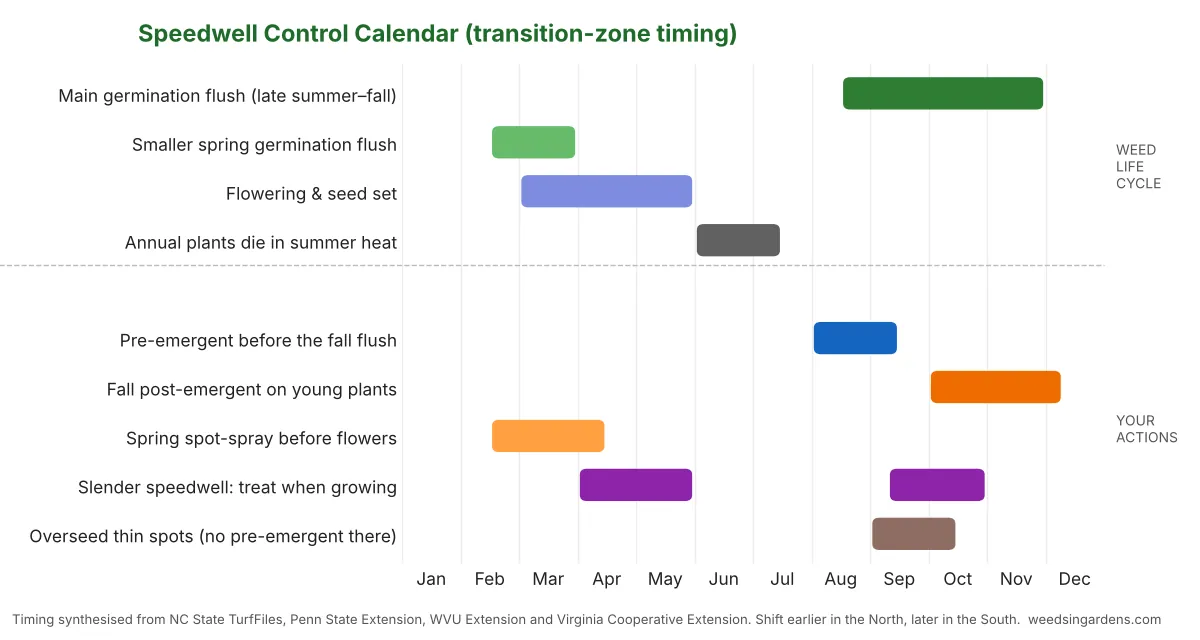
| Season | Annual speedwells (corn, Persian, ivyleaf) | Slender speedwell | Your move |
|---|---|---|---|
| Late summer (Aug–Sep) | Seeds start germinating in cool, moist weather | Growth picks up again | Apply a pre-emergent on areas you won’t seed, or overseed thin spots. Not both on the same patch. |
| Fall (Oct–early Dec) | Young seedlings with immature roots, the easiest stage to kill | Actively growing | The best post-emergent window for cool-season lawns; atrazine or simazine from mid-November in warm-season lawns |
| Winter | Semi-dormant, growing during warm spells | Slow growth | Scout and mark patches; avoid spraying dormant turf against label directions |
| Early spring (Feb–Apr) | Smaller second germination flush; flowering begins | Growing and flowering | Spot-spray before flowers set seed; mow when the first flowers appear |
| Late spring–summer | Plants set seed and die in the heat | Persists through summer | Don’t waste herbicide on dying annuals; repair thin turf |
If you’re reading this in fall, you’re in the best window of the year for speedwell in lawn control. NC State’s guidance for home lawns is to scout from late September through October and treat from October to early December, depending on weather, while the winter weeds are young. Controlling them now also gives the grass time to fill in before the cold slows it down.
Which plan fits your lawn?
| If you see… | It’s probably… | Do this |
|---|---|---|
| Fuzzy, upright plants with tiny blue flowers in thin, sunny turf | Corn speedwell | Pull or spot-spray young plants in fall; thicken the turf; pre-emergent next late summer |
| Scattered plants with larger sky-blue flowers on long stalks | Persian speedwell | Same plan as corn speedwell; it’s easier to control |
| Dense mats of small round leaves, flowers on thread-like stalks, back every year | Slender speedwell | Quinclorac in tolerant grasses, bag clippings, dig and reseed small patches |
| Speedwell in St. Augustinegrass or centipedegrass | Any species | Atrazine or simazine in late fall, or a warm-season product that lists speedwell; avoid quinclorac |
| More speedwell than grass | Usually slender speedwell | Renovate: kill the area with a non-selective herbicide and reseed |
| Speedwell in flower beds | Annual speedwells | Hoe, mulch, and use a bed pre-emergent around established plants |
A Note from the Agronomist’s Side
The first question to ask about speedwell in lawn grass isn’t “what do I spray?” It’s “annual or perennial?” Get that right and almost every other decision follows. Annual speedwells are a seed-bank problem with a predictable calendar: a closed canopy, a fall spray on seedlings and, where it fits, a well-timed pre-emergent will beat them. Slender speedwell is a spread problem: stop the fragments moving, use a chemistry it doesn’t tolerate, and fill every gap with grass.
The herbicide pattern makes sense once you see it. The phenoxy herbicides (2,4-D, MCPP) and dicamba in most budget lawn sprays simply aren’t strong on speedwells. Control improves when you add a different chemistry, such as triclopyr, quinclorac or a fast-acting “zone” herbicide (carfentrazone or sulfentrazone). Read the active-ingredient panel, not the front of the jug.
Two judgment calls are worth making on purpose. First, most pre-emergents stop grass seed as well as weed seed, so on any patch you choose one or the other each fall. In a thin lawn, seeding usually wins, because density is what keeps speedwell out for good. Second, annual speedwell in full flower in May is often best left alone. It will be gone by summer; spend the effort on the bare soil it leaves behind.
And if a few blue flowers in spring don’t bother you, the RHS makes a fair point: speedwells feed pollinators and cover bare soil. In a relaxed, pollinator-friendly lawn, tolerating a little speedwell is a legitimate choice, not a failure. Browse more lawn weed guides if you’re deciding what to tolerate and what to tackle.
Speedwell in Lawn FAQ
Is speedwell a weed or a wildflower?
Both. Speedwells are attractive wildflowers that feed pollinators, but in a lawn kept as pure grass they behave as weeds because their stems root and form dense patches that survive mowing. Whether to control speedwell in lawn grass depends on the kind of lawn you want.
What kills speedwell but not grass?
Selective products containing triclopyr, carfentrazone or sulfentrazone work best on annual speedwells, and quinclorac controls slender speedwell in tolerant grasses such as Kentucky bluegrass, perennial ryegrass and tall fescue. Standard 2,4-D, MCPP and dicamba mixes give poor control on their own. Always check the label for your grass type.
Will speedwell go away on its own?
Annual speedwells (corn, Persian and ivyleaf) die in early summer heat, but their seed sprouts again the following fall, so the problem returns unless the lawn thickens up. Slender speedwell is a perennial and won’t go away without intervention.
When is the best time to spray speedwell?
For annual speedwells, fall (October to early December) while the seedlings are small is best, with early spring before flowering as a second chance. Treat slender speedwell when it’s actively growing in spring or fall.
Is slender speedwell the same as creeping speedwell?
Yes. Veronica filiformis goes by both names. Don’t confuse it with ornamental creeping speedwells sold as groundcovers, which are different species.
Can I put down a pre-emergent and overseed at the same time?
Usually not. Most pre-emergents also stop grass seed from establishing. Check the label’s reseeding interval, and on thin patches choose overseeding first, since a dense lawn is the best long-term defense against speedwell.
Sources
- Abbey, T., Landschoot, P. and Delvalle, T. Lawn and Turfgrass Weeds: Corn Speedwell. Penn State Extension (updated 2025).
- Penn State Extension. Lawn and Turfgrass Weeds: Common Field Speedwell (Veronica persica).
- Yelverton, F. Corn Speedwell, Persian Speedwell and Ivyleaf Speedwell. NC State Extension TurfFiles (2022).
- Yelverton, F. and Warren, L. Fall Weed Control Options for Home Lawns. NC State Extension TurfFiles (updated 2025).
- UMass Amherst Center for Agriculture, Food, and the Environment. Speedwells in Lawns.
- Chandran, R. Corn Speedwell: A Speedy Spring Weed. West Virginia University Extension.
- Virginia Cooperative Extension. Pest Management Guide: Home Grounds and Animals 2026, Lawn: Weeds, Table 5.9 (ENTO-634P).
- Clemson University. Turfgrass Pest Management Guide: Postemergence Herbicides table (2014).
- Pacific Northwest Pest Management Handbooks. Chemical Control of Broadleaf Weeds in Turf.
- Neal, J.C. and Senesac, A.F. (1993). Slender speedwell (Veronica filiformis) control in cool-season turf with quinclorac. Weed Technology 7(2): 390–395. doi:10.1017/S0890037X00027780.
- Baskin, J.M. and Baskin, C.C. (1983). Seasonal changes in the germination responses of seeds of Veronica peregrina during burial, and ecological implications. Canadian Journal of Botany 61: 3332–3336.
- Kaufmann, J.E. (1983). Control of creeping speedwell in turfgrass. Michigan State University, via the MSU Turfgrass Information Center.
- Iowa State University Extension. What is the proper way to apply broadleaf herbicides to the lawn? (2022).
- U.S. Environmental Protection Agency. EPA Finalizes Cancellation of the Pesticide Dacthal (October 22, 2024).
- Royal Horticultural Society. Speedwell.
- Washington State University Hortsense. Weeds: Speedwells (Veronica spp.).