
It’s the strip of lawn beside the driveway that gives it away. The grass there was never great, but by midsummer it has vanished under a flat, wiry, blue-green mat that you can’t seem to pull up, mow down or spray away. By late October it looks scraggly and half dead, and you assume the problem is solving itself.
Short answer: Prostrate knotweed is a summer annual weed that thrives in compacted, trampled soil. It germinates in late winter, weeks before crabgrass, which is why spring crabgrass preventers usually miss it. The most reliable plan is a fall or very-late-winter pre-emergent (isoxaben is the standout), spot-treating young plants in spring with a 2,4-D + dicamba or triclopyr combination, and core aeration to fix the compaction that invites it back.
This guide shows you how to identify prostrate knotweed in seconds, why late fall is the most important moment in its whole life cycle, which herbicides actually work (and which don’t), and how to change the soil so the weed stops winning. By the end you’ll have a month-by-month plan you can start this week.
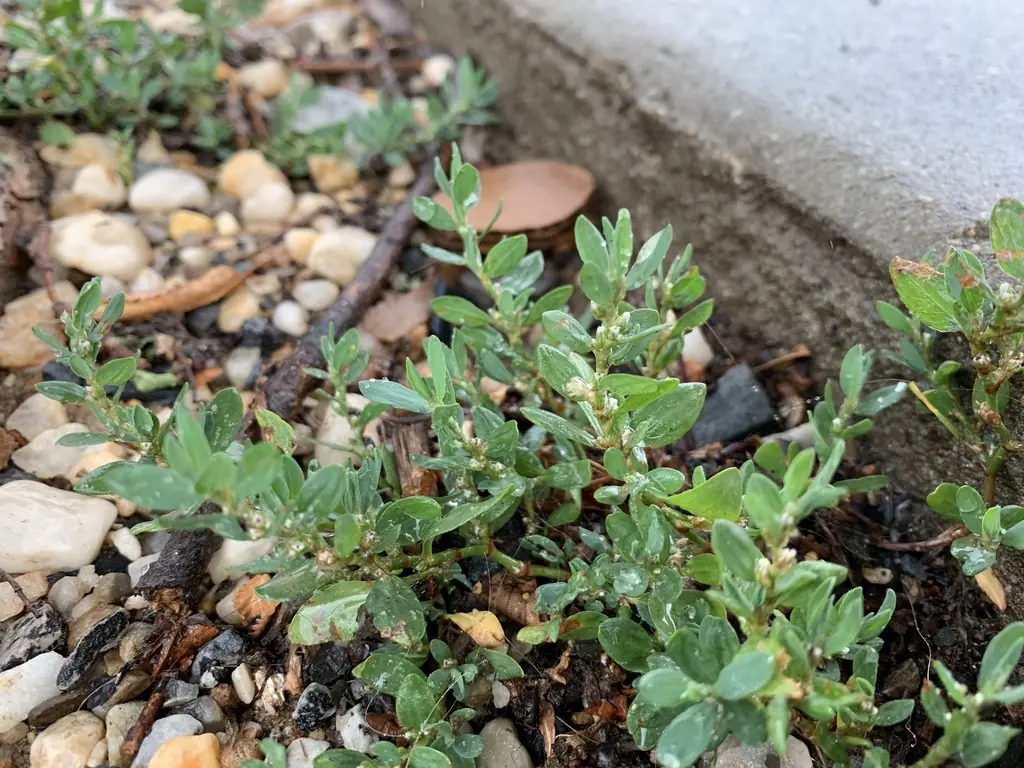
What Is Prostrate Knotweed (and Why It Loves Your Worst Soil)?
Prostrate knotweed (Polygonum aviculare) is a non-native annual in the buckwheat family, Polygonaceae. It reproduces only from seed, and it is described by Montana State University IPM specialists as “one of the earliest germinating summer annual weeds.” Old-timers call it knotgrass or wiregrass, because its seedlings look like grass and its stems turn wire-tough.
The real story is the soil underneath. The University of Illinois Home, Yard & Garden newsletter calls the plant “an indicator of compacted soils,” usually found in full sun in thin turf or next to sidewalks and driveways “where traffic has spilled over.” Purdue notes it also shows up in low-oxygen soils, including areas that were previously flooded.
Why does that matter? Because the weed isn’t really beating your grass in a fair fight. Compacted soil starves grass roots of oxygen, the turf thins, and knotweed, which tolerates low oxygen and heavy trampling, simply moves into the space. Kill the weed without fixing the soil and you’re signing up for the same fight next year.
Where you’ll usually find it
- Lawn edges along driveways, sidewalks and curbs
- Footpaths worn across the lawn, play areas and dog runs
- Heavy clay that stays wet after rain, then bakes hard
- Gravel edges, patio cracks and parking strips
- Thin, low-input turf where the grass never fully filled in (see our guide to growing grass in compacted soil)
How to Identify Prostrate Knotweed in 30 Seconds
Knotweed is easy to confuse with prostrate spurge and even with crabgrass seedlings, and the control plans for each are different. Get down at eye level and check these features:
- Seedlings: very narrow, grass-like seed leaves with a reddish stem just below them. This is the stage most people mistake for grass.
- Leaves: dull blue-green, alternate on the stem, long and narrow, up to 1¼ inches long and about 1/3 inch wide (University of Illinois).
- Ocrea: a thin, papery, silvery sheath wrapped around the stem at every leaf base. This is the single best ID clue.
- Stems: wiry, tough and swollen at the nodes (the “knots”), spreading flat from a single centre. Stems run 4 to 24 inches long and are hard to snap, especially in dry soil.
- Flowers: tiny clusters of 1 to 5 white-to-pinkish flowers tucked in the leaf axils, from about June into fall.
- Root: one thin taproot. No runners, no rooting at the nodes.
- Late-season look: leaves often turn grayish or whitish with powdery mildew, and the plant can turn purplish in cool weather.
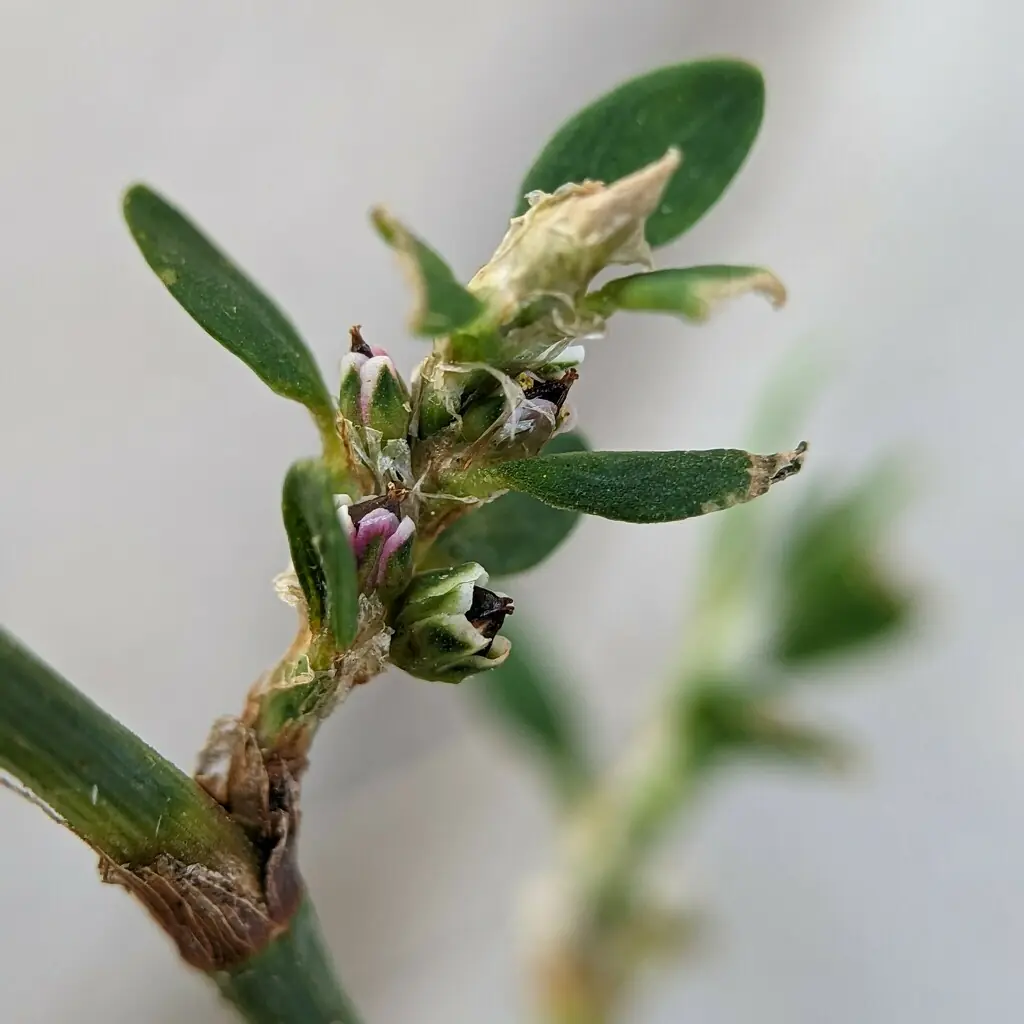
Prostrate knotweed vs prostrate spurge vs crabgrass
The quickest field test: snap a stem. Spurge bleeds milky white sap and has opposite leaves; knotweed has no sap and alternate leaves with that papery sheath. If you’re dealing with spurge, the timing is completely different, so read our spurge control guide instead.
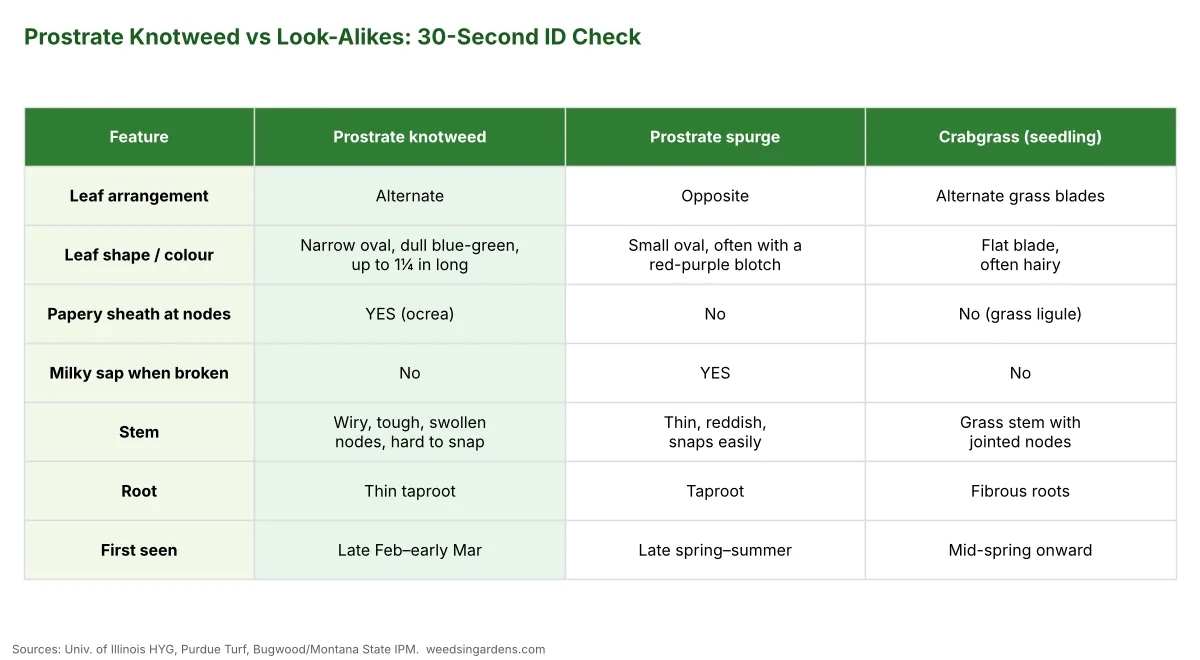
| Feature | Prostrate knotweed | Prostrate spurge | Crabgrass |
|---|---|---|---|
| Leaf arrangement | Alternate | Opposite | Grass blades |
| Papery sheath (ocrea) | Yes | No | No |
| Milky sap | No | Yes | No |
| Emerges | Late Feb–early Mar | Late spring | Mid-spring |
| Best pre-emergent window | Late fall / late winter | Spring | Spring |
The Prostrate Knotweed Life Cycle: Why Your Spring Pre-Emergent Misses It
Here’s the surprising part. Most homeowners put down a crabgrass preventer in spring and assume it covers “weeds.” But prostrate knotweed is already up before most people open that bag.
Research from Argentina on Polygonum aviculare seed shows that dormancy is broken by winter chilling: seeds lose dormancy as they experience low temperatures in moist soil (Batlla and Benech-Arnold, Seed Science Research, 2003). Once chilled, they germinate in a single flush at temperatures as low as 41°F, mostly from the top inch of soil, according to the Bugwood/Montana State profile.
In practice that means late February to early March across much of the Midwest. Purdue turf specialist Aaron Patton reports first germination in Indiana in late February or the first week of March, and University of Nebraska turf scientist Roch Gaussoin notes it typically starts in February in Nebraska. Crabgrass, by contrast, waits for soils to warm considerably. A spring crabgrass application timed for crabgrass is simply late for knotweed.
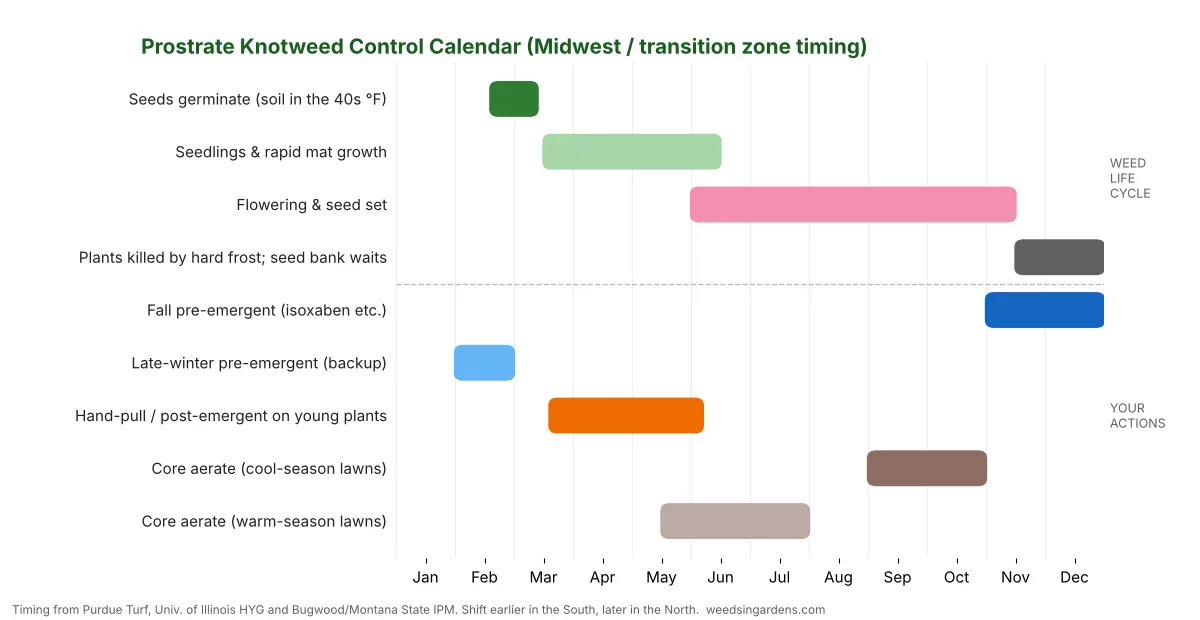
| Season | What knotweed is doing | What you should do |
|---|---|---|
| Late fall (Nov–Dec) | Parent plants dying; seeds in soil chilling | Apply a pre-emergent (isoxaben is best) before the ground freezes; water it in |
| Late winter (Feb–early Mar) | Seeds germinate in a single flush, soil in the 40s °F | Backup pre-emergent window if you missed fall; watch bare spots |
| Spring (Mar–May) | Seedlings upright, growing fast | Hand-pull in moist soil or spot-spray young plants |
| Summer (Jun–Aug) | Dense mats; flowering and seeding | Spot-treat only if needed; keep traffic off; warm-season lawns: aerate |
| Early fall (Sep–Oct) | Still seeding; mildew common; growth slowing | Cool-season lawns: core aerate and overseed thin spots |
Notice the pattern: the two most powerful moves, the pre-emergent and the aeration, both happen when the weed looks least threatening. That’s exactly why it keeps coming back in so many lawns.
How to Get Rid of Prostrate Knotweed: 7 Proven Steps
No single tactic wins on its own. Montana State’s IPM profile puts it bluntly: mechanical methods “are usually not efficient alone” and work best combined with other controls. Stack these steps instead.
1. Fix the compaction first
Core aeration pulls plugs of soil out and lets oxygen, water and roots back in. Purdue’s cultural recommendation is to “reduce soil compaction through aerification and improve drainage in areas prone to flooding.” Aerate when your grass is actively growing so it can fill the holes: early fall for cool-season lawns, late spring to early summer for warm-season lawns. Avoid aerating soggy soil; our post on aerating after rain explains the right moisture window.
2. Re-route the traffic
If a path is worn across the lawn, people (and dogs) will keep compacting it. Stepping stones, a mulched path or a small fence often does more than any herbicide. Along driveway edges, consider a narrow gravel or paver strip where tires keep cutting the corner.
3. Thicken the turf
Cornell’s IPM guidance for knotweed recommends overseeding thin spots in fall or early spring, keeping soil pH around 6.0 to 6.8 (test every 3 to 5 years), and never removing more than half the leaf blade at a mow. Dense grass shades the soil surface, and knotweed seeds germinate better in light than in darkness.
4. Pull young plants while the soil is moist
Knotweed has a single thin taproot, so seedlings pull out easily in spring after rain. By midsummer the stems are wiry and the taproot is anchored in hard soil; you’ll mostly snap the plant off. A narrow weeding fork beats fingers here.
5. Apply a pre-emergent at the right time
This is the step most lawns are missing. See the herbicide section below for actives, rates and timing.
6. Spot-spray young plants in spring
Post-emergent herbicides work best “in the spring when plants are still upright and actively growing,” per the Bugwood profile, and are “mostly ineffective on larger plants.” Treat early, not in August.
7. Reseed or resod the bare patches
Once the weed is gone, bare soil is an invitation for the next flush. Fill it with grass in the right season, and keep in mind that some pre-emergents block grass seed too (more below). Our guide to killing weeds before overseeding covers the waiting periods.
Best Herbicides for Prostrate Knotweed Control (by Active Ingredient)
Always read and follow the product label. The label is the law: it sets the rate, the turf species you can treat, the temperature limits, and how long to wait before seeding. The notes below summarise what university specialists report for lawns.
Pre-emergent options
The University of Illinois lists dithiopyr, isoxaben, pendimethalin and prodiamine as pre-emergent options, adding that “isoxaben has been rated as excellent in research trials” and that “late fall preemergent applications are often used” because the weed arrives so early. Purdue goes further: its top recommendation is a late fall (November or December) application of isoxaben, noting other pre-emergents “will also work, but are less effective.”
Label-rate example: NC State Extension lists Gallery (isoxaben) 75 DF at 0.25 to 0.5 oz per 1,000 sq ft (0.66 to 1.33 lb per acre) for established turf. It needs about 1/2 inch of water to activate, should go onto weed-free soil, and labels cap use at 4 lb of Gallery per 12 months. Expect roughly 60 to 90 days of residual in the Southeast, longer in the North and West.
| Active ingredient | Type | Knotweed performance | Best timing | Key caution |
|---|---|---|---|---|
| Isoxaben (e.g., Gallery) | Pre-emergent, broadleaf | Excellent (Illinois, Purdue) | Nov–Dec, or late Feb | Established turf only; blocks broadleaf seedlings; check label before seeding |
| Prodiamine | Pre-emergent, mainly grassy | Works, less effective than isoxaben | Fall or late winter | Will prevent grass seed from establishing |
| Dithiopyr | Pre-emergent, mainly grassy | Works, less effective | Late winter | Prevents new grass seed; follow label interval |
| Pendimethalin | Pre-emergent, mainly grassy | Works, less effective | Late winter | Same seeding restriction |
| 2,4-D + dicamba (e.g., Trimec-type) | Post-emergent | Excellent on young plants in cool-season turf | Spring, seedling to early growth | Dicamba can move into tree and shrub roots; follow label |
| 2,4-D + triclopyr | Post-emergent | Excellent on young plants in cool-season turf | Spring | Triclopyr injures some warm-season grasses; check label |
| 2,4-D alone | Post-emergent | Only fair (Purdue) | Spring | Best used in combination |
| Metsulfuron (e.g., MSM-type) | Post-emergent | Effective in warm-season turf | Spring | Warm-season lawns only per label |
Post-emergent: why the combination matters
Purdue reports that 2,4-D alone gives only fair control, but combined with dicamba or triclopyr it “should provide excellent control in cool-season turf.” For warm-season lawns, metsulfuron or those same combinations work. If you’re new to these products, our post-emergent herbicide guide explains how they move in the plant and how to spray safely.
Temperature and turf-safety rules
- Spray on a calm day when the weed is actively growing and temperatures fall within the label range. Most broadleaf combination labels warn against hot-weather application; spring knotweed timing usually keeps you clear of that.
- Check the turf list on the label. Triclopyr, dicamba and 2,4-D products differ in which warm-season grasses (St. Augustine, centipede and others) they tolerate.
- Don’t spray newly seeded grass until the label says it is established, and don’t apply pre-emergents where you plan to seed soon.
- Keep dicamba products away from the root zones of trees and shrubs, and never spray on windy days.
Honestly, for a few plants along a sidewalk, a weeding fork in April is cheaper and faster than any of these. Save herbicides for lawns with large, repeat infestations.
Natural and organic options that actually help
There’s no proven biological control for prostrate knotweed; the Bugwood profile states “none are currently available.” That leaves cultural and mechanical tactics, which are the backbone of control anyway.
- Aeration plus overseeding is the most effective non-chemical control, because it removes the conditions knotweed needs.
- Hand-pulling works well on young plants in moist soil (University of Illinois).
- Boiling water or vinegar can burn back plants in pavement cracks, but they also kill grass and don’t touch the seed bank. See boiling water for weeds for the limits.
- Mulch or pavers along chronic edges stop seeds from reaching light.
- Timing your mowing: Cornell notes frequent low mowing in spring may slow spread, but low mowing also weakens cool-season grass, so use it only on the worst patches and raise the deck again by summer.
Common Mistakes That Keep Knotweed Coming Back
| Mistake | Why it fails | Do this instead |
|---|---|---|
| Relying on a spring crabgrass preventer | Applied after knotweed has already germinated | Apply isoxaben in Nov–Dec or late Feb |
| Spraying big summer mats | Post-emergents are mostly ineffective on large plants | Spot-spray young plants in spring |
| Pulling in dry, hard soil | Wiry stems snap and the taproot stays | Pull after rain, with a weeding fork |
| Killing the weed but not fixing compaction | Grass can’t recover, so the bare spot reseeds | Core aerate and redirect traffic |
| Seeding right after a grass pre-emergent | Prodiamine, dithiopyr and pendimethalin stop grass seed too | Follow the label’s seeding interval |
| Ignoring seed set | Each plant drops seed that stays viable in the soil | Remove plants before late summer seeding |
If knotweed is part of a bigger flat-weed problem, our plantain weed guide is worth a look too: broadleaf plantain is another classic compaction indicator, and the same aeration plan helps both.
A Note from the Agronomist’s Side
Prostrate knotweed is one of the most useful weeds you can have, at least as a diagnostic tool. When it dominates a strip of lawn, it is telling you the soil there has lost its pore space. Grass roots need oxygen to grow; knotweed is unusually tolerant of low oxygen. So the weed’s presence is a fairly honest reading of soil structure, not just bad luck.
That changes how I’d rank the controls. Herbicides deal with this year’s plants. Aeration, traffic management and overseeding deal with the reason there were plants in the first place. If you have to choose where to spend effort, spend it on the soil; a weed-free bare patch of compacted clay is just next year’s knotweed nursery.
The second lesson is about timing logic. Most lawn programs are built around crabgrass, so they fire in spring. Knotweed’s seed biology, which needs winter chilling and then germinates at cool temperatures, puts it outside that window. When a weed “survives” a pre-emergent, it often wasn’t resistance at all; the product simply went down after the seeds had already sprouted. Notably, the Bugwood profile reports no herbicide resistance in prostrate knotweed in the United States, so a correctly timed program should work.
A practical rule of thumb: if you already apply a fall pre-emergent for Poa annua or winter annuals, check whether the product’s label covers knotweed, and you may be able to solve two problems with one application.
Prostrate Knotweed FAQ
Is prostrate knotweed the same as Japanese knotweed?
No. Prostrate knotweed (Polygonum aviculare) is a low, mat-forming annual that lives one season. Japanese knotweed is a tall, bamboo-like invasive perennial with deep rhizomes and needs a completely different approach; see our Japanese knotweed removal guide.
When is the best time to treat prostrate knotweed?
Late fall (November or December) for a pre-emergent such as isoxaben, because the seeds germinate in late February to early March. For plants you can already see, spot-spray or pull them in spring while they are young and upright.
Will crabgrass preventer stop prostrate knotweed?
Usually not, if it is applied at normal crabgrass timing. Knotweed germinates weeks earlier. Prodiamine, dithiopyr and pendimethalin can work if applied in fall or late winter, but isoxaben is rated the most effective.
What kills prostrate knotweed in lawns?
In cool-season lawns, 2,4-D combined with dicamba or triclopyr gives excellent control of young plants; 2,4-D alone gives only fair control. In warm-season lawns, metsulfuron is also effective. Always follow the label for your grass type.
Does prostrate knotweed die in winter?
Yes. It is a summer annual, so the plants die after hard frost. The problem is the seed it dropped, which chills over winter and germinates early the next spring.
Why does knotweed grow along my driveway and sidewalk?
Those edges get driven over and walked on, which compacts the soil. Prostrate knotweed tolerates compacted, low-oxygen soil that grass struggles in, so it takes over there first.
Can I pull prostrate knotweed by hand?
Yes, especially young plants in moist soil in spring. It has a single thin taproot. Older plants in dry, hard soil tend to snap off, so water the area first or use a weeding fork.
Sources
- Wiesbrook, M. (2019). “Prostrate Knotweed.” Home, Yard & Garden Newsletter, Issue 14, University of Illinois Extension. hyg.ipm.illinois.edu
- Patton, A. “Prostrate Knotweed.” Weed of the Month, Purdue University Turfgrass Science. turf.purdue.edu
- Graves, M. & Schat, M. “Prostrate knotweed.” High Plains IPM Guide, Montana State University / Bugwood Wiki. wiki.bugwood.org
- Neal, J. (2014, reviewed 2024). “Gallery (isoxaben).” Herbicide Information Factsheets, NC State Extension. content.ces.ncsu.edu
- Cornell Integrated Pest Management / Northeastern IPM Center (rev. 2020). “Knotweed, Polygonum aviculare.” schools.northeastipm.org
- Gaussoin, R. (2019). “Control of prostrate knotweed (and crabgrass?) with preemergence herbicides this fall.” University of Nebraska-Lincoln, via Sports Field Management Association. sportsfieldmanagement.org
- Batlla, D. & Benech-Arnold, R. L. (2003). A quantitative analysis of dormancy loss dynamics in Polygonum aviculare L. seeds. Seed Science Research, 13, 55–68. doi:10.1079/ssr2002124