
Short answer: spurge is a summer annual, so each plant dies at the first hard frost, but it can drop seed as soon as five weeks after it sprouts, and that seed bank is why it returns every year. To get rid of spurge, pull young plants from moist soil before they flower (wear gloves, because the milky sap irritates skin), block new seedlings with 2 inches or more of mulch in beds or a pre-emergent in lawns applied before the soil reaches about 55–60°F, and thicken the turf so seeds have no bare, sunny soil to land on.
Spurge is one of the most common weeds that people search for in July and August, usually after a flat, reddish mat has appeared overnight along a driveway or in a thin patch of lawn. The plan below covers how to confirm what you have, why it keeps coming back, and which method fits a lawn, a garden bed or a crack in the pavement.
Table of Contents
How to identify spurge
Weedy spurges in lawns and paving share four features. The stems lie flat and radiate from a single taproot. The leaves are small, oval and arranged in opposite pairs. The stems are often pink to red. And any broken stem oozes a white, milky sap. That sap is the quickest field test: no other common mat-forming lawn weed has it.
The University of California lists seven weedy species in its UC IPM Pest Notes on spotted spurge and other spurges, with leaves only 1/8 to 1/2 inch long and mats up to 3 feet across. In most home landscapes you will meet the three below.
Spotted spurge (Euphorbia maculata)
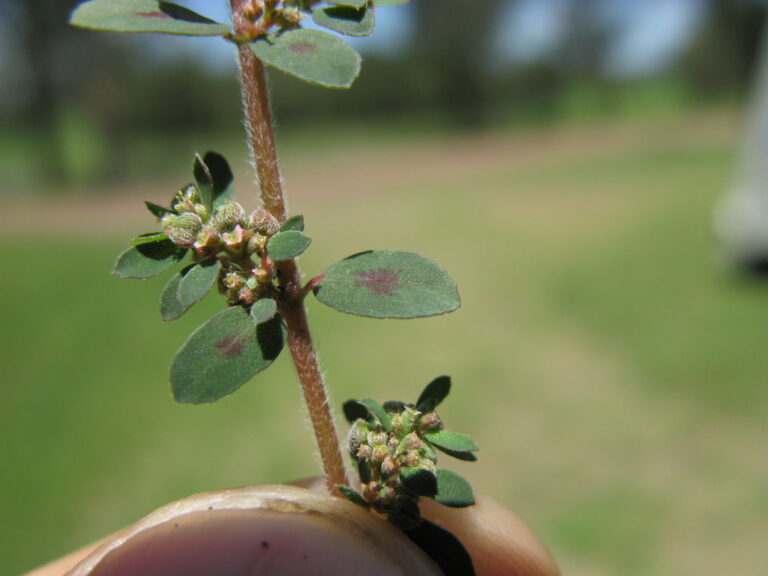
This is the species most people have in mind. Leaves are 1/2 to 3/4 inch long, dark green and often carry a purple or maroon blotch in the centre of the upper surface, according to Penn State Extension. The stems are hairy. The spot is not always present, as UW–Madison Extension notes, so do not rule a plant out just because the leaves are plain green. You will also see it sold under the older genus name Chamaesyce, and some guides call it prostrate spurge.
Ground or prostrate spurge (Euphorbia prostrata)
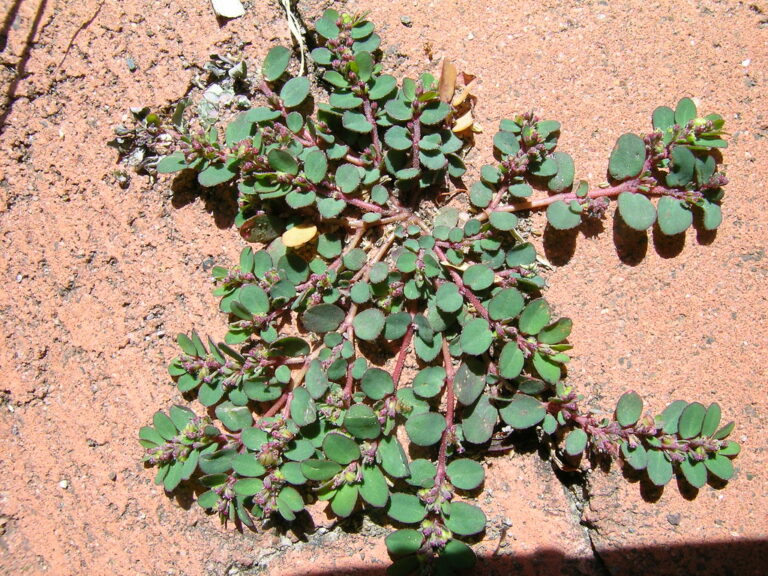
This species looks like a smaller, paler version. The NC State Extension Plant Toolbox separates it by its shorter leaves, which are more rounded at the tips and have no central spot. The common names overlap badly between regions, but the control steps below are the same for both.
Garden spurge (Euphorbia hirta)
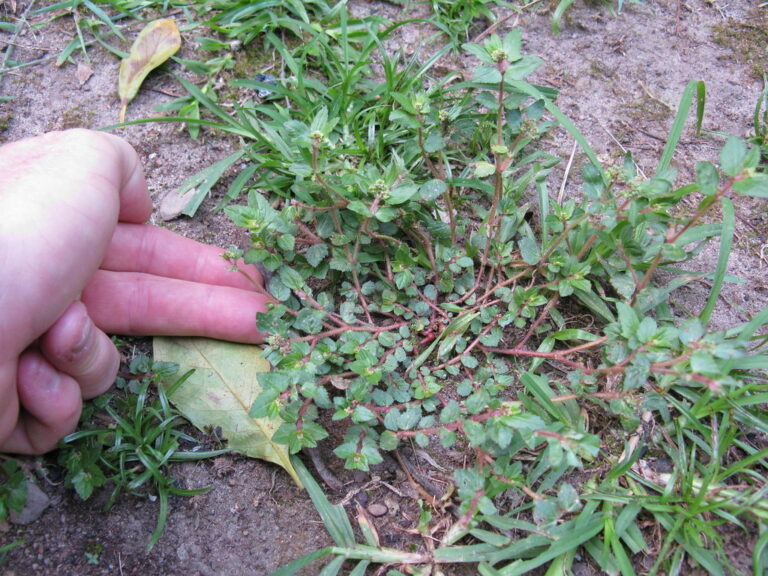
Garden spurge, also called asthma plant, grows more upright, with larger toothed leaves and round clusters of tiny flowers in the leaf joints. It is common in warm climates and thin warm-season lawns. It has its own page here: Euphorbia hirta identification, uses and control.
Spurge lookalikes: knotweed and purslane
Two other flat summer weeds are often mistaken for it. Getting this right matters, because the timing of control differs.
Prostrate knotweed

Knotweed has alternate leaves, wiry ribbed stems and a thin papery sheath (the ocrea) around each swollen node. It has no milky sap. A UC weed science note by Lynn Sosnoskie points out that knotweed is one of the earliest weeds to emerge in late winter, and it thrives in compacted soil along paths.
Common purslane

Purslane also has red stems and a flat habit, but its leaves are thick, succulent and up to 1.5 inches long, its stems are smooth, and it has small yellow flowers, per Penn State Extension. Snap a stem: purslane sap is clear and watery. Our purslane guide covers identification, control and eating it safely.
| Feature | Spotted | Ground | Prostrate knotweed | Common purslane |
|---|---|---|---|---|
| Leaf arrangement | Opposite | Opposite | Alternate | Opposite or clustered |
| Leaf | Oblong, often a purple spot | Short, rounded tip, no spot | Small, narrow, one per node | Thick, fleshy, up to 1.5 in |
| Stem | Hairy, pink to red | Pink to red | Wiry, papery sheath at nodes | Smooth, red, succulent |
| Sap when broken | Milky white | Milky white | None | Clear |
| When it appears | Late spring to autumn | Late spring to autumn | Late winter to early spring | Summer |
Why spurge keeps coming back
Four numbers from extension and research sources explain almost every failed attempt at control.
- Seed in about five weeks. UC IPM reports that spotted spurge can set seed as soon as 5 weeks after germination, and a single plant can produce several thousand seeds. UF/IFAS publication HS1529 adds that seed production can start within weeks of the first flowers.
- A late, long germination window. Seeds sprout between about 60°F and 100°F, with an optimum of 75–85°F (UC IPM). In Kansas, K-State turfgrass specialist Ross Braun notes that spurge usually emerges from early May into June, later than crabgrass.
- Light-dependent, shallow germination. Seeds buried deeper than 1/2 inch do not germinate well (UC IPM). That is why it explodes on bare, sunny soil, thin turf and the grit in paving joints.
- A persistent seed bank. In a field study, Asgarpour and colleagues (2020, Advances in Weed Science) found that spotted spurge seed buried at 10 cm kept more than 95% viability after a year. Digging or tilling brings that seed back to the surface where it can sprout.
The taproot also matters: UC IPM says it can reach more than 24 inches deep in loose soil. Tearing off the top of a mature plant often leaves enough root to regrow.
Spurge control methods compared
| Method | Best for | What to know |
|---|---|---|
| Hand pulling or a weeding knife | Small numbers anywhere | Work on moist soil before flowering; wear gloves |
| Organic mulch | Garden beds | At least 2 in; coarse bark needs 3–4 in |
| Pre-emergent herbicide | Lawns, beds, patios with a history of the weed | Stops seedlings only; does nothing to plants already up |
| Selective post-emergent | Established lawns | Works best on young, actively growing plants |
| Dense turf | Lawns | The only long-term fix in grass |
| Solarization | Bare beds before planting | 4–6 weeks of hot summer weather |
| Non-selective spot spray | Cracks, gravel | Kills any plant it touches |
How to get rid of spurge in lawns
In a lawn, this weed is a symptom of thin turf. The University of Maryland Extension puts dense, healthy turf first, and Utah State University Extension (Beddes and colleagues, 2017) recommends mowing at about 3 inches. UC IPM suggests raising the mower to 2 inches or more on tall fescue and perennial ryegrass and keeping thatch under 1/2 inch. Mowing itself will not remove it, because the plant grows below the blade.
Pull what is there now. On a few plants, hand pulling after rain or irrigation removes the taproot cleanly. Bag plants that already carry seed capsules instead of leaving them on the lawn.
Spot-spray larger patches. Penn State and Maryland list broadleaf lawn products that combine 2,4-D, MCPP (mecoprop) and dicamba, alone or with fluroxypyr or triclopyr. Utah State also lists sulfentrazone and carfentrazone. For St. Augustine grass and centipedegrass, Clemson Cooperative Extension lists atrazine among the options labelled for spurge. Clemson advises spraying broadleaf weeds when air temperatures are between 65 and 85°F, and warns that sensitive grasses can be injured during spring green-up. Maryland adds a useful warning: do not spray dicamba over the root zone of trees and shrubs.
Prevent next year’s flush. Pre-emergent herbicides such as dithiopyr, pendimethalin, prodiamine and isoxaben stop it from seed (Penn State). UC IPM advises applying before the soil at 1 inch deep exceeds 55–60°F. Because spurge germinates later and over a longer period than crabgrass, check the label for how long your product keeps working; a lawn treated early for crabgrass can lose protection before the late flush ends. Our crabgrass identification and control guide covers the crabgrass side of that timing.
Reseed at the right time. Penn State recommends establishing cool-season turf in late summer or autumn, which is also when the weed is winding down. Most pre-emergents also stop grass seed, so do not overseed where you have just applied one.
Spurge in sidewalk cracks, patios and gravel
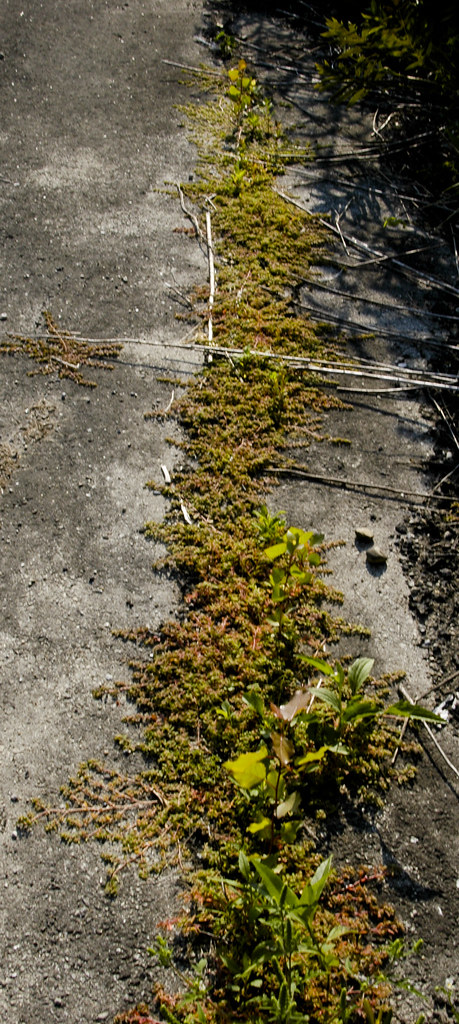
Paving joints are close to ideal for this weed: full sun, shallow grit and heat. Here the goal is to remove plants before they seed and to take away the thin layer of soil they grow in.
- Pull or scrape early. A crack weeder or old knife lifts young plants out whole. Do it when the joints are damp, and wear gloves.
- Clean the joints. Sweep or blow out the organic grit that collects in cracks, then refill paver joints with fresh jointing sand. Fewer seeds can lodge and germinate in a clean joint.
- Spot-treat what you cannot pull. UC IPM lists glyphosate as a post-emergent option; it is non-selective, so keep it off lawn edges and bed plants. Vinegar mainly burns top growth on established plants; see does vinegar kill weeds for what the research shows.
- Use a pre-emergent on repeat problem areas. If you do, confirm that the label lists patios, walks or hardscapes as a use site before applying.
For gravel paths and stone beds, the methods in how to kill weeds in rock gardens and gravel beds also apply here.
How to control spurge in garden beds
Mulch is the most effective tool in beds because the seeds need light. UC IPM and UW–Madison both recommend organic mulch at least 2 inches thick, with coarse bark needing 3–4 inches. UF/IFAS reports that even 1 inch of pine bark nuggets cut spotted spurge emergence by about 90%. Keep mulch topped up; seedlings readily colonise mulch once it thins. The guide to stopping weeds growing through mulch covers depth, fabric and edging.
Avoid deep digging once plants have seeded, because buried seed stays viable for at least a year. In vegetable beds, a light hoeing of seedlings on a dry, sunny day works well, the same stale-seedbed approach described in our chickweed control guide. For empty beds in hot regions, UC IPM reports that solarizing under clear plastic for 4–6 weeks in summer controls it, with only partial control where daytime temperatures stay below 90°F.
Is spurge poisonous? Sap safety for people and pets
Yes, treat it with care. The NC State Plant Toolbox states that the milky latex in all parts of spotted spurge can cause mild to severe contact dermatitis, that sap in the eyes can damage the cornea, and that eating the plant can blister the lips and mouth. It flags spotted spurge as a problem for cats, dogs and children. Wear gloves and eye protection when pulling large mats, wash hands afterwards, and do not rub your eyes. If a pet chews a lot of the plant or sap gets into anyone’s eyes, contact a veterinarian or doctor.
A season plan for spurge
- Early spring: plan your pre-emergent before soil at 1 inch passes 55–60°F; fix thin lawn areas.
- Late spring to early summer: scan bare spots, bed edges and paving every week; the first seedlings are the easiest you will ever pull.
- Mid to late summer: pull or spot-treat before plants flower; bag seeding mats.
- Late summer to autumn: overseed cool-season lawns where the weed thinned the turf, and renew mulch in beds.
Where this applies: the timings above are for temperate, cool-season lawns in the Northern Hemisphere. In warm climates and on warm-season grasses such as Bermuda, St. Augustine and zoysia, spurge germinates over a longer season, for example from February through September in much of California according to UC IPM. In the Southern Hemisphere, shift the months by six. Herbicide registration and labels differ between countries and states, so check that a product is registered for your grass and location.
A note from the agronomist’s side
In trial plots in the tropics, the spurge that caused the most trouble was never the first flush but the second and third, which appeared after the early cohort had already dropped seed along irrigation lines and bed edges. The lesson carries over to home gardens: one clean-up in July is not a strategy. Short, frequent visits in the first six weeks of warm weather prevent far more plants than a single big weeding later, and every bare patch you cover with grass, mulch or a crop is a patch where it cannot start.
Frequently asked questions
Does spurge come back every year?
The individual plants die in frost, but the seeds they dropped germinate the next spring and summer, and buried seed can survive for years. Stopping seed production for two or three seasons is what shrinks the problem.
Will mowing kill spurge?
No. It grows below mowing height, as NC State notes. Mowing high helps indirectly by keeping the grass dense enough to shade the soil.
What kills spurge but not grass?
Selective broadleaf lawn herbicides that contain combinations of 2,4-D, MCPP, dicamba, fluroxypyr or triclopyr control spurge in most lawn grasses when the weeds are young. Check the label for your grass type, especially on St. Augustine and centipede.
Related reading: how to get rid of oxalis, another summer weed of lawns and paving, and lawn weeds with yellow flowers. Browse all lawn weed guides or garden and bed weeds.
Related guides: Purslane: Weed or Vegetable? How to Identify, Control and Eat It Safely · How to Get Rid of Chickweed in a Vegetable Garden (and Keep It Gone) · How to Get Rid of Oxalis (Yellow Woodsorrel) in Lawns and Garden Beds · Does Boiling Water Kill Weeds? Where It Works and Where It Damages the Garden
Sources
- Molinar, R.H., Cudney, D.W., Elmore, C.L. and Sanders, A. Pest Notes: Spotted Spurge and Other Spurges, Publication 7445. UC Statewide IPM Program.
- University of Florida IFAS Extension. HS1529: Biology and Management of Spotted Spurge in Ornamental Crop Production and Landscapes.
- Penn State Extension. Lawn and Turfgrass Weeds: Spotted Spurge and Common Purslane.
- Beddes, T., Caron, M., Kopp, K. and Ransom, C. (2017). Prostrate and Spotted Spurge Management in Home Landscapes. Utah State University Extension.
- UW–Madison Extension. Spotted Spurge, Euphorbia maculata.
- University of Maryland Extension. Prostrate Spurge.
- NC State Extension Gardener Plant Toolbox. Euphorbia maculata.
- Braun, R. (2026). Timing Your Turf: A Guide to Preemergence Herbicides. K-State Turf and Landscape Newsletter.
- Clemson Cooperative Extension HGIC. Managing Weeds in Warm Season Lawns.
- Asgarpour, R. et al. (2020). Seed Longevity of Spotted Spurge and Wild Poinsettia Under Diverse Environmental Conditions. Advances in Weed Science.
- Sosnoskie, L.M. Identifying prostrate knotweed (and how to distinguish it from spurge). UC Weed Science blog.